Lecturer: Dr Sumaiya Zainal Abidin
           Room: A3-08
   Email: sumaiya@ump.edu.my
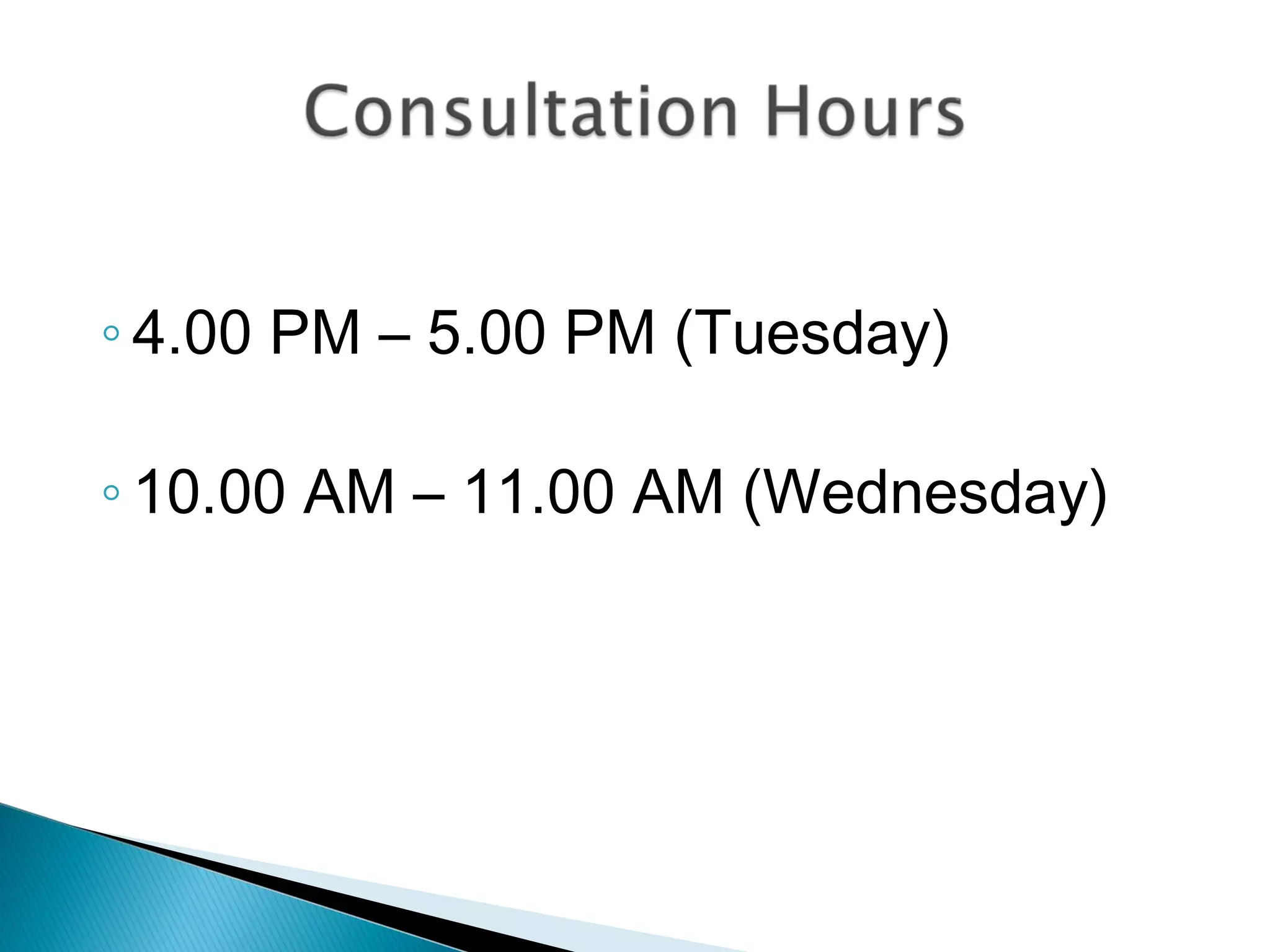
◦ 4.00 PM – 5.00 PM (Tuesday)

◦ 10.00 AM – 11.00 AM (Wednesday)
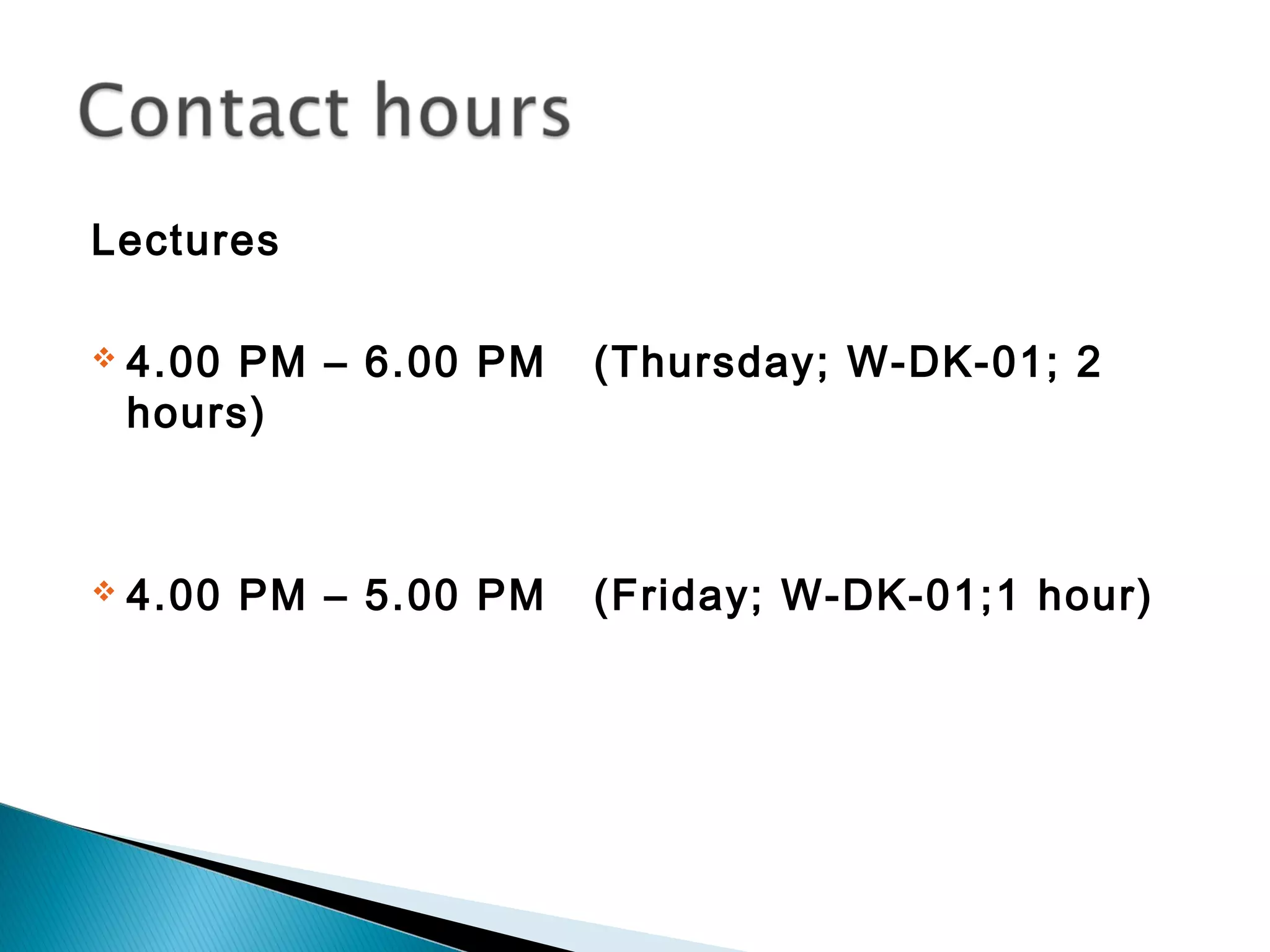
Lectures

   4.00 PM – 6.00 PM   (Thursday; W-DK-01; 2
    hours)


   4.00 PM – 5.00 PM   (Friday; W-DK-01;1 hour)
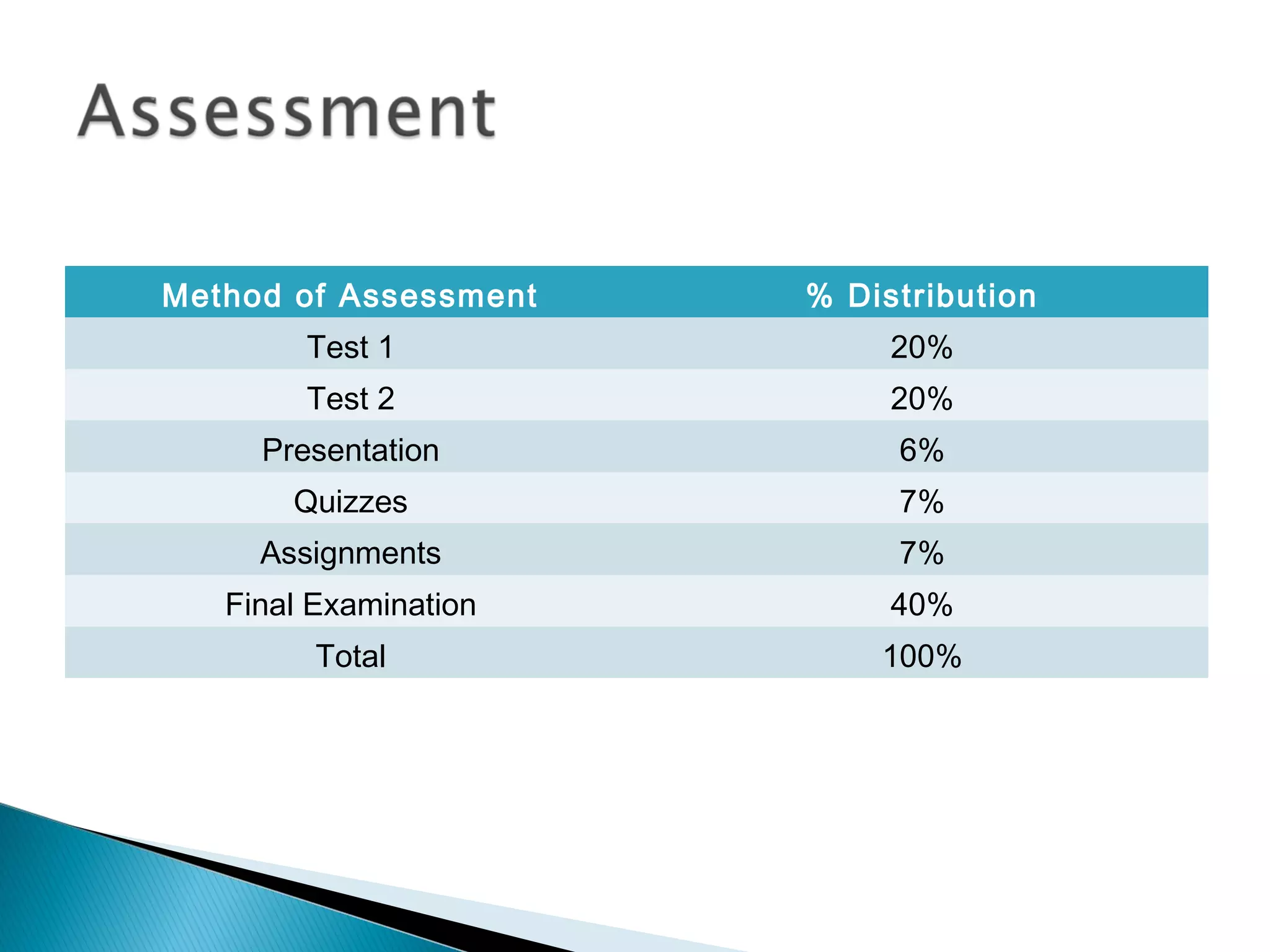
Method of Assessment   % Distribution
        Test 1              20%
        Test 2              20%
     Presentation           6%
       Quizzes              7%
     Assignments            7%
   Final Examination        40%
         Total             100%
 David Harvey – Modern Analytical Chemistry
  (McGraw Hill)
 Kealy & Haines – Analytical Chemistry

 Skoog et al. – Fundamental of Analytical

  Chemistry
CLASS POLICY
 100% attendance
   Punctuality

  Ask questions
   Chemical analysis includes any aspect of the
    chemical characterization of a sample
    material.

   Analytical Chemistry?
    ◦ “Science of Chemical Measurements”
   Quantitation:
    ◦ How much of substance X is in the sample?
   Detection:
    ◦ Does the sample contain substance X?
   Identification:
    ◦ What is the identity of the substance in the sample?
   Separation:
    ◦ How can the species of interest be separated from
      the sample matrix for better quantitation and
      identification?
 Analytical Chemistry provides the methods and
  tools needed for insight into our material world…
  for answering four basic questions about a
  material sample?
 What?
 Where?
 How much?
 What arrangement, structure or form?

(Fresenius’ J. Anal. Chem. 343 (1992):812-813)
   Analytical chemists work to improve the reliability of existing
    techniques to meet the demands of for better chemical
    measurements which arise constantly in our society.

   They adapt proven methodologies to new kinds of materials or to
    answer new questions about their composition.

   They carry out research to discover completely new principles of
    measurements and are at the forefront of the utilization of major
    discoveries such as lasers and microchip devices for practical
    purposes.
   Classical methods: early years (separation of analytes) via
    precipitation, extraction or distillation

   Qualitative: recognized by color, boiling point, solubility,
    taste

   Quantitative: gravimetric or titrimetric measurements

   Instrumental Methods : newer, faster, more efficient

   Physical properties of analytes: conductivity, electrode
    potential, light emission absorption, mass to charge ratio and
    fluorescence, many more…
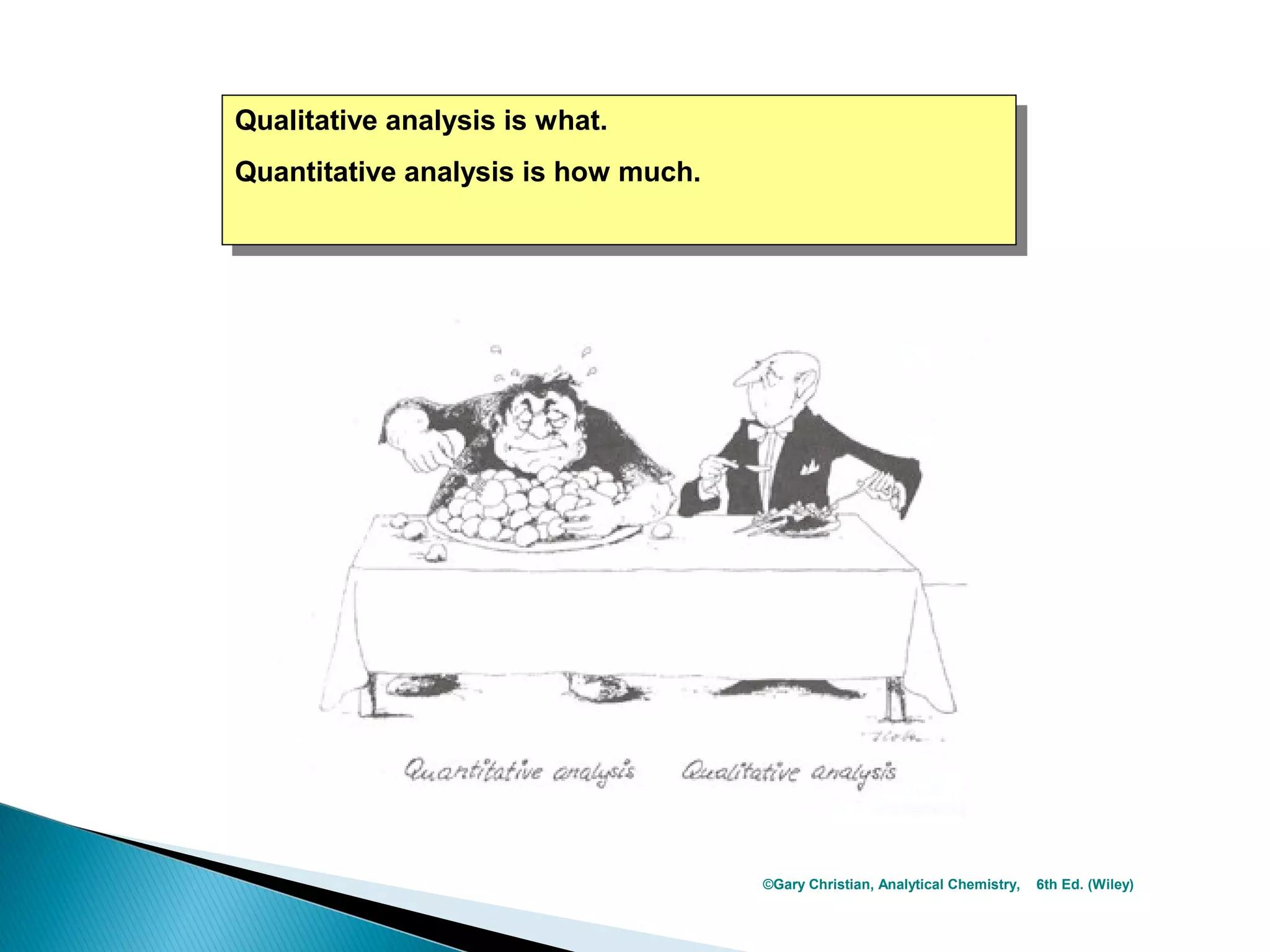
Qualitative analysis is what.
Quantitative analysis is how much.


                                     ©Gary Christian, Analytical Chemistry,   6th Ed. (Wiley)
   Gravimetric Methods determine the mass of the analyte or some
    compound chemically related to it.
    Volumetric Methods measure the volume of a solution containing
    sufficient reagent to react completely with the analyte
   Electroanalytical Methods involve the measurement of electrical
    properties such as voltage, current, resistance, and quantity of
    electrical charge
   Spectroscopic Methods are based on the measurement of the
    interaction between electromagnetic radiation and analyte atoms or
    molecules, or the production of such radiation by analytes
   Miscellaneous Methods include the measurement of such
    quantities as mass-to-charge ratio, rate of radioactive decay, heat of
    reaction, rate of reaction, sample thermal conductivity, optical activity,
    and refractive index
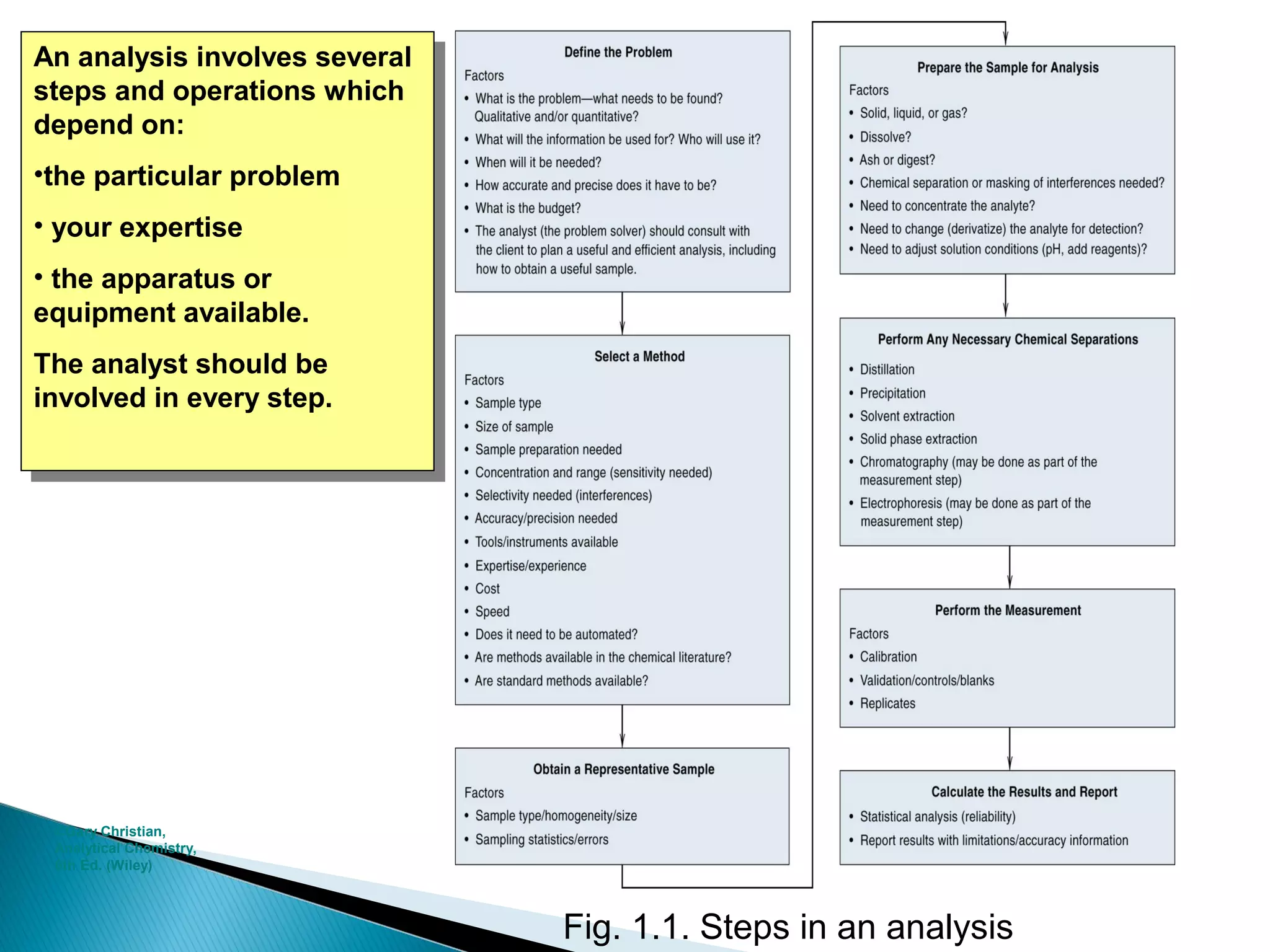
An analysis involves several
 An analysis involves several
steps and operations which
 steps and operations which
depend on:
 depend on:
•the particular problem
 •the particular problem
• •your expertise
    your expertise
• •the apparatus or
    the apparatus or
equipment available.
  equipment available.
The analyst should be
 The analyst should be
involved in every step.
 involved in every step.


 ©Gary Christian,
 Analytical Chemistry,
 6th Ed. (Wiley)


                                Fig. 1.1. Steps in an analysis
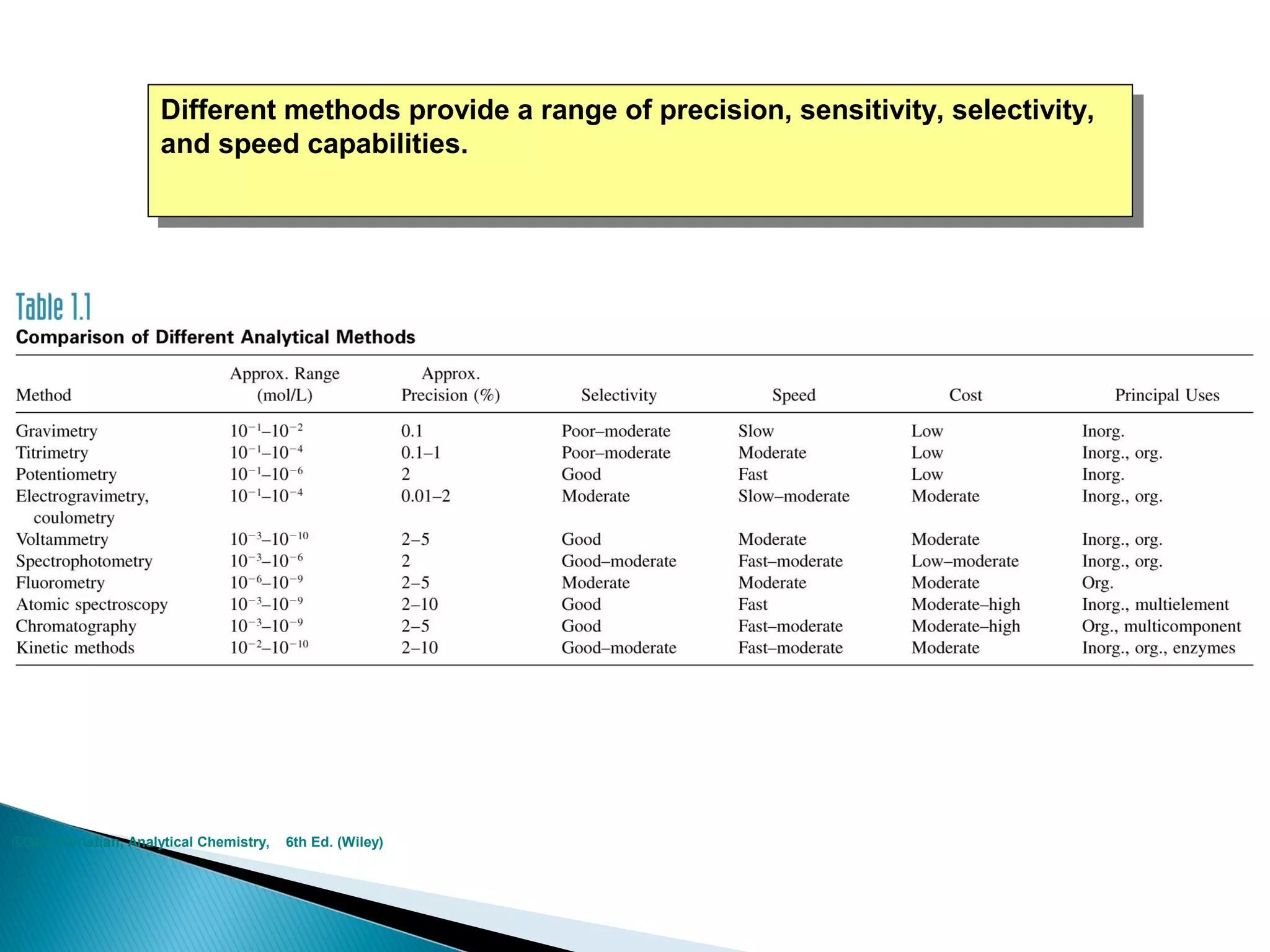
Different methods provide aarange of precision, sensitivity, selectivity,
                      Different methods provide range of precision, sensitivity, selectivity,
                     and speed capabilities.
                      and speed capabilities.


©Gary Christian, Analytical Chemistry,   6th Ed. (Wiley)
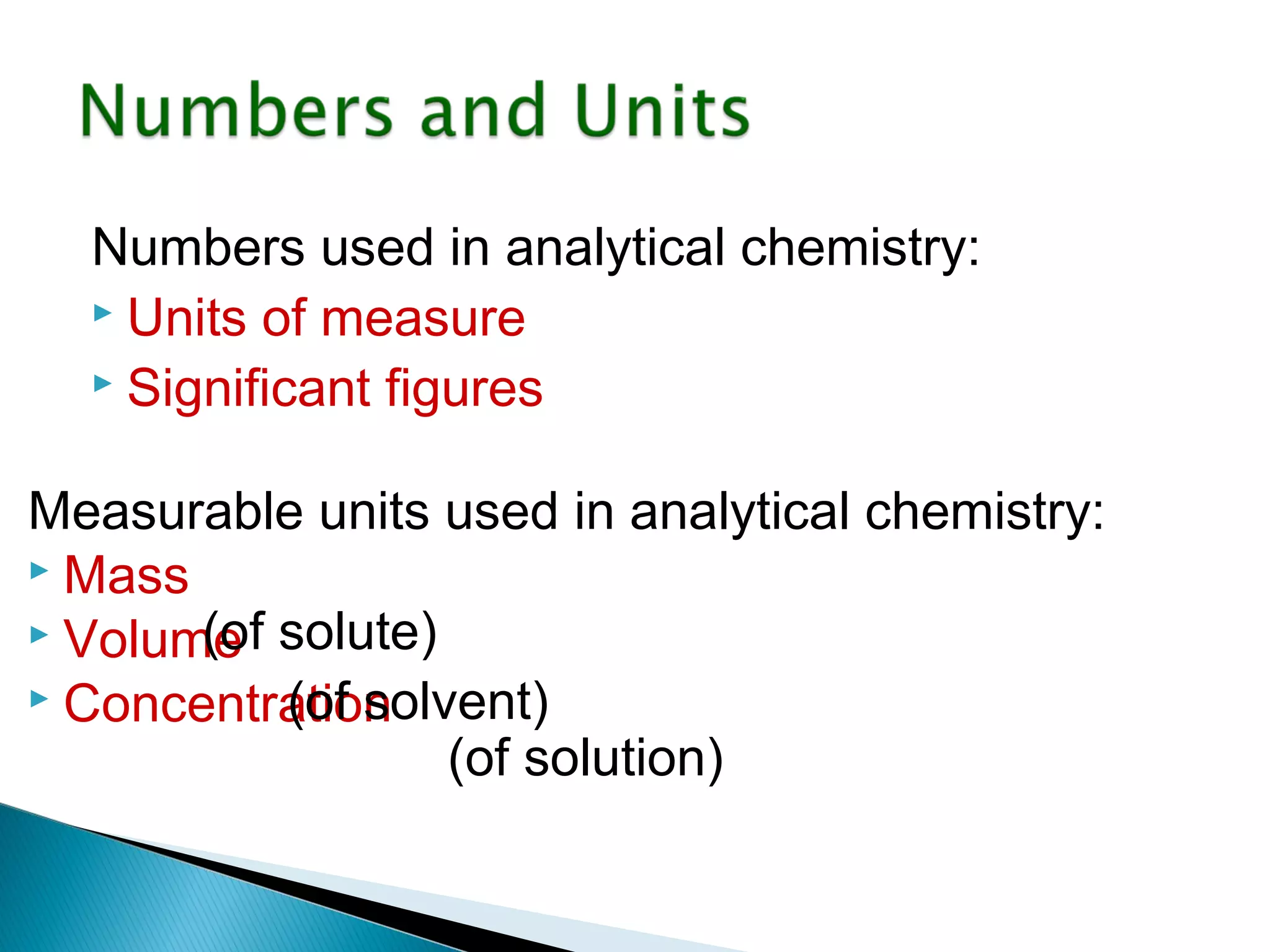
Numbers used in analytical chemistry:
   Units of measure
   Significant figures


Measurable units used in analytical chemistry:
 Mass
 Volume solute)
       (of
 Concentration
           (of solvent)
                   (of solution)
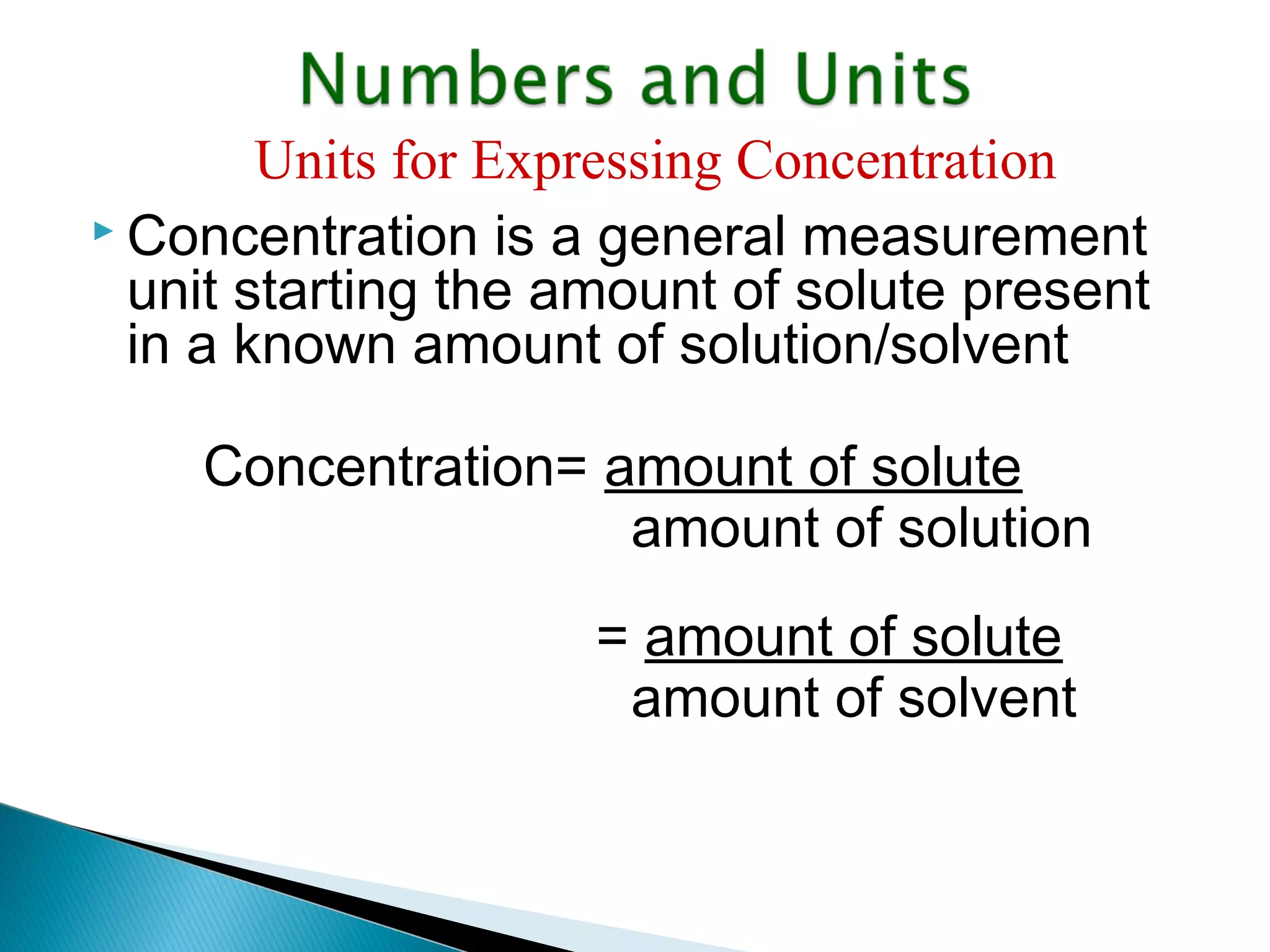
Units for Expressing Concentration
 Concentration is a general measurement
  unit starting the amount of solute present
  in a known amount of solution/solvent

    Concentration= amount of solute
                    amount of solution
                    = amount of solute
                     amount of solvent
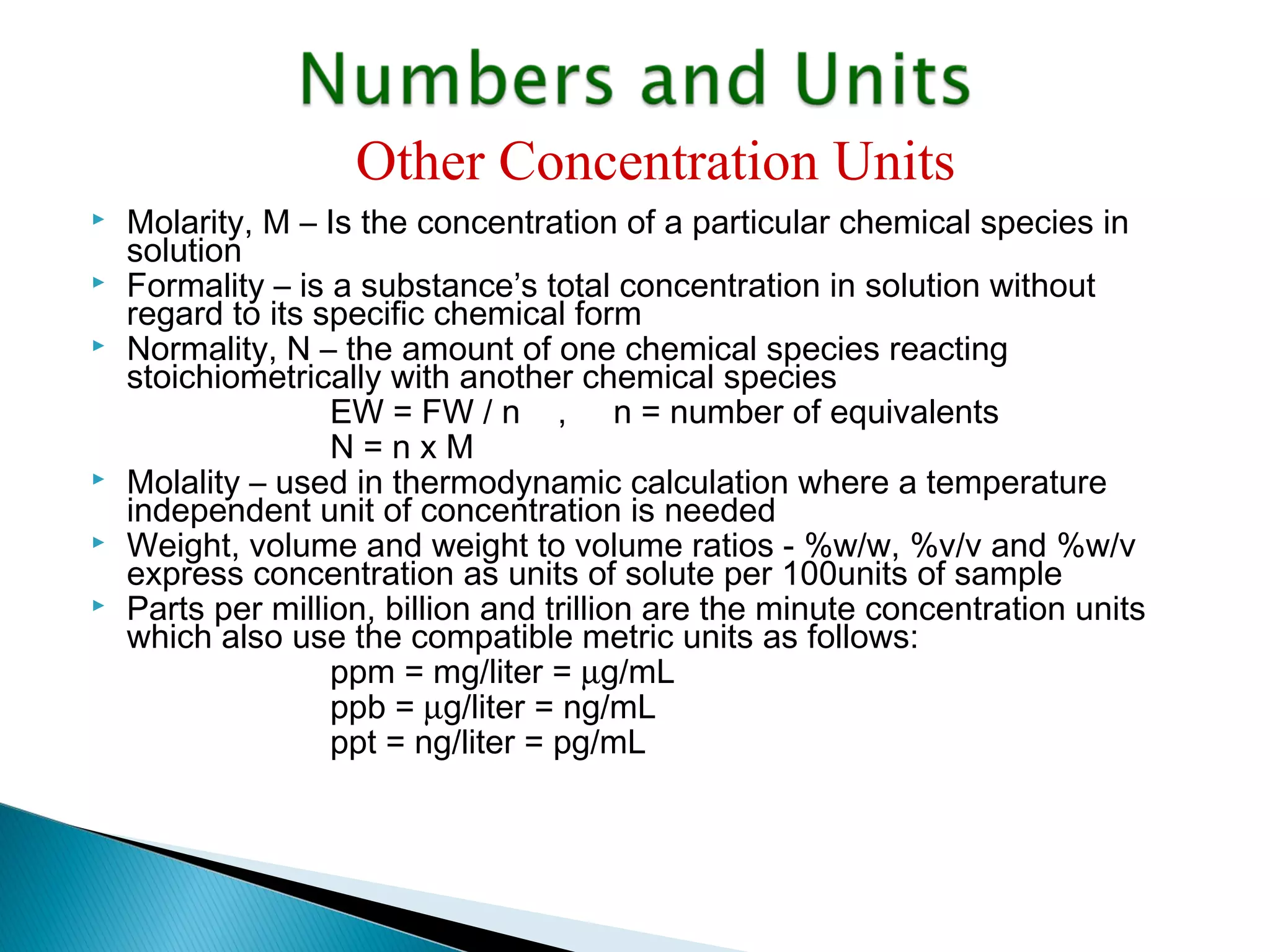
Other Concentration Units
   Molarity, M – Is the concentration of a particular chemical species in
    solution
   Formality – is a substance’s total concentration in solution without
    regard to its specific chemical form
   Normality, N – the amount of one chemical species reacting
    stoichiometrically with another chemical species
                   EW = FW / n , n = number of equivalents
                   N=nxM
   Molality – used in thermodynamic calculation where a temperature
    independent unit of concentration is needed
   Weight, volume and weight to volume ratios - %w/w, %v/v and %w/v
    express concentration as units of solute per 100units of sample
   Parts per million, billion and trillion are the minute concentration units
    which also use the compatible metric units as follows:
                   ppm = mg/liter = µg/mL
                   ppb = µg/liter = ng/mL
                   ppt = ng/liter = pg/mL
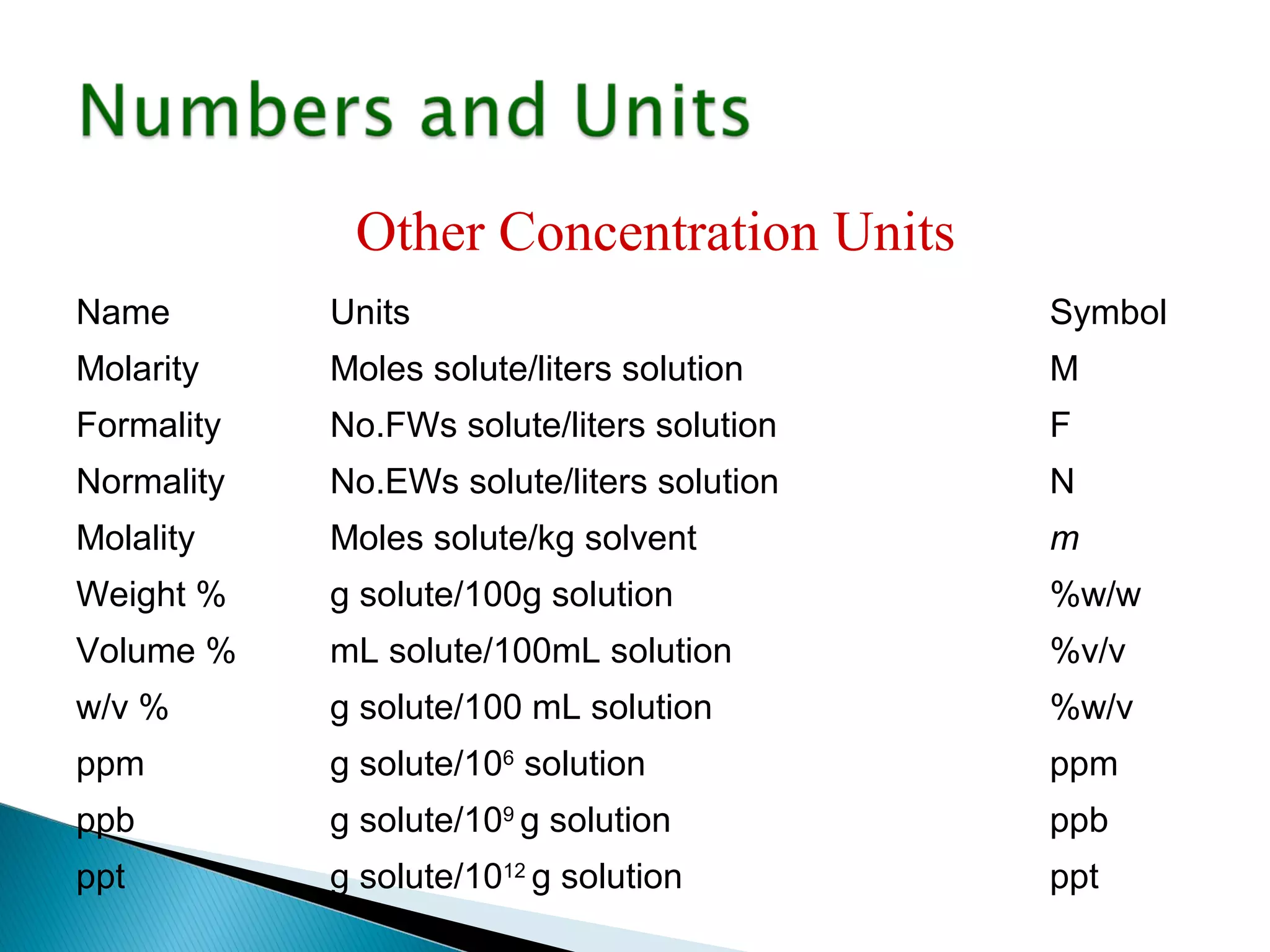
Other Concentration Units
Name        Units                           Symbol
Molarity    Moles solute/liters solution    M
Formality   No.FWs solute/liters solution   F
Normality   No.EWs solute/liters solution   N
Molality    Moles solute/kg solvent         m
Weight %    g solute/100g solution          %w/w
Volume %    mL solute/100mL solution        %v/v
w/v %       g solute/100 mL solution        %w/v
ppm         g solute/106 solution           ppm
ppb         g solute/109 g solution         ppb
ppt         g solute/1012 g solution        ppt
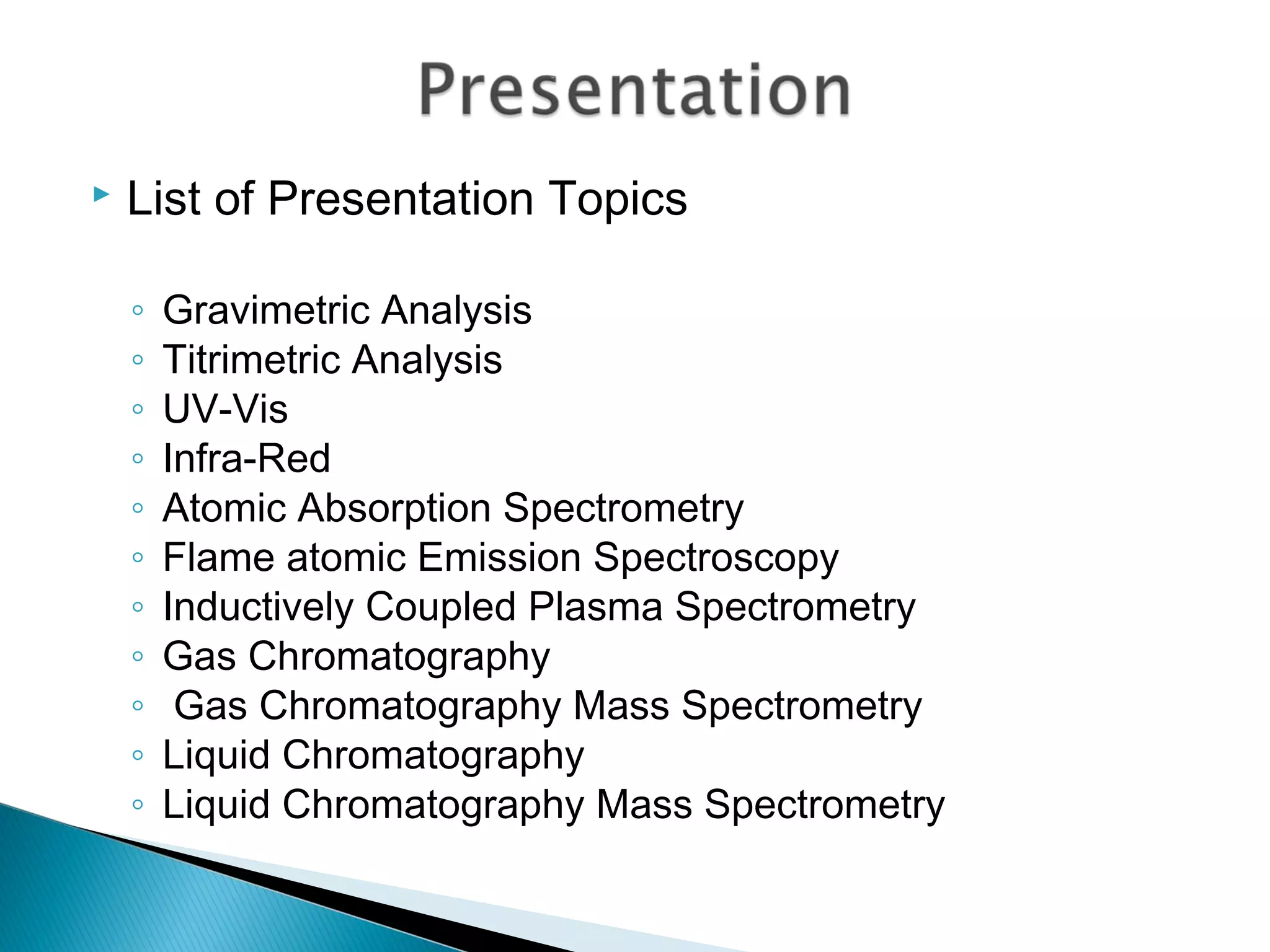
   List of Presentation Topics

    ◦   Gravimetric Analysis
    ◦   Titrimetric Analysis
    ◦   UV-Vis
    ◦   Infra-Red
    ◦   Atomic Absorption Spectrometry
    ◦   Flame atomic Emission Spectroscopy
    ◦   Inductively Coupled Plasma Spectrometry
    ◦   Gas Chromatography
    ◦    Gas Chromatography Mass Spectrometry
    ◦   Liquid Chromatography
    ◦   Liquid Chromatography Mass Spectrometry
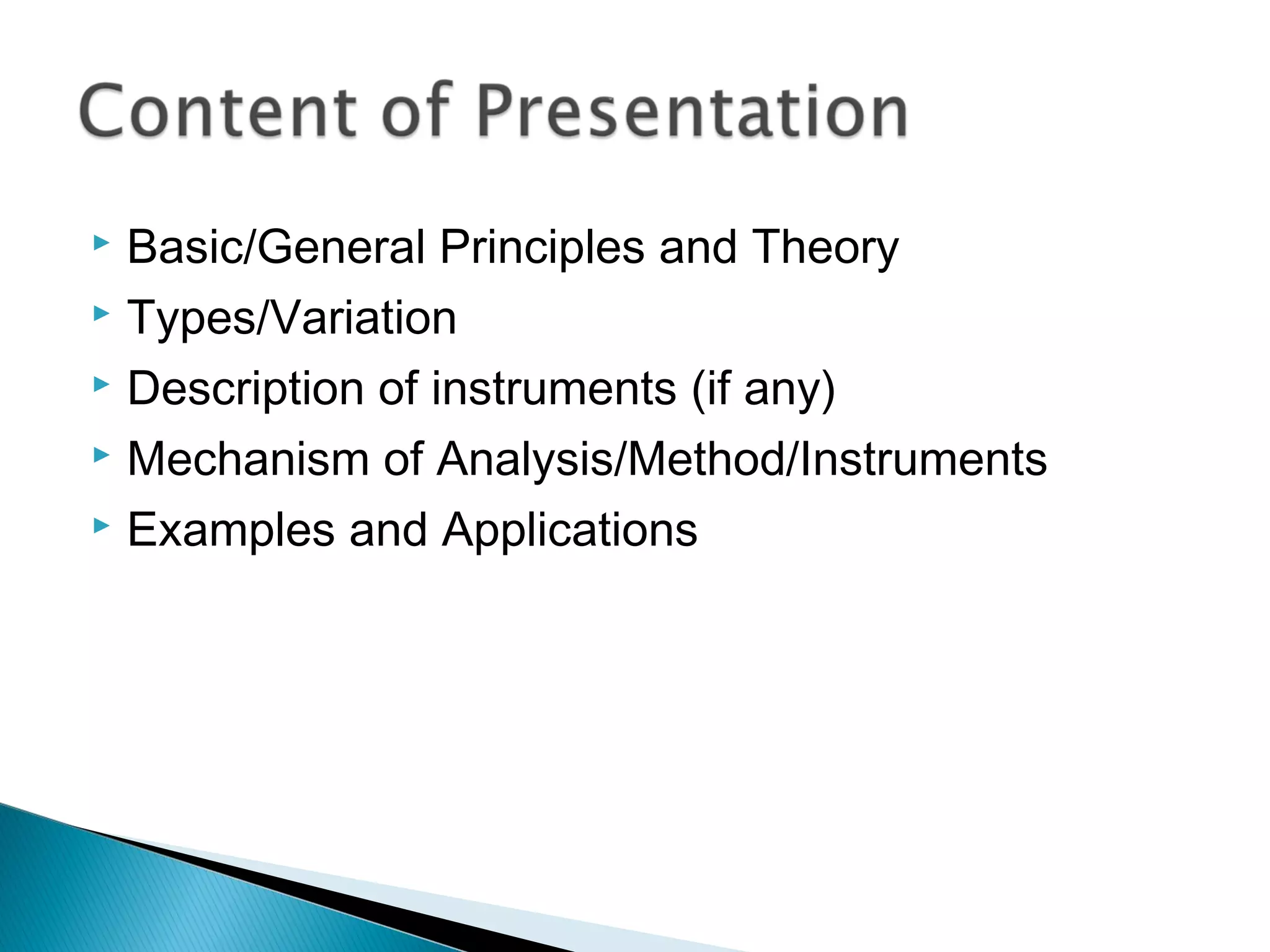
 Basic/General Principles and Theory
 Types/Variation

 Description of instruments (if any)

 Mechanism of Analysis/Method/Instruments

 Examples and Applications

Chapter 1 introduction to analytical chemistry

  • 1.
    Lecturer: Dr SumaiyaZainal Abidin Room: A3-08 Email: sumaiya@ump.edu.my
  • 2.
    ◦ 4.00 PM– 5.00 PM (Tuesday) ◦ 10.00 AM – 11.00 AM (Wednesday)
  • 3.
    Lectures  4.00 PM – 6.00 PM (Thursday; W-DK-01; 2 hours)  4.00 PM – 5.00 PM (Friday; W-DK-01;1 hour)
  • 4.
    Method of Assessment % Distribution Test 1 20% Test 2 20% Presentation 6% Quizzes 7% Assignments 7% Final Examination 40% Total 100%
  • 5.
     David Harvey– Modern Analytical Chemistry (McGraw Hill)  Kealy & Haines – Analytical Chemistry  Skoog et al. – Fundamental of Analytical Chemistry
  • 6.
    CLASS POLICY 100%attendance Punctuality Ask questions
  • 7.
    Chemical analysis includes any aspect of the chemical characterization of a sample material.  Analytical Chemistry? ◦ “Science of Chemical Measurements”
  • 8.
    Quantitation: ◦ How much of substance X is in the sample?  Detection: ◦ Does the sample contain substance X?  Identification: ◦ What is the identity of the substance in the sample?  Separation: ◦ How can the species of interest be separated from the sample matrix for better quantitation and identification?
  • 9.
     Analytical Chemistryprovides the methods and tools needed for insight into our material world… for answering four basic questions about a material sample?  What?  Where?  How much?  What arrangement, structure or form? (Fresenius’ J. Anal. Chem. 343 (1992):812-813)
  • 10.
    Analytical chemists work to improve the reliability of existing techniques to meet the demands of for better chemical measurements which arise constantly in our society.  They adapt proven methodologies to new kinds of materials or to answer new questions about their composition.  They carry out research to discover completely new principles of measurements and are at the forefront of the utilization of major discoveries such as lasers and microchip devices for practical purposes.
  • 11.
    Classical methods: early years (separation of analytes) via precipitation, extraction or distillation  Qualitative: recognized by color, boiling point, solubility, taste  Quantitative: gravimetric or titrimetric measurements  Instrumental Methods : newer, faster, more efficient  Physical properties of analytes: conductivity, electrode potential, light emission absorption, mass to charge ratio and fluorescence, many more…
  • 12.
    Qualitative analysis iswhat. Qualitative analysis is what. Quantitative analysis is how much. Quantitative analysis is how much. ©Gary Christian, Analytical Chemistry, 6th Ed. (Wiley)
  • 13.
    Gravimetric Methods determine the mass of the analyte or some compound chemically related to it.  Volumetric Methods measure the volume of a solution containing sufficient reagent to react completely with the analyte  Electroanalytical Methods involve the measurement of electrical properties such as voltage, current, resistance, and quantity of electrical charge  Spectroscopic Methods are based on the measurement of the interaction between electromagnetic radiation and analyte atoms or molecules, or the production of such radiation by analytes  Miscellaneous Methods include the measurement of such quantities as mass-to-charge ratio, rate of radioactive decay, heat of reaction, rate of reaction, sample thermal conductivity, optical activity, and refractive index
  • 14.
    An analysis involvesseveral An analysis involves several steps and operations which steps and operations which depend on: depend on: •the particular problem •the particular problem • •your expertise your expertise • •the apparatus or the apparatus or equipment available. equipment available. The analyst should be The analyst should be involved in every step. involved in every step. ©Gary Christian, Analytical Chemistry, 6th Ed. (Wiley) Fig. 1.1. Steps in an analysis
  • 16.
    Different methods provideaarange of precision, sensitivity, selectivity, Different methods provide range of precision, sensitivity, selectivity, and speed capabilities. and speed capabilities. ©Gary Christian, Analytical Chemistry, 6th Ed. (Wiley)
  • 17.
    Numbers used inanalytical chemistry:  Units of measure  Significant figures Measurable units used in analytical chemistry:  Mass  Volume solute) (of  Concentration (of solvent) (of solution)
  • 18.
    Units for ExpressingConcentration  Concentration is a general measurement unit starting the amount of solute present in a known amount of solution/solvent Concentration= amount of solute amount of solution = amount of solute amount of solvent
  • 19.
    Other Concentration Units  Molarity, M – Is the concentration of a particular chemical species in solution  Formality – is a substance’s total concentration in solution without regard to its specific chemical form  Normality, N – the amount of one chemical species reacting stoichiometrically with another chemical species EW = FW / n , n = number of equivalents N=nxM  Molality – used in thermodynamic calculation where a temperature independent unit of concentration is needed  Weight, volume and weight to volume ratios - %w/w, %v/v and %w/v express concentration as units of solute per 100units of sample  Parts per million, billion and trillion are the minute concentration units which also use the compatible metric units as follows: ppm = mg/liter = µg/mL ppb = µg/liter = ng/mL ppt = ng/liter = pg/mL
  • 20.
    Other Concentration Units Name Units Symbol Molarity Moles solute/liters solution M Formality No.FWs solute/liters solution F Normality No.EWs solute/liters solution N Molality Moles solute/kg solvent m Weight % g solute/100g solution %w/w Volume % mL solute/100mL solution %v/v w/v % g solute/100 mL solution %w/v ppm g solute/106 solution ppm ppb g solute/109 g solution ppb ppt g solute/1012 g solution ppt
  • 21.
    List of Presentation Topics ◦ Gravimetric Analysis ◦ Titrimetric Analysis ◦ UV-Vis ◦ Infra-Red ◦ Atomic Absorption Spectrometry ◦ Flame atomic Emission Spectroscopy ◦ Inductively Coupled Plasma Spectrometry ◦ Gas Chromatography ◦ Gas Chromatography Mass Spectrometry ◦ Liquid Chromatography ◦ Liquid Chromatography Mass Spectrometry
  • 22.
     Basic/General Principlesand Theory  Types/Variation  Description of instruments (if any)  Mechanism of Analysis/Method/Instruments  Examples and Applications

Editor's Notes

  • #15   An analysis involves several steps and operations which depend on: the particular problem your expertise the apparatus or equipment available. The analyst should be involved in every step.