Quality control in
pathological
laboratory
Presented to Dr. Khizar Abbas Rizvi
Presented by Sana Rehman
What is Quality
• A measure of excellence and a state of being free
from defects, errors and significant variations.
• Quality is never an accident; it is always result of
high intention, sincere effort, intelligent direction
and skilful execution. It represents the wise choice
of many alternatives
What is Quality control
• Quality control in the medical laboratory is
a statistical process used to monitor and
evaluate the analytical process that produces
patient results. QC results are used to
validate whether the instrument is operating
within pre-defined specifications, inferring
that patient test results are reliable.
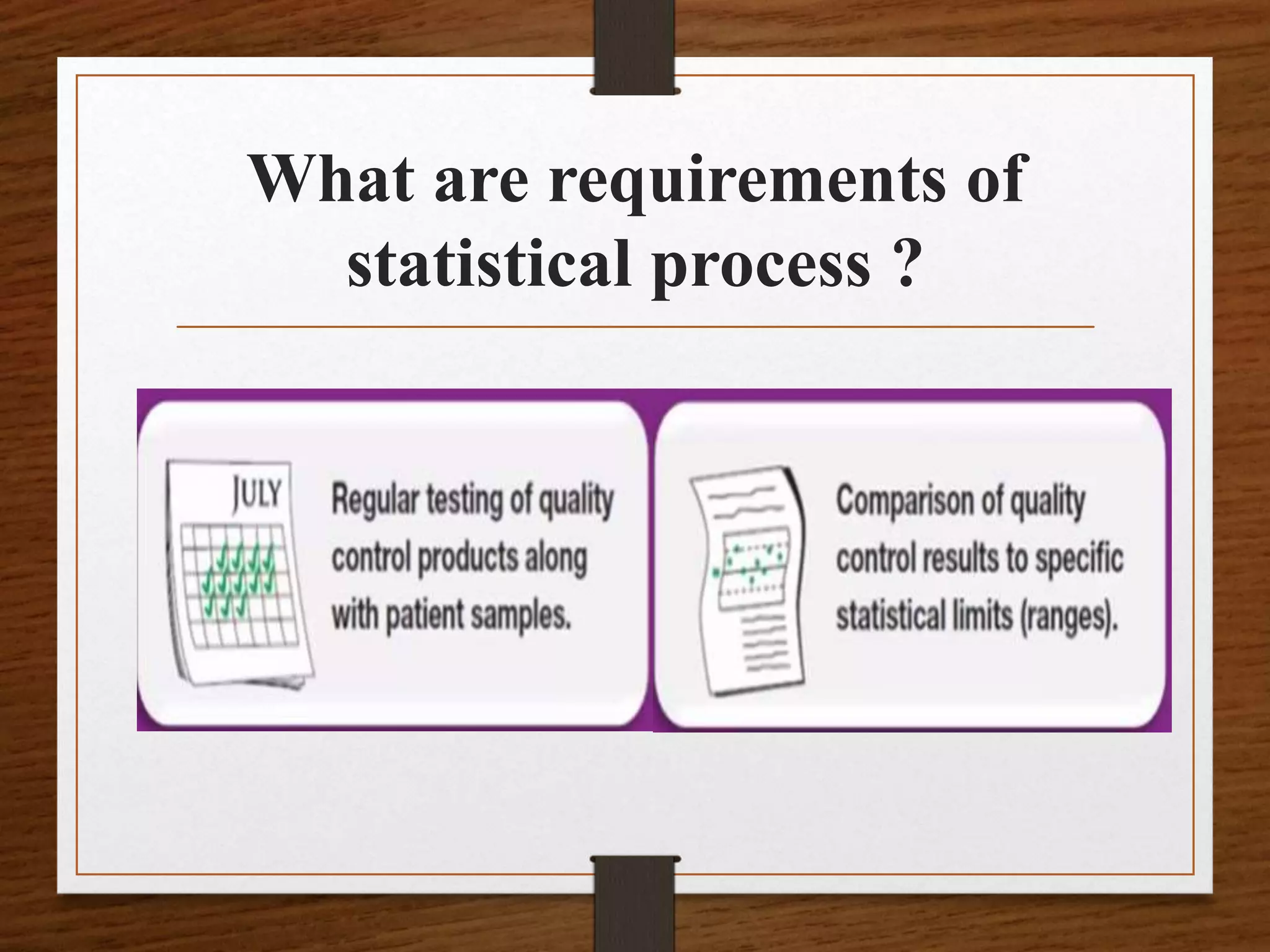
What are requirements of
statistical process ?
Quality Control
Types of Quality Control
• There are two types of laboratory control
procedures
• Internal quality control
• External quality control
Internal quality control: This includes all quality
control procedures adopted by the laboratory staff for
checking day to day accuracy and precision of all
procedures and equipment
.
• External quality control A system for objectively
checking the laboratory’s performance using an
external agency and facility.
• Example: Bio Rad is an external agency for CPE
institute of cardiology multan pathological lab.
• Quality Assurance
• It is an ongoing, comprehensive program which
analyzes every aspect of an entire operation.
Quality assurance
• Quality Assurance : In the laboratory, quality
assurance involves the entire testing
process: pre-analytical, analytical (testing),
and post-analytical processes.
• The QA program must:
• Assess the effectiveness of the lab’s policies and
procedures.
• Identify and correct problems.
• Assure the accurate, reliable, and prompt reporting
of test results.
• Assure the adequacy and competency of the staff.
Why quality control is
important?
• There is no doubt that biochemical and
other lab tests are always an important part
of overall diagnostic process.
• The results obtained from laboratory
analysis are used to
• Diagnose
• Prescribe treatment
• Monitor the health and progress of patient
• Since such importance is placed upon test
results, they must be reliable and accurate as
possible
Phases of Laboratory testing
• Pre analytical
• Proper Patient Identification and Preparation
• Wrist bands for in-patients / wrist bands or valid
identification for out-patients.
Proper Specimen collection:
• Specimen handling and processing
• Correct sample type
• Proper tube mixing and specimen volume
Correct phlebotomy procedure
• Adequate staffing to maintain collection
standards
• Competent and skilled staff to perform
phlebotomy procedures to minimize redraw for
patient care.
• Correct Labeling procedure
• Specimen transport carefully.
Requirements
1. Timing
• Some specimens must be transported immediately
after collection, for example:
• Arterial Blood Gases,
• STAT samples
• 2. Temperature
3. Transport containers
• Some samples need to be protected from
light, for example, bilirubin
• The specimens must be delivered to the
laboratory within 45 minutes of
collection in order to ensure the
centrifugation and separation of the
specimen within 1hour.
• Analytical phase
• Analyzers and Equipments.
• Laboratory Equipment Management Plan
• Controls
• is designed to detect, reduce, and correct deficiencies in
a laboratory's internal analytical process prior to the
release of patient results, in order to improve the quality
of the results reported by the laboratory
• Calibration
The calibration is the first and foremost step in the
analytical process of the method or instrument prior
to the measurement of quality control material or
patient samples.
• Very often the operator is unable to handle a pipette
in the correct way and might therefore dissolve the
lyophilized calibrator material with the wrong
amount of solvent
Calibration Criteria:
• New lot of Reagents
• When control results gives unacceptable results
and shows a trend or shift
• After major machine maintenance which may
affect performance of test results
• As recommended by the manufacturer
Requirements and
Documentations:
• Daily, Weekly, Monthly, or as Needed Maintenance
• Daily control reports
• Monthly control reports
• Levey-Jennings chart
• Corrective action report for unacceptable results
• Technical Procedure
• Post - Analytical Phase
• Review of results
• Validation of results- rerunning of Critical
results/Abnormal results for double checking
• Evaluation of results- correlating patient results
with patient’s history, previous results, medications,
etc.
• Releasing of results to finalize
Testing Sequence
• When a diagnostic test is performed in the medical
laboratory, the outcome of the test is a result. The
result may be a patient result or it may be a quality
control (QC) result. The result may be
quantitative (a number) or qualitative (positive or
negative).
• QC results are used to validate whether the
instrument is operating within pre-defined
specifications, inferring that patient test results are
reliable.
• Once the test system is validated, patient results
can then be used for:
• diagnosis, prognosis, or treatment planning
• EXAMPLE: When a patient’s serum is assayed
(tested) for potassium, the test result tells us how
much potassium (concentration) is present in the
blood. This result is then used by the physician to
determine whether the patient has a low, normal or
high potassium.
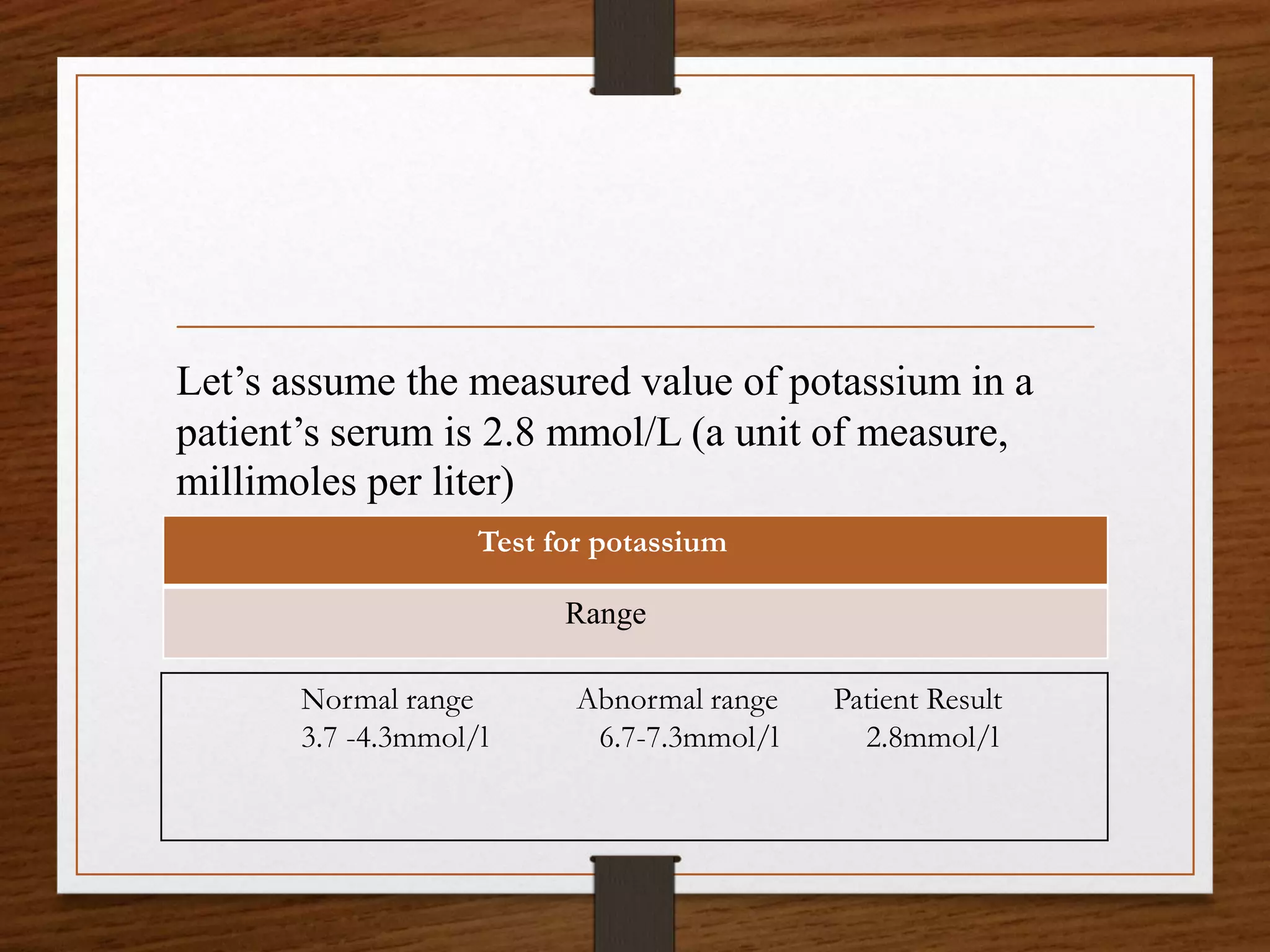
Test for potassium
Range
Normal range Abnormal range Patient Result
3.7 -4.3mmol/l 6.7-7.3mmol/l 2.8mmol/l
Let’s assume the measured value of potassium in a
patient’s serum is 2.8 mmol/L (a unit of measure,
millimoles per liter)
Question of Reliability
• This result is abnormally low and indicates an
inappropriate loss of potassium. But how does the
person performing the test know that this result is
truly reliable? It could be possible that the
instrument is out of calibration and the patient’s
true potassium value is 4.2 mmol/L – a normal
result. The question of reliability for most testing
can be resolved by regular use of quality control
materials and statistical process control.
Quality Control Product
• A quality control product is a patient-like
material ideally made from human serum.
• A control product can be a liquid or freeze
dried (lyophilized) material and is composed of
one or more constituents (analytes) of known
concentration.
Normal Control
• Normal control: A normal control product contains
normal levels for the analyte being tested. For example,
the normal range for a potassium level is about 3.5 – 5.0
mmol/L. A normal control would contain potassium at a
level within this range.
• Abnormal control: An abnormal control product
contains the analyte at a concentration above or below
the normal range for the analyte. An abnormal control
would contain potassium at a level below 3.5 mmol/L or
above 5.0 mmol/L
Regular testing
• Good laboratory practice requires testing normal
and abnormal controls for each test at least daily to
monitor the analytical process.
• Regular testing of quality control products creates a
QC database that the laboratory uses to validate the
test system. Validation occurs by comparing daily
QC results to a laboratory-defined range of QC
values.
Comparison of Quality Control
Results to Specific Statistical
Limits
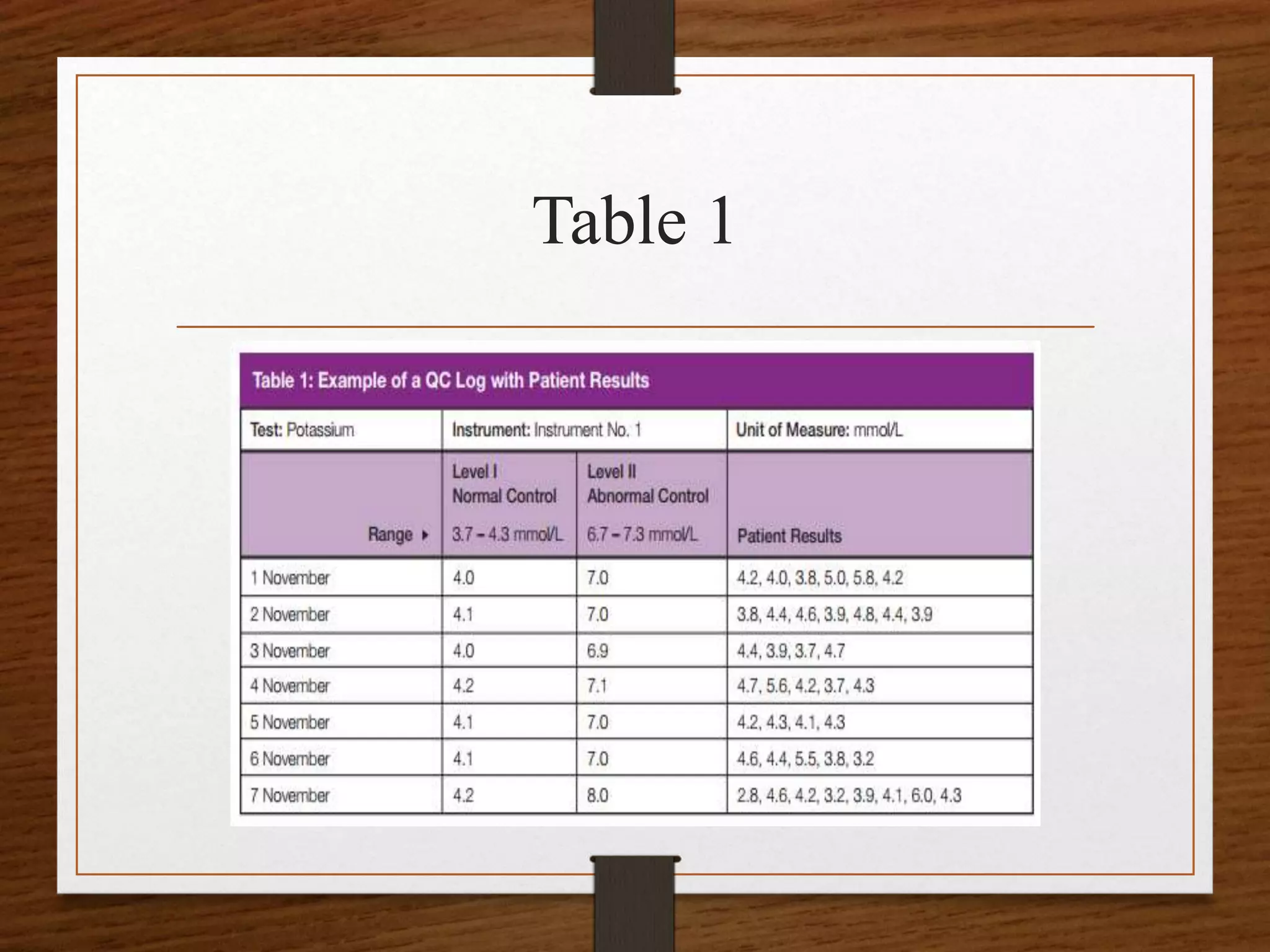
• In Table 1, there are two ranges reported. The
acceptable range for the Level I (Normal Control)
is 3.7 – 4.3 mmol/L. The range for Level II
(Abnormal Control) is 6.7 – 7.3 mmol/L. When the
daily QC result obtained for the normal control is
compared to the range calculated for the normal
control, it becomes apparent that each result lies
somewhere within the expected range. This
indicates that the analytical process is “in control”
at the normal level on that day of testing.
• When the daily QC result for the abnormal control (high
potassium) is compared to the defined range for the
abnormal control, the analytical process is shown to be
“in control” for each day of testing except for the last
day (11/7).
• On November 1 through November 6, both controls
were “in control” and patient values could be reliably
reported. However, the laboratory was “out of control”
for abnormal high potassium on November 7 because
the value obtained for the QC material (8.0 mmol/L)
was outside the acceptable range (6.7 – 7.3 mmol/L).
• This means that some error occurred which may
have made some patient results unreliable.
• The laboratory should not report any patient
samples with an abnormally high potassium result
until the error is resolved and the abnormally high
sample(s) are re-tested. Perhaps it is now apparent
that the range defined for each level of control is
fundamental to the quality control system.
Table 1
Calculation and Use of QC
Statistics
• QC statistics for each test performed in the laboratory
are calculated from the QC database collected by
regular testing of control products.
• The most fundamental statistics used by the laboratory
are the mean [x] and standard deviation [s].
• Mean
• The mean (or average) is the laboratory’s best estimate
of the analyte’s true value for a specific level of control.
Mean
• To calculate a mean for a specific level of control,
first, add all the values collected for that control.
Then divide the sum of these values by the total
number of values. For instance, to calculate the
mean for the normal control (Level I) in Table 1,
• find the sum of the data {4.0, 4.1, 4.0, 4.2, 4.1, 4.1,
4.2}. The sum [∑] is 28.7 mmol/L.
• The number of values is 7 (n = 7).
Calculating mean
• Therefore, the mean for the normal potassium
control in Table 1 from November 1–7 is 4.1
mmol/L (or 28.7 mmol/L divided by 7).
• Calculating a Standard Deviation [s]
• Standard deviation is a statistic that quantifies how
close numerical values (i.e., QC values) are in
relation to each other. The term precision is often
used interchangeably with standard deviation.
Another term, imprecision, is used to express how
far apart numerical values are from each other.
• Standard deviation is calculated for control products
from the same data used to calculate the mean. It
provides the laboratory an estimate of test consistency at
specific concentrations. The repeatability of a test may
be consistent (low standard deviation, low imprecision)
or inconsistent (high standard deviation, high
imprecision). Inconsistent repeatability may be due to
the chemistry involved or to a malfunction. If it is a
malfunction, the laboratory must correct the problem.
• Standard deviation may also be used to monitor on-
going day-to-day performance.
Accuracy vs. Precision
Standard Deviation formula
• Calculate the standard deviation for the normal level of control (Level I)
in Table 1, begin by calculating the mean [ x ]:
• x = 4.0 + 4.1 + 4.0 + 4.2 + 4.1 + 4.1 + 4.2 mmol/L ÷ 7
• x = 28.7 mmol/L ÷ 7
• x = 4.1 mmol/L
• Calculate the standard deviation [s] as follows:
• s= √[{(4−4.1)2 + (4.1 – 4.1)2 +
(4−4.1)2+(4.2−4.1)2+(4.1−4.1)2+(4.2−4.1)2}/6]
• s= √[{(−0.1)2 + ( 0.0)2 + (−0.1)2+(0.1)2+(0.0)2+(0.1)2}/6]
• s =√[ 𝟎. 𝟎𝟏 + 𝟎. 𝟎 + 𝟎. 𝟎𝟏 + 𝟎. 𝟎𝟏 + 𝟎. 𝟎 + 𝟎. 𝟎 + 𝟎. 𝟎𝟏 ÷ 𝟔]
• s = √[𝟎. 𝟎𝟒 ÷ 𝟔]
• s = 0.082 0r 0.1 rounded
• For instance, if during the next week of testing, the
standard deviation calculated in the example for the
normal potassium control increases from .08 to 0.16
mmol/L, this indicates a serious loss of precision. This
instability may be due to a malfunction of the analytical
process. Investigation of the test system is necessary
and the following questions should be asked:
• • Has the reagent or reagent lot changed recently?
• • Has maintenance been performed routinely and on
schedule?
• Does the potassium electrode require cleaning or
replacement?
• Are the reagent and sample pipettes operating
correctly? • Has the test operator changed recently?
• Creating a Levey-Jennings Chart
• Standard deviation is commonly used for preparing
Levey-Jennings (L-J or LJ) charts. The Levey-Jennings
chart is used to graph successive (run-to-run or day-to-
day) quality control values.
• A chart is created for each test and level of control.
The first step is to calculate decision limits.
• These limits are ±1s, ±2s and ±3s from the mean.
• The mean for the Level I potassium control in
Table 1 is 4.1 mmol/L.
• And the standard deviation is 0.1 mmol/L. Formula
3 provides examples on how ±1s, ±2s
FORMULA 3
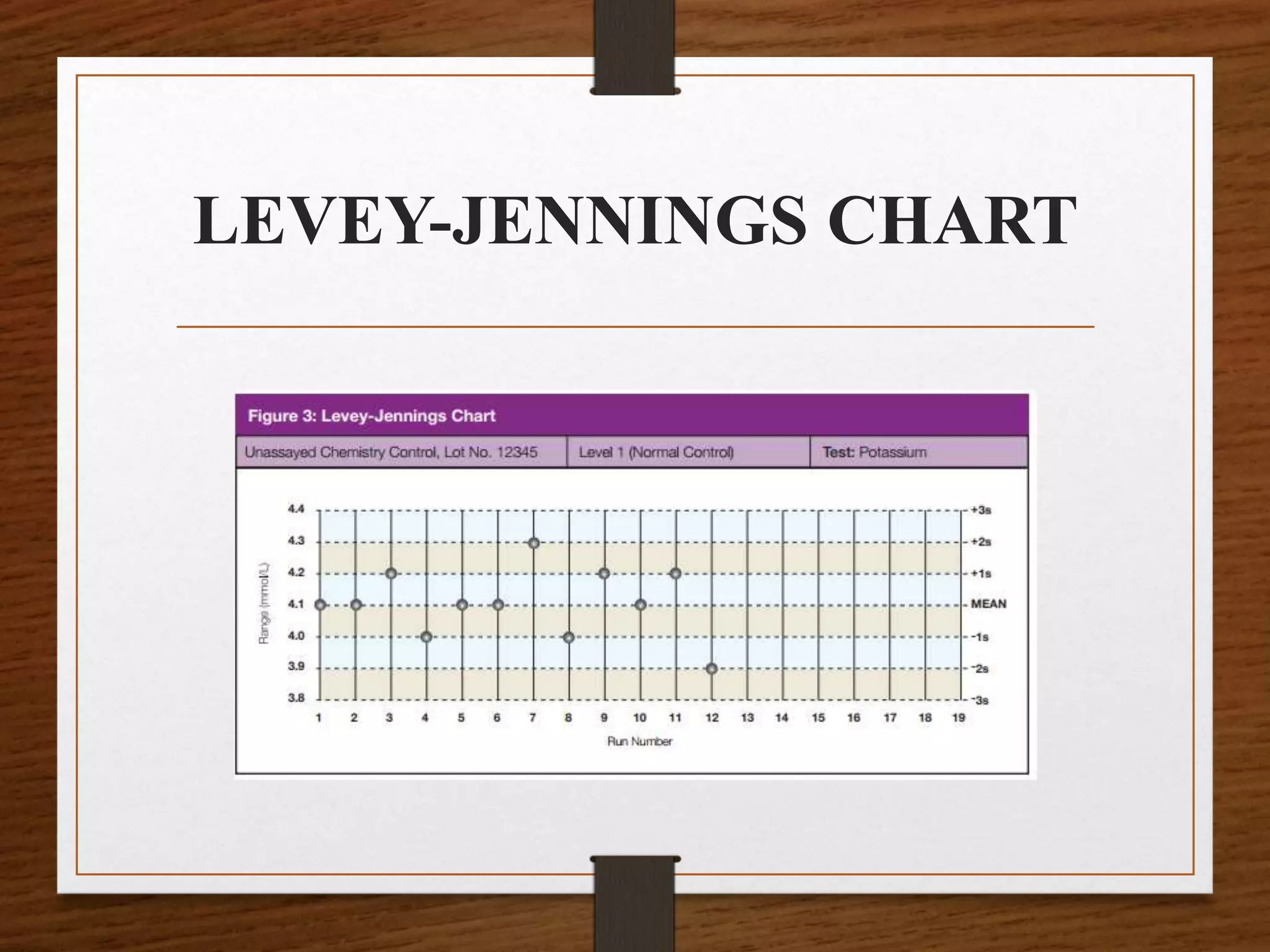
LEVEY-JENNINGS CHART
• Once the QC results are entered into the QC log,
they should be plotted on the Levey-Jennings chart.
When the results are plotted, an assessment can be
made about the quality of the run. The
technologist/technician performing the test should
look for systematic error and random error.
• Systematic Error
• Systematic error is evidenced by a change in the
mean of the control values.
• Systematic Error
• The change in the mean may be gradual and
demonstrated as a trend in control values or it may
be abrupt and demonstrated as a shift in control
values.
• Trend
• A trend indicates a gradual loss of reliability in the
test system. Trends are usually subtle.
Shift
Abrupt changes in the control mean are defined as
shifts. Shifts in QC data represent a sudden and
dramatic positive or negative change in test system
performance.
Random Error Technically, random error is any
deviation away from an expected result. For QC
results, any positive or negative deviation away from
the calculated mean is defined as random error.
West-guard rules
• The values of controls (normal and abnormal) are
plotted daily on the LJ chart and these values are
monitored using Westguard rules.
• There are six basic rules in westguard scheme.
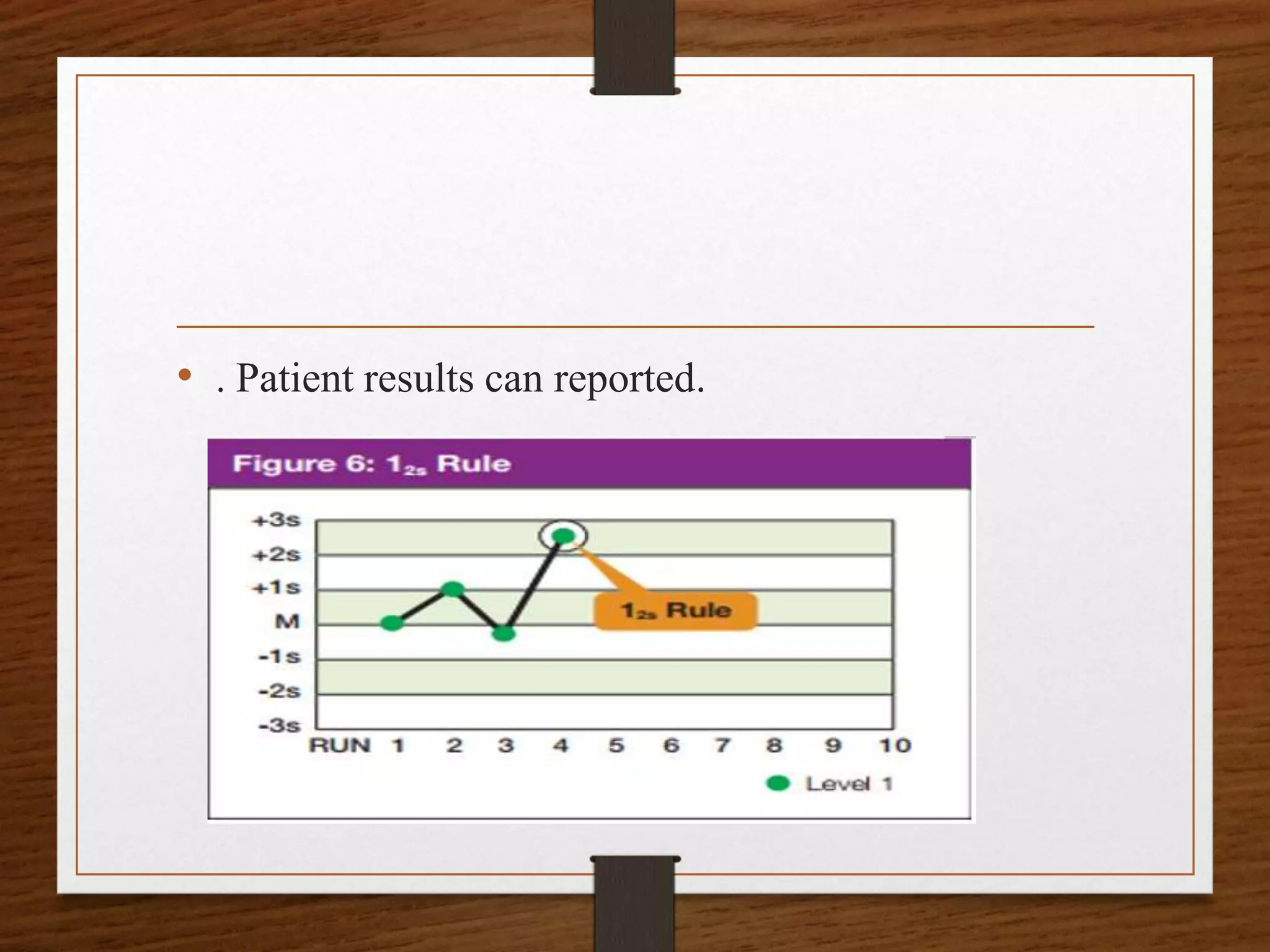
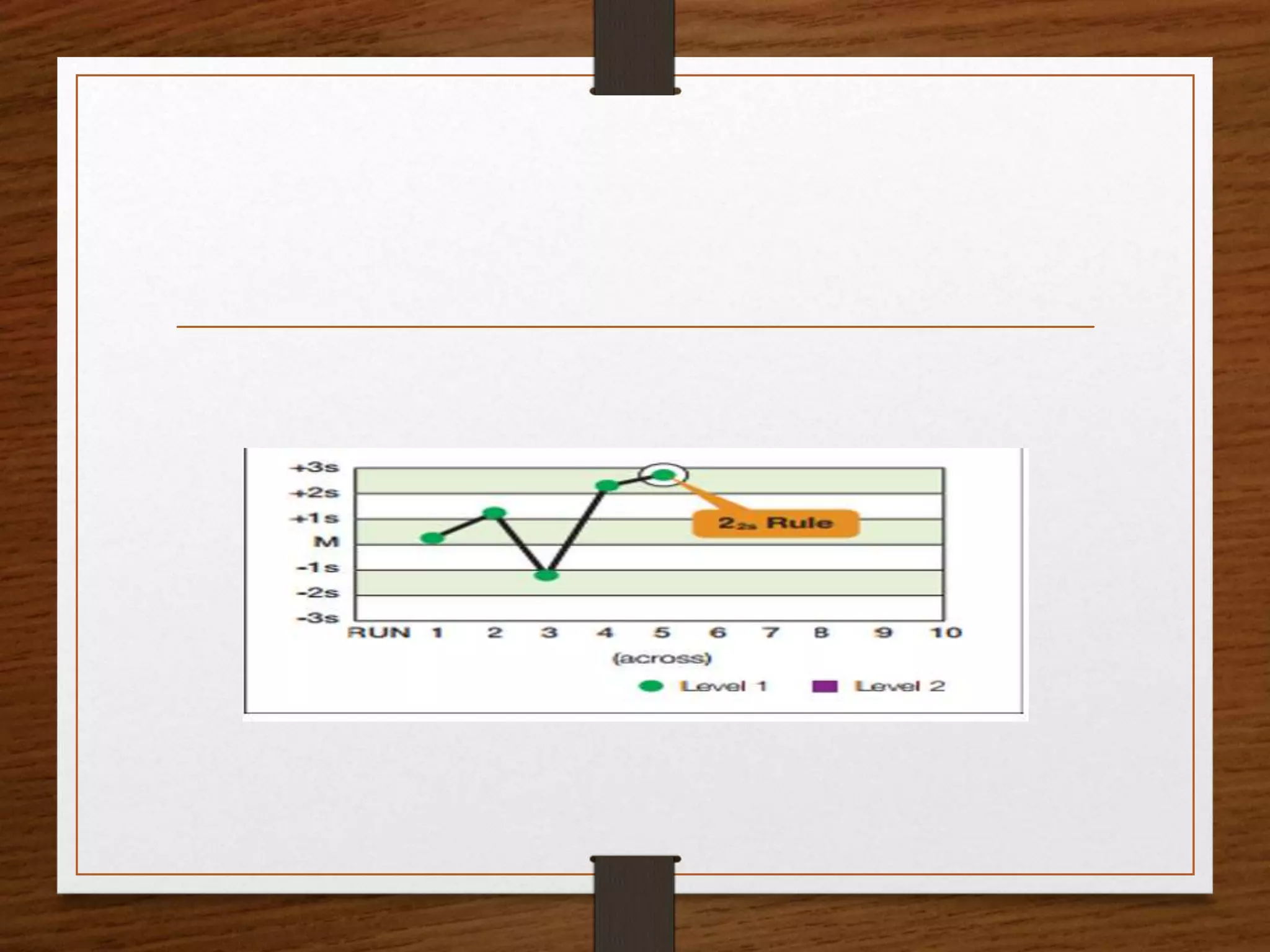
This is a warning rule that is violated when a single
control observation is outside the ±2s limits.
• . Patient results can reported.
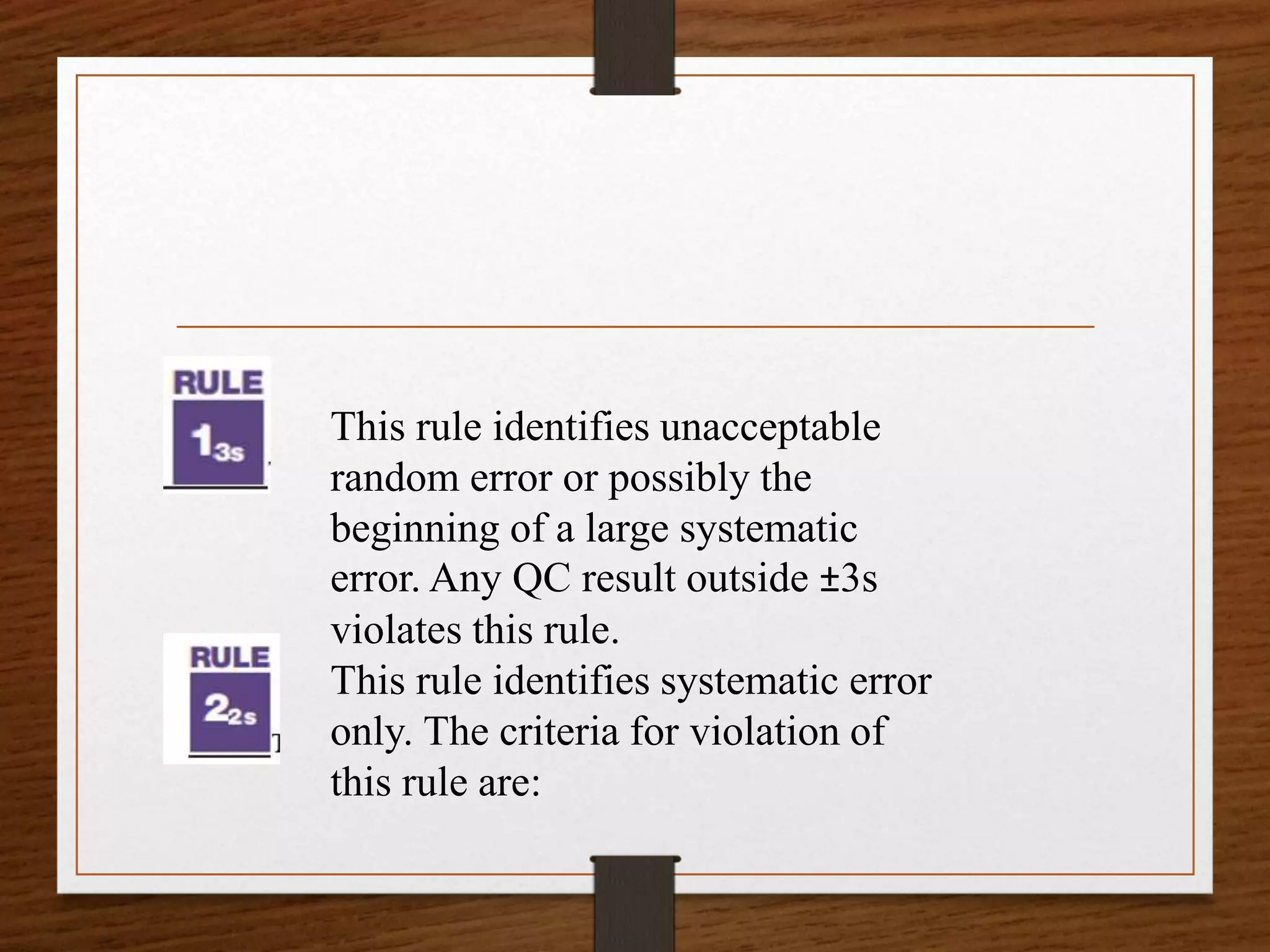
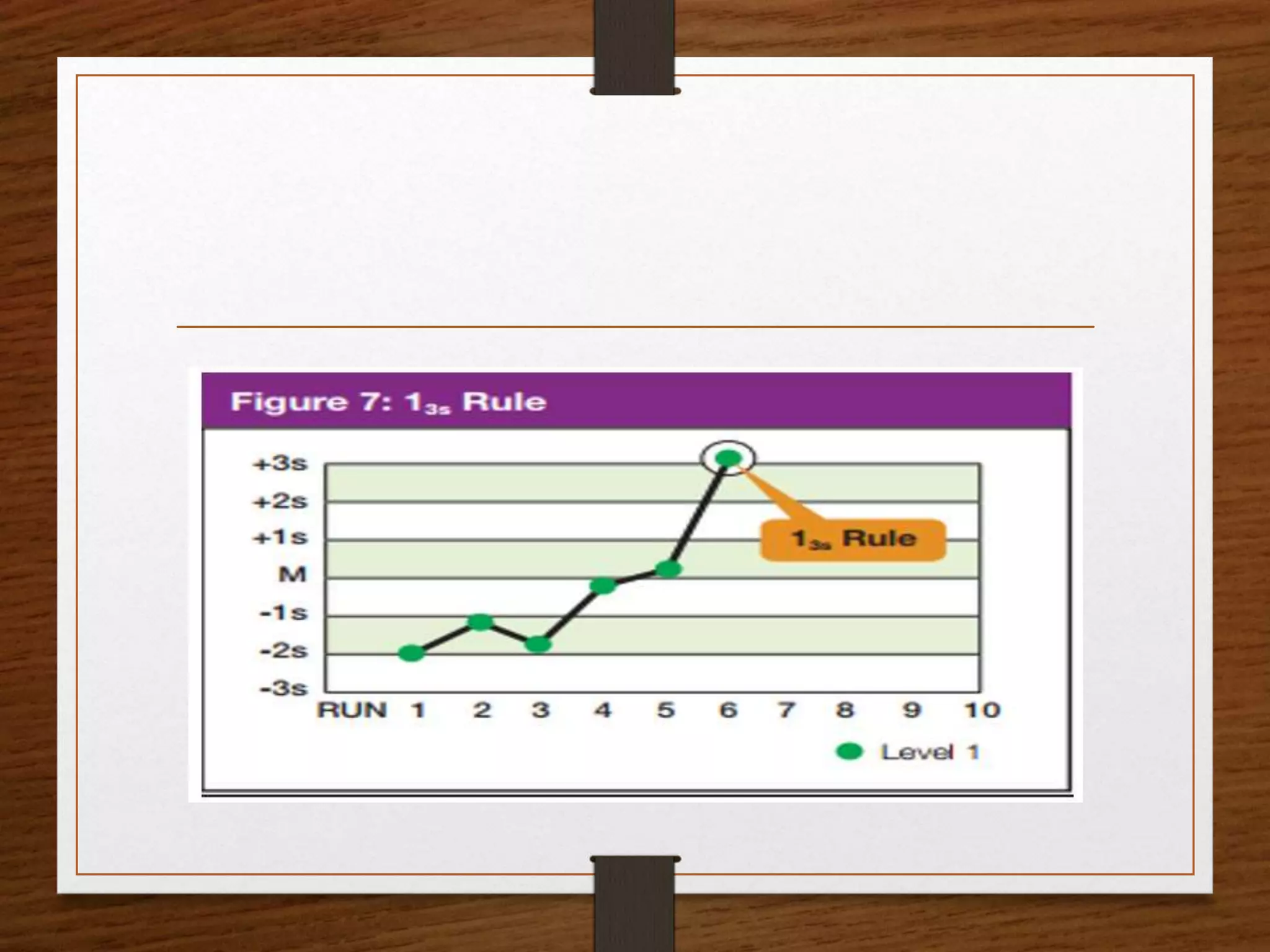
This rule identifies unacceptable
random error or possibly the
beginning of a large systematic
error. Any QC result outside ±3s
violates this rule.
This rule identifies systematic error
only. The criteria for violation of
this rule are:
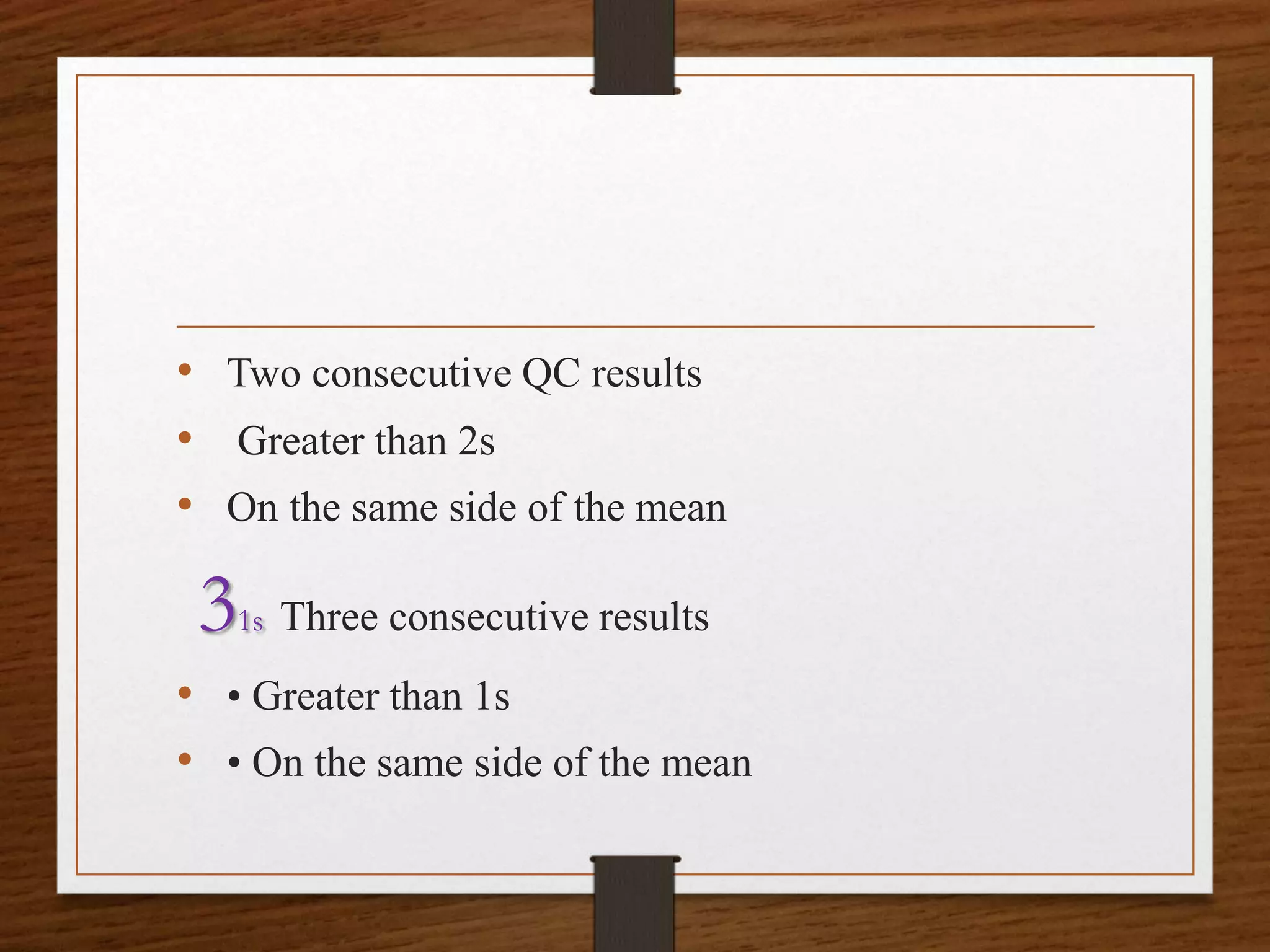
• Two consecutive QC results
• Greater than 2s
• On the same side of the mean
31s Three consecutive results
• • Greater than 1s
• • On the same side of the mean
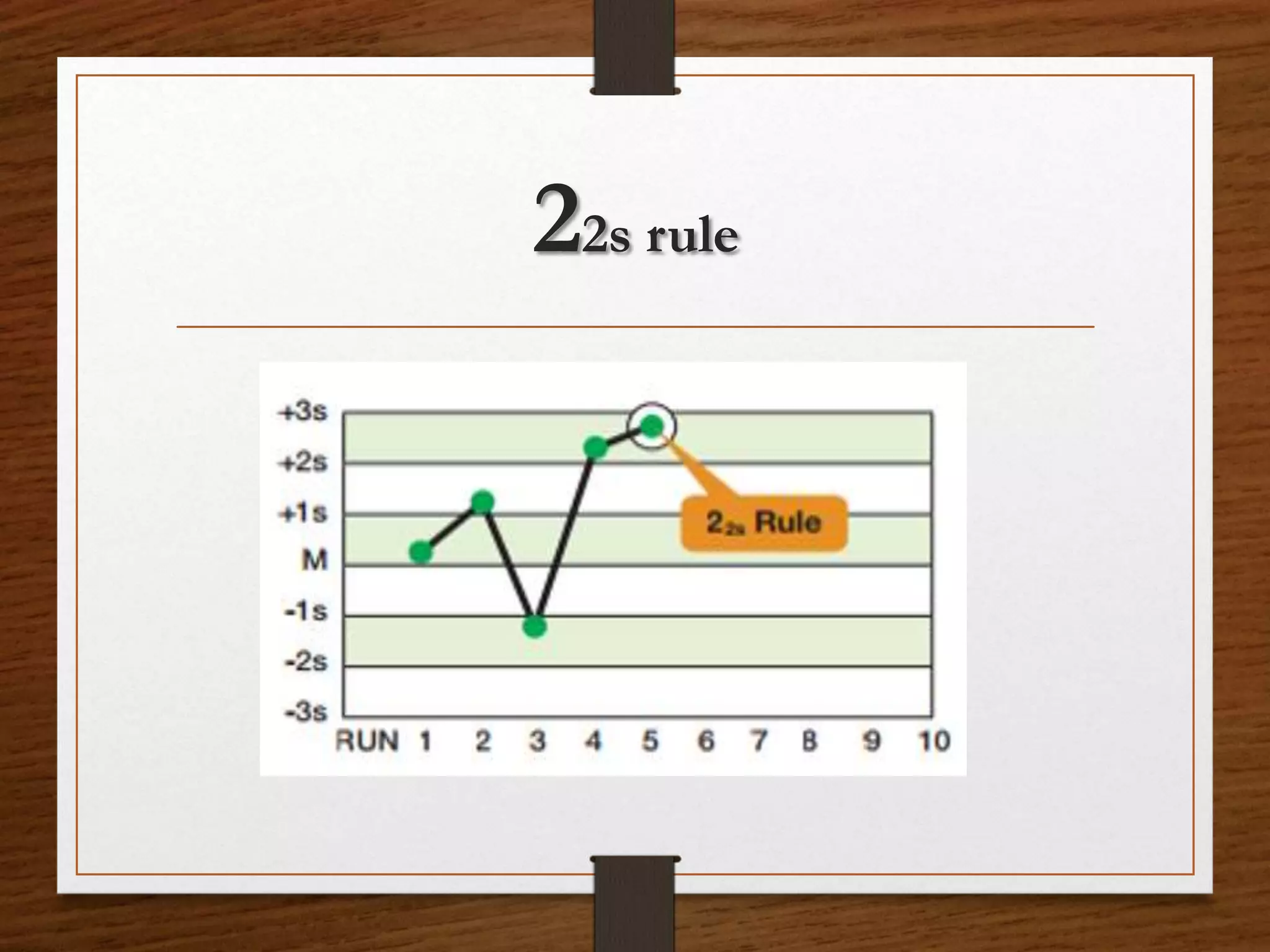
22s rule
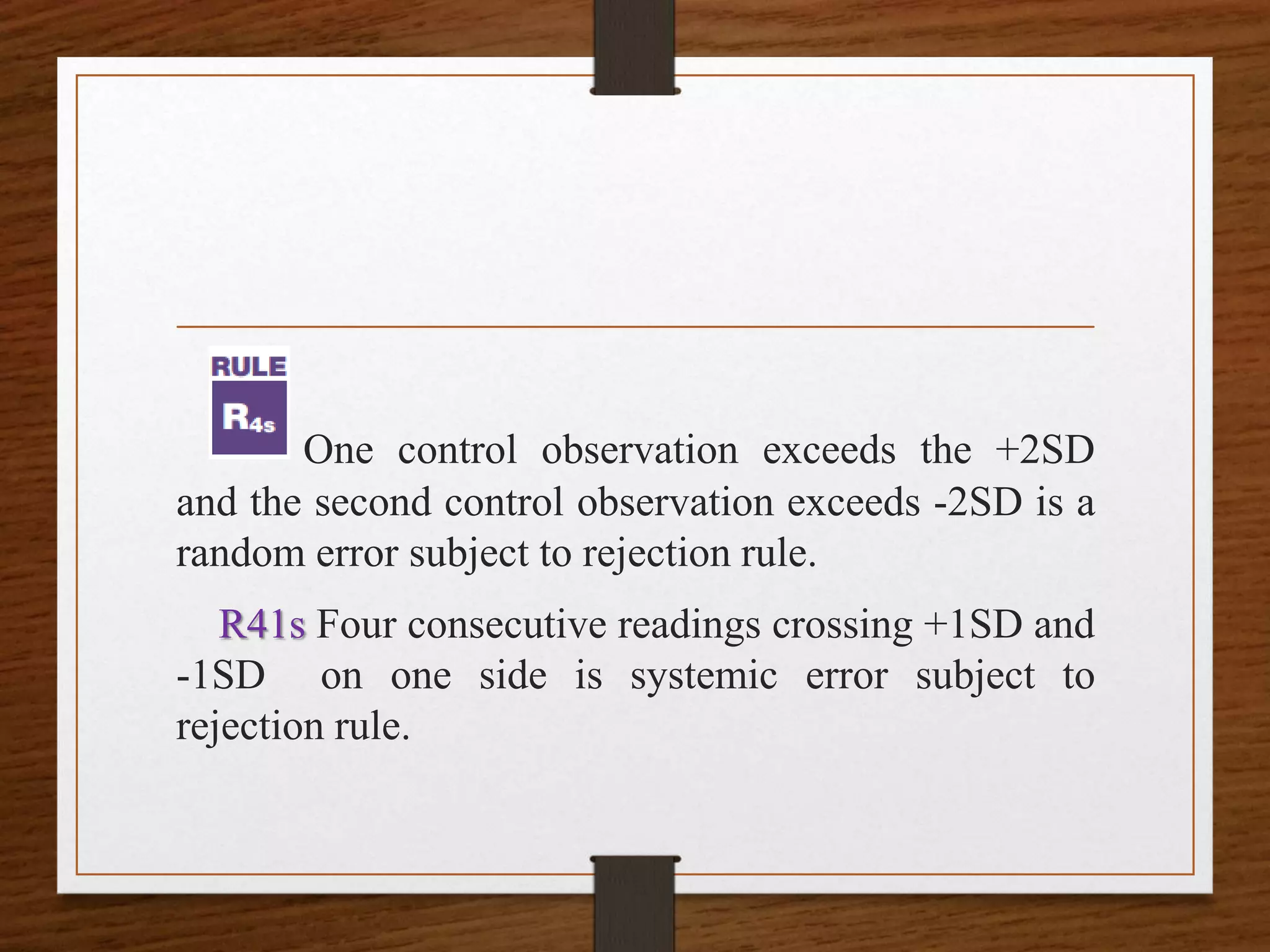
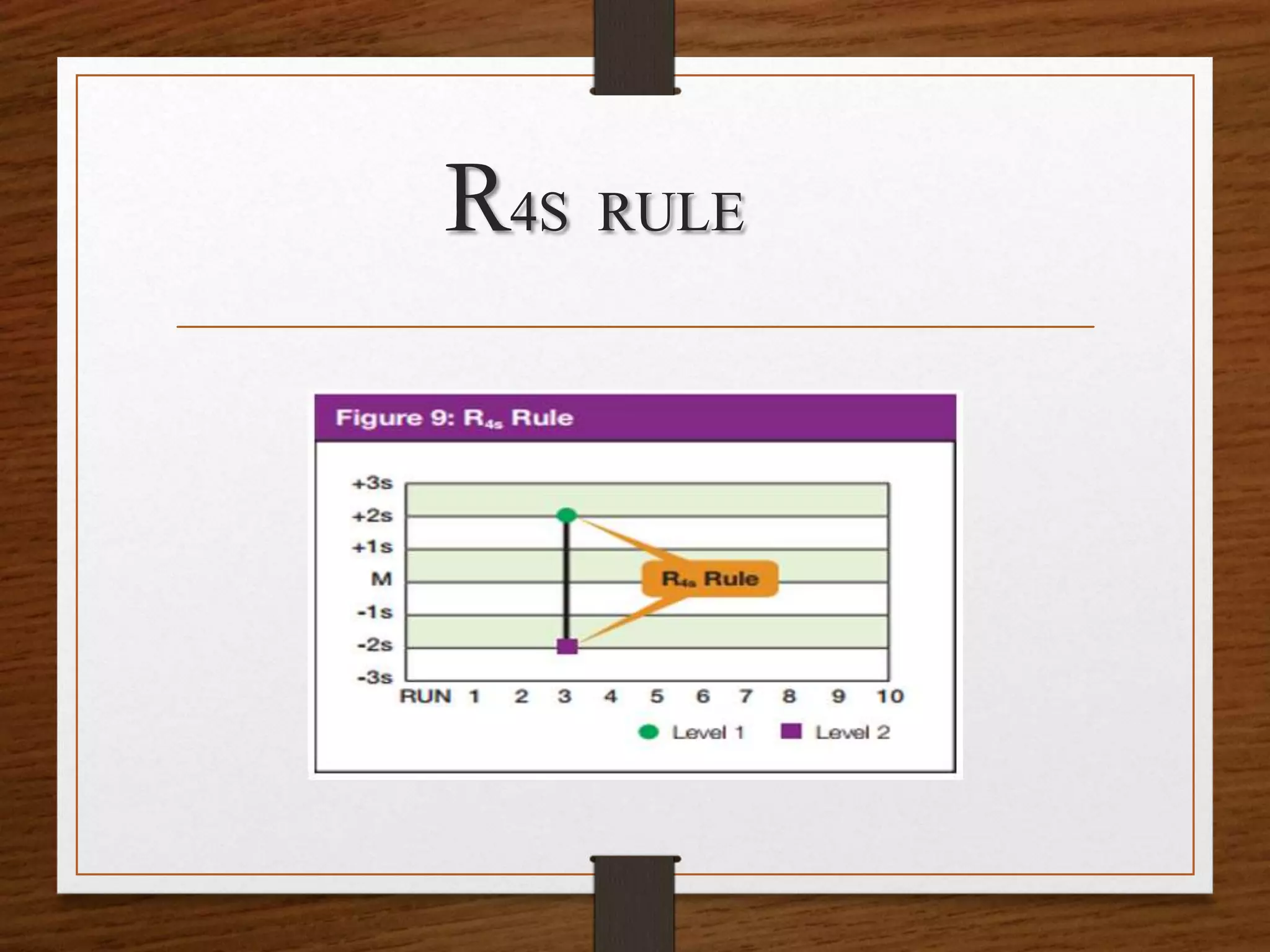
One control observation exceeds the +2SD
and the second control observation exceeds -2SD is a
random error subject to rejection rule.
R41s Four consecutive readings crossing +1SD and
-1SD on one side is systemic error subject to
rejection rule.
R4S RULE
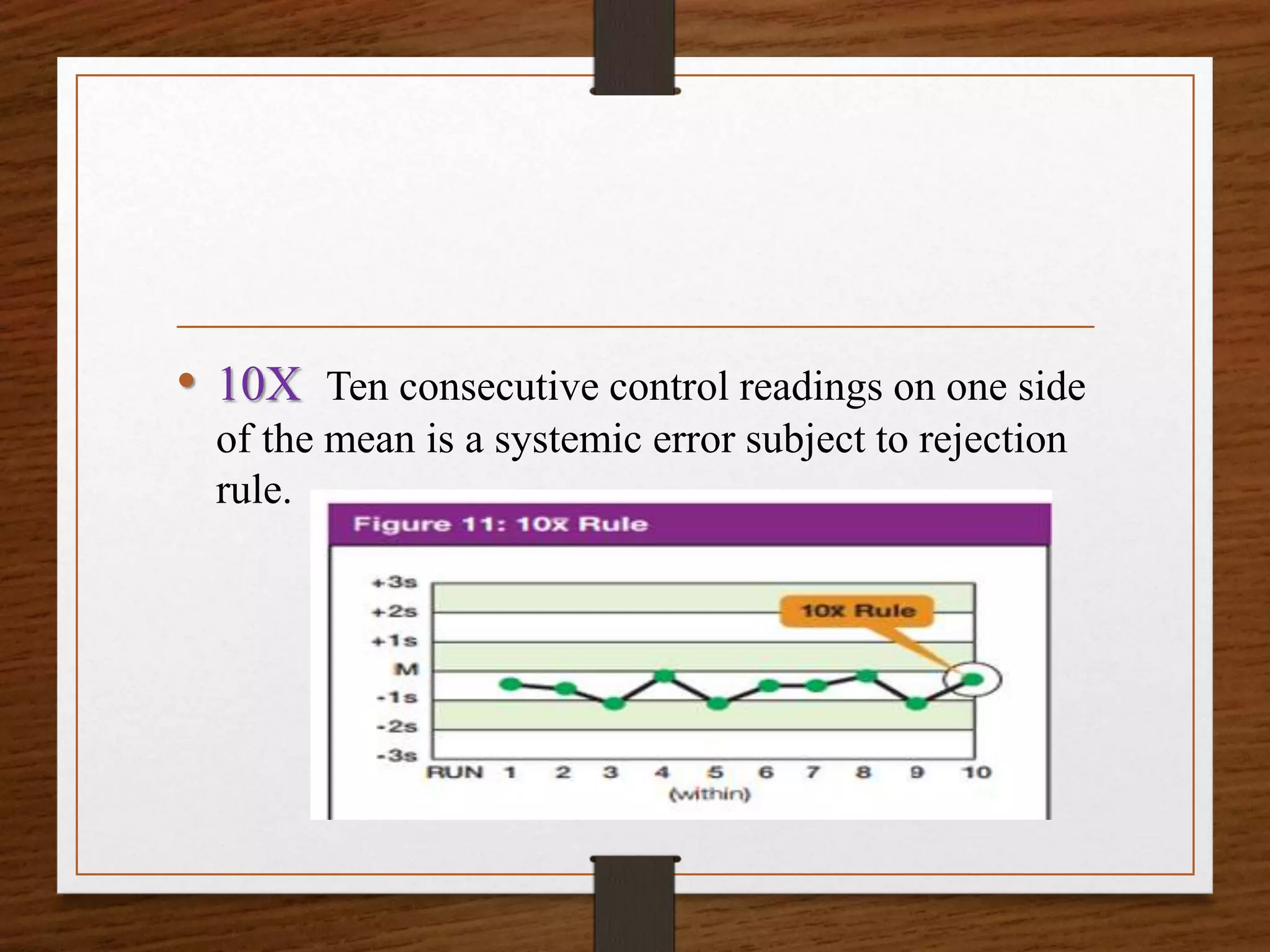
• 10X Ten consecutive control readings on one side
of the mean is a systemic error subject to rejection
rule.
•
• Precautions
• Competent staff to perform the test
• Correct sample handling
• avoid sample switching
• recapping is discouraged to avoid cross
contamination
• Proficiency Testing
• Technical Procedure
• The results of tests are recorded and filled
according to report number.
• Appropriate and valid SOP’s should be established
and followed.
• Adequate degree of separation of different activites.
References
• http://www.qcnet.com/Portals/50/PDFs/QCWorkbook20
08_Jun08.pdf
• http://www.aafp.org/practice-
management/regulatory/clia/quality-assurance.html
• https://en.wikipedia.org/wiki/Laboratory_quality_contro
l
• https://www.slideshare.net/drgomibasar/quality-control-
in-clinical-laboratory
• www.BioRd.cpm/quality control

Quality Control in Pathological Laboratory

  • 1.
    Quality control in pathological laboratory Presentedto Dr. Khizar Abbas Rizvi Presented by Sana Rehman
  • 2.
    What is Quality •A measure of excellence and a state of being free from defects, errors and significant variations. • Quality is never an accident; it is always result of high intention, sincere effort, intelligent direction and skilful execution. It represents the wise choice of many alternatives
  • 3.
    What is Qualitycontrol • Quality control in the medical laboratory is a statistical process used to monitor and evaluate the analytical process that produces patient results. QC results are used to validate whether the instrument is operating within pre-defined specifications, inferring that patient test results are reliable.
  • 4.
    What are requirementsof statistical process ?
  • 5.
  • 6.
    Types of QualityControl • There are two types of laboratory control procedures • Internal quality control • External quality control Internal quality control: This includes all quality control procedures adopted by the laboratory staff for checking day to day accuracy and precision of all procedures and equipment .
  • 7.
    • External qualitycontrol A system for objectively checking the laboratory’s performance using an external agency and facility. • Example: Bio Rad is an external agency for CPE institute of cardiology multan pathological lab. • Quality Assurance • It is an ongoing, comprehensive program which analyzes every aspect of an entire operation.
  • 8.
    Quality assurance • QualityAssurance : In the laboratory, quality assurance involves the entire testing process: pre-analytical, analytical (testing), and post-analytical processes.
  • 9.
    • The QAprogram must: • Assess the effectiveness of the lab’s policies and procedures. • Identify and correct problems. • Assure the accurate, reliable, and prompt reporting of test results. • Assure the adequacy and competency of the staff.
  • 10.
    Why quality controlis important? • There is no doubt that biochemical and other lab tests are always an important part of overall diagnostic process. • The results obtained from laboratory analysis are used to
  • 11.
    • Diagnose • Prescribetreatment • Monitor the health and progress of patient • Since such importance is placed upon test results, they must be reliable and accurate as possible
  • 12.
    Phases of Laboratorytesting • Pre analytical • Proper Patient Identification and Preparation • Wrist bands for in-patients / wrist bands or valid identification for out-patients. Proper Specimen collection: • Specimen handling and processing • Correct sample type
  • 13.
    • Proper tubemixing and specimen volume Correct phlebotomy procedure • Adequate staffing to maintain collection standards • Competent and skilled staff to perform phlebotomy procedures to minimize redraw for patient care. • Correct Labeling procedure
  • 14.
    • Specimen transportcarefully. Requirements 1. Timing • Some specimens must be transported immediately after collection, for example: • Arterial Blood Gases, • STAT samples • 2. Temperature
  • 15.
    3. Transport containers •Some samples need to be protected from light, for example, bilirubin • The specimens must be delivered to the laboratory within 45 minutes of collection in order to ensure the centrifugation and separation of the specimen within 1hour.
  • 16.
    • Analytical phase •Analyzers and Equipments. • Laboratory Equipment Management Plan • Controls • is designed to detect, reduce, and correct deficiencies in a laboratory's internal analytical process prior to the release of patient results, in order to improve the quality of the results reported by the laboratory
  • 17.
    • Calibration The calibrationis the first and foremost step in the analytical process of the method or instrument prior to the measurement of quality control material or patient samples. • Very often the operator is unable to handle a pipette in the correct way and might therefore dissolve the lyophilized calibrator material with the wrong amount of solvent
  • 18.
    Calibration Criteria: • Newlot of Reagents • When control results gives unacceptable results and shows a trend or shift • After major machine maintenance which may affect performance of test results • As recommended by the manufacturer
  • 19.
    Requirements and Documentations: • Daily,Weekly, Monthly, or as Needed Maintenance • Daily control reports • Monthly control reports • Levey-Jennings chart • Corrective action report for unacceptable results • Technical Procedure
  • 20.
    • Post -Analytical Phase • Review of results • Validation of results- rerunning of Critical results/Abnormal results for double checking • Evaluation of results- correlating patient results with patient’s history, previous results, medications, etc. • Releasing of results to finalize
  • 21.
    Testing Sequence • Whena diagnostic test is performed in the medical laboratory, the outcome of the test is a result. The result may be a patient result or it may be a quality control (QC) result. The result may be quantitative (a number) or qualitative (positive or negative). • QC results are used to validate whether the instrument is operating within pre-defined specifications, inferring that patient test results are reliable.
  • 22.
    • Once thetest system is validated, patient results can then be used for: • diagnosis, prognosis, or treatment planning • EXAMPLE: When a patient’s serum is assayed (tested) for potassium, the test result tells us how much potassium (concentration) is present in the blood. This result is then used by the physician to determine whether the patient has a low, normal or high potassium.
  • 23.
    Test for potassium Range Normalrange Abnormal range Patient Result 3.7 -4.3mmol/l 6.7-7.3mmol/l 2.8mmol/l Let’s assume the measured value of potassium in a patient’s serum is 2.8 mmol/L (a unit of measure, millimoles per liter)
  • 24.
    Question of Reliability •This result is abnormally low and indicates an inappropriate loss of potassium. But how does the person performing the test know that this result is truly reliable? It could be possible that the instrument is out of calibration and the patient’s true potassium value is 4.2 mmol/L – a normal result. The question of reliability for most testing can be resolved by regular use of quality control materials and statistical process control.
  • 25.
    Quality Control Product •A quality control product is a patient-like material ideally made from human serum. • A control product can be a liquid or freeze dried (lyophilized) material and is composed of one or more constituents (analytes) of known concentration.
  • 26.
    Normal Control • Normalcontrol: A normal control product contains normal levels for the analyte being tested. For example, the normal range for a potassium level is about 3.5 – 5.0 mmol/L. A normal control would contain potassium at a level within this range. • Abnormal control: An abnormal control product contains the analyte at a concentration above or below the normal range for the analyte. An abnormal control would contain potassium at a level below 3.5 mmol/L or above 5.0 mmol/L
  • 27.
    Regular testing • Goodlaboratory practice requires testing normal and abnormal controls for each test at least daily to monitor the analytical process. • Regular testing of quality control products creates a QC database that the laboratory uses to validate the test system. Validation occurs by comparing daily QC results to a laboratory-defined range of QC values.
  • 28.
    Comparison of QualityControl Results to Specific Statistical Limits • In Table 1, there are two ranges reported. The acceptable range for the Level I (Normal Control) is 3.7 – 4.3 mmol/L. The range for Level II (Abnormal Control) is 6.7 – 7.3 mmol/L. When the daily QC result obtained for the normal control is compared to the range calculated for the normal control, it becomes apparent that each result lies somewhere within the expected range. This indicates that the analytical process is “in control” at the normal level on that day of testing.
  • 29.
    • When thedaily QC result for the abnormal control (high potassium) is compared to the defined range for the abnormal control, the analytical process is shown to be “in control” for each day of testing except for the last day (11/7). • On November 1 through November 6, both controls were “in control” and patient values could be reliably reported. However, the laboratory was “out of control” for abnormal high potassium on November 7 because the value obtained for the QC material (8.0 mmol/L) was outside the acceptable range (6.7 – 7.3 mmol/L).
  • 30.
    • This meansthat some error occurred which may have made some patient results unreliable. • The laboratory should not report any patient samples with an abnormally high potassium result until the error is resolved and the abnormally high sample(s) are re-tested. Perhaps it is now apparent that the range defined for each level of control is fundamental to the quality control system.
  • 31.
  • 32.
    Calculation and Useof QC Statistics • QC statistics for each test performed in the laboratory are calculated from the QC database collected by regular testing of control products. • The most fundamental statistics used by the laboratory are the mean [x] and standard deviation [s]. • Mean • The mean (or average) is the laboratory’s best estimate of the analyte’s true value for a specific level of control.
  • 33.
  • 34.
    • To calculatea mean for a specific level of control, first, add all the values collected for that control. Then divide the sum of these values by the total number of values. For instance, to calculate the mean for the normal control (Level I) in Table 1, • find the sum of the data {4.0, 4.1, 4.0, 4.2, 4.1, 4.1, 4.2}. The sum [∑] is 28.7 mmol/L. • The number of values is 7 (n = 7).
  • 35.
    Calculating mean • Therefore,the mean for the normal potassium control in Table 1 from November 1–7 is 4.1 mmol/L (or 28.7 mmol/L divided by 7). • Calculating a Standard Deviation [s] • Standard deviation is a statistic that quantifies how close numerical values (i.e., QC values) are in relation to each other. The term precision is often used interchangeably with standard deviation. Another term, imprecision, is used to express how far apart numerical values are from each other.
  • 36.
    • Standard deviationis calculated for control products from the same data used to calculate the mean. It provides the laboratory an estimate of test consistency at specific concentrations. The repeatability of a test may be consistent (low standard deviation, low imprecision) or inconsistent (high standard deviation, high imprecision). Inconsistent repeatability may be due to the chemistry involved or to a malfunction. If it is a malfunction, the laboratory must correct the problem. • Standard deviation may also be used to monitor on- going day-to-day performance.
  • 37.
  • 38.
  • 39.
    • Calculate thestandard deviation for the normal level of control (Level I) in Table 1, begin by calculating the mean [ x ]: • x = 4.0 + 4.1 + 4.0 + 4.2 + 4.1 + 4.1 + 4.2 mmol/L ÷ 7 • x = 28.7 mmol/L ÷ 7 • x = 4.1 mmol/L • Calculate the standard deviation [s] as follows: • s= √[{(4−4.1)2 + (4.1 – 4.1)2 + (4−4.1)2+(4.2−4.1)2+(4.1−4.1)2+(4.2−4.1)2}/6] • s= √[{(−0.1)2 + ( 0.0)2 + (−0.1)2+(0.1)2+(0.0)2+(0.1)2}/6] • s =√[ 𝟎. 𝟎𝟏 + 𝟎. 𝟎 + 𝟎. 𝟎𝟏 + 𝟎. 𝟎𝟏 + 𝟎. 𝟎 + 𝟎. 𝟎 + 𝟎. 𝟎𝟏 ÷ 𝟔] • s = √[𝟎. 𝟎𝟒 ÷ 𝟔] • s = 0.082 0r 0.1 rounded
  • 40.
    • For instance,if during the next week of testing, the standard deviation calculated in the example for the normal potassium control increases from .08 to 0.16 mmol/L, this indicates a serious loss of precision. This instability may be due to a malfunction of the analytical process. Investigation of the test system is necessary and the following questions should be asked: • • Has the reagent or reagent lot changed recently? • • Has maintenance been performed routinely and on schedule?
  • 41.
    • Does thepotassium electrode require cleaning or replacement? • Are the reagent and sample pipettes operating correctly? • Has the test operator changed recently? • Creating a Levey-Jennings Chart • Standard deviation is commonly used for preparing Levey-Jennings (L-J or LJ) charts. The Levey-Jennings chart is used to graph successive (run-to-run or day-to- day) quality control values.
  • 42.
    • A chartis created for each test and level of control. The first step is to calculate decision limits. • These limits are ±1s, ±2s and ±3s from the mean. • The mean for the Level I potassium control in Table 1 is 4.1 mmol/L. • And the standard deviation is 0.1 mmol/L. Formula 3 provides examples on how ±1s, ±2s
  • 43.
  • 44.
  • 45.
    • Once theQC results are entered into the QC log, they should be plotted on the Levey-Jennings chart. When the results are plotted, an assessment can be made about the quality of the run. The technologist/technician performing the test should look for systematic error and random error. • Systematic Error • Systematic error is evidenced by a change in the mean of the control values.
  • 46.
    • Systematic Error •The change in the mean may be gradual and demonstrated as a trend in control values or it may be abrupt and demonstrated as a shift in control values. • Trend • A trend indicates a gradual loss of reliability in the test system. Trends are usually subtle.
  • 47.
    Shift Abrupt changes inthe control mean are defined as shifts. Shifts in QC data represent a sudden and dramatic positive or negative change in test system performance. Random Error Technically, random error is any deviation away from an expected result. For QC results, any positive or negative deviation away from the calculated mean is defined as random error.
  • 48.
    West-guard rules • Thevalues of controls (normal and abnormal) are plotted daily on the LJ chart and these values are monitored using Westguard rules. • There are six basic rules in westguard scheme. This is a warning rule that is violated when a single control observation is outside the ±2s limits.
  • 49.
    • . Patientresults can reported.
  • 50.
    This rule identifiesunacceptable random error or possibly the beginning of a large systematic error. Any QC result outside ±3s violates this rule. This rule identifies systematic error only. The criteria for violation of this rule are:
  • 51.
    • Two consecutiveQC results • Greater than 2s • On the same side of the mean 31s Three consecutive results • • Greater than 1s • • On the same side of the mean
  • 53.
  • 55.
    One control observationexceeds the +2SD and the second control observation exceeds -2SD is a random error subject to rejection rule. R41s Four consecutive readings crossing +1SD and -1SD on one side is systemic error subject to rejection rule.
  • 56.
  • 57.
    • 10X Tenconsecutive control readings on one side of the mean is a systemic error subject to rejection rule.
  • 61.
    • • Precautions • Competentstaff to perform the test • Correct sample handling • avoid sample switching • recapping is discouraged to avoid cross contamination • Proficiency Testing
  • 62.
    • Technical Procedure •The results of tests are recorded and filled according to report number. • Appropriate and valid SOP’s should be established and followed. • Adequate degree of separation of different activites.
  • 63.
    References • http://www.qcnet.com/Portals/50/PDFs/QCWorkbook20 08_Jun08.pdf • http://www.aafp.org/practice- management/regulatory/clia/quality-assurance.html •https://en.wikipedia.org/wiki/Laboratory_quality_contro l • https://www.slideshare.net/drgomibasar/quality-control- in-clinical-laboratory • www.BioRd.cpm/quality control