Three phases of laboratory testing:
 Pre-analytical:
Specimen collection, transport &
processing
 Analytical:
Testing
 Post-analytical:
Results transmission, interpretation, follow-
up, retesting
 Preanalytical variables can dramatically
affect the results of laboratory tests.
 Paying close attention to control the
preanalytical variables will help to
ensure accurate test results in clinical
laboratory.
No result is better than bad result.
Accurate result is the best of all.
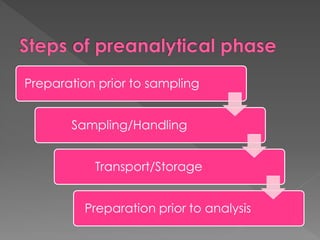
Preparation prior to sampling
Sampling/Handling
Transport/Storage
Preparation prior to analysis
 Pre-& post-analytical errors: > 90% of
errors
 These potential errors are not inevitable
but could be prevented with an
accurate application of quality control,
continuing education and effective
collection systems.
 Patient Identification
 Sampling Technique
 Collection Procedures
 Specimen Transport
 Specimen Processing
 Attention to the preanalytical variables
associated with blood collection is
critical in ensuring accurate test results.
 Record significant variables on request
form.
Some patient variables that affect test results
 Age
 Genetic variation/ Race
 Sex
 Nutritional status
 Diet
 Exercise
 Pregnancy
 Timing
 Special habits
 Hemolysis, lipemia, Jaundice
When identifying the patient, get:
 Full name
 Age & sex
 Address/Nationality
 Identification number:
 Hospital No for inpatients,
 Identification band should contain the
above information (confirm before
venipuncture)
The highest frequency of errors occurs with
the use of handwritten labels & request
forms.
These can be eliminated by:
 Confirming patient’s identifiers (name,
medical record number, date of birth,
room location or address)
 Barcode technology.
 Locate Patient
 Label
 Prepare Patient
 Draw Sample
 Dispose of supplies
Timing of Collection:
 Therapeutic Drug Monitoring
-Peak and trough collection times
 Basal State Collections
-Fasting requirements: no food or liquid
except water (10-12h), (12-14 h for TG)
-2h postprandial, from the start of food .
 Specimens affected by time of day, for
example, cortisol, iron and TSH.
 Venipuncture requires expert knowledge
and critical judgment.
 Phlebotomy errors may cause harm to
patients or result in needle stick injury to
the phlebotomist.
 It could result in many preanalytical
errors in Lab results
 Phlebotomy Education
-Academic course and training under the
supervision of a senior phlebotomist.
 Continuous Medical Education
-Competency assessments (written and
observational).
-Professional License.
 Phlebotomy Staffing
-Adequate staffing to maintain collection
standards.
 Technology
-Use of barcode scanners for patient
identification.
1. Posture:
- Comfortably seated patient or supine for
20 min before sampling (not standing).
- The arm should be extended in a straight
line from the shoulder to the wrist.
2. Collection site:
- The median cubital vein is the preferred
site.
- Veins on the hand or at ankle may be
used.
 Cleaning of venipuncture site
-Thorough cleaning with alcohol
-Allow alcohol to dry completely to avoid
stinging sensation and hemolysis of sample
-Iodine for blood culture samples (sterile
sample)
 N.B: contamination occurs in 50% at some
hospitals with increased costs & patient
overtreatment.
Avoid the arm with:
- Extensive scarring, hematoma, infection,
edema or burn
-On the same side of mastectomy.
-I.V. infusion (Document if IV ).
3. Correct collection system :
-Vacutainers for large veins in antecubital fossa.
-Syringe for small, fragile veins or veins outside
antecubital fossa.
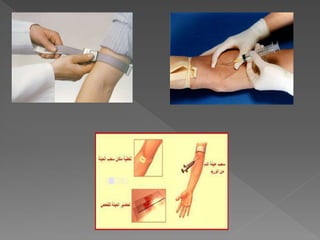
4. Venous access :
-Needle entry should be at 15-30o depending on
depth of vein.
-Needle entry should be in same direction as vein,
centered over vein.
-Anchor vein to prevent movement during needle
entry and to reduce pain to patient.
 Tourniquet Application
-Tourniquet tied too close to venipuncture
site can cause hematoma.
 Veins may not become prominent if
tourniquet is tied too high (> 3-4 inches
above venipuncture site)
 Tourniquet left for > 1 min can result in
hemoconcentration, affecting some test
results.
 Tourniquet should be released as soon as
needle is in the lumen of vein and blood
flow is established.
Additives used:
 EDTA,
 Citrate,
 Lithium heparin,
 Fluoride/ Oxalate
 Typical errors :
Incorrect tube
• cannot be analysed
• risk of contamination
 Solution: New sample needs to be sent to lab.
Causes of Hemolysis
 Traumatic venipuncture
 Blood collected from area with hematoma
 Vigorous shaking after collection
 Milking the site when collecting capillary
samples
 Blood collected using a small diameter needle.
 High filling pressure through a narrow entrance
(e.g during too vigorous sample aspiration)
 Cooling down the sample < 0 °C.
Affects analytes that are present at
higher concentrations in erythrocytes
than in plasma (K, LD, AST, Mg, P)
Capillary Collections:
 Appropriate site
-Heel stick: sides of bottom surface of the
heel (infants)
-Finger stick: third or fourth fingers,
perpendicular to fingerprint lines on
fleshy pads on finger surface.
 Warm before collection to increase
capillary blood flow near skin surface.
 Clean site with alcohol and allow to dry.
 Discard first drop of blood.
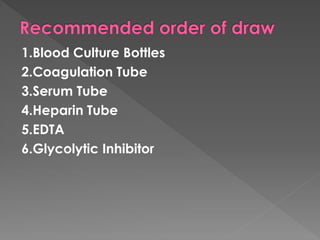
1.Blood Culture Bottles
2.Coagulation Tube
3.Serum Tube
4.Heparin Tube
5.EDTA
6.Glycolytic Inhibitor
Proper Tube Mixing:
All tubes with additives need to be
inverted (10 times) to mix the additive
evenly with the blood. Improper mixing
of the tube after venipuncture could
contribute to sample clotting.
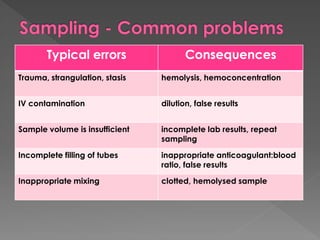
Consequences
Typical errors
hemolysis, hemoconcentration
Trauma, strangulation, stasis
dilution, false results
IV contamination
incomplete lab results, repeat
sampling
Sample volume is insufficient
inappropriate anticoagulant:blood
ratio, false results
Incomplete filling of tubes
clotted, hemolysed sample
Inappropriate mixing
Solution:
 Lab report with preanalytical comment
(if problem recognized).
 New sample is requested.
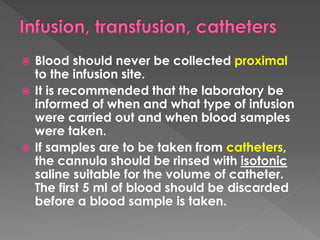
 Blood should never be collected proximal
to the infusion site.
 It is recommended that the laboratory be
informed of when and what type of infusion
were carried out and when blood samples
were taken.
 If samples are to be taken from catheters,
the cannula should be rinsed with isotonic
saline suitable for the volume of catheter.
The first 5 ml of blood should be discarded
before a blood sample is taken.
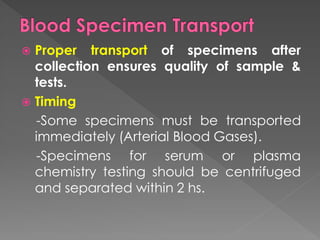
 Proper transport of specimens after
collection ensures quality of sample &
tests.
 Timing
-Some specimens must be transported
immediately (Arterial Blood Gases).
-Specimens for serum or plasma
chemistry testing should be centrifuged
and separated within 2 hs.
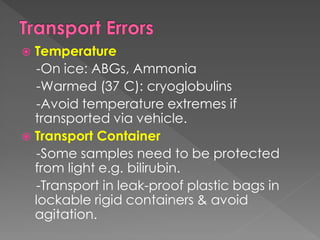
 Temperature
-On ice: ABGs, Ammonia
-Warmed (37 C): cryoglobulins
-Avoid temperature extremes if
transported via vehicle.
 Transport Container
-Some samples need to be protected
from light e.g. bilirubin.
-Transport in leak-proof plastic bags in
lockable rigid containers & avoid
agitation.
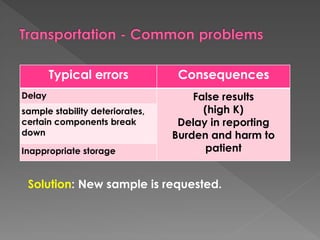
Consequences
Typical errors
False results
(high K)
Delay in reporting
Burden and harm to
patient
Delay
sample stability deteriorates,
certain components break
down
Inappropriate storage
Solution: New sample is requested.
 Registration, identification
 Checking for clots
 Centrifugation
 Distribution
 Storage (non routine daily analysis , for
post-analysis if it is needed)
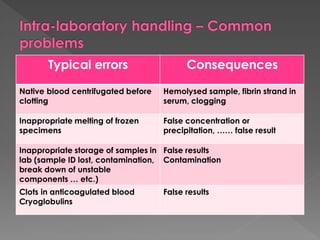
Consequences
Typical errors
Hemolysed sample, fibrin strand in
serum, clogging
Native blood centrifugated before
clotting
False concentration or
precipitation, …… false result
Inappropriate melting of frozen
specimens
False results
Contamination
Inappropriate storage of samples in
lab (sample ID lost, contamination,
break down of unstable
components … etc.)
False results
Clots in anticoagulated blood
Cryoglobulins
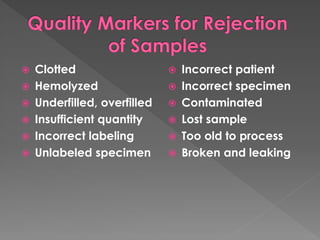
 Clotted
 Hemolyzed
 Underfilled, overfilled
 Insufficient quantity
 Incorrect labeling
 Unlabeled specimen
 Incorrect patient
 Incorrect specimen
 Contaminated
 Lost sample
 Too old to process
 Broken and leaking
 The human role in sample collection
makes complete elimination of errors
associated with laboratory testing
unrealistic
 However, good practices and
compliance with strategies for error
prevention can lead to a substantial
reduction in pre-analytical errors.
Laboratory errors.pdf

Laboratory errors.pdf

  • 2.
    Three phases oflaboratory testing:  Pre-analytical: Specimen collection, transport & processing  Analytical: Testing  Post-analytical: Results transmission, interpretation, follow- up, retesting
  • 3.
     Preanalytical variablescan dramatically affect the results of laboratory tests.  Paying close attention to control the preanalytical variables will help to ensure accurate test results in clinical laboratory.
  • 4.
    No result isbetter than bad result. Accurate result is the best of all.
  • 5.
    Preparation prior tosampling Sampling/Handling Transport/Storage Preparation prior to analysis
  • 6.
     Pre-& post-analyticalerrors: > 90% of errors  These potential errors are not inevitable but could be prevented with an accurate application of quality control, continuing education and effective collection systems.
  • 7.
     Patient Identification Sampling Technique  Collection Procedures  Specimen Transport  Specimen Processing
  • 8.
     Attention tothe preanalytical variables associated with blood collection is critical in ensuring accurate test results.  Record significant variables on request form.
  • 9.
    Some patient variablesthat affect test results  Age  Genetic variation/ Race  Sex  Nutritional status  Diet  Exercise  Pregnancy  Timing  Special habits  Hemolysis, lipemia, Jaundice
  • 10.
    When identifying thepatient, get:  Full name  Age & sex  Address/Nationality  Identification number:  Hospital No for inpatients,  Identification band should contain the above information (confirm before venipuncture)
  • 11.
    The highest frequencyof errors occurs with the use of handwritten labels & request forms. These can be eliminated by:  Confirming patient’s identifiers (name, medical record number, date of birth, room location or address)  Barcode technology.
  • 12.
     Locate Patient Label  Prepare Patient  Draw Sample  Dispose of supplies
  • 13.
    Timing of Collection: Therapeutic Drug Monitoring -Peak and trough collection times  Basal State Collections -Fasting requirements: no food or liquid except water (10-12h), (12-14 h for TG) -2h postprandial, from the start of food .  Specimens affected by time of day, for example, cortisol, iron and TSH.
  • 14.
     Venipuncture requiresexpert knowledge and critical judgment.  Phlebotomy errors may cause harm to patients or result in needle stick injury to the phlebotomist.  It could result in many preanalytical errors in Lab results
  • 15.
     Phlebotomy Education -Academiccourse and training under the supervision of a senior phlebotomist.  Continuous Medical Education -Competency assessments (written and observational). -Professional License.  Phlebotomy Staffing -Adequate staffing to maintain collection standards.  Technology -Use of barcode scanners for patient identification.
  • 16.
    1. Posture: - Comfortablyseated patient or supine for 20 min before sampling (not standing). - The arm should be extended in a straight line from the shoulder to the wrist. 2. Collection site: - The median cubital vein is the preferred site. - Veins on the hand or at ankle may be used.
  • 17.
     Cleaning ofvenipuncture site -Thorough cleaning with alcohol -Allow alcohol to dry completely to avoid stinging sensation and hemolysis of sample -Iodine for blood culture samples (sterile sample)  N.B: contamination occurs in 50% at some hospitals with increased costs & patient overtreatment.
  • 18.
    Avoid the armwith: - Extensive scarring, hematoma, infection, edema or burn -On the same side of mastectomy. -I.V. infusion (Document if IV ).
  • 19.
    3. Correct collectionsystem : -Vacutainers for large veins in antecubital fossa. -Syringe for small, fragile veins or veins outside antecubital fossa. 4. Venous access : -Needle entry should be at 15-30o depending on depth of vein. -Needle entry should be in same direction as vein, centered over vein. -Anchor vein to prevent movement during needle entry and to reduce pain to patient.
  • 21.
     Tourniquet Application -Tourniquettied too close to venipuncture site can cause hematoma.  Veins may not become prominent if tourniquet is tied too high (> 3-4 inches above venipuncture site)  Tourniquet left for > 1 min can result in hemoconcentration, affecting some test results.  Tourniquet should be released as soon as needle is in the lumen of vein and blood flow is established.
  • 22.
    Additives used:  EDTA, Citrate,  Lithium heparin,  Fluoride/ Oxalate
  • 23.
     Typical errors: Incorrect tube • cannot be analysed • risk of contamination  Solution: New sample needs to be sent to lab.
  • 24.
    Causes of Hemolysis Traumatic venipuncture  Blood collected from area with hematoma  Vigorous shaking after collection  Milking the site when collecting capillary samples  Blood collected using a small diameter needle.  High filling pressure through a narrow entrance (e.g during too vigorous sample aspiration)  Cooling down the sample < 0 °C.
  • 25.
    Affects analytes thatare present at higher concentrations in erythrocytes than in plasma (K, LD, AST, Mg, P)
  • 26.
    Capillary Collections:  Appropriatesite -Heel stick: sides of bottom surface of the heel (infants) -Finger stick: third or fourth fingers, perpendicular to fingerprint lines on fleshy pads on finger surface.  Warm before collection to increase capillary blood flow near skin surface.  Clean site with alcohol and allow to dry.  Discard first drop of blood.
  • 27.
    1.Blood Culture Bottles 2.CoagulationTube 3.Serum Tube 4.Heparin Tube 5.EDTA 6.Glycolytic Inhibitor
  • 28.
    Proper Tube Mixing: Alltubes with additives need to be inverted (10 times) to mix the additive evenly with the blood. Improper mixing of the tube after venipuncture could contribute to sample clotting.
  • 29.
    Consequences Typical errors hemolysis, hemoconcentration Trauma,strangulation, stasis dilution, false results IV contamination incomplete lab results, repeat sampling Sample volume is insufficient inappropriate anticoagulant:blood ratio, false results Incomplete filling of tubes clotted, hemolysed sample Inappropriate mixing
  • 30.
    Solution:  Lab reportwith preanalytical comment (if problem recognized).  New sample is requested.
  • 31.
     Blood shouldnever be collected proximal to the infusion site.  It is recommended that the laboratory be informed of when and what type of infusion were carried out and when blood samples were taken.  If samples are to be taken from catheters, the cannula should be rinsed with isotonic saline suitable for the volume of catheter. The first 5 ml of blood should be discarded before a blood sample is taken.
  • 33.
     Proper transportof specimens after collection ensures quality of sample & tests.  Timing -Some specimens must be transported immediately (Arterial Blood Gases). -Specimens for serum or plasma chemistry testing should be centrifuged and separated within 2 hs.
  • 34.
     Temperature -On ice:ABGs, Ammonia -Warmed (37 C): cryoglobulins -Avoid temperature extremes if transported via vehicle.  Transport Container -Some samples need to be protected from light e.g. bilirubin. -Transport in leak-proof plastic bags in lockable rigid containers & avoid agitation.
  • 35.
    Consequences Typical errors False results (highK) Delay in reporting Burden and harm to patient Delay sample stability deteriorates, certain components break down Inappropriate storage Solution: New sample is requested.
  • 36.
     Registration, identification Checking for clots  Centrifugation  Distribution  Storage (non routine daily analysis , for post-analysis if it is needed)
  • 37.
    Consequences Typical errors Hemolysed sample,fibrin strand in serum, clogging Native blood centrifugated before clotting False concentration or precipitation, …… false result Inappropriate melting of frozen specimens False results Contamination Inappropriate storage of samples in lab (sample ID lost, contamination, break down of unstable components … etc.) False results Clots in anticoagulated blood Cryoglobulins
  • 38.
     Clotted  Hemolyzed Underfilled, overfilled  Insufficient quantity  Incorrect labeling  Unlabeled specimen  Incorrect patient  Incorrect specimen  Contaminated  Lost sample  Too old to process  Broken and leaking
  • 40.
     The humanrole in sample collection makes complete elimination of errors associated with laboratory testing unrealistic  However, good practices and compliance with strategies for error prevention can lead to a substantial reduction in pre-analytical errors.