ANALYTICAL AND
POST-ANALYTICAL ERROR IN
CLINICAL CHEMISTRY
LABORATORY
Hanisha Erica P. Villaester, RMT
Analytical Errors
Analytical Errors
• Test System Not Calibrated
• Results reported when control results out of range
• Improper measurements of specimens and/or reagents
• Reagents prepared incorrectly
• Reagents stored inappropriately or used after expiration
date
• Instrument maintenance not dance
• Dilution and pipetting errors
Analytical Errors
• Inaccuracy
• Imprecision Errors
• Insensitivity
• Linearity Issues
Analytical Errors
• Inaccuracy
• Invalidates reference ranges and cut-off points
• May lead to inappropriate therapy or failure to treat
• May lead to misdiagnosis
• May lead to failure to diagnose
• Imprecision Issues
• Poor reproducibility invalidates patient monitoring using
laboratory results
Analytical Errors
• Insensitivity
• A change in assay sensitivity leads to issue of detection
• Affects robustness of results near the detection limit
• Linearity Issues
• A clear understanding of the linearity of a method is essential to
ensure that grossly inaccurate results are not reported where
there are high concentrations or activities of analytes
Post-Analytical Errors
Post-Analytical Error
• Transcription errors in reporting
• Report sent to the wrong location
• Report illegible
• Report not sent
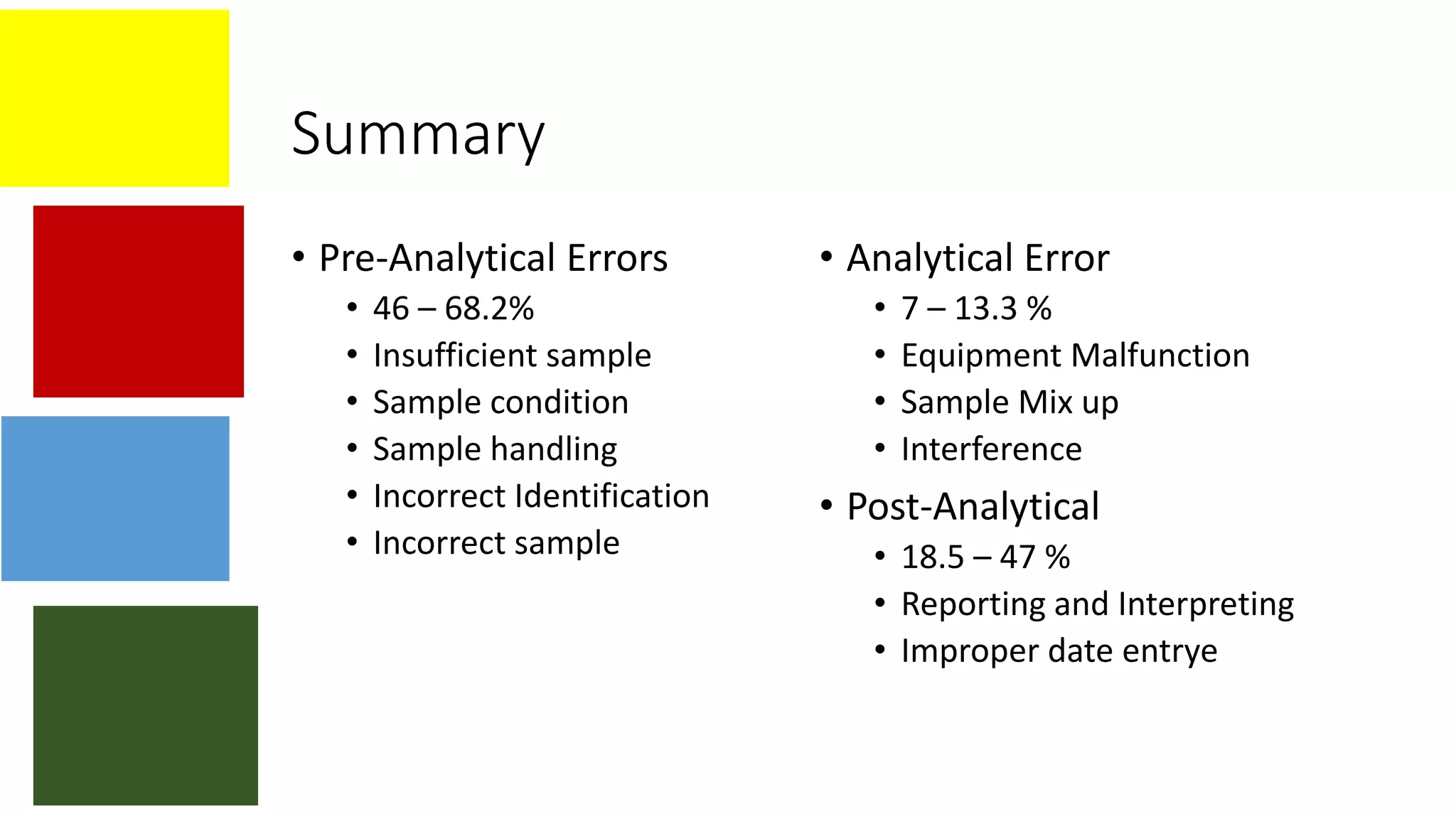
Summary
• Pre-Analytical Errors
• 46 – 68.2%
• Insufficient sample
• Sample condition
• Sample handling
• Incorrect Identification
• Incorrect sample
• Analytical Error
• 7 – 13.3 %
• Equipment Malfunction
• Sample Mix up
• Interference
• Post-Analytical
• 18.5 – 47 %
• Reporting and Interpreting
• Improper date entrye
Impact of Errors
• Inadequate or improper patient care
• Inconvenience to patient
• Misdiagnosis
• Harm to patient
• Death
WHAT SHOULD WE DO?
• Develop systematic workflow
• Identify critical processes
• Continuous monitoring
• Predict accidental events so preparation may be ahead
• Strengthen defences and decrease vulnerability
References
• Odell, M. (Feb 2014). CSE Senior Design 1. Retrieved from
https://www.google.com.ph/url?sa=t&rct=j&q=&esrc=s&source=web&cd=35&cad
=rja&uact=8&ved=0CDUQFjAEOB5qFQoTCNL0jbC99MYCFYUmlAodnY8CvQ&url=ht
tp%3A%2F%2Franger.uta.edu%2F~odell%2FCSE_4316_Senior_Design_I%2FCSE%25
204316%2520Classic%2520Mistakes.ppt&ei=946yVZKdLIXN0ASdn4roCw&usg=AFQ
jCNFgWECvcwF_hLS-nwPKhoXuOs0cAA&bvm=bv.98476267,bs.1,d.c2E

Analytical and post analytical errors in laboratory

  • 1.
    ANALYTICAL AND POST-ANALYTICAL ERRORIN CLINICAL CHEMISTRY LABORATORY Hanisha Erica P. Villaester, RMT
  • 2.
  • 3.
    Analytical Errors • TestSystem Not Calibrated • Results reported when control results out of range • Improper measurements of specimens and/or reagents • Reagents prepared incorrectly • Reagents stored inappropriately or used after expiration date • Instrument maintenance not dance • Dilution and pipetting errors
  • 4.
    Analytical Errors • Inaccuracy •Imprecision Errors • Insensitivity • Linearity Issues
  • 5.
    Analytical Errors • Inaccuracy •Invalidates reference ranges and cut-off points • May lead to inappropriate therapy or failure to treat • May lead to misdiagnosis • May lead to failure to diagnose • Imprecision Issues • Poor reproducibility invalidates patient monitoring using laboratory results
  • 6.
    Analytical Errors • Insensitivity •A change in assay sensitivity leads to issue of detection • Affects robustness of results near the detection limit • Linearity Issues • A clear understanding of the linearity of a method is essential to ensure that grossly inaccurate results are not reported where there are high concentrations or activities of analytes
  • 7.
  • 8.
    Post-Analytical Error • Transcriptionerrors in reporting • Report sent to the wrong location • Report illegible • Report not sent
  • 9.
    Summary • Pre-Analytical Errors •46 – 68.2% • Insufficient sample • Sample condition • Sample handling • Incorrect Identification • Incorrect sample • Analytical Error • 7 – 13.3 % • Equipment Malfunction • Sample Mix up • Interference • Post-Analytical • 18.5 – 47 % • Reporting and Interpreting • Improper date entrye
  • 10.
    Impact of Errors •Inadequate or improper patient care • Inconvenience to patient • Misdiagnosis • Harm to patient • Death
  • 11.
    WHAT SHOULD WEDO? • Develop systematic workflow • Identify critical processes • Continuous monitoring • Predict accidental events so preparation may be ahead • Strengthen defences and decrease vulnerability
  • 12.
    References • Odell, M.(Feb 2014). CSE Senior Design 1. Retrieved from https://www.google.com.ph/url?sa=t&rct=j&q=&esrc=s&source=web&cd=35&cad =rja&uact=8&ved=0CDUQFjAEOB5qFQoTCNL0jbC99MYCFYUmlAodnY8CvQ&url=ht tp%3A%2F%2Franger.uta.edu%2F~odell%2FCSE_4316_Senior_Design_I%2FCSE%25 204316%2520Classic%2520Mistakes.ppt&ei=946yVZKdLIXN0ASdn4roCw&usg=AFQ jCNFgWECvcwF_hLS-nwPKhoXuOs0cAA&bvm=bv.98476267,bs.1,d.c2E

Editor's Notes

  • #3 Analytical errors rates has decreased significantly as a result of standardization, automation and technological advancement thus improving the analytical reliability of Laboratory tests. Possible causes of analytical errors includes: incorrect measuring of the sample or reagents; usually these are dilution or pipetting errors; using reagents that have been improperly stored, or after their expiration date.