QUALITY CONTROL
IN CLINICAL LABORATORY
DR RAJESH V BENDRE
MD(PATH), DNB(PATH), DPB
CHIEF PATHOLOGIST, HEAD LABORATORY & BLOOD BANK SERVICES
JASLOK HOSPITAL & RESEARCH CENTER
Introduction- what is Quality?
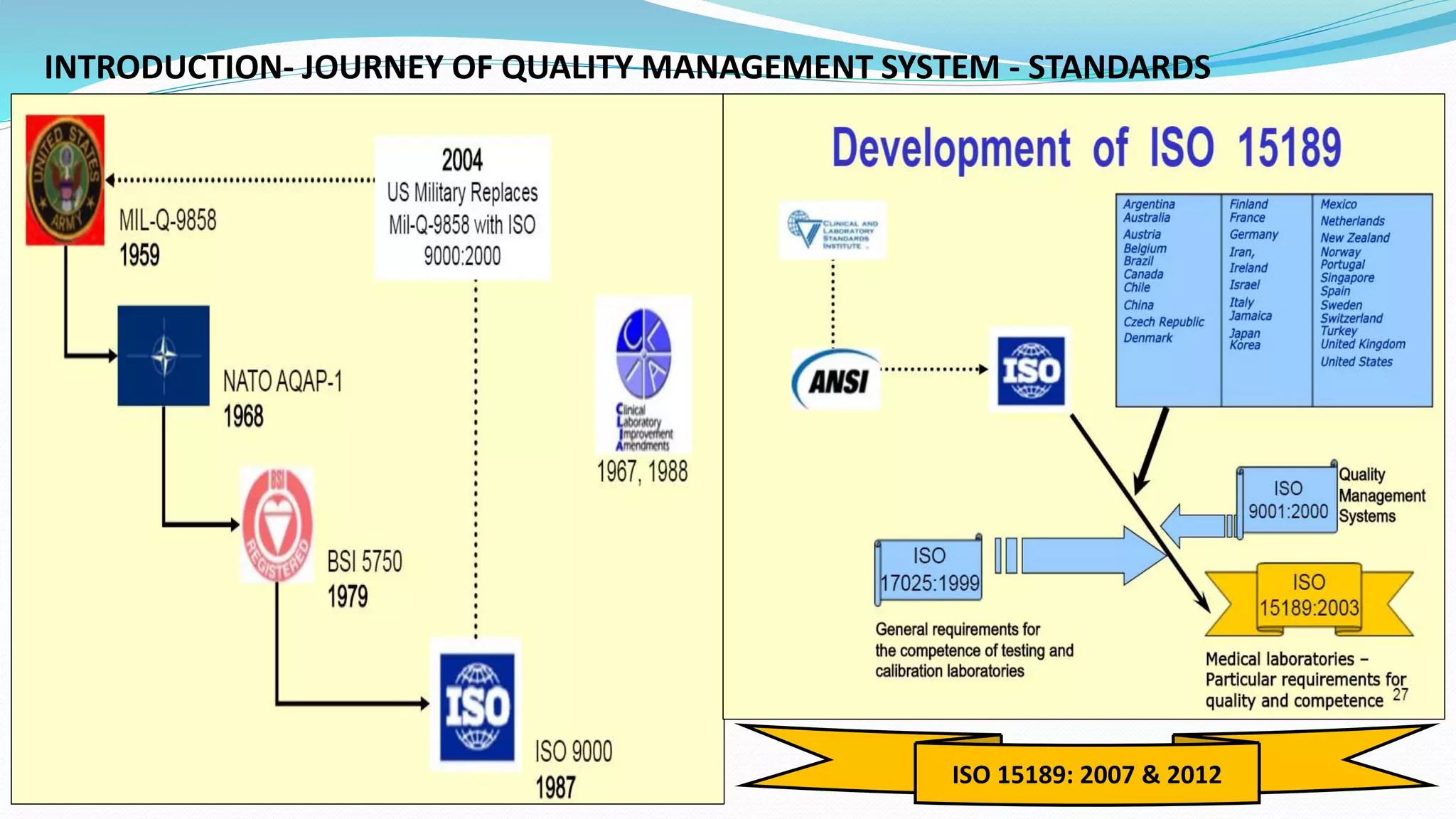
INTRODUCTION- JOURNEY OF QUALITY MANAGEMENT SYSTEM - STANDARDS
ISO 15189: 2007 & 2012
NABL
INRODUCTION- JOURNEY OF QUALITY MANAGEMENT SYSTEM – Individual Lab
Introduction- Why Quality for Individual Lab?
Consequences of Poor Quality-
 Inappropriate action
 Over-investigation
 Over-treatment
 Mistreatment
 Inappropriate inaction
 Lack of investigation
 No treatment
 Delayed action
 Loss of credibility of
laboratory
 Legal action
Objectives of Quality-
Support provision of high
quality healthcare
 Reduce morbidity
 Reduce mortality
 Reduce economic loss
 Ensure credibility of lab
 Error proof & Generate
confidence in lab results
 Consistency
 Accuracy
 Precision
 Right result
 First time
 Every time
 Invisible when GOOD
 Impossible to ignore when BAD
Laboratory Errors
Laboratory Errors
Sample Collection
 Anticoagulant of choice 3.8% or 3.2% Sodium
Citrate?
 3.2 % Preferred as the standard measure due
to stability and closeness to the plasma
osmolality
 Anticoagulant/blood ratio is critical (1:9)
 CLSI guideline is +/- 10 % of fill line
 Order of Draw- special emphasis in collections post
blood culture
Sample transport-
Separated citrated plasma at 2 to 6^C – upto 24hrs for
PT but within 4hrs for aPTT & other coagulation assays
OR frozen, ensure that specimen is not in direct contact
with ice.
Pre-preanalytical variables- Coagulation
9
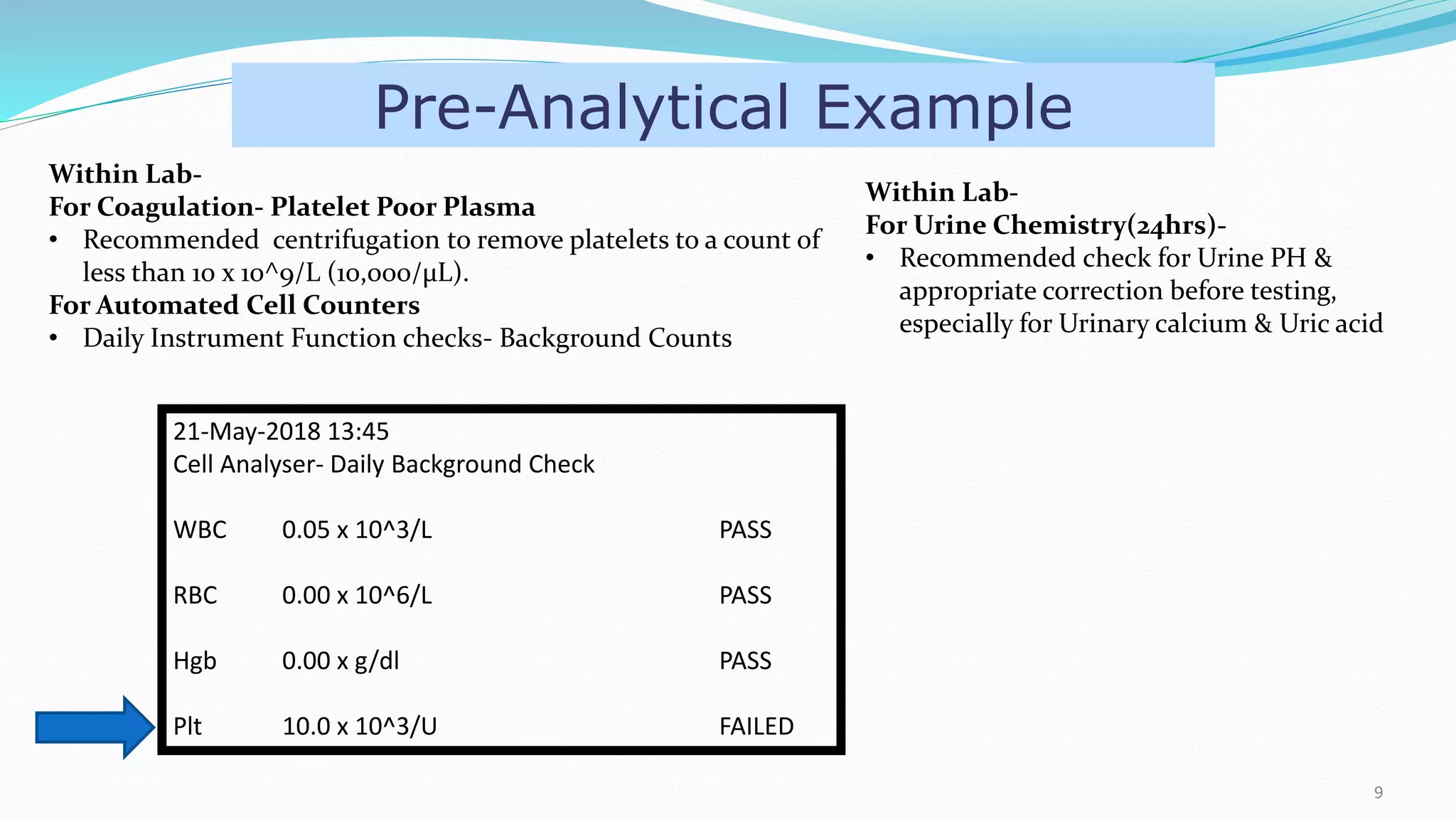
21-May-2018 13:45
Cell Analyser- Daily Background Check
WBC 0.05 x 10^3/L PASS
RBC 0.00 x 10^6/L PASS
Hgb 0.00 x g/dl PASS
Plt 10.0 x 10^3/U FAILED
Pre-Analytical Example
Within Lab-
For Coagulation- Platelet Poor Plasma
• Recommended centrifugation to remove platelets to a count of
less than 10 x 10^9/L (10,000/µL).
For Automated Cell Counters
• Daily Instrument Function checks- Background Counts
Within Lab-
For Urine Chemistry(24hrs)-
• Recommended check for Urine PH &
appropriate correction before testing,
especially for Urinary calcium & Uric acid
ANALYTICAL- QUALITY CONTROL PROGRAMME
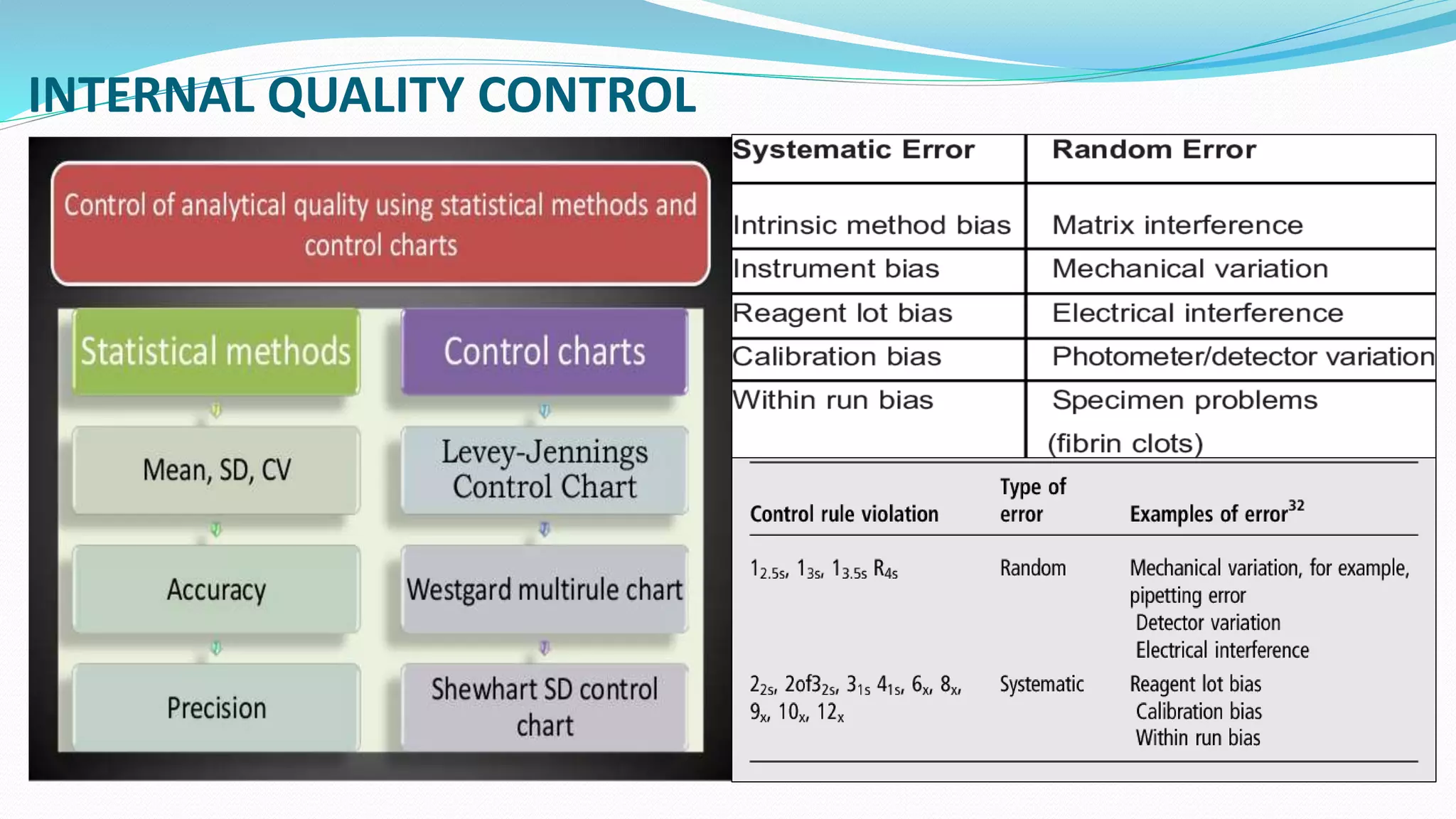
 It includes all QC methods which are performed every day by the laboratory personnel with the
laboratory’s materials and equipment. It checks primarily the precision (repeatability or
reproducibility) of the method.
INTERNAL QUALITY CONTROL
Test Calibration- Using company provided traceable
calibrators at defined frequency as per manufacturer & as
required following preventive maintenance or as part of
corrective action for IQC outlier
Control materials- are all the materials which can be used
for error detection in SQC methods.
• Control samples are pools of biological fluids (serum,
whole blood, urine or other materials) with known values
of analytes of interest.(Assayed controls)
• Guidelines recommendation to use Third Party Assayed
controls as far as possible.
• Before control samples are assayed for SQC methods,
each laboratory has to estimate their own control limits.
(Lab Mean & Lab SD)
• To Increase the stability of controls – they are lyophilized,
requiring reconstitution with diluent water (HPLC grade,
sterile), alliquoted & frozen(as applicable)
Instrument Calibration-
• For Analytical instruments- Use company
provided defined protocols & frequency
• For Non-Analytical instruments- like centrifuge &
pipettes- the frequency should twice yearly or more
as defined by laboratory
Instrument Maintenance-
Using company provided defined protocols &
frequency
Maintain log for daily, weekly, monthly instrument
function checks & periodic preventive maintenance as
per company defined protocol.
Guideline recommendations for Instrument Labels
mentioning- date of installation, date of calibration
(performed & due), date of preventive maintenance
(performed & due)
INTERNAL QUALITY CONTROL
• Patient Data as Alternate Quality Control-
- Correlation of test results Across patients-
- Trends in patient results
- Average of Normal
- Correlation of test results within same patient
- With clinical findings eg- ammonia levels
with altered sensorium
- With Other tests eg- BUN & creatinine
- With same test but alternate method eg-
Infectious Serology, Tumour markers
- Delta check- Reference Change Value (RCV) for
chemistry & immunoassay analytes based on
equation: RCV = 2½ × Z × [CVA
2 + CVI
2]½ where
Z=1.96, CVA is Analytical variance ,
CVI is intra-individual biological variance
Choice of External Quality Control Programme-
ISO 17043
• Accreditation of the PT provider
• Adequate PT event frequency and number of
samples
• Clinically relevant targets used in the PT
samples
• Faster PT results delivered.
• PT sample/analyte stability- liquid based /
lyophilised
• PT evaluation, often uses peer group means
which fails to identify systematic bias, in
cases with several instruments or methods,
which can have substantial implications for
quality of results & patient care.
Idealistic- Accuracy Based Surveys
• Cost effective
 PT samples must be tested along with the laboratory's regular patient sample.
 PT samples must be tested the same number of times that patients' samples
are tested routinely.
 Laboratories should not send PT samples to another laboratory for analysis.
 Laboratories must document all steps of processing for PT samples.
The NABL/CAP/NABH/JCI standards for handling proficiency testing
specimens are as follows:
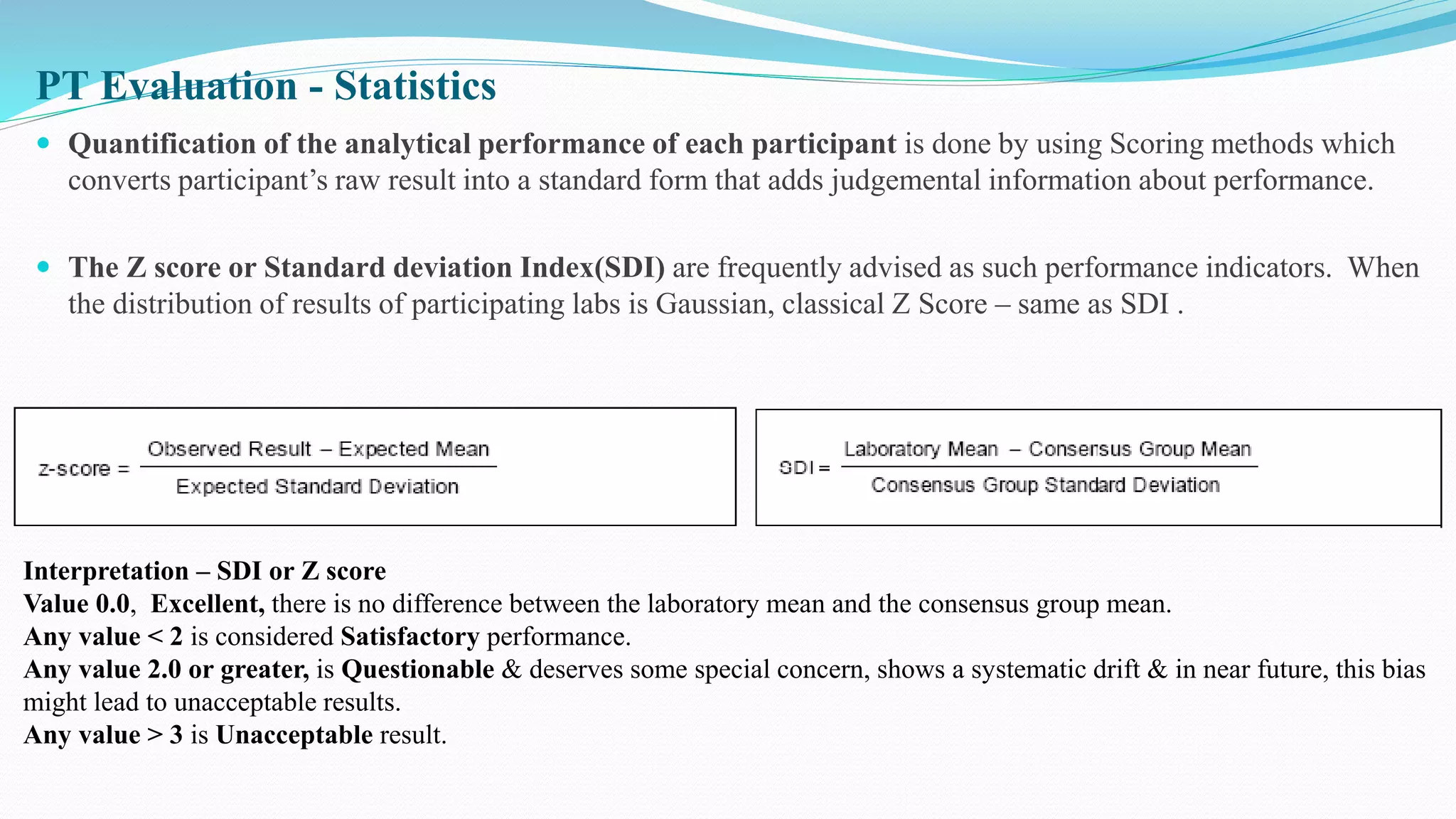
 Quantification of the analytical performance of each participant is done by using Scoring methods which
converts participant’s raw result into a standard form that adds judgemental information about performance.
 The Z score or Standard deviation Index(SDI) are frequently advised as such performance indicators. When
the distribution of results of participating labs is Gaussian, classical Z Score – same as SDI .
PT Evaluation - Statistics
Interpretation – SDI or Z score
Value 0.0, Excellent, there is no difference between the laboratory mean and the consensus group mean.
Any value < 2 is considered Satisfactory performance.
Any value 2.0 or greater, is Questionable & deserves some special concern, shows a systematic drift & in near future, this bias
might lead to unacceptable results.
Any value > 3 is Unacceptable result.
Step wise approach to resolve "Proficiency Testing" failure in clinical laboratory –
Step 1: Look for clerical, computer entry, or scanning errors
Step 2: Review Specimen Handling
Step 3: Review Testing Process
Step 4: Evaluate Test Kit/Instrument Performance
Step 5: Review Internal Quality Control
Step 6: Retesting of PT samples, depending on analyte stability or
perform interlaboratory comparison with patient samples
Step 7: Note Number of Samples Failing and any Patterns of
Failure- positive or negative trend.
PT Failure Evaluation – Algorithm -1
PT Failure Evaluation – Algorithm- 2 CAP-SDI
Source: CLSI EP-23A.
Root Cause Analysis for PT Outlier
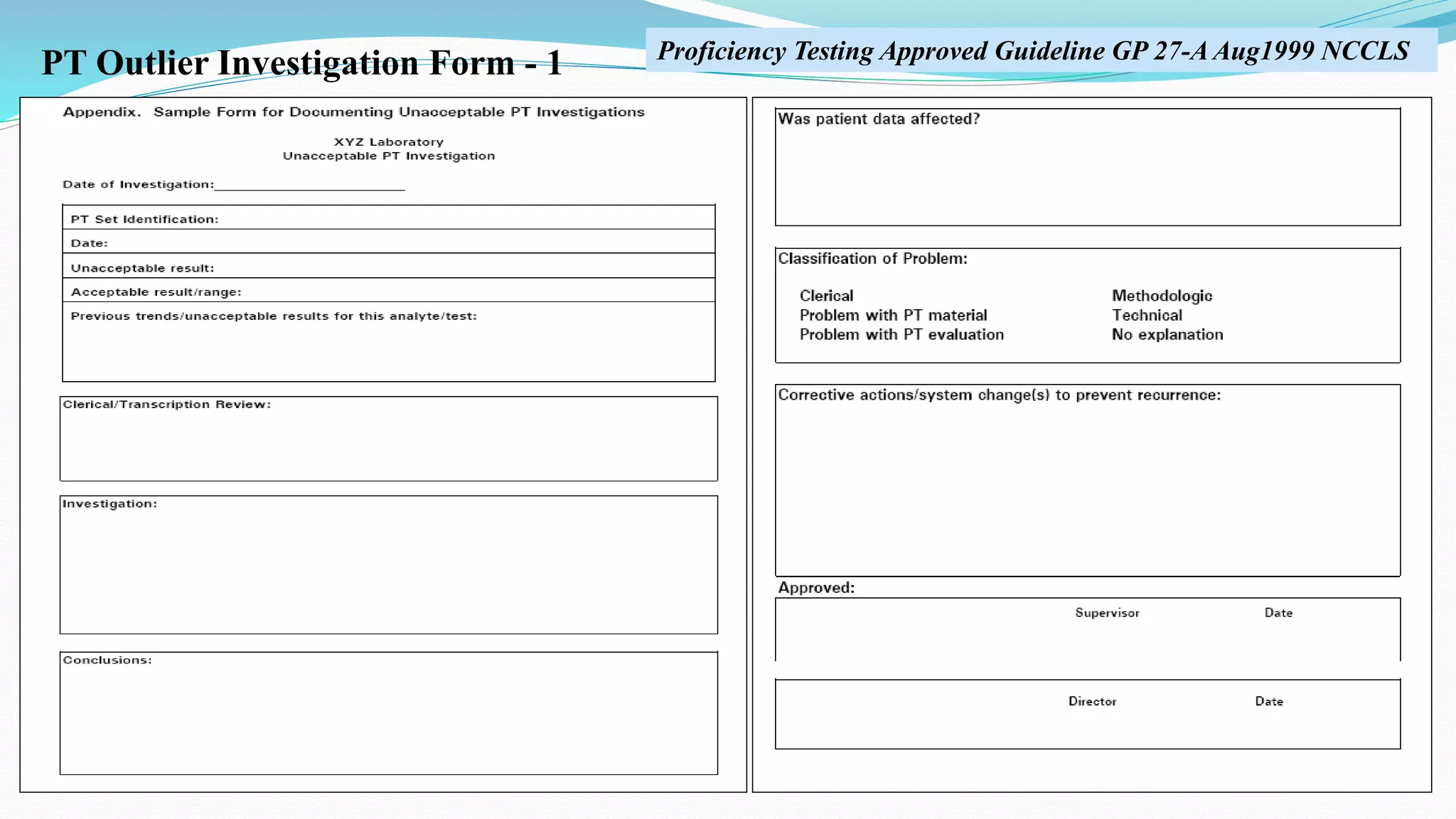
PT Outlier Investigation Form - 1 Proficiency Testing Approved Guideline GP 27-A Aug1999 NCCLS
PT Outlier Investigation Form - 2
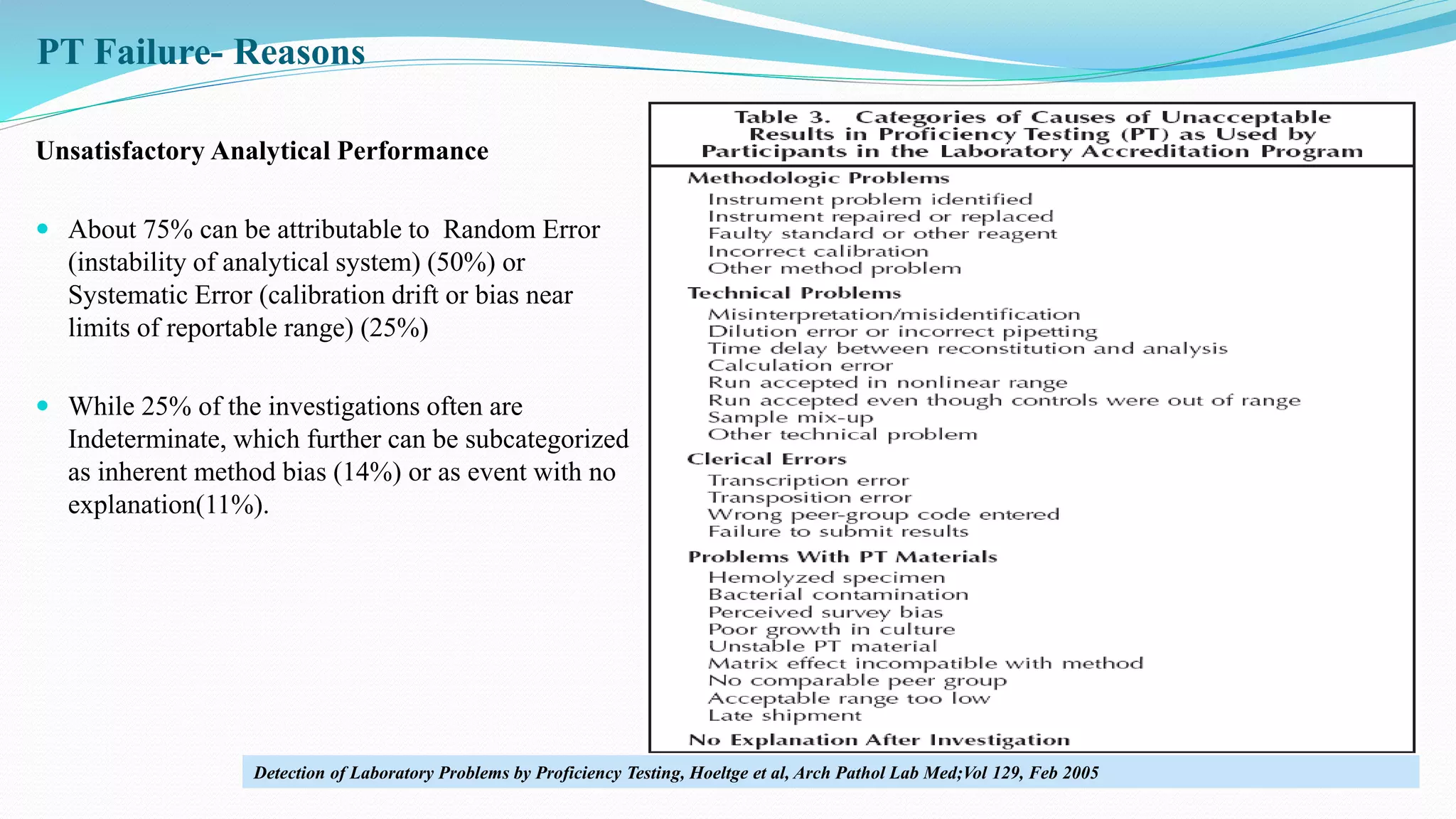
Unsatisfactory Analytical Performance
 About 75% can be attributable to Random Error
(instability of analytical system) (50%) or
Systematic Error (calibration drift or bias near
limits of reportable range) (25%)
 While 25% of the investigations often are
Indeterminate, which further can be subcategorized
as inherent method bias (14%) or as event with no
explanation(11%).
PT Failure- Reasons
Detection of Laboratory Problems by Proficiency Testing, Hoeltge et al, Arch Pathol Lab Med;Vol 129, Feb 2005
Proficiency Testing Monitoring by Accreditation Program
• Today’s competitive environment
leaves no room for error. This is why
six sigma quality must be a part of our
culture.
• What is six sigma- It is a process that
helps us focus on developing and
delivering near perfect products and
services.
• Sigma = (Tea – bias)/cv
Tea = tolerable error or allowable total
error (determined by CLIA, Ricos-2014)
Bias = inaccuracy, CV= imprecision
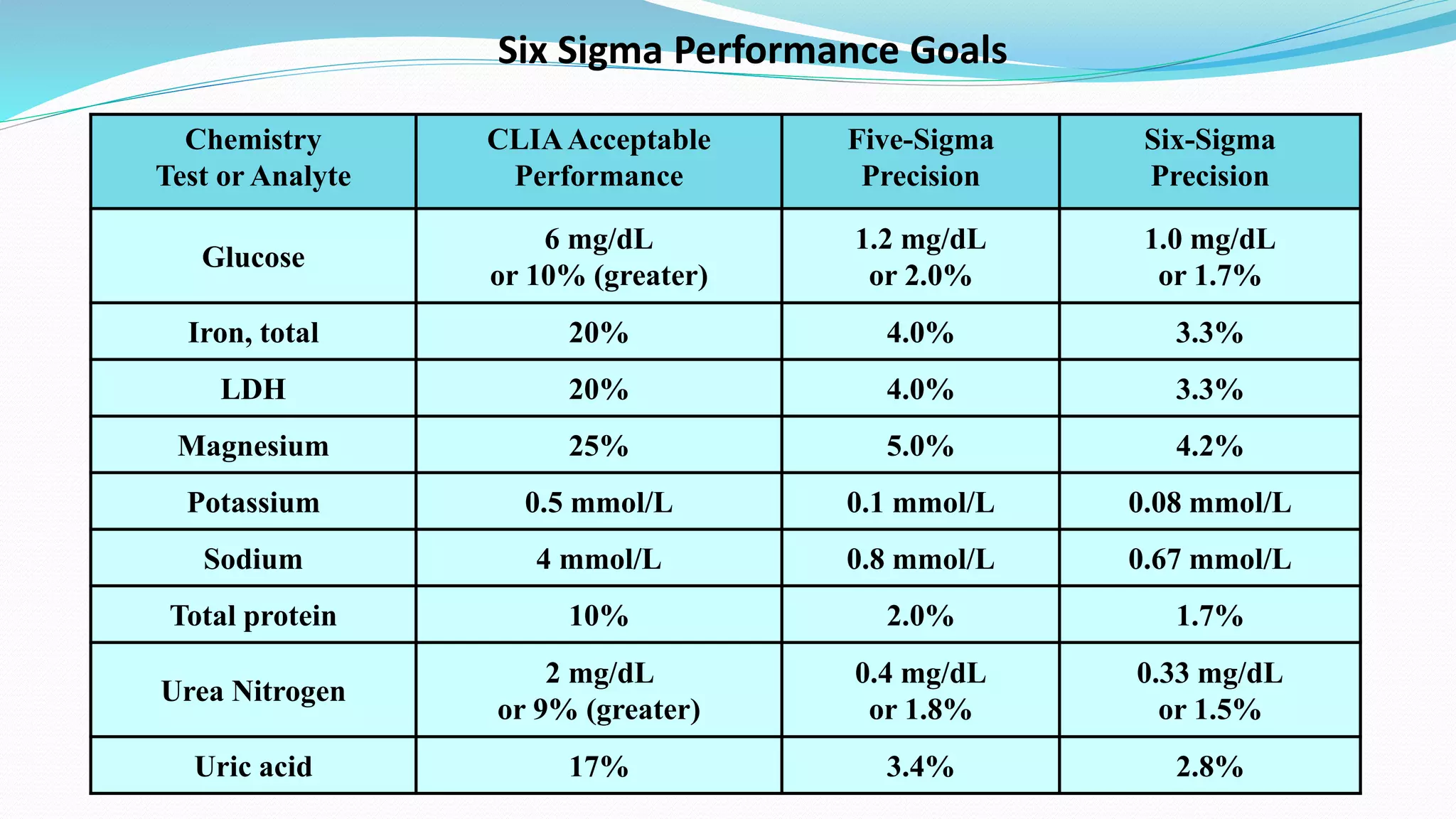
Six Sigma metrics- For Analytical Performance
Chemistry
Test or Analyte
CLIAAcceptable
Performance
Five-Sigma
Precision
Six-Sigma
Precision
Glucose
6 mg/dL
or 10% (greater)
1.2 mg/dL
or 2.0%
1.0 mg/dL
or 1.7%
Iron, total 20% 4.0% 3.3%
LDH 20% 4.0% 3.3%
Magnesium 25% 5.0% 4.2%
Potassium 0.5 mmol/L 0.1 mmol/L 0.08 mmol/L
Sodium 4 mmol/L 0.8 mmol/L 0.67 mmol/L
Total protein 10% 2.0% 1.7%
Urea Nitrogen
2 mg/dL
or 9% (greater)
0.4 mg/dL
or 1.8%
0.33 mg/dL
or 1.5%
Uric acid 17% 3.4% 2.8%
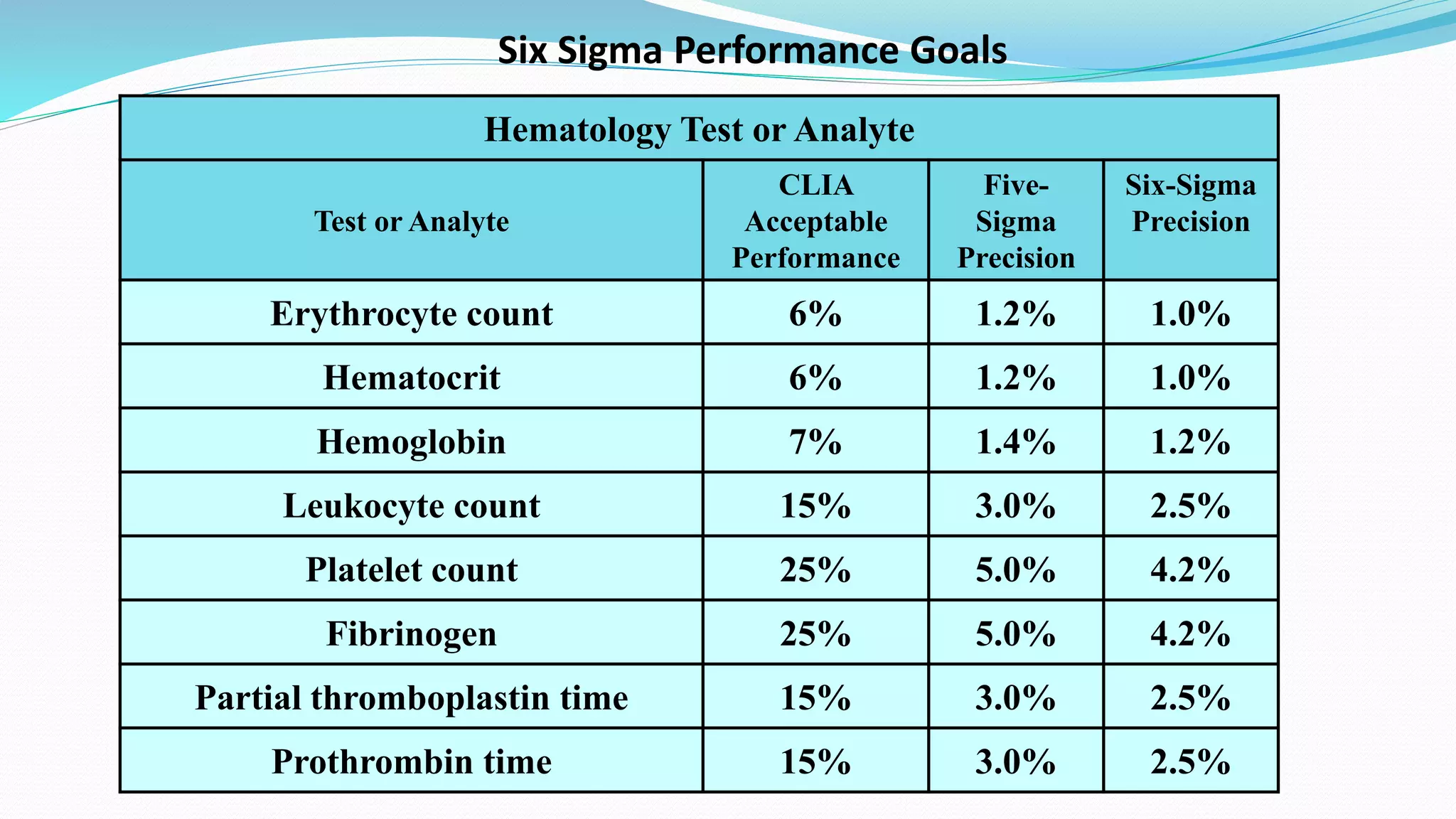
Six Sigma Performance Goals
Hematology Test or Analyte
Test or Analyte
CLIA
Acceptable
Performance
Five-
Sigma
Precision
Six-Sigma
Precision
Erythrocyte count 6% 1.2% 1.0%
Hematocrit 6% 1.2% 1.0%
Hemoglobin 7% 1.4% 1.2%
Leukocyte count 15% 3.0% 2.5%
Platelet count 25% 5.0% 4.2%
Fibrinogen 25% 5.0% 4.2%
Partial thromboplastin time 15% 3.0% 2.5%
Prothrombin time 15% 3.0% 2.5%
Six Sigma Performance Goals
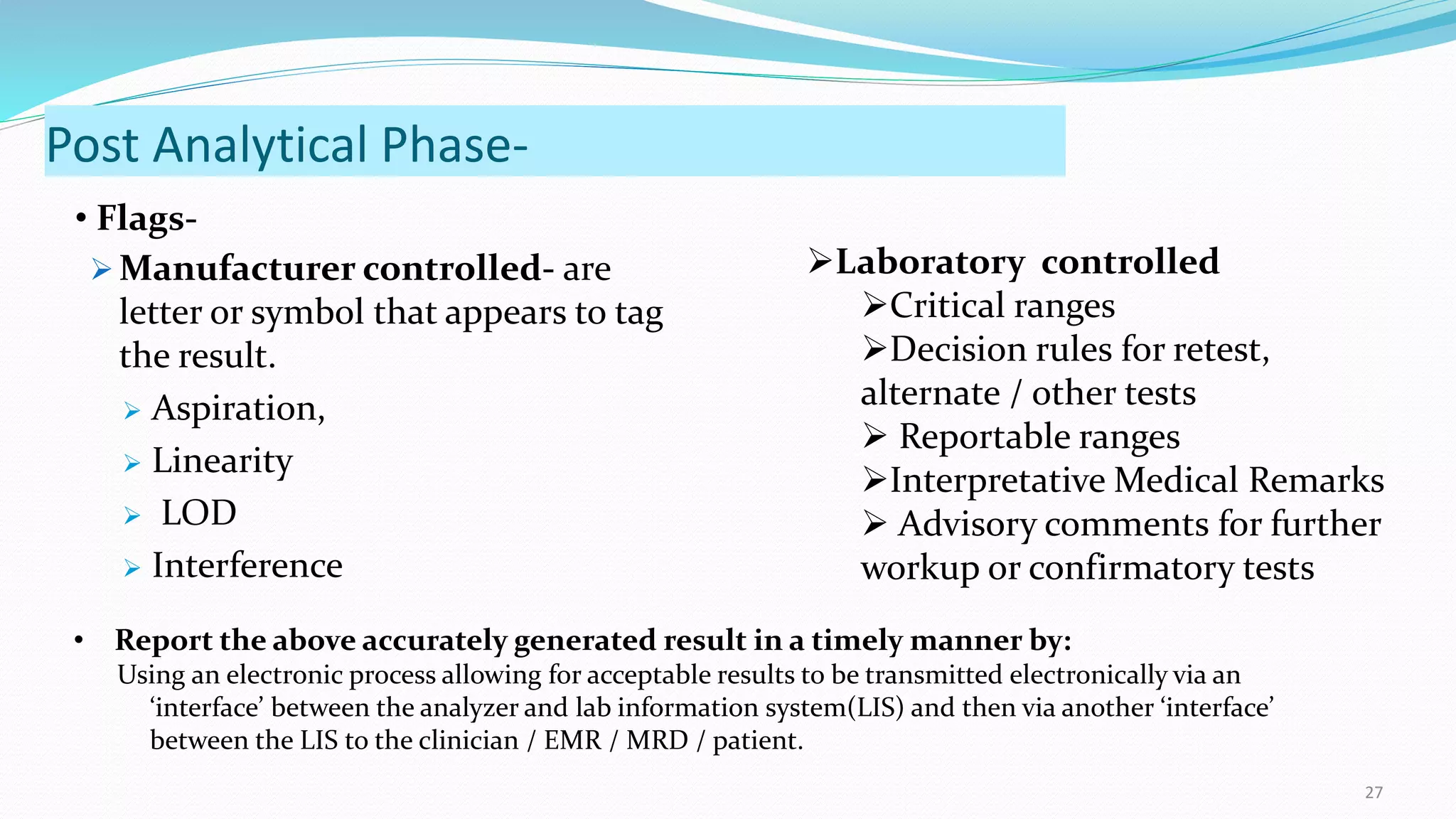
 Manufacturer controlled- are
letter or symbol that appears to tag
the result.
 Aspiration,
 Linearity
 LOD
 Interference
27
Post Analytical Phase-
Laboratory controlled
Critical ranges
Decision rules for retest,
alternate / other tests
 Reportable ranges
Interpretative Medical Remarks
 Advisory comments for further
workup or confirmatory tests
• Flags-
• Report the above accurately generated result in a timely manner by:
Using an electronic process allowing for acceptable results to be transmitted electronically via an
‘interface’ between the analyzer and lab information system(LIS) and then via another ‘interface’
between the LIS to the clinician / EMR / MRD / patient.
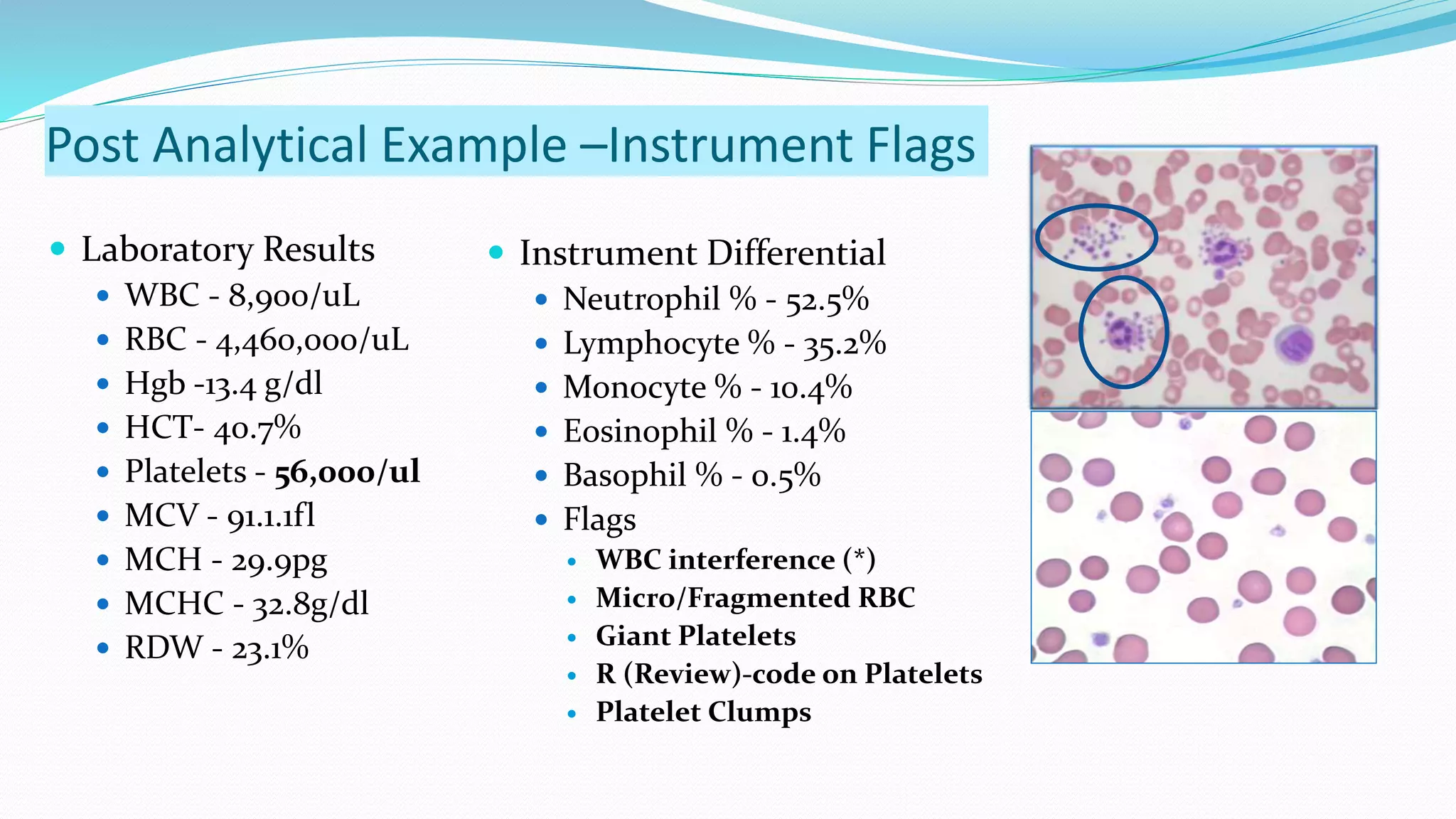
Post Analytical Example –Instrument Flags
 Laboratory Results
 WBC - 8,900/uL
 RBC - 4,460,000/uL
 Hgb -13.4 g/dl
 HCT- 40.7%
 Platelets - 56,000/ul
 MCV - 91.1.1fl
 MCH - 29.9pg
 MCHC - 32.8g/dl
 RDW - 23.1%
 Instrument Differential
 Neutrophil % - 52.5%
 Lymphocyte % - 35.2%
 Monocyte % - 10.4%
 Eosinophil % - 1.4%
 Basophil % - 0.5%
 Flags
 WBC interference (*)
 Micro/Fragmented RBC
 Giant Platelets
 R (Review)-code on Platelets
 Platelet Clumps
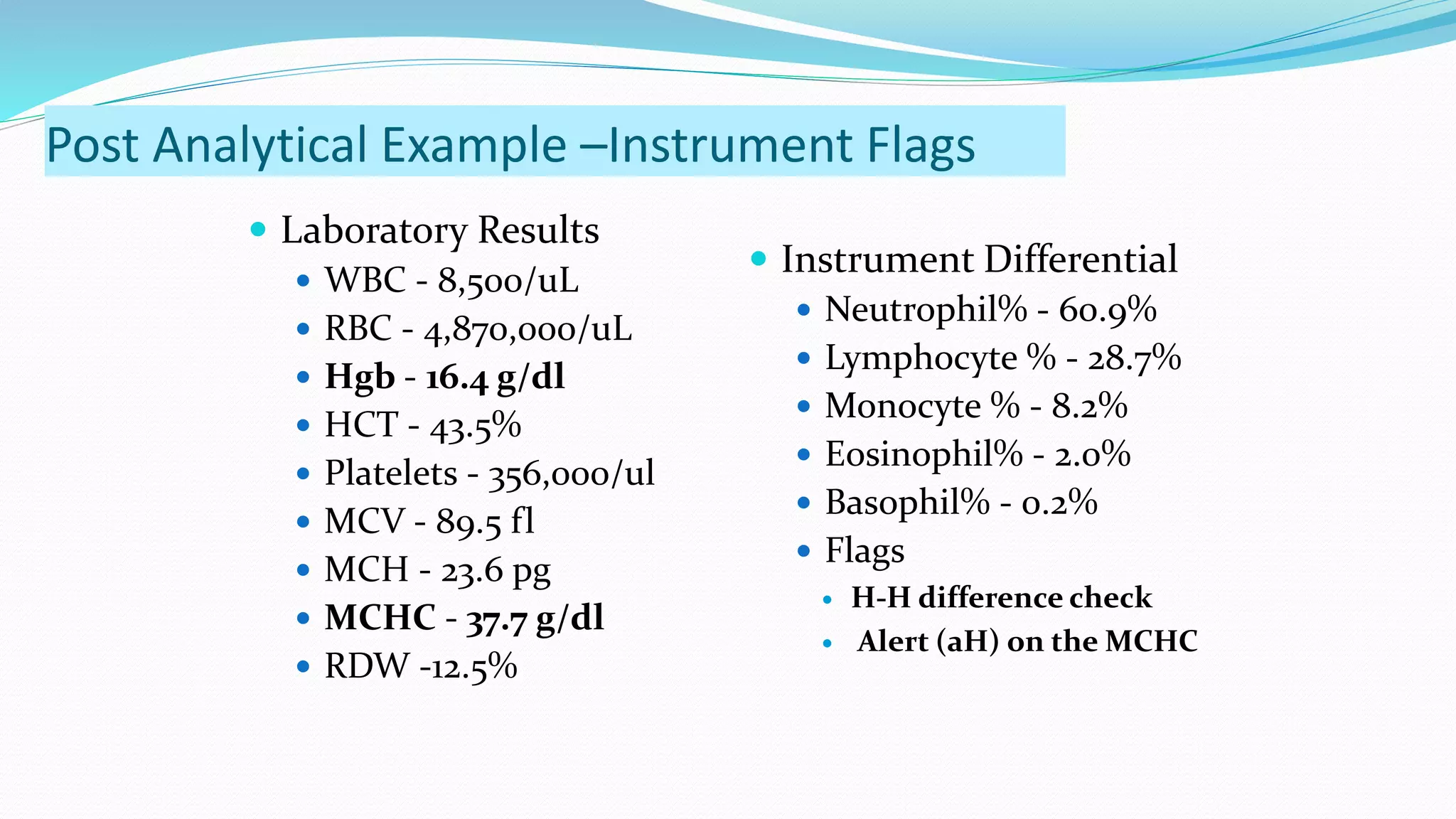
 Laboratory Results
 WBC - 8,500/uL
 RBC - 4,870,000/uL
 Hgb - 16.4 g/dl
 HCT - 43.5%
 Platelets - 356,000/ul
 MCV - 89.5 fl
 MCH - 23.6 pg
 MCHC - 37.7 g/dl
 RDW -12.5%
 Instrument Differential
 Neutrophil% - 60.9%
 Lymphocyte % - 28.7%
 Monocyte % - 8.2%
 Eosinophil% - 2.0%
 Basophil% - 0.2%
 Flags
 H-H difference check
 Alert (aH) on the MCHC
Post Analytical Example –Instrument Flags
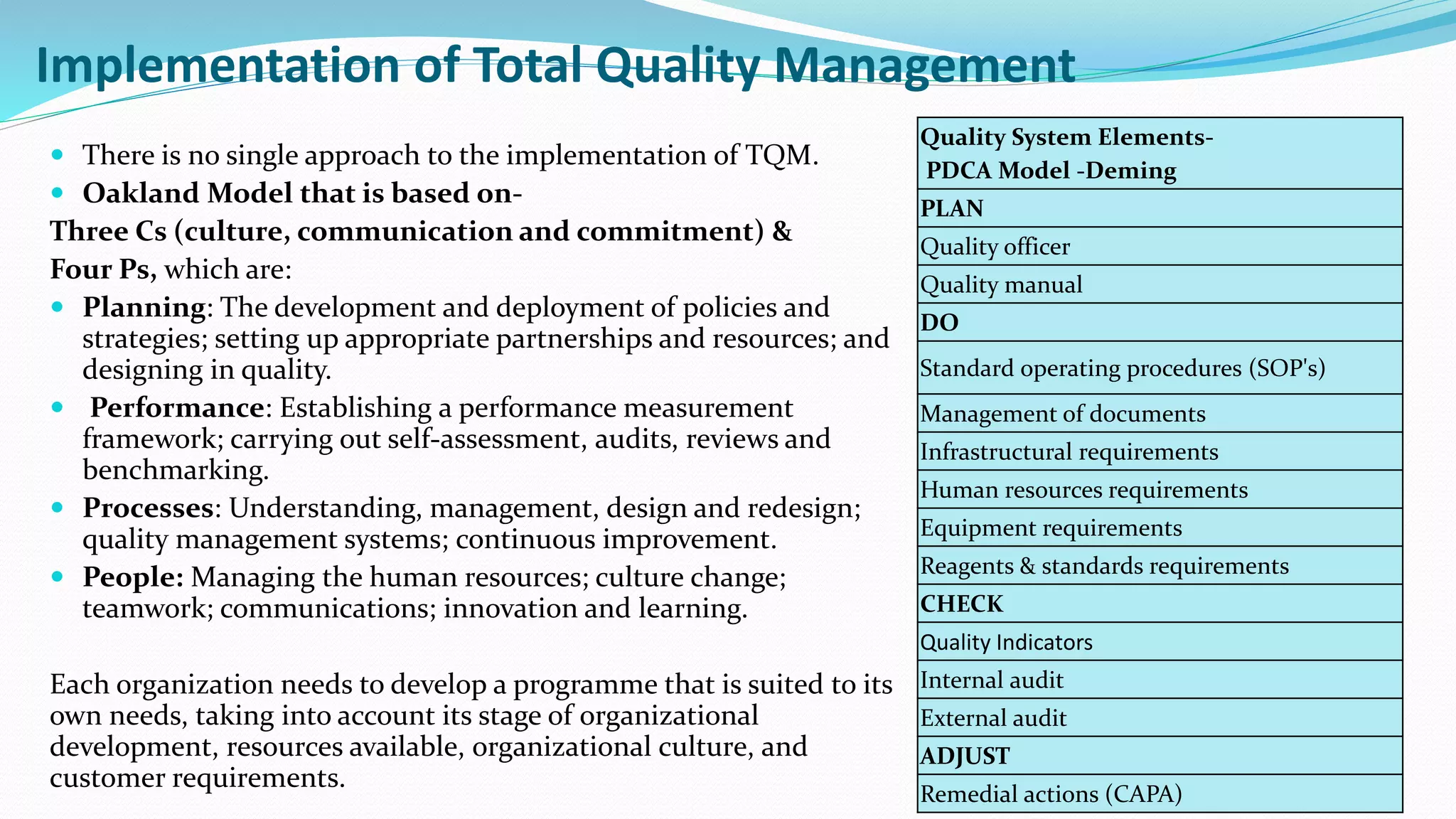
Implementation of Total Quality Management
 There is no single approach to the implementation of TQM.
 Oakland Model that is based on-
Three Cs (culture, communication and commitment) &
Four Ps, which are:
 Planning: The development and deployment of policies and
strategies; setting up appropriate partnerships and resources; and
designing in quality.
 Performance: Establishing a performance measurement
framework; carrying out self-assessment, audits, reviews and
benchmarking.
 Processes: Understanding, management, design and redesign;
quality management systems; continuous improvement.
 People: Managing the human resources; culture change;
teamwork; communications; innovation and learning.
Each organization needs to develop a programme that is suited to its
own needs, taking into account its stage of organizational
development, resources available, organizational culture, and
customer requirements.
Quality System Elements-
PDCA Model -Deming
PLAN
Quality officer
Quality manual
DO
Standard operating procedures (SOP's)
Management of documents
Infrastructural requirements
Human resources requirements
Equipment requirements
Reagents & standards requirements
CHECK
Quality Indicators
Internal audit
External audit
ADJUST
Remedial actions (CAPA)
31
Continuing
Education
Training
Job
Descriptions
Orientation
Competency
Assessment
Job
Qualifications
Personnel
Management
Orientation
Competency Assessment
Task-specific Training
Competency Recognition
Job Description
Qualified Technician/Doctor
Retraining
6monthly
for 1st year
& atleast
Annually
thereafter for all
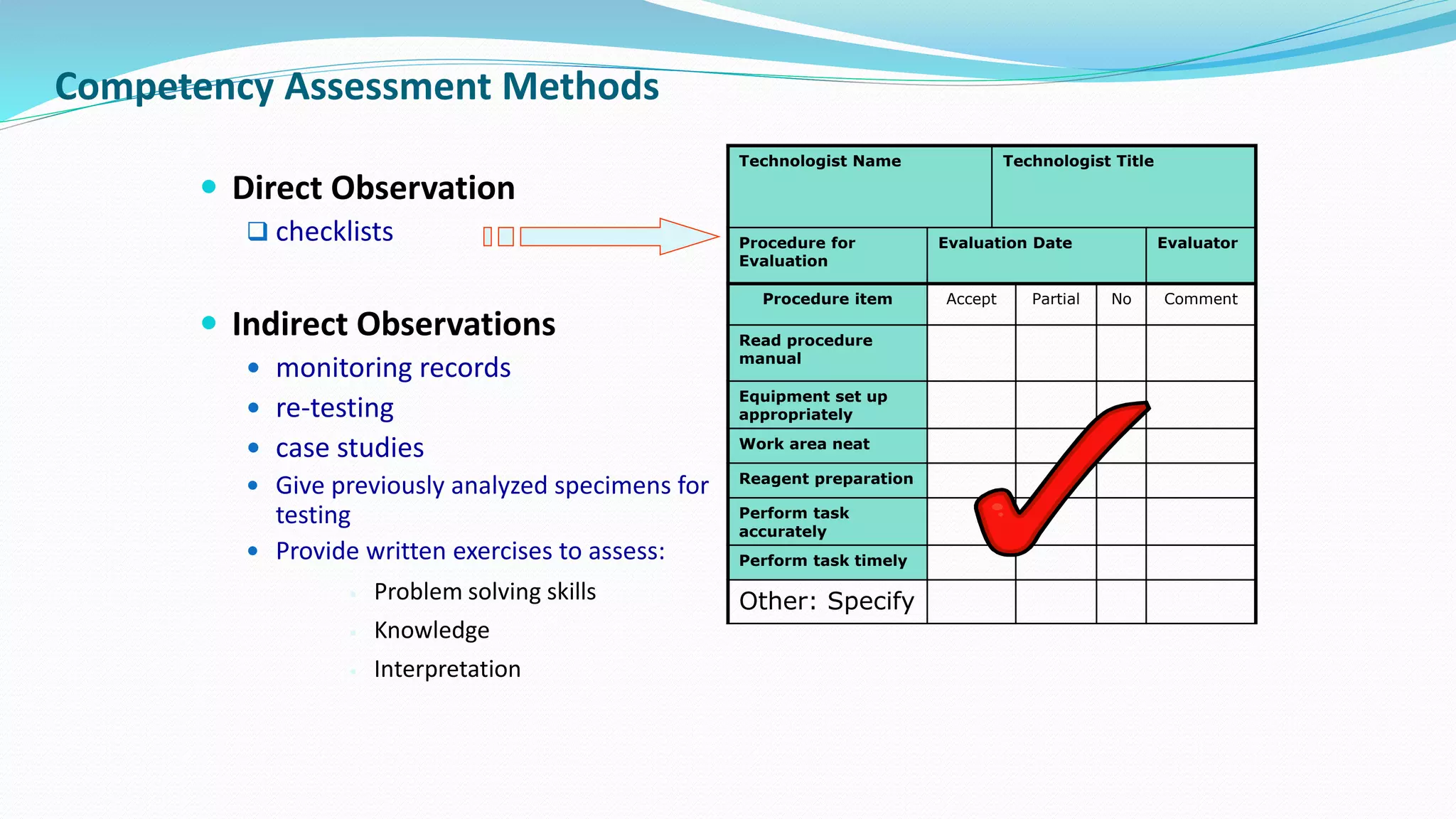
Competency Assessment Methods
 Direct Observation
 checklists
 Indirect Observations
 monitoring records
 re-testing
 case studies
 Give previously analyzed specimens for
testing
 Provide written exercises to assess:
• Problem solving skills
• Knowledge
• Interpretation
Technologist Name Technologist Title
Procedure for
Evaluation
Evaluation Date Evaluator
Procedure item Accept Partial No Comment
Read procedure
manual
Equipment set up
appropriately
Work area neat
Reagent preparation
Perform task
accurately
Perform task timely
Other: Specify
QUALITY AS LAB CULTURE- IS A REPORTING CULTURE-
As Quality Journey Continues……
Blame Culture Just Culture
Focus on Fault
Finding exercise
Focus on Process
& system
improvement
Lack/poor Quality
awareness at all
levels
Improved Quality
awareness at all
levels
Reactive Proactive
Decentrailized
quality leadership
centrailized
quality leadership
High COPQ Low COPQ
Compliance
Focussed
Best Practice
Focussed
Lab Centric Clinician/Patient
centric
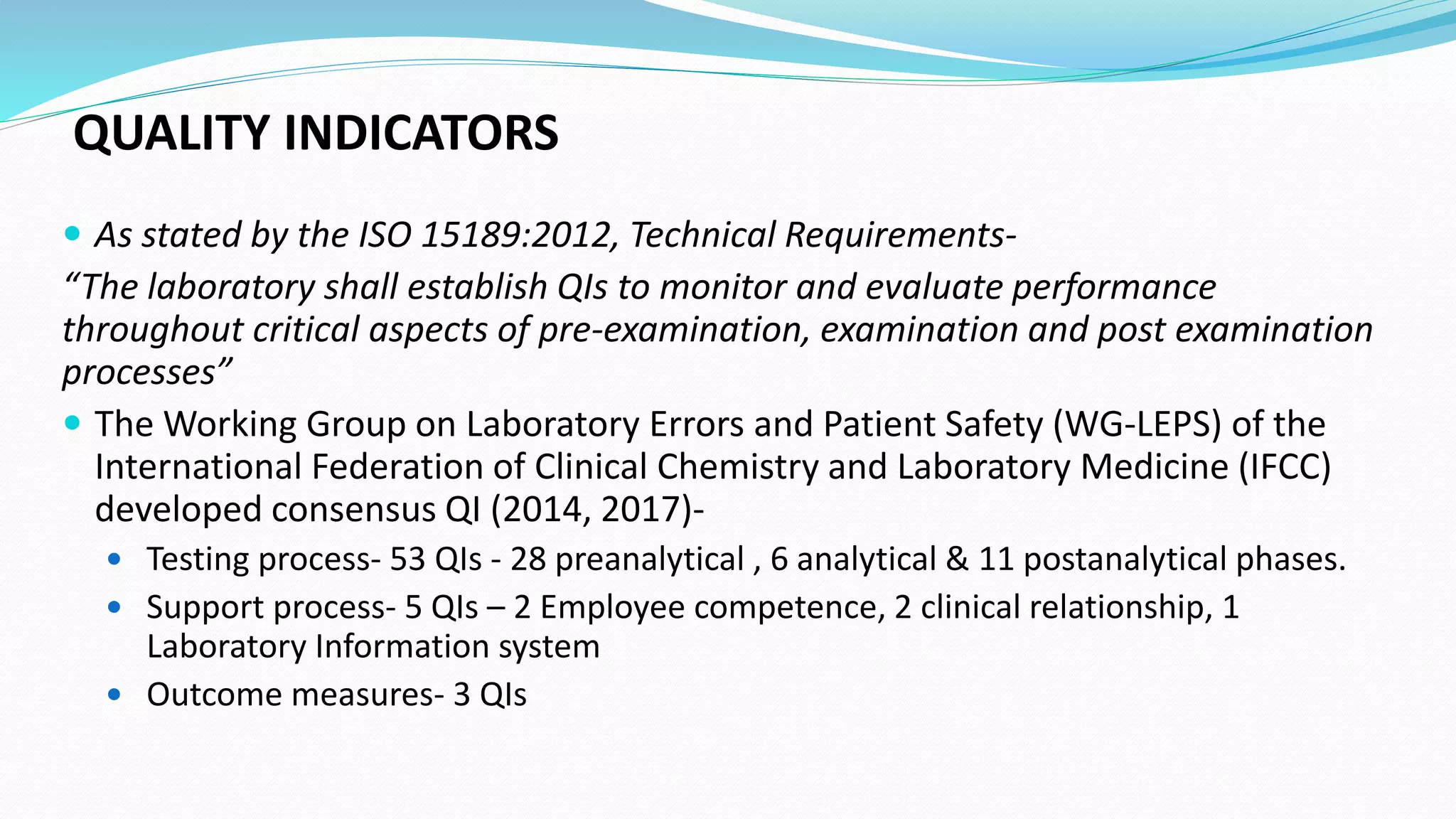
QUALITY INDICATORS
 As stated by the ISO 15189:2012, Technical Requirements-
“The laboratory shall establish QIs to monitor and evaluate performance
throughout critical aspects of pre-examination, examination and post examination
processes”
 The Working Group on Laboratory Errors and Patient Safety (WG-LEPS) of the
International Federation of Clinical Chemistry and Laboratory Medicine (IFCC)
developed consensus QI (2014, 2017)-
 Testing process- 53 QIs - 28 preanalytical , 6 analytical & 11 postanalytical phases.
 Support process- 5 QIs – 2 Employee competence, 2 clinical relationship, 1
Laboratory Information system
 Outcome measures- 3 QIs
QUALITY INDICATORS LABORATORY Bench Mark
TESTING PROCESS-
Pre Analytical Misidentification errors
Incorrect sample type
Incorrect sample quality- hemolysed, clotted,contaminated(Microbiology)
Inappropriate time in sample collection
0.08%
0.05%
1-2%
0.05%
Analytical Test with inappropriate/outlier IQC performances
Test uncovered by an EQA-PT control Performances
Unacceptable performances in EQA-PT schemes
2-3%
RCA compliance100%
RCA compliance 100%
Post Analytical Data transcription errors
Notification of critical values
Interpretative comments
Inappropriate turnaround times
0.02%
Time- within15mins 100%
Testwise compliance 100%
Testwise TAT compliance 95%
SUPPORT PROCESS-
Employee competence Training followed by competency assessment as per schedule 100%
Customer Satisfaction Surveys for both clinicians & patients RCA 100%
LIMS/IT Efficacy System Downtime, Interface errors No unplanned events
OUTCOME MEASURES-
Sample recollection Total including lab & clinician/patient reasons 2%
Incorrect laboratory reports Total including lab & clinician/patient reasons RCA compliance 100%
THANK YOU

Quality Control In Clinical Laboratory

  • 1.
    QUALITY CONTROL IN CLINICALLABORATORY DR RAJESH V BENDRE MD(PATH), DNB(PATH), DPB CHIEF PATHOLOGIST, HEAD LABORATORY & BLOOD BANK SERVICES JASLOK HOSPITAL & RESEARCH CENTER
  • 2.
  • 3.
    INTRODUCTION- JOURNEY OFQUALITY MANAGEMENT SYSTEM - STANDARDS ISO 15189: 2007 & 2012
  • 4.
    NABL INRODUCTION- JOURNEY OFQUALITY MANAGEMENT SYSTEM – Individual Lab
  • 5.
    Introduction- Why Qualityfor Individual Lab? Consequences of Poor Quality-  Inappropriate action  Over-investigation  Over-treatment  Mistreatment  Inappropriate inaction  Lack of investigation  No treatment  Delayed action  Loss of credibility of laboratory  Legal action Objectives of Quality- Support provision of high quality healthcare  Reduce morbidity  Reduce mortality  Reduce economic loss  Ensure credibility of lab  Error proof & Generate confidence in lab results  Consistency  Accuracy  Precision  Right result  First time  Every time  Invisible when GOOD  Impossible to ignore when BAD
  • 6.
  • 7.
  • 8.
    Sample Collection  Anticoagulantof choice 3.8% or 3.2% Sodium Citrate?  3.2 % Preferred as the standard measure due to stability and closeness to the plasma osmolality  Anticoagulant/blood ratio is critical (1:9)  CLSI guideline is +/- 10 % of fill line  Order of Draw- special emphasis in collections post blood culture Sample transport- Separated citrated plasma at 2 to 6^C – upto 24hrs for PT but within 4hrs for aPTT & other coagulation assays OR frozen, ensure that specimen is not in direct contact with ice. Pre-preanalytical variables- Coagulation
  • 9.
    9 21-May-2018 13:45 Cell Analyser-Daily Background Check WBC 0.05 x 10^3/L PASS RBC 0.00 x 10^6/L PASS Hgb 0.00 x g/dl PASS Plt 10.0 x 10^3/U FAILED Pre-Analytical Example Within Lab- For Coagulation- Platelet Poor Plasma • Recommended centrifugation to remove platelets to a count of less than 10 x 10^9/L (10,000/µL). For Automated Cell Counters • Daily Instrument Function checks- Background Counts Within Lab- For Urine Chemistry(24hrs)- • Recommended check for Urine PH & appropriate correction before testing, especially for Urinary calcium & Uric acid
  • 10.
  • 11.
     It includesall QC methods which are performed every day by the laboratory personnel with the laboratory’s materials and equipment. It checks primarily the precision (repeatability or reproducibility) of the method. INTERNAL QUALITY CONTROL Test Calibration- Using company provided traceable calibrators at defined frequency as per manufacturer & as required following preventive maintenance or as part of corrective action for IQC outlier Control materials- are all the materials which can be used for error detection in SQC methods. • Control samples are pools of biological fluids (serum, whole blood, urine or other materials) with known values of analytes of interest.(Assayed controls) • Guidelines recommendation to use Third Party Assayed controls as far as possible. • Before control samples are assayed for SQC methods, each laboratory has to estimate their own control limits. (Lab Mean & Lab SD) • To Increase the stability of controls – they are lyophilized, requiring reconstitution with diluent water (HPLC grade, sterile), alliquoted & frozen(as applicable) Instrument Calibration- • For Analytical instruments- Use company provided defined protocols & frequency • For Non-Analytical instruments- like centrifuge & pipettes- the frequency should twice yearly or more as defined by laboratory Instrument Maintenance- Using company provided defined protocols & frequency Maintain log for daily, weekly, monthly instrument function checks & periodic preventive maintenance as per company defined protocol. Guideline recommendations for Instrument Labels mentioning- date of installation, date of calibration (performed & due), date of preventive maintenance (performed & due)
  • 12.
  • 13.
    INTERNAL QUALITY CONTROL •Patient Data as Alternate Quality Control- - Correlation of test results Across patients- - Trends in patient results - Average of Normal - Correlation of test results within same patient - With clinical findings eg- ammonia levels with altered sensorium - With Other tests eg- BUN & creatinine - With same test but alternate method eg- Infectious Serology, Tumour markers - Delta check- Reference Change Value (RCV) for chemistry & immunoassay analytes based on equation: RCV = 2½ × Z × [CVA 2 + CVI 2]½ where Z=1.96, CVA is Analytical variance , CVI is intra-individual biological variance
  • 14.
    Choice of ExternalQuality Control Programme- ISO 17043 • Accreditation of the PT provider • Adequate PT event frequency and number of samples • Clinically relevant targets used in the PT samples • Faster PT results delivered. • PT sample/analyte stability- liquid based / lyophilised • PT evaluation, often uses peer group means which fails to identify systematic bias, in cases with several instruments or methods, which can have substantial implications for quality of results & patient care. Idealistic- Accuracy Based Surveys • Cost effective
  • 15.
     PT samplesmust be tested along with the laboratory's regular patient sample.  PT samples must be tested the same number of times that patients' samples are tested routinely.  Laboratories should not send PT samples to another laboratory for analysis.  Laboratories must document all steps of processing for PT samples. The NABL/CAP/NABH/JCI standards for handling proficiency testing specimens are as follows:
  • 16.
     Quantification ofthe analytical performance of each participant is done by using Scoring methods which converts participant’s raw result into a standard form that adds judgemental information about performance.  The Z score or Standard deviation Index(SDI) are frequently advised as such performance indicators. When the distribution of results of participating labs is Gaussian, classical Z Score – same as SDI . PT Evaluation - Statistics Interpretation – SDI or Z score Value 0.0, Excellent, there is no difference between the laboratory mean and the consensus group mean. Any value < 2 is considered Satisfactory performance. Any value 2.0 or greater, is Questionable & deserves some special concern, shows a systematic drift & in near future, this bias might lead to unacceptable results. Any value > 3 is Unacceptable result.
  • 17.
    Step wise approachto resolve "Proficiency Testing" failure in clinical laboratory – Step 1: Look for clerical, computer entry, or scanning errors Step 2: Review Specimen Handling Step 3: Review Testing Process Step 4: Evaluate Test Kit/Instrument Performance Step 5: Review Internal Quality Control Step 6: Retesting of PT samples, depending on analyte stability or perform interlaboratory comparison with patient samples Step 7: Note Number of Samples Failing and any Patterns of Failure- positive or negative trend. PT Failure Evaluation – Algorithm -1
  • 18.
    PT Failure Evaluation– Algorithm- 2 CAP-SDI
  • 19.
    Source: CLSI EP-23A. RootCause Analysis for PT Outlier
  • 20.
    PT Outlier InvestigationForm - 1 Proficiency Testing Approved Guideline GP 27-A Aug1999 NCCLS
  • 21.
  • 22.
    Unsatisfactory Analytical Performance About 75% can be attributable to Random Error (instability of analytical system) (50%) or Systematic Error (calibration drift or bias near limits of reportable range) (25%)  While 25% of the investigations often are Indeterminate, which further can be subcategorized as inherent method bias (14%) or as event with no explanation(11%). PT Failure- Reasons Detection of Laboratory Problems by Proficiency Testing, Hoeltge et al, Arch Pathol Lab Med;Vol 129, Feb 2005
  • 23.
    Proficiency Testing Monitoringby Accreditation Program
  • 24.
    • Today’s competitiveenvironment leaves no room for error. This is why six sigma quality must be a part of our culture. • What is six sigma- It is a process that helps us focus on developing and delivering near perfect products and services. • Sigma = (Tea – bias)/cv Tea = tolerable error or allowable total error (determined by CLIA, Ricos-2014) Bias = inaccuracy, CV= imprecision Six Sigma metrics- For Analytical Performance
  • 25.
    Chemistry Test or Analyte CLIAAcceptable Performance Five-Sigma Precision Six-Sigma Precision Glucose 6mg/dL or 10% (greater) 1.2 mg/dL or 2.0% 1.0 mg/dL or 1.7% Iron, total 20% 4.0% 3.3% LDH 20% 4.0% 3.3% Magnesium 25% 5.0% 4.2% Potassium 0.5 mmol/L 0.1 mmol/L 0.08 mmol/L Sodium 4 mmol/L 0.8 mmol/L 0.67 mmol/L Total protein 10% 2.0% 1.7% Urea Nitrogen 2 mg/dL or 9% (greater) 0.4 mg/dL or 1.8% 0.33 mg/dL or 1.5% Uric acid 17% 3.4% 2.8% Six Sigma Performance Goals
  • 26.
    Hematology Test orAnalyte Test or Analyte CLIA Acceptable Performance Five- Sigma Precision Six-Sigma Precision Erythrocyte count 6% 1.2% 1.0% Hematocrit 6% 1.2% 1.0% Hemoglobin 7% 1.4% 1.2% Leukocyte count 15% 3.0% 2.5% Platelet count 25% 5.0% 4.2% Fibrinogen 25% 5.0% 4.2% Partial thromboplastin time 15% 3.0% 2.5% Prothrombin time 15% 3.0% 2.5% Six Sigma Performance Goals
  • 27.
     Manufacturer controlled-are letter or symbol that appears to tag the result.  Aspiration,  Linearity  LOD  Interference 27 Post Analytical Phase- Laboratory controlled Critical ranges Decision rules for retest, alternate / other tests  Reportable ranges Interpretative Medical Remarks  Advisory comments for further workup or confirmatory tests • Flags- • Report the above accurately generated result in a timely manner by: Using an electronic process allowing for acceptable results to be transmitted electronically via an ‘interface’ between the analyzer and lab information system(LIS) and then via another ‘interface’ between the LIS to the clinician / EMR / MRD / patient.
  • 28.
    Post Analytical Example–Instrument Flags  Laboratory Results  WBC - 8,900/uL  RBC - 4,460,000/uL  Hgb -13.4 g/dl  HCT- 40.7%  Platelets - 56,000/ul  MCV - 91.1.1fl  MCH - 29.9pg  MCHC - 32.8g/dl  RDW - 23.1%  Instrument Differential  Neutrophil % - 52.5%  Lymphocyte % - 35.2%  Monocyte % - 10.4%  Eosinophil % - 1.4%  Basophil % - 0.5%  Flags  WBC interference (*)  Micro/Fragmented RBC  Giant Platelets  R (Review)-code on Platelets  Platelet Clumps
  • 29.
     Laboratory Results WBC - 8,500/uL  RBC - 4,870,000/uL  Hgb - 16.4 g/dl  HCT - 43.5%  Platelets - 356,000/ul  MCV - 89.5 fl  MCH - 23.6 pg  MCHC - 37.7 g/dl  RDW -12.5%  Instrument Differential  Neutrophil% - 60.9%  Lymphocyte % - 28.7%  Monocyte % - 8.2%  Eosinophil% - 2.0%  Basophil% - 0.2%  Flags  H-H difference check  Alert (aH) on the MCHC Post Analytical Example –Instrument Flags
  • 30.
    Implementation of TotalQuality Management  There is no single approach to the implementation of TQM.  Oakland Model that is based on- Three Cs (culture, communication and commitment) & Four Ps, which are:  Planning: The development and deployment of policies and strategies; setting up appropriate partnerships and resources; and designing in quality.  Performance: Establishing a performance measurement framework; carrying out self-assessment, audits, reviews and benchmarking.  Processes: Understanding, management, design and redesign; quality management systems; continuous improvement.  People: Managing the human resources; culture change; teamwork; communications; innovation and learning. Each organization needs to develop a programme that is suited to its own needs, taking into account its stage of organizational development, resources available, organizational culture, and customer requirements. Quality System Elements- PDCA Model -Deming PLAN Quality officer Quality manual DO Standard operating procedures (SOP's) Management of documents Infrastructural requirements Human resources requirements Equipment requirements Reagents & standards requirements CHECK Quality Indicators Internal audit External audit ADJUST Remedial actions (CAPA)
  • 31.
  • 32.
    Orientation Competency Assessment Task-specific Training CompetencyRecognition Job Description Qualified Technician/Doctor Retraining 6monthly for 1st year & atleast Annually thereafter for all
  • 33.
    Competency Assessment Methods Direct Observation  checklists  Indirect Observations  monitoring records  re-testing  case studies  Give previously analyzed specimens for testing  Provide written exercises to assess: • Problem solving skills • Knowledge • Interpretation Technologist Name Technologist Title Procedure for Evaluation Evaluation Date Evaluator Procedure item Accept Partial No Comment Read procedure manual Equipment set up appropriately Work area neat Reagent preparation Perform task accurately Perform task timely Other: Specify
  • 34.
    QUALITY AS LABCULTURE- IS A REPORTING CULTURE- As Quality Journey Continues…… Blame Culture Just Culture Focus on Fault Finding exercise Focus on Process & system improvement Lack/poor Quality awareness at all levels Improved Quality awareness at all levels Reactive Proactive Decentrailized quality leadership centrailized quality leadership High COPQ Low COPQ Compliance Focussed Best Practice Focussed Lab Centric Clinician/Patient centric
  • 35.
    QUALITY INDICATORS  Asstated by the ISO 15189:2012, Technical Requirements- “The laboratory shall establish QIs to monitor and evaluate performance throughout critical aspects of pre-examination, examination and post examination processes”  The Working Group on Laboratory Errors and Patient Safety (WG-LEPS) of the International Federation of Clinical Chemistry and Laboratory Medicine (IFCC) developed consensus QI (2014, 2017)-  Testing process- 53 QIs - 28 preanalytical , 6 analytical & 11 postanalytical phases.  Support process- 5 QIs – 2 Employee competence, 2 clinical relationship, 1 Laboratory Information system  Outcome measures- 3 QIs
  • 36.
    QUALITY INDICATORS LABORATORYBench Mark TESTING PROCESS- Pre Analytical Misidentification errors Incorrect sample type Incorrect sample quality- hemolysed, clotted,contaminated(Microbiology) Inappropriate time in sample collection 0.08% 0.05% 1-2% 0.05% Analytical Test with inappropriate/outlier IQC performances Test uncovered by an EQA-PT control Performances Unacceptable performances in EQA-PT schemes 2-3% RCA compliance100% RCA compliance 100% Post Analytical Data transcription errors Notification of critical values Interpretative comments Inappropriate turnaround times 0.02% Time- within15mins 100% Testwise compliance 100% Testwise TAT compliance 95% SUPPORT PROCESS- Employee competence Training followed by competency assessment as per schedule 100% Customer Satisfaction Surveys for both clinicians & patients RCA 100% LIMS/IT Efficacy System Downtime, Interface errors No unplanned events OUTCOME MEASURES- Sample recollection Total including lab & clinician/patient reasons 2% Incorrect laboratory reports Total including lab & clinician/patient reasons RCA compliance 100%
  • 37.