ByPRATIK P POLADIA
DEFINATION
An ongoing process that seeks to efficiently

achieve the objectives of a medical laboratory.
The objectives of a medical laboratory are
providing its customers (physicians on behalf of
patients) accurate answers which contribute to
clinical treatment”..
Lab manager
•
•
•

•

A good manager studies management as a daily
practice. The high-performance manager is:
A strategist: one who looks to the future.
A Problem solver: one who uses his factors under
his or her control to redirect the course of action to
achieve the organisation objectives
A teacher: One who guides and helps others to
identify and solves problems
LAB PLAN
• Each laboratory must have a strategic plan that describes its long-term

•

•
•
•

goals, such as a move toward more automation or any modern
diagnostic techniques.
Each employee’s role should be clearly defined, and written job
descriptions should be provided so personnel know what they are
expected to do. Therefore, it is a not an easy task for a manger to
strike a balance among the clinical laboratory regulations, fiscal
responsibility, and employee competence and morale to maintain the
overall quality of patient care.
it is appropriate to remember that the two most important
components of management are
common sense
open communication with laboratory staff
Lab DIRECTOR
He/She must be a physician or a doctoral scientist
qualified to assume professional , scientific , consultative ,
organizational , administrative , and educational
responsibility for the services offered by the lab .
•
If a non-pathologist physician or doctoral scientist
service as director , he/she must be qualified by virtue of
documented training ,expertise , and experience in areas of
analytic testing offered by the lab .
•
He/She must have sufficient training and experience in
clinical medicine , sciences basic to medicine , clinical lab
sciences
•
DUTIES
• The following directorial functions are :

1- interpretation , correlation , and communication of lab
data
2- interaction with physicians and/or medical staff , patient ,
administration .
3- monitoring of standard of performance , QC , QI.
4- provision of education programs , planning , research.
5- ensuring sufficient personnel with adequate documented
training and experience to meet the needs of the lab .
6- he/she must be decision-maker in the selection of all lab
equipments and supplies .
SUPERVISOR
Bachelor degree in chemical or clinical lab / medical

technology science with at least one year experience .

Is reponsible for day-to-day supervision of the lab

operation , as well as personnel performing testing
and reporting test results .
Quality Management System Definition
All aspects of the laboratory operation need to be

addressed to assure quality; this constitutes a quality
management system
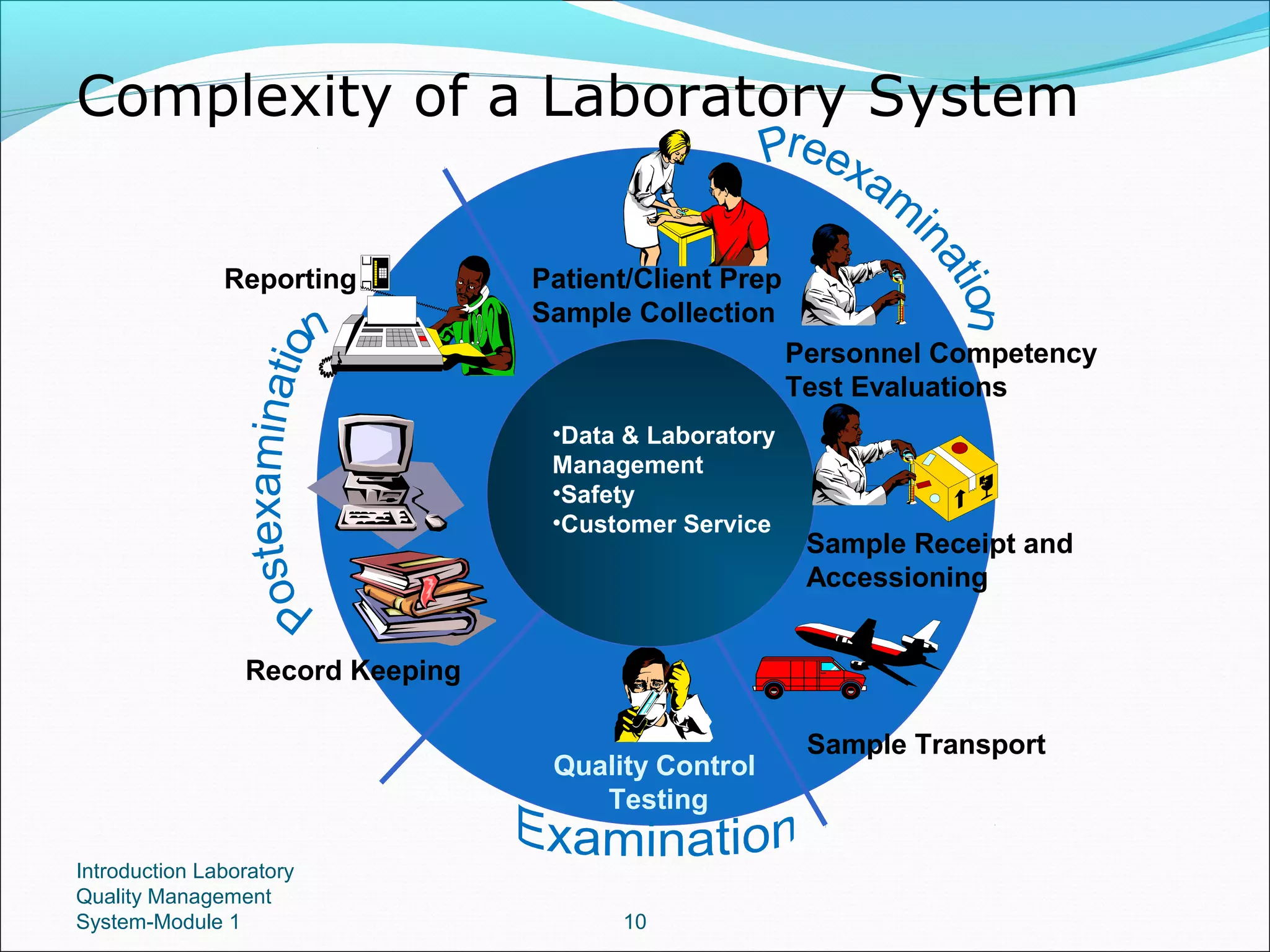
Complexity of a Laboratory System
Reporting

Patient/Client Prep
Sample Collection
Personnel Competency
Test Evaluations
•Data & Laboratory
Management
•Safety
•Customer Service

Sample Receipt and
Accessioning

Record Keeping
Quality Control
Testing
Introduction Laboratory
Quality Management
System-Module 1

10

Sample Transport
Why Medical Labs need Quality
Management

Medical Laboratories

Highly complex operations
Individuals doing complex tasks
Absolute need for Accuracy
Absolute need for Confidentiality
Absolute need for Time Effectiveness
Absolute need for Cost Effectiveness

January 2009

11
Path of Workflow
THE PATIENT

Test selection

Sample Collection

Preexamination Phase
Sample Transport

Laboratory Analysis
Examination Phase

Report Transport
Result Interpretation
Introduction Laboratory
Quality Management
System-Module 1

Report Creation

Postexamination Phase
12
Personnel
 human resources
 job qualifications
 job descriptions
 orientation
 training
 competency assessment
 professional development
 continuing education
Equipment
• acquisition
• installation
• validation
• maintenance
• calibration
• troubleshooting
• service and repair
• records
Purchasing and
Inventory
 vendor qualifications
 supplies and reagents
 critical services
 contract review
 inventory management
Process Control
 quality control
 sample management
 method validation
 method verification
Information Management
 confidentiality
 requisitions
 logs and records
 reports
 computerized laboratory

information systems (LIS)
Documents
creation
revisions and review
control and distribution

Introduction Laboratory
Quality Management
System-Module 1

18

Records
collection
review
storage
retention
Occurrence Management
 complaints
 mistakes and problems
 documentation
 root cause analysis
 immediate actions
 corrective actions
 preventive actions
Laboratory Assessment
Internal
Internal

External
Proficiency
testing (EQA)
Inspections
Accreditations

Introduction Laboratory
Quality Management
System-Module 1

20
Process Improvement
 opportunities for improvement (OFIs)
 stakeholder feedback
 problem resolution
 risk assessment
 preventive actions
 corrective actions
Customer Service
 customer group identification
 customer needs
 customer feedback
Facilities and Safety
 safe working environment
 transport management
 security
 containment
 waste management
 laboratory safety
 ergonomics
Implementing
Quality Management
does not
guarantee
an
ERROR-FREE
Laboratory

But it detects
errors that may
occur and
prevents them
from recurring

Introduction Laboratory Quality Management
System-Module 1

24
Laboratory errors cost in
time

personnel
effort

patient
outcomes

Introduction Laboratory Quality Management
System-Module 1

25
ECONOMY MANAGEMENT
Economic model may be used to improve business
performance of laboratories by
removing weaknesses,
minimizing threats,
 using external opportunities and
internal strengths.

Introduction Laboratory Quality Management
System-Module 1

26
INTERNAL /EXTERNAL FACTORS
Strength and Weaknesses refer to internal

characteristics of a clinical laboratory, whereas
Opportunities and Threats are external factors

Introduction Laboratory Quality Management
System-Module 1

27
Introduction Laboratory Quality Management
System-Module 1

28
STRENGTHS & WEAKNESS
Strengths describe advantages of the laboratory in

comparison with other similar laboratories in the
same geographical region.
Weaknesses refer to shortcomings in the work of
laboratory and removing the weaknesses would create
new opportunities that could improve the quality of
workand, consequently, increase profitability.

Introduction Laboratory Quality Management
System-Module 1

29
OPPORTUNITIES & THREATS
 Opportunities refer to conditions in the laboratory

that may lead to the improvement in business
operations.
Threats represent conditions that may lead to
difficulties in business operations

Introduction Laboratory Quality Management
System-Module 1

30
PROFIT OF LAB
The operating profit as a measure of profitability of

the clinical laboratory was defined as
total revenue minus total expenses

Introduction Laboratory Quality Management
System-Module 1

31
HOW?
Quality Management and good work organization

aimed at achieving a continuous improvement in preanalytical ,analytical, and post-analytical phases are
part of a good laboratory practice

32
CONT…..
Successful quality management in a clinical

laboratory setting reduces both the
need to repeat tests and
raw material consumption,
Leading to increased business effectiveness.

Introduction Laboratory Quality Management
System-Module 1

33
CONCLUSION
The fact that making profit is not the primary

function of the health system.
 Every health department should have basic
knowledge of economic principles and their
application.

Introduction Laboratory Quality Management
System-Module 1

34

Lab management

  • 1.
  • 2.
    DEFINATION An ongoing processthat seeks to efficiently achieve the objectives of a medical laboratory. The objectives of a medical laboratory are providing its customers (physicians on behalf of patients) accurate answers which contribute to clinical treatment”..
  • 3.
    Lab manager • • • • A goodmanager studies management as a daily practice. The high-performance manager is: A strategist: one who looks to the future. A Problem solver: one who uses his factors under his or her control to redirect the course of action to achieve the organisation objectives A teacher: One who guides and helps others to identify and solves problems
  • 4.
    LAB PLAN • Eachlaboratory must have a strategic plan that describes its long-term • • • • goals, such as a move toward more automation or any modern diagnostic techniques. Each employee’s role should be clearly defined, and written job descriptions should be provided so personnel know what they are expected to do. Therefore, it is a not an easy task for a manger to strike a balance among the clinical laboratory regulations, fiscal responsibility, and employee competence and morale to maintain the overall quality of patient care. it is appropriate to remember that the two most important components of management are common sense open communication with laboratory staff
  • 5.
    Lab DIRECTOR He/She mustbe a physician or a doctoral scientist qualified to assume professional , scientific , consultative , organizational , administrative , and educational responsibility for the services offered by the lab . • If a non-pathologist physician or doctoral scientist service as director , he/she must be qualified by virtue of documented training ,expertise , and experience in areas of analytic testing offered by the lab . • He/She must have sufficient training and experience in clinical medicine , sciences basic to medicine , clinical lab sciences •
  • 6.
    DUTIES • The followingdirectorial functions are : 1- interpretation , correlation , and communication of lab data 2- interaction with physicians and/or medical staff , patient , administration . 3- monitoring of standard of performance , QC , QI. 4- provision of education programs , planning , research. 5- ensuring sufficient personnel with adequate documented training and experience to meet the needs of the lab . 6- he/she must be decision-maker in the selection of all lab equipments and supplies .
  • 7.
    SUPERVISOR Bachelor degree inchemical or clinical lab / medical technology science with at least one year experience . Is reponsible for day-to-day supervision of the lab operation , as well as personnel performing testing and reporting test results .
  • 9.
    Quality Management SystemDefinition All aspects of the laboratory operation need to be addressed to assure quality; this constitutes a quality management system
  • 10.
    Complexity of aLaboratory System Reporting Patient/Client Prep Sample Collection Personnel Competency Test Evaluations •Data & Laboratory Management •Safety •Customer Service Sample Receipt and Accessioning Record Keeping Quality Control Testing Introduction Laboratory Quality Management System-Module 1 10 Sample Transport
  • 11.
    Why Medical Labsneed Quality Management  Medical Laboratories Highly complex operations Individuals doing complex tasks Absolute need for Accuracy Absolute need for Confidentiality Absolute need for Time Effectiveness Absolute need for Cost Effectiveness January 2009 11
  • 12.
    Path of Workflow THEPATIENT Test selection Sample Collection Preexamination Phase Sample Transport Laboratory Analysis Examination Phase Report Transport Result Interpretation Introduction Laboratory Quality Management System-Module 1 Report Creation Postexamination Phase 12
  • 13.
    Personnel  human resources job qualifications  job descriptions  orientation  training  competency assessment  professional development  continuing education
  • 14.
    Equipment • acquisition • installation •validation • maintenance • calibration • troubleshooting • service and repair • records
  • 15.
    Purchasing and Inventory  vendorqualifications  supplies and reagents  critical services  contract review  inventory management
  • 16.
    Process Control  qualitycontrol  sample management  method validation  method verification
  • 17.
    Information Management  confidentiality requisitions  logs and records  reports  computerized laboratory information systems (LIS)
  • 18.
    Documents creation revisions and review controland distribution Introduction Laboratory Quality Management System-Module 1 18 Records collection review storage retention
  • 19.
    Occurrence Management  complaints mistakes and problems  documentation  root cause analysis  immediate actions  corrective actions  preventive actions
  • 20.
  • 21.
    Process Improvement  opportunitiesfor improvement (OFIs)  stakeholder feedback  problem resolution  risk assessment  preventive actions  corrective actions
  • 22.
    Customer Service  customergroup identification  customer needs  customer feedback
  • 23.
    Facilities and Safety safe working environment  transport management  security  containment  waste management  laboratory safety  ergonomics
  • 24.
    Implementing Quality Management does not guarantee an ERROR-FREE Laboratory Butit detects errors that may occur and prevents them from recurring Introduction Laboratory Quality Management System-Module 1 24
  • 25.
    Laboratory errors costin time personnel effort patient outcomes Introduction Laboratory Quality Management System-Module 1 25
  • 26.
    ECONOMY MANAGEMENT Economic modelmay be used to improve business performance of laboratories by removing weaknesses, minimizing threats,  using external opportunities and internal strengths. Introduction Laboratory Quality Management System-Module 1 26
  • 27.
    INTERNAL /EXTERNAL FACTORS Strengthand Weaknesses refer to internal characteristics of a clinical laboratory, whereas Opportunities and Threats are external factors Introduction Laboratory Quality Management System-Module 1 27
  • 28.
    Introduction Laboratory QualityManagement System-Module 1 28
  • 29.
    STRENGTHS & WEAKNESS Strengthsdescribe advantages of the laboratory in comparison with other similar laboratories in the same geographical region. Weaknesses refer to shortcomings in the work of laboratory and removing the weaknesses would create new opportunities that could improve the quality of workand, consequently, increase profitability. Introduction Laboratory Quality Management System-Module 1 29
  • 30.
    OPPORTUNITIES & THREATS Opportunities refer to conditions in the laboratory that may lead to the improvement in business operations. Threats represent conditions that may lead to difficulties in business operations Introduction Laboratory Quality Management System-Module 1 30
  • 31.
    PROFIT OF LAB Theoperating profit as a measure of profitability of the clinical laboratory was defined as total revenue minus total expenses Introduction Laboratory Quality Management System-Module 1 31
  • 32.
    HOW? Quality Management andgood work organization aimed at achieving a continuous improvement in preanalytical ,analytical, and post-analytical phases are part of a good laboratory practice 32
  • 33.
    CONT….. Successful quality managementin a clinical laboratory setting reduces both the need to repeat tests and raw material consumption, Leading to increased business effectiveness. Introduction Laboratory Quality Management System-Module 1 33
  • 34.
    CONCLUSION The fact thatmaking profit is not the primary function of the health system.  Every health department should have basic knowledge of economic principles and their application. Introduction Laboratory Quality Management System-Module 1 34

Editor's Notes