
PRE-ANALYTICAL QUALITY CONTROL
PRACTICES
IN CLINICAL LABORATORY
DR RAJESH V BENDRE
MD(PATH), DNB(PATH), DPB
Introduction- what is Quality?
Introduction- Why Quality for Individual Lab?
Consequences of Poor Quality-
 Inappropriate action
 Over-investigation
 Over-treatment
 Mistreatment
 Inappropriate inaction
 Lack of investigation
 No treatment
 Delayed action
 Loss of credibility of
laboratory
 Legal action
Objectives of Quality-
Support provision of high
quality healthcare
 Reduce morbidity
 Reduce mortality
 Reduce economic loss
 Ensure credibility of lab
 Error proof & Generate
confidence in lab results
 Consistency
 Accuracy
 Precision
 Right result
 First time
 Every time
 Invisible when GOOD
 Impossible to ignore when BAD
Laboratory Errors
Laboratory Errors
 Patient Identification: It is
important to identify a patient
accurately so that blood is
collected from the correct
person. Drawing blood from the
wrong person, or labeling the
correct patient’s sample with a
different patient’s label can
certainly contribute to laboratory
error. (Mislabeling ???)
Effects of Pre-analytical Variables on the Quality of
Laboratory Testing
 Patient Preparation: Prior to
collecting specimens for chemistry,
certain patient variables need to be
considered. For certain chemistry
analytes, such as glucose and
cholesterol, patients need to be fasting
for at least 12 hours prior to
venipuncture. Other analytes, such as
cortisol and adrenocorticotropin, have
diurnal variations, where the analyte is
at its highest level in the morning, and
the levels gradually decrease during the
course of the day.
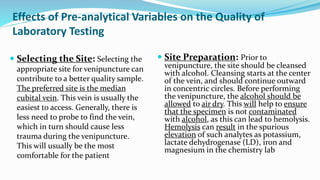
 Selecting the Site: Selecting the
appropriate site for venipuncture can
contribute to a better quality sample.
The preferred site is the median
cubital vein. This vein is usually the
easiest to access. Generally, there is
less need to probe to find the vein,
which in turn should cause less
trauma during the venipuncture.
This will usually be the most
comfortable for the patient
Effects of Pre-analytical Variables on the Quality of
Laboratory Testing
 Site Preparation: Prior to
venipuncture, the site should be cleansed
with alcohol. Cleansing starts at the center
of the vein, and should continue outward
in concentric circles. Before performing
the venipuncture, the alcohol should be
allowed to air dry. This will help to ensure
that the specimen is not contaminated
with alcohol, as this can lead to hemolysis.
Hemolysis can result in the spurious
elevation of such analytes as potassium,
lactate dehydrogenase (LD), iron and
magnesium in the chemistry lab
 Tourniquet Application and Time:
The tourniquet should be applied
approximately three to four inches above the
venipuncture site. The tourniquet should be
on the arm no longer than one minute. A
good rule of thumb to determine the one-
minute tourniquet time is to remove the
tourniquet when blood starts to flow into
the first tube of blood being drawn.
Prolonged tourniquet time can lead to an
increase in various chemistry analytes,
including serum protein, potassium and
lactic acid due to hemoconcentration of
blood at the puncture site.
Effects of Pre-analytical Variables on the Quality of
Laboratory Testing
 Proper Venipuncture
Technique: During phlebotomy,
avoid probing to find the vein and
achieve blood flow. Excessive probing
and/or “fishing” to find a vein can
result in a poor quality sample,
including hemolysis. As mentioned
previously, hemolysis can affect
several chemistry analaytes.
 Order of Draw:
 Following the correct order of
draw during venipuncture is
critical to ensure accurate test
results.
 The CLSI (Clinical and
Laboratory Standards Institute,
formerly NCCLS) have
established recommendations
for the proper order of draw for
evacuated blood collection tubes
Effects of Pre-analytical Variables on the
Quality of Laboratory Testing
 Proper Tube Mixing: All tubes with
additives need to be inverted to mix the
additive evenly with the blood. Plastic
serum tubes and BD SST ™ tubes contain
clot activator and should be inverted 5
times to mix the activator with the blood
and help the specimen clot completely.
Improper mixing of the tube after
venipuncture could contribute to a
gelatinous serum sample.
 Correct Specimen Volume: All
blood collection tubes need to be filled
to the correct volume. This will ensure
the proper amount of blood for the
amount of additive in the tube (blood to
additive ratio). For example, if a 5 mL
draw heparin tube is only filled with 3
mL of blood, the heparin concentration
is erroneously high and may potentially
interfere with some chemistry analytes.
Effects of Pre-analytical Variables on the Quality of
Laboratory Testing
 Expiration dates: Should also
be checked on the evacuated
tubes
 Expired tubes should not be
used, as they may have a
decreased vacuum, as well as
potential changes in any
additives in the tubes
Proper Tube Handling and
Specimen Processing
 Serum specimens: Namely red
top tubes and BD SST™ gel tubes,
need to clot completely prior to
centrifugation and processing. Blood
specimens in red top tubes should clot
for 45 to 60 minutes, and those in BD
SST ™ tubes should be allowed to clot
for 30 minutes to ensure complete
clot formation.
Effects of Pre-analytical Variables on the Quality of
Laboratory Testing
 Blood from patients who are
receiving anticoagulant therapy,
such as heparin or coumadin, may
take longer to clot. Tubes should
be allowed to clot at room
temperature, upright in a test tube
rack, with the closures on the
tubes. Spinning the tube too
soon may result in a gelatinous
and/or fibrinous serum sample
that will require respinning.
Sample Collection
 Anticoagulant of choice 3.8% or 3.2% Sodium
Citrate?
 3.2 % Preferred as the standard measure due
to stability and closeness to the plasma
osmolality
 Anticoagulant/blood ratio is critical (1:9)
 CLSI guideline is +/- 10 % of fill line
 Order of Draw- special emphasis in collections post
blood culture
Sample transport-
Separated citrated plasma at 2 to 6^C – upto 24hrs for
PT but within 4hrs for aPTT & other coagulation assays
OR frozen, ensure that specimen is not in direct contact
with ice.
Pre-preanalytical variables- Coagulation
13
21-May-2019 13:45
Cell Analyser- Daily Background Check
WBC 0.05 x 10^3/L PASS
RBC 0.00 x 10^6/L PASS
Hgb 0.00 x g/dl PASS
Plt 10.0 x 10^3/U FAILED
Pre-Analytical Example
Within Lab-
For Coagulation- Platelet Poor Plasma
• Recommended centrifugation to remove platelets to a count of
less than 10 x 10^9/L (10,000/µL).
For Automated Cell Counters
• Daily Instrument Function checks- Background Counts
Within Lab-
For Urine Chemistry(24hrs)-
• Recommended check for Urine PH &
appropriate correction before testing,
especially for Urinary calcium & Uric acid
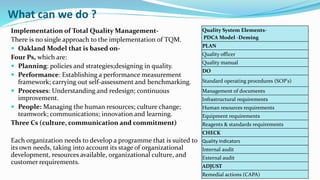
What can we do ?
Implementation of Total Quality Management-
There is no single approach to the implementation of TQM.
 Oakland Model that is based on-
Four Ps, which are:
 Planning: policies and strategies;designing in quality.
 Performance: Establishing a performance measurement
framework; carrying out self-assessment and benchmarking.
 Processes: Understanding and redesign; continuous
improvement.
 People: Managing the human resources; culture change;
teamwork; communications; innovation and learning.
Three Cs (culture, communication and commitment)
Each organization needs to develop a programme that is suited to
its own needs, taking into account its stage of organizational
development, resources available, organizational culture, and
customer requirements.
Quality System Elements-
PDCA Model -Deming
PLAN
Quality officer
Quality manual
DO
Standard operating procedures (SOP's)
Management of documents
Infrastructural requirements
Human resources requirements
Equipment requirements
Reagents & standards requirements
CHECK
Quality Indicators
Internal audit
External audit
ADJUST
Remedial actions (CAPA)
15
Continuing
Education
Training
Job
Descriptions
Orientation
Competency
Assessment
Job
Qualifications
Personnel
Management
Orientation
Competency Assessment
Task-specific Training
Competency Recognition
Job Description
Qualified Technician/Doctor
Retraining
6monthly
for 1st year
& atleast
Annually
thereafter for all
Competency Assessment Methods
 Direct Observation
 checklists
 Indirect Observations
 monitoring records
 re-testing
 case studies
 Give previously analyzed specimens for
testing
 Provide written exercises to assess:
• Problem solving skills
• Knowledge
• Interpretation
Technologist Name Technologist Title
Procedure for
Evaluation
Evaluation Date Evaluator
Procedure item Accept Partial No Comment
Read procedure
manual
Equipment set up
appropriately
Work area neat
Reagent preparation
Perform task
accurately
Perform task timely
Other: Specify
QUALITY INDICATORS
 As stated by the ISO 15189:2012, Technical Requirements-
“The laboratory shall establish QIs to monitor and evaluate performance
throughout critical aspects of pre-examination, examination and post examination
processes”
 The Working Group on Laboratory Errors and Patient Safety (WG-LEPS) of the
International Federation of Clinical Chemistry and Laboratory Medicine (IFCC)
developed consensus QI (2014, 2017)-
 Testing process- 53 QIs - 28 preanalytical , 6 analytical & 11 postanalytical phases.
 Support process- 5 QIs – 2 Employee competence, 2 clinical relationship, 1
Laboratory Information system
 Outcome measures- 3 QIs
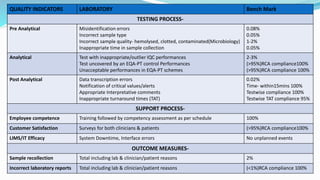
QUALITY INDICATORS- PRE ANALYTICAL
QUALITY INDICATORS LABORATORY Bench Mark
TESTING PROCESS-
Pre Analytical Misidentification errors
Incorrect sample type
Incorrect sample quality- hemolysed, clotted, contaminated(Microbiology)
Inappropriate time in sample collection
0.08%
0.05%
1-2%
0.05%
Analytical Test with inappropriate/outlier IQC performances
Test uncovered by an EQA-PT control Performances
Unacceptable performances in EQA-PT schemes
2-3%
(>95%)RCA compliance100%
(>95%)RCA compliance 100%
Post Analytical Data transcription errors
Notification of critical values/alerts
Appropriate Interpretative comments
Inappropriate turnaround times (TAT)
0.02%
Time- within15mins 100%
Testwise compliance 100%
Testwise TAT compliance 95%
SUPPORT PROCESS-
Employee competence Training followed by competency assessment as per schedule 100%
Customer Satisfaction Surveys for both clinicians & patients (>95%)RCA compliance100%
LIMS/IT Efficacy System Downtime, Interface errors No unplanned events
OUTCOME MEASURES-
Sample recollection Total including lab & clinician/patient reasons 2%
Incorrect laboratory reports Total including lab & clinician/patient reasons (<1%)RCA compliance 100%
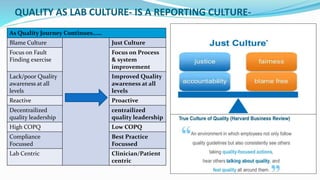
QUALITY AS LAB CULTURE- IS A REPORTING CULTURE-
As Quality Journey Continues……
Blame Culture Just Culture
Focus on Fault
Finding exercise
Focus on Process
& system
improvement
Lack/poor Quality
awareness at all
levels
Improved Quality
awareness at all
levels
Reactive Proactive
Decentrailized
quality leadership
centrailized
quality leadership
High COPQ Low COPQ
Compliance
Focussed
Best Practice
Focussed
Lab Centric Clinician/Patient
centric
 Reused Torniquet
Neglected Areas Requiring Focus-
 Cotton used for
disinfection
 Post phlebotomy care
including quality of
sticking or bandage
used
 Hand Hygiene
practices
 Reused Needle
Holder
 Disposal as per
Biomedical waste
guidelines
Inappropriately conducted above activities can inadvertently cause patient harm-
transmission of infections like s.aureus, including MRSA have been described
 Storage area for blood collection material
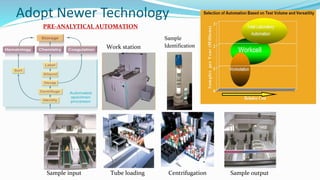
Adopt Newer Technology
Sample
IdentificationWork station
Sample input Tube loading Sample outputCentrifugation
PRE-ANALYTICAL AUTOMATION
Adopt Newer Technology
Future : Not very Far
THANK YOU