A Presentation on Pre-Analytical
errors
Presented By:
Pawan Kumar
Quality assurance system
 “The activity of a laboratory to ensure the
reliability of test results, to increase
accuracy, reproducibility and laboratory to
laboratory comparability."
 Quality assurance system depends upon 3
factors
– Pre-analytical factors
– Analytical factors
– Post-analytical factors
The whole testing process can be
divided into 3 stages
 Pre-analytical :- test request, patient and specimen
identification, specimen collection ,transport ,
accessioning and processing.
 Analytical:-specimen testing
 Post analytical:-reporting test results, interpretation ,
follow up, storage, retesting if needed.
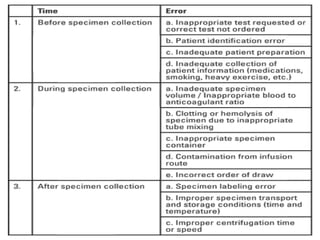
Pre-analytical errors
 There is consolidated evidence that lack of standardization and
monitoring of pre analytic variables, including procedures for
patient identification, sample collection, handling and
processing has an adverse influence on the reliability of test
results, consuming valuable healthcare resources and
compromising the patient's outcome. The pre analytic phase
enfolds the greatest potential for quality improvement.
 Pre analytical variables can dramatically affect the results of
any laboratory test
 Outcomes of pre-analytical errors range from no detected harm
to death
Pre-analytical errors (Contd…)
 Patient Identification
 Patient Preparation
 Selecting the Site
 Site Preparation
 Tourniquet Application and Time
 Proper Venipuncture Technique
 Order of Draw
 Proper Tube Mixing
 Correct Specimen Volume
 Proper Tube Handling and Specimen Processing
 Serum Samples
 Plasma Samples
 Centrifugation
 Special Handling of Blood Samples
 Stability for Whole Blood, Serum and Plasma
Pre-analytical errors (Contd…)
 Patient Identification:
– It is important to identify a patient properly so that blood is
being collected from the correct person. Drawing blood from
the wrong person or labeling the correct patient’s sample
with a different patient’s label can certainly contribute to
laboratory error. Blood should not be drawn from a patient
before confirming that he is the right person. A nurse,
physician, relative or guardian should identify patients that
are unable to speak or identify themselves.
Pre-analytical errors (Contd…)
 Patient Preparation:
– Prior to collecting specimens for chemistry, certain patient
variables need to be considered. For certain chemistry
analytes, such as glucose and cholesterol, patients need to
be fasting (absence of food and liquids) for at least 12 hours
prior to veni-puncture. Other analytes, such as cortisol and
adrenocorticotropin, have diurnal variations, where the
analyte is at its highest level in the morning, and the levels
gradually decrease during the course of the day.
Pre-analytical errors (Contd…)
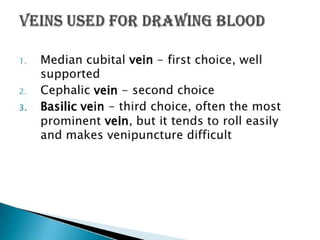
 Selecting the Site: 
– Selecting  the  appropriate  site  for  venipuncture  can 
contribute  to  a  better  quality  sample.  The  preferred  site 
is the median cubital vein. This vein is usually the easiest to 
access.  Generally,  there  is  less  need  to  probe  to  find  the 
vein, which in turn should cause fewer traumas during the 
venipuncture. This will usually be the most comfortable for 
the patient. If the median cubital vein cannot be used, the 
next choice  would  be  the  cephalic  vein.  .  The  last vein to 
consider for venipuncture is the basilic vein. This vein is in 
close proximity to the median nerve and brachial artery, and 
extreme caution must be used so that only the basilic vein 
is being punctured.
Pre-analytical errors (Contd…)
 Site Preparation: 
– Prior  to  venipuncture,  the  site  should  be  cleansed  with 
alcohol.  Cleansing  starts  at  the  center  of  the  vein,  and 
should  continue  outward  in  concentric  circles.  Before 
performing the venipuncture, the alcohol should be allowed 
to air dry. This will help to ensure that the specimen is not 
contaminated  with  alcohol,  as  this  can  lead  to  hemolysis. 
Hemolysis  can  result  in  the  spurious  elevation  of  such 
analytes  as  potassium,  lactate  dehydrogenase  (LD),  iron 
and magnesium in the chemistry lab. Allowing the alcohol to 
dry completely will also cause less burning and pain to the 
patient.
Pre-analytical errors (Contd…)
 Tourniquet Application and Time: 
– The  tourniquet  should  be  applied  approximately  three  to 
four  inches  above  the  venipuncture  site.  The  tourniquet 
should be on the arm no longer than one minute.  A good 
rule of thumb to determine the one-minute tourniquet time is 
to remove the tourniquet when blood starts to flow into the 
first tube  of  blood being  drawn.  Prolonged tourniquet time 
can  lead  to  an  increase  in  various  chemistry  analytes, 
including  serum  protein,  potassium  and  lactic  acid  due  to 
heam concentration of blood at the puncture site.
Pre-analytical errors (Contd…)
 Proper Venipuncture Technique:
–  During phlebotomy, avoid probing to find the vein 
and achieve blood flow. Excessive probing and/or 
“fishing” to find a vein can result in a poor quality 
sample,  including  hemolysis.  As  mentioned 
previously, hemolysis can affect several chemistry 
analytes.
Pre-analytical errors (Contd…)
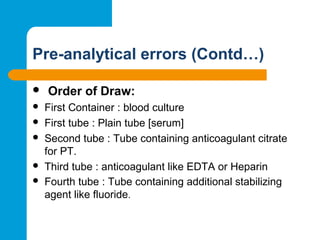
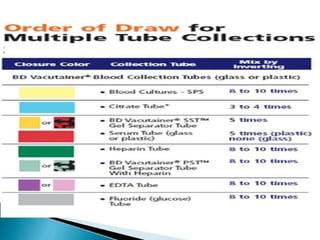
 Order of Draw:
 First Container : blood culture
 First tube : Plain tube [serum]
 Second tube : Tube containing anticoagulant citrate 
for PT.
 Third tube : anticoagulant like EDTA or Heparin
 Fourth tube : Tube containing additional stabilizing 
agent like fluoride.
Pre-analytical errors (Contd…)
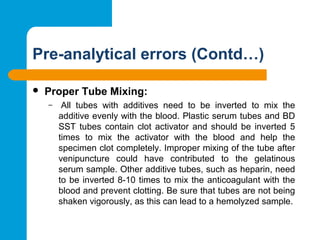
 Proper Tube Mixing:
–  All  tubes  with  additives  need  to  be  inverted  to  mix  the 
additive evenly with the blood. Plastic serum tubes and BD 
SST tubes contain clot activator and should be inverted 5 
times  to  mix  the  activator  with  the  blood  and  help  the 
specimen clot completely. Improper mixing of the tube after 
venipuncture  could  have  contributed  to  the  gelatinous 
serum sample. Other additive tubes, such as heparin, need 
to be inverted 8-10 times to mix the anticoagulant with the 
blood and prevent clotting. Be sure that tubes are not being 
shaken vigorously, as this can lead to a hemolyzed sample.
Pre-analytical errors (Contd…)
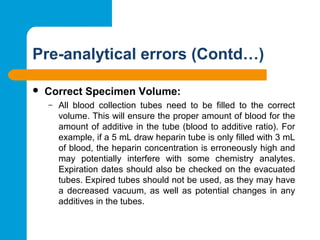
 Correct Specimen Volume: 
– All  blood  collection  tubes  need  to  be  filled  to  the  correct 
volume. This will ensure the proper amount of blood for the 
amount of additive in the tube (blood to additive ratio). For 
example, if a 5 mL draw heparin tube is only filled with 3 mL 
of blood, the heparin concentration is erroneously high and 
may  potentially  interfere  with  some  chemistry  analytes. 
Expiration dates should also be checked on the evacuated 
tubes. Expired tubes should not be used, as they may have 
a decreased vacuum, as well as potential changes in any 
additives in the tubes.
Pre-analytical errors (Contd…)
 Proper Tube Handling and Specimen
Processing: 
– Once the blood collection tubes have been drawn 
in the correct order, to the proper fill volume and 
mixed  thoroughly,  the  next  step  toward  accurate 
test  results  is  processing  the  tubes  properly. 
Serum  and  plasma  tubes  would  be  discussed 
separately,  as  both  specimen  types  have  their 
own special handling requirements.
Pre-analytical errors (Contd…)
 Serum Samples:
Serum  specimens,  namely  red  top  tubes  and  BD  SST  gel 
tubes,  need  to  clot  completely  prior  to  centrifugation  and 
processing. Blood specimens in red top tubes should clot for 45 
to 60 minutes, and those in BD SST tubes should be allowed to 
clot  for  30  minutes  to  ensure  complete  clot  formation. Blood 
from patients who are receiving anticoagulant therapy, such as 
heparin  may  take  longer  to  clot.  Tubes  should  be  allowed  to 
clot at room temperature, upright in a test tube rack, with the 
closures on the tubes. In the gelatinous sample, the blood does 
not  clot  completely  prior  to  centrifugation  because  a  cardiac 
patient is often heparanized. Spinning the tube too soon may 
result  in  a  gelatinous  and/or  fibrinous  serum  sample  that  will 
require re-spinning.
Pre-analytical errors (Contd…)
 Plasma Samples:
– Plasma  specimens  collected  in  plasma  tubes, 
such as the plain heparinized green top tubes and 
the  BD  PST  tubes  with  heparin  and  gel  do  not 
require clotting prior to centrifugation. This allows 
the  tube  of  blood  to  be  drawn,  mixed  and 
centrifuged  immediately,  resulting  in  a  quicker 
turn-around-time for test results.
Pre-analytical errors (Contd…)
 Centrifugation:
– The next step in sample processing is the centrifugation of the blood collection tubes. 
In a swinging bucket centrifuge (preferred type of spin for gel separation tubes), the 
tubes should be spun for ten minutes at a speed of 1100 to 1300 relative centrifugal 
force (RCF). A fifteen-minute spin at the same speed is required for spinning tubes in 
a  fixed-  angle  centrifuge.  Serum  and  plasma  tubes  without  gel  can  be  spun  at  a 
speed of 1000 RCF for ten minutes.
It is important to spin gel tubes for the recommended time. The gel 
barrier in the tubes needs time to move and form a solid barrier between 
the red cells and the serum or plasma. Also, in BD PST tubes, the white 
blood cells and platelets that remain in the plasma need adequate time to 
spin out of the plasma. If the BD PST tubes are spun for less than the 
recommended 10 minutes, these cells and platelets may remain in the 
plasma and could cause interference with some chemistry analytes. It is 
recommended that BD SST tubes should not be re-centrifuged after their 
initial centrifugation. Re-spinning the tubes can result in elevated 
potassium values, as excess serum that has been in contact with the red cells 
will be expressed from underneath the gel barrier.
Pre-analytical errors (Contd…)
 Special Handling of Blood Samples:
Certain chemistry analytes will require the tube of blood to 
be chilled after collection in order to maintain the stability of the 
analyte. A slurry of ice and water is recommended for chilling the 
tubes of blood. Examples of specimens that need to be chilled or 
transported on ice include adrenocorticotropic hormone (ACTH), 
angiotensin  converting  enzyme  (ACE),  acetone,  ammonia, 
catecholamines, free fatty acids, lactic acid, pyruvate and rennin. 
Other  anayltes  are  photo-sensitive,  and  need  to  be  protected 
from  light  in  order  to  remain  stable  and  to  ensure  that  the 
laboratory  reports  an  accurate  result.  This  can  be  done  by 
wrapping the tube of blood in aluminum foil. The most common 
example of a light-sensitive analyte is bilirubin. Other chemistry 
analytes  that  need  to  be  light-protected  include  beta-carotene 
and erythrocyte protoporphyrin.
Pre-analytical errors (Contd…)
 Stability for Whole Blood, Serum and Plasma:
A whole blood specimen that is going to be spun down should be 
centrifuged and the serum or plasma removed from the red blood cells 
within two hours after the venipuncture. Once the serum is removed or 
separated from the red blood cells (in the case of a gel barrier tube), the 
sample will be stable at room temperature for eight hours, and up to 48 
hours at 2-4 degrees C. After 48 hours, the serum specimen should be 
frozen at –20 degrees C in an aliquot tube.
Paying  close  attention  to  the  pre  analytical  variables  associated  with 
blood collection will help to ensure accurate test results in the chemistry 
department,  as  well  as  all  areas  of  the  clinical  laboratory.  As  was 
evident, there are often several variables that can potentially contribute 
to erroneous test results. Therefore, it is important to remember that a 
better quality sample during the preanalytical phase of blood collection 
will yield a better test result.
Types of preanalytical errors
 Patient misidentification [ incorrectly labelled tubes or
incorrectly filled forms ]
Most common causes are :
1] inadequate data on test requisition form
2] missing patient identifiers
3] labelling specimen container away from bedside
Possible consequences include wrong blood transfusion leading to
acute hemolytic reaction.
Specimen collection from wrong patient leading to delayed
diagnosis or misdiagnosis
To minimize such errors, at least 2 patient identifiers should be
used, specimen should be labelled immediately after specimen
collection
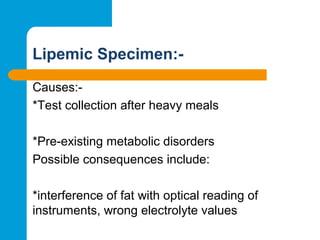
Lipemic Specimen:-
Causes:-
*Test collection after heavy meals
*Pre-existing metabolic disorders
Possible consequences include:
*interference of fat with optical reading of
instruments, wrong electrolyte values
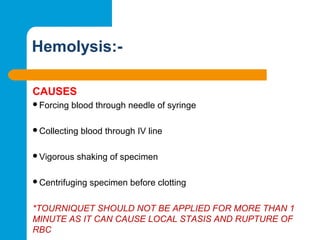
Hemolysis:-
CAUSES
Forcing blood through needle of syringe
Collecting blood through IV line
Vigorous shaking of specimen
Centrifuging specimen before clotting
*TOURNIQUET SHOULD NOT BE APPLIED FOR MORE THAN 1
MINUTE AS IT CAN CAUSE LOCAL STASIS AND RUPTURE OF
RBC
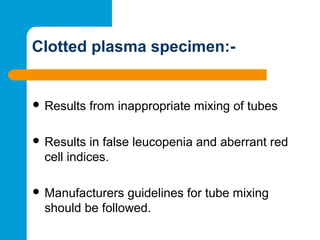
Clotted plasma specimen:-
 Results from inappropriate mixing of tubes
 Results in false leucopenia and aberrant red
cell indices.
 Manufacturers guidelines for tube mixing
should be followed.
Pre analytical errors.