P- ERRORS
Pre and Post Analytical Errors in Laboratory
SPEAKER : MARRIAPPA MANI
MICROBIOLOGICAL LABORATORY
Diagnosis
is largely
DEPENDENT
upon integrity of
LABORATORYdata.
FACT
But more than 60-80%
of the most IMPORTANT DECISIONS
on ADMISSION, DISCHARGE and MEDICATION are
based on LABORATORY TEST RESULTS
but the AWFUL FACTis
There is a OOPS
in Laboratory Results.
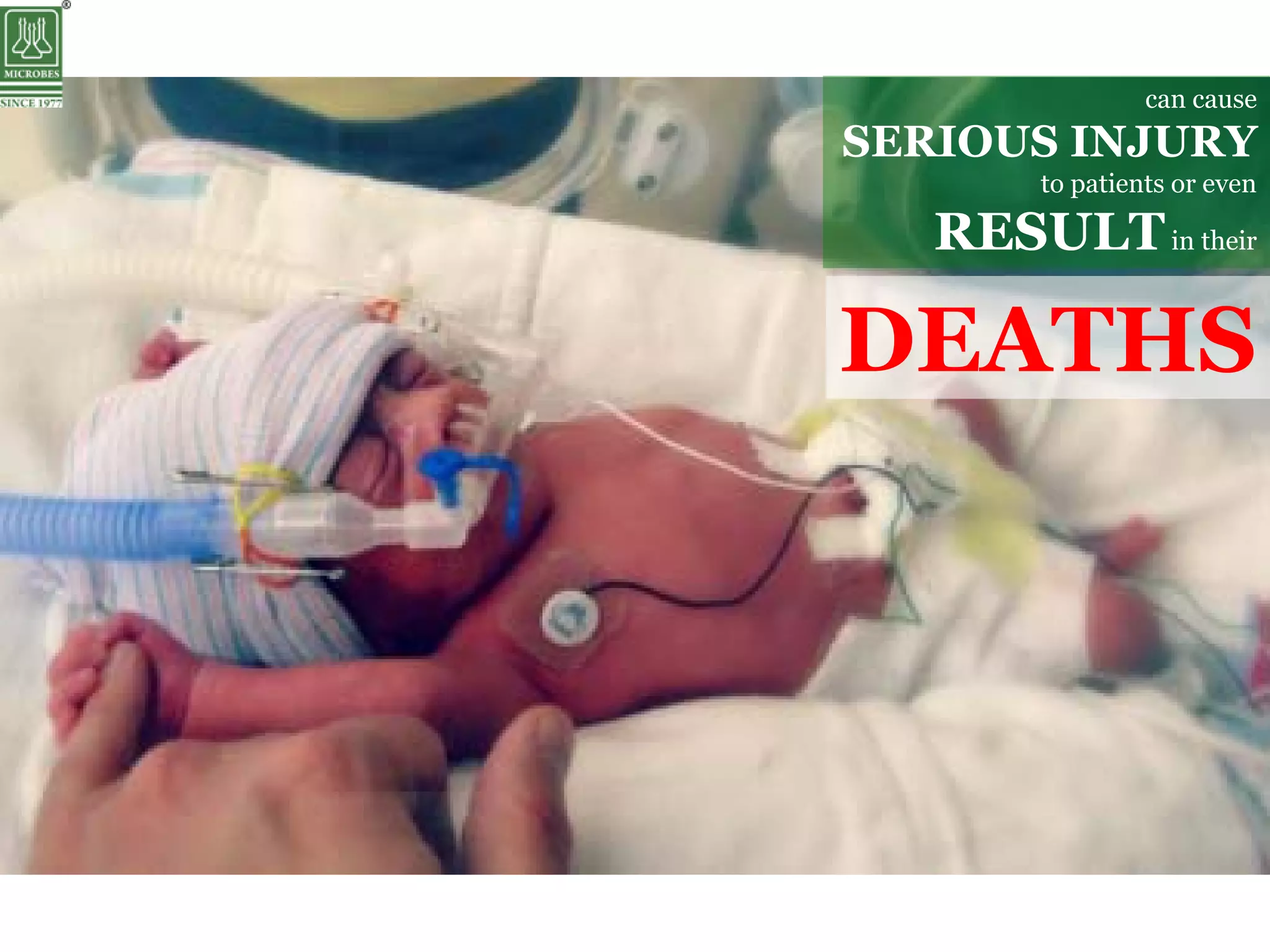
can cause
SERIOUS INJURY
to patients or even
RESULTin their
DEATHS
A defect occurring at any part of
the laboratory cycle, from
ordering tests to reporting
results and appropriately
interpreting and reacting on these
Laboratory ERROR is define as
OOPS
Laboratory Testing, which commonly
called the Total Testing Process-TTP,
is a highly Multifarious process.
Pre-Analytical Phase
3 Phases
Testing
Patient Requisition.1
Order the Test.2
Specimen Collection.3
Transportation.4
Processing.5
1.Testing result
Transmission
2. Interpretation
3.Follow-up
4.Retesting
Analytical Phase Post-Analytical Phase
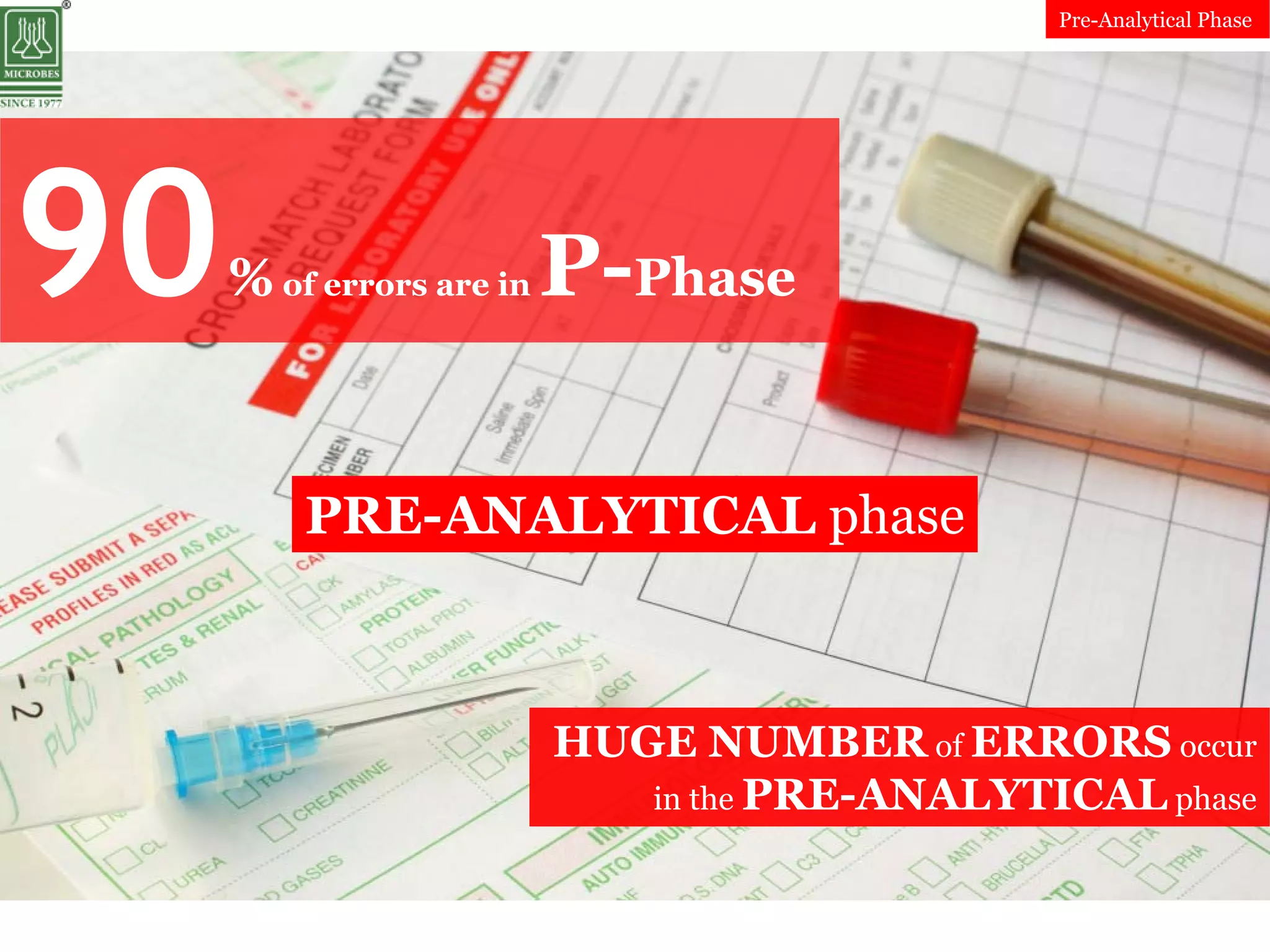
HUGE NUMBER of ERRORS occur
in the PRE-ANALYTICAL phase
90% of errors are in P-Phase
PRE-ANALYTICAL phase
Pre-Analytical Phase
P-Phaseis the most CRUCIAL and HARDEST to
REGULATE and MONITOR because of the
INVOLVEMENT of TOO many PROFESSIONALS such as
Physicians, Specialists of laboratory medicine, Nurses, Laboratory technicians
and Phlebotomists
Pre-Analytical Phase
major REASONS for Ordering a
LABORATORY TEST
DIAGNOSIS MONITORING SCREENING
to rule in or rule out a diagnosis the effect of drug therapy
eg, for congenital hypothyroidism
via neonatal thyroxine testing
CLINICALperformance CHARACTERISTICS
of laboratory tests
PREVALENCE
EFFICIENCY
ACCURACY
PREDICTIVE VALUE
Pre-Analytical Phase
most 7USUAL types of Pre-analytical ERRORS
MISSING sample/
TEST REQUEST WRONG/missing identification CONTAMINATION
from infusion route
HAEMOLYSED/
CLOTTED and
insufficient samples
INAPPROPRIATE
containers
Inappropriate BLOOD to
anticoagulant ratio
Inappropriate TRANSPORT and STORAGE conditions
Pre-Analytical Phase
MISIDENTIFICATION of Patient
MISLABELLING of specimen
SHORT Draws/ Wrong anticoagulant/ blood
RATIO
MIXING problems/CLOT
Wrong Tubes/ Wrong Anticogulate
HEMOLYSIS/LIPEMIA
HEMOCONCENTRATION from prolonged
TOURNIQUET time
EXPOSURE to light/ EXTREME temperatures
IMPROPERLY TIMED specimens/ DELAYED
delivery to laboratory
PROCESSING errors
Incomplete CENTRIFUGATIONS /
IMPROPER storage
10common ERRORS
in SPECIMEN COLLECTION
Pre-Analytical Phase
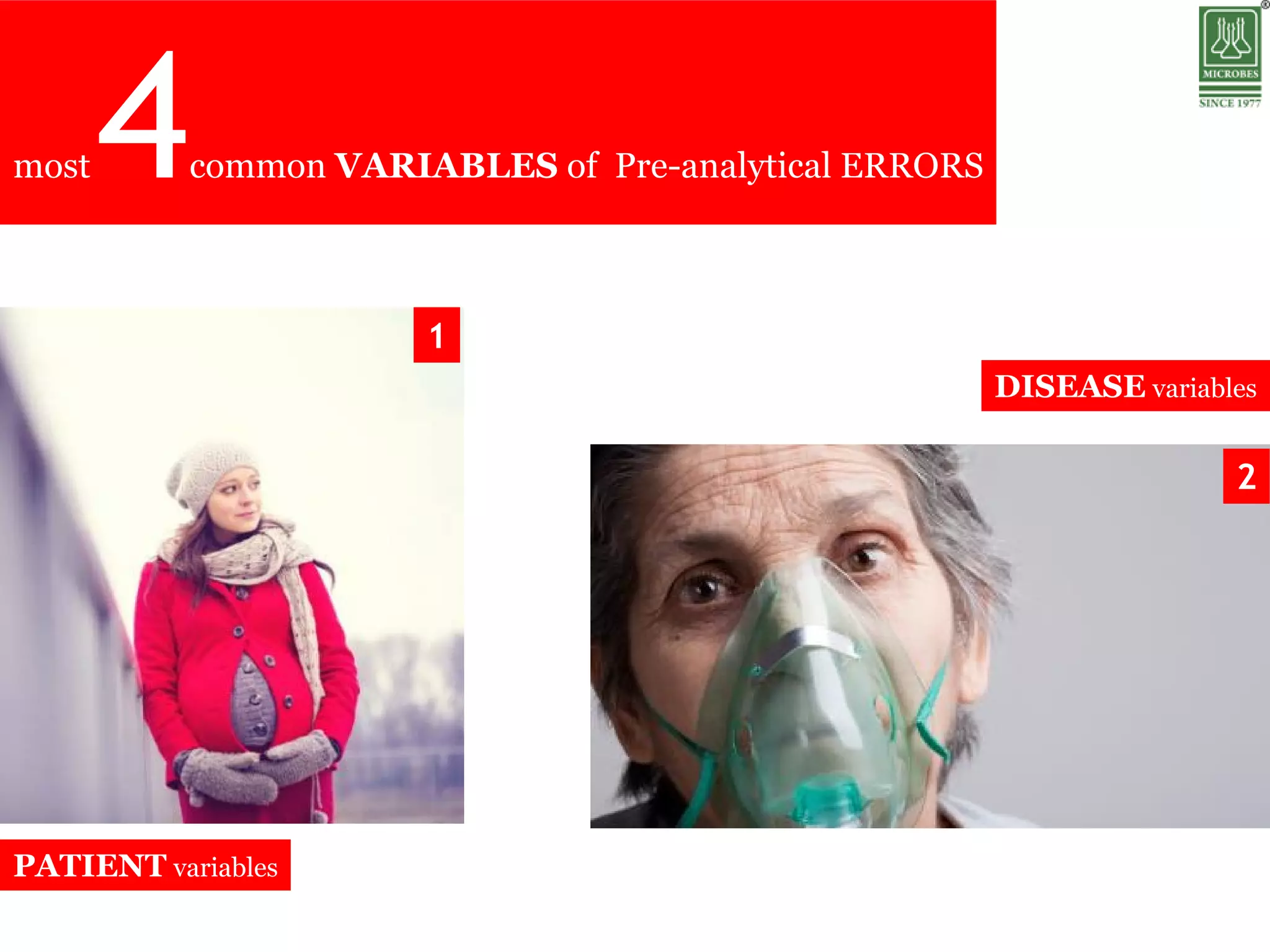
most 4common VARIABLES of Pre-analytical ERRORS
PATIENT variables
DISEASE variables
1
2
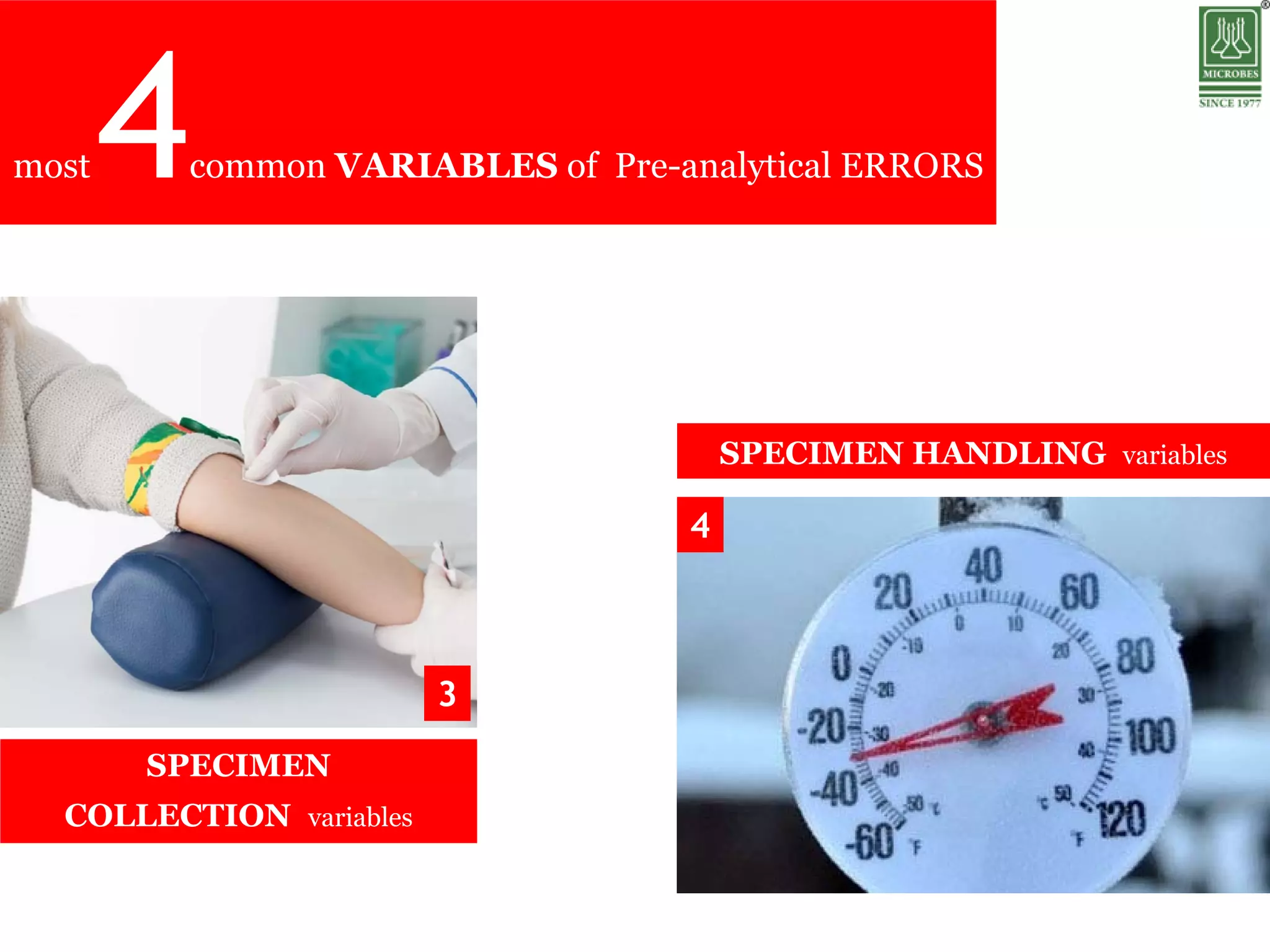
most 4common VARIABLES of Pre-analytical ERRORS
SPECIMEN
COLLECTION variables
SPECIMEN HANDLING variables
3
4
1. PATIENTVariables
DIET
AGE
EXERCISE
PREGNANCY
SMOKING
MEDICATIONS
BODY MASS
DEHYDRATION
2. DISEASEVariables
INSULIN –DEPENDENT
DIABETUS MELLITUS
NEPHROTIC SYNDROME/
CHRONIC RENEL FAILURE
BILIARY TRACT
OBSTRUCTION
HYPOTHYROIDISM
ACUTE MYOCARDIAL
INFARCTION
Order of draw
TOURNIQUET
TIME of collection
POSTURE
Presence of IVs
FASTING status
DIURNAL variation
Anticoagulants
3. SPECIMEN
COLLECTIONVariables
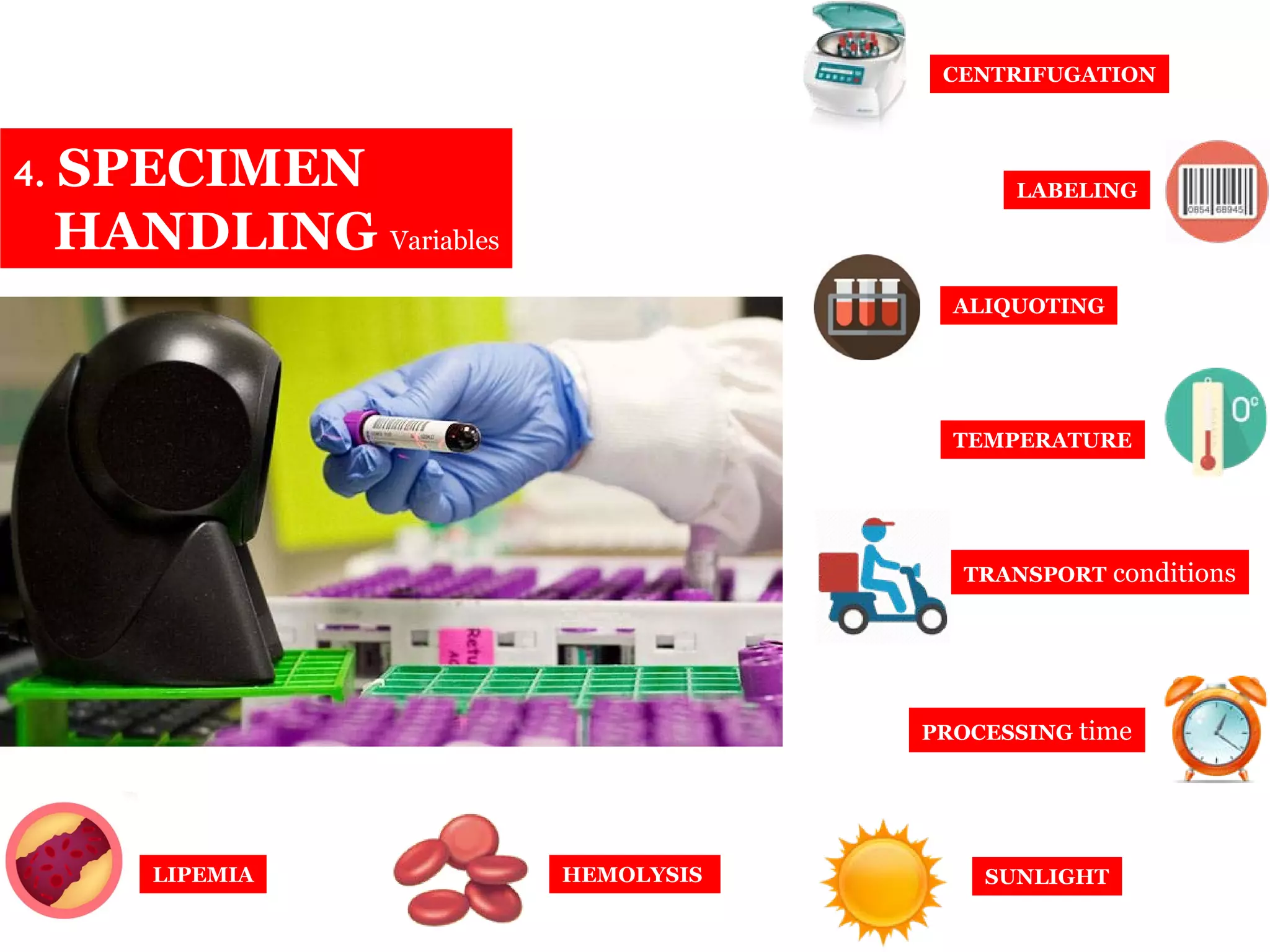
CENTRIFUGATION
LABELING
ALIQUOTING
TEMPERATURE
TRANSPORT conditions
PROCESSING time
SUNLIGHTLIPEMIA HEMOLYSIS
4. SPECIMEN
HANDLING Variables
9reasons for SPECIMEN REJECTION
Pre-Analytical Phase
1. HEMOLYSIS/LIPEMIA
2. CLOT present in the
ANTICOAGULATED specimen
3. NONFASTING specimen when test
REQUIRES FASTING
4. IMPROPER blood collection tube
5. SHORT draws/ Wrong Volume
6. Improper TRANSPORT conditions
(Ice for blood gases)
7. DISCREPANICES between
SPECIMEN LABEL and
REQUISITION
8. UNLABELED or
MISLABELLED specimen
9. CONTAMINATED specimen/
LEAKING container
TESTS
AFFECTED
by DIURNAL
VARIATION,
POSTURE
and STRESS
TEST NAME MORNING AFTERNOON EVENING NIGHT STRESS SUPINE
CORTISOL
ADRENOCORTIC
OPIC HORMONE
PLASMA RENIN
ACTIVITY
ALDOSTERONE
INSULIN
GROWTH
HORMONE
ACID
PHOSPHATASE
THYROXINE
PROLACTIN
IRON
CALCIUM
Pre-Analytical Phase
Minimal Hgb 20 50 100 250 500 1000
Approximate Hemoglobin Concentration (mg/dL)
General guidance for acceptance/rejection:
<50 mg/dL – not hemolyzed
>100 mg/dL – hemolyzed
HEMOLYSIS chart of SERUM/PLASMA
Pre-Analytical Phase
CALIBRATION of the
centrifuge must be PARTof the
QUALITY
ASSURANCE
PROCESS
Pre-Analytical Phase
to avoiding IDENTIFICATION ERRORS
CORRELATE Orders with
Patient NAME
Use BARCODE readers
Identification on SAMPLE DEVICE at site of Collection Patient ID label attached
Pre-Analytical Phase
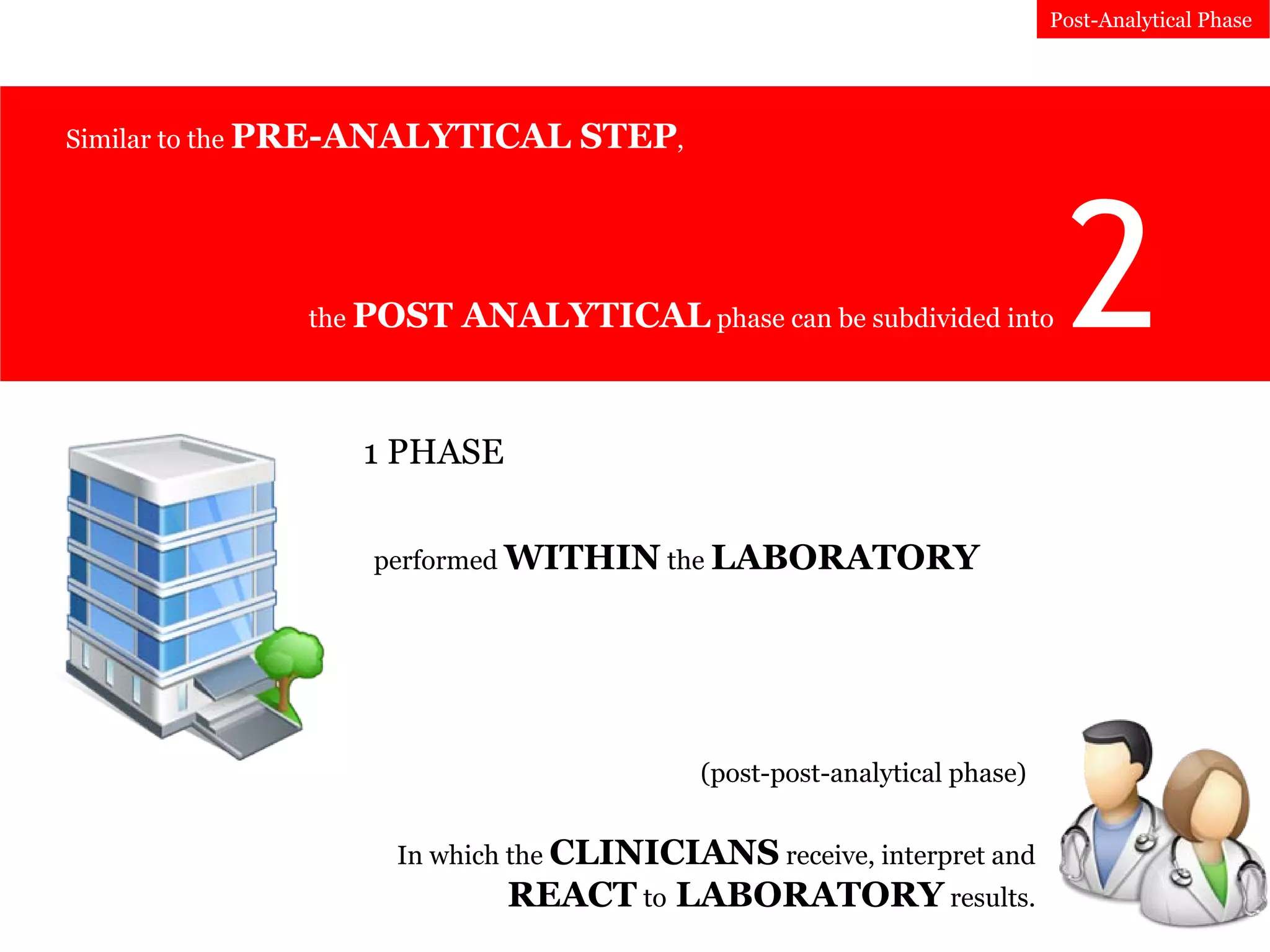
In which the CLINICIANS receive, interpret and
REACT to LABORATORY results.
Similar to the PRE-ANALYTICAL STEP,
the POST ANALYTICAL phase can be subdivided into 2
1 PHASE
performed WITHIN the LABORATORY
(post-post-analytical phase)
Post-Analytical Phase
Common Post-Analyticalactivities
Assurance of CONFIDENTIALITY
of patient information
PROCEDURES for notification
of test results with statistics
Corrected REPORTS
REFERRAL specimens and
their reports
TAT
ACCURACY and completeness of
results and reports
Disposition of
UNACCEPTABLE specimens
Procedures and POLICIES
to Prevent recurrences
Post-Analytical Phase
3 most common POST ANALYTICAL procedures within laboratory
VERIFYING laboratory RESULTS
Feeding them into the laboratory information system (LIS)
COMMUNICATING them to the clinicians in a number of ways (in particular,
by producing a report and making any necessary ORAL communications regarding
‘‘ALERT’’ or PANIC results).
Post-Analytical Phase
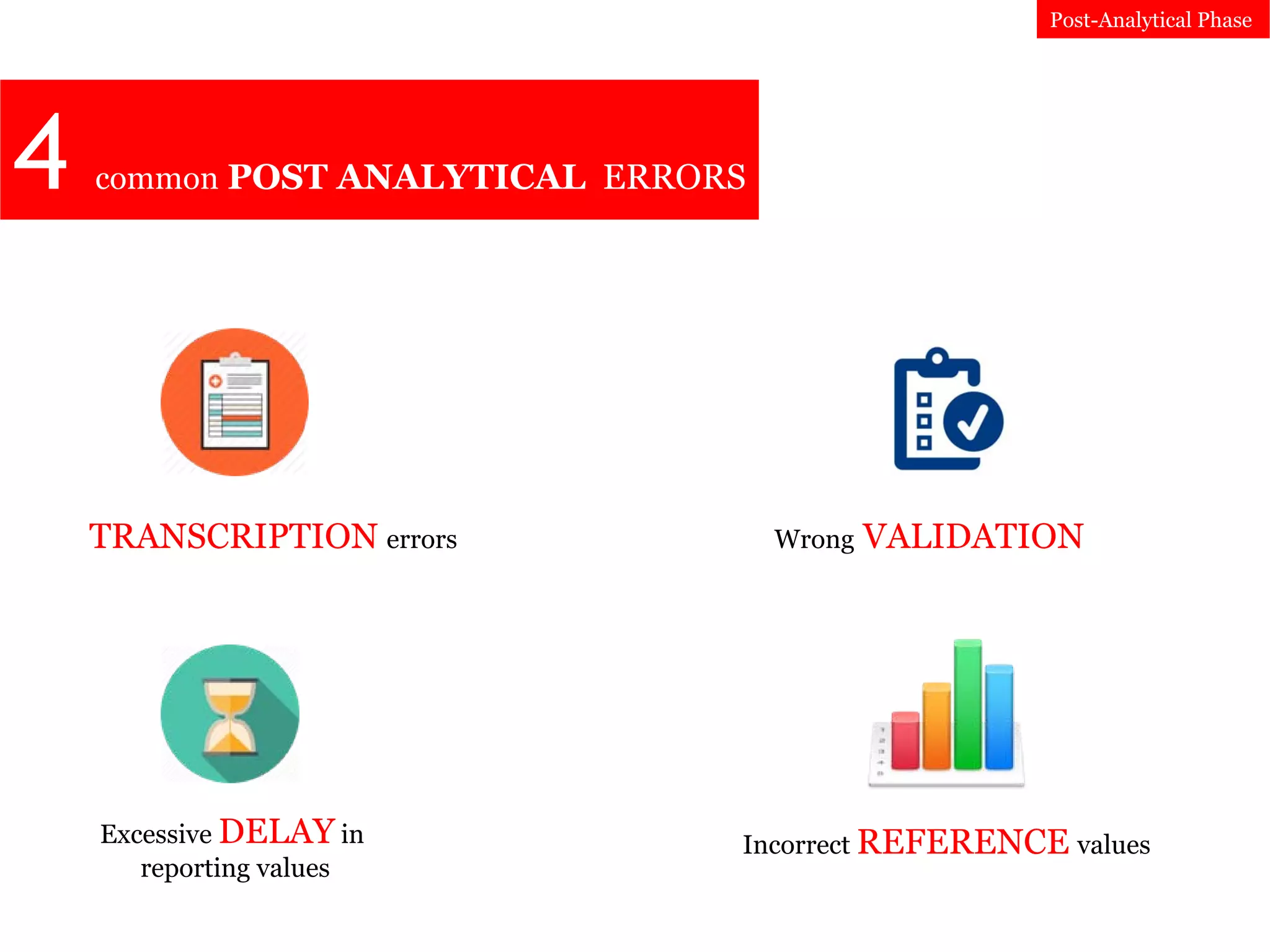
Incorrect REFERENCE values
4 common POST ANALYTICAL ERRORS
TRANSCRIPTION errors Wrong VALIDATION
Excessive DELAY in
reporting values
Post-Analytical Phase
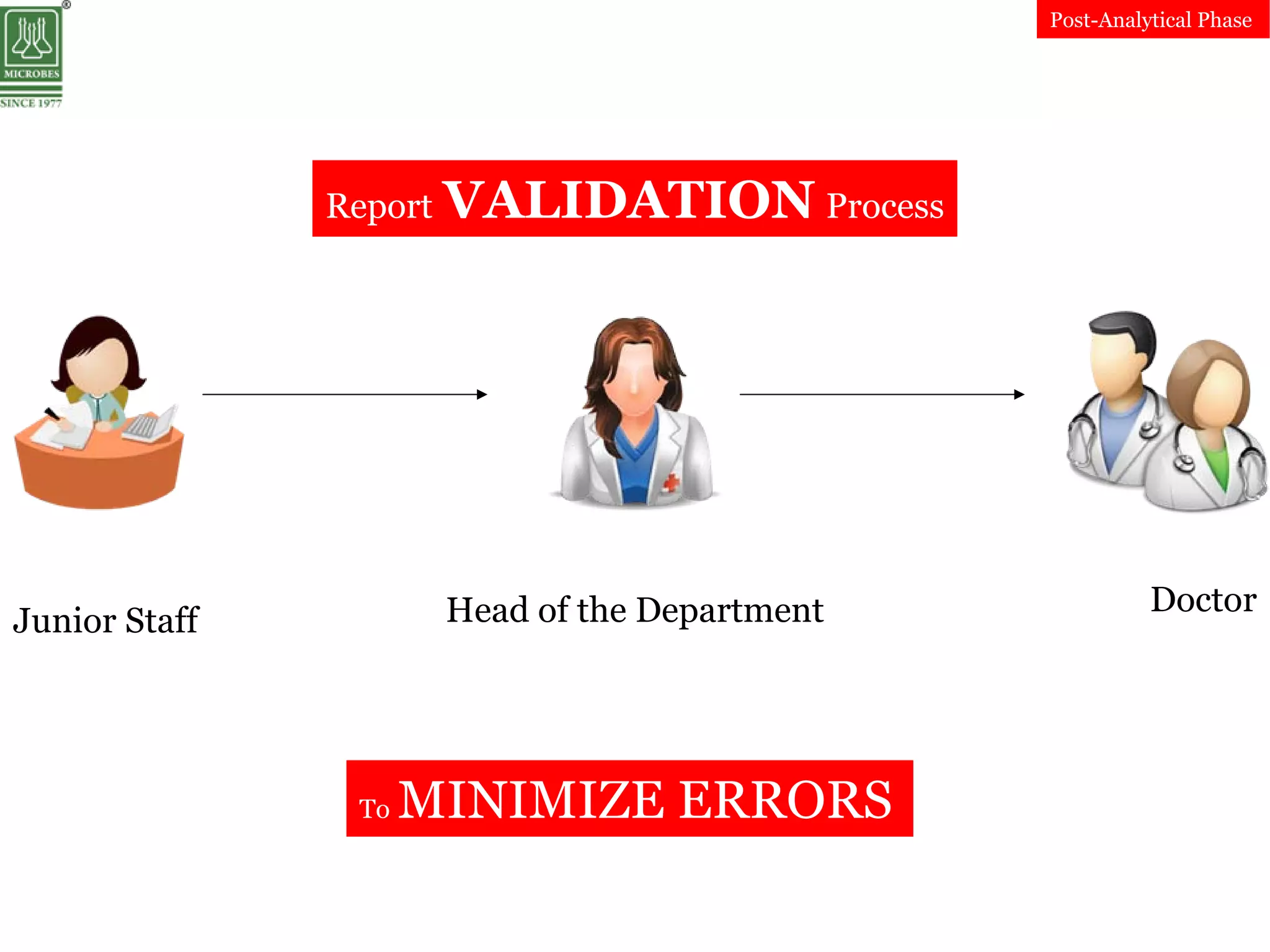
Junior Staff Head of the Department Doctor
Report VALIDATION Process
To MINIMIZE ERRORS
Post-Analytical Phase
All the ERRORS
(Pre-analytical or Post-analytical) occurring at
the different stages of TTP RESULTS in
Increase
TURNAROUND TIME
Patient
INCONVENIENCE
Extra
WORK LOAD on staff
Extra cost to
REPEAT TESTING
as a whole significantly
AFFECT THE PATIENT WELL BEING
ERROR SUMMARY
Information Technology (IT) Establishment of (LIS)
LEAD to
improved quality of HEALTH care and
PATIENT SAFETY
Moreover Increasing use of
STEPS that can PREVENTERRORS
Improve the health
professional continuous
EDUCATION and
TRAINING
Implement
Standard Operating Procedures
Improve COMMUNICATION
and TEAMWORK between
health care professionals
as well as promote
COOPERATION between
DEPARTMENTS
to improve PATIENT CARE
CLINICIANS & LABORATORIANS should recognize that the Laboratory data, although
poten-tially extremely USEFUL AID in DIAGNOSTIC DECISION MAKING
FINAL ANALYSIS
QUERIES PLEASE
MICROBIOLOGICAL LABORATORY

Pre and Post Analytical Errors

  • 1.
    P- ERRORS Pre andPost Analytical Errors in Laboratory SPEAKER : MARRIAPPA MANI MICROBIOLOGICAL LABORATORY
  • 2.
  • 3.
    But more than60-80% of the most IMPORTANT DECISIONS on ADMISSION, DISCHARGE and MEDICATION are based on LABORATORY TEST RESULTS
  • 4.
    but the AWFULFACTis There is a OOPS in Laboratory Results.
  • 5.
    can cause SERIOUS INJURY topatients or even RESULTin their DEATHS
  • 6.
    A defect occurringat any part of the laboratory cycle, from ordering tests to reporting results and appropriately interpreting and reacting on these Laboratory ERROR is define as OOPS
  • 7.
    Laboratory Testing, whichcommonly called the Total Testing Process-TTP, is a highly Multifarious process.
  • 8.
    Pre-Analytical Phase 3 Phases Testing PatientRequisition.1 Order the Test.2 Specimen Collection.3 Transportation.4 Processing.5 1.Testing result Transmission 2. Interpretation 3.Follow-up 4.Retesting Analytical Phase Post-Analytical Phase
  • 9.
    HUGE NUMBER ofERRORS occur in the PRE-ANALYTICAL phase 90% of errors are in P-Phase PRE-ANALYTICAL phase Pre-Analytical Phase
  • 10.
    P-Phaseis the mostCRUCIAL and HARDEST to REGULATE and MONITOR because of the INVOLVEMENT of TOO many PROFESSIONALS such as Physicians, Specialists of laboratory medicine, Nurses, Laboratory technicians and Phlebotomists Pre-Analytical Phase
  • 11.
    major REASONS forOrdering a LABORATORY TEST DIAGNOSIS MONITORING SCREENING to rule in or rule out a diagnosis the effect of drug therapy eg, for congenital hypothyroidism via neonatal thyroxine testing
  • 12.
    CLINICALperformance CHARACTERISTICS of laboratorytests PREVALENCE EFFICIENCY ACCURACY PREDICTIVE VALUE Pre-Analytical Phase
  • 13.
    most 7USUAL typesof Pre-analytical ERRORS MISSING sample/ TEST REQUEST WRONG/missing identification CONTAMINATION from infusion route HAEMOLYSED/ CLOTTED and insufficient samples INAPPROPRIATE containers Inappropriate BLOOD to anticoagulant ratio Inappropriate TRANSPORT and STORAGE conditions Pre-Analytical Phase
  • 14.
    MISIDENTIFICATION of Patient MISLABELLINGof specimen SHORT Draws/ Wrong anticoagulant/ blood RATIO MIXING problems/CLOT Wrong Tubes/ Wrong Anticogulate HEMOLYSIS/LIPEMIA HEMOCONCENTRATION from prolonged TOURNIQUET time EXPOSURE to light/ EXTREME temperatures IMPROPERLY TIMED specimens/ DELAYED delivery to laboratory PROCESSING errors Incomplete CENTRIFUGATIONS / IMPROPER storage 10common ERRORS in SPECIMEN COLLECTION Pre-Analytical Phase
  • 15.
    most 4common VARIABLESof Pre-analytical ERRORS PATIENT variables DISEASE variables 1 2
  • 16.
    most 4common VARIABLESof Pre-analytical ERRORS SPECIMEN COLLECTION variables SPECIMEN HANDLING variables 3 4
  • 17.
  • 18.
    2. DISEASEVariables INSULIN –DEPENDENT DIABETUSMELLITUS NEPHROTIC SYNDROME/ CHRONIC RENEL FAILURE BILIARY TRACT OBSTRUCTION HYPOTHYROIDISM ACUTE MYOCARDIAL INFARCTION
  • 19.
    Order of draw TOURNIQUET TIMEof collection POSTURE Presence of IVs FASTING status DIURNAL variation Anticoagulants 3. SPECIMEN COLLECTIONVariables
  • 20.
  • 21.
    9reasons for SPECIMENREJECTION Pre-Analytical Phase 1. HEMOLYSIS/LIPEMIA 2. CLOT present in the ANTICOAGULATED specimen 3. NONFASTING specimen when test REQUIRES FASTING 4. IMPROPER blood collection tube 5. SHORT draws/ Wrong Volume 6. Improper TRANSPORT conditions (Ice for blood gases) 7. DISCREPANICES between SPECIMEN LABEL and REQUISITION 8. UNLABELED or MISLABELLED specimen 9. CONTAMINATED specimen/ LEAKING container
  • 22.
    TESTS AFFECTED by DIURNAL VARIATION, POSTURE and STRESS TESTNAME MORNING AFTERNOON EVENING NIGHT STRESS SUPINE CORTISOL ADRENOCORTIC OPIC HORMONE PLASMA RENIN ACTIVITY ALDOSTERONE INSULIN GROWTH HORMONE ACID PHOSPHATASE THYROXINE PROLACTIN IRON CALCIUM Pre-Analytical Phase
  • 23.
    Minimal Hgb 2050 100 250 500 1000 Approximate Hemoglobin Concentration (mg/dL) General guidance for acceptance/rejection: <50 mg/dL – not hemolyzed >100 mg/dL – hemolyzed HEMOLYSIS chart of SERUM/PLASMA Pre-Analytical Phase
  • 24.
    CALIBRATION of the centrifugemust be PARTof the QUALITY ASSURANCE PROCESS Pre-Analytical Phase
  • 25.
    to avoiding IDENTIFICATIONERRORS CORRELATE Orders with Patient NAME Use BARCODE readers Identification on SAMPLE DEVICE at site of Collection Patient ID label attached Pre-Analytical Phase
  • 26.
    In which theCLINICIANS receive, interpret and REACT to LABORATORY results. Similar to the PRE-ANALYTICAL STEP, the POST ANALYTICAL phase can be subdivided into 2 1 PHASE performed WITHIN the LABORATORY (post-post-analytical phase) Post-Analytical Phase
  • 27.
    Common Post-Analyticalactivities Assurance ofCONFIDENTIALITY of patient information PROCEDURES for notification of test results with statistics Corrected REPORTS REFERRAL specimens and their reports TAT ACCURACY and completeness of results and reports Disposition of UNACCEPTABLE specimens Procedures and POLICIES to Prevent recurrences Post-Analytical Phase
  • 28.
    3 most commonPOST ANALYTICAL procedures within laboratory VERIFYING laboratory RESULTS Feeding them into the laboratory information system (LIS) COMMUNICATING them to the clinicians in a number of ways (in particular, by producing a report and making any necessary ORAL communications regarding ‘‘ALERT’’ or PANIC results). Post-Analytical Phase
  • 29.
    Incorrect REFERENCE values 4common POST ANALYTICAL ERRORS TRANSCRIPTION errors Wrong VALIDATION Excessive DELAY in reporting values Post-Analytical Phase
  • 30.
    Junior Staff Headof the Department Doctor Report VALIDATION Process To MINIMIZE ERRORS Post-Analytical Phase
  • 31.
    All the ERRORS (Pre-analyticalor Post-analytical) occurring at the different stages of TTP RESULTS in Increase TURNAROUND TIME Patient INCONVENIENCE Extra WORK LOAD on staff Extra cost to REPEAT TESTING as a whole significantly AFFECT THE PATIENT WELL BEING ERROR SUMMARY
  • 32.
    Information Technology (IT)Establishment of (LIS) LEAD to improved quality of HEALTH care and PATIENT SAFETY Moreover Increasing use of
  • 33.
    STEPS that canPREVENTERRORS Improve the health professional continuous EDUCATION and TRAINING Implement Standard Operating Procedures Improve COMMUNICATION and TEAMWORK between health care professionals as well as promote COOPERATION between DEPARTMENTS to improve PATIENT CARE
  • 34.
    CLINICIANS & LABORATORIANSshould recognize that the Laboratory data, although poten-tially extremely USEFUL AID in DIAGNOSTIC DECISION MAKING FINAL ANALYSIS
  • 35.
  • 36.