Quality assurance in blood
banking
Dr. Shahida Baloch
Quality assurance in blood
banking
• Fitness for purpose
Introducing Quality
Quality is a process
A continues cycle of
Plan
Do
Check
Act (Deming cycle)
Quality is an ongoing
activity, not a goal to be
reached.
Quality control
Checks puts in places
to ensure that process,
procedures and
products meets the
quality requirements.
(consistency)
How to start QC
Start from today and make a plan for QC.
The quality requirements involve:-
Quality control and proficiency testing
Internal and external audits
Personnel and organization
Premises, equipment and materials
Documentation
Blood processing
Complaints and component recall
Investigation of errors and accidents
Premises- must be located , designed, constructed and
adapted to suit the operation to be carried out.It
should include separate areas for :-
a) Donor selection
b) Blood collection
c) Blood processing
d) Storage
e) Laboratory facilities
f) Auxiliary facilities (Supportive facilities)
.
QA IN COLLECTION OF BLOOD
The quality, safety and efficacy of the product
transfused is the result of many steps:-
– Donor selection
– Blood collection
– Component preparation
– Storage , issue and transportation
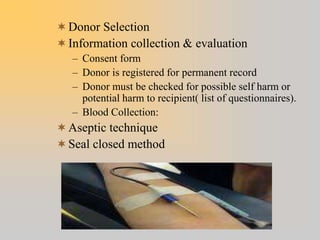
Donor Selection
Information collection & evaluation
– Consent form
– Donor is registered for permanent record
– Donor must be checked for possible self harm or
potential harm to recipient( list of questionnaires).
– Blood Collection:
Aseptic technique
Seal closed method
Blood processing
After blood Collection immediate storage
at 1-6ºC
Components preparation has to be done
within 6 hours after collection
Labels/Records : ABO and Rh grouping
Screening, expiry date and volume of the
blood
Equipment requirements :-
All the equipment in blood transfusion laboratory
should meet mandatory specifications.
A written record of periodic function checks and
maintenance on each piece of equipment should
be mandatory.
A preventive maintenance should be planned for
trouble free operation.
Uninterrupted power supply should be
maintained for all the equipment with efficient
back-up system.
Annual maintenance contract with manufacturers
and suppliers should be obtained.
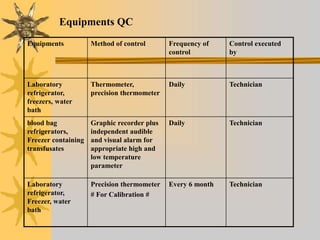
Equipments Method of control Frequency of
control
Control executed
by
Laboratory
refrigerator,
freezers, water
bath
Thermometer,
precision thermometer
Daily Technician
blood bag
refrigerators,
Freezer containing
transfusates
Graphic recorder plus
independent audible
and visual alarm for
appropriate high and
low temperature
parameter
Daily Technician
Laboratory
refrigerator,
Freezer, water
bath
Precision thermometer
# For Calibration #
Every 6 month Technician
Equipments QC
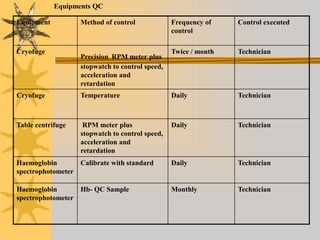
Equipment Method of control Frequency of
control
Control executed
Cryofuge
Precision RPM meter plus
stopwatch to control speed,
acceleration and
retardation
Twice / month Technician
Cryofuge Temperature Daily Technician
Table centrifuge RPM meter plus
stopwatch to control speed,
acceleration and
retardation
Daily Technician
Haemoglobin
spectrophotometer
Calibrate with standard Daily Technician
Haemoglobin
spectrophotometer
Hb- QC Sample Monthly Technician
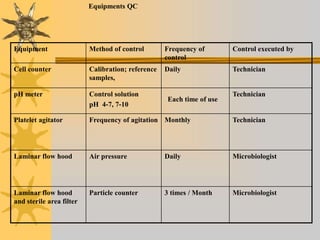
Equipments QC
Equipment Method of control Frequency of
control
Control executed by
Cell counter Calibration; reference
samples,
Daily Technician
pH meter Control solution
pH 4-7, 7-10
Each time of use
Technician
Platelet agitator Frequency of agitation Monthly Technician
Laminar flow hood Air pressure Daily Microbiologist
Laminar flow hood
and sterile area filter
Particle counter 3 times / Month Microbiologist
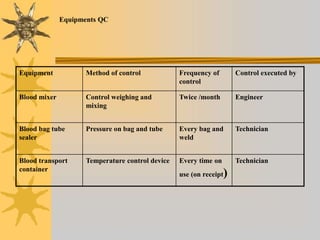
Equipments QC
Equipment Method of control Frequency of
control
Control executed by
Blood mixer Control weighing and
mixing
Twice /month Engineer
Blood bag tube
sealer
Pressure on bag and tube Every bag and
weld
Technician
Blood transport
container
Temperature control device Every time on
use (on receipt)
Technician
Equipments QC
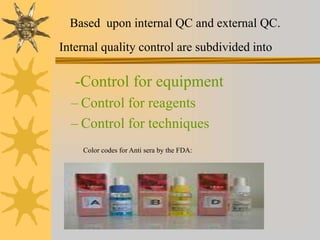
-Control for equipment
– Control for reagents
– Control for techniques
Based upon internal QC and external QC.
Internal quality control are subdivided into
Color codes for Anti sera by the FDA:
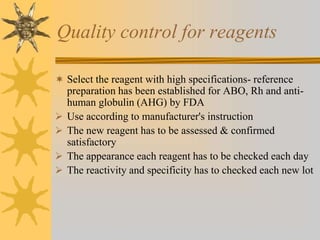
Quality control for reagents
 Select the reagent with high specifications- reference
preparation has been established for ABO, Rh and anti-
human globulin (AHG) by FDA
 Use according to manufacturer's instruction
 The new reagent has to be assessed & confirmed
satisfactory
 The appearance each reagent has to be checked each day
 The reactivity and specificity has to checked each new lot
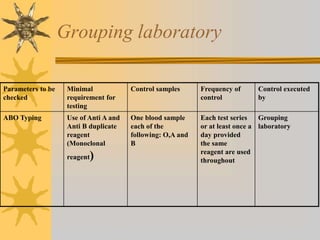
Grouping laboratory
Parameters to be
checked
Minimal
requirement for
testing
Control samples Frequency of
control
Control executed
by
ABO Typing Use of Anti A and
Anti B duplicate
reagent
(Monoclonal
reagent)
One blood sample
each of the
following: O,A and
B
Each test series
or at least once a
day provided
the same
reagent are used
throughout
Grouping
laboratory
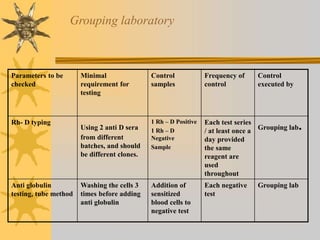
Parameters to be
checked
Minimal
requirement for
testing
Control
samples
Frequency of
control
Control
executed by
Rh- D typing
Using 2 anti D sera
from different
batches, and should
be different clones.
1 Rh – D Positive
1 Rh – D
Negative
Sample
Each test series
/ at least once a
day provided
the same
reagent are
used
throughout
Grouping lab.
Anti globulin
testing, tube method
Washing the cells 3
times before adding
anti globulin
Addition of
sensitized
blood cells to
negative test
Each negative
test
Grouping lab
Grouping laboratory
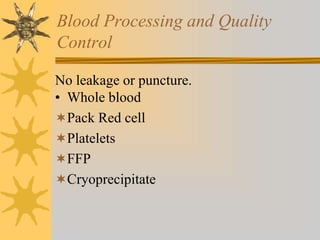
Blood Processing and Quality
Control
No leakage or puncture.
• Whole blood
Pack Red cell
Platelets
FFP
Cryoprecipitate
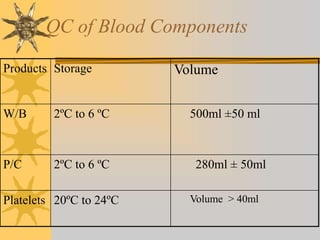
QC of Blood Components
Products Storage Volume
W/B 2ºC to 6 ºC 500ml ±50 ml
P/C 2ºC to 6 ºC 280ml ± 50ml
Platelets 20ºC to 24ºC Volume > 40ml
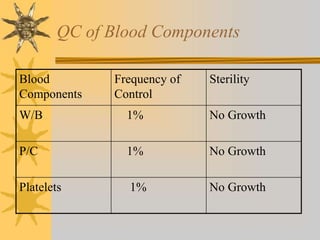
QC of Blood Components
Blood
Components
Frequency of
Control
Sterility
W/B 1% No Growth
P/C 1% No Growth
Platelets 1% No Growth
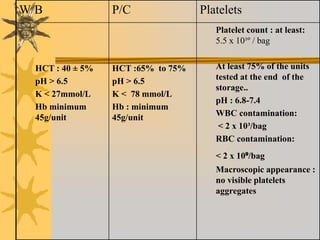
W/B P/C Platelets
HCT : 40 ± 5%
pH > 6.5
K < 27mmol/L
Hb minimum
45g/unit
HCT :65% to 75%
pH > 6.5
K < 78 mmol/L
Hb : minimum
45g/unit
Platelet count : at least:
5.5 x 10¹º / bag
At least 75% of the units
tested at the end of the
storage..
pH : 6.8-7.4
WBC contamination:
< 2 x 10³/bag
RBC contamination:
< 2 x 10⁹/bag
Macroscopic appearance :
no visible platelets
aggregates
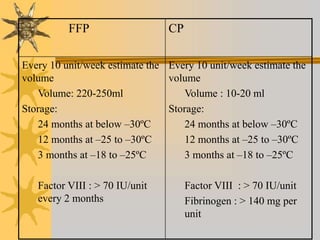
FFP CP
Every 10 unit/week estimate the
volume
Volume: 220-250ml
Storage:
24 months at below –30ºC
12 months at –25 to –30ºC
3 months at –18 to –25ºC
Factor VIII : > 70 IU/unit
every 2 months
Every 10 unit/week estimate the
volume
Volume : 10-20 ml
Storage:
24 months at below –30ºC
12 months at –25 to –30ºC
3 months at –18 to –25ºC
Factor VIII : > 70 IU/unit
Fibrinogen : > 140 mg per
unit
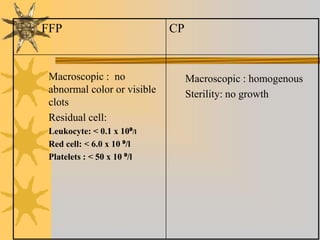
FFP CP
Macroscopic : no
abnormal color or visible
clots
Residual cell:
Leukocyte: < 0.1 x 10⁹/l
Red cell: < 6.0 x 10 ⁹/l
Platelets : < 50 x 10 ⁹/l
Macroscopic : homogenous
Sterility: no growth
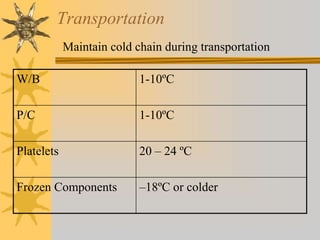
Transportation
W/B 1-10ºC
P/C 1-10ºC
Platelets 20 – 24 ºC
Frozen Components –18ºC or colder
Maintain cold chain during transportation
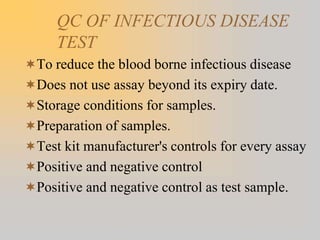
QC OF INFECTIOUS DISEASE
TEST
To reduce the blood borne infectious disease
Does not use assay beyond its expiry date.
Storage conditions for samples.
Preparation of samples.
Test kit manufacturer's controls for every assay
Positive and negative control
Positive and negative control as test sample.
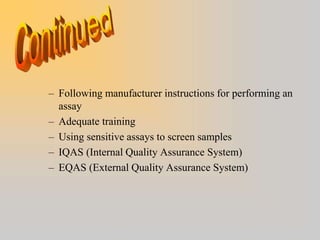
– Following manufacturer instructions for performing an
assay
– Adequate training
– Using sensitive assays to screen samples
– IQAS (Internal Quality Assurance System)
– EQAS (External Quality Assurance System)
References
Guide to the preparation, use and quality
assurance of blood components, 7th edition,
Council of Europe Publishing
Technical Manual American Association of
blood Banks, 11th edition

Quality assurance is necessary in blood banking

  • 1.
    Quality assurance inblood banking Dr. Shahida Baloch
  • 2.
    Quality assurance inblood banking • Fitness for purpose Introducing Quality
  • 3.
    Quality is aprocess A continues cycle of Plan Do Check Act (Deming cycle) Quality is an ongoing activity, not a goal to be reached.
  • 4.
    Quality control Checks putsin places to ensure that process, procedures and products meets the quality requirements. (consistency)
  • 5.
    How to startQC Start from today and make a plan for QC.
  • 6.
    The quality requirementsinvolve:- Quality control and proficiency testing Internal and external audits Personnel and organization Premises, equipment and materials Documentation Blood processing Complaints and component recall Investigation of errors and accidents
  • 7.
    Premises- must belocated , designed, constructed and adapted to suit the operation to be carried out.It should include separate areas for :- a) Donor selection b) Blood collection c) Blood processing d) Storage e) Laboratory facilities f) Auxiliary facilities (Supportive facilities) .
  • 8.
    QA IN COLLECTIONOF BLOOD The quality, safety and efficacy of the product transfused is the result of many steps:- – Donor selection – Blood collection – Component preparation – Storage , issue and transportation
  • 9.
    Donor Selection Information collection& evaluation – Consent form – Donor is registered for permanent record – Donor must be checked for possible self harm or potential harm to recipient( list of questionnaires). – Blood Collection: Aseptic technique Seal closed method
  • 10.
    Blood processing After bloodCollection immediate storage at 1-6ºC Components preparation has to be done within 6 hours after collection Labels/Records : ABO and Rh grouping Screening, expiry date and volume of the blood
  • 11.
    Equipment requirements :- Allthe equipment in blood transfusion laboratory should meet mandatory specifications. A written record of periodic function checks and maintenance on each piece of equipment should be mandatory. A preventive maintenance should be planned for trouble free operation. Uninterrupted power supply should be maintained for all the equipment with efficient back-up system. Annual maintenance contract with manufacturers and suppliers should be obtained.
  • 12.
    Equipments Method ofcontrol Frequency of control Control executed by Laboratory refrigerator, freezers, water bath Thermometer, precision thermometer Daily Technician blood bag refrigerators, Freezer containing transfusates Graphic recorder plus independent audible and visual alarm for appropriate high and low temperature parameter Daily Technician Laboratory refrigerator, Freezer, water bath Precision thermometer # For Calibration # Every 6 month Technician Equipments QC
  • 13.
    Equipment Method ofcontrol Frequency of control Control executed Cryofuge Precision RPM meter plus stopwatch to control speed, acceleration and retardation Twice / month Technician Cryofuge Temperature Daily Technician Table centrifuge RPM meter plus stopwatch to control speed, acceleration and retardation Daily Technician Haemoglobin spectrophotometer Calibrate with standard Daily Technician Haemoglobin spectrophotometer Hb- QC Sample Monthly Technician Equipments QC
  • 14.
    Equipment Method ofcontrol Frequency of control Control executed by Cell counter Calibration; reference samples, Daily Technician pH meter Control solution pH 4-7, 7-10 Each time of use Technician Platelet agitator Frequency of agitation Monthly Technician Laminar flow hood Air pressure Daily Microbiologist Laminar flow hood and sterile area filter Particle counter 3 times / Month Microbiologist Equipments QC
  • 15.
    Equipment Method ofcontrol Frequency of control Control executed by Blood mixer Control weighing and mixing Twice /month Engineer Blood bag tube sealer Pressure on bag and tube Every bag and weld Technician Blood transport container Temperature control device Every time on use (on receipt) Technician Equipments QC
  • 16.
    -Control for equipment –Control for reagents – Control for techniques Based upon internal QC and external QC. Internal quality control are subdivided into Color codes for Anti sera by the FDA:
  • 17.
    Quality control forreagents  Select the reagent with high specifications- reference preparation has been established for ABO, Rh and anti- human globulin (AHG) by FDA  Use according to manufacturer's instruction  The new reagent has to be assessed & confirmed satisfactory  The appearance each reagent has to be checked each day  The reactivity and specificity has to checked each new lot
  • 18.
    Grouping laboratory Parameters tobe checked Minimal requirement for testing Control samples Frequency of control Control executed by ABO Typing Use of Anti A and Anti B duplicate reagent (Monoclonal reagent) One blood sample each of the following: O,A and B Each test series or at least once a day provided the same reagent are used throughout Grouping laboratory
  • 19.
    Parameters to be checked Minimal requirementfor testing Control samples Frequency of control Control executed by Rh- D typing Using 2 anti D sera from different batches, and should be different clones. 1 Rh – D Positive 1 Rh – D Negative Sample Each test series / at least once a day provided the same reagent are used throughout Grouping lab. Anti globulin testing, tube method Washing the cells 3 times before adding anti globulin Addition of sensitized blood cells to negative test Each negative test Grouping lab Grouping laboratory
  • 20.
    Blood Processing andQuality Control No leakage or puncture. • Whole blood Pack Red cell Platelets FFP Cryoprecipitate
  • 21.
    QC of BloodComponents Products Storage Volume W/B 2ºC to 6 ºC 500ml ±50 ml P/C 2ºC to 6 ºC 280ml ± 50ml Platelets 20ºC to 24ºC Volume > 40ml
  • 22.
    QC of BloodComponents Blood Components Frequency of Control Sterility W/B 1% No Growth P/C 1% No Growth Platelets 1% No Growth
  • 23.
    W/B P/C Platelets HCT: 40 ± 5% pH > 6.5 K < 27mmol/L Hb minimum 45g/unit HCT :65% to 75% pH > 6.5 K < 78 mmol/L Hb : minimum 45g/unit Platelet count : at least: 5.5 x 10¹º / bag At least 75% of the units tested at the end of the storage.. pH : 6.8-7.4 WBC contamination: < 2 x 10³/bag RBC contamination: < 2 x 10⁹/bag Macroscopic appearance : no visible platelets aggregates
  • 24.
    FFP CP Every 10unit/week estimate the volume Volume: 220-250ml Storage: 24 months at below –30ºC 12 months at –25 to –30ºC 3 months at –18 to –25ºC Factor VIII : > 70 IU/unit every 2 months Every 10 unit/week estimate the volume Volume : 10-20 ml Storage: 24 months at below –30ºC 12 months at –25 to –30ºC 3 months at –18 to –25ºC Factor VIII : > 70 IU/unit Fibrinogen : > 140 mg per unit
  • 25.
    FFP CP Macroscopic :no abnormal color or visible clots Residual cell: Leukocyte: < 0.1 x 10⁹/l Red cell: < 6.0 x 10 ⁹/l Platelets : < 50 x 10 ⁹/l Macroscopic : homogenous Sterility: no growth
  • 26.
    Transportation W/B 1-10ºC P/C 1-10ºC Platelets20 – 24 ºC Frozen Components –18ºC or colder Maintain cold chain during transportation
  • 27.
    QC OF INFECTIOUSDISEASE TEST To reduce the blood borne infectious disease Does not use assay beyond its expiry date. Storage conditions for samples. Preparation of samples. Test kit manufacturer's controls for every assay Positive and negative control Positive and negative control as test sample.
  • 28.
    – Following manufacturerinstructions for performing an assay – Adequate training – Using sensitive assays to screen samples – IQAS (Internal Quality Assurance System) – EQAS (External Quality Assurance System)
  • 29.
    References Guide to thepreparation, use and quality assurance of blood components, 7th edition, Council of Europe Publishing Technical Manual American Association of blood Banks, 11th edition