Quality control in
Clinical
Biochemistry
Presented by: Anish Dhakal (Aryan)
Quality control
• It refers to the measures that must
be included during each test run to
verify that the test is working
properly.
• It is done to ensure that the results
generated by the tests are correct.
OVERVIEW OF QC
• Quality includes all those aspects of laboratory work and
sample handling from test ordering by doctor, sample
collection, transport and storage, sample preparation, data
entry, analysis, data recording and information transfer back to
requesting doctor
• It can be seen that the analysis is only one of a number of items
in this chain, problems in any one of which vitiate the result
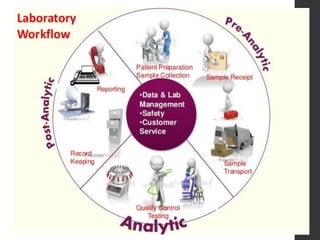
• We customarily divide the process into 3 sections:
• Pre-analytical, where problems in collection, storage and
transport, delays in receipt in laboratory, errors in data entry
and errors in sample preparation for analysis must be
identified and rectified
• Analytical, the area where calibrators, standards, internal and
external QC programs are relevant
• Post-analytical, where storage and access of results must be
easy, and delays in transmitting results to requesting doctor
including urgent messages must be minimised
Types of errors
• Random error
• Systematic error
Random error
• An error which varies in an
unpredictable manner in
magnitude.
• Difficult to eliminate.
• But repetition reduces the influence
of random error.
• Can be minimized by appropriate
trainings, supervision and standard
operating procedures.
Systematic error
• An error which, in the course of a
number of measurements of the same
value of a given quantity remains
constant under same condition.
• It creates a characteristic bias in the
test results
• Can be accounted for by applying a
correction.
• Example: change in the reagent batch
or modification in the testing method.
• The analytical stage and post
analytical stage depends primarily
on the integrity of the specimen
submitted to the laboratory.
• Pre-analytical stage can account for
up to the 75% of the laboratory
errors.
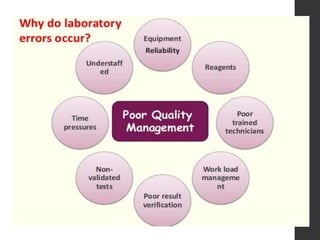
PRE-ANALYTICAL ERRORS
• With the sophistication of modern analytical equipment, errors
are fewer and so a major proportion of current errors arises in
this pre-analytical phase
• Wrong patient identification, especially with crowded
wards/clinics and overworked staff
• Wrong sample collection – wrong anticoagulant for the test –
inadequate identification details (or none) or no time on sample
• Collection of contaminated sample – wrong tube for trace metals,
collection from vein with drip running in. Improper handling,
container, preservative and storage in 24-hour urine collections
• Wrong storage or transport conditions – too cold affects K, too
warm affects glucose. Some tests need freezing ASAP after
collection and centrifugation (-20º or -80º)
• Incorrect data entry, typos, illegible handwriting by doctor, delays
in receipt in laboratory and cell content leakage into plasma
PRE-ANALYTICAL SURVEILLANCE
• Modern computer systems can generate lists of results that
fulfil criteria that indicate especial risks of errors
• These include major change from previous results in
electrolytes, renal function, liver enzymes etc. which need to
be examined by the clinical chemist for consistency with
patient management
• Drip arm contamination is suspected from high Cl (normal
saline), unexpectedly high glucose and low Na (5% glucose or
glucose saline), unexpectedly high K (K supplements) and
overall it is surprisingly common, often due to inadequate
return of blood through the cannula to wash out the fluid (this
is not easy with premature babies!)
• Laboratory experience is the only way to learn these problems
ANALYTICAL PROCESSES
• We tend to concentrate on these aspects as they are much
closer to our normal place of work and there are extensive
systems already available to check the results
• Precision is the term used to describe the degree of
concordance among a series of tests on the same sample –
usually as SD or as CV which is SD/mean as %
• Accuracy is the term used to describe the agreement
between the result obtained and the correct value (if we
know it!)
• It is apparent that precision and accuracy do not
necessarily co-exist – we can get repeated results, all
incorrect by the same amount (precise but inaccurate) or
we can get a wide scatter round the true value (accurate
but imprecise)
• The aim is to be both precise and accurate
LABORATORY CONTROL
• According to the instructions on the machine and/or the
kit inserts, suitable calibrators from the supply firm are
used to set up the analysis. The calibration process has to
be done as often as recommended – depending on machine
and test. If the calibration does not give the correct result
then suitable cleaning or other maintenance is needed
• For most tests we run internal controls (usually obtained
from a different source) once or more each day, and these
results are stored in the machine computer for 4-6 weeks
so that a graphical presentation can be viewed.
How do we know we are right?
• Standardization
• Calibration
• Reagents
• Test conditions
• Quality control
• Internal quality control
• External quality assurance
Quality assurance
• It is defined as the over all program
that ensures the final results
reported by the laboratory are
correct.
• It is done to ensure: 6 R’s
• Right test is done
• Right specimen
• Right result
• Right interpretation is delivered
• Right person
• Right time
Quality assurance in
laboratory
• It involve:
• Internal quality control
• External quality assurance
Internal quality control (IQC)
• Done daily in the lab
• Applied to all work process and to
every tests done in the lab
• IQC procedures identifies problems
immediately.
Internal quality control (IQC)
• Examples:
• Daily recording of temperature in
refrigerator/incubator
• Repeating tests
• Following standard operating procedures
• Advantages:
• Mistakes can be avoided
• Quality of test results are raised
Internal quality control (IQC)
• Done by using:
• Levey – Jennings chart
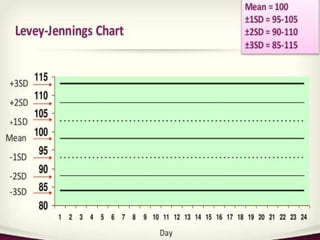
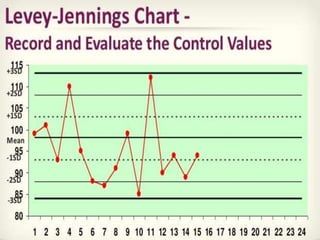
Levey - Jennings chart
• It is graphical representation of
control ranges.
If QC is out of control
• Stop the test
• Identify and correct the problem
• Repeat testing on patient sample
and control
• Do not report patient result until
problem is solved.
External Quality Assurance
(EQA)
• A system for objectively checking
the laboratory’s performance using
an external agency or facility.
• Important for improvement
Thank you

Quality Control

  • 1.
  • 2.
    Quality control • Itrefers to the measures that must be included during each test run to verify that the test is working properly. • It is done to ensure that the results generated by the tests are correct.
  • 3.
    OVERVIEW OF QC •Quality includes all those aspects of laboratory work and sample handling from test ordering by doctor, sample collection, transport and storage, sample preparation, data entry, analysis, data recording and information transfer back to requesting doctor • It can be seen that the analysis is only one of a number of items in this chain, problems in any one of which vitiate the result • We customarily divide the process into 3 sections: • Pre-analytical, where problems in collection, storage and transport, delays in receipt in laboratory, errors in data entry and errors in sample preparation for analysis must be identified and rectified • Analytical, the area where calibrators, standards, internal and external QC programs are relevant • Post-analytical, where storage and access of results must be easy, and delays in transmitting results to requesting doctor including urgent messages must be minimised
  • 4.
    Types of errors •Random error • Systematic error
  • 5.
    Random error • Anerror which varies in an unpredictable manner in magnitude. • Difficult to eliminate. • But repetition reduces the influence of random error. • Can be minimized by appropriate trainings, supervision and standard operating procedures.
  • 6.
    Systematic error • Anerror which, in the course of a number of measurements of the same value of a given quantity remains constant under same condition. • It creates a characteristic bias in the test results • Can be accounted for by applying a correction. • Example: change in the reagent batch or modification in the testing method.
  • 9.
    • The analyticalstage and post analytical stage depends primarily on the integrity of the specimen submitted to the laboratory. • Pre-analytical stage can account for up to the 75% of the laboratory errors.
  • 10.
    PRE-ANALYTICAL ERRORS • Withthe sophistication of modern analytical equipment, errors are fewer and so a major proportion of current errors arises in this pre-analytical phase • Wrong patient identification, especially with crowded wards/clinics and overworked staff • Wrong sample collection – wrong anticoagulant for the test – inadequate identification details (or none) or no time on sample • Collection of contaminated sample – wrong tube for trace metals, collection from vein with drip running in. Improper handling, container, preservative and storage in 24-hour urine collections • Wrong storage or transport conditions – too cold affects K, too warm affects glucose. Some tests need freezing ASAP after collection and centrifugation (-20º or -80º) • Incorrect data entry, typos, illegible handwriting by doctor, delays in receipt in laboratory and cell content leakage into plasma
  • 11.
    PRE-ANALYTICAL SURVEILLANCE • Moderncomputer systems can generate lists of results that fulfil criteria that indicate especial risks of errors • These include major change from previous results in electrolytes, renal function, liver enzymes etc. which need to be examined by the clinical chemist for consistency with patient management • Drip arm contamination is suspected from high Cl (normal saline), unexpectedly high glucose and low Na (5% glucose or glucose saline), unexpectedly high K (K supplements) and overall it is surprisingly common, often due to inadequate return of blood through the cannula to wash out the fluid (this is not easy with premature babies!) • Laboratory experience is the only way to learn these problems
  • 12.
    ANALYTICAL PROCESSES • Wetend to concentrate on these aspects as they are much closer to our normal place of work and there are extensive systems already available to check the results • Precision is the term used to describe the degree of concordance among a series of tests on the same sample – usually as SD or as CV which is SD/mean as % • Accuracy is the term used to describe the agreement between the result obtained and the correct value (if we know it!) • It is apparent that precision and accuracy do not necessarily co-exist – we can get repeated results, all incorrect by the same amount (precise but inaccurate) or we can get a wide scatter round the true value (accurate but imprecise) • The aim is to be both precise and accurate
  • 13.
    LABORATORY CONTROL • Accordingto the instructions on the machine and/or the kit inserts, suitable calibrators from the supply firm are used to set up the analysis. The calibration process has to be done as often as recommended – depending on machine and test. If the calibration does not give the correct result then suitable cleaning or other maintenance is needed • For most tests we run internal controls (usually obtained from a different source) once or more each day, and these results are stored in the machine computer for 4-6 weeks so that a graphical presentation can be viewed.
  • 14.
    How do weknow we are right? • Standardization • Calibration • Reagents • Test conditions • Quality control • Internal quality control • External quality assurance
  • 15.
    Quality assurance • Itis defined as the over all program that ensures the final results reported by the laboratory are correct. • It is done to ensure: 6 R’s • Right test is done • Right specimen • Right result • Right interpretation is delivered • Right person • Right time
  • 16.
    Quality assurance in laboratory •It involve: • Internal quality control • External quality assurance
  • 17.
    Internal quality control(IQC) • Done daily in the lab • Applied to all work process and to every tests done in the lab • IQC procedures identifies problems immediately.
  • 18.
    Internal quality control(IQC) • Examples: • Daily recording of temperature in refrigerator/incubator • Repeating tests • Following standard operating procedures • Advantages: • Mistakes can be avoided • Quality of test results are raised
  • 19.
    Internal quality control(IQC) • Done by using: • Levey – Jennings chart
  • 20.
    Levey - Jenningschart • It is graphical representation of control ranges.
  • 23.
    If QC isout of control • Stop the test • Identify and correct the problem • Repeat testing on patient sample and control • Do not report patient result until problem is solved.
  • 24.
    External Quality Assurance (EQA) •A system for objectively checking the laboratory’s performance using an external agency or facility. • Important for improvement
  • 25.