









1 of 58
2 of 58Quality Control in
Clinical Biochemistry
Ashok Katta
“Quality is never an accident; it is always the result of
high intention, sincere effort, intelligent direction and
skillful execution; it represents the wise choice of
many alternatives.”
3 of 58Quality Control in
Clinical Biochemistry
Ashok Katta
Importance of laboratory test in
clinical medicine
Lab tests constitute only one part of the
diagnostic process in clinical medicine.
In fact, it has been stated that an experienced
physician may arrive at a relatively accurate
diagnosis in ~80% of cases, based solely on a
thorough history and physical examination.
However, there is no doudt that, nowadays,
biochemical and other lab tests are almost always
an important part of the overall diagnostic process.
The use of biochemical investigation and lab tests
is, helping physicians and healthcare workers make
diagnoses and other clinical judgment.
4 of 58Quality Control in
Clinical Biochemistry
Ashok Katta
The results obtained from
laboratory analyses are used
to…
diagnose,
prescribe treatment, and/or
Monitor the health or progress
of the patient.
Since such importance is
placed upon test results, they
must be as reliable and
accurate as possible.
5 of 58Quality Control in
Clinical Biochemistry
Ashok Katta
Who determines if a patient gets a statin?
We do !
6 of 58Quality Control in
Clinical Biochemistry
Ashok Katta
Who determines if a patient gets a Dx of DM?
We do !
7 of 58Quality Control in
Clinical Biochemistry
Ashok Katta
Who determines if a patient gets a prostrate biopsy?
We do !
8 of 58Quality Control in
Clinical Biochemistry
Ashok Katta
Who determines if a patient gets dialysis?
We do !
9 of 58Quality Control in
Clinical Biochemistry
Ashok Katta
How do we know we are right?
Do we?We do !
10 of 58Quality Control in
Clinical Biochemistry
Ashok Katta
LAB-1
LAB-2
LAB-3
11 of 58Quality Control in
Clinical Biochemistry
Ashok Katta
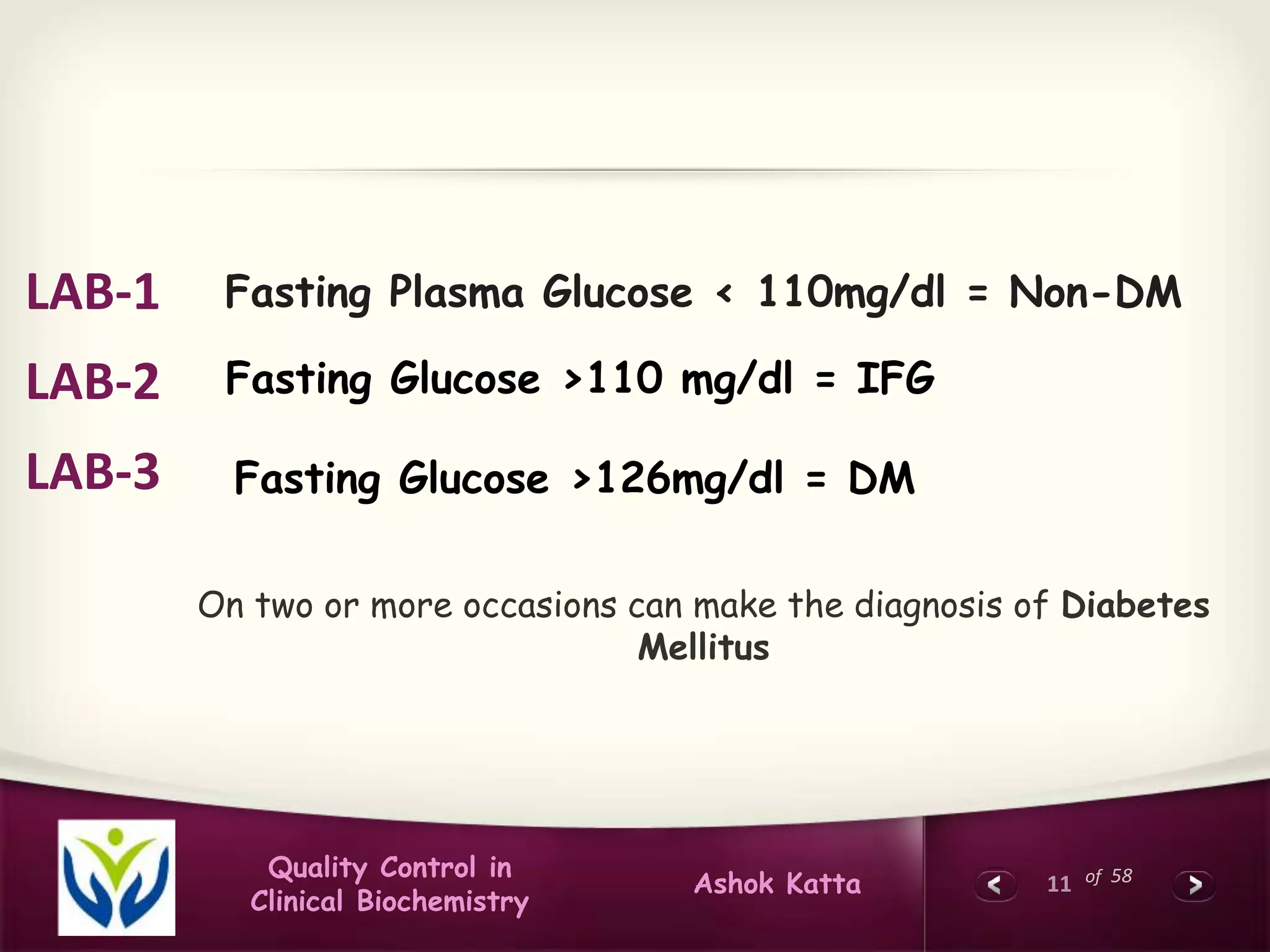
Fasting Plasma Glucose < 110mg/dl = Non-DM
On two or more occasions can make the diagnosis of Diabetes
Mellitus
Fasting Glucose >110 mg/dl = IFG
Fasting Glucose >126mg/dl = DM
LAB-1
LAB-2
LAB-3
12 of 58Quality Control in
Clinical Biochemistry
Ashok Katta
To know the answer for this
question, first you should
understand
How Clinical Biochemistry
Lab works.
How do we know we are right?
13 of 58Quality Control in
Clinical Biochemistry
Ashok Katta
Errors in the
clinical Laboratory
Equipment
Reliability
Reagents
Poor
trained
technicians
Work load
managemen
t
Poor result
verification
Non-
validated
tests
Time
pressures
Under-
staffed
Why do laboratory
errors occur?
Poor Quality
Management
15 of 58Quality Control in
Clinical Biochemistry
Ashok Katta
Types of Error
Random error
An error which varies in an
unpredictable manner in…
Magnitude
Sign
Difficult to eliminate but
repetition reduces the influence
of random error
Example – error in pipetting
Can be minimized by training,
supervision and by SOPs
Systematic error
An error which, in the course of a
number of measurements of the same
value of a given quantity remains
constant under same condition.
Systematic errors create a
characteristic bias in the test results
and can be accounted for by applying a
correction.
Example - change in the reagent batch
or modifications in testing method.
16 of 58Quality Control in
Clinical Biochemistry
Ashok Katta
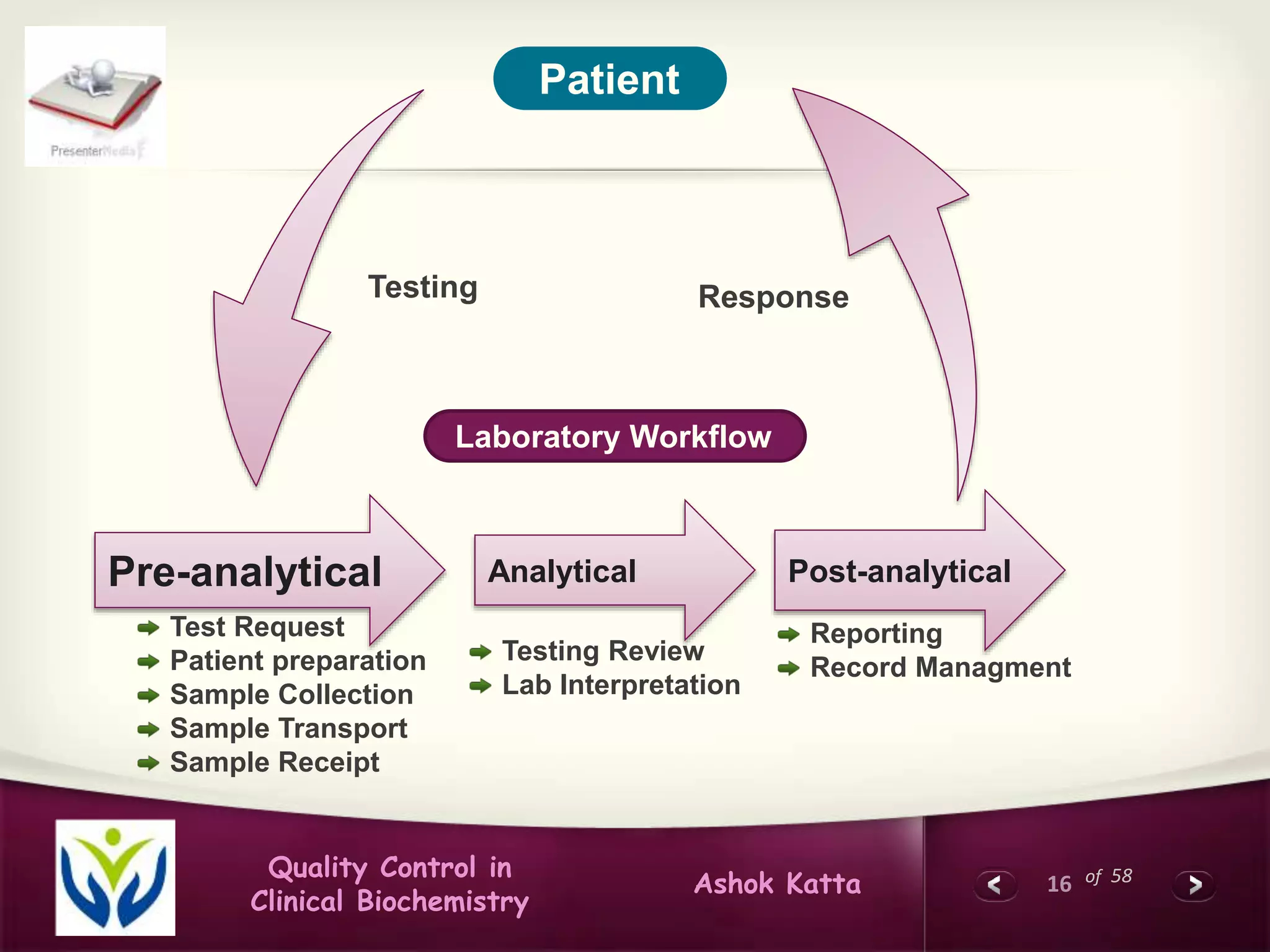
Testing Response
Laboratory Workflow
Patient
Pre-analytical Analytical Post-analytical
Test Request
Patient preparation
Sample Collection
Sample Transport
Sample Receipt
Testing Review
Lab Interpretation
Reporting
Record Managment
Laboratory
Workflow
Patient Preparation
Sample Collection Sample Receipt
Sample
Transport
Reporting
•Data & Lab
Management
•Safety
•Customer
Service
Quality Control
Testing
Record
Keeping
18 of 58Quality Control in
Clinical Biochemistry
Ashok Katta
3 phases of laboratory testing:
Pre-analytical,
analytical and
post-analytical
Pre-analytical—specimen
collection, transport and processing
Analytical—testing
Post-analytical—testing results
transmission, interpretation, follow-
up, retesting.
19 of 58Quality Control in
Clinical Biochemistry
Ashok Katta
Effects of Pre-analytical Variables on the
Quality of Laboratory Testing
What are pre-analytical variables ?
These are variables that can occur from the time when
the test is ordered by the physician until the sample is
ready for analysis.
The pre-analytical stage is the most important.
Pre-analytical variables account for upto 75% of
laboratory errors.
The analytical stage & post analytical stages depend
primarily on the integrity of the specimen submitted to
the laboratory.
Laboratory staff involved in specimen collection have a
direct impact on the outcome of patients lab results.
20 of 58Quality Control in
Clinical Biochemistry
Ashok Katta
The Pre-Analytical process
Identify the patient:
Get A Suitable Sample
Transport to Lab
Receive In Lab:
Prepare For Testing:
21 of 58Quality Control in
Clinical Biochemistry
Ashok Katta
Examples of possible preanalytical variables:
Patient Identification:
- It is important to identify a patient accurately so
that blood is collected from the correct person.
- Drawing blood from the wrong person, or labeling
the correct patient’s sample with a different
patient’s label can certainly contribute to
laboratory error. (Mislabeling ???)
22 of 58Quality Control in
Clinical Biochemistry
Ashok Katta
Analytical phase
Standardisation
Calibrators
Reagents
Test conditions
Quality Control
External Quality Assurance (EQA)
Internal Quality Control (IQC)
How do we know we are right?
23 of 58Quality Control in
Clinical Biochemistry
Ashok Katta
Factors influencing quality:
Post-analytical
• Right recording and reporting
• Right interpretation
– Range of normal values
• Right turnaround time
• Report to right user
24 of 58Quality Control in
Clinical Biochemistry
Ashok Katta
Quality control & Quality Assurance
Quality control
Refers to the measures that must be
included during each test run to verify that
the test is working properly
Aim:
• To ensure that the results generated by
the tests are correct
Quality Assurance
Defined as the overall program that
ensures that final results reported by the
laboratory are correct.
Aim:
• Ensure that
Right test is carried out on
Right specimen and
Right result and
Right interpretation is delivered to
Right person at
Right time.
25 of 58Quality Control in
Clinical Biochemistry
Ashok Katta
Quality Assurance in Laboratory
Quality assurance in Laboratory involves……
Internal Quality Control (IQC)
External Quality Assurance (EQA)
26 of 58Quality Control in
Clinical Biochemistry
Ashok Katta
Internal Quality Control (IQC)
Done daily in the laboratory
Applied to all work processes and to every
test done in the lab.
IQC procedures identify problems
immediately.
27 of 58Quality Control in
Clinical Biochemistry
Ashok Katta
Internal Quality Control (IQC)
Examples
Daily recording of temp in refrigerator / incubator
Repeating tests
Following SOPs
Advantage
Mistakes can be avoided
Quality of test results are raised
28 of 58Quality Control in
Clinical Biochemistry
Ashok Katta
IQC Program
Internal Quality Control program
depends on the use of....
Internal Quality Control (IQC) specimen
Levey Jennings Charts
The use of statistical methods for interpretation.
29 of 58Quality Control in
Clinical Biochemistry
Ashok Katta
What is control?
Material that contains the substance
being analysed
Used to validate reliability of the
test system.
Run after calibrating the instrument
Run periodically during testing
30 of 58Quality Control in
Clinical Biochemistry
Ashok Katta
Steps in Implementing Quality Control
Obtain control material
Run each control daily along
with patient sample. OR
Run each control 20 times over
30 days
Calculate mean and ± 1,2,3 SD
Mean
1SD
1SD
2SD
3SD
2SD
3SD
31 of 58Ashok KattaQuality Control in
Clinical Biochemistry
Levey- Jennings Chart
Graphically Representing Control Ranges
32 of 58Quality Control in
Clinical Biochemistry
Ashok Katta
80
85
90
95
100
105
110
115
1 2 3 4 5 6 7 8 9 10 11 12 13 14 15 16 17 18 19 20 21 22 23 24
Mean
Day
+1SD
+2SD
+3SD
-1SD
-2SD
-3SD
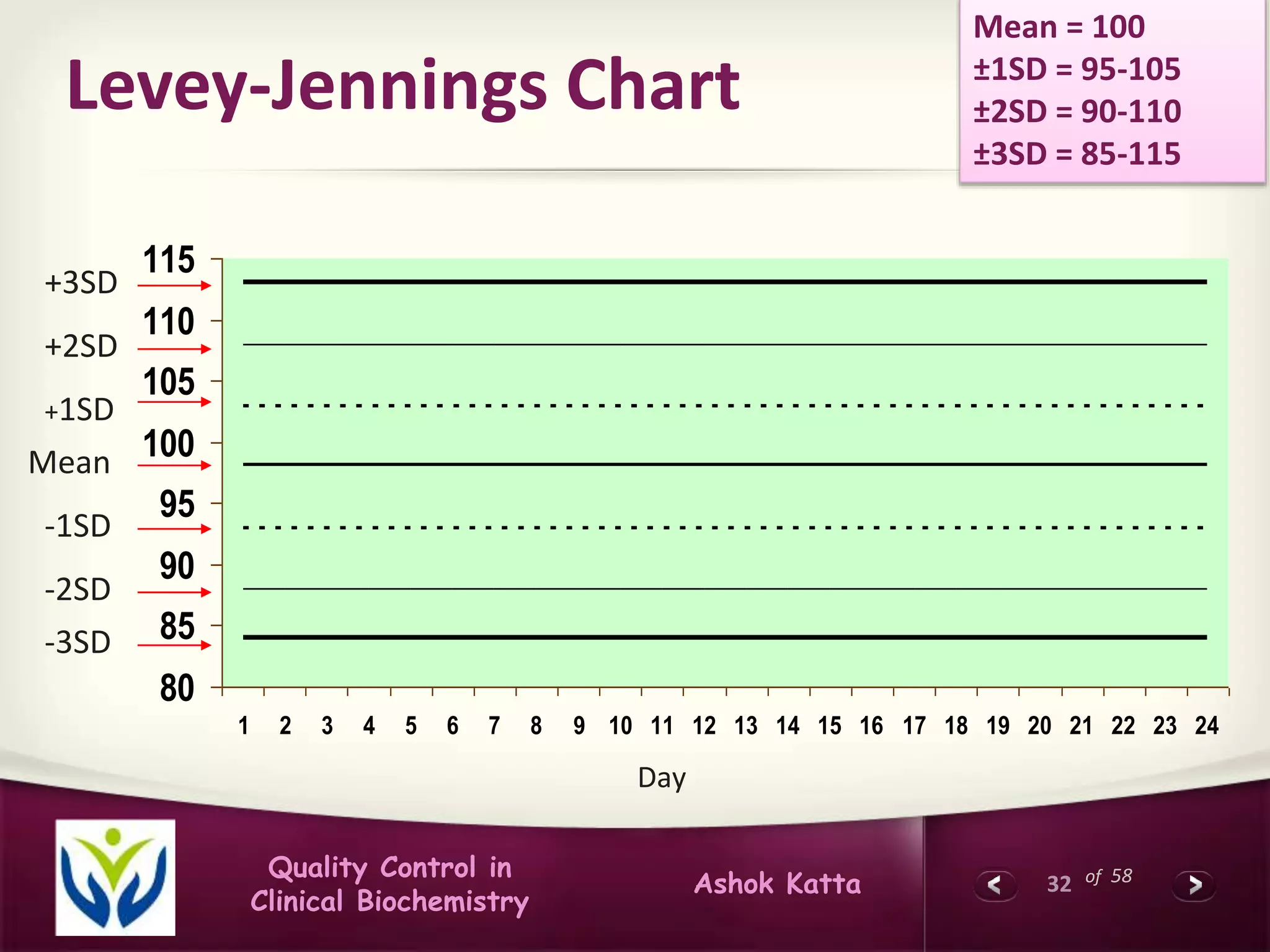
Levey-Jennings Chart
Mean = 100
±1SD = 95-105
±2SD = 90-110
±3SD = 85-115
33 of 58Quality Control in
Clinical Biochemistry
Ashok Katta
Levey-Jennings Chart -
Record and Evaluate the Control Values
80
85
90
95
100
105
110
115
1 2 3 4 5 6 7 8 9 10 11 12 13 14 15 16 17 18 19 20 21 22 23 24
Mean
Day
+1SD
+2SD
+3SD
-1SD
-2SD
-3SD
34 of 58Quality Control in
Clinical Biochemistry
Ashok Katta
35 of 58Quality Control in
Clinical Biochemistry
Ashok Katta
36 of 58Quality Control in
Clinical Biochemistry
Ashok Katta
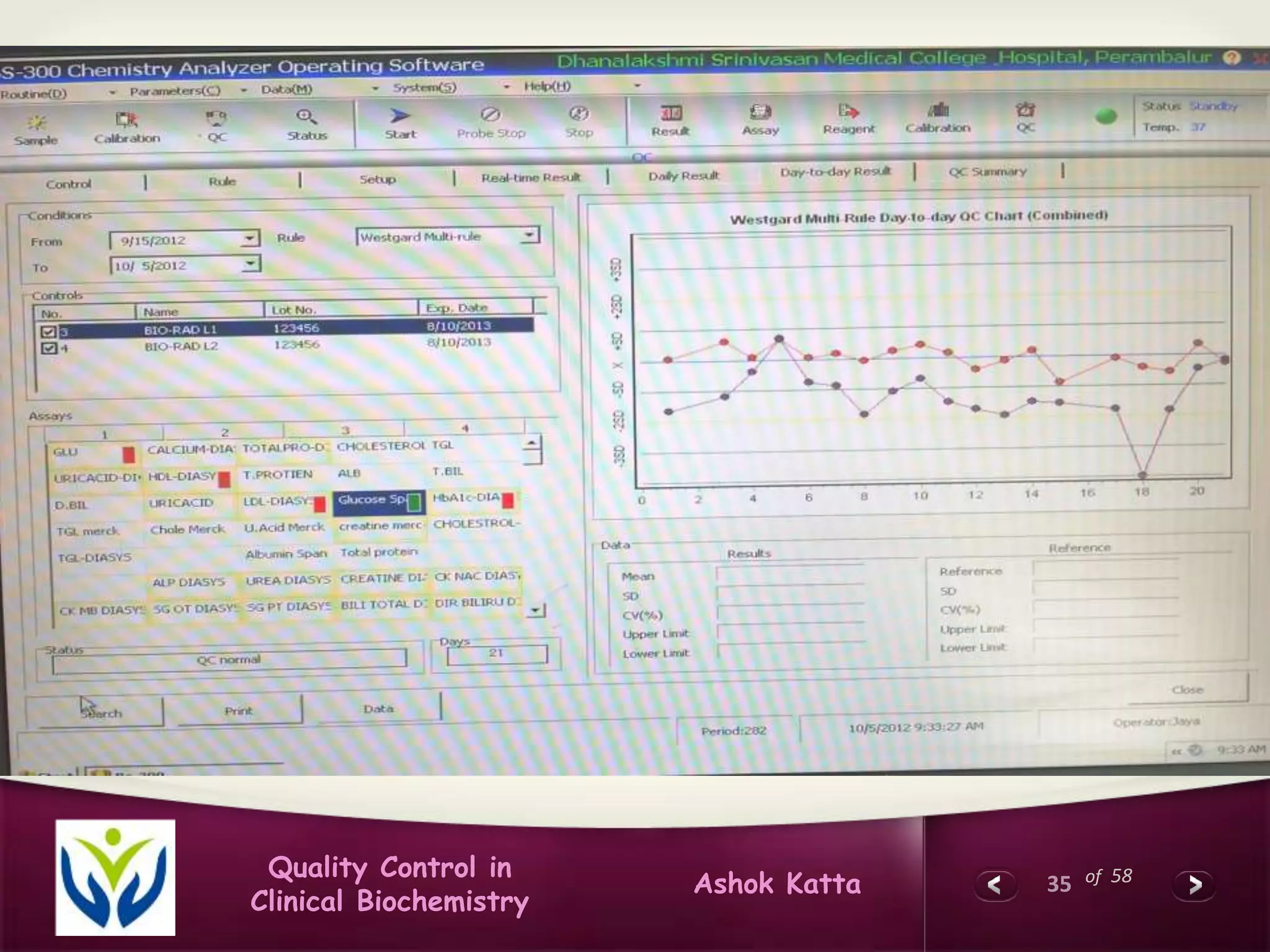
Westgard Rules
“Multirule Quality Control”
Uses a combination of decision
criteria or control rules
Allows determination of whether
an analytical run is “in-control” or
“out-of-control”
37 of 58Quality Control in
Clinical Biochemistry
Ashok Katta
Westgard Rules
12S rule
13S rule
22S rule
R4S rule
41S rule
10X rule
(Generally used where 2 levels of control
material are analyzed per run)
WARNING RULES -
 Warning 12SD : One of two control results falls
outside ±2SD. Alerts tech to possible problems. Not
cause for rejecting a run.
Control Rules – Westguard Multirule Chart
WARNING RULES -
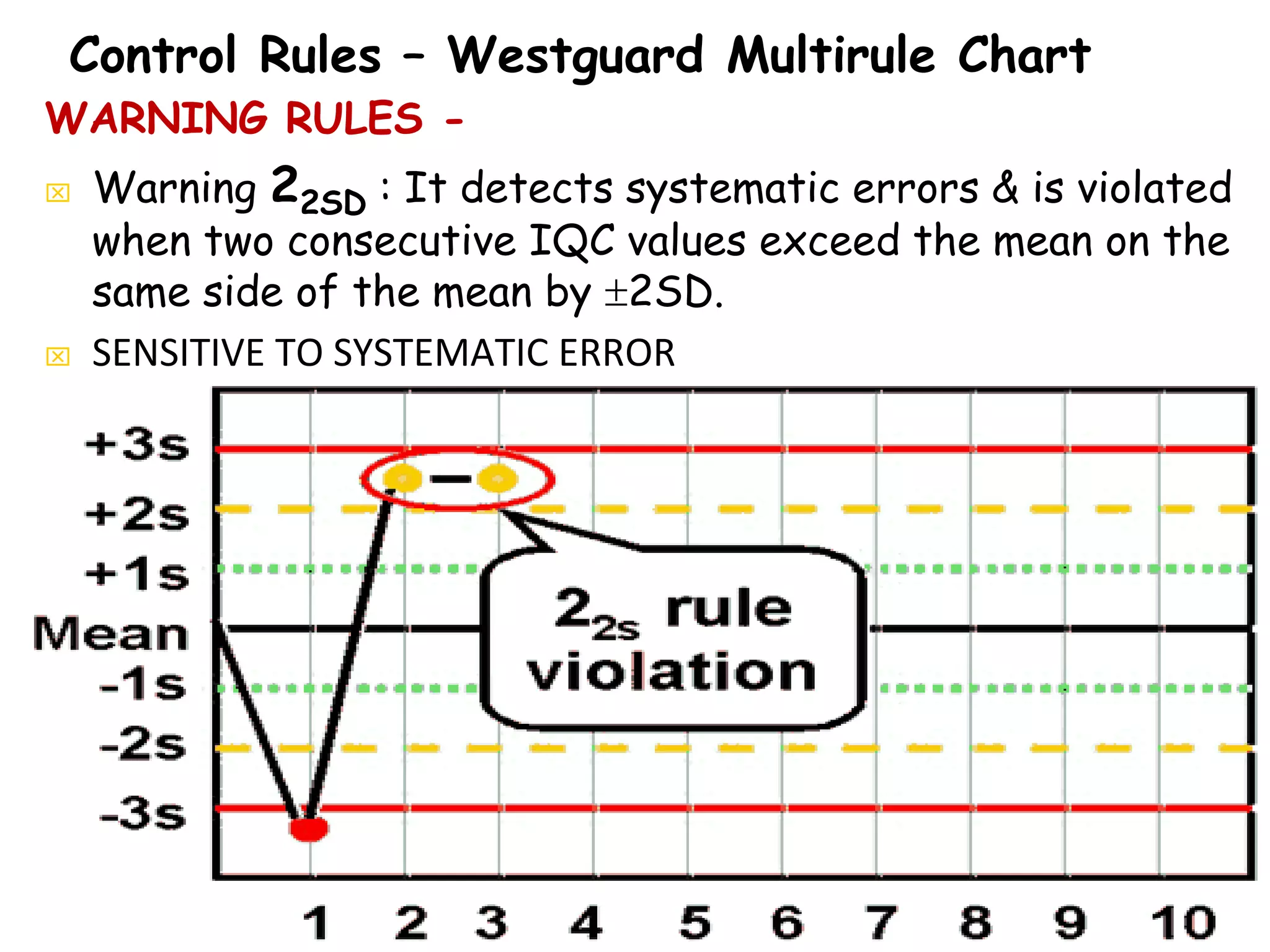
 Warning 22SD : It detects systematic errors & is violated
when two consecutive IQC values exceed the mean on the
same side of the mean by 2SD.
 SENSITIVE TO SYSTEMATIC ERROR
Control Rules – Westguard Multirule Chart
WARNING RULES -
 Warning 41SD: It is violated if 04 consecutive IQC values
exceed the same limit (mean  1SD) & this may indicate
the need to perform instrument maintenance or reagent.
 SENSITIVE TO SYSTEMATIC ERROR
Control Rules – Westguard Multirule Chart
MANDATORY RULES -
 Mandatory 13SD: It is violated when the IQC value
exceeds the mean by 3SD. The assay run is regarded as
out of control. SENSITIVE TO RANDOM ERROR
Control Rules – Westguard Multirule Chart
MANDATORY RULES -
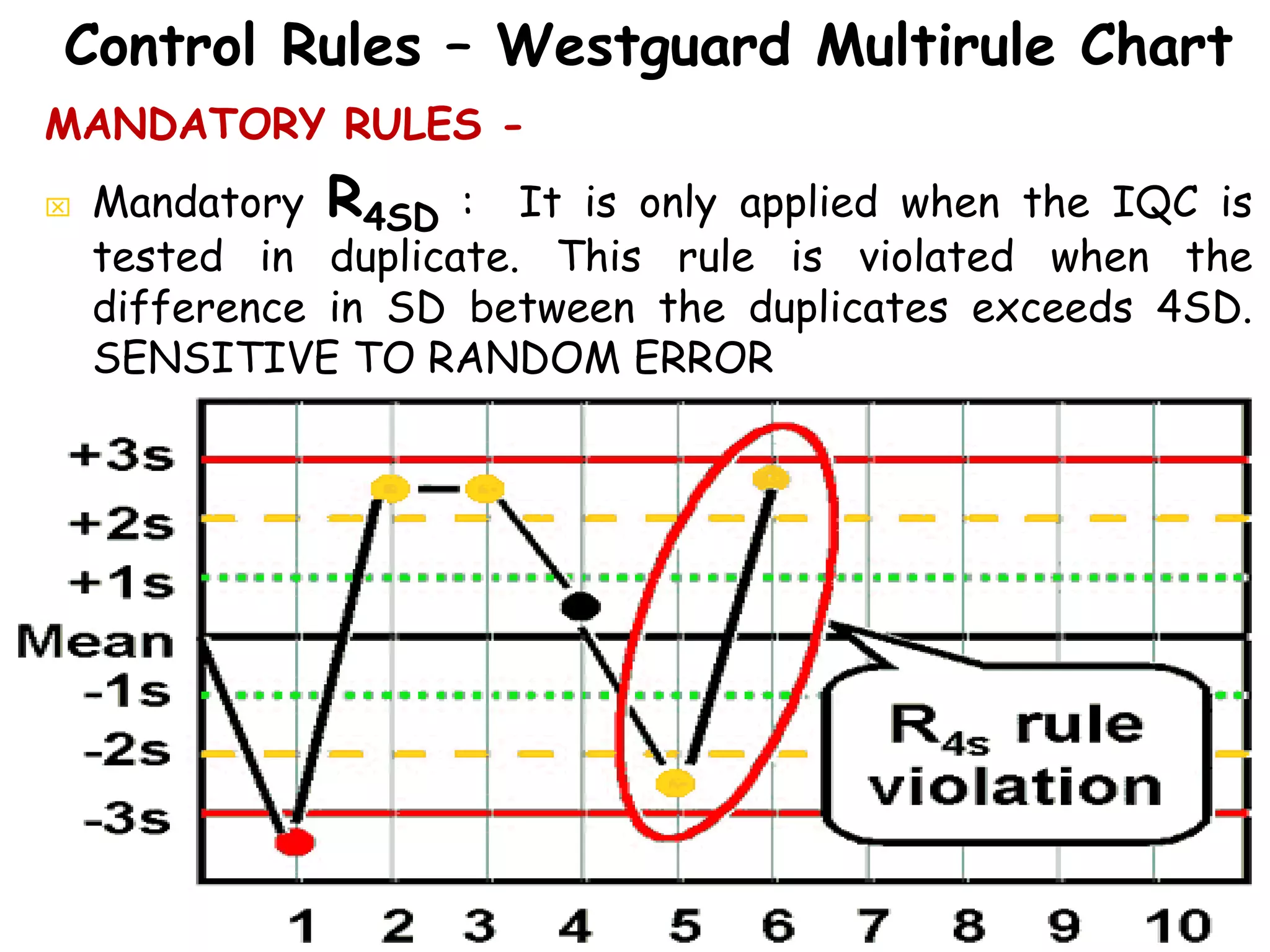
 Mandatory R4SD : It is only applied when the IQC is
tested in duplicate. This rule is violated when the
difference in SD between the duplicates exceeds 4SD.
SENSITIVE TO RANDOM ERROR
Control Rules – Westguard Multirule Chart
MANDATORY RULES -
 Mandatory 10x : Reject the run when 10 consecutive
control measurements fall on one side of the mean.
SENSITIVE TO SYSTEMATIC ERROR
Control Rules – Westguard Multirule Chart
44 of 58Quality Control in
Clinical Biochemistry
Ashok Katta
When a rule is violated
QC Data
12s
13s 22s R4s 41s 10x
Report Results
“Out of control” Take Corrective Action
45 of 58Quality Control in
Clinical Biochemistry
Ashok Katta
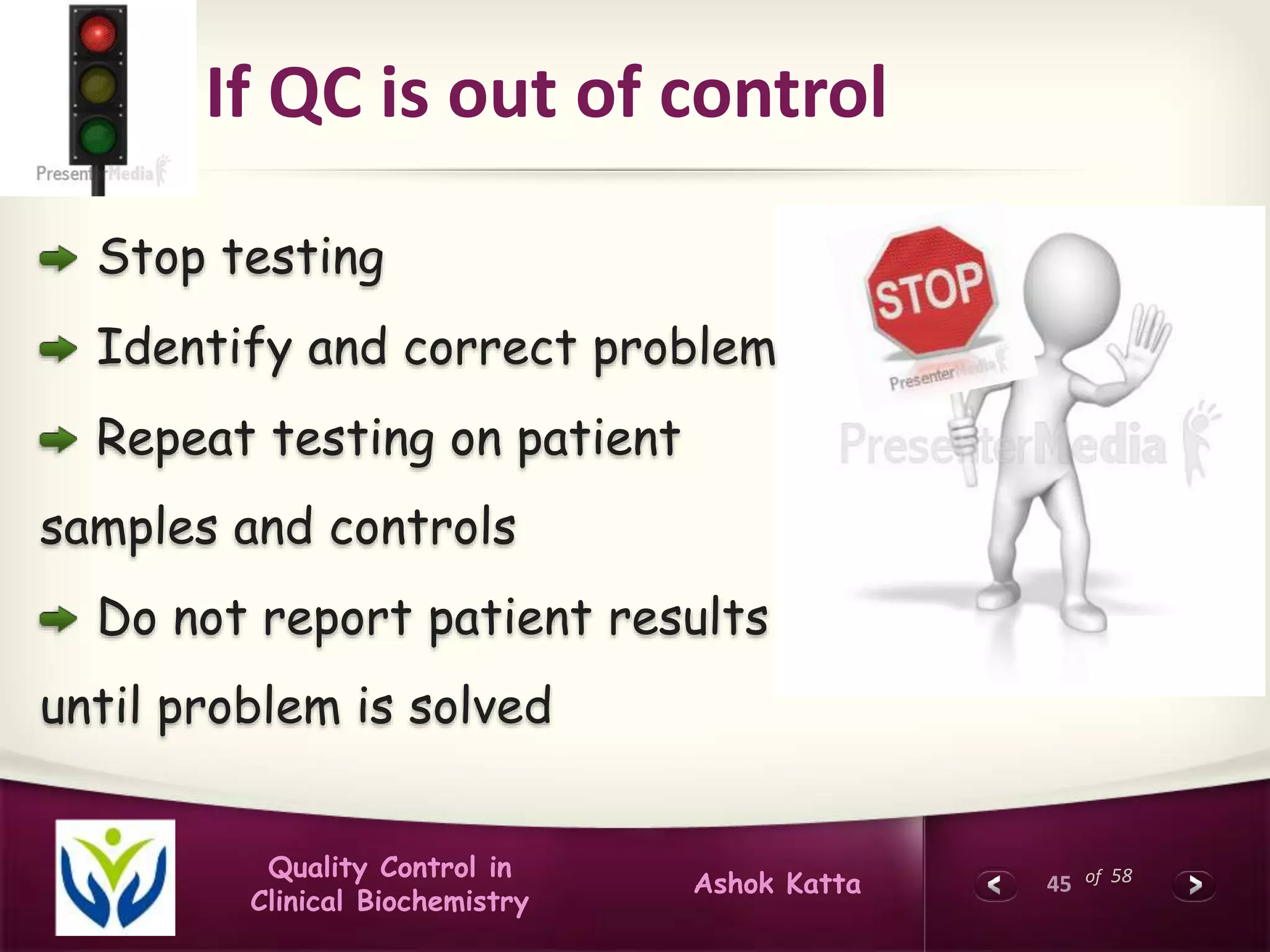
If QC is out of control
Stop testing
Identify and correct problem
Repeat testing on patient
samples and controls
Do not report patient results
until problem is solved
46 of 58Quality Control in
Clinical Biochemistry
Ashok Katta
Solving out-of-control problems
Identify problem
Refer to established policies
and procedures for remedial
action.
47 of 58Quality Control in
Clinical Biochemistry
Ashok Katta
Possible Problems
Degradation of reagents or kits
Control material degradation
Calibration error
Operator error
An outdated procedure manual
Equipment failure
48 of 58Quality Control in
Clinical Biochemistry
Ashok Katta
EXTERNAL QUALITY CONTROL /
ASSESSMENT
E Q A S
49 of 58Quality Control in
Clinical Biochemistry
Ashok Katta
External Quality Assessment
A system for objectively checking the
laboratory’s performance using an external
agency or facility.
50 of 58Ashok KattaQuality Control in
Clinical Biochemistry
EQA
Important for improvement
A measure of laboratory
performance
51 of 58Quality Control in
Clinical Biochemistry
Ashok Katta
EQA process
EQA organization / Provider Laboratory
Corrective Action
EQAS samples
Sent regularly
Analyze
Return results
Evaluation
EQAS performance
report
52 of 58Quality Control in
Clinical Biochemistry
Ashok Katta
Calculation of VIS
Designated Value [DV] = 120 mg %
Participant's result = 95 mg%
% Variation [%V] = Participant's Result – [DV]
---------------------------------- X 100
Designated value
120-95 X 100 = 25 X 100
120 120
= 20.8
Variance
Index = %V X 100 = 20.8 X 100 = 277
CCV 7.5
VIS = 277
53 of 58Quality Control in
Clinical Biochemistry
Ashok Katta
• Check the VIS & OMVIS values for each parameter
every month
• Check if your value is close to DV
• Closer it is lower will be your VIS & better is your lab’s
accuracy
• Remember If your VIS is < 50 it is regarded and given
as zero score
•Even if >400, it is still given as 400 only
54 of 58Quality Control in
Clinical Biochemistry
Ashok Katta
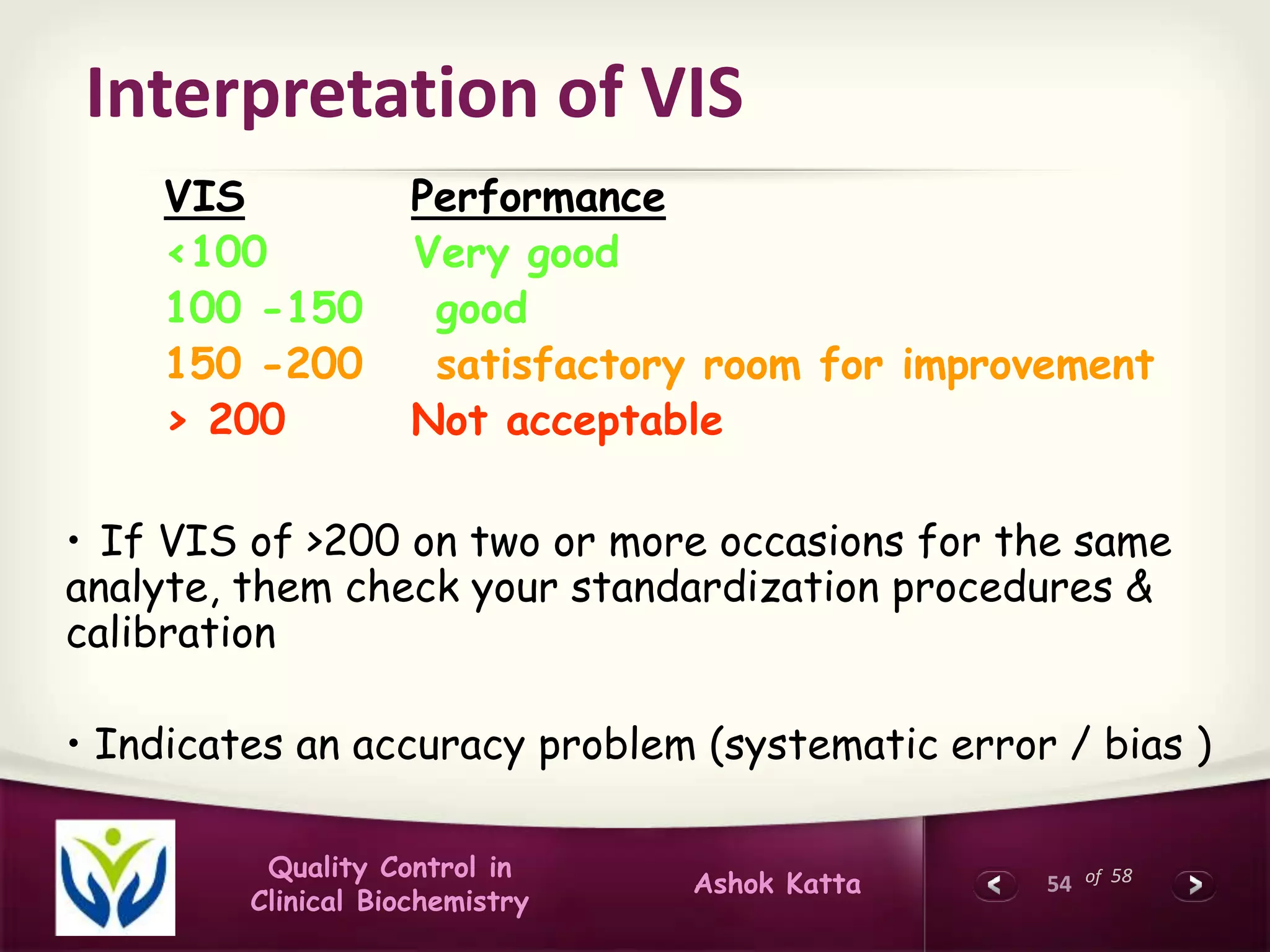
Interpretation of VIS
VIS Performance
<100 Very good
100 -150 good
150 -200 satisfactory room for improvement
> 200 Not acceptable
• If VIS of >200 on two or more occasions for the same
analyte, them check your standardization procedures &
calibration
• Indicates an accuracy problem (systematic error / bias )
55 of 58Quality Control in
Clinical Biochemistry
Ashok Katta
Interpretation of VIS
Check the monthly OMVIS.
OMVIS Performance
< 100 Very good - your result are very close to DV
150-200 Need to take care of those parameters
> 250 You are probably reporting many wrong
results & you should take urgent steps to locate the
problem and correct them
56 of 58Quality Control in
Clinical Biochemistry
Ashok Katta
Performance of our Lab in EQAS
57 of 58Quality Control in
Clinical Biochemistry
Ashok Katta
58 of 58Quality Control in
Clinical Biochemistry
Ashok Katta
59 of 58Quality Control in
Clinical Biochemistry
Ashok Katta
60 of 58Quality Control in
Clinical Biochemistry
Ashok Katta
61 of 58Ashok KattaQuality Control in
Clinical Biochemistry
Key Messages
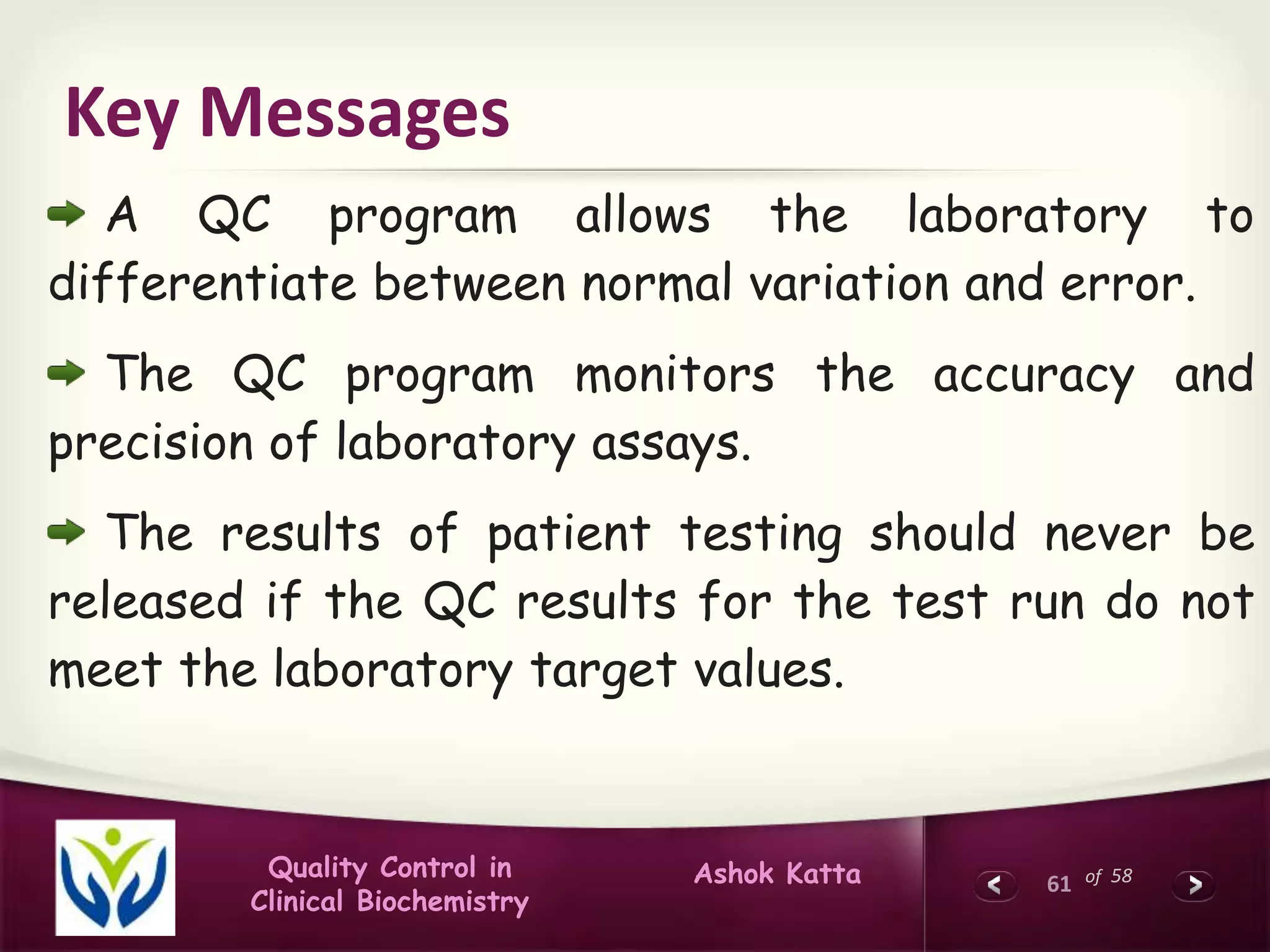
A QC program allows the laboratory to
differentiate between normal variation and error.
The QC program monitors the accuracy and
precision of laboratory assays.
The results of patient testing should never be
released if the QC results for the test run do not
meet the laboratory target values.
62 of 58
Contact no. – 07418831766
E mail – ashokkt@gmail.com
For more presentation visit - http://www.slideshare.net/ashokktt
Ashok Katta
Dept. of Biochemistry,
Dhanalakshmi Srinivasan Medical College,
Perambalur

Quality control in clinical biochemistry

  • 1.
  • 2.
    2 of 58QualityControl in Clinical Biochemistry Ashok Katta “Quality is never an accident; it is always the result of high intention, sincere effort, intelligent direction and skillful execution; it represents the wise choice of many alternatives.”
  • 3.
    3 of 58QualityControl in Clinical Biochemistry Ashok Katta Importance of laboratory test in clinical medicine Lab tests constitute only one part of the diagnostic process in clinical medicine. In fact, it has been stated that an experienced physician may arrive at a relatively accurate diagnosis in ~80% of cases, based solely on a thorough history and physical examination. However, there is no doudt that, nowadays, biochemical and other lab tests are almost always an important part of the overall diagnostic process. The use of biochemical investigation and lab tests is, helping physicians and healthcare workers make diagnoses and other clinical judgment.
  • 4.
    4 of 58QualityControl in Clinical Biochemistry Ashok Katta The results obtained from laboratory analyses are used to… diagnose, prescribe treatment, and/or Monitor the health or progress of the patient. Since such importance is placed upon test results, they must be as reliable and accurate as possible.
  • 5.
    5 of 58QualityControl in Clinical Biochemistry Ashok Katta Who determines if a patient gets a statin? We do !
  • 6.
    6 of 58QualityControl in Clinical Biochemistry Ashok Katta Who determines if a patient gets a Dx of DM? We do !
  • 7.
    7 of 58QualityControl in Clinical Biochemistry Ashok Katta Who determines if a patient gets a prostrate biopsy? We do !
  • 8.
    8 of 58QualityControl in Clinical Biochemistry Ashok Katta Who determines if a patient gets dialysis? We do !
  • 9.
    9 of 58QualityControl in Clinical Biochemistry Ashok Katta How do we know we are right? Do we?We do !
  • 10.
    10 of 58QualityControl in Clinical Biochemistry Ashok Katta LAB-1 LAB-2 LAB-3
  • 11.
    11 of 58QualityControl in Clinical Biochemistry Ashok Katta Fasting Plasma Glucose < 110mg/dl = Non-DM On two or more occasions can make the diagnosis of Diabetes Mellitus Fasting Glucose >110 mg/dl = IFG Fasting Glucose >126mg/dl = DM LAB-1 LAB-2 LAB-3
  • 12.
    12 of 58QualityControl in Clinical Biochemistry Ashok Katta To know the answer for this question, first you should understand How Clinical Biochemistry Lab works. How do we know we are right?
  • 13.
    13 of 58QualityControl in Clinical Biochemistry Ashok Katta Errors in the clinical Laboratory
  • 14.
  • 15.
    15 of 58QualityControl in Clinical Biochemistry Ashok Katta Types of Error Random error An error which varies in an unpredictable manner in… Magnitude Sign Difficult to eliminate but repetition reduces the influence of random error Example – error in pipetting Can be minimized by training, supervision and by SOPs Systematic error An error which, in the course of a number of measurements of the same value of a given quantity remains constant under same condition. Systematic errors create a characteristic bias in the test results and can be accounted for by applying a correction. Example - change in the reagent batch or modifications in testing method.
  • 16.
    16 of 58QualityControl in Clinical Biochemistry Ashok Katta Testing Response Laboratory Workflow Patient Pre-analytical Analytical Post-analytical Test Request Patient preparation Sample Collection Sample Transport Sample Receipt Testing Review Lab Interpretation Reporting Record Managment
  • 17.
    Laboratory Workflow Patient Preparation Sample CollectionSample Receipt Sample Transport Reporting •Data & Lab Management •Safety •Customer Service Quality Control Testing Record Keeping
  • 18.
    18 of 58QualityControl in Clinical Biochemistry Ashok Katta 3 phases of laboratory testing: Pre-analytical, analytical and post-analytical Pre-analytical—specimen collection, transport and processing Analytical—testing Post-analytical—testing results transmission, interpretation, follow- up, retesting.
  • 19.
    19 of 58QualityControl in Clinical Biochemistry Ashok Katta Effects of Pre-analytical Variables on the Quality of Laboratory Testing What are pre-analytical variables ? These are variables that can occur from the time when the test is ordered by the physician until the sample is ready for analysis. The pre-analytical stage is the most important. Pre-analytical variables account for upto 75% of laboratory errors. The analytical stage & post analytical stages depend primarily on the integrity of the specimen submitted to the laboratory. Laboratory staff involved in specimen collection have a direct impact on the outcome of patients lab results.
  • 20.
    20 of 58QualityControl in Clinical Biochemistry Ashok Katta The Pre-Analytical process Identify the patient: Get A Suitable Sample Transport to Lab Receive In Lab: Prepare For Testing:
  • 21.
    21 of 58QualityControl in Clinical Biochemistry Ashok Katta Examples of possible preanalytical variables: Patient Identification: - It is important to identify a patient accurately so that blood is collected from the correct person. - Drawing blood from the wrong person, or labeling the correct patient’s sample with a different patient’s label can certainly contribute to laboratory error. (Mislabeling ???)
  • 22.
    22 of 58QualityControl in Clinical Biochemistry Ashok Katta Analytical phase Standardisation Calibrators Reagents Test conditions Quality Control External Quality Assurance (EQA) Internal Quality Control (IQC) How do we know we are right?
  • 23.
    23 of 58QualityControl in Clinical Biochemistry Ashok Katta Factors influencing quality: Post-analytical • Right recording and reporting • Right interpretation – Range of normal values • Right turnaround time • Report to right user
  • 24.
    24 of 58QualityControl in Clinical Biochemistry Ashok Katta Quality control & Quality Assurance Quality control Refers to the measures that must be included during each test run to verify that the test is working properly Aim: • To ensure that the results generated by the tests are correct Quality Assurance Defined as the overall program that ensures that final results reported by the laboratory are correct. Aim: • Ensure that Right test is carried out on Right specimen and Right result and Right interpretation is delivered to Right person at Right time.
  • 25.
    25 of 58QualityControl in Clinical Biochemistry Ashok Katta Quality Assurance in Laboratory Quality assurance in Laboratory involves…… Internal Quality Control (IQC) External Quality Assurance (EQA)
  • 26.
    26 of 58QualityControl in Clinical Biochemistry Ashok Katta Internal Quality Control (IQC) Done daily in the laboratory Applied to all work processes and to every test done in the lab. IQC procedures identify problems immediately.
  • 27.
    27 of 58QualityControl in Clinical Biochemistry Ashok Katta Internal Quality Control (IQC) Examples Daily recording of temp in refrigerator / incubator Repeating tests Following SOPs Advantage Mistakes can be avoided Quality of test results are raised
  • 28.
    28 of 58QualityControl in Clinical Biochemistry Ashok Katta IQC Program Internal Quality Control program depends on the use of.... Internal Quality Control (IQC) specimen Levey Jennings Charts The use of statistical methods for interpretation.
  • 29.
    29 of 58QualityControl in Clinical Biochemistry Ashok Katta What is control? Material that contains the substance being analysed Used to validate reliability of the test system. Run after calibrating the instrument Run periodically during testing
  • 30.
    30 of 58QualityControl in Clinical Biochemistry Ashok Katta Steps in Implementing Quality Control Obtain control material Run each control daily along with patient sample. OR Run each control 20 times over 30 days Calculate mean and ± 1,2,3 SD Mean 1SD 1SD 2SD 3SD 2SD 3SD
  • 31.
    31 of 58AshokKattaQuality Control in Clinical Biochemistry Levey- Jennings Chart Graphically Representing Control Ranges
  • 32.
    32 of 58QualityControl in Clinical Biochemistry Ashok Katta 80 85 90 95 100 105 110 115 1 2 3 4 5 6 7 8 9 10 11 12 13 14 15 16 17 18 19 20 21 22 23 24 Mean Day +1SD +2SD +3SD -1SD -2SD -3SD Levey-Jennings Chart Mean = 100 ±1SD = 95-105 ±2SD = 90-110 ±3SD = 85-115
  • 33.
    33 of 58QualityControl in Clinical Biochemistry Ashok Katta Levey-Jennings Chart - Record and Evaluate the Control Values 80 85 90 95 100 105 110 115 1 2 3 4 5 6 7 8 9 10 11 12 13 14 15 16 17 18 19 20 21 22 23 24 Mean Day +1SD +2SD +3SD -1SD -2SD -3SD
  • 34.
    34 of 58QualityControl in Clinical Biochemistry Ashok Katta
  • 35.
    35 of 58QualityControl in Clinical Biochemistry Ashok Katta
  • 36.
    36 of 58QualityControl in Clinical Biochemistry Ashok Katta Westgard Rules “Multirule Quality Control” Uses a combination of decision criteria or control rules Allows determination of whether an analytical run is “in-control” or “out-of-control”
  • 37.
    37 of 58QualityControl in Clinical Biochemistry Ashok Katta Westgard Rules 12S rule 13S rule 22S rule R4S rule 41S rule 10X rule (Generally used where 2 levels of control material are analyzed per run)
  • 38.
    WARNING RULES - Warning 12SD : One of two control results falls outside ±2SD. Alerts tech to possible problems. Not cause for rejecting a run. Control Rules – Westguard Multirule Chart
  • 39.
    WARNING RULES - Warning 22SD : It detects systematic errors & is violated when two consecutive IQC values exceed the mean on the same side of the mean by 2SD.  SENSITIVE TO SYSTEMATIC ERROR Control Rules – Westguard Multirule Chart
  • 40.
    WARNING RULES - Warning 41SD: It is violated if 04 consecutive IQC values exceed the same limit (mean  1SD) & this may indicate the need to perform instrument maintenance or reagent.  SENSITIVE TO SYSTEMATIC ERROR Control Rules – Westguard Multirule Chart
  • 41.
    MANDATORY RULES - Mandatory 13SD: It is violated when the IQC value exceeds the mean by 3SD. The assay run is regarded as out of control. SENSITIVE TO RANDOM ERROR Control Rules – Westguard Multirule Chart
  • 42.
    MANDATORY RULES - Mandatory R4SD : It is only applied when the IQC is tested in duplicate. This rule is violated when the difference in SD between the duplicates exceeds 4SD. SENSITIVE TO RANDOM ERROR Control Rules – Westguard Multirule Chart
  • 43.
    MANDATORY RULES - Mandatory 10x : Reject the run when 10 consecutive control measurements fall on one side of the mean. SENSITIVE TO SYSTEMATIC ERROR Control Rules – Westguard Multirule Chart
  • 44.
    44 of 58QualityControl in Clinical Biochemistry Ashok Katta When a rule is violated QC Data 12s 13s 22s R4s 41s 10x Report Results “Out of control” Take Corrective Action
  • 45.
    45 of 58QualityControl in Clinical Biochemistry Ashok Katta If QC is out of control Stop testing Identify and correct problem Repeat testing on patient samples and controls Do not report patient results until problem is solved
  • 46.
    46 of 58QualityControl in Clinical Biochemistry Ashok Katta Solving out-of-control problems Identify problem Refer to established policies and procedures for remedial action.
  • 47.
    47 of 58QualityControl in Clinical Biochemistry Ashok Katta Possible Problems Degradation of reagents or kits Control material degradation Calibration error Operator error An outdated procedure manual Equipment failure
  • 48.
    48 of 58QualityControl in Clinical Biochemistry Ashok Katta EXTERNAL QUALITY CONTROL / ASSESSMENT E Q A S
  • 49.
    49 of 58QualityControl in Clinical Biochemistry Ashok Katta External Quality Assessment A system for objectively checking the laboratory’s performance using an external agency or facility.
  • 50.
    50 of 58AshokKattaQuality Control in Clinical Biochemistry EQA Important for improvement A measure of laboratory performance
  • 51.
    51 of 58QualityControl in Clinical Biochemistry Ashok Katta EQA process EQA organization / Provider Laboratory Corrective Action EQAS samples Sent regularly Analyze Return results Evaluation EQAS performance report
  • 52.
    52 of 58QualityControl in Clinical Biochemistry Ashok Katta Calculation of VIS Designated Value [DV] = 120 mg % Participant's result = 95 mg% % Variation [%V] = Participant's Result – [DV] ---------------------------------- X 100 Designated value 120-95 X 100 = 25 X 100 120 120 = 20.8 Variance Index = %V X 100 = 20.8 X 100 = 277 CCV 7.5 VIS = 277
  • 53.
    53 of 58QualityControl in Clinical Biochemistry Ashok Katta • Check the VIS & OMVIS values for each parameter every month • Check if your value is close to DV • Closer it is lower will be your VIS & better is your lab’s accuracy • Remember If your VIS is < 50 it is regarded and given as zero score •Even if >400, it is still given as 400 only
  • 54.
    54 of 58QualityControl in Clinical Biochemistry Ashok Katta Interpretation of VIS VIS Performance <100 Very good 100 -150 good 150 -200 satisfactory room for improvement > 200 Not acceptable • If VIS of >200 on two or more occasions for the same analyte, them check your standardization procedures & calibration • Indicates an accuracy problem (systematic error / bias )
  • 55.
    55 of 58QualityControl in Clinical Biochemistry Ashok Katta Interpretation of VIS Check the monthly OMVIS. OMVIS Performance < 100 Very good - your result are very close to DV 150-200 Need to take care of those parameters > 250 You are probably reporting many wrong results & you should take urgent steps to locate the problem and correct them
  • 56.
    56 of 58QualityControl in Clinical Biochemistry Ashok Katta Performance of our Lab in EQAS
  • 57.
    57 of 58QualityControl in Clinical Biochemistry Ashok Katta
  • 58.
    58 of 58QualityControl in Clinical Biochemistry Ashok Katta
  • 59.
    59 of 58QualityControl in Clinical Biochemistry Ashok Katta
  • 60.
    60 of 58QualityControl in Clinical Biochemistry Ashok Katta
  • 61.
    61 of 58AshokKattaQuality Control in Clinical Biochemistry Key Messages A QC program allows the laboratory to differentiate between normal variation and error. The QC program monitors the accuracy and precision of laboratory assays. The results of patient testing should never be released if the QC results for the test run do not meet the laboratory target values.
  • 62.
    62 of 58 Contactno. – 07418831766 E mail – ashokkt@gmail.com For more presentation visit - http://www.slideshare.net/ashokktt Ashok Katta Dept. of Biochemistry, Dhanalakshmi Srinivasan Medical College, Perambalur