MAINTENANCE MANAGEMENT
PREPARED & PRESENTED BY-
AWANTIKA DIWAN
MBA
(HA&HC)
INTRODUCTION
Maintaining the production capability of an
organization is an important function of production
and operation management.
Maintenance refers to upkeep & protection of
-plant
-building
-machinery
-other fixed assets
DEFINITION
• MAINTENANCE- Function of production
management that is concerned with day-to-
day problem of keeping the physical plant in
good operating condition.
• MAINTENANCE MANAGEMENT- Concerned
with planning,organising and directing the
resources in order to control the availability
and performance of the industrial plants to
some specified level.
CATEGORIES
Two categories of maintenance-
1. Maintaining buildings,parking lots, lawns, fences,
services and utilities.
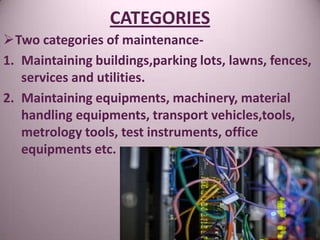
2. Maintaining equipments, machinery, material
handling equipments, transport vehicles,tools,
metrology tools, test instruments, office
equipments etc.
IMPORTANCE
1. Dependability of service
2. Quality assurance
3. Low cost inventories
4. Cost control
5. Investment
OBJECTIVES
• Minimizing loss of productive time
• Minimizing the repair time & repair cost
• Minimizing the loss due to production stoppage
• Efficient use of maintenance personnel &
equipments
• Prolonging the life of capital
• To keep all productive assets in good working
• To maximize efficiency & economy
• To improve the quality of products & to improve
productivity.
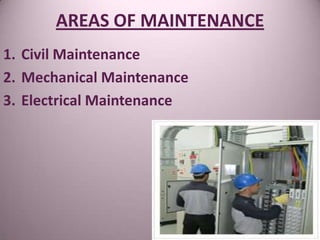
AREAS OF MAINTENANCE
1. Civil Maintenance
2. Mechanical Maintenance
3. Electrical Maintenance
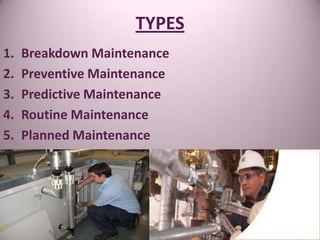
TYPES
1. Breakdown Maintenance
2. Preventive Maintenance
3. Predictive Maintenance
4. Routine Maintenance
5. Planned Maintenance
IMPACT OF POOR MAINTENANCE
1. Production Capacity
2. Production Costs
3. Product and Service Quality
4. Employee or Customer Safety
5. Customer Satisfaction
MAINTENANCE PLANNING
• Know
• Establish priorities
• Investigate
• Develop
• Prepare list
• Estimate
• Provide
TOTAL PRODUCTIVE MAINTENANCE
• TPM is an approach which brings the concept of
total quality management in the practice of
preventive maintenance.
• It involves the concepts of reducing variability
through employee involvement and excellent
maintenance records.
• TQM is a method designed to eliminate the losses
caused by breakdown of machines and
equipments.
• By identifying & attacking all causes of equipment
breakdown & system down-time.
CONT..
• Specific actions of TQM requires following-
1. Restoring equipment to a like new condition
2. Having operators involved in maintenance
3. Improving maintenance efficiency & effectiveness
4. Training the labour force to improve their job
skills
5. The effective use of preventive & predictive
maintenance technology.
CONCLUSION
“Maintenance management encompasses all those
activities required to keep the physical facilities &
equipments in good working conditions & making
necessary repairs when breakdown occur,so that
the system can perform as intended.”
Maintenance management

Maintenance management

  • 1.
    MAINTENANCE MANAGEMENT PREPARED &PRESENTED BY- AWANTIKA DIWAN MBA (HA&HC)
  • 2.
    INTRODUCTION Maintaining the productioncapability of an organization is an important function of production and operation management. Maintenance refers to upkeep & protection of -plant -building -machinery -other fixed assets
  • 3.
    DEFINITION • MAINTENANCE- Functionof production management that is concerned with day-to- day problem of keeping the physical plant in good operating condition. • MAINTENANCE MANAGEMENT- Concerned with planning,organising and directing the resources in order to control the availability and performance of the industrial plants to some specified level.
  • 4.
    CATEGORIES Two categories ofmaintenance- 1. Maintaining buildings,parking lots, lawns, fences, services and utilities. 2. Maintaining equipments, machinery, material handling equipments, transport vehicles,tools, metrology tools, test instruments, office equipments etc.
  • 5.
    IMPORTANCE 1. Dependability ofservice 2. Quality assurance 3. Low cost inventories 4. Cost control 5. Investment
  • 6.
    OBJECTIVES • Minimizing lossof productive time • Minimizing the repair time & repair cost • Minimizing the loss due to production stoppage • Efficient use of maintenance personnel & equipments • Prolonging the life of capital • To keep all productive assets in good working • To maximize efficiency & economy • To improve the quality of products & to improve productivity.
  • 7.
    AREAS OF MAINTENANCE 1.Civil Maintenance 2. Mechanical Maintenance 3. Electrical Maintenance
  • 8.
    TYPES 1. Breakdown Maintenance 2.Preventive Maintenance 3. Predictive Maintenance 4. Routine Maintenance 5. Planned Maintenance
  • 9.
    IMPACT OF POORMAINTENANCE 1. Production Capacity 2. Production Costs 3. Product and Service Quality 4. Employee or Customer Safety 5. Customer Satisfaction
  • 10.
    MAINTENANCE PLANNING • Know •Establish priorities • Investigate • Develop • Prepare list • Estimate • Provide
  • 11.
    TOTAL PRODUCTIVE MAINTENANCE •TPM is an approach which brings the concept of total quality management in the practice of preventive maintenance. • It involves the concepts of reducing variability through employee involvement and excellent maintenance records. • TQM is a method designed to eliminate the losses caused by breakdown of machines and equipments. • By identifying & attacking all causes of equipment breakdown & system down-time.
  • 12.
    CONT.. • Specific actionsof TQM requires following- 1. Restoring equipment to a like new condition 2. Having operators involved in maintenance 3. Improving maintenance efficiency & effectiveness 4. Training the labour force to improve their job skills 5. The effective use of preventive & predictive maintenance technology.
  • 13.
    CONCLUSION “Maintenance management encompassesall those activities required to keep the physical facilities & equipments in good working conditions & making necessary repairs when breakdown occur,so that the system can perform as intended.”