VARIETY REDUCTION AND
STANDARDIZATION
Navindu Munidasa
MSc Logistics and Supply Chain (UK) (Reading); BSc Operations and
Logistics Management (UK); Dip in Computer Hardware and Networking ;
Certificate in Motor Mechanism (CGTTI); Certificate in Workshop Practices
(CGTTI)
VARIETY
REDUCTION
The process of standardization logically leads to
simplification and variety reduction.
Variety reduction defined as a form of
standardization consisting of the reduction of the
number of types of products, or materials or parts
within a definite range to a lesser number which is
adequate to meet prevailing needs at a given time.
HOW TO
CONTROL
VARIETY?
By Simplifications
By Standardization
By Specialization
STANDARDIZATION
• It is the process of establishing basic specifications for
a set of commonly used characteristics of size, shape
and performance for products.
SIMPLIFICATION
• It is defined as the elimination of superfluous
varieties, sizes, dimensions, features etc., making the
design, assembly or product simpler, less complex and
less difficult to use.
BENEFITS OF VARIETY CONTROL
• Better after sales service
• Greater technical productivity
• Better understanding of
technical problems
• Lesser set up times
• Higher equipment utilization
• Reduction in inventory
• Higher equipment utilization
• Easier inventory control
• Better use of storage space
• Quicker stock-checking
• Reduction in purchasing effort
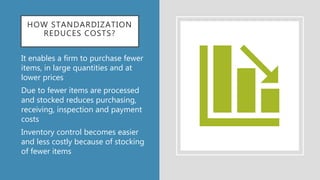
HOW STANDARDIZATION
REDUCES COSTS?
• It enables a firm to purchase fewer
items, in large quantities and at
lower prices
• Due to fewer items are processed
and stocked reduces purchasing,
receiving, inspection and payment
costs
• Inventory control becomes easier
and less costly because of stocking
of fewer items
AIMS OF STANDARDIZATION
To achieve maximum
overall economy
To ensure maximum
convenience in use
To ensure uniformity and
reduction in variety
To help in quality
assurance by
improving quality in every
activity
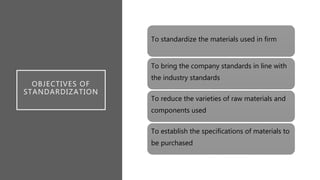
OBJECTIVES OF
STANDARDIZATION
To standardize the materials used in firm
To bring the company standards in line with
the industry standards
To reduce the varieties of raw materials and
components used
To establish the specifications of materials to
be purchased
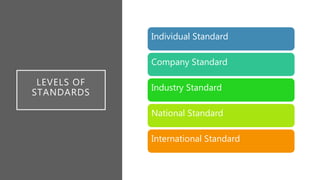
LEVELS OF
STANDARDS
Individual Standard
Company Standard
Industry Standard
National Standard
International Standard
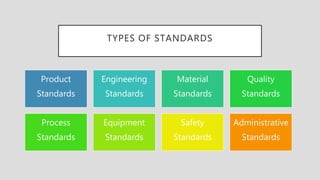
TYPES OF STANDARDS
Product
Standards
Engineering
Standards
Material
Standards
Quality
Standards
Process
Standards
Equipment
Standards
Safety
Standards
Administrative
Standards
ADVANTAGES OF STANDARDIZATION
Fewer parts to deal with inventory and in manufacturing
Simpler and more routine purchasing, handling and inspection procedures
Facilitates longer production runs and automation
Helps in better understanding of customer requirements
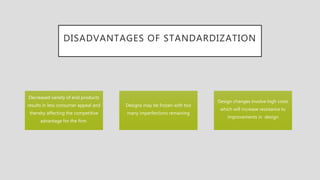
DISADVANTAGES OF STANDARDIZATION
Decreased variety of end products
results in less consumer appeal and
thereby affecting the competitive
advantage for the firm.
Designs may be frozen with too
many imperfections remaining
Design changes involve high costs
which will increase resistance to
improvements in design
THANK YOU

Variety reduction and standardization

  • 1.
    VARIETY REDUCTION AND STANDARDIZATION NavinduMunidasa MSc Logistics and Supply Chain (UK) (Reading); BSc Operations and Logistics Management (UK); Dip in Computer Hardware and Networking ; Certificate in Motor Mechanism (CGTTI); Certificate in Workshop Practices (CGTTI)
  • 2.
    VARIETY REDUCTION The process ofstandardization logically leads to simplification and variety reduction. Variety reduction defined as a form of standardization consisting of the reduction of the number of types of products, or materials or parts within a definite range to a lesser number which is adequate to meet prevailing needs at a given time.
  • 3.
    HOW TO CONTROL VARIETY? By Simplifications ByStandardization By Specialization
  • 4.
    STANDARDIZATION • It isthe process of establishing basic specifications for a set of commonly used characteristics of size, shape and performance for products. SIMPLIFICATION • It is defined as the elimination of superfluous varieties, sizes, dimensions, features etc., making the design, assembly or product simpler, less complex and less difficult to use.
  • 5.
    BENEFITS OF VARIETYCONTROL • Better after sales service • Greater technical productivity • Better understanding of technical problems • Lesser set up times • Higher equipment utilization • Reduction in inventory • Higher equipment utilization • Easier inventory control • Better use of storage space • Quicker stock-checking • Reduction in purchasing effort
  • 6.
    HOW STANDARDIZATION REDUCES COSTS? •It enables a firm to purchase fewer items, in large quantities and at lower prices • Due to fewer items are processed and stocked reduces purchasing, receiving, inspection and payment costs • Inventory control becomes easier and less costly because of stocking of fewer items
  • 7.
    AIMS OF STANDARDIZATION Toachieve maximum overall economy To ensure maximum convenience in use To ensure uniformity and reduction in variety To help in quality assurance by improving quality in every activity
  • 8.
    OBJECTIVES OF STANDARDIZATION To standardizethe materials used in firm To bring the company standards in line with the industry standards To reduce the varieties of raw materials and components used To establish the specifications of materials to be purchased
  • 9.
    LEVELS OF STANDARDS Individual Standard CompanyStandard Industry Standard National Standard International Standard
  • 10.
  • 11.
    ADVANTAGES OF STANDARDIZATION Fewerparts to deal with inventory and in manufacturing Simpler and more routine purchasing, handling and inspection procedures Facilitates longer production runs and automation Helps in better understanding of customer requirements
  • 12.
    DISADVANTAGES OF STANDARDIZATION Decreasedvariety of end products results in less consumer appeal and thereby affecting the competitive advantage for the firm. Designs may be frozen with too many imperfections remaining Design changes involve high costs which will increase resistance to improvements in design
  • 13.