AGGREGATE PLANNING
Meaning
 Aggregate planning is the process of developing,
analyzing, and maintaining a preliminary,
approximate schedule of the overall operations of
an organization.
 The aggregate plan generally contains targeted
sales forecasts, production levels, inventory levels,
and customer backlogs. This schedule is intended
to satisfy the demand forecast at a minimum cost.
2
Defined as …
 The process of determining output levels of
product groups over the coming 6 to 18 months on
a weekly or monthly basis ; the plan identifies the
overall level of outputs in support of the business
plan.
 Aggregate planning involves translating long-term
forecasted demand into specific production rates
and the corresponding labor requirements for the
intermediate term.
3
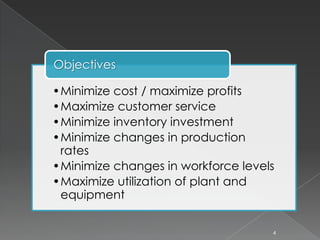
•Minimize cost / maximize profits
•Maximize customer service
•Minimize inventory investment
•Minimize changes in production
rates
•Minimize changes in workforce levels
•Maximize utilization of plant and
equipment
Objectives
4
Aggregate Planning Process
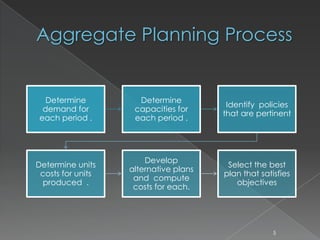
Determine
demand for
each period .
Determine
capacities for
each period .
Identify policies
that are pertinent
Determine units
costs for units
produced .
Develop
alternative plans
and compute
costs for each.
Select the best
plan that satisfies
objectives
5
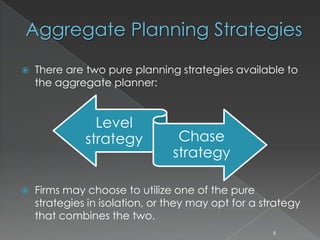
Aggregate Planning Strategies
 There are two pure planning strategies available to
the aggregate planner:
 Firms may choose to utilize one of the pure
strategies in isolation, or they may opt for a strategy
that combines the two.
Level
strategy Chase
strategy
6
Level strategy
 A level strategy seeks to produce an aggregate
plan that maintains a steady production rate and
a steady employment level.
 In order to satisfy changes in customer demand,
the firm must raise or lower inventory levels in
anticipation of increased or decreased levels of
forecast demand.
7
Level strategy
 The firm maintains a level workforce and a steady
rate of output when demand is low. This allows the
firm to establish higher inventory levels than are
currently needed.
 As demand increases, the firm is able to continue a
steady production rate/steady employment level,
while allowing the inventory surplus to absorb the
increased demand
8
Chase strategy
 A chase strategy implies matching demand and
capacity period by period.
 This could result in a considerable amount of hiring,
firing or laying off of employees; insecure and
unhappy employees; increased inventory carrying
costs; problems with labor unions; and erratic
utilization of plant and equipment.
9
Chase strategy
 It also implies a great deal of flexibility on the firm's
part. The major advantage of a chase strategy is
that it allows inventory to be held to the lowest
level possible, and for some firms this is a
considerable savings.
 Most firms embracing the just-in-time production
concept utilize a chase strategy approach to
aggregate planning
10
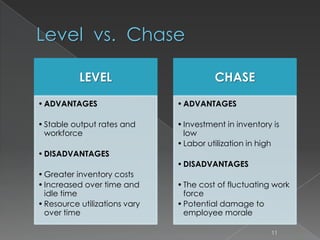
Level vs. Chase
LEVEL
•ADVANTAGES
•Stable output rates and
workforce
•DISADVANTAGES
•Greater inventory costs
•Increased over time and
idle time
•Resource utilizations vary
over time
CHASE
•ADVANTAGES
•Investment in inventory is
low
•Labor utilization in high
•DISADVANTAGES
•The cost of fluctuating work
force
•Potential damage to
employee morale
11
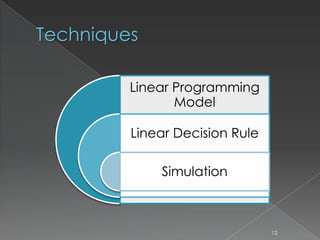
Techniques
Linear Programming
Model
Linear Decision Rule
Simulation
12
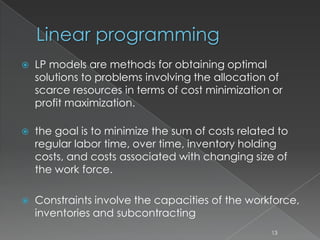
Linear programming
 LP models are methods for obtaining optimal
solutions to problems involving the allocation of
scarce resources in terms of cost minimization or
profit maximization.
 the goal is to minimize the sum of costs related to
regular labor time, over time, inventory holding
costs, and costs associated with changing size of
the work force.
 Constraints involve the capacities of the workforce,
inventories and subcontracting
13
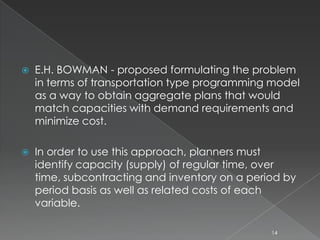
 E.H. BOWMAN - proposed formulating the problem
in terms of transportation type programming model
as a way to obtain aggregate plans that would
match capacities with demand requirements and
minimize cost.
 In order to use this approach, planners must
identify capacity (supply) of regular time, over
time, subcontracting and inventory on a period by
period basis as well as related costs of each
variable.
14
LINEAR DECISION RULE
 Linear decision rule is another optimizing
technique. It seeks to minimize total production
costs (labor, overtime, hiring/lay off, inventory
carrying cost) using a set of cost-approximating
functions to obtain a single quadratic equation.
 Then, by using calculus, two linear equations can
be derived from the quadratic equation, one to be
used to plan the output for each period and the
other for planning the workforce for each period.
15
SIMULATION MODELS
 By developing an aggregate plan within the
environment of a simulation model, it can be
tested under a variety of conditions to find
acceptable plans for consideration.
 These models can also be incorporated into a
decision support system, which can aid in planning
and evaluating alternative control policies.
16
SIMULATION MODELS
 These models can integrate the multiple conflicting
objectives inherent in manufacturing strategy by
using different quantitative measures of
productivity, customer service, and flexibility.
17
THANK YOU
Presented by:
Atif Ghayas
12MBA23

Aggregate planning

  • 1.
  • 2.
    Meaning  Aggregate planningis the process of developing, analyzing, and maintaining a preliminary, approximate schedule of the overall operations of an organization.  The aggregate plan generally contains targeted sales forecasts, production levels, inventory levels, and customer backlogs. This schedule is intended to satisfy the demand forecast at a minimum cost. 2
  • 3.
    Defined as … The process of determining output levels of product groups over the coming 6 to 18 months on a weekly or monthly basis ; the plan identifies the overall level of outputs in support of the business plan.  Aggregate planning involves translating long-term forecasted demand into specific production rates and the corresponding labor requirements for the intermediate term. 3
  • 4.
    •Minimize cost /maximize profits •Maximize customer service •Minimize inventory investment •Minimize changes in production rates •Minimize changes in workforce levels •Maximize utilization of plant and equipment Objectives 4
  • 5.
    Aggregate Planning Process Determine demandfor each period . Determine capacities for each period . Identify policies that are pertinent Determine units costs for units produced . Develop alternative plans and compute costs for each. Select the best plan that satisfies objectives 5
  • 6.
    Aggregate Planning Strategies There are two pure planning strategies available to the aggregate planner:  Firms may choose to utilize one of the pure strategies in isolation, or they may opt for a strategy that combines the two. Level strategy Chase strategy 6
  • 7.
    Level strategy  Alevel strategy seeks to produce an aggregate plan that maintains a steady production rate and a steady employment level.  In order to satisfy changes in customer demand, the firm must raise or lower inventory levels in anticipation of increased or decreased levels of forecast demand. 7
  • 8.
    Level strategy  Thefirm maintains a level workforce and a steady rate of output when demand is low. This allows the firm to establish higher inventory levels than are currently needed.  As demand increases, the firm is able to continue a steady production rate/steady employment level, while allowing the inventory surplus to absorb the increased demand 8
  • 9.
    Chase strategy  Achase strategy implies matching demand and capacity period by period.  This could result in a considerable amount of hiring, firing or laying off of employees; insecure and unhappy employees; increased inventory carrying costs; problems with labor unions; and erratic utilization of plant and equipment. 9
  • 10.
    Chase strategy  Italso implies a great deal of flexibility on the firm's part. The major advantage of a chase strategy is that it allows inventory to be held to the lowest level possible, and for some firms this is a considerable savings.  Most firms embracing the just-in-time production concept utilize a chase strategy approach to aggregate planning 10
  • 11.
    Level vs. Chase LEVEL •ADVANTAGES •Stableoutput rates and workforce •DISADVANTAGES •Greater inventory costs •Increased over time and idle time •Resource utilizations vary over time CHASE •ADVANTAGES •Investment in inventory is low •Labor utilization in high •DISADVANTAGES •The cost of fluctuating work force •Potential damage to employee morale 11
  • 12.
  • 13.
    Linear programming  LPmodels are methods for obtaining optimal solutions to problems involving the allocation of scarce resources in terms of cost minimization or profit maximization.  the goal is to minimize the sum of costs related to regular labor time, over time, inventory holding costs, and costs associated with changing size of the work force.  Constraints involve the capacities of the workforce, inventories and subcontracting 13
  • 14.
     E.H. BOWMAN- proposed formulating the problem in terms of transportation type programming model as a way to obtain aggregate plans that would match capacities with demand requirements and minimize cost.  In order to use this approach, planners must identify capacity (supply) of regular time, over time, subcontracting and inventory on a period by period basis as well as related costs of each variable. 14
  • 15.
    LINEAR DECISION RULE Linear decision rule is another optimizing technique. It seeks to minimize total production costs (labor, overtime, hiring/lay off, inventory carrying cost) using a set of cost-approximating functions to obtain a single quadratic equation.  Then, by using calculus, two linear equations can be derived from the quadratic equation, one to be used to plan the output for each period and the other for planning the workforce for each period. 15
  • 16.
    SIMULATION MODELS  Bydeveloping an aggregate plan within the environment of a simulation model, it can be tested under a variety of conditions to find acceptable plans for consideration.  These models can also be incorporated into a decision support system, which can aid in planning and evaluating alternative control policies. 16
  • 17.
    SIMULATION MODELS  Thesemodels can integrate the multiple conflicting objectives inherent in manufacturing strategy by using different quantitative measures of productivity, customer service, and flexibility. 17
  • 18.