May 26, 2012   1
INTRODUCTION
What is a Poka- yoke?

 Shigeo shingo defined poka-yoke as POKA- ‘Inadvertent
  mistake that anyone can make’ and YOKE- ‘To prevent or
  proof’
 Poka-yoke is a tool to have “zero defects” and even reduce or
  eliminate quality control.
 Poka-yoke is a Japanese name for “fool-proofing”.
 Poke-yoke represents the intelligence of the operator by
  excluding repetitive actions that require a thinking process.


 May 26, 2012                                                     2
MISTAKE PROOFING
 Mistake-Proofing a product's design and its manufacturing
  process is a key element of design for manufacturability /
  assembly (DFM/A)
 Mistake proofing is also a key element of improving product
  quality and reliability

FACTORS CONTRIBUTING TO MISTAKE PROOFING:
 Attention
 Perception
 Memory
 Logical reasoning


 May 26, 2012                                                   3
PRINCIPLES OF MISTAKE-PROOFING
          There are six mistake-proofing principles or methods.
 Elimination seeks to eliminate the possibility of error by
  redesigning the product or process so that the task or part is
  no longer necessary.
 Replacement substitutes a more reliable process to improve
  consistency.
 Prevention engineers the product or process so that it is
  impossible to make a mistake at all.
 Facilitation employs techniques and combining steps to
  make work easier to perform.
 Detection involves identifying an error before further
  processing occurs so that the user can quickly correct the
  problem.
 Mitigation seeks to minimize the effects of errors.
 May 26, 2012                                                    4
2-STATUS & 3-FUNCTIONS OF POKA-YOKE
 POKA-YOKE HAS 2 STATUS AND 3 FUNCTIONS:

  Status:
       1.The fault will happen or
       2.The fault has happened
  Functions:
       1.Stop
       2.Check or
       3.Alarm


May 26, 2012                               5
THREE STRATEGIES FOR ZERO DEFECT
 Only make the product when required!


 Make the product so it can not be used for anything else.


 If the product is ready use it immediately.


 May 26, 2012                                                 6
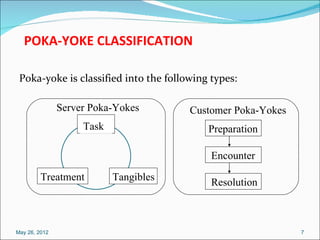
POKA-YOKE CLASSIFICATION

 Poka-yoke is classified into the following types:

               Server Poka-Yokes       Customer Poka-Yokes
                    Task                   Preparation

                                            Encounter

         Treatment         Tangibles        Resolution


May 26, 2012                                                 7
PROVIDER(SERVER) ERRORS
 Task Errors
    • Doing the work incorrectly
    • Doing work not requested
    • Doing work in the wrong order
    • Doing work too slowly
 Treatment Errors
    • Not acknowledging the customer
    • Not listening to the customer
    • Not reacting appropriately to the customer
 Tangible Errors
    • Failure to clean facilities
    • Failure to control noise


May 26, 2012                                       8
CUSTOMER ERRORS
 Preparation Errors
    • Failure to bring necessary materials to the encounter
    • Failure to engage the correct service
 Encounter Errors
    • Failure to remember steps in the service process
    • Failure to follow system flow
    • Failure to follow instructions
 Resolution Errors
    • Failure to learn from experience
    • Failure to adjust expectations appropriately


 May 26, 2012                                                 9
SEVEN STEPS TO POKA-YOKE ATTAINMENT

 Quality Processes

 Utilize a team environment

 Elimination of Errors

 Eliminate the “Root Cause” of The Errors

 Do It Right The First Time

 Eliminate Non-Value Added Decisions

 Implement a Continual Improvement Approach

May 26, 2012                                   10
POKA-YOKE APPROACH
 Proactive Approach :
 A fully implemented ZERO DEFECT QUALITY system requires
  Poka-Yoke usage at or before the inspection points during the
  process.
 Poka-yoke will catch the errors before a defective part is
  manufactured 100% of the time.
 Reactive Approach :
 Check occurs immediately after the process.
 Can be an operator check at the process or successive check at the
  next      process.
 Not 100% effective, will not eliminate all defects.
 Effective in preventing defects from being passed to next process.

 May 26, 2012                                                          11
Two Poka-Yoke System approaches are utilized in
  manufacturing which lead to successful ZERO DEFECT
  QUALITY:
 1.Control Approach:
  Shuts down the process when an error occurs.
  Keeps the “suspect” part in place when an operation is
               incomplete.
 2.Warning Approach
  Signals the operator to stop the process and correct the
    problem.
May 26, 2012                                                  12
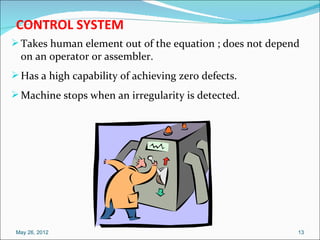
CONTROL SYSTEM
 Takes human element out of the equation ; does not depend
  on an operator or assembler.
 Has a high capability of achieving zero defects.
 Machine stops when an irregularity is detected.


 May 26, 2012                                             13
WARNING SYSTEMS

 Sometimes an automatic shut off system is not an option.
 A warning or alarm system can be used to get an operators
  attention.
 Color coding is also an effective non-automatic option


 May 26, 2012                                                 14
TEN TYPES OF HUMAN MISTAKES

  Forgetfulness
  Mis-understanding
  Wrong identification
  Lack of experience
  Willful (ignoring rules or procedure)
  Inadvertent or sloppiness
  Slowliness
  Lack of standardization
  Surprise (unexpected machine operation, etc.)
  Intentional (sabotage)
May 26, 2012                                       15
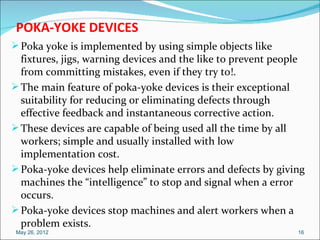
POKA-YOKE DEVICES
 Poka yoke is implemented by using simple objects like
  fixtures, jigs, warning devices and the like to prevent people
  from committing mistakes, even if they try to!.
 The main feature of poka-yoke devices is their exceptional
  suitability for reducing or eliminating defects through
  effective feedback and instantaneous corrective action.
 These devices are capable of being used all the time by all
  workers; simple and usually installed with low
  implementation cost.
 Poka-yoke devices help eliminate errors and defects by giving
  machines the “intelligence” to stop and signal when a error
  occurs.
 Poka-yoke devices stop machines and alert workers when a
  problem exists.
 May 26, 2012                                                 16
THE THREE LEVELS OF POKA-YOKE:

  There are three levels at which your company can effect poka-
  yoke:
 Eliminating errors defects and losses at the source or
  prevention of a mistake from being committed..
 Detection of a loss or mistakes it occurs,allowing correction
  before it becomes a problem.
 Detection of a loss or mistakes after it has occurred,just in
  time before it blows up into a major issue(least effective).
May 26, 2012                                                      17
EXAMPLES OF POKA-YOKE PRODUCTS


May 26, 2012                     18
May 26, 2012   19
IMPLEMENTATION IN MANUFACTURING
       Poka-yoke can be implemented at any step of a
  manufacturing process where something can go wrong or an
  error can be made.
        Shigeo Shingo recognized three types of poka-yoke for
  detecting and preventing errors in a mass production system:
 The contact method identifies product defects by testing the
  product's shape, size, color, or other physical attributes.
 The fixed-value (or constant number) method alerts the
  operator if a certain number of movements are not made.
 The motion-step (or sequence) method determines whether
  the prescribed steps of the process have been followed.


 May 26, 2012                                                20
ADVANTAGES
 They are simple and cheap.

 They are part of the process, implementing what Shingo calls
  "100%" inspection.
 They are placed close to where the mistakes occur, providing
  quick feedback to the workers so that the mistakes can be
  corrected.
 Once put in place, they require minimal supervision.


 May 26, 2012                                                 21
CONCLUSION
                Poka-yokes deals with understanding why
     people make errors and how to analyze the process to
     know where errors are likely to occur and what root
     causes contribute to them.
         Since the poka-yoke devices detect errors at their
     roots n prevent them from blowing up to become
     bigger problems, there is consistency in the quality of
     the products, saving the cost and time spent in
     subsequent quality inspection processes.

May 26, 2012                                               22
THANK YOU


May 26, 2012               23

Poka yoke

  • 1.
  • 2.
    INTRODUCTION What is aPoka- yoke?  Shigeo shingo defined poka-yoke as POKA- ‘Inadvertent mistake that anyone can make’ and YOKE- ‘To prevent or proof’  Poka-yoke is a tool to have “zero defects” and even reduce or eliminate quality control.  Poka-yoke is a Japanese name for “fool-proofing”.  Poke-yoke represents the intelligence of the operator by excluding repetitive actions that require a thinking process. May 26, 2012 2
  • 3.
    MISTAKE PROOFING  Mistake-Proofinga product's design and its manufacturing process is a key element of design for manufacturability / assembly (DFM/A)  Mistake proofing is also a key element of improving product quality and reliability FACTORS CONTRIBUTING TO MISTAKE PROOFING:  Attention  Perception  Memory  Logical reasoning May 26, 2012 3
  • 4.
    PRINCIPLES OF MISTAKE-PROOFING There are six mistake-proofing principles or methods.  Elimination seeks to eliminate the possibility of error by redesigning the product or process so that the task or part is no longer necessary.  Replacement substitutes a more reliable process to improve consistency.  Prevention engineers the product or process so that it is impossible to make a mistake at all.  Facilitation employs techniques and combining steps to make work easier to perform.  Detection involves identifying an error before further processing occurs so that the user can quickly correct the problem.  Mitigation seeks to minimize the effects of errors. May 26, 2012 4
  • 5.
    2-STATUS & 3-FUNCTIONSOF POKA-YOKE POKA-YOKE HAS 2 STATUS AND 3 FUNCTIONS:  Status: 1.The fault will happen or 2.The fault has happened  Functions: 1.Stop 2.Check or 3.Alarm May 26, 2012 5
  • 6.
    THREE STRATEGIES FORZERO DEFECT  Only make the product when required!  Make the product so it can not be used for anything else.  If the product is ready use it immediately. May 26, 2012 6
  • 7.
    POKA-YOKE CLASSIFICATION Poka-yokeis classified into the following types: Server Poka-Yokes Customer Poka-Yokes Task Preparation Encounter Treatment Tangibles Resolution May 26, 2012 7
  • 8.
    PROVIDER(SERVER) ERRORS  TaskErrors • Doing the work incorrectly • Doing work not requested • Doing work in the wrong order • Doing work too slowly  Treatment Errors • Not acknowledging the customer • Not listening to the customer • Not reacting appropriately to the customer  Tangible Errors • Failure to clean facilities • Failure to control noise May 26, 2012 8
  • 9.
    CUSTOMER ERRORS  PreparationErrors • Failure to bring necessary materials to the encounter • Failure to engage the correct service  Encounter Errors • Failure to remember steps in the service process • Failure to follow system flow • Failure to follow instructions  Resolution Errors • Failure to learn from experience • Failure to adjust expectations appropriately May 26, 2012 9
  • 10.
    SEVEN STEPS TOPOKA-YOKE ATTAINMENT  Quality Processes  Utilize a team environment  Elimination of Errors  Eliminate the “Root Cause” of The Errors  Do It Right The First Time  Eliminate Non-Value Added Decisions  Implement a Continual Improvement Approach May 26, 2012 10
  • 11.
    POKA-YOKE APPROACH  ProactiveApproach :  A fully implemented ZERO DEFECT QUALITY system requires Poka-Yoke usage at or before the inspection points during the process.  Poka-yoke will catch the errors before a defective part is manufactured 100% of the time.  Reactive Approach :  Check occurs immediately after the process.  Can be an operator check at the process or successive check at the next process.  Not 100% effective, will not eliminate all defects.  Effective in preventing defects from being passed to next process. May 26, 2012 11
  • 12.
    Two Poka-Yoke Systemapproaches are utilized in manufacturing which lead to successful ZERO DEFECT QUALITY: 1.Control Approach:  Shuts down the process when an error occurs.  Keeps the “suspect” part in place when an operation is incomplete. 2.Warning Approach  Signals the operator to stop the process and correct the problem. May 26, 2012 12
  • 13.
    CONTROL SYSTEM  Takeshuman element out of the equation ; does not depend on an operator or assembler.  Has a high capability of achieving zero defects.  Machine stops when an irregularity is detected. May 26, 2012 13
  • 14.
    WARNING SYSTEMS  Sometimesan automatic shut off system is not an option.  A warning or alarm system can be used to get an operators attention.  Color coding is also an effective non-automatic option May 26, 2012 14
  • 15.
    TEN TYPES OFHUMAN MISTAKES  Forgetfulness  Mis-understanding  Wrong identification  Lack of experience  Willful (ignoring rules or procedure)  Inadvertent or sloppiness  Slowliness  Lack of standardization  Surprise (unexpected machine operation, etc.)  Intentional (sabotage) May 26, 2012 15
  • 16.
    POKA-YOKE DEVICES  Pokayoke is implemented by using simple objects like fixtures, jigs, warning devices and the like to prevent people from committing mistakes, even if they try to!.  The main feature of poka-yoke devices is their exceptional suitability for reducing or eliminating defects through effective feedback and instantaneous corrective action.  These devices are capable of being used all the time by all workers; simple and usually installed with low implementation cost.  Poka-yoke devices help eliminate errors and defects by giving machines the “intelligence” to stop and signal when a error occurs.  Poka-yoke devices stop machines and alert workers when a problem exists. May 26, 2012 16
  • 17.
    THE THREE LEVELSOF POKA-YOKE: There are three levels at which your company can effect poka- yoke:  Eliminating errors defects and losses at the source or prevention of a mistake from being committed..  Detection of a loss or mistakes it occurs,allowing correction before it becomes a problem.  Detection of a loss or mistakes after it has occurred,just in time before it blows up into a major issue(least effective). May 26, 2012 17
  • 18.
    EXAMPLES OF POKA-YOKEPRODUCTS May 26, 2012 18
  • 19.
  • 20.
    IMPLEMENTATION IN MANUFACTURING Poka-yoke can be implemented at any step of a manufacturing process where something can go wrong or an error can be made. Shigeo Shingo recognized three types of poka-yoke for detecting and preventing errors in a mass production system:  The contact method identifies product defects by testing the product's shape, size, color, or other physical attributes.  The fixed-value (or constant number) method alerts the operator if a certain number of movements are not made.  The motion-step (or sequence) method determines whether the prescribed steps of the process have been followed. May 26, 2012 20
  • 21.
    ADVANTAGES  They aresimple and cheap.  They are part of the process, implementing what Shingo calls "100%" inspection.  They are placed close to where the mistakes occur, providing quick feedback to the workers so that the mistakes can be corrected.  Once put in place, they require minimal supervision. May 26, 2012 21
  • 22.
    CONCLUSION Poka-yokes deals with understanding why people make errors and how to analyze the process to know where errors are likely to occur and what root causes contribute to them. Since the poka-yoke devices detect errors at their roots n prevent them from blowing up to become bigger problems, there is consistency in the quality of the products, saving the cost and time spent in subsequent quality inspection processes. May 26, 2012 22
  • 23.