MATERIAL
HANDLING
BY
DEV JAIN
MECHANICAL
DEPT
SURANA POWER
LIMITED
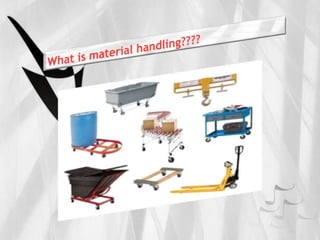
Material Handling is the movement, storage, control and
protection of materials, goods and products throughout the
process of manufacturing, distribution, consumption and
disposal. The focus is on the methods, mechanical equipment,
systems and related controls used to achieve these functions.
The material handling industry manufactures and distributes

the equipment and services required to implement material
handling systems. Material handling systems range from simple
pallet rack and shelving projects, to complex conveyor belt and
Automated Storage and Retrieval Systems (AS/RS).
Material handling can also consist of sorting and picking,
as well as automatic guided vehicles.
MATERIAL HANDLING
Material

handling is the
function of moving the right
material to the right place in
the right time, in the right
amount, in sequence, and in
the right condition to
minimize production cost.
MATERIAL HANDLING
A

material-handling system can be
simply defined as an integrated system
involving such activities as handling,
storing, and controlling of materials.

 The

word material has very broad
meaning, covering all kinds of raw
materials, work in process,
subassemblies, and finished assemblies.
Objectives
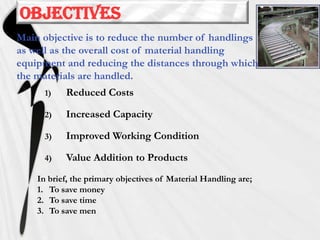
Main objective is to reduce the number of handlings
as well as the overall cost of material handling
equipment and reducing the distances through which
the materials are handled.
1)

Reduced Costs

2)

Increased Capacity

3)

Improved Working Condition

4)

Value Addition to Products

In brief, the primary objectives of Material Handling are;
1. To save money
2. To save time
3. To save men
objectives
The

primary objective of
using a material handling
system is to ensure that the
material in the right amount is
safely delivered to the desired
destination at the right time
and at minimum cost.
Objectives
The

material handling system is
properly designed not only to
ensure the minimum cost and
compatibility with other
manufacturing equipment but also
to meet safety concerns.
The cost of MH estimates 20-25
of total manufacturing labor cost.
Other Objectives


Lower unit material handling costs



Reduction in manufacturing cycle time through faster
movement of materials and by reducing the distance
through which the materials are moved. Reduction in
manufacturing cycle time results in reduced work –in –
progress inventory costs.



Improved working conditions and greater safety in
movement of materials



Contribute to better quality by avoiding damage to
products by inefficient handling



Increased storage capacity through better utilisation of
storage areas



Higher productivity at lower manufacturing cost
GOALS OF MATERIAL HANDLING
The

primary goal is to reduce unit
costs of production

Maintain

or improve product
quality, reduce damage of
materials

Promote

safety and improve
working conditions
GOALS OF MATERIAL HANDLING
Promote

increased use of

facilities
Reduce

tare weight (dead

weight)
Control

inventory
GOALS OF MATERIAL HANDLING
Promote

productivity

material should flow in a straight
line
use gravity! It is free power

move more material at one time
mechanize material handling

automate material handling
GOALS OF MATERIAL HANDLING
 Material

handling equipment includes:

Transport Equipment: industrial
trucks, Automated Guided vehicles
(AGVs), monorails, conveyors, cranes
and hoists.

Storage Systems: bulk storage, rack
systems, shelving and bins, drawer
storage, automated storage systems.
Unitizing Equipment: palletizers
Identification and Tracking systems
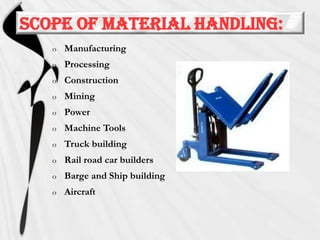
Scope of Material handling:
o

Manufacturing

o

Processing

o

Construction

o

Mining

o

Power

o

Machine Tools

o

Truck building

o

Rail road car builders

o

Barge and Ship building

o

Aircraft
Importance of M H


Efficient material handling is important to manufacturing
operations. Materials sent by vendors must be unloaded,
moved through inspections and production operations to
stores and finally to the shipping department.

These movements do not add value to the product but they
do add value to the cost
Material handling is an integral part of any industrial
activity. With growing business, a greater emphasis is laid
on productivity, profitability as well as resource
conservation and ecological preservation. Material
handling plays a very crucial role in sustaining efficiency
in financial and human resources.
Importance of M H
•

Material handling analysis is a subset of plant layout.
Method study, plant layout and material handling are
all part of the design of a production facility

•

Material handling system and plant layout enhance
effectiveness of each other.

•

Efficient operation of appropriate material handling
methods reduces costs and enables maximum
capabilities to be derived from a given production
facility
CONSIDERATIONS IN MATERIAL
HANDLING SYSTEM DESIGN
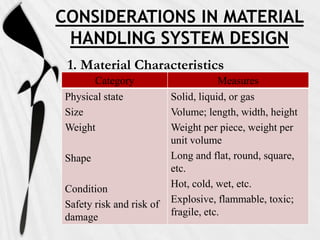
1. Material Characteristics
Category
Physical state
Size
Weight
Shape
Condition
Safety risk and risk of
damage

Measures
Solid, liquid, or gas
Volume; length, width, height
Weight per piece, weight per
unit volume
Long and flat, round, square,
etc.
Hot, cold, wet, etc.
Explosive, flammable, toxic;
fragile, etc.
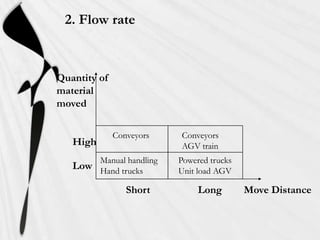
2. Flow rate

Quantity of
material
moved
High

Conveyors

Manual handling
Low Hand trucks

Short

Conveyors
AGV train
Powered trucks
Unit load AGV

Long

Move Distance
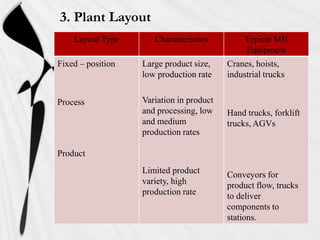
3. Plant Layout
Layout Type

Characteristics

Typical MH
Equipment

Fixed – position

Large product size,
low production rate

Cranes, hoists,
industrial trucks

Process

Variation in product
and processing, low
and medium
production rates

Hand trucks, forklift
trucks, AGVs

Product

Limited product
variety, high
production rate

Conveyors for
product flow, trucks
to deliver
components to
stations.
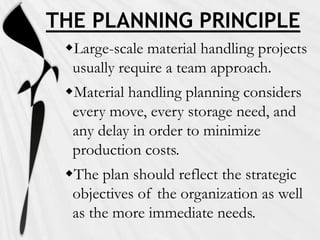
THE PLANNING PRINCIPLE
Large-scale material handling projects
usually require a team approach.

Material handling planning considers
every move, every storage need, and
any delay in order to minimize
production costs.
The plan should reflect the strategic
objectives of the organization as well
as the more immediate needs.
THE SYSTEMS PRINCIPLE
MH and storage activities should be fully integrated to
form a coordinated, operational system that spans
receiving, inspection, storage, production,
assembly…, shipping, and the handling of returns.
Information flow and physical material flow should
be integrated and treated as concurrent activities.

Methods should be provided for easily identifying
materials and products, for determining their
location and status within facilities and within the
supply chain.
SIMPLIFICATION PRINCIPLE
simplify handling by reducing, eliminating, or
combining unnecessary movement and/or
equipment.
Four questions to ask to simplify any job:

Can this job be eliminated?
If we can’t eliminate, can we combine
movements to reduce cost? (unit load concept)
If we can’t eliminate or combine, can we
rearrange the operations to reduce the travel
distance?

If we can’t do any of the above, can we simplify?
GRAVITY PRINCIPLE
Utilize gravity to move material whenever
practical.

SPACE UTILIZATION
PRINCIPLE
The better we use our building cube, the less
space we need to buy or rent.
Racks, mezzanines, and overhead conveyors are a
few examples that promote this goal.
UNIT LOAD PRINCIPLE
Unit loads should be appropriately
sized and configured at each stage of
the supply chain.
The most common unit load is the
pallet
cardboard pallets
plastic pallets
wooden pallets
steel skids
AUTOMATION PRINCIPLE
MH operations should be
mechanized and/or automated
where feasible to improve
operational efficiency, increase
responsiveness, improve
consistency and predictability,
decrease operating costs.
THE STANDARDIZATION
PRINCIPLE
standardize handling methods as well as
types and sizes of handling equipment

too many sizes and brands of
equipment results in higher operational
cost.
A fewer sizes of carton will simplify
the storage.
EQUIPMENT SELECTION
PRINCIPLE
Why? What? Where? When? How? Who?
If we answer these questions about each move, the
solution will become evident.

THE MAINTENANCE
PRINCIPLE
 Plan for preventive maintenance and scheduled
repairs of all handling equipment.
 Pallets and storage facilities need repair too.
THE DEAD WEIGHT
PRINCIPLE
 Try to reduce the ratio of equipment weight
to product weight. Don’t buy equipment
that is bigger than necessary.
 Reduce tare weight and save money.

THE CAPACITY PRINCIPLE
 use handling equipment to help achieve
desired production capacity
 i.e. material handling equipment can help to
maximize production equipment utilization.








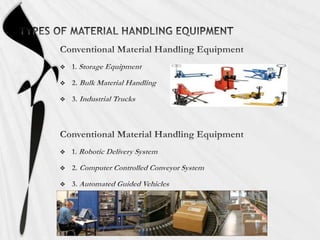
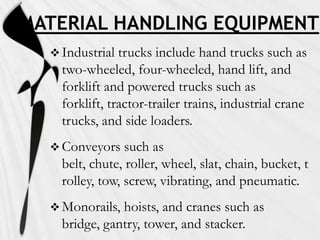
MATERIAL HANDLING EQUIPMENT
 Industrial

trucks include hand trucks such as
two-wheeled, four-wheeled, hand lift, and
forklift and powered trucks such as
forklift, tractor-trailer trains, industrial crane
trucks, and side loaders.

 Conveyors

such as
belt, chute, roller, wheel, slat, chain, bucket, t
rolley, tow, screw, vibrating, and pneumatic.

 Monorails,

hoists, and cranes such as
bridge, gantry, tower, and stacker.
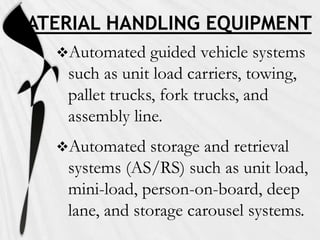
MATERIAL HANDLING EQUIPMENT
Automated

guided vehicle systems
such as unit load carriers, towing,
pallet trucks, fork trucks, and
assembly line.

Automated

storage and retrieval
systems (AS/RS) such as unit load,
mini-load, person-on-board, deep
lane, and storage carousel systems.
1.






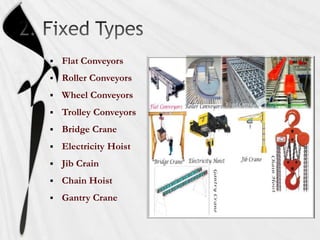
Flat Conveyors



Roller Conveyors



Wheel Conveyors



Trolley Conveyors



Bridge Crane



Electricity Hoist



Jib Crain



Chain Hoist



Gantry Crane
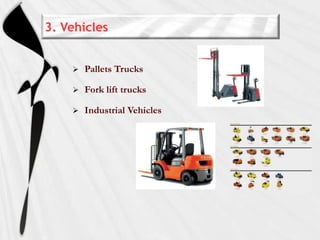
3. Vehicles


Pallets Trucks



Fork lift trucks



Industrial Vehicles
Pros and Cons of Using Material Handling Equipment


PROS:



CONS:



Lessen manual labor.



Require fast data tracking and
processing.



Less shipping errors.





Minimal damage on goods
and materials.

Require reliable and fool-proof
inventory management system.



Require more free floor spaces so
that equipment can move
properly.



Buying your own material
handling equipment may require
you to raise bigger funds or
initial capital.




Less shipping and production
costs.

Lessen employees
compensation claims therefore
allows you to save more in the
long run.
 Require you to set aside funds for
maintenance and repair.
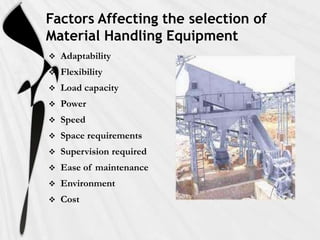
Factors Affecting the selection of
Material Handling Equipment


Adaptability



Flexibility



Load capacity



Power



Speed



Space requirements



Supervision required



Ease of maintenance



Environment



Cost
Material handling

Material handling

  • 2.
  • 4.
    Material Handling isthe movement, storage, control and protection of materials, goods and products throughout the process of manufacturing, distribution, consumption and disposal. The focus is on the methods, mechanical equipment, systems and related controls used to achieve these functions. The material handling industry manufactures and distributes the equipment and services required to implement material handling systems. Material handling systems range from simple pallet rack and shelving projects, to complex conveyor belt and Automated Storage and Retrieval Systems (AS/RS). Material handling can also consist of sorting and picking, as well as automatic guided vehicles.
  • 5.
    MATERIAL HANDLING Material handling isthe function of moving the right material to the right place in the right time, in the right amount, in sequence, and in the right condition to minimize production cost.
  • 6.
    MATERIAL HANDLING A material-handling systemcan be simply defined as an integrated system involving such activities as handling, storing, and controlling of materials.  The word material has very broad meaning, covering all kinds of raw materials, work in process, subassemblies, and finished assemblies.
  • 7.
    Objectives Main objective isto reduce the number of handlings as well as the overall cost of material handling equipment and reducing the distances through which the materials are handled. 1) Reduced Costs 2) Increased Capacity 3) Improved Working Condition 4) Value Addition to Products In brief, the primary objectives of Material Handling are; 1. To save money 2. To save time 3. To save men
  • 8.
    objectives The primary objective of usinga material handling system is to ensure that the material in the right amount is safely delivered to the desired destination at the right time and at minimum cost.
  • 9.
    Objectives The material handling systemis properly designed not only to ensure the minimum cost and compatibility with other manufacturing equipment but also to meet safety concerns. The cost of MH estimates 20-25 of total manufacturing labor cost.
  • 10.
    Other Objectives  Lower unitmaterial handling costs  Reduction in manufacturing cycle time through faster movement of materials and by reducing the distance through which the materials are moved. Reduction in manufacturing cycle time results in reduced work –in – progress inventory costs.  Improved working conditions and greater safety in movement of materials  Contribute to better quality by avoiding damage to products by inefficient handling  Increased storage capacity through better utilisation of storage areas  Higher productivity at lower manufacturing cost
  • 11.
    GOALS OF MATERIALHANDLING The primary goal is to reduce unit costs of production Maintain or improve product quality, reduce damage of materials Promote safety and improve working conditions
  • 12.
    GOALS OF MATERIALHANDLING Promote increased use of facilities Reduce tare weight (dead weight) Control inventory
  • 13.
    GOALS OF MATERIALHANDLING Promote productivity material should flow in a straight line use gravity! It is free power move more material at one time mechanize material handling automate material handling
  • 14.
    GOALS OF MATERIALHANDLING  Material handling equipment includes: Transport Equipment: industrial trucks, Automated Guided vehicles (AGVs), monorails, conveyors, cranes and hoists. Storage Systems: bulk storage, rack systems, shelving and bins, drawer storage, automated storage systems. Unitizing Equipment: palletizers Identification and Tracking systems
  • 15.
    Scope of Materialhandling: o Manufacturing o Processing o Construction o Mining o Power o Machine Tools o Truck building o Rail road car builders o Barge and Ship building o Aircraft
  • 16.
    Importance of MH  Efficient material handling is important to manufacturing operations. Materials sent by vendors must be unloaded, moved through inspections and production operations to stores and finally to the shipping department. These movements do not add value to the product but they do add value to the cost Material handling is an integral part of any industrial activity. With growing business, a greater emphasis is laid on productivity, profitability as well as resource conservation and ecological preservation. Material handling plays a very crucial role in sustaining efficiency in financial and human resources.
  • 17.
    Importance of MH • Material handling analysis is a subset of plant layout. Method study, plant layout and material handling are all part of the design of a production facility • Material handling system and plant layout enhance effectiveness of each other. • Efficient operation of appropriate material handling methods reduces costs and enables maximum capabilities to be derived from a given production facility
  • 18.
    CONSIDERATIONS IN MATERIAL HANDLINGSYSTEM DESIGN 1. Material Characteristics Category Physical state Size Weight Shape Condition Safety risk and risk of damage Measures Solid, liquid, or gas Volume; length, width, height Weight per piece, weight per unit volume Long and flat, round, square, etc. Hot, cold, wet, etc. Explosive, flammable, toxic; fragile, etc.
  • 19.
    2. Flow rate Quantityof material moved High Conveyors Manual handling Low Hand trucks Short Conveyors AGV train Powered trucks Unit load AGV Long Move Distance
  • 20.
    3. Plant Layout LayoutType Characteristics Typical MH Equipment Fixed – position Large product size, low production rate Cranes, hoists, industrial trucks Process Variation in product and processing, low and medium production rates Hand trucks, forklift trucks, AGVs Product Limited product variety, high production rate Conveyors for product flow, trucks to deliver components to stations.
  • 21.
    THE PLANNING PRINCIPLE Large-scalematerial handling projects usually require a team approach. Material handling planning considers every move, every storage need, and any delay in order to minimize production costs. The plan should reflect the strategic objectives of the organization as well as the more immediate needs.
  • 22.
    THE SYSTEMS PRINCIPLE MHand storage activities should be fully integrated to form a coordinated, operational system that spans receiving, inspection, storage, production, assembly…, shipping, and the handling of returns. Information flow and physical material flow should be integrated and treated as concurrent activities. Methods should be provided for easily identifying materials and products, for determining their location and status within facilities and within the supply chain.
  • 23.
    SIMPLIFICATION PRINCIPLE simplify handlingby reducing, eliminating, or combining unnecessary movement and/or equipment. Four questions to ask to simplify any job: Can this job be eliminated? If we can’t eliminate, can we combine movements to reduce cost? (unit load concept) If we can’t eliminate or combine, can we rearrange the operations to reduce the travel distance? If we can’t do any of the above, can we simplify?
  • 24.
    GRAVITY PRINCIPLE Utilize gravityto move material whenever practical. SPACE UTILIZATION PRINCIPLE The better we use our building cube, the less space we need to buy or rent. Racks, mezzanines, and overhead conveyors are a few examples that promote this goal.
  • 25.
    UNIT LOAD PRINCIPLE Unitloads should be appropriately sized and configured at each stage of the supply chain. The most common unit load is the pallet cardboard pallets plastic pallets wooden pallets steel skids
  • 26.
    AUTOMATION PRINCIPLE MH operationsshould be mechanized and/or automated where feasible to improve operational efficiency, increase responsiveness, improve consistency and predictability, decrease operating costs.
  • 27.
    THE STANDARDIZATION PRINCIPLE standardize handlingmethods as well as types and sizes of handling equipment too many sizes and brands of equipment results in higher operational cost. A fewer sizes of carton will simplify the storage.
  • 28.
    EQUIPMENT SELECTION PRINCIPLE Why? What?Where? When? How? Who? If we answer these questions about each move, the solution will become evident. THE MAINTENANCE PRINCIPLE  Plan for preventive maintenance and scheduled repairs of all handling equipment.  Pallets and storage facilities need repair too.
  • 29.
    THE DEAD WEIGHT PRINCIPLE Try to reduce the ratio of equipment weight to product weight. Don’t buy equipment that is bigger than necessary.  Reduce tare weight and save money. THE CAPACITY PRINCIPLE  use handling equipment to help achieve desired production capacity  i.e. material handling equipment can help to maximize production equipment utilization.
  • 30.
  • 31.
    MATERIAL HANDLING EQUIPMENT Industrial trucks include hand trucks such as two-wheeled, four-wheeled, hand lift, and forklift and powered trucks such as forklift, tractor-trailer trains, industrial crane trucks, and side loaders.  Conveyors such as belt, chute, roller, wheel, slat, chain, bucket, t rolley, tow, screw, vibrating, and pneumatic.  Monorails, hoists, and cranes such as bridge, gantry, tower, and stacker.
  • 32.
    MATERIAL HANDLING EQUIPMENT Automated guidedvehicle systems such as unit load carriers, towing, pallet trucks, fork trucks, and assembly line. Automated storage and retrieval systems (AS/RS) such as unit load, mini-load, person-on-board, deep lane, and storage carousel systems.
  • 33.
  • 34.
     Flat Conveyors  Roller Conveyors  WheelConveyors  Trolley Conveyors  Bridge Crane  Electricity Hoist  Jib Crain  Chain Hoist  Gantry Crane
  • 35.
    3. Vehicles  Pallets Trucks  Forklift trucks  Industrial Vehicles
  • 36.
    Pros and Consof Using Material Handling Equipment  PROS:  CONS:  Lessen manual labor.  Require fast data tracking and processing.  Less shipping errors.   Minimal damage on goods and materials. Require reliable and fool-proof inventory management system.  Require more free floor spaces so that equipment can move properly.  Buying your own material handling equipment may require you to raise bigger funds or initial capital.   Less shipping and production costs. Lessen employees compensation claims therefore allows you to save more in the long run.  Require you to set aside funds for maintenance and repair.
  • 37.
    Factors Affecting theselection of Material Handling Equipment  Adaptability  Flexibility  Load capacity  Power  Speed  Space requirements  Supervision required  Ease of maintenance  Environment  Cost