Just-In-Time Manufacturing
       Matt Schmidt
    Penn State University
       OISM 470W
Just-In-Time Manufacturing?
What is JIT Manufacturing?

Where did it come from?

What are the main principles?

Is it easy to Implement?

What phrase best describes JIT?
Just-In Time Manufacturing

 JIT- A philosophy of continuous improvement
 that puts emphasis on prevention rather than
 correction, and demands a company wide focus
 on quality.

 JIT- operational management approach to
 achieve world class manufacturing.

 JIT- production is based on demand
History of JIT Manufacturing
  Evolved in Japan after World War II, as a result of
  their diminishing market share in the auto
  industry.

  Toyota Motor Company- Birthplace of the JIT
  Philosophy Under Taiichi Ohno.
  • W. Edwards Deming
  • 14 points for Management


  JIT is now on the rise in American Industries.
Principles Of JIT Manufacturing
 Total Quality Management

 Production Management

 Supplier Management

 Inventory Management

 Human Resource Management
Principles Of JIT Manufacturing
 Total Quality Management

 Production Management

 Supplier Management

 Inventory Management

 Human Resource Management
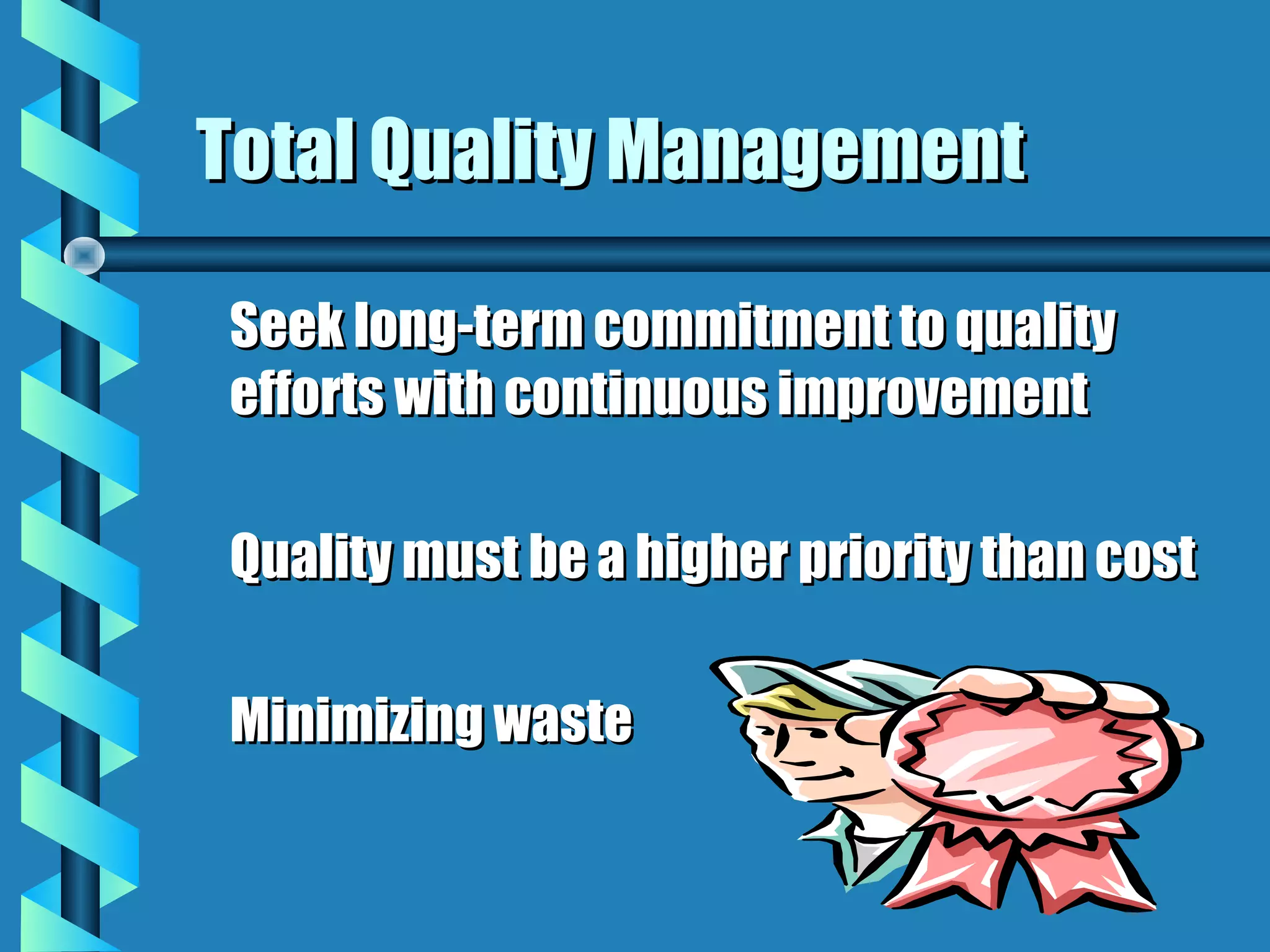
Total Quality Management

Seek long-term commitment to quality
efforts with continuous improvement

Quality must be a higher priority than cost

Minimizing waste
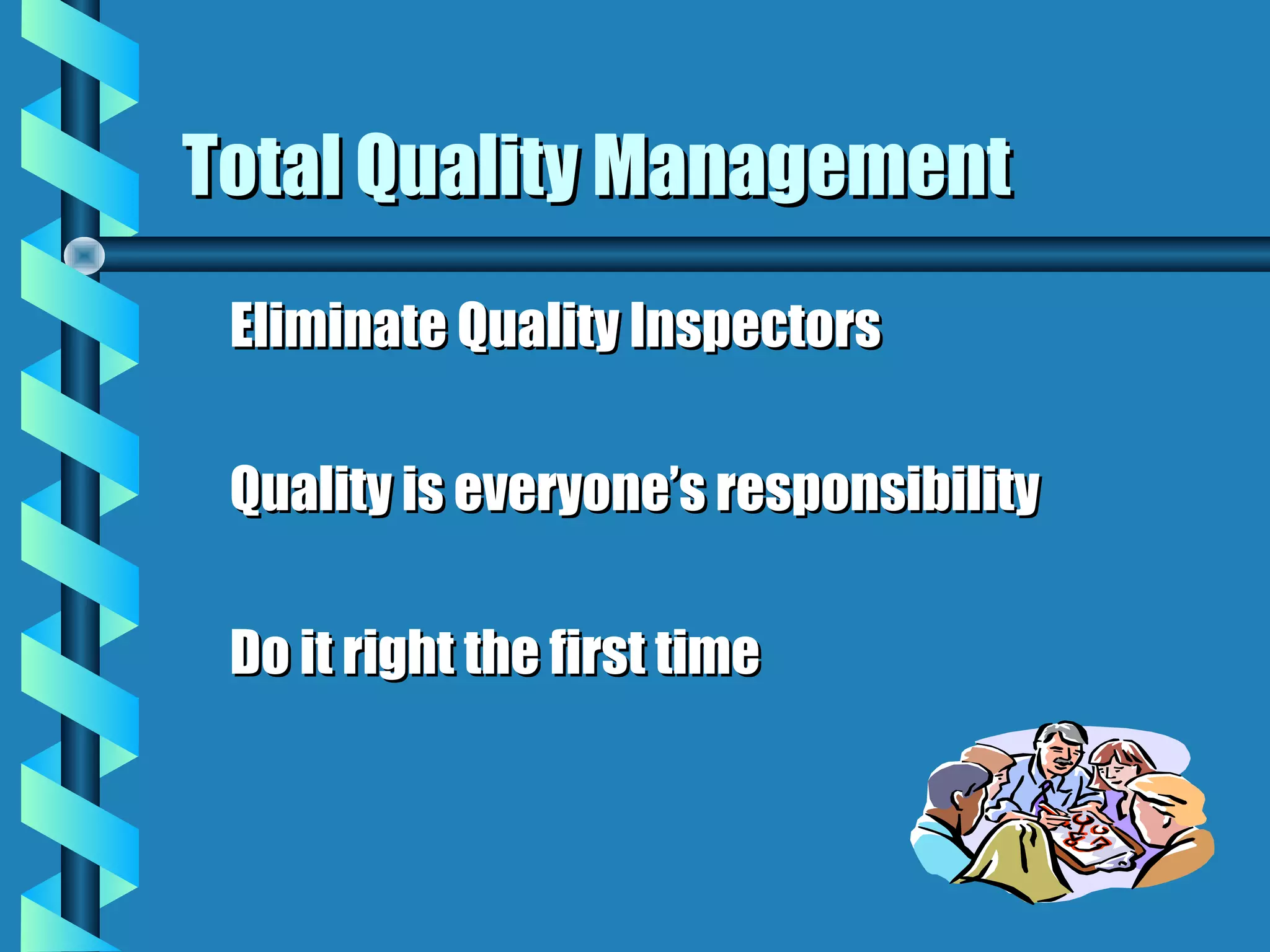
Total Quality Management
 Eliminate Quality Inspectors

 Quality is everyone’s responsibility

 Do it right the first time
Principles Of JIT Manufacturing
 Total Quality Management

 Production Management

 Supplier Management

 Inventory Management

 Human Resource Management
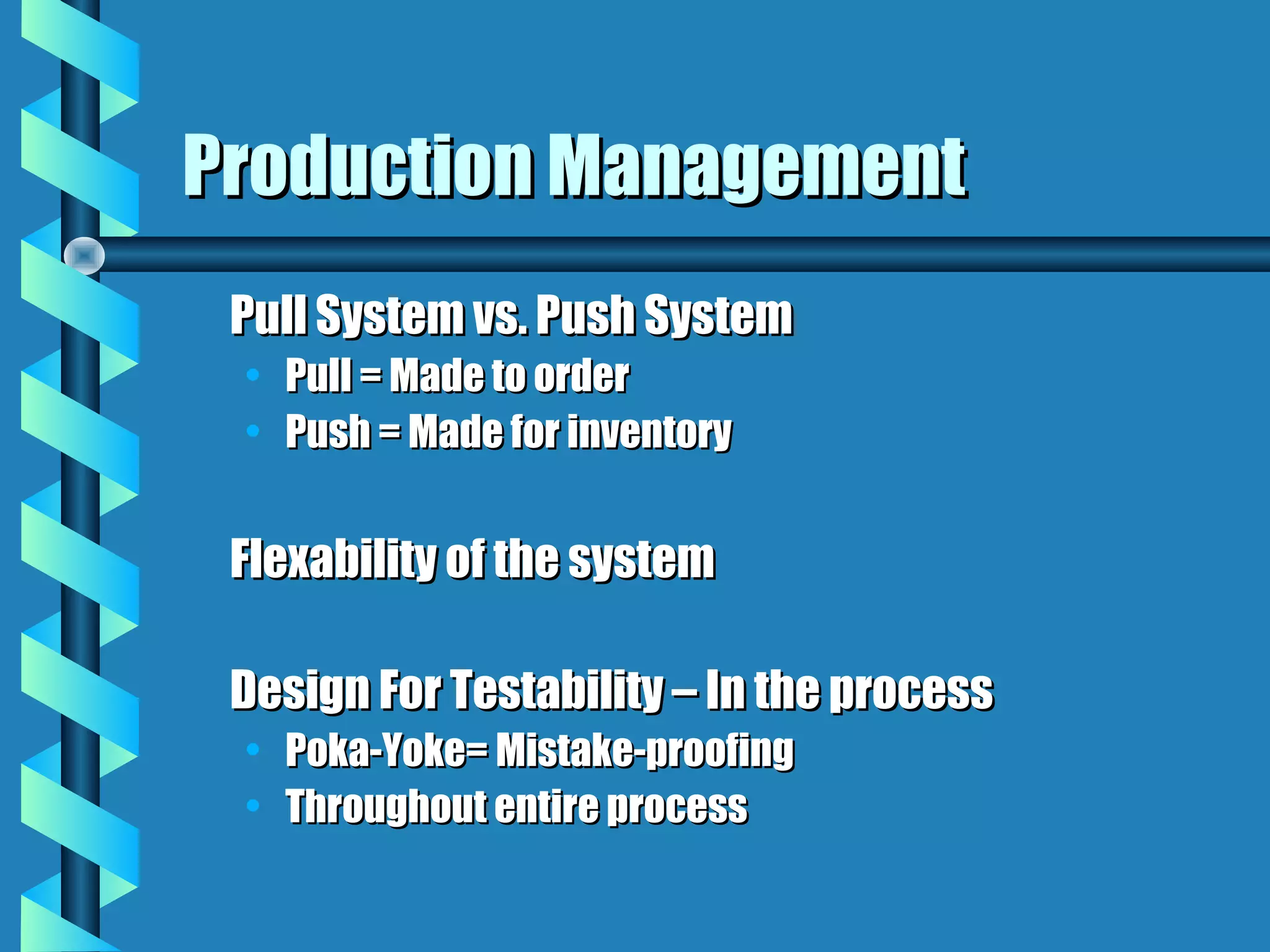
Production Management
 Pull System vs. Push System
 • Pull = Made to order
 • Push = Made for inventory


 Flexability of the system

 Design For Testability – In the process
 • Poka-Yoke= Mistake-proofing
 • Throughout entire process
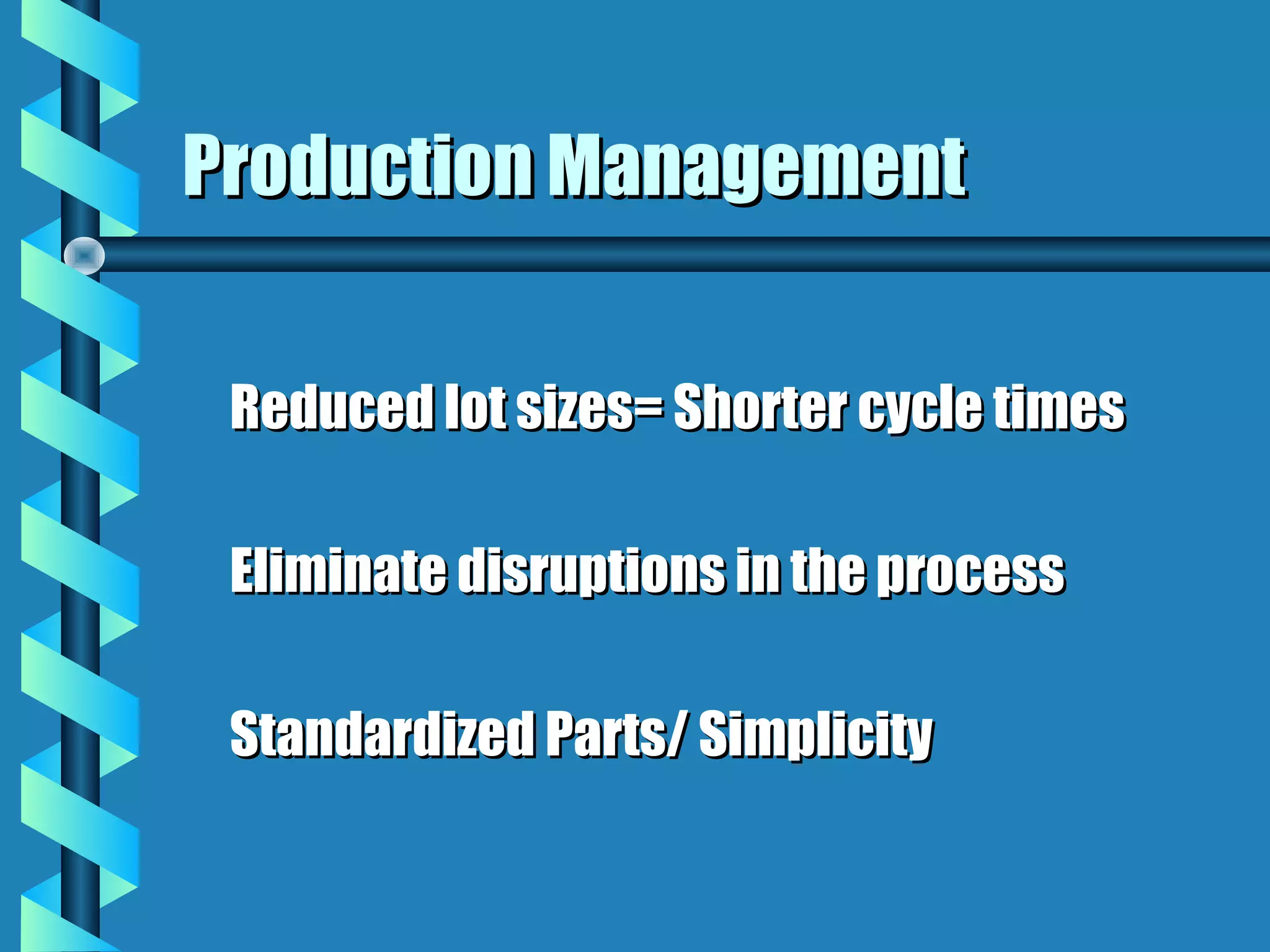
Production Management


 Reduced lot sizes= Shorter cycle times

 Eliminate disruptions in the process

 Standardized Parts/ Simplicity
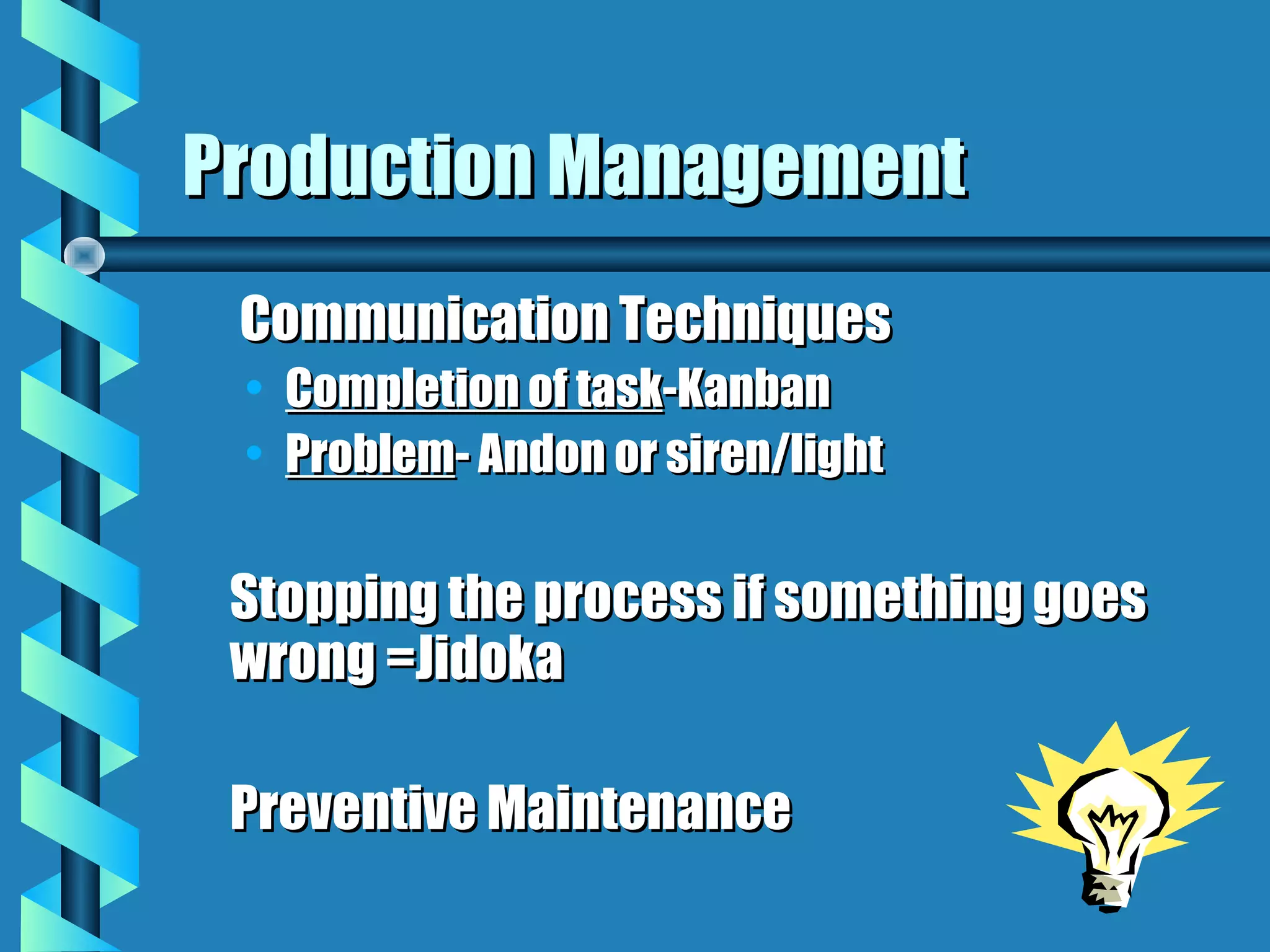
Production Management
 Communication Techniques
 •   Completion of task-Kanban
 •   Problem- Andon or siren/light

 Stopping the process if something goes
 wrong =Jidoka

 Preventive Maintenance
Production Management at
Toyota
   Toyota uses a Kanban pull system
    throughout the production process.

   Each task in the process seems to take
    identical length and work content, so
    everyone is working at the same pace to
    reduce bottlenecks.
Principles Of JIT Manufacturing
 Total Quality Management

 Production Management

 Supplier Management

 Inventory Management

 Human Resource Management
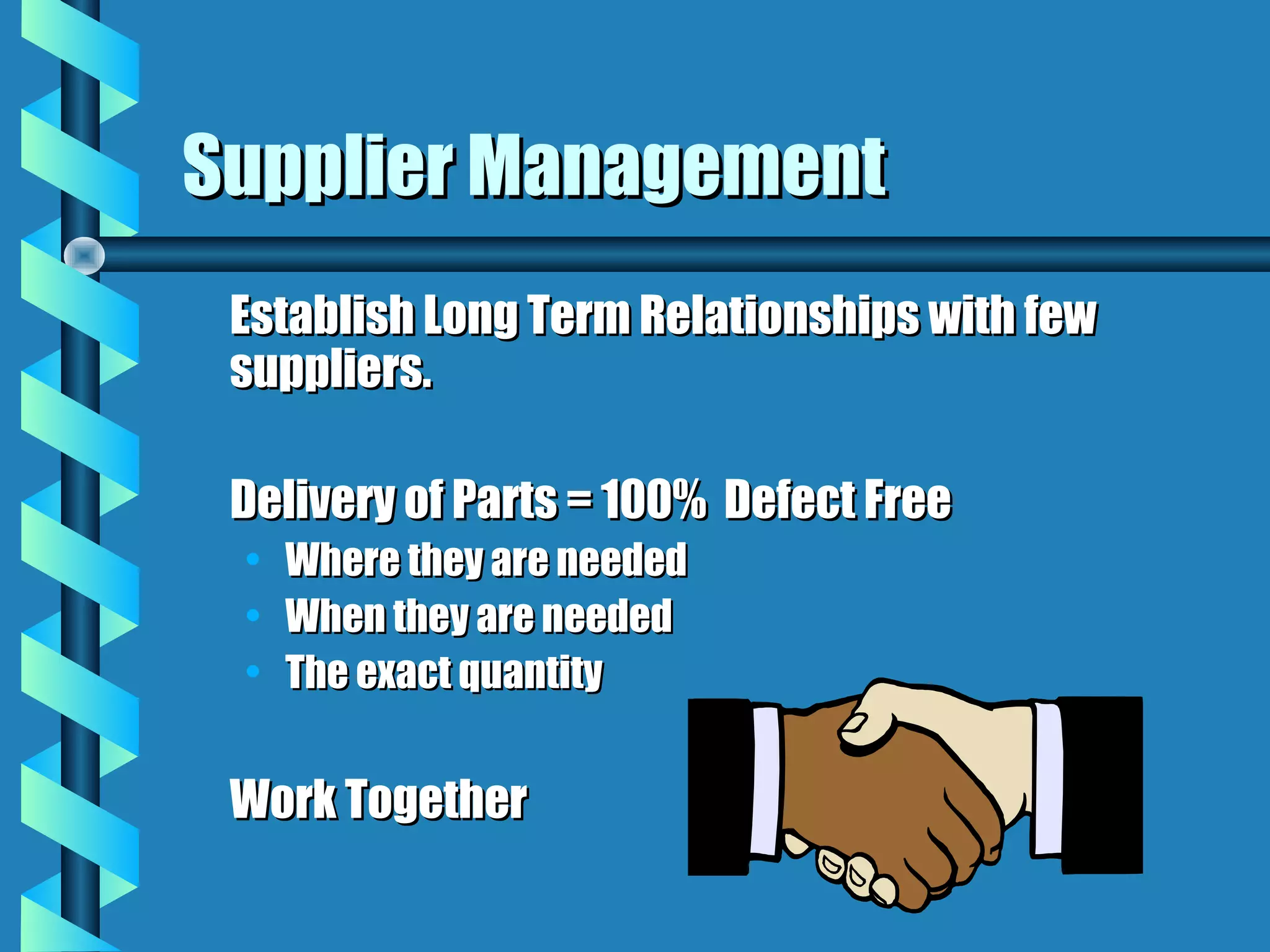
Supplier Management
 Establish Long Term Relationships with few
 suppliers.

 Delivery of Parts = 100% Defect Free
 • Where they are needed
 • When they are needed
 • The exact quantity


 Work Together
Supplier Management
 Elimination inspection of parts

 Information Systems
 • Eliminating barriers to information


 Communicate problems to suppliers in a
 positive manner.
Supplier Relations at Toyota
   Toyota communicates their damand for
    parts 20 days in advance to their suppliers,
    with the right to change the forecast up to
    the 10th day.
Principles Of JIT Manufacturing
 Total Quality Management

 Production Management

 Supplier Management

 Inventory Management

 Human Resource Management
Inventory Management
 Eliminate Safety Stock = Zero Inventory

 Reduce WIP

 JIT is not an inventory control system

 Reduction in inventory opens up space
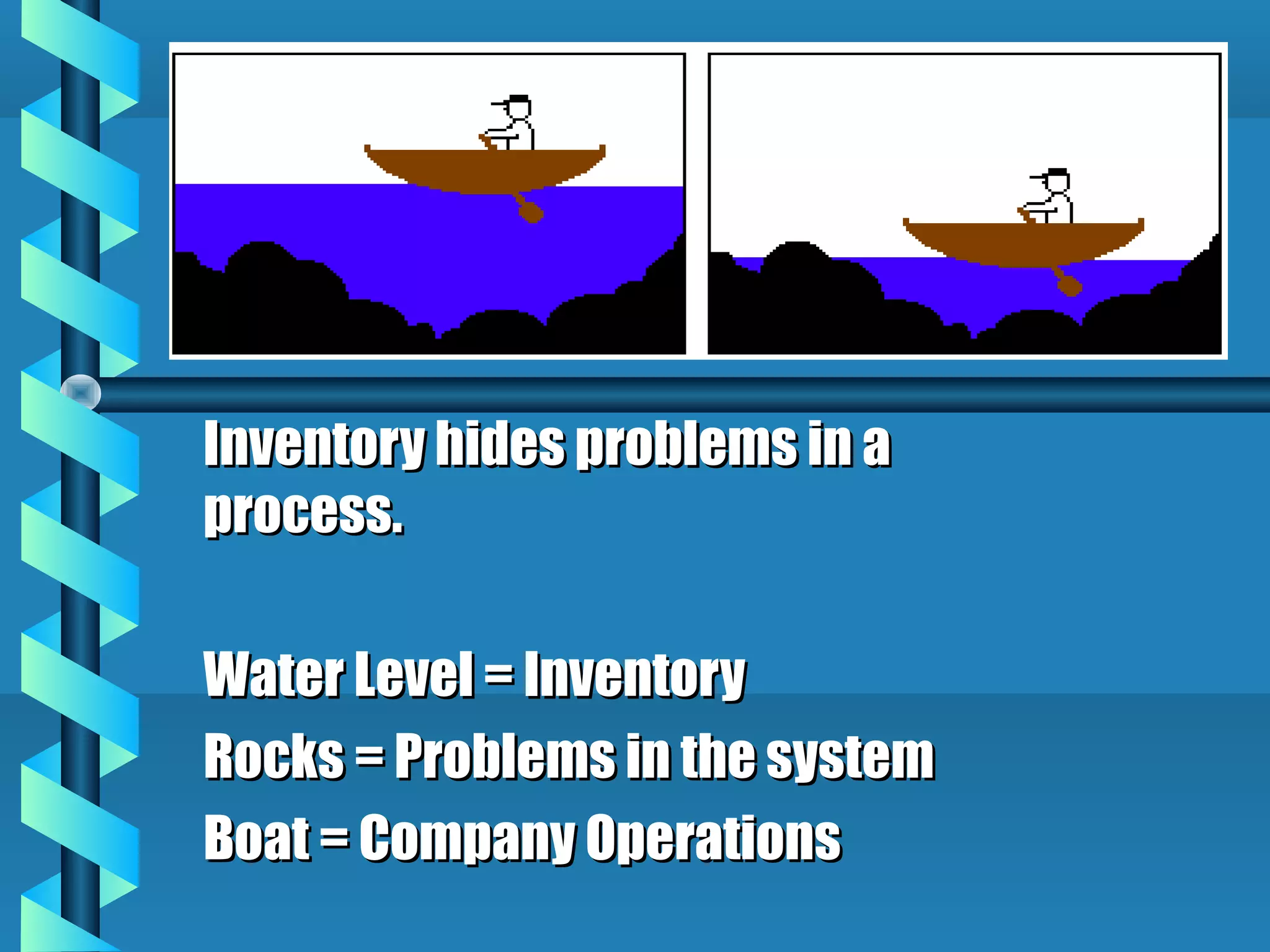
Inventory hides problems in a
process.

Water Level = Inventory
Rocks = Problems in the system
Boat = Company Operations
Principles Of JIT Manufacturing
 Total Quality Management

 Production Management

 Supplier Management

 Inventory Management

 Human Resource Management
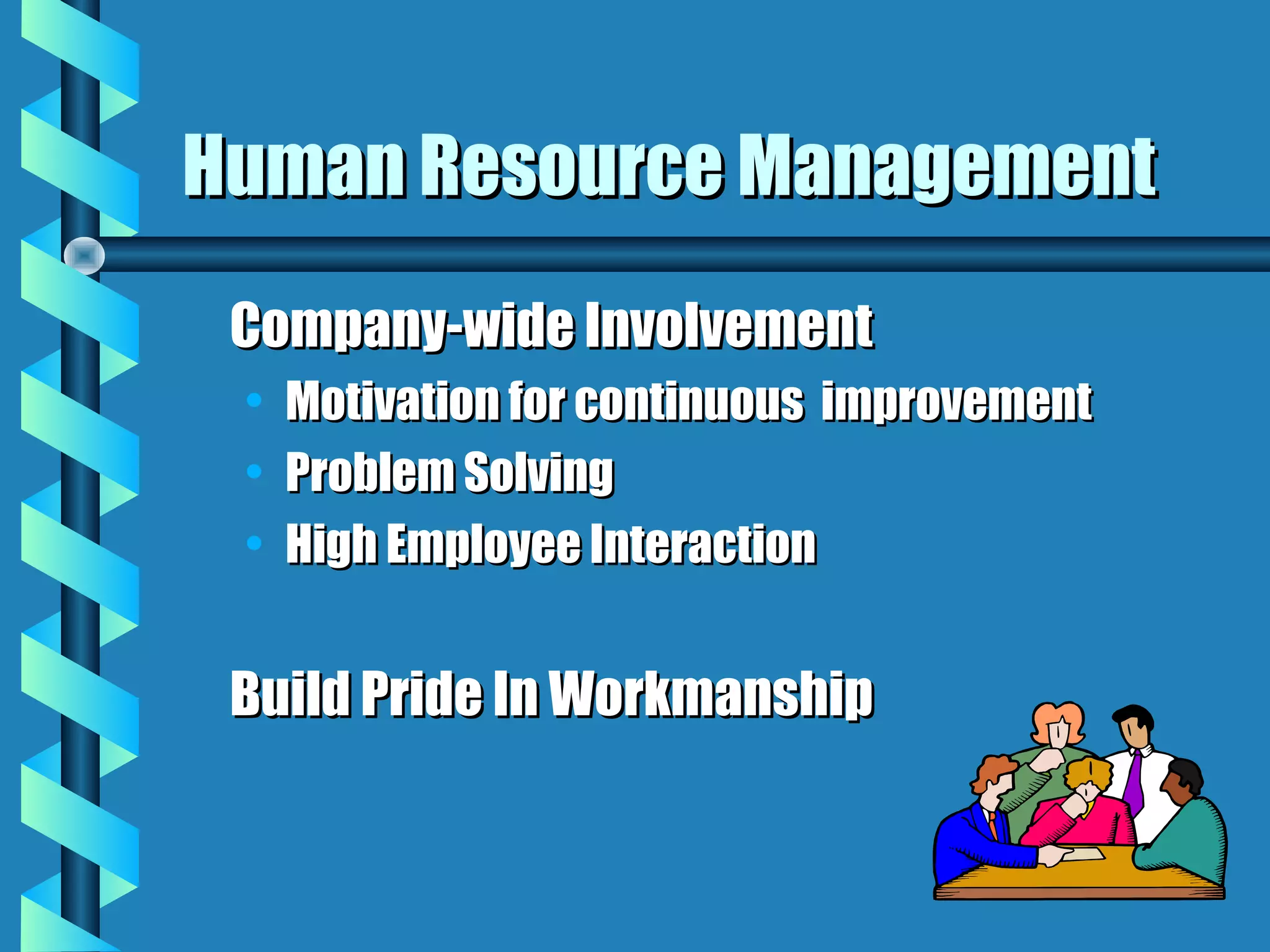
Human Resource Management
 Company-wide Involvement
 •   Motivation for continuous improvement
 •   Problem Solving
 •   High Employee Interaction


 Build Pride In Workmanship
Human Resource Management

 Self-Inspection of work

 Diversified Employees
 • Absenteeism
 • To eliminate boredom in process


 Management Support and Empowerment of
 workforce
Human Resource Management at
Toyota


   In 1986 from a labor force of 60,000 Toyota
    received 2.6 million improvement
    proposals, 96% of which were
    implemented by either management or the
    employees themselves.
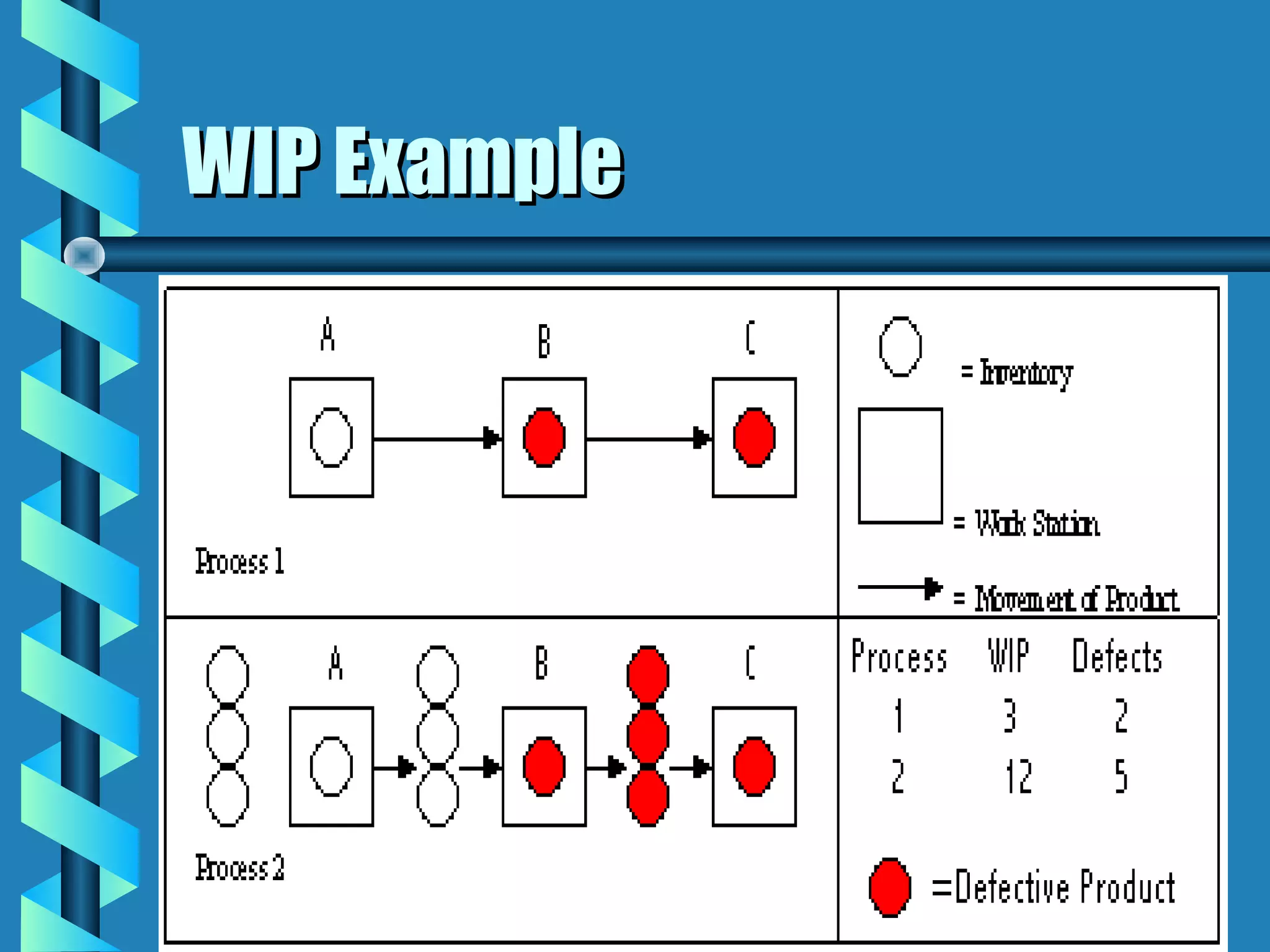
WIP Example
Implementation Problems

 Worker resistance

 Lack of top management support

 Lack of communication

 Lack of formal training
Most Important Question
 What phrase best describes the
 Just-In-Time philosophy?


   Continuous Improvement
Summary
JIT- A philosophy of continuous improvement
   that puts emphasis on prevention rather
  than correction, and demands a company
  wide focus on quality.
References


Cammaranano, J. Lessons to be Learned: JIT. Atlanta, Georgia: Engineering and Management
    Press, 1997.
Dear, A. Working toward JIT: Management Technology. London: Derek Doyle and Associates,
    1988.
Fisher, D. The JIT Self Test: Success Through Assesment and Implementation. Chicago, IL:
    Irwin Inc., 1995.
Hernandez, A. JIT Quality: A Practical Approach. Englewood Cliffs, NJ: Prentice-Hall, 1993.
Hutchins, D. Just-In-Time: Inventory Control. Brookfield, VT: Gower Publishing, 1988.
O’Grady, P.J. Putting the JIT Philosophy Into Practice. New York, NY: Nichols Publishing, 1988.
Reinfeld, N.V. Handbook of Production and Inventory Control. Englewood Cliffs, NJ: Prentice-
    Hall, 1987.
Schneiderjans, M.J. Advanced Topics In JIT Management: JIT Systems. Westport, CT:
    Greenwood Publishing Group, 1999.
Taver, R.W. Manufacturing Solutions for Consistent Quality and Reliability: The 9 Step
    Problem Solving Process. New York, NY: AMACON, 1995.
Wesner, J.W., Hiatt, J.M., and Trimble, D.C. Winning with Quality: Applying Quality Principles in
    Product Development. Reading, MASS: Addison-Wesley Publishing Co., 1995.

JIT for manufacturing ppt

  • 1.
    Just-In-Time Manufacturing Matt Schmidt Penn State University OISM 470W
  • 2.
    Just-In-Time Manufacturing? What isJIT Manufacturing? Where did it come from? What are the main principles? Is it easy to Implement? What phrase best describes JIT?
  • 3.
    Just-In Time Manufacturing JIT- A philosophy of continuous improvement that puts emphasis on prevention rather than correction, and demands a company wide focus on quality. JIT- operational management approach to achieve world class manufacturing. JIT- production is based on demand
  • 4.
    History of JITManufacturing Evolved in Japan after World War II, as a result of their diminishing market share in the auto industry. Toyota Motor Company- Birthplace of the JIT Philosophy Under Taiichi Ohno. • W. Edwards Deming • 14 points for Management JIT is now on the rise in American Industries.
  • 5.
    Principles Of JITManufacturing Total Quality Management Production Management Supplier Management Inventory Management Human Resource Management
  • 6.
    Principles Of JITManufacturing Total Quality Management Production Management Supplier Management Inventory Management Human Resource Management
  • 7.
    Total Quality Management Seeklong-term commitment to quality efforts with continuous improvement Quality must be a higher priority than cost Minimizing waste
  • 8.
    Total Quality Management Eliminate Quality Inspectors Quality is everyone’s responsibility Do it right the first time
  • 9.
    Principles Of JITManufacturing Total Quality Management Production Management Supplier Management Inventory Management Human Resource Management
  • 10.
    Production Management PullSystem vs. Push System • Pull = Made to order • Push = Made for inventory Flexability of the system Design For Testability – In the process • Poka-Yoke= Mistake-proofing • Throughout entire process
  • 11.
    Production Management Reducedlot sizes= Shorter cycle times Eliminate disruptions in the process Standardized Parts/ Simplicity
  • 12.
    Production Management CommunicationTechniques • Completion of task-Kanban • Problem- Andon or siren/light Stopping the process if something goes wrong =Jidoka Preventive Maintenance
  • 13.
    Production Management at Toyota  Toyota uses a Kanban pull system throughout the production process.  Each task in the process seems to take identical length and work content, so everyone is working at the same pace to reduce bottlenecks.
  • 14.
    Principles Of JITManufacturing Total Quality Management Production Management Supplier Management Inventory Management Human Resource Management
  • 15.
    Supplier Management EstablishLong Term Relationships with few suppliers. Delivery of Parts = 100% Defect Free • Where they are needed • When they are needed • The exact quantity Work Together
  • 16.
    Supplier Management Eliminationinspection of parts Information Systems • Eliminating barriers to information Communicate problems to suppliers in a positive manner.
  • 17.
    Supplier Relations atToyota  Toyota communicates their damand for parts 20 days in advance to their suppliers, with the right to change the forecast up to the 10th day.
  • 18.
    Principles Of JITManufacturing Total Quality Management Production Management Supplier Management Inventory Management Human Resource Management
  • 19.
    Inventory Management EliminateSafety Stock = Zero Inventory Reduce WIP JIT is not an inventory control system Reduction in inventory opens up space
  • 20.
    Inventory hides problemsin a process. Water Level = Inventory Rocks = Problems in the system Boat = Company Operations
  • 21.
    Principles Of JITManufacturing Total Quality Management Production Management Supplier Management Inventory Management Human Resource Management
  • 22.
    Human Resource Management Company-wide Involvement • Motivation for continuous improvement • Problem Solving • High Employee Interaction Build Pride In Workmanship
  • 23.
    Human Resource Management Self-Inspection of work Diversified Employees • Absenteeism • To eliminate boredom in process Management Support and Empowerment of workforce
  • 24.
    Human Resource Managementat Toyota  In 1986 from a labor force of 60,000 Toyota received 2.6 million improvement proposals, 96% of which were implemented by either management or the employees themselves.
  • 25.
  • 26.
    Implementation Problems Workerresistance Lack of top management support Lack of communication Lack of formal training
  • 27.
    Most Important Question What phrase best describes the Just-In-Time philosophy? Continuous Improvement
  • 28.
    Summary JIT- A philosophyof continuous improvement that puts emphasis on prevention rather than correction, and demands a company wide focus on quality.
  • 29.
    References Cammaranano, J. Lessonsto be Learned: JIT. Atlanta, Georgia: Engineering and Management Press, 1997. Dear, A. Working toward JIT: Management Technology. London: Derek Doyle and Associates, 1988. Fisher, D. The JIT Self Test: Success Through Assesment and Implementation. Chicago, IL: Irwin Inc., 1995. Hernandez, A. JIT Quality: A Practical Approach. Englewood Cliffs, NJ: Prentice-Hall, 1993. Hutchins, D. Just-In-Time: Inventory Control. Brookfield, VT: Gower Publishing, 1988. O’Grady, P.J. Putting the JIT Philosophy Into Practice. New York, NY: Nichols Publishing, 1988. Reinfeld, N.V. Handbook of Production and Inventory Control. Englewood Cliffs, NJ: Prentice- Hall, 1987. Schneiderjans, M.J. Advanced Topics In JIT Management: JIT Systems. Westport, CT: Greenwood Publishing Group, 1999. Taver, R.W. Manufacturing Solutions for Consistent Quality and Reliability: The 9 Step Problem Solving Process. New York, NY: AMACON, 1995. Wesner, J.W., Hiatt, J.M., and Trimble, D.C. Winning with Quality: Applying Quality Principles in Product Development. Reading, MASS: Addison-Wesley Publishing Co., 1995.

Editor's Notes

  • #2 Hello, my name is Matt Schmidt, I am from Penn State University and today I will be discussing Just-In-Time Manufacturing.
  • #3 For those of you that have never heard of Just-In-Time Manufacturing, today we will be covering these four questions. What is JIT Manufacturing, Where did it come from, What are the main principles, is it easy to implement, and most important What phrase best describes JIT?
  • #4 Just-In-Time Manufacturing or JIT, is a philosophy of continuous improvement that puts emphasis on prevention rather than correction, and demands a company wide focus on quality. It is also an operational management approach to achieve world class manufacturing. I would also like to emphasize that JIT is a philosophy, and that the philosophy bases production of demand.
  • #5 Jit philosophy evolved in Japan after World War II, as a result of their diminishing market share in the auto industry. Toyota Motor Company is the birthplace of the JIT philosophy under Taiichi Ohno. Taiichi’s JIT philosophy also encompasses many of W. Edwards Deming’s 14 points of Management concepts. Pause JIT is now on the rise in American Industries.
  • #6 These are the 5 main principles of Jit Management: Total Quality Management, Production Management, Supplier Management, Inventory Management , and Human Resource Management.
  • #7 The first principle that we will focus on today is Total Quality Management. JIT will not survive if there is not a strong emphasis on TQM.
  • #8 There are countless points to emphasize when considering TQM, some of the stronger areas to concentrate on are as follows. Seeking long-term commitment to quality efforts will ensure that the your efforts will be maintained throughout the life of the company. Quality must be a higher priority than cost because in the market of today, quality is no longer an order winner, it is an order qualifier. Minimizing Waste in production consists of more than minimizing losses of time and resources. Waste can be defined in production terms as "everything not needed in production."
  • #9 Eliminate Quality Inspectors, Make Quality everyone’s responsibility, and doing the job right the first time delegates the responsibility of quality across all levels of the organization.
  • #10 The second principle of JIT Manufacturing is Production Management.
  • #11 The principle of Production Management is important to sustain quality in the process. JIT philosophy uses a Pull System as apposed to a Push System. Pull = Made to order, and Push = Made for inventory. This allows for demand to set the tone for production. It is also important for the system to be flexible. This means that production levels must have the ability to change from day to day, working with the aspect of made to order. From a production management standpoint designing for testability is essential in the process, to aid in the quest for ZERO DEFECTS. One tool used to aid in this quest is the Poka-Yoke device, also known as a mistake proofing device. This device will prevent mistakes from happening, or display obvious problems at a glance. It is also important to test throughout the entire process to ensure Zero defects.
  • #12 Reduction of lot sizes will shorten the cycle times, and as a result this reduction will free up capital that was otherwise tied up in Inventory. JIT should eliminate any disruptions in the process, to maximize productivity, while eliminating any bottlenecks. Standardized parts should be used to increase simplicity in a process, and as a result defective products will be reduced and eventually eliminated.
  • #13 The JIT philosophy uses multiple communication techniques to aid in the production process, two of which are the use of a Kanban system and an Andon. Kanban is Japanese for the word Card. Kanban is used to control the flow of inventory throughout the process in a pull system utilizing a card to signal demand. An Andon is a light or signal in the process throughout the work stations that will alarm the workers that there is a problem in the process, and there is a collaborative effort to correct and prevent the problem from happening again. Stopping the process in this manner is referred to in Japanese as Jidoka, or a halt of the line. Preventive maintenance is necessary to eliminate any down time for machinery failure in a process.
  • #14 Throughout my research Toyota was the predominant example in each book. So I will continue to refer to Toyota in my examples. Toyota uses a Kanban pull system throughout the production process. Each task in the process seems to take identical length and work content, so everyone is working at the same pace to reduce bottlenecks.
  • #15 The next principle in JIT Manufacturing is supplier management.
  • #16 The main focus of supplier management is to establish long term relationships with few firms. By doing this, you can grow with your supplier. Jit considers inventory to be wasteful, so therefore it is eliminated. When inventory is eliminated, parts need to be delivered exactally when they are needed, where they are needed, in the exact quantity, and in addition need to be 100% DEFECT FREE. This is why it is important to work together as a team with your supplier
  • #17 Establishing this relationship will also allow for the elimination of high levels of inventory being inspected for use in the production process. Communication is vital Supplier Management, therefore efficient Information systems will open new line of communication with these suppliers. Eliminating barriers to information will increase the efficiency. Communicate problems to your suppliers in a positive manner. Don’t assign the blame, work together to overcome the problem to prevent it from happening in the future.
  • #18 Toyota communicates their damand for parts 20 days in advance to their suppliers, with the right to change the forecast up to the 10 th day.
  • #19 The next principle in JIT Manufacturing is Inventory Management.
  • #20 A main emphasis in JIT manufacturing is the goal of Zero Inventory, to achieve this goal you must Eliminate safety stock. A reduction in WIP will reduce the number of defects in the event of a problem. Jit is not an inventory control system, it is a philosophy for continuous improvement of quailty that puts emphasis on prevention rather than correction. Reduction of Inventory will also open up more space in your factory. . Next is an analogy of how reducing inventory will aid in overall performance.
  • #21 Inventory hides problems in a process, if you reduce it, then problems in the system become more clear. Look at the above pictures. In the first picture the boat in clearly above all rocks in the water, and no problems clearly exist. In the second picture the water level lower and the rocks have now become a problem for the boat. The water level represents inventory, the rocks represent problems in the system, and the boat represents the company’s operations. If inventory is reduced, problems in the system become more clear from the operations standpoint.
  • #22 The last principle in JIT manufacturing is Human resource management.
  • #23 To be successful in a Jit manufacturing, or quality based process the need for Human resource management is essential. You need company wide involvement across all departments. Motivation is needed from a managerial standpoint to maintain continuous improvement. Problem solving skills are needed to maintain speed of the line in the event of of a halt. High employee interaction is essential for employees to work together to change the process for the better. Build Pride In Workmanship to increase the level of quality.
  • #24 Self Inspection of work is needed to keep the process flowing smoothly. The moving around of employees to different work stations throughout the day is needed in the event of absenteeism, and a technique to break up the routine task of the process. Management support and empowerment of the work force is needed, so that employees are not afraid of stopping the process in the event of a problem.
  • #25 In 1986 from a labor force of 60,000 Toyota received 2.6 million improvement proposals, 96% of which were implemented by either management or the employees themselves.
  • #26 Here is an example of how JIT Manufacturing can reduce total defects, in the event of a problem in work station B. In a real world example, a simple reduction in product defects would save your company a significant amount of time and money. In a true JIT system, the product would have never left station B in a defective state, and if it did, a halt would be put of the process to prevent it from happening again.
  • #27 It is crucial to Implement these JIT principles correctly. Worker co-operation is the most important aspect of JIT. Managers often overlook the importance of the support from the workforce, as well as looking over the amount of work and dedication needed to strive for continuous improvement. Overlooking these implementation Problems is a time bomb waiting to explode.
  • #28 What phrase best describes the Just-In-Time philosophy? Continuous Improvement
  • #29 In conclusion, I hope you now have a better understanding for JIT Manufacturing and it’s principles. Companies that are determined to stick to these principles will see results. Companies that believe the responsibility of quality falls in the hands of the quality department will not be around long enough to have a market share.
  • #30 Here are the sources where I did my research.