Productivity  and  Quality Management
Question Bank What is TQM? State the objectives and benefits of TQM (ppt 27,29) What are Quality management systems? State eight building blocks of TQM (ppt28) State 10 steps of TQM (ppt 26) What is TPM and explain TPM awards (32-34) 14 points of Deming’s philosophy(chpt7 &39-40 14 points of Crosby’s philosophy (chpt 7 &41,42) Explain eight Principles of TQM (ppt17-25) What is Juran’s Triology
Question Bank What are Quality circles and how do they differ from Kaizen? What are 5 ‘S’ practices? (ppt 30) What is BPR? Why is it necessary to initiate this before we start ISO 9000? What is COQ? How do we bring down the COQ? What is six sigma? (Ppt -10)
Question Bank Explain Malcolm Baldrige award (ppt74,77) what are the Techniques used in TQM (ppt 57) State the factors affecting product and service Quality seperately (ppt78,79)
Increase Sales Volume (Increase Market share) Increase Sale Price Reduce Purchase cost of Input Reduce cost of production Improve quality (Reduce cost of Quality) Improve productivity Improve Profit
Productivity and Quality Mgmt  Differentiate Production and Productivity Inspection and Quality Control System, Procedures and Processes Quality Control and Total Quality Mgmt (TQM) TQM and Six Sigma
Productivity- Definition (Productivity is a ratio) The amount of output per unit of input  (labor, equipment, and capital).  Number of products / No. of hours taken to produce them Revenue generated by employee / Salary of employee
System, Procedure and Process System is a set of interactive elements corresponding to the given inputs to produce the desired output Procedure is a set of activities which have to follow in a systematic format without taking any shortcuts Process is a set of activities/operations which follow the procedures and systems with right RM and intermittent checking to avoid any lapses.
Process Process is a summation of activities such as operations, inspection, delays, storage, transportation and everything else that happens between the beginning and the end of the process
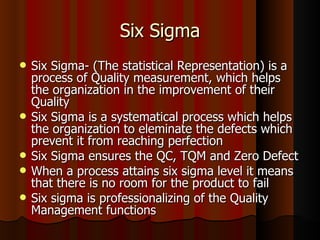
Six Sigma Six Sigma- (The statistical Representation) is a process of Quality measurement, which helps the organization in the improvement of their Quality Six Sigma is a systematical process which helps the organization to eleminate the defects which prevent it from reaching perfection  Six Sigma ensures the QC, TQM and Zero Defect When a process attains six sigma level it means that there is no room for the product to fail Six sigma is professionalizing of the Quality Management functions
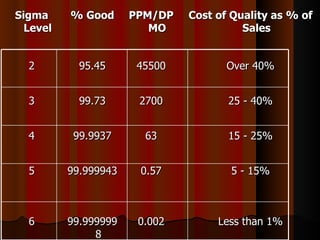
Sigma Level % Good PPM/DPMO Cost of Quality as % of Sales 2 95.45 45500 Over 40% 3 99.73 2700 25 - 40% 4 99.9937 63 15 - 25% 5 99.999943 0.57 5 - 15% 6 99.9999998 0.002 Less than 1%
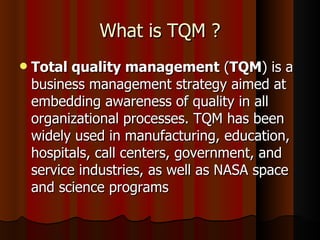
What is TQM ? Total quality management  ( TQM ) is a business management strategy aimed at embedding awareness of quality in all organizational processes. TQM has been widely used in manufacturing, education, hospitals, call centers, government, and service industries, as well as NASA space and science programs
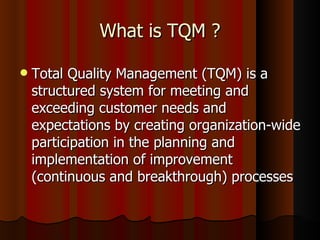
Total Quality Management (TQM) is a structured system for meeting and exceeding customer needs and expectations by creating organization-wide participation in the planning and implementation of improvement (continuous and breakthrough) processes What is TQM ?
Total Quality Management Total :  Involve all functions to have customer focus and give reliable delivery of  product+service in line with customer’s expectations at lowest cost Quality : Design and manufacture the product+service to achieve zero defect and 100% customer satisfaction  Management : Lead to achieve quality for customers by communicating the vision, mission and values to all employees and creating continuous improvement culture
Techniques for TQM Total Employee Involvement  : (205) Kaizen, Small Group Acitvity, Quality Circles, Key Business Process /Biz Process Re-engineering,  customer satisfaction surveys, Training Just in Time/ Waste Elemination  :  (206) TPM, Zero Defect, supplier Partnership Total Quality Control : (207) TQC is aplicable to all functions, use of 7 QC Tools, use of SPC/SQC and PDCA, ISO 9000, Six Sigma, ISO 14000, understand the processes critical to quality (CTQ)
In a global marketplace a major characteristic that will distinguish those organizations that are successful will be the quality of leadership, management, employees, work processes, product and service.    This means that products must not only meet  customer’s community needs for value, they must be provided in a continuously improving, timely, cost-effective, innovative, and productive manner Why TQM ?
Principles of TQM 1. Customer-Focused Organisation  2. Leadership  3. Involvement of People  4. Process Approach  5. System Approach to Management  6. Continual Improvement  7. Factual Approach to Decision Making  8. Mutually Beneficial Supplier Relationships
1.Customer Focussed Organization Understand customer needs and expectations for products, delivery, price, dependability, etc.  Ensure a balanced approach among customers and other stake holders’ (owners, people, suppliers, local communities and society at large) needs and expectations.  Communicate these needs and expectations throughout the organisation.  Measure customer satisfaction & act on results,  Manage customer relationships
2. Leadership Be proactive and lead by example.  Understand and respond to changes in the external environment.  Consider the needs of all stake holders including customers, owners, people, suppliers, local communities and society at large.  Establish a clear vision of the organisation's future.  Establish shared values and ethical role models at all levels of the organisation.  Build trust and eliminate fear.  Provide people with the required resources and freedom to act with responsibility and accountability.  Inspire, encourage and recognise people's contributions.  Promote open and honest communication.  Educate, train and coach people.  Set challenging goals and targets, and  Implement a strategy to achieve these goals and targets.
3. Involvement of People Accept ownership and responsibility to solve problems.  Actively seek opportunities to make improvements, and enhance competencies, knowledge and experience.  Freely share knowledge & experience in teams.  Focus on the creation of value for customers.  Be innovative in furthering the organisation’s objectives.  Improve the way of representing the organisation to customers, local communities and society at large.  Help people derive satisfaction from their work, and  Make people enthusiastic and proud to be part of the organisation.
4. Process Approach Define the process to achieve the desired result.  Identify and measure the inputs and outputs of the process.  Identify the interfaces of the process with the functions of the organisation.  Evaluate possible risks, consequences and impacts of processes on customers, suppliers and other stake holders of the process.  Establish clear responsibility, authority, and accountability for managing the process.  Identify internal and external customers, suppliers and other stake holders of the process When designing processes, consider process steps, activities, flows, control measures, training needs, equipment, methods, information, materials and other  resources to achieve the desired result.
5. System Approach to Management Define the system by identifying or developing the processes that affect a given objective.  Structure the system to achieve the objective in the most efficient way.  Understand the interdependencies among the processes of the system.  Continually improve the system through measurement and evaluation, and  Estimate the resource requirements and establish resource constraints prior to action.
6. Continual Improvements Make continual improvement of products, processes and systems an objective for every individual in the organisation.  Apply the basic improvement concepts of incremental improvement and breakthrough improvement.  Use periodic assessments against established criteria of excellence to identify areas for potential improvement.  Continually improve the efficiency and effectiveness of all processes.  Promote prevention based activities.  Provide every member of the organisation with appropriate education and training, on the methods and tools of continual improvement such as the Plan-Do-Check-Act cycle , problem solving , process re-engineering, and process innovation.  Establish measures and goals to guide and track improvements,and  Recognise improvements.
7. Factual Approach to Decision Making Take measurements and collect data and information relevant to the objective.  Ensure that the data and information are sufficiently accurate, reliable and accessible.  Analyse the data and information using valid methods.  Understand the value of appropriate statistical techniques, and  Make decisions and take action based on the results of logical analysis balanced with experience and intuition.
8.  Supplier Relationship Identify and select key suppliers.  Establish supplier relationships that balance short-term gains with long-term considerations for the organisation and society at large.  Create clear and open communications.  Initiate joint development and improvement of products and processes.  Jointly establish a clear understanding of customers' needs.  Share information and future plans, and  Recognise supplier improvements and achievements.
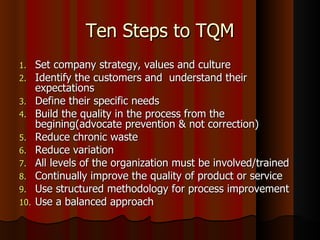
Ten Steps to TQM Set company strategy, values and culture Identify the customers and  understand their expectations Define their specific needs Build the quality in the process from the begining(advocate prevention & not correction) Reduce chronic waste Reduce variation All levels of the organization must be involved/trained  Continually improve the quality of product or service Use structured methodology for process improvement Use a balanced approach
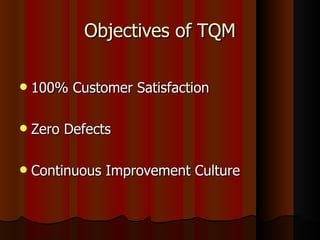
Objectives of TQM 100% Customer Satisfaction Zero Defects Continuous Improvement Culture
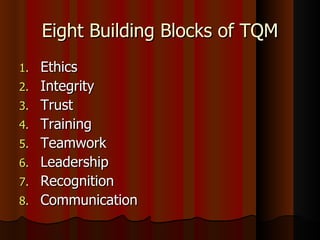
Eight Building Blocks of TQM Ethics Integrity  Trust Training Teamwork Leadership Recognition Communication
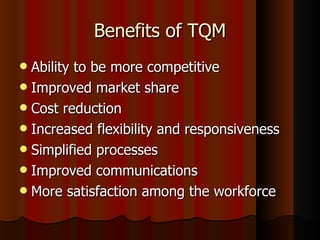
Benefits of TQM Ability to be more competitive Improved market share Cost reduction Increased flexibility and responsiveness Simplified processes Improved communications More satisfaction among the workforce
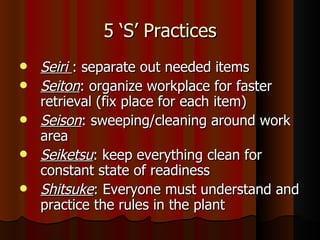
5 ‘S’ Practices Seiri  : separate out needed items Seiton : organize workplace for faster retrieval (fix place for each item) Seison : sweeping/cleaning around work area Seiketsu : keep everything clean for constant state of readiness Shitsuke : Everyone must understand and practice the rules in the plant
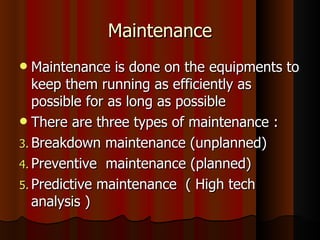
Maintenance Maintenance is done on the equipments to keep them running as efficiently as possible for as long as possible There are three types of maintenance : Breakdown maintenance (unplanned) Preventive  maintenance (planned) Predictive maintenance  ( High tech analysis )
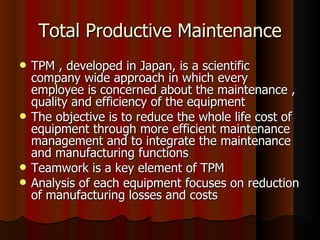
Total Productive Maintenance TPM , developed in Japan, is a scientific company wide approach in which every employee is concerned about the maintenance , quality and efficiency of the equipment The objective is to reduce the whole life cost of equipment through more efficient maintenance management and to integrate the maintenance and manufacturing functions Teamwork is a key element of TPM Analysis of each equipment focuses on reduction of manufacturing losses and costs
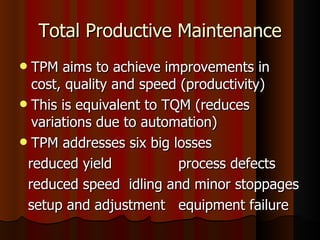
Total Productive Maintenance TPM aims to achieve improvements in cost, quality and speed (productivity) This is equivalent to TQM (reduces variations due to automation) TPM addresses six big losses reduced yield  process defects reduced speed  idling and minor stoppages setup and adjustment  equipment failure
TPM Awards Effective 1971, the factories which displayed remarkable achievement in plant maintenance were given this award Effective 1989, the factories which have achieved company-wide efficiency & productivity by adopting company-wide TPM are given this award
Five Pillars of TPM 1. Quality Integration  (Process capability- Cpk) 2. New Equipment Management (design) 3. Autonomous Maintenance (military like) 4. Planned Maintenance (reduce unplanned) 5. Equipment Improvement (productivity)
Seven Deadly Disasters Dr Deming- TQM Lack of consistency of purpose Emphasis on short term profits MBO and performance Appraisal system Job hopping by managers Using only visible data for decision making Excessive medical costs Excessive cost of liability
Deming Application Prize For organizations or divisions of organizations that manage their business autonomously  Given to organizations or divisions of organizations that have achieved distinctive performance improvement through the application of TQM in a designated year
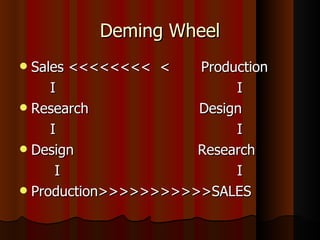
Deming Wheel Sales <<<<<<<<  <  Production I  I Research  Design I  I Design  Research I  I Production>>>>>>>>>>>SALES
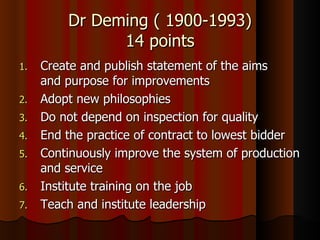
Dr Deming ( 1900-1993) 14 points Create and publish statement of the aims  and purpose for improvements Adopt new philosophies Do not depend on inspection for quality End the practice of contract to lowest bidder Continuously improve the system of production and service Institute training on the job Teach and institute leadership
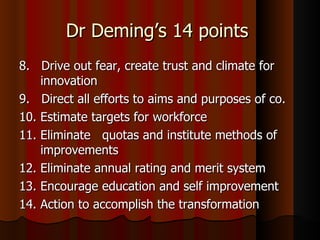
Dr Deming’s 14 points  8.  Drive out fear, create trust and climate for innovation 9.  Direct all efforts to aims and purposes of co. 10. Estimate targets for workforce 11. Eliminate  quotas and institute methods of  improvements 12. Eliminate annual rating and merit system 13. Encourage education and self improvement 14. Action to accomplish the transformation
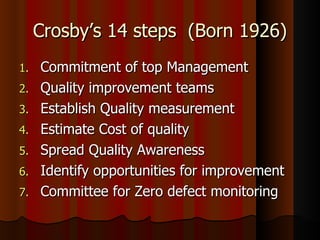
Crosby’s 14 steps  (Born 1926) Commitment of top Management Quality improvement teams Establish Quality measurement Estimate Cost of quality Spread Quality Awareness Identify opportunities for improvement Committee for Zero defect monitoring
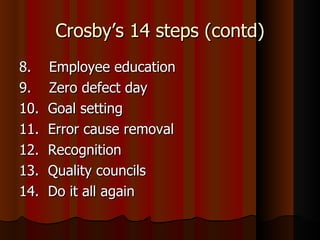
Crosby’s 14 steps (contd) 8.  Employee education 9.  Zero defect day 10.  Goal setting 11.  Error cause removal 12.  Recognition 13.  Quality councils 14.  Do it all again
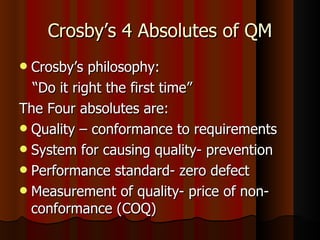
Crosby’s 4 Absolutes of QM Crosby’s philosophy:  “ Do it right the first time” The Four absolutes are: Quality – conformance to requirements System for causing quality- prevention Performance standard- zero defect Measurement of quality- price of non-conformance (COQ)
Juran’s Philosophy(1904-2008) Quality = fitness for use by the customer Juran’s Triology : (Quality oriented Principles) Quality Planning Quality Control Quality improvement
Steps of Quality Control Setting Quality standards  Apraising conformance to these standards Acting when standards are exceeded Planning for improvements in standards
Quality Assurance Definition : For the customer to buy the product/service with confidence and use it for a long time with ease and satisfaction, the manufacturer has to give assurance and also give evidence that the product will not fail
Steps of Quality Assurance Develop quality plans Carryout vendor quality surveys Carryout product quality audits Review disposition of non-conforming products Initiate customers’ future needs Co-ordinate document control activity Upgrade inspection records
Concepts of Quality Variation is the main reason of poor Quality There is no such thing as Quality Problem, it is an opportunity to improve There is nothing like economics of Quality,it is cheaper to do the job right , the first time The only performance measurement is the cost of Quality The only Performance standard is  “ ZERO DEFECT”
Cost Of Quality Prevention Cost…….investment cost Appraisal  Cost……Inspection & Analysis Internal  Cost……Scrap and rework External  Cost……Customer Complaints  Product Recalls and    Returns
Cost of Quality
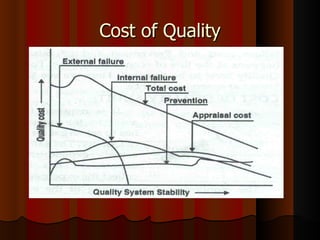
Contribution of Quality Costs Prevention costs…..High throughout Appraisal costs……low/same throughout Internal costs……..initially high, gradually declining External costs……initially high, sharply  decline (stability period) Total Cost……….sharply decline as the    product becomes stable
Economic Balance of  Quality and Costs As we keep improving the Quality, the total Cost of Quality keeps coming down However if we improve the Quality beyond a certain point, the prevention cost will sharply go up and the total cost will also go up Hence we have to find an economic Balance of Cost and Quality (six sigma)
Audit of COQ Set an annual target of COQ Monitor the actual expenses of COQ All departments to control COQ Evaluate COQ every month/Quarter Compute COQ as a percentage of Sales At the start of TQM activity COQ and COQ as % of Sales is high, but gradually this comes down if TQM is implemented in the scientific manner Revise the annual target of COQ downwards year after year
The Customer Delight Customer awareness = keeping customer’s requirements in mind These requirements are:  Right Quality,  Right Quantity, Right time &  Right Cost The customer delight is far beyond customer satisfaction e.g: Taxi keeping newspapers, Telephone directory, Railway Timetable,  etc
Repeat Orders Why customers Quit ? 1%  die natural death 3%  relocate 5%  move away due to friends contact 9%  due to competitive reasons 14%  poor quality of product 68% indifferent attitude towards customers
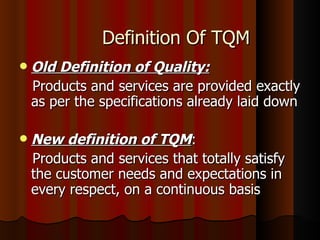
Definition Of TQM Old Definition of Quality: Products and services are provided exactly as per the specifications already laid down New definition of TQM : Products and services that totally satisfy the customer needs and expectations in every respect, on a continuous basis
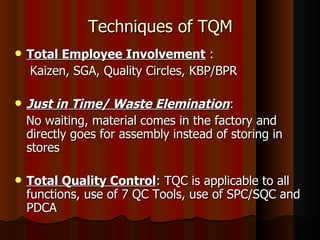
Techniques of TQM Total Employee Involvement  : Kaizen, SGA, Quality Circles, KBP/BPR Just in Time/ Waste Elemination : No waiting, material comes in the factory and directly goes for assembly instead of storing in stores Total Quality Control : TQC is applicable to all functions, use of 7 QC Tools, use of SPC/SQC and PDCA
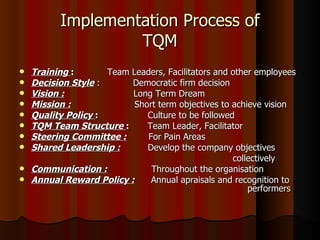
Implementation Process of TQM Training  :   Team Leaders, Facilitators and other employees  Decision Style  :   Democratic firm decision Vision :   Long Term Dream  Mission :   Short term objectives to achieve vision  Quality Policy  :  Culture to be followed TQM Team Structure  :  Team Leader, Facilitator Steering Committee :   For Pain Areas Shared Leadership :   Develop the company objectives  collectively Communication :   Throughout the organisation Annual Reward Policy :   Annual apraisals and recognition to    performers
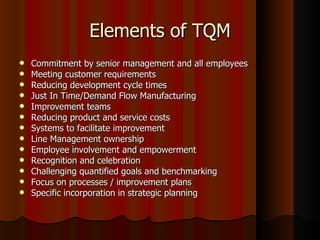
Elements of TQM Commitment by senior management and all employees  Meeting customer requirements  Reducing development cycle times  Just In Time/Demand Flow Manufacturing  Improvement teams  Reducing product and service costs  Systems to facilitate improvement  Line Management ownership  Employee involvement and empowerment  Recognition and celebration  Challenging quantified goals and benchmarking  Focus on processes / improvement plans  Specific incorporation in strategic planning
Vision Statement Bill Gates:There will be a personal computer on every desk running microsoft software Vision Statement should answer: Why did I start this business When I move on from this business, what do    I leave behind What am I providing for my customers    beyond  product/service If my business could be everything I dreamed  how would it be
Mission Statement Mission statement describes the WHAT of your business, it states why your organization is in business and what  you are hoping to achieve Components of Mission Statement: The overall purpose of your business What is your business: product/service What is important for your business-  the values your business lives by
Expectations from the Mission Statement Mission draws on your belief statements Mission must be future oriented and portray your organization as it will be Mission must focus on one common purpose Mission must be specific to the organization, not generic Mission statement must be short, two sentences max
Quality Systems ( Quality Mgmt systems) The quality of the product is checked to see the variation The control in variation wrt the design spec/dimension is aimed at More the variation, poorer the quality Less the variation better the quality The analysis of variations ( control charts) give direction for the action to be taken to control the variation
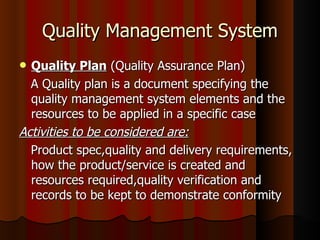
Quality Management System Quality Plan  (Quality Assurance Plan) A Quality plan is a document specifying the quality management system elements and the resources to be applied in a specific case Activities to be considered are: Product spec,quality and delivery requirements, how the product/service is created and resources required,quality verification and records to be kept to demonstrate conformity
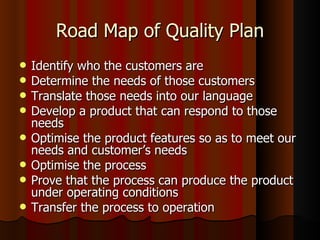
Road Map of Quality Plan Identify who the customers are Determine the needs of those customers Translate those needs into our language Develop a product that can respond to those needs Optimise the product features so as to meet our needs and customer’s needs Optimise the process Prove that the process can produce the product under operating conditions Transfer the process to operation
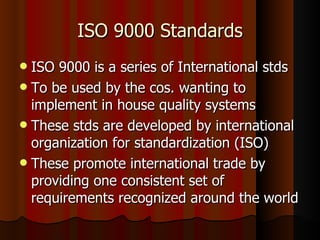
ISO 9000 Standards ISO 9000 is a series of International stds To be used by the cos. wanting to implement in house quality systems These stds are developed by international organization for standardization (ISO) These promote international trade by providing one consistent set of requirements recognized around the world
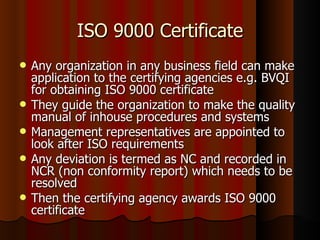
ISO 9000 Certificate Any organization in any business field can make application to the certifying agencies e.g. BVQI for obtaining ISO 9000 certificate They guide the organization to make the quality manual of inhouse procedures and systems Management representatives are appointed to look after ISO requirements Any deviation is termed as NC and recorded in NCR (non conformity report) which needs to be resolved  Then the certifying agency awards ISO 9000 certificate
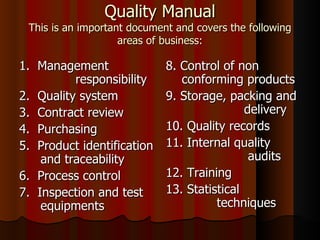
Quality Manual This is an important document and covers the following areas of business: 1.  Management    responsibility 2.  Quality system 3.  Contract review 4.  Purchasing 5.  Product identification and traceability 6.  Process control 7.  Inspection and test equipments 8. Control of non   conforming products 9. Storage, packing and    delivery 10. Quality records 11. Internal quality    audits 12. Training  13. Statistical    techniques
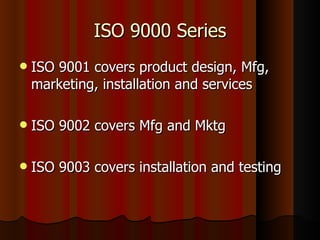
ISO 9000 Series ISO 9001 covers product design, Mfg, marketing, installation and services ISO 9002 covers Mfg and Mktg ISO 9003 covers installation and testing
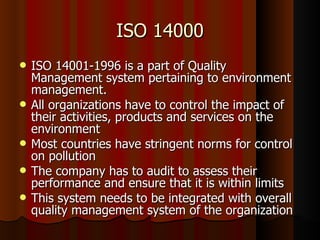
ISO 14000 ISO 14001-1996 is a part of Quality Management system pertaining to environment management. All organizations have to control the impact of their activities, products and services on the environment Most countries have stringent norms for control on pollution The company has to audit to assess their performance and ensure that it is within limits  This system needs to be integrated with overall quality management system of the organization
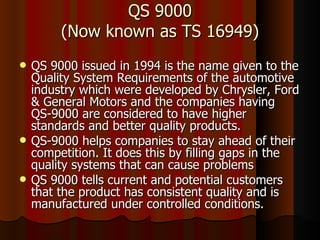
QS 9000 (Now known as TS 16949) QS 9000 issued in 1994 is the name given to the Quality System Requirements of the automotive industry which were developed by Chrysler, Ford & General Motors and the companies having  QS-9000 are considered to have higher standards and better quality products.  QS-9000 helps companies to stay ahead of their competition. It does this by filling gaps in the quality systems that can cause problems  QS 9000 tells current and potential customers that the product has consistent quality and is manufactured under controlled conditions.
Business Process Re-engineering (BPR) BPR is  a management approach aiming at improvements by identifying and implementing new ways of carrying out work. Thus elevating efficiency and effectiveness of the processes that exist within and across the organization
Steps of BPR Develop the business Vision and process objectives such as cost reduction, time reduction, output quality imrovement etc. Identify the business processes to be redesigned (challenge old processes) Evaluate old processes to avoid repetition of old mistakes Identify IT levers: awareness of IT capabilities can influence BPR process Design and build new process
Malcolm Baldrige Award This annual award was introduced in US in 1987 to recognize US companies for Business Excellence and Quality achievement. The objectives were : To promote awareness of Quality To understand requirements for Performance Excellence Sharing of successful practices with other companies
Malcolm Baldrige Award Important Roles: Improve performance practices and capabilities Sharing of best practices Serve as a working tool for managing performance, planning, training and assessment Improvement of overall co. performance
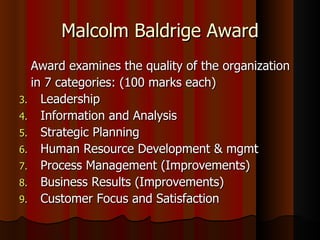
Malcolm Baldrige Award Award examines the quality of the organization in 7 categories: (100 marks each) Leadership Information and Analysis Strategic Planning Human Resource Development & mgmt Process Management (Improvements) Business Results (Improvements) Customer Focus and Satisfaction
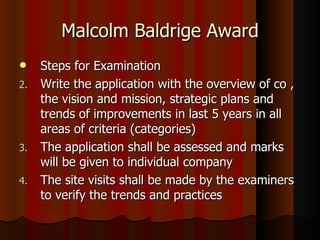
Malcolm Baldrige Award Steps for Examination Write the application with the overview of co , the vision and mission, strategic plans and trends of improvements in last 5 years in all areas of criteria (categories) The application shall be assessed and marks will be given to individual company The site visits shall be made by the examiners to verify the trends and practices
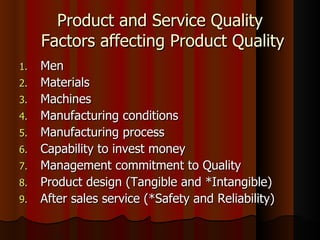
Product and Service Quality  Factors affecting Product Quality Men Materials Machines Manufacturing conditions Manufacturing process Capability to invest money Management commitment to Quality Product design (Tangible and *Intangible) After sales service (*Safety and Reliability)
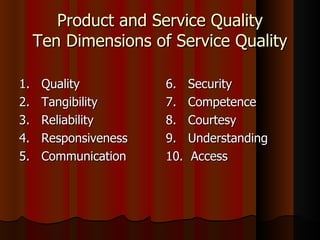
Product and Service Quality Ten Dimensions of Service Quality 1.  Quality 2.  Tangibility 3.  Reliability 4.  Responsiveness 5.  Communication 6.  Security 7.  Competence 8.  Courtesy 9.  Understanding 10.  Access
Some examples of Service Quality Answer the phone Don’t overpromise Listen to your Customers Deal with Complaints Be helpful and knowledgeable Train the staff to be courteous Take the extra step Throw in something extra
Service Quality Service quality has high level of intangibility Most services are intangible as there are performances and not objects Services are perishable , they can not be inventoried, saved and resold later The actual performance of service differs from provider to provider
Quality Circles QC is a small group of employees working on similar jobs, mostly at worker level to perform quality control and improvement activities within their workplace These groups work on continuous improvements as a part of company wide activity This was started in Japan in 1962 in line with the conviction of Ishikawa that the workers can significantly contribute to improve quality and productivity Japan attributes phenomenal growth in 1960-1970 to QC
Quality Circles Basic Objectives: Wider contribution towards improvement and development of the enterprise Respecting humanity and building a happy and cheerful workplace Exploiting human capabilities fully and drawing out infinite possibilities
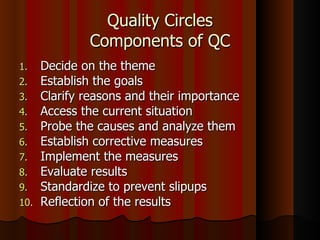
Quality Circles Components of QC Decide on the theme Establish the goals Clarify reasons and their importance Access the current situation Probe the causes and analyze them Establish corrective measures  Implement the measures Evaluate results Standardize to prevent slipups Reflection of the results
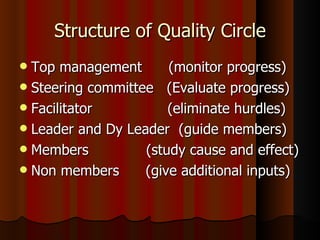
Structure of Quality Circle Top management  (monitor progress) Steering committee  (Evaluate progress) Facilitator  (eliminate hurdles) Leader and Dy Leader  (guide members) Members  (study cause and effect) Non members  (give additional inputs)
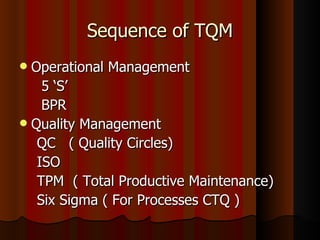
Sequence of TQM Operational Management 5 ‘S’ BPR Quality Management QC  ( Quality Circles) ISO TPM  ( Total Productive Maintenance) Six Sigma ( For Processes CTQ )
Books For Reference Quality Mgmt Systems Devendra Kumar Bhatt / Aparna Raj Productivity and Quality Mgmt Shashikant D Aphale Vipul Prakashan

Productivity and quality_mgmt_v2

  • 1.
    Productivity and Quality Management
  • 2.
    Question Bank Whatis TQM? State the objectives and benefits of TQM (ppt 27,29) What are Quality management systems? State eight building blocks of TQM (ppt28) State 10 steps of TQM (ppt 26) What is TPM and explain TPM awards (32-34) 14 points of Deming’s philosophy(chpt7 &39-40 14 points of Crosby’s philosophy (chpt 7 &41,42) Explain eight Principles of TQM (ppt17-25) What is Juran’s Triology
  • 3.
    Question Bank Whatare Quality circles and how do they differ from Kaizen? What are 5 ‘S’ practices? (ppt 30) What is BPR? Why is it necessary to initiate this before we start ISO 9000? What is COQ? How do we bring down the COQ? What is six sigma? (Ppt -10)
  • 4.
    Question Bank ExplainMalcolm Baldrige award (ppt74,77) what are the Techniques used in TQM (ppt 57) State the factors affecting product and service Quality seperately (ppt78,79)
  • 5.
    Increase Sales Volume(Increase Market share) Increase Sale Price Reduce Purchase cost of Input Reduce cost of production Improve quality (Reduce cost of Quality) Improve productivity Improve Profit
  • 6.
    Productivity and QualityMgmt Differentiate Production and Productivity Inspection and Quality Control System, Procedures and Processes Quality Control and Total Quality Mgmt (TQM) TQM and Six Sigma
  • 7.
    Productivity- Definition (Productivityis a ratio) The amount of output per unit of input (labor, equipment, and capital). Number of products / No. of hours taken to produce them Revenue generated by employee / Salary of employee
  • 8.
    System, Procedure andProcess System is a set of interactive elements corresponding to the given inputs to produce the desired output Procedure is a set of activities which have to follow in a systematic format without taking any shortcuts Process is a set of activities/operations which follow the procedures and systems with right RM and intermittent checking to avoid any lapses.
  • 9.
    Process Process isa summation of activities such as operations, inspection, delays, storage, transportation and everything else that happens between the beginning and the end of the process
  • 10.
    Six Sigma SixSigma- (The statistical Representation) is a process of Quality measurement, which helps the organization in the improvement of their Quality Six Sigma is a systematical process which helps the organization to eleminate the defects which prevent it from reaching perfection Six Sigma ensures the QC, TQM and Zero Defect When a process attains six sigma level it means that there is no room for the product to fail Six sigma is professionalizing of the Quality Management functions
  • 11.
    Sigma Level %Good PPM/DPMO Cost of Quality as % of Sales 2 95.45 45500 Over 40% 3 99.73 2700 25 - 40% 4 99.9937 63 15 - 25% 5 99.999943 0.57 5 - 15% 6 99.9999998 0.002 Less than 1%
  • 12.
    What is TQM? Total quality management ( TQM ) is a business management strategy aimed at embedding awareness of quality in all organizational processes. TQM has been widely used in manufacturing, education, hospitals, call centers, government, and service industries, as well as NASA space and science programs
  • 13.
    Total Quality Management(TQM) is a structured system for meeting and exceeding customer needs and expectations by creating organization-wide participation in the planning and implementation of improvement (continuous and breakthrough) processes What is TQM ?
  • 14.
    Total Quality ManagementTotal : Involve all functions to have customer focus and give reliable delivery of product+service in line with customer’s expectations at lowest cost Quality : Design and manufacture the product+service to achieve zero defect and 100% customer satisfaction Management : Lead to achieve quality for customers by communicating the vision, mission and values to all employees and creating continuous improvement culture
  • 15.
    Techniques for TQMTotal Employee Involvement : (205) Kaizen, Small Group Acitvity, Quality Circles, Key Business Process /Biz Process Re-engineering, customer satisfaction surveys, Training Just in Time/ Waste Elemination : (206) TPM, Zero Defect, supplier Partnership Total Quality Control : (207) TQC is aplicable to all functions, use of 7 QC Tools, use of SPC/SQC and PDCA, ISO 9000, Six Sigma, ISO 14000, understand the processes critical to quality (CTQ)
  • 16.
    In a globalmarketplace a major characteristic that will distinguish those organizations that are successful will be the quality of leadership, management, employees, work processes, product and service. This means that products must not only meet customer’s community needs for value, they must be provided in a continuously improving, timely, cost-effective, innovative, and productive manner Why TQM ?
  • 17.
    Principles of TQM1. Customer-Focused Organisation 2. Leadership 3. Involvement of People 4. Process Approach 5. System Approach to Management 6. Continual Improvement 7. Factual Approach to Decision Making 8. Mutually Beneficial Supplier Relationships
  • 18.
    1.Customer Focussed OrganizationUnderstand customer needs and expectations for products, delivery, price, dependability, etc. Ensure a balanced approach among customers and other stake holders’ (owners, people, suppliers, local communities and society at large) needs and expectations. Communicate these needs and expectations throughout the organisation. Measure customer satisfaction & act on results, Manage customer relationships
  • 19.
    2. Leadership Beproactive and lead by example. Understand and respond to changes in the external environment. Consider the needs of all stake holders including customers, owners, people, suppliers, local communities and society at large. Establish a clear vision of the organisation's future. Establish shared values and ethical role models at all levels of the organisation. Build trust and eliminate fear. Provide people with the required resources and freedom to act with responsibility and accountability. Inspire, encourage and recognise people's contributions. Promote open and honest communication. Educate, train and coach people. Set challenging goals and targets, and Implement a strategy to achieve these goals and targets.
  • 20.
    3. Involvement ofPeople Accept ownership and responsibility to solve problems. Actively seek opportunities to make improvements, and enhance competencies, knowledge and experience. Freely share knowledge & experience in teams. Focus on the creation of value for customers. Be innovative in furthering the organisation’s objectives. Improve the way of representing the organisation to customers, local communities and society at large. Help people derive satisfaction from their work, and Make people enthusiastic and proud to be part of the organisation.
  • 21.
    4. Process ApproachDefine the process to achieve the desired result. Identify and measure the inputs and outputs of the process. Identify the interfaces of the process with the functions of the organisation. Evaluate possible risks, consequences and impacts of processes on customers, suppliers and other stake holders of the process. Establish clear responsibility, authority, and accountability for managing the process. Identify internal and external customers, suppliers and other stake holders of the process When designing processes, consider process steps, activities, flows, control measures, training needs, equipment, methods, information, materials and other resources to achieve the desired result.
  • 22.
    5. System Approachto Management Define the system by identifying or developing the processes that affect a given objective. Structure the system to achieve the objective in the most efficient way. Understand the interdependencies among the processes of the system. Continually improve the system through measurement and evaluation, and Estimate the resource requirements and establish resource constraints prior to action.
  • 23.
    6. Continual ImprovementsMake continual improvement of products, processes and systems an objective for every individual in the organisation. Apply the basic improvement concepts of incremental improvement and breakthrough improvement. Use periodic assessments against established criteria of excellence to identify areas for potential improvement. Continually improve the efficiency and effectiveness of all processes. Promote prevention based activities. Provide every member of the organisation with appropriate education and training, on the methods and tools of continual improvement such as the Plan-Do-Check-Act cycle , problem solving , process re-engineering, and process innovation. Establish measures and goals to guide and track improvements,and Recognise improvements.
  • 24.
    7. Factual Approachto Decision Making Take measurements and collect data and information relevant to the objective. Ensure that the data and information are sufficiently accurate, reliable and accessible. Analyse the data and information using valid methods. Understand the value of appropriate statistical techniques, and Make decisions and take action based on the results of logical analysis balanced with experience and intuition.
  • 25.
    8. SupplierRelationship Identify and select key suppliers. Establish supplier relationships that balance short-term gains with long-term considerations for the organisation and society at large. Create clear and open communications. Initiate joint development and improvement of products and processes. Jointly establish a clear understanding of customers' needs. Share information and future plans, and Recognise supplier improvements and achievements.
  • 26.
    Ten Steps toTQM Set company strategy, values and culture Identify the customers and understand their expectations Define their specific needs Build the quality in the process from the begining(advocate prevention & not correction) Reduce chronic waste Reduce variation All levels of the organization must be involved/trained Continually improve the quality of product or service Use structured methodology for process improvement Use a balanced approach
  • 27.
    Objectives of TQM100% Customer Satisfaction Zero Defects Continuous Improvement Culture
  • 28.
    Eight Building Blocksof TQM Ethics Integrity Trust Training Teamwork Leadership Recognition Communication
  • 29.
    Benefits of TQMAbility to be more competitive Improved market share Cost reduction Increased flexibility and responsiveness Simplified processes Improved communications More satisfaction among the workforce
  • 30.
    5 ‘S’ PracticesSeiri : separate out needed items Seiton : organize workplace for faster retrieval (fix place for each item) Seison : sweeping/cleaning around work area Seiketsu : keep everything clean for constant state of readiness Shitsuke : Everyone must understand and practice the rules in the plant
  • 31.
    Maintenance Maintenance isdone on the equipments to keep them running as efficiently as possible for as long as possible There are three types of maintenance : Breakdown maintenance (unplanned) Preventive maintenance (planned) Predictive maintenance ( High tech analysis )
  • 32.
    Total Productive MaintenanceTPM , developed in Japan, is a scientific company wide approach in which every employee is concerned about the maintenance , quality and efficiency of the equipment The objective is to reduce the whole life cost of equipment through more efficient maintenance management and to integrate the maintenance and manufacturing functions Teamwork is a key element of TPM Analysis of each equipment focuses on reduction of manufacturing losses and costs
  • 33.
    Total Productive MaintenanceTPM aims to achieve improvements in cost, quality and speed (productivity) This is equivalent to TQM (reduces variations due to automation) TPM addresses six big losses reduced yield process defects reduced speed idling and minor stoppages setup and adjustment equipment failure
  • 34.
    TPM Awards Effective1971, the factories which displayed remarkable achievement in plant maintenance were given this award Effective 1989, the factories which have achieved company-wide efficiency & productivity by adopting company-wide TPM are given this award
  • 35.
    Five Pillars ofTPM 1. Quality Integration (Process capability- Cpk) 2. New Equipment Management (design) 3. Autonomous Maintenance (military like) 4. Planned Maintenance (reduce unplanned) 5. Equipment Improvement (productivity)
  • 36.
    Seven Deadly DisastersDr Deming- TQM Lack of consistency of purpose Emphasis on short term profits MBO and performance Appraisal system Job hopping by managers Using only visible data for decision making Excessive medical costs Excessive cost of liability
  • 37.
    Deming Application PrizeFor organizations or divisions of organizations that manage their business autonomously Given to organizations or divisions of organizations that have achieved distinctive performance improvement through the application of TQM in a designated year
  • 38.
    Deming Wheel Sales<<<<<<<< < Production I I Research Design I I Design Research I I Production>>>>>>>>>>>SALES
  • 39.
    Dr Deming (1900-1993) 14 points Create and publish statement of the aims and purpose for improvements Adopt new philosophies Do not depend on inspection for quality End the practice of contract to lowest bidder Continuously improve the system of production and service Institute training on the job Teach and institute leadership
  • 40.
    Dr Deming’s 14points 8. Drive out fear, create trust and climate for innovation 9. Direct all efforts to aims and purposes of co. 10. Estimate targets for workforce 11. Eliminate quotas and institute methods of improvements 12. Eliminate annual rating and merit system 13. Encourage education and self improvement 14. Action to accomplish the transformation
  • 41.
    Crosby’s 14 steps (Born 1926) Commitment of top Management Quality improvement teams Establish Quality measurement Estimate Cost of quality Spread Quality Awareness Identify opportunities for improvement Committee for Zero defect monitoring
  • 42.
    Crosby’s 14 steps(contd) 8. Employee education 9. Zero defect day 10. Goal setting 11. Error cause removal 12. Recognition 13. Quality councils 14. Do it all again
  • 43.
    Crosby’s 4 Absolutesof QM Crosby’s philosophy: “ Do it right the first time” The Four absolutes are: Quality – conformance to requirements System for causing quality- prevention Performance standard- zero defect Measurement of quality- price of non-conformance (COQ)
  • 44.
    Juran’s Philosophy(1904-2008) Quality= fitness for use by the customer Juran’s Triology : (Quality oriented Principles) Quality Planning Quality Control Quality improvement
  • 45.
    Steps of QualityControl Setting Quality standards Apraising conformance to these standards Acting when standards are exceeded Planning for improvements in standards
  • 46.
    Quality Assurance Definition: For the customer to buy the product/service with confidence and use it for a long time with ease and satisfaction, the manufacturer has to give assurance and also give evidence that the product will not fail
  • 47.
    Steps of QualityAssurance Develop quality plans Carryout vendor quality surveys Carryout product quality audits Review disposition of non-conforming products Initiate customers’ future needs Co-ordinate document control activity Upgrade inspection records
  • 48.
    Concepts of QualityVariation is the main reason of poor Quality There is no such thing as Quality Problem, it is an opportunity to improve There is nothing like economics of Quality,it is cheaper to do the job right , the first time The only performance measurement is the cost of Quality The only Performance standard is “ ZERO DEFECT”
  • 49.
    Cost Of QualityPrevention Cost…….investment cost Appraisal Cost……Inspection & Analysis Internal Cost……Scrap and rework External Cost……Customer Complaints Product Recalls and Returns
  • 50.
  • 51.
    Contribution of QualityCosts Prevention costs…..High throughout Appraisal costs……low/same throughout Internal costs……..initially high, gradually declining External costs……initially high, sharply decline (stability period) Total Cost……….sharply decline as the product becomes stable
  • 52.
    Economic Balance of Quality and Costs As we keep improving the Quality, the total Cost of Quality keeps coming down However if we improve the Quality beyond a certain point, the prevention cost will sharply go up and the total cost will also go up Hence we have to find an economic Balance of Cost and Quality (six sigma)
  • 53.
    Audit of COQSet an annual target of COQ Monitor the actual expenses of COQ All departments to control COQ Evaluate COQ every month/Quarter Compute COQ as a percentage of Sales At the start of TQM activity COQ and COQ as % of Sales is high, but gradually this comes down if TQM is implemented in the scientific manner Revise the annual target of COQ downwards year after year
  • 54.
    The Customer DelightCustomer awareness = keeping customer’s requirements in mind These requirements are: Right Quality, Right Quantity, Right time & Right Cost The customer delight is far beyond customer satisfaction e.g: Taxi keeping newspapers, Telephone directory, Railway Timetable, etc
  • 55.
    Repeat Orders Whycustomers Quit ? 1% die natural death 3% relocate 5% move away due to friends contact 9% due to competitive reasons 14% poor quality of product 68% indifferent attitude towards customers
  • 56.
    Definition Of TQMOld Definition of Quality: Products and services are provided exactly as per the specifications already laid down New definition of TQM : Products and services that totally satisfy the customer needs and expectations in every respect, on a continuous basis
  • 57.
    Techniques of TQMTotal Employee Involvement : Kaizen, SGA, Quality Circles, KBP/BPR Just in Time/ Waste Elemination : No waiting, material comes in the factory and directly goes for assembly instead of storing in stores Total Quality Control : TQC is applicable to all functions, use of 7 QC Tools, use of SPC/SQC and PDCA
  • 58.
    Implementation Process ofTQM Training : Team Leaders, Facilitators and other employees Decision Style : Democratic firm decision Vision : Long Term Dream Mission : Short term objectives to achieve vision Quality Policy : Culture to be followed TQM Team Structure : Team Leader, Facilitator Steering Committee : For Pain Areas Shared Leadership : Develop the company objectives collectively Communication : Throughout the organisation Annual Reward Policy : Annual apraisals and recognition to performers
  • 59.
    Elements of TQMCommitment by senior management and all employees Meeting customer requirements Reducing development cycle times Just In Time/Demand Flow Manufacturing Improvement teams Reducing product and service costs Systems to facilitate improvement Line Management ownership Employee involvement and empowerment Recognition and celebration Challenging quantified goals and benchmarking Focus on processes / improvement plans Specific incorporation in strategic planning
  • 60.
    Vision Statement BillGates:There will be a personal computer on every desk running microsoft software Vision Statement should answer: Why did I start this business When I move on from this business, what do I leave behind What am I providing for my customers beyond product/service If my business could be everything I dreamed how would it be
  • 61.
    Mission Statement Missionstatement describes the WHAT of your business, it states why your organization is in business and what you are hoping to achieve Components of Mission Statement: The overall purpose of your business What is your business: product/service What is important for your business- the values your business lives by
  • 62.
    Expectations from theMission Statement Mission draws on your belief statements Mission must be future oriented and portray your organization as it will be Mission must focus on one common purpose Mission must be specific to the organization, not generic Mission statement must be short, two sentences max
  • 63.
    Quality Systems (Quality Mgmt systems) The quality of the product is checked to see the variation The control in variation wrt the design spec/dimension is aimed at More the variation, poorer the quality Less the variation better the quality The analysis of variations ( control charts) give direction for the action to be taken to control the variation
  • 64.
    Quality Management SystemQuality Plan (Quality Assurance Plan) A Quality plan is a document specifying the quality management system elements and the resources to be applied in a specific case Activities to be considered are: Product spec,quality and delivery requirements, how the product/service is created and resources required,quality verification and records to be kept to demonstrate conformity
  • 65.
    Road Map ofQuality Plan Identify who the customers are Determine the needs of those customers Translate those needs into our language Develop a product that can respond to those needs Optimise the product features so as to meet our needs and customer’s needs Optimise the process Prove that the process can produce the product under operating conditions Transfer the process to operation
  • 66.
    ISO 9000 StandardsISO 9000 is a series of International stds To be used by the cos. wanting to implement in house quality systems These stds are developed by international organization for standardization (ISO) These promote international trade by providing one consistent set of requirements recognized around the world
  • 67.
    ISO 9000 CertificateAny organization in any business field can make application to the certifying agencies e.g. BVQI for obtaining ISO 9000 certificate They guide the organization to make the quality manual of inhouse procedures and systems Management representatives are appointed to look after ISO requirements Any deviation is termed as NC and recorded in NCR (non conformity report) which needs to be resolved Then the certifying agency awards ISO 9000 certificate
  • 68.
    Quality Manual Thisis an important document and covers the following areas of business: 1. Management responsibility 2. Quality system 3. Contract review 4. Purchasing 5. Product identification and traceability 6. Process control 7. Inspection and test equipments 8. Control of non conforming products 9. Storage, packing and delivery 10. Quality records 11. Internal quality audits 12. Training 13. Statistical techniques
  • 69.
    ISO 9000 SeriesISO 9001 covers product design, Mfg, marketing, installation and services ISO 9002 covers Mfg and Mktg ISO 9003 covers installation and testing
  • 70.
    ISO 14000 ISO14001-1996 is a part of Quality Management system pertaining to environment management. All organizations have to control the impact of their activities, products and services on the environment Most countries have stringent norms for control on pollution The company has to audit to assess their performance and ensure that it is within limits This system needs to be integrated with overall quality management system of the organization
  • 71.
    QS 9000 (Nowknown as TS 16949) QS 9000 issued in 1994 is the name given to the Quality System Requirements of the automotive industry which were developed by Chrysler, Ford & General Motors and the companies having QS-9000 are considered to have higher standards and better quality products. QS-9000 helps companies to stay ahead of their competition. It does this by filling gaps in the quality systems that can cause problems QS 9000 tells current and potential customers that the product has consistent quality and is manufactured under controlled conditions.
  • 72.
    Business Process Re-engineering(BPR) BPR is a management approach aiming at improvements by identifying and implementing new ways of carrying out work. Thus elevating efficiency and effectiveness of the processes that exist within and across the organization
  • 73.
    Steps of BPRDevelop the business Vision and process objectives such as cost reduction, time reduction, output quality imrovement etc. Identify the business processes to be redesigned (challenge old processes) Evaluate old processes to avoid repetition of old mistakes Identify IT levers: awareness of IT capabilities can influence BPR process Design and build new process
  • 74.
    Malcolm Baldrige AwardThis annual award was introduced in US in 1987 to recognize US companies for Business Excellence and Quality achievement. The objectives were : To promote awareness of Quality To understand requirements for Performance Excellence Sharing of successful practices with other companies
  • 75.
    Malcolm Baldrige AwardImportant Roles: Improve performance practices and capabilities Sharing of best practices Serve as a working tool for managing performance, planning, training and assessment Improvement of overall co. performance
  • 76.
    Malcolm Baldrige AwardAward examines the quality of the organization in 7 categories: (100 marks each) Leadership Information and Analysis Strategic Planning Human Resource Development & mgmt Process Management (Improvements) Business Results (Improvements) Customer Focus and Satisfaction
  • 77.
    Malcolm Baldrige AwardSteps for Examination Write the application with the overview of co , the vision and mission, strategic plans and trends of improvements in last 5 years in all areas of criteria (categories) The application shall be assessed and marks will be given to individual company The site visits shall be made by the examiners to verify the trends and practices
  • 78.
    Product and ServiceQuality Factors affecting Product Quality Men Materials Machines Manufacturing conditions Manufacturing process Capability to invest money Management commitment to Quality Product design (Tangible and *Intangible) After sales service (*Safety and Reliability)
  • 79.
    Product and ServiceQuality Ten Dimensions of Service Quality 1. Quality 2. Tangibility 3. Reliability 4. Responsiveness 5. Communication 6. Security 7. Competence 8. Courtesy 9. Understanding 10. Access
  • 80.
    Some examples ofService Quality Answer the phone Don’t overpromise Listen to your Customers Deal with Complaints Be helpful and knowledgeable Train the staff to be courteous Take the extra step Throw in something extra
  • 81.
    Service Quality Servicequality has high level of intangibility Most services are intangible as there are performances and not objects Services are perishable , they can not be inventoried, saved and resold later The actual performance of service differs from provider to provider
  • 82.
    Quality Circles QCis a small group of employees working on similar jobs, mostly at worker level to perform quality control and improvement activities within their workplace These groups work on continuous improvements as a part of company wide activity This was started in Japan in 1962 in line with the conviction of Ishikawa that the workers can significantly contribute to improve quality and productivity Japan attributes phenomenal growth in 1960-1970 to QC
  • 83.
    Quality Circles BasicObjectives: Wider contribution towards improvement and development of the enterprise Respecting humanity and building a happy and cheerful workplace Exploiting human capabilities fully and drawing out infinite possibilities
  • 84.
    Quality Circles Componentsof QC Decide on the theme Establish the goals Clarify reasons and their importance Access the current situation Probe the causes and analyze them Establish corrective measures Implement the measures Evaluate results Standardize to prevent slipups Reflection of the results
  • 85.
    Structure of QualityCircle Top management (monitor progress) Steering committee (Evaluate progress) Facilitator (eliminate hurdles) Leader and Dy Leader (guide members) Members (study cause and effect) Non members (give additional inputs)
  • 86.
    Sequence of TQMOperational Management 5 ‘S’ BPR Quality Management QC ( Quality Circles) ISO TPM ( Total Productive Maintenance) Six Sigma ( For Processes CTQ )
  • 87.
    Books For ReferenceQuality Mgmt Systems Devendra Kumar Bhatt / Aparna Raj Productivity and Quality Mgmt Shashikant D Aphale Vipul Prakashan