INTRODUCTION
 Forecasting plays a crucial role in the
development of plans for the future
 It is an essential tool for the organization to
know what level of activities one is planning
before investment in inputs i.e. man,
machines and materials be made
INTRODUCTION
Before making an investment decision, many questions
will arise like:
 What should be the size or amount of capital
required?
 How large should be the size of the work force?
 What should be the size of the order and safety
stock?
 What should be the capacity of the plant?
The answer to above question depends upon the
forecast for the future level of operations.
CONTD..
 Forecasting as defined by American
Marketing Association is: “An estimate of
sales in physical units (or monetary
value) for a specified future period under
proposed marketing plan or program and
under the assumed set of economic and
other forces outside the organization for
which the forecast is made”.
FORECASTING Vs PREDICTION
Prediction:
 Prediction is an estimate of future event
through subjective considerations other than
just the past data.
 For prediction, a good subjective estimation
is based on managers skill, experience and
judgment.
CONTD..
Forecasting:
 Forecasting is based on the historical data
and it requires statistical and management
science techniques.
 It is an estimate of future event achieved by
systematically combining and casting
forward in a predetermined way data about
the past.
NEED FOR SALES FORECATING
 Majority of the activities of the industries depend upon the
future sales.
 Projected sales for the future assists in decision-making
with respect to investment in plant and machinery, market
planning programs.
 To schedule the production activity to ensure optimum
utilization of plant’s capacity.
 To prepare material planning to take up the replenishment
action to make the materials available at right quantity
and right time.
 To provide an information about the relationship between
sales for different products as a function of time.
 Forecasting is going to provide a future trend which is
very much essential for products design and
development.
LONG TERM AND SHORT TERM FORECASTING
 Forecasts which cover the period of less than 1
year are called as short term forecasting
 Short term forecasts are made for the purpose
of materials control, loading and scheduling and
budgeting
 Forecast which cover the period of more than 1
year (5 years or 10 years) are termed as long
term forecasting
 Long term forecast are made for the purposes
of product diversification, sales and advertising
budgets, capacity planning and investment
planning.
FACTORS AFFECTING SALES FORECASTING
External Factors
 Relative state of the economy
 Direct and indirect competition
 Styles or fashions
 Consumer earnings
 Population changes
 Weather
FACTORS AFFECTING SALES FORECASTING
Internal Factors
 Labour problems
 Inventory shortages
 Working capital shortage
 Price changes
 Change in distribution method
 Production capability shortage
 New product lines
CLASSIFICATION OF FORECASTING METHODS
 Judgmental (subjective method)
 Timer series (based on past data arranged in
a chronological order)
 Econometric (cause and effect relationship)
JUDGMENTAL TECHNIQUES
 Opinion survey method
 Executive opinion method
 Customer and distributor surveys
 Marketing trials
 Market research
 Delphi technique
TIME SERIES ANALYSIS
 Based on the past data arranged in
chronological order as a dependent variable and
time as an independent variable
 For e.g. sales of TV sets for last four years are:
 Time series method does not study the factors
that influence the demand, in this method all the
factors that shape the demand are grouped into
one factor-time and demand is expressed as a
series of data with respect to time.
YEAR 1993-94 1994-95 1995-96 1996-97
NO. OF TV SETS 20 30 40 58
FOUR COMPONENTS OF TIME SERIES ANALYSIS
 1. Trend(T)  2. Cyclical
fluctuation(C)
 3. Seasonal
variation (S)
 1. Irregular
variations(R)
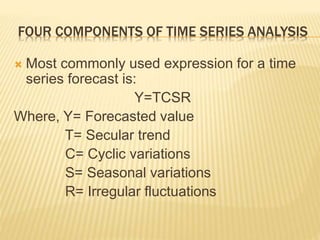
 Most commonly used expression for a time
series forecast is:
Y=TCSR
Where, Y= Forecasted value
T= Secular trend
C= Cyclic variations
S= Seasonal variations
R= Irregular fluctuations
FOUR COMPONENTS OF TIME SERIES ANALYSIS
MOVING AVERAGES
 The sales results of multiple prior periods are
averaged to predict a future period
 Called ‘moving’ because it is
continually recomputed as
new data becomes available,
it progresses by dropping the
earliest value and adding the
latest value.
EXPONENTIAL SMOOTHING
 Similar to moving average method
 Used for short run forecasts
 Instead of weighing all observations equally in
generating the forecast, exponential smoothing
weighs the most recent observations heaviest
Next year’s sale=a(this year’s sale) + (1-a)(this
year’s forecast)
a is smoothing constant taken in scale 0-1
MARKET TEST METHOD
 Used for developing one time forecasts
particularly relating to new products
 A market test provides data about
consumers' actual purchases and
responsiveness to the various elements of
the marketing mix.
 On the basis of the response received to a
sample market test, product sales forecast is
prepared.
REGRESSION ANALYSIS
 Identifies a statistical relationship between
sales(dependent variable) and one or more
influencing factors, which are termed the
independent variables.
 When just one independent variable is
considered (eg. population growth), it is called a
linear regression, and the results can be shown
as a line graph predicting future values of sales
based on changes in the independent variable.
 When more than one independent variable is
considered, it is called a multiple regression
BENEFITS OF SALES FORECASTING
 Better control of Inventory
 Staffing
 Customer Information
 Use for Sales People
 Obtaining Financing
LIMITATIONS OF SALES FORECASTING
 Part hard fact, part guesswork
 Forecast may be wrong
 Times may change
Sales forecasting

Sales forecasting

  • 2.
    INTRODUCTION  Forecasting playsa crucial role in the development of plans for the future  It is an essential tool for the organization to know what level of activities one is planning before investment in inputs i.e. man, machines and materials be made
  • 3.
    INTRODUCTION Before making aninvestment decision, many questions will arise like:  What should be the size or amount of capital required?  How large should be the size of the work force?  What should be the size of the order and safety stock?  What should be the capacity of the plant? The answer to above question depends upon the forecast for the future level of operations.
  • 4.
    CONTD..  Forecasting asdefined by American Marketing Association is: “An estimate of sales in physical units (or monetary value) for a specified future period under proposed marketing plan or program and under the assumed set of economic and other forces outside the organization for which the forecast is made”.
  • 5.
    FORECASTING Vs PREDICTION Prediction: Prediction is an estimate of future event through subjective considerations other than just the past data.  For prediction, a good subjective estimation is based on managers skill, experience and judgment.
  • 6.
    CONTD.. Forecasting:  Forecasting isbased on the historical data and it requires statistical and management science techniques.  It is an estimate of future event achieved by systematically combining and casting forward in a predetermined way data about the past.
  • 7.
    NEED FOR SALESFORECATING  Majority of the activities of the industries depend upon the future sales.  Projected sales for the future assists in decision-making with respect to investment in plant and machinery, market planning programs.  To schedule the production activity to ensure optimum utilization of plant’s capacity.  To prepare material planning to take up the replenishment action to make the materials available at right quantity and right time.  To provide an information about the relationship between sales for different products as a function of time.  Forecasting is going to provide a future trend which is very much essential for products design and development.
  • 8.
    LONG TERM ANDSHORT TERM FORECASTING  Forecasts which cover the period of less than 1 year are called as short term forecasting  Short term forecasts are made for the purpose of materials control, loading and scheduling and budgeting  Forecast which cover the period of more than 1 year (5 years or 10 years) are termed as long term forecasting  Long term forecast are made for the purposes of product diversification, sales and advertising budgets, capacity planning and investment planning.
  • 9.
    FACTORS AFFECTING SALESFORECASTING External Factors  Relative state of the economy  Direct and indirect competition  Styles or fashions  Consumer earnings  Population changes  Weather
  • 10.
    FACTORS AFFECTING SALESFORECASTING Internal Factors  Labour problems  Inventory shortages  Working capital shortage  Price changes  Change in distribution method  Production capability shortage  New product lines
  • 11.
    CLASSIFICATION OF FORECASTINGMETHODS  Judgmental (subjective method)  Timer series (based on past data arranged in a chronological order)  Econometric (cause and effect relationship)
  • 12.
    JUDGMENTAL TECHNIQUES  Opinionsurvey method  Executive opinion method  Customer and distributor surveys  Marketing trials  Market research  Delphi technique
  • 13.
    TIME SERIES ANALYSIS Based on the past data arranged in chronological order as a dependent variable and time as an independent variable  For e.g. sales of TV sets for last four years are:  Time series method does not study the factors that influence the demand, in this method all the factors that shape the demand are grouped into one factor-time and demand is expressed as a series of data with respect to time. YEAR 1993-94 1994-95 1995-96 1996-97 NO. OF TV SETS 20 30 40 58
  • 14.
    FOUR COMPONENTS OFTIME SERIES ANALYSIS  1. Trend(T)  2. Cyclical fluctuation(C)  3. Seasonal variation (S)  1. Irregular variations(R)
  • 15.
     Most commonlyused expression for a time series forecast is: Y=TCSR Where, Y= Forecasted value T= Secular trend C= Cyclic variations S= Seasonal variations R= Irregular fluctuations FOUR COMPONENTS OF TIME SERIES ANALYSIS
  • 16.
    MOVING AVERAGES  Thesales results of multiple prior periods are averaged to predict a future period  Called ‘moving’ because it is continually recomputed as new data becomes available, it progresses by dropping the earliest value and adding the latest value.
  • 17.
    EXPONENTIAL SMOOTHING  Similarto moving average method  Used for short run forecasts  Instead of weighing all observations equally in generating the forecast, exponential smoothing weighs the most recent observations heaviest Next year’s sale=a(this year’s sale) + (1-a)(this year’s forecast) a is smoothing constant taken in scale 0-1
  • 18.
    MARKET TEST METHOD Used for developing one time forecasts particularly relating to new products  A market test provides data about consumers' actual purchases and responsiveness to the various elements of the marketing mix.  On the basis of the response received to a sample market test, product sales forecast is prepared.
  • 19.
    REGRESSION ANALYSIS  Identifiesa statistical relationship between sales(dependent variable) and one or more influencing factors, which are termed the independent variables.  When just one independent variable is considered (eg. population growth), it is called a linear regression, and the results can be shown as a line graph predicting future values of sales based on changes in the independent variable.  When more than one independent variable is considered, it is called a multiple regression
  • 20.
    BENEFITS OF SALESFORECASTING  Better control of Inventory  Staffing  Customer Information  Use for Sales People  Obtaining Financing
  • 21.
    LIMITATIONS OF SALESFORECASTING  Part hard fact, part guesswork  Forecast may be wrong  Times may change