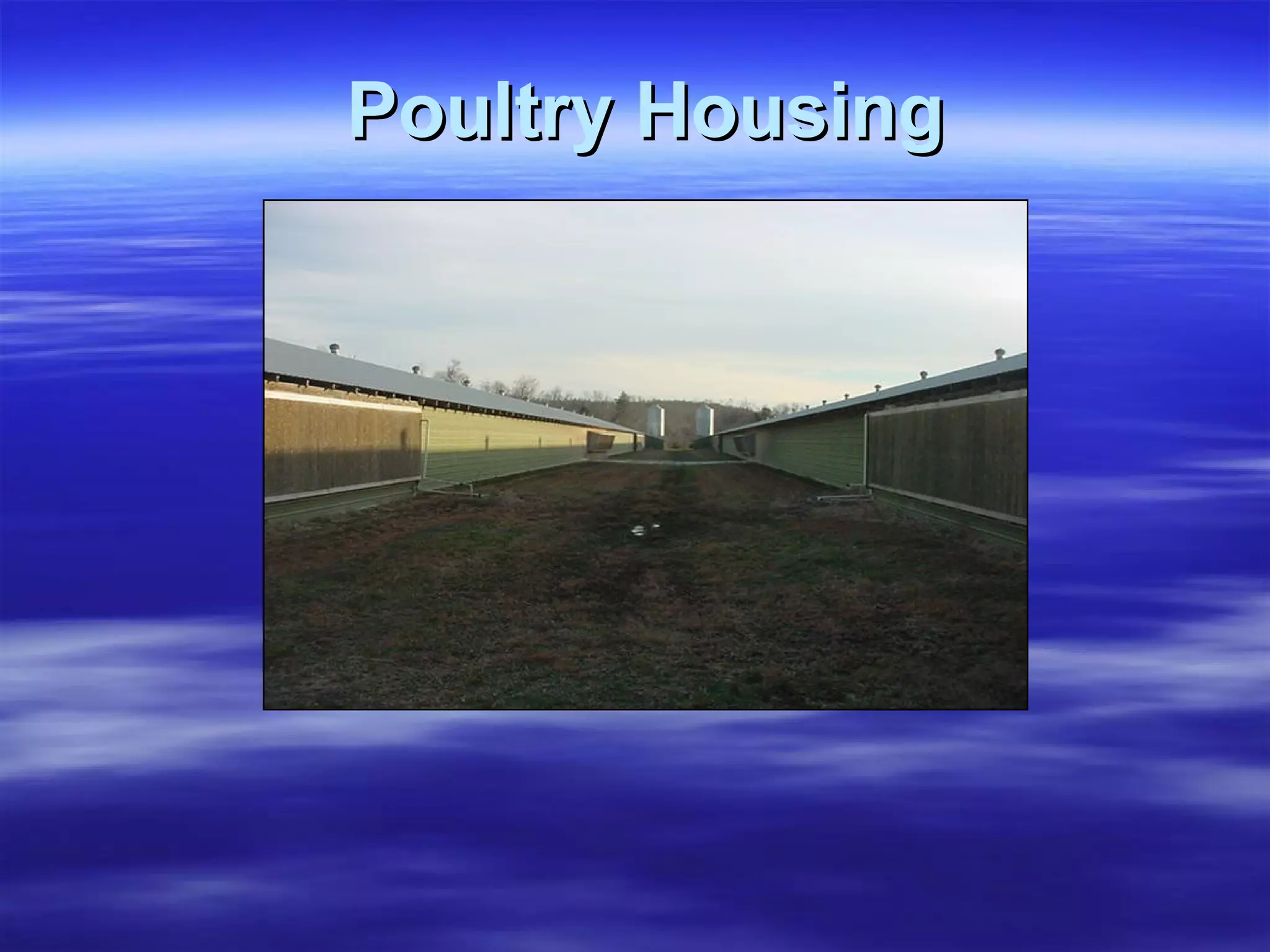
Poultry HousingPoultry Housing
OBJECTIVESOBJECTIVES
 To know about need of housing for poultryTo know about need of housing for poultry
productionproduction
 Different types of poultry housesDifferent types of poultry houses
 Location and layout of poultry housesLocation and layout of poultry houses
 Floor space requirementFloor space requirement
 Different systems of rearing with relativeDifferent systems of rearing with relative
advantage and disadvantages.advantage and disadvantages.
DIFFERENT TYPES OFDIFFERENT TYPES OF
POULTRY HOUSESPOULTRY HOUSES
 Brooder/chick houseBrooder/chick house
– It is used to brood and rear egg-type chicksIt is used to brood and rear egg-type chicks
from 0 to 8 weeks of age.from 0 to 8 weeks of age.
 Grower houseGrower house
– It is used to grow egg-type birds from 9 to 18It is used to grow egg-type birds from 9 to 18
weeks of age.weeks of age.
 Brooder cum grower houseBrooder cum grower house
 Here, the birds are reared from 0 to 18 weeksHere, the birds are reared from 0 to 18 weeks
of age (entire brooding and growing period ofof age (entire brooding and growing period of
egg-type chickenegg-type chicken
 Layer houseLayer house
– In which birds over 18 weeks of age are reared,In which birds over 18 weeks of age are reared,
usually up to 72 weeks of age.usually up to 72 weeks of age.
 Broiler houseBroiler house
– In which broilers (meat-type birds) are reared upIn which broilers (meat-type birds) are reared up
to 5/6 weeks of age.to 5/6 weeks of age.
 Breeder houseBreeder house
– In which both male and female breeders areIn which both male and female breeders are
maintained at appropriate sex ratio.maintained at appropriate sex ratio.
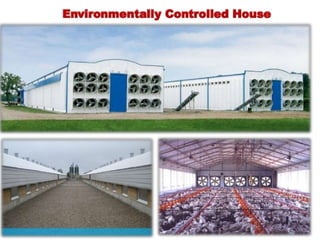
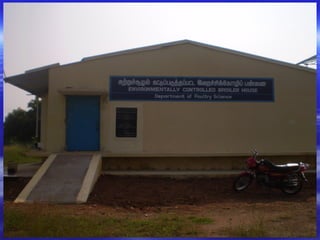
 Environmentally controlled (EC) houseEnvironmentally controlled (EC) house
– In which, entire environment is manipulated inIn which, entire environment is manipulated in
such a way that is optimum for the birds growth.such a way that is optimum for the birds growth.
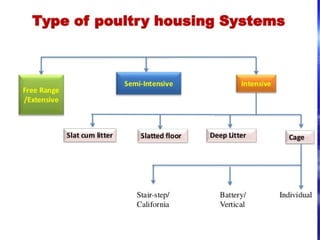
Systems of poultry housingSystems of poultry housing
FACTORSFACTORS
 Poultry can be housed under differentPoultry can be housed under different
systems based on following factors:systems based on following factors:
– Availability of landAvailability of land
– Cost of landCost of land
– Type of farming activityType of farming activity
– Climatic conditionClimatic condition
– Labour availabilityLabour availability
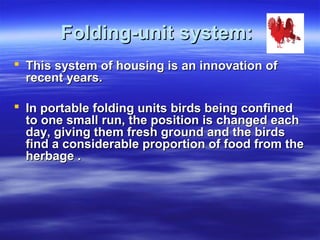
Folding-unit system:Folding-unit system:
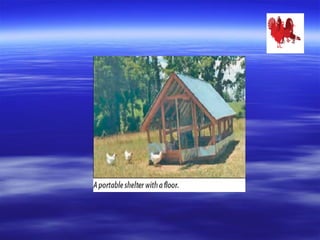
 This system of housing is an innovation ofThis system of housing is an innovation of
recent years.recent years.
 In portable folding units birds being confinedIn portable folding units birds being confined
to one small run, the position is changed eachto one small run, the position is changed each
day, giving them fresh ground and the birdsday, giving them fresh ground and the birds
find a considerable proportion of food from thefind a considerable proportion of food from the
herbage .herbage .
 The most convenient folding unit to handleThe most convenient folding unit to handle
is that which is made for 25 hens.is that which is made for 25 hens.
 A floor space of 1 square foot should beA floor space of 1 square foot should be
allowed for each bird in the house, and 3allowed for each bird in the house, and 3
square feet in the run, so that a total floorsquare feet in the run, so that a total floor
space to the whole unit is 4 square feet perspace to the whole unit is 4 square feet per
bird, as with the intensive system.bird, as with the intensive system.
 A suitable measurement for a folding house toA suitable measurement for a folding house to
take 25 birds is 5 feet wide and 20 feet long, thetake 25 birds is 5 feet wide and 20 feet long, the
house being 5’ x 5’, one-third of the run.house being 5’ x 5’, one-third of the run.
 DisadvantagesDisadvantages
 The food and water must be carried out to theThe food and water must be carried out to the
birds and eggs brought back.birds and eggs brought back.
 There is some extra labour involved in the regularThere is some extra labour involved in the regular
moving of the fold units.moving of the fold units.
 More expensiveMore expensive
INTENSIVE SYSTEM
 Birds are totally confined to houses either
on ground / floor or on wire-netting floor in
cages or on slats.
 It is the most efficient, convenient and
economical system for modern poultry
production with huge numbers.
Advantages
 Minimum land is required for farming.
 Farms can be located near market area.
 Day-to-day management is easier.
 The production performance is higher as
more energy is saved due to restricted
movements.
 Scientific management practices like
breeding, feeding, medication, culling etc.
can be applied easily and accurately.
 The sick birds can be detected, isolated and
treated easily.
Disadvantages
 Birds’ welfare is affected. They can not perform
the natural behaviour like roosting, spreading
wings, scratching the floor with legs etc.
 Since they are not exposed to outside sunlight and
feed sources, all the nutrients should be provided
in balanced manner to avoid nutritionally deficient
diseases.
 Chances for spreading of diseases are more.
Deep litter system:
In this system the poultry birds are reared on floor
covered with litters like straw, saw dust or leaves up to
depth of 8-12 inches.
we can define deep litter, as the accumulation of the
material used for litter with poultry manure until it
reaches a depth of 8 to 12 inches.
Suitable dry organic materials like straw (needs to beSuitable dry organic materials like straw (needs to be
cut into 2 or 3 inch lengths), saw dust, leaves, drycut into 2 or 3 inch lengths), saw dust, leaves, dry
grasses, groundnut shells, broken up maize stalks andgrasses, groundnut shells, broken up maize stalks and
cobs, bark of trees in sufficient quantity to give a depthcobs, bark of trees in sufficient quantity to give a depth
of about 6 inches in the pen should be used.of about 6 inches in the pen should be used.
The droppings of the birds gradually combine with theThe droppings of the birds gradually combine with the
materials used to build up the litter. In about 2materials used to build up the litter. In about 2
months, it has usually become deep litter, and by 6months, it has usually become deep litter, and by 6
months it has become built-up deep litter. At about 12months it has become built-up deep litter. At about 12
months of old stage it is fully built up. Extra littermonths of old stage it is fully built up. Extra litter
materials can be added to maintain sufficientmaterials can be added to maintain sufficient depth.depth.
The deep litter pen should be started when the
weather is dry, and is likely to remain so for about 2
months for the operation of the bacterial action,
which alters the composition of the litters. Start new
litter with each year’s pullets and continue with it for
their laying period.
Advantages of Deep Litter System:
Birds and eggs are safety as enclosed in deep litter
intensive pen, which has strong wire netting or expanded
metal.
Built-up deep litter also supplies some of the food
requirements of the birds. They obtain "Animal Protein Factor"
from deep litter.
The level of coccidiosis and worm infestation is much lower
with poultry kept on good deep litter than with birds (or
chicken) in bare yards. Well managed deep litter kept in dry
condition with no wet spots around waterer has a sterilising
action. .
With correct conditions observed with well managed litter
there is no need to clean a pen out for a whole year; the
only attention is the regular stirring and adding of some
material as needed.
Generally 35 laying birds can produce in one year about 1
tonne of deep litter fertilizer. The level of nitrogen in fresh
manure is about 1%, but on well built-up deep litter it may
be around 3% nitrogen (nearly 20% protein). It also
contains about 2% phosphorus and 2% potash. Its value is
about 3 times that of cattle manure.
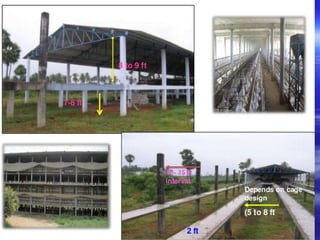
It is a valuable insulating agent, the litter maintains
its own constant temperature, so birds burrow into it
when the air temperature is high and thereby cool
themselves. Conversely, they can warm themselves
in the same way when the weather is very cool
There will be no incident of breast blisters.
There will be no problem in cage layer fatigue.
Initial investment will be less when the land cost is
low
Disadvantages
Housing density is lower than the cage system.
There will be more feed wastage during spilling
Litter-born diseases can occur, especially coccideosis,
costing severe economic loss particularly in broiler
industry.
Disease spread faster due to mainly to free
movements.
Incidence of unclean or soiled eggs is higher.
Birds consume more feed since they move about more
freely wasting some energy; hence feed efficiency is
inferior to the birds in cages.
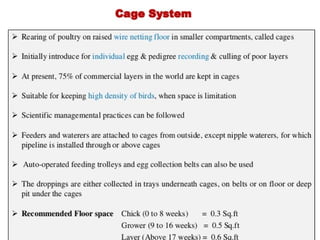
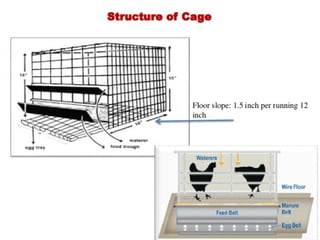
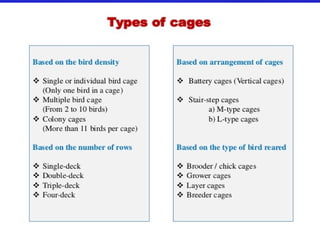
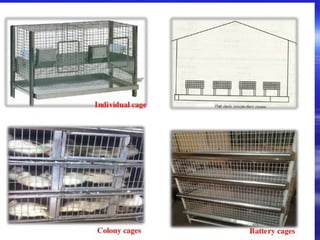
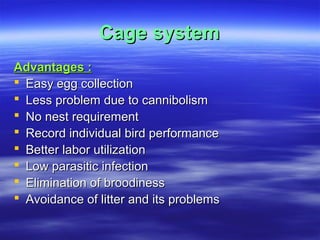
Cage systemCage system
Advantages :Advantages :
 Easy egg collectionEasy egg collection
 Less problem due to cannibolismLess problem due to cannibolism
 No nest requirementNo nest requirement
 Record individual bird performanceRecord individual bird performance
 Better labor utilizationBetter labor utilization
 Low parasitic infectionLow parasitic infection
 Elimination of broodinessElimination of broodiness
 Avoidance of litter and its problemsAvoidance of litter and its problems
DisadvantagesDisadvantages
More heat stress in summer
Fly problem
Incidence of broken egg is more
Cage layer fatigue
Fatty liver syndrome
Poor shell quality
Difficulty in manure disposal
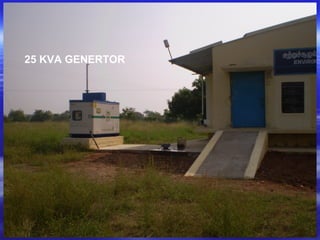
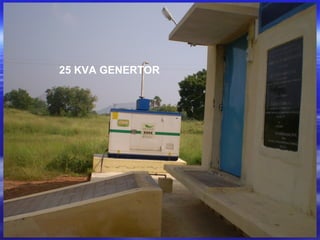
25 KVA GENERTOR
25 KVA GENERTOR
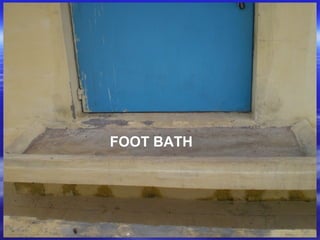
FOOT BATH
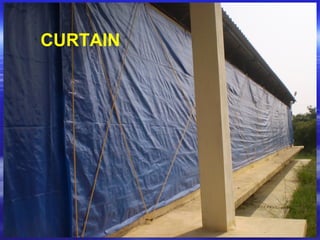
CURTAIN
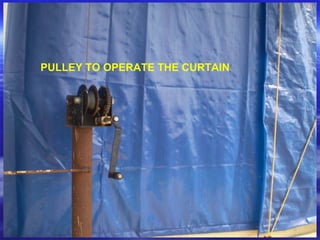
PULLEY TO OPERATE THE CURTAIN
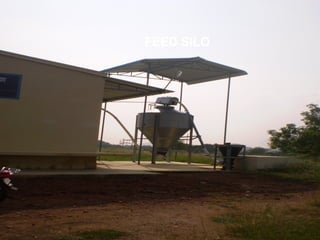
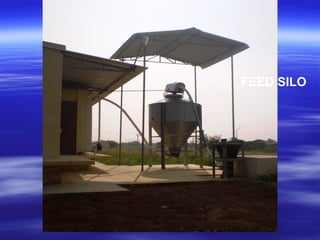
FEED SILO
FEED SILO
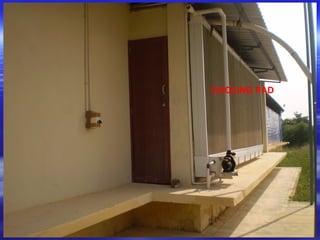
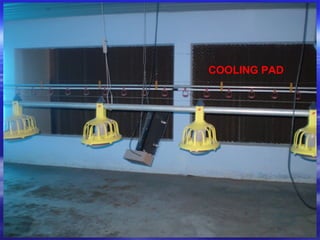
COOLING PAD
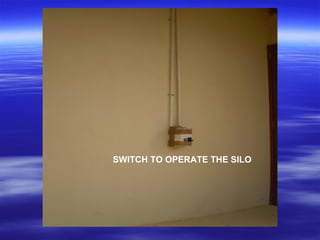
SWITCH TO OPERATE THE SILO
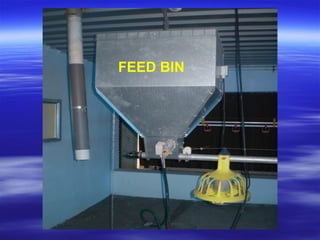
FEED BIN
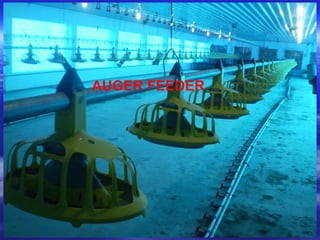
AUGER FEEDER
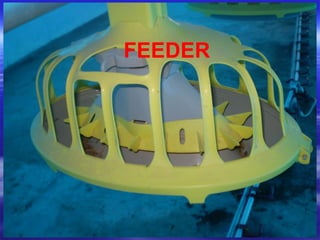
FEEDER
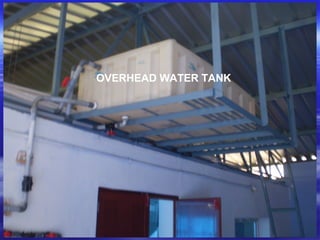
OVERHEAD WATER TANK
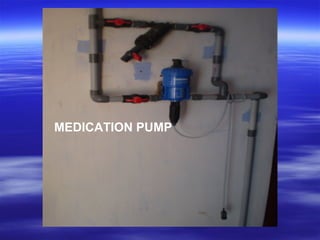
MEDICATION PUMP
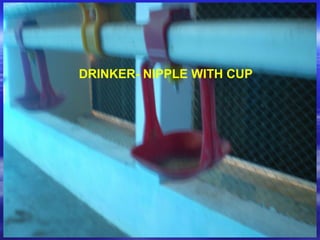
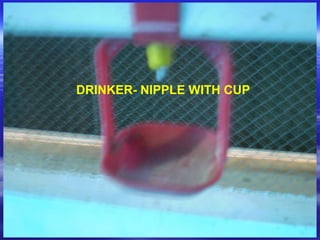
DRINKER- NIPPLE WITH CUP
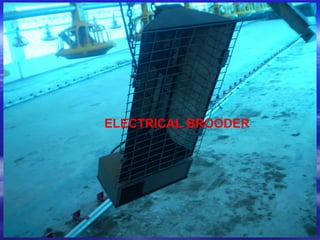
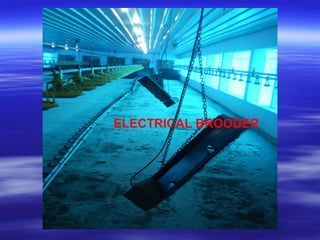
ELECTRICAL BROODER
ELECTRICAL BROODER
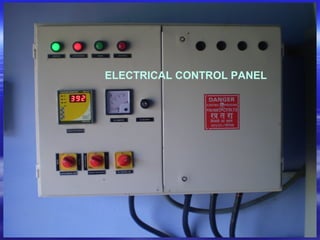
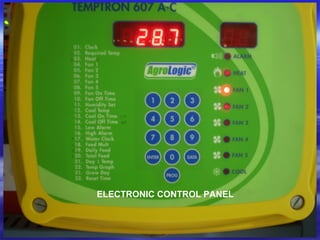
ELECTRICAL CONTROL PANEL
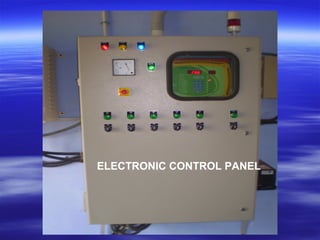
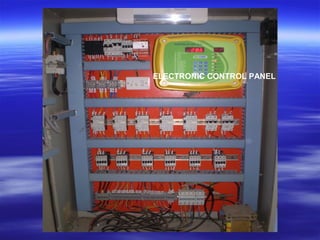
ELECTRONIC CONTROL PANEL
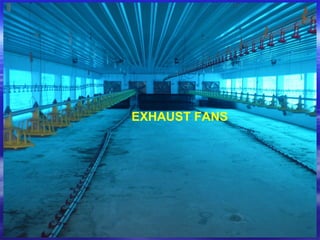
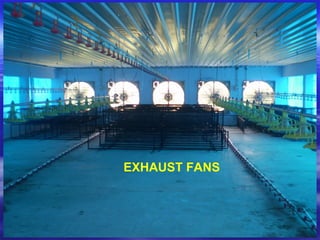
EXHAUST FANS
EXHAUST FANS
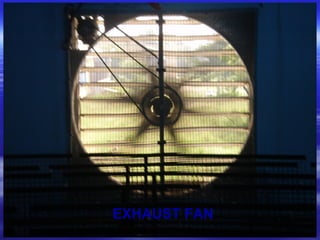
EXHAUST FAN
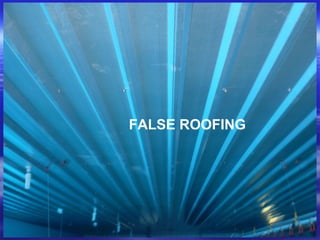
FALSE ROOFING
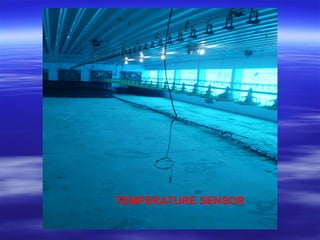
TEMPERATURE SENSOR
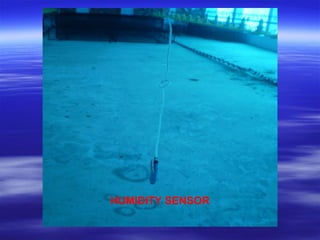
HUMIDITY SENSOR
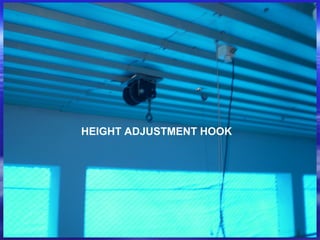
HEIGHT ADJUSTMENT HOOK
COOLING PAD
LAYOUT OF POULTRY FARMLAYOUT OF POULTRY FARM
 A small size poultry farm doesn’t requireA small size poultry farm doesn’t require
any special layout as it involves constructionany special layout as it involves construction
of only one house.of only one house.
 The medium and large size farms requireThe medium and large size farms require
special considerations for placement ofspecial considerations for placement of
building in the farm premises.building in the farm premises.
The basic principles to be observed for layoutThe basic principles to be observed for layout
are,are,
– Layout should not allow visitors or outsideLayout should not allow visitors or outside
vehicles near the birds.vehicles near the birds.
– The sheds should be so located that the freshThe sheds should be so located that the fresh
air first passes through the brooder shed,air first passes through the brooder shed,
followed by grower and layer sheds. This willfollowed by grower and layer sheds. This will
prevent the spread of diseases from layerprevent the spread of diseases from layer
houses to brooder house.houses to brooder house.
– There should be a minimum distance of 50-100There should be a minimum distance of 50-100
feet between chick and grower shed and thefeet between chick and grower shed and the
distance between grower and layer shedsdistance between grower and layer sheds
should be of minimum 100 metre.should be of minimum 100 metre.
– The egg store room, office room and the feedThe egg store room, office room and the feed
store room should be located near entrance tostore room should be located near entrance to
minimize the movement of people around theminimize the movement of people around the
poultry sheds.poultry sheds.
– The disposal pit and sick room should beThe disposal pit and sick room should be
constructed only at the extreme end of the site.constructed only at the extreme end of the site.
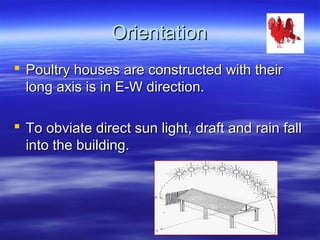
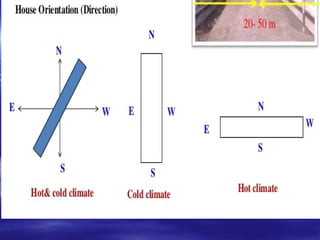
OrientationOrientation
 Poultry houses are constructed with theirPoultry houses are constructed with their
long axis is in E-W direction.long axis is in E-W direction.
 To obviate direct sun light, draft and rain fallTo obviate direct sun light, draft and rain fall
into the building.into the building.
Open-sided housesOpen-sided houses
Very popular in our country.Very popular in our country.
Cheaper in construction and maintenance.Cheaper in construction and maintenance.
SizeSize
 Each broiler require one square foot of floorEach broiler require one square foot of floor
space while a layer requires two square feetspace while a layer requires two square feet
of floor space under deep-litter system ofof floor space under deep-litter system of
rearing. So the size of the house dependsrearing. So the size of the house depends
on the number of birds to be reared.on the number of birds to be reared.
LengthLength
 The length of the house can be of anyThe length of the house can be of any
extent. The number of birds reared andextent. The number of birds reared and
availability of the land determines the lengthavailability of the land determines the length
of poultry house.of poultry house.
RoofsRoofs
 The roof must be draft and moisture proof.The roof must be draft and moisture proof.
 Insulation of roof helps in both summer and winterInsulation of roof helps in both summer and winter
 To reflect as much heat as possible, the roofTo reflect as much heat as possible, the roof
should painted with reflecting type of paint such asshould painted with reflecting type of paint such as
Al paint.Al paint.
RoofsRoofs
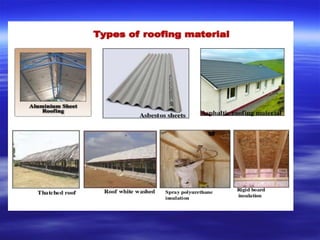
 Thatched roof is cheap but not durable.Thatched roof is cheap but not durable.
 It is good for low rain fall areas.It is good for low rain fall areas.
 Is not vermin proof and exposed to fireIs not vermin proof and exposed to fire
hazards.hazards.
RoofsRoofs
 Asbestos or cement board roofs do not radiate asAsbestos or cement board roofs do not radiate as
much as heat as metal roofing to birds in a poultrymuch as heat as metal roofing to birds in a poultry
house, more desirable for poultry roofs.house, more desirable for poultry roofs.
 Can be improved by adding insulation and painting orCan be improved by adding insulation and painting or
covering with thatch.covering with thatch.
RoofsRoofs
Metal roofs are good radiators unless insulatedMetal roofs are good radiators unless insulated
not recommended as roofing materials.not recommended as roofing materials.
Even with insulation , the outside of the roofEven with insulation , the outside of the roof
should be painted white to aid in keeping it cool.should be painted white to aid in keeping it cool.
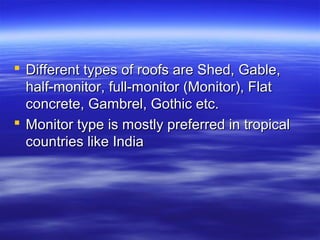
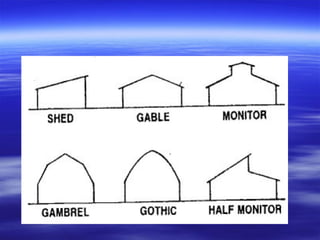
 Different types of roofs are Shed, Gable,Different types of roofs are Shed, Gable,
half-monitor, full-monitor (Monitor), Flathalf-monitor, full-monitor (Monitor), Flat
concrete, Gambrel, Gothic etc.concrete, Gambrel, Gothic etc.
 Monitor type is mostly preferred in tropicalMonitor type is mostly preferred in tropical
countries like Indiacountries like India
OverhangOverhang
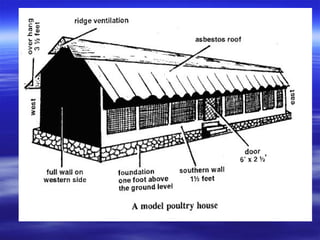
 The overhang of the roof should not be lessThe overhang of the roof should not be less
than 3.5 feet in order to prevent the entry ofthan 3.5 feet in order to prevent the entry of
rain water into the shed.rain water into the shed.
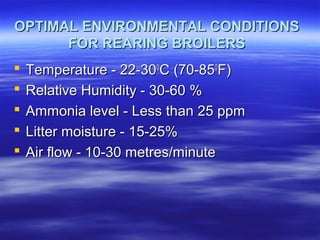
OPTIMAL ENVIRONMENTAL CONDITIONSOPTIMAL ENVIRONMENTAL CONDITIONS
FOR REARING BROILERSFOR REARING BROILERS
 Temperature - 22-30Temperature - 22-3000
C (70-85C (70-8500
F)F)
 Relative Humidity - 30-60 %Relative Humidity - 30-60 %
 Ammonia level - Less than 25 ppmAmmonia level - Less than 25 ppm
 Litter moisture - 15-25%Litter moisture - 15-25%
 Air flow - 10-30 metres/minuteAir flow - 10-30 metres/minute
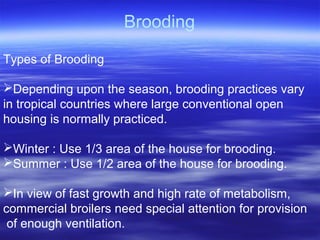
Brooding
Types of Brooding
Depending upon the season, brooding practices vary
in tropical countries where large conventional open
housing is normally practiced.
Winter : Use 1/3 area of the house for brooding.
Summer : Use 1/2 area of the house for brooding.
In view of fast growth and high rate of metabolism,
commercial broilers need special attention for provision
of enough ventilation.
Brooder Management
Start and adjust the brooder stoves 24 hours before the
arrival of chicks.
Ensure that they are working properly.
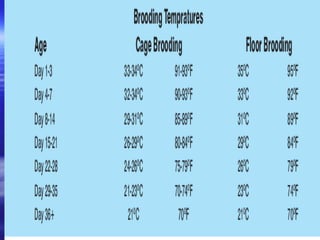
Adjust the temperature to 95°F (35°C) at the edge of the
brooder 2" (5 cm) above the litter.
Lower the temperature by 5°F (2.8°C) each week until it
reaches 70°F.
Brooder Guard
Make the guards from material which can be
properly sterilised.
 Height of guard should be approximately 16" to 18“
 Guards will ensure chicks stay near the source of
heat
 Help in preventing chilling and piling
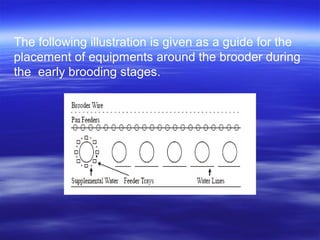
The following illustration is given as a guide for the
placement of equipments around the brooder during
the early brooding stages.
Cage Brooding
Before the birds arrive, prepare the house as follows:
1. Put nonskid paper on the bottom of the cage. This paper
may disintegrate and fall through the cage bottom or it
should be removed at beak trimming time (10 days).
2. Start the heating system 24 hours before the birds arrive.
Adjust the temperature to 33-34ºC (91.4-93.2ºF.).
3. Keep the relative humidity at 50% minimum. In cage
brooding, adequate humidity is very important.
Temperature Management
In a cage or warm room brooding system, reduce the
temperature 3ºC (5ºF.) per week from 34ºC (93.2ºF.) until
21ºC (70ºF.) isreached.
Look for signs of overheating (panting and drowsiness)
or chilling (huddling) and make appropriate adjustments.
Heat control is more critical in cage brooding because the
chicks cannot move to find their comfort zone.
Maintain adequate humidity if you brood in cages. Relative
humidity for cage brooding must be maintained at 40-60%.
If necessary, sprinkle water on the walks or floors to increase
humidity.
ThankyouThankyou

Poultry housing

  • 1.
  • 2.
    OBJECTIVESOBJECTIVES  To knowabout need of housing for poultryTo know about need of housing for poultry productionproduction  Different types of poultry housesDifferent types of poultry houses  Location and layout of poultry housesLocation and layout of poultry houses  Floor space requirementFloor space requirement  Different systems of rearing with relativeDifferent systems of rearing with relative advantage and disadvantages.advantage and disadvantages.
  • 4.
    DIFFERENT TYPES OFDIFFERENTTYPES OF POULTRY HOUSESPOULTRY HOUSES  Brooder/chick houseBrooder/chick house – It is used to brood and rear egg-type chicksIt is used to brood and rear egg-type chicks from 0 to 8 weeks of age.from 0 to 8 weeks of age.  Grower houseGrower house – It is used to grow egg-type birds from 9 to 18It is used to grow egg-type birds from 9 to 18 weeks of age.weeks of age.  Brooder cum grower houseBrooder cum grower house  Here, the birds are reared from 0 to 18 weeksHere, the birds are reared from 0 to 18 weeks of age (entire brooding and growing period ofof age (entire brooding and growing period of egg-type chickenegg-type chicken
  • 5.
     Layer houseLayerhouse – In which birds over 18 weeks of age are reared,In which birds over 18 weeks of age are reared, usually up to 72 weeks of age.usually up to 72 weeks of age.  Broiler houseBroiler house – In which broilers (meat-type birds) are reared upIn which broilers (meat-type birds) are reared up to 5/6 weeks of age.to 5/6 weeks of age.
  • 6.
     Breeder houseBreederhouse – In which both male and female breeders areIn which both male and female breeders are maintained at appropriate sex ratio.maintained at appropriate sex ratio.  Environmentally controlled (EC) houseEnvironmentally controlled (EC) house – In which, entire environment is manipulated inIn which, entire environment is manipulated in such a way that is optimum for the birds growth.such a way that is optimum for the birds growth.
  • 7.
    Systems of poultryhousingSystems of poultry housing FACTORSFACTORS  Poultry can be housed under differentPoultry can be housed under different systems based on following factors:systems based on following factors: – Availability of landAvailability of land – Cost of landCost of land – Type of farming activityType of farming activity – Climatic conditionClimatic condition – Labour availabilityLabour availability
  • 11.
    Folding-unit system:Folding-unit system: This system of housing is an innovation ofThis system of housing is an innovation of recent years.recent years.  In portable folding units birds being confinedIn portable folding units birds being confined to one small run, the position is changed eachto one small run, the position is changed each day, giving them fresh ground and the birdsday, giving them fresh ground and the birds find a considerable proportion of food from thefind a considerable proportion of food from the herbage .herbage .
  • 12.
     The mostconvenient folding unit to handleThe most convenient folding unit to handle is that which is made for 25 hens.is that which is made for 25 hens.  A floor space of 1 square foot should beA floor space of 1 square foot should be allowed for each bird in the house, and 3allowed for each bird in the house, and 3 square feet in the run, so that a total floorsquare feet in the run, so that a total floor space to the whole unit is 4 square feet perspace to the whole unit is 4 square feet per bird, as with the intensive system.bird, as with the intensive system.
  • 13.
     A suitablemeasurement for a folding house toA suitable measurement for a folding house to take 25 birds is 5 feet wide and 20 feet long, thetake 25 birds is 5 feet wide and 20 feet long, the house being 5’ x 5’, one-third of the run.house being 5’ x 5’, one-third of the run.  DisadvantagesDisadvantages  The food and water must be carried out to theThe food and water must be carried out to the birds and eggs brought back.birds and eggs brought back.  There is some extra labour involved in the regularThere is some extra labour involved in the regular moving of the fold units.moving of the fold units.  More expensiveMore expensive
  • 15.
    INTENSIVE SYSTEM  Birdsare totally confined to houses either on ground / floor or on wire-netting floor in cages or on slats.  It is the most efficient, convenient and economical system for modern poultry production with huge numbers.
  • 16.
    Advantages  Minimum landis required for farming.  Farms can be located near market area.  Day-to-day management is easier.  The production performance is higher as more energy is saved due to restricted movements.
  • 17.
     Scientific managementpractices like breeding, feeding, medication, culling etc. can be applied easily and accurately.  The sick birds can be detected, isolated and treated easily.
  • 18.
    Disadvantages  Birds’ welfareis affected. They can not perform the natural behaviour like roosting, spreading wings, scratching the floor with legs etc.  Since they are not exposed to outside sunlight and feed sources, all the nutrients should be provided in balanced manner to avoid nutritionally deficient diseases.  Chances for spreading of diseases are more.
  • 19.
    Deep litter system: Inthis system the poultry birds are reared on floor covered with litters like straw, saw dust or leaves up to depth of 8-12 inches. we can define deep litter, as the accumulation of the material used for litter with poultry manure until it reaches a depth of 8 to 12 inches.
  • 20.
    Suitable dry organicmaterials like straw (needs to beSuitable dry organic materials like straw (needs to be cut into 2 or 3 inch lengths), saw dust, leaves, drycut into 2 or 3 inch lengths), saw dust, leaves, dry grasses, groundnut shells, broken up maize stalks andgrasses, groundnut shells, broken up maize stalks and cobs, bark of trees in sufficient quantity to give a depthcobs, bark of trees in sufficient quantity to give a depth of about 6 inches in the pen should be used.of about 6 inches in the pen should be used. The droppings of the birds gradually combine with theThe droppings of the birds gradually combine with the materials used to build up the litter. In about 2materials used to build up the litter. In about 2 months, it has usually become deep litter, and by 6months, it has usually become deep litter, and by 6 months it has become built-up deep litter. At about 12months it has become built-up deep litter. At about 12 months of old stage it is fully built up. Extra littermonths of old stage it is fully built up. Extra litter materials can be added to maintain sufficientmaterials can be added to maintain sufficient depth.depth.
  • 21.
    The deep litterpen should be started when the weather is dry, and is likely to remain so for about 2 months for the operation of the bacterial action, which alters the composition of the litters. Start new litter with each year’s pullets and continue with it for their laying period.
  • 22.
    Advantages of DeepLitter System: Birds and eggs are safety as enclosed in deep litter intensive pen, which has strong wire netting or expanded metal. Built-up deep litter also supplies some of the food requirements of the birds. They obtain "Animal Protein Factor" from deep litter. The level of coccidiosis and worm infestation is much lower with poultry kept on good deep litter than with birds (or chicken) in bare yards. Well managed deep litter kept in dry condition with no wet spots around waterer has a sterilising action. .
  • 23.
    With correct conditionsobserved with well managed litter there is no need to clean a pen out for a whole year; the only attention is the regular stirring and adding of some material as needed. Generally 35 laying birds can produce in one year about 1 tonne of deep litter fertilizer. The level of nitrogen in fresh manure is about 1%, but on well built-up deep litter it may be around 3% nitrogen (nearly 20% protein). It also contains about 2% phosphorus and 2% potash. Its value is about 3 times that of cattle manure.
  • 24.
    It is avaluable insulating agent, the litter maintains its own constant temperature, so birds burrow into it when the air temperature is high and thereby cool themselves. Conversely, they can warm themselves in the same way when the weather is very cool There will be no incident of breast blisters. There will be no problem in cage layer fatigue. Initial investment will be less when the land cost is low
  • 25.
    Disadvantages Housing density islower than the cage system. There will be more feed wastage during spilling Litter-born diseases can occur, especially coccideosis, costing severe economic loss particularly in broiler industry. Disease spread faster due to mainly to free movements. Incidence of unclean or soiled eggs is higher. Birds consume more feed since they move about more freely wasting some energy; hence feed efficiency is inferior to the birds in cages.
  • 34.
    Cage systemCage system Advantages:Advantages :  Easy egg collectionEasy egg collection  Less problem due to cannibolismLess problem due to cannibolism  No nest requirementNo nest requirement  Record individual bird performanceRecord individual bird performance  Better labor utilizationBetter labor utilization  Low parasitic infectionLow parasitic infection  Elimination of broodinessElimination of broodiness  Avoidance of litter and its problemsAvoidance of litter and its problems
  • 35.
    DisadvantagesDisadvantages More heat stressin summer Fly problem Incidence of broken egg is more Cage layer fatigue Fatty liver syndrome Poor shell quality Difficulty in manure disposal
  • 39.
  • 40.
  • 41.
  • 42.
  • 43.
    PULLEY TO OPERATETHE CURTAIN
  • 44.
  • 45.
  • 46.
  • 47.
  • 48.
  • 49.
  • 50.
  • 51.
  • 52.
  • 53.
  • 54.
  • 55.
  • 56.
  • 57.
  • 58.
  • 59.
  • 60.
  • 61.
  • 62.
  • 63.
  • 64.
  • 65.
  • 66.
  • 67.
  • 69.
  • 72.
    LAYOUT OF POULTRYFARMLAYOUT OF POULTRY FARM  A small size poultry farm doesn’t requireA small size poultry farm doesn’t require any special layout as it involves constructionany special layout as it involves construction of only one house.of only one house.  The medium and large size farms requireThe medium and large size farms require special considerations for placement ofspecial considerations for placement of building in the farm premises.building in the farm premises.
  • 73.
    The basic principlesto be observed for layoutThe basic principles to be observed for layout are,are, – Layout should not allow visitors or outsideLayout should not allow visitors or outside vehicles near the birds.vehicles near the birds. – The sheds should be so located that the freshThe sheds should be so located that the fresh air first passes through the brooder shed,air first passes through the brooder shed, followed by grower and layer sheds. This willfollowed by grower and layer sheds. This will prevent the spread of diseases from layerprevent the spread of diseases from layer houses to brooder house.houses to brooder house.
  • 74.
    – There shouldbe a minimum distance of 50-100There should be a minimum distance of 50-100 feet between chick and grower shed and thefeet between chick and grower shed and the distance between grower and layer shedsdistance between grower and layer sheds should be of minimum 100 metre.should be of minimum 100 metre. – The egg store room, office room and the feedThe egg store room, office room and the feed store room should be located near entrance tostore room should be located near entrance to minimize the movement of people around theminimize the movement of people around the poultry sheds.poultry sheds. – The disposal pit and sick room should beThe disposal pit and sick room should be constructed only at the extreme end of the site.constructed only at the extreme end of the site.
  • 75.
    OrientationOrientation  Poultry housesare constructed with theirPoultry houses are constructed with their long axis is in E-W direction.long axis is in E-W direction.  To obviate direct sun light, draft and rain fallTo obviate direct sun light, draft and rain fall into the building.into the building.
  • 77.
    Open-sided housesOpen-sided houses Verypopular in our country.Very popular in our country. Cheaper in construction and maintenance.Cheaper in construction and maintenance.
  • 78.
    SizeSize  Each broilerrequire one square foot of floorEach broiler require one square foot of floor space while a layer requires two square feetspace while a layer requires two square feet of floor space under deep-litter system ofof floor space under deep-litter system of rearing. So the size of the house dependsrearing. So the size of the house depends on the number of birds to be reared.on the number of birds to be reared. LengthLength  The length of the house can be of anyThe length of the house can be of any extent. The number of birds reared andextent. The number of birds reared and availability of the land determines the lengthavailability of the land determines the length of poultry house.of poultry house.
  • 81.
    RoofsRoofs  The roofmust be draft and moisture proof.The roof must be draft and moisture proof.  Insulation of roof helps in both summer and winterInsulation of roof helps in both summer and winter  To reflect as much heat as possible, the roofTo reflect as much heat as possible, the roof should painted with reflecting type of paint such asshould painted with reflecting type of paint such as Al paint.Al paint.
  • 82.
    RoofsRoofs  Thatched roofis cheap but not durable.Thatched roof is cheap but not durable.  It is good for low rain fall areas.It is good for low rain fall areas.  Is not vermin proof and exposed to fireIs not vermin proof and exposed to fire hazards.hazards.
  • 83.
    RoofsRoofs  Asbestos orcement board roofs do not radiate asAsbestos or cement board roofs do not radiate as much as heat as metal roofing to birds in a poultrymuch as heat as metal roofing to birds in a poultry house, more desirable for poultry roofs.house, more desirable for poultry roofs.  Can be improved by adding insulation and painting orCan be improved by adding insulation and painting or covering with thatch.covering with thatch.
  • 84.
    RoofsRoofs Metal roofs aregood radiators unless insulatedMetal roofs are good radiators unless insulated not recommended as roofing materials.not recommended as roofing materials. Even with insulation , the outside of the roofEven with insulation , the outside of the roof should be painted white to aid in keeping it cool.should be painted white to aid in keeping it cool.
  • 86.
     Different typesof roofs are Shed, Gable,Different types of roofs are Shed, Gable, half-monitor, full-monitor (Monitor), Flathalf-monitor, full-monitor (Monitor), Flat concrete, Gambrel, Gothic etc.concrete, Gambrel, Gothic etc.  Monitor type is mostly preferred in tropicalMonitor type is mostly preferred in tropical countries like Indiacountries like India
  • 88.
    OverhangOverhang  The overhangof the roof should not be lessThe overhang of the roof should not be less than 3.5 feet in order to prevent the entry ofthan 3.5 feet in order to prevent the entry of rain water into the shed.rain water into the shed.
  • 92.
    OPTIMAL ENVIRONMENTAL CONDITIONSOPTIMALENVIRONMENTAL CONDITIONS FOR REARING BROILERSFOR REARING BROILERS  Temperature - 22-30Temperature - 22-3000 C (70-85C (70-8500 F)F)  Relative Humidity - 30-60 %Relative Humidity - 30-60 %  Ammonia level - Less than 25 ppmAmmonia level - Less than 25 ppm  Litter moisture - 15-25%Litter moisture - 15-25%  Air flow - 10-30 metres/minuteAir flow - 10-30 metres/minute
  • 93.
    Brooding Types of Brooding Dependingupon the season, brooding practices vary in tropical countries where large conventional open housing is normally practiced. Winter : Use 1/3 area of the house for brooding. Summer : Use 1/2 area of the house for brooding. In view of fast growth and high rate of metabolism, commercial broilers need special attention for provision of enough ventilation.
  • 94.
    Brooder Management Start andadjust the brooder stoves 24 hours before the arrival of chicks. Ensure that they are working properly. Adjust the temperature to 95°F (35°C) at the edge of the brooder 2" (5 cm) above the litter. Lower the temperature by 5°F (2.8°C) each week until it reaches 70°F.
  • 95.
    Brooder Guard Make theguards from material which can be properly sterilised.  Height of guard should be approximately 16" to 18“  Guards will ensure chicks stay near the source of heat  Help in preventing chilling and piling
  • 96.
    The following illustrationis given as a guide for the placement of equipments around the brooder during the early brooding stages.
  • 97.
    Cage Brooding Before thebirds arrive, prepare the house as follows: 1. Put nonskid paper on the bottom of the cage. This paper may disintegrate and fall through the cage bottom or it should be removed at beak trimming time (10 days). 2. Start the heating system 24 hours before the birds arrive. Adjust the temperature to 33-34ºC (91.4-93.2ºF.). 3. Keep the relative humidity at 50% minimum. In cage brooding, adequate humidity is very important.
  • 98.
    Temperature Management In acage or warm room brooding system, reduce the temperature 3ºC (5ºF.) per week from 34ºC (93.2ºF.) until 21ºC (70ºF.) isreached. Look for signs of overheating (panting and drowsiness) or chilling (huddling) and make appropriate adjustments. Heat control is more critical in cage brooding because the chicks cannot move to find their comfort zone. Maintain adequate humidity if you brood in cages. Relative humidity for cage brooding must be maintained at 40-60%. If necessary, sprinkle water on the walks or floors to increase humidity.
  • 100.