BACKGROUND

 More than 60 % of total meat consumption in
  the country was met by the export from other
  countries.
 National production fulfilling only the 40% of
  the demand.
 In this scenario, poultry farming has got a
  huge potential in Nepal.
   Putting this scenario into consideration, we (
    Suraj, and Umesh, proprieties of Rato Bhale
    company ) decided to capitalize this
    opportunity to serve the people and to make
    the country self dependent in the poultry
    products.
PRELIMINARY WORK

 1000 chickens would be optimum for the
  initial operation of the business.
 Production site :- Gokarna;
  Plenty open space, cheap labors, road
  connection, water availability and immediate
  access to Kathmandu valley.
 Feasibility study by the experts shows
  positive results.
PRELIMINARY WORK
 An area of about 10,000 sq. feet for the farm
 House with 3 rooms rented for the storage of
  pellets, equipment as well as for the
  employees to guard the farm.
 The land leased for 5 years with options of
  extension.
 Initial investment Rs.10, 00,000
 Three lakhs from each partner and the rest
  as loan.
 Buying chickens, building cage
  house, stocking the pellets, hiring the expert
  and other miscellaneous tasks.
 50% gross margin expected within 6 months
  of its operations withholding the chances of
  any accidental or unexpected incidence.
 Loan repayment within 3 years and obtain
  the breakeven point within 2 years
OBJECTIVES
 Becoming the "Best and most hygienic poultry
  producer in the area" complying by the national
  standards for food and drugs.
 Turn in profits from the first six weeks of
  operations.
 Maintain 50% gross margin ratio.
 Winning the hearts and tastes of our beloved
  consumers and establishing a brand image of
  the company through heavy marketing
  campaigns in the first one year.
KEYS TO SUCCESS

 State of art cage framework accommodating
  optimum number of chickens with mitigated
  possible hazards.
 Diverse slaughters network, market chain
  management, optimum inventory level and
  ‘customer is king’ policy.
 Regular visits by medical workers and
  hygienic poultry house environment.
MISSION:

   Rato Bhale poultry producer will make its
    best effort to live up to the consumer’s
    expectations by delivering the best of its
    product to the end users. The nutritious and
    protein rich product from our farm would
    always be the first choice of our consumers.
COMPANY SUMMARY
 Limited liability company, producing
  chickens, eggs, and, litter as a by-product in
  its state of art poultry farm units.
 Status: small and cottage industry.

             Ownership structure
   The company would be jointly owned by Mr.
    Suraj Ghimire, and Mr. Umesh B.C. It would
    be a partnership enterprise with each of the
    owners holding 50-50 % of the share
PRODUCTS
 In the phase I, only mature broiler hens
  produced for the purpose of meat.
 Achieved by using highly-nutritious pellet
  ingredients and a high level of hygiene.
 Battery units accommodate 9X9 inch space
  per Hen.
 Price list would be verified with the latest
  market trend and optimum mix for demand
  and supply would be maintained.
MANAGEMENT TEAM
 Energetic and able managers cum owners.
 Mr. Suraj Ghimire as the General Manager
  and also responsible for the sales, marketing
  and operation department.
 Mr. Umesh BC responsible for the
  HR, finance and public relation department.
 Advisory board consists of dignified
  personalities like Mr. Sushil Pant, Dr Shyam
  Maskey and different experts in the field.
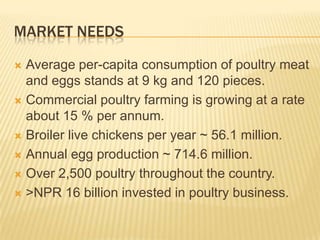
MARKET NEEDS

 Average per-capita consumption of poultry meat
  and eggs stands at 9 kg and 120 pieces.
 Commercial poultry farming is growing at a rate
  about 15 % per annum.
 Broiler live chickens per year ~ 56.1 million.

 Annual egg production ~ 714.6 million.

 Over 2,500 poultry throughout the country.

 >NPR 16 billion invested in poultry business.
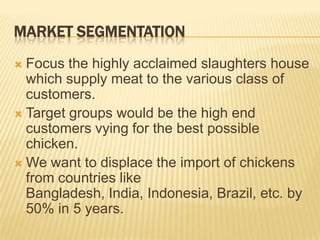
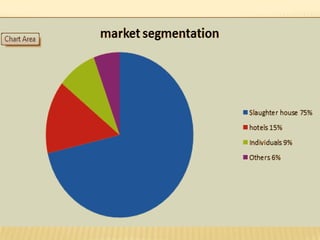
MARKET SEGMENTATION
 Focus the highly acclaimed slaughters house
  which supply meat to the various class of
  customers.
 Target groups would be the high end
  customers vying for the best possible
  chicken.
 We want to displace the import of chickens
  from countries like
  Bangladesh, India, Indonesia, Brazil, etc. by
  50% in 5 years.
Start-up Summary:
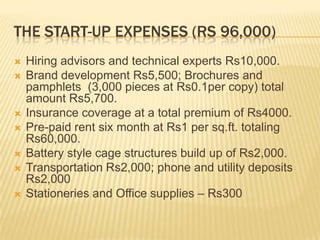
THE START-UP EXPENSES (RS 96,000)
   Hiring advisors and technical experts Rs10,000.
   Brand development Rs5,500; Brochures and
    pamphlets (3,000 pieces at Rs0.1per copy) total
    amount Rs5,700.
   Insurance coverage at a total premium of Rs4000.
   Pre-paid rent six month at Rs1 per sq.ft. totaling
    Rs60,000.
   Battery style cage structures build up of Rs2,000.
   Transportation Rs2,000; phone and utility deposits
    Rs2,000
   Stationeries and Office supplies – Rs300
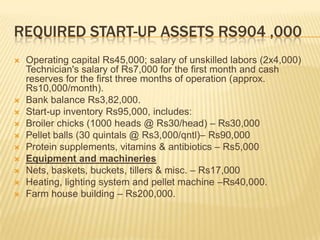
REQUIRED START-UP ASSETS RS904 ,000
   Operating capital Rs45,000; salary of unskilled labors (2x4,000)
    Technician's salary of Rs7,000 for the first month and cash
    reserves for the first three months of operation (approx.
    Rs10,000/month).
   Bank balance Rs3,82,000.
   Start-up inventory Rs95,000, includes:
   Broiler chicks (1000 heads @ Rs30/head) – Rs30,000
   Pellet balls (30 quintals @ Rs3,000/qntl)– Rs90,000
   Protein supplements, vitamins & antibiotics – Rs5,000
   Equipment and machineries
   Nets, baskets, buckets, tillers & misc. – Rs17,000
   Heating, lighting system and pellet machine –Rs40,000.
   Farm house building – Rs200,000.
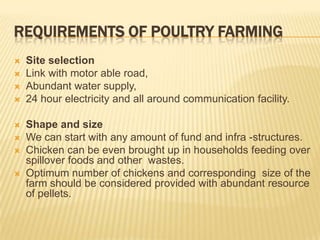
REQUIREMENTS OF POULTRY FARMING
   Site selection
   Link with motor able road,
   Abundant water supply,
   24 hour electricity and all around communication facility.

   Shape and size
   We can start with any amount of fund and infra -structures.
   Chicken can be even brought up in households feeding over
    spillover foods and other wastes.
   Optimum number of chickens and corresponding size of the
    farm should be considered provided with abundant resource
    of pellets.
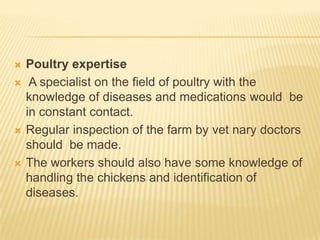
   Poultry expertise
    A specialist on the field of poultry with the
    knowledge of diseases and medications would be
    in constant contact.
   Regular inspection of the farm by vet nary doctors
    should be made.
   The workers should also have some knowledge of
    handling the chickens and identification of
    diseases.
 Acquisition of materials:
 Raw materials should always be available and
  stock should be plenty as chickens cannot
  survive much without food.
 Pellets bought in big lots provide economies of
  scale.
 Protein rich supplements, antibiotics and
  vitamins should also be given in regular basis.
 Required amount of feed and day old chicks will
  be imported.
   Marketing and distribution
   Poultry farms, with the broilers, won’t make profits if the
    finished products i.e. hen are not taken to the market after
    specified time normally 6 weeks.
   After 6 weeks the hens won’t convert the feeds into flesh
    so, it would be unproductive to hold them any longer.
   Preparation and disinfection of shed
   Floors ,interior of the walls & roof will be scrubbed to
    remove litters
   Dust from pens will be washed with fresh water and
    battery brooders will be disinfected using 5% phenol
    solution ,followed by spraying of 3% solution of Korhsolin
    (disinfectant) inside and outside the shade .
   Feeding
   Starter ration from 0 to 3 week.
   The ration will have energy value of 3200MEKcal/kg.
   A combination of 23.5 sesame meal and 28%
    soybean meal gives good result in broiler
    performance ,provided the minimum recommended
    levels of lysine ,methionine and cysteine.
   Diet formulated using locally available sesame seeds
    without a premix, produces a weight gain about 20%
    lower than attained by a commercial diet , with 15%
    inferior feed conversion and a similar mortality.
 Vaccination and medication
   To maintain health of poultry, timely vaccination
  and medication by vet nary will be done.
 Litter management
 Rice husk will be used as litter by maintaining 5
  cm thick on floor.
 The litter will be stirred twice in a week to
  prevent watery.
 Wet litter will be removed and dry will be
  replaced. Before placing the litter in poultry
  house, dust lime will be used as disinfectant.
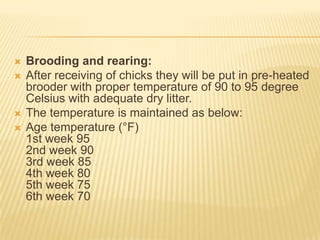
   Brooding and rearing:
   After receiving of chicks they will be put in pre-heated
    brooder with proper temperature of 90 to 95 degree
    Celsius with adequate dry litter.
   The temperature is maintained as below:
   Age temperature (°F)
    1st week 95
    2nd week 90
    3rd week 85
    4th week 80
    5th week 75
    6th week 70
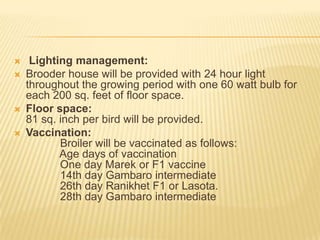
    Lighting management:
   Brooder house will be provided with 24 hour light
    throughout the growing period with one 60 watt bulb for
    each 200 sq. feet of floor space.
   Floor space:
    81 sq. inch per bird will be provided.
   Vaccination:
           Broiler will be vaccinated as follows:
           Age days of vaccination
           One day Marek or F1 vaccine
           14th day Gambaro intermediate
           26th day Ranikhet F1 or Lasota.
           28th day Gambaro intermediate
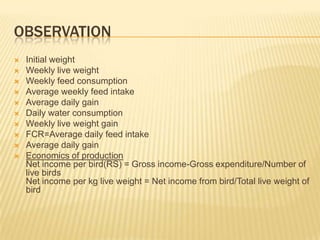
OBSERVATION
   Initial weight
   Weekly live weight
   Weekly feed consumption
   Average weekly feed intake
   Average daily gain
   Daily water consumption
   Weekly live weight gain
   FCR=Average daily feed intake
   Average daily gain
   Economics of production
    Net income per bird(RS) = Gross income-Gross expenditure/Number of
    live birds
    Net income per kg live weight = Net income from bird/Total live weight of
    bird
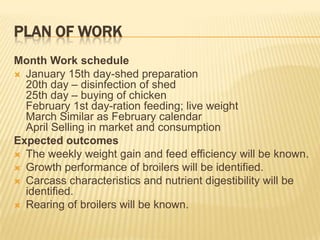
PLAN OF WORK
Month Work schedule
 January 15th day-shed preparation
  20th day – disinfection of shed
  25th day – buying of chicken
  February 1st day-ration feeding; live weight
  March Similar as February calendar
  April Selling in market and consumption
Expected outcomes
 The weekly weight gain and feed efficiency will be known.
 Growth performance of broilers will be identified.
 Carcass characteristics and nutrient digestibility will be
  identified.
 Rearing of broilers will be known.
BUSINESS RISKS
Financial Risks
 Changes in our own or competitors' pricing policies
 Fluctuations in expected revenues from
  distributors, retailors and strategic partners.
 Timing of costs related to acquisitions or payments.
Legislative / Legal Landscape
 Malpractice and other related liability
 State regulations on quarantine, insurance and the
  practice of medicine.
 Storage, transmission and disclosure of firm’s
  information and hygiene records
STRATEGY
   Anticipate and respond to consumer preferences for
    content, Preference and service.
   Attract, excite and retain a large audience of consumers to the
    Rato Bhale Products.
   Create and maintain successful strategic alliances with high
    quality partners
   Build the Rato Bhale brand rapidly and substantially
   Timely availability of budget and feeds.
   Compete effectively against better-established Rivals, like Ratna
    Hatchery (P) Ltd , Gems Agro Livestock Industries Pvt. Ltd etc
   Assumptions
   Poultry raising environment will be favorable for growth.
   Poultry grower will adopt technology
   Outbreak of birdflue remains normal
 Financial Plan:
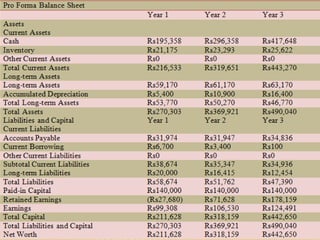
 The owners have provided the company with
  sufficient start-up capital.
 With successful management aimed at
  establishing and growing a loyal customer
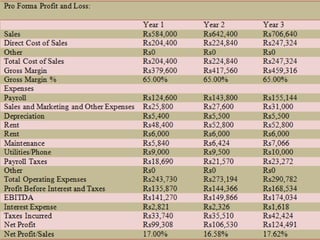
  base, the company will see its net worth
  doubling in two years.
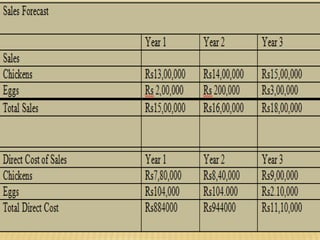
 Rato Bhale will maintain a healthy 50% gross
  margin, which combined with reasonable
  operating expenses, will provide enough cash to
  finance further growth.
Business Plan for poultry farm

Business Plan for poultry farm

  • 3.
    BACKGROUND  More than60 % of total meat consumption in the country was met by the export from other countries.  National production fulfilling only the 40% of the demand.  In this scenario, poultry farming has got a huge potential in Nepal.
  • 4.
    Putting this scenario into consideration, we ( Suraj, and Umesh, proprieties of Rato Bhale company ) decided to capitalize this opportunity to serve the people and to make the country self dependent in the poultry products.
  • 5.
    PRELIMINARY WORK  1000chickens would be optimum for the initial operation of the business.  Production site :- Gokarna; Plenty open space, cheap labors, road connection, water availability and immediate access to Kathmandu valley.  Feasibility study by the experts shows positive results.
  • 6.
    PRELIMINARY WORK  Anarea of about 10,000 sq. feet for the farm  House with 3 rooms rented for the storage of pellets, equipment as well as for the employees to guard the farm.  The land leased for 5 years with options of extension.  Initial investment Rs.10, 00,000  Three lakhs from each partner and the rest as loan.
  • 7.
     Buying chickens,building cage house, stocking the pellets, hiring the expert and other miscellaneous tasks.  50% gross margin expected within 6 months of its operations withholding the chances of any accidental or unexpected incidence.  Loan repayment within 3 years and obtain the breakeven point within 2 years
  • 8.
    OBJECTIVES  Becoming the"Best and most hygienic poultry producer in the area" complying by the national standards for food and drugs.  Turn in profits from the first six weeks of operations.  Maintain 50% gross margin ratio.  Winning the hearts and tastes of our beloved consumers and establishing a brand image of the company through heavy marketing campaigns in the first one year.
  • 9.
    KEYS TO SUCCESS State of art cage framework accommodating optimum number of chickens with mitigated possible hazards.  Diverse slaughters network, market chain management, optimum inventory level and ‘customer is king’ policy.  Regular visits by medical workers and hygienic poultry house environment.
  • 10.
    MISSION:  Rato Bhale poultry producer will make its best effort to live up to the consumer’s expectations by delivering the best of its product to the end users. The nutritious and protein rich product from our farm would always be the first choice of our consumers.
  • 11.
    COMPANY SUMMARY  Limitedliability company, producing chickens, eggs, and, litter as a by-product in its state of art poultry farm units.  Status: small and cottage industry. Ownership structure  The company would be jointly owned by Mr. Suraj Ghimire, and Mr. Umesh B.C. It would be a partnership enterprise with each of the owners holding 50-50 % of the share
  • 12.
    PRODUCTS  In thephase I, only mature broiler hens produced for the purpose of meat.  Achieved by using highly-nutritious pellet ingredients and a high level of hygiene.  Battery units accommodate 9X9 inch space per Hen.  Price list would be verified with the latest market trend and optimum mix for demand and supply would be maintained.
  • 13.
    MANAGEMENT TEAM  Energeticand able managers cum owners.  Mr. Suraj Ghimire as the General Manager and also responsible for the sales, marketing and operation department.  Mr. Umesh BC responsible for the HR, finance and public relation department.  Advisory board consists of dignified personalities like Mr. Sushil Pant, Dr Shyam Maskey and different experts in the field.
  • 14.
    MARKET NEEDS  Averageper-capita consumption of poultry meat and eggs stands at 9 kg and 120 pieces.  Commercial poultry farming is growing at a rate about 15 % per annum.  Broiler live chickens per year ~ 56.1 million.  Annual egg production ~ 714.6 million.  Over 2,500 poultry throughout the country.  >NPR 16 billion invested in poultry business.
  • 15.
    MARKET SEGMENTATION  Focusthe highly acclaimed slaughters house which supply meat to the various class of customers.  Target groups would be the high end customers vying for the best possible chicken.  We want to displace the import of chickens from countries like Bangladesh, India, Indonesia, Brazil, etc. by 50% in 5 years.
  • 17.
  • 18.
    THE START-UP EXPENSES(RS 96,000)  Hiring advisors and technical experts Rs10,000.  Brand development Rs5,500; Brochures and pamphlets (3,000 pieces at Rs0.1per copy) total amount Rs5,700.  Insurance coverage at a total premium of Rs4000.  Pre-paid rent six month at Rs1 per sq.ft. totaling Rs60,000.  Battery style cage structures build up of Rs2,000.  Transportation Rs2,000; phone and utility deposits Rs2,000  Stationeries and Office supplies – Rs300
  • 19.
    REQUIRED START-UP ASSETSRS904 ,000  Operating capital Rs45,000; salary of unskilled labors (2x4,000) Technician's salary of Rs7,000 for the first month and cash reserves for the first three months of operation (approx. Rs10,000/month).  Bank balance Rs3,82,000.  Start-up inventory Rs95,000, includes:  Broiler chicks (1000 heads @ Rs30/head) – Rs30,000  Pellet balls (30 quintals @ Rs3,000/qntl)– Rs90,000  Protein supplements, vitamins & antibiotics – Rs5,000  Equipment and machineries  Nets, baskets, buckets, tillers & misc. – Rs17,000  Heating, lighting system and pellet machine –Rs40,000.  Farm house building – Rs200,000.
  • 20.
    REQUIREMENTS OF POULTRYFARMING  Site selection  Link with motor able road,  Abundant water supply,  24 hour electricity and all around communication facility.  Shape and size  We can start with any amount of fund and infra -structures.  Chicken can be even brought up in households feeding over spillover foods and other wastes.  Optimum number of chickens and corresponding size of the farm should be considered provided with abundant resource of pellets.
  • 21.
    Poultry expertise  A specialist on the field of poultry with the knowledge of diseases and medications would be in constant contact.  Regular inspection of the farm by vet nary doctors should be made.  The workers should also have some knowledge of handling the chickens and identification of diseases.
  • 22.
     Acquisition ofmaterials:  Raw materials should always be available and stock should be plenty as chickens cannot survive much without food.  Pellets bought in big lots provide economies of scale.  Protein rich supplements, antibiotics and vitamins should also be given in regular basis.  Required amount of feed and day old chicks will be imported.
  • 23.
    Marketing and distribution  Poultry farms, with the broilers, won’t make profits if the finished products i.e. hen are not taken to the market after specified time normally 6 weeks.  After 6 weeks the hens won’t convert the feeds into flesh so, it would be unproductive to hold them any longer.  Preparation and disinfection of shed  Floors ,interior of the walls & roof will be scrubbed to remove litters  Dust from pens will be washed with fresh water and battery brooders will be disinfected using 5% phenol solution ,followed by spraying of 3% solution of Korhsolin (disinfectant) inside and outside the shade .
  • 24.
    Feeding  Starter ration from 0 to 3 week.  The ration will have energy value of 3200MEKcal/kg.  A combination of 23.5 sesame meal and 28% soybean meal gives good result in broiler performance ,provided the minimum recommended levels of lysine ,methionine and cysteine.  Diet formulated using locally available sesame seeds without a premix, produces a weight gain about 20% lower than attained by a commercial diet , with 15% inferior feed conversion and a similar mortality.
  • 25.
     Vaccination andmedication To maintain health of poultry, timely vaccination and medication by vet nary will be done.  Litter management  Rice husk will be used as litter by maintaining 5 cm thick on floor.  The litter will be stirred twice in a week to prevent watery.  Wet litter will be removed and dry will be replaced. Before placing the litter in poultry house, dust lime will be used as disinfectant.
  • 26.
    Brooding and rearing:  After receiving of chicks they will be put in pre-heated brooder with proper temperature of 90 to 95 degree Celsius with adequate dry litter.  The temperature is maintained as below:  Age temperature (°F) 1st week 95 2nd week 90 3rd week 85 4th week 80 5th week 75 6th week 70
  • 27.
    Lighting management:  Brooder house will be provided with 24 hour light throughout the growing period with one 60 watt bulb for each 200 sq. feet of floor space.  Floor space: 81 sq. inch per bird will be provided.  Vaccination: Broiler will be vaccinated as follows: Age days of vaccination One day Marek or F1 vaccine 14th day Gambaro intermediate 26th day Ranikhet F1 or Lasota. 28th day Gambaro intermediate
  • 28.
    OBSERVATION  Initial weight  Weekly live weight  Weekly feed consumption  Average weekly feed intake  Average daily gain  Daily water consumption  Weekly live weight gain  FCR=Average daily feed intake  Average daily gain  Economics of production Net income per bird(RS) = Gross income-Gross expenditure/Number of live birds Net income per kg live weight = Net income from bird/Total live weight of bird
  • 29.
    PLAN OF WORK MonthWork schedule  January 15th day-shed preparation 20th day – disinfection of shed 25th day – buying of chicken February 1st day-ration feeding; live weight March Similar as February calendar April Selling in market and consumption Expected outcomes  The weekly weight gain and feed efficiency will be known.  Growth performance of broilers will be identified.  Carcass characteristics and nutrient digestibility will be identified.  Rearing of broilers will be known.
  • 30.
    BUSINESS RISKS Financial Risks Changes in our own or competitors' pricing policies  Fluctuations in expected revenues from distributors, retailors and strategic partners.  Timing of costs related to acquisitions or payments. Legislative / Legal Landscape  Malpractice and other related liability  State regulations on quarantine, insurance and the practice of medicine.  Storage, transmission and disclosure of firm’s information and hygiene records
  • 31.
    STRATEGY  Anticipate and respond to consumer preferences for content, Preference and service.  Attract, excite and retain a large audience of consumers to the Rato Bhale Products.  Create and maintain successful strategic alliances with high quality partners  Build the Rato Bhale brand rapidly and substantially  Timely availability of budget and feeds.  Compete effectively against better-established Rivals, like Ratna Hatchery (P) Ltd , Gems Agro Livestock Industries Pvt. Ltd etc  Assumptions  Poultry raising environment will be favorable for growth.  Poultry grower will adopt technology  Outbreak of birdflue remains normal
  • 32.
     Financial Plan: The owners have provided the company with sufficient start-up capital.  With successful management aimed at establishing and growing a loyal customer base, the company will see its net worth doubling in two years.  Rato Bhale will maintain a healthy 50% gross margin, which combined with reasonable operating expenses, will provide enough cash to finance further growth.

Editor's Notes

  • #6 The farm’s production site would be located in Gokarna which has plenty open space, cheap labors, road connection, water availability and immediate access to the huge market of our product i.e. Kathmandu valley.
  • #7 An area of about 10,000 sq. feet would be occupied by the farm and a house with 3 rooms would be rented for the storage of pellets and other equipment as well as for the employees to reside and guard the farm.The land has been taken into lease for 5 years with the options of extension and the feasibility study by the experts has shown positive results.