Objectives
 To know the vaccines available in the field, route, dose
and cost per bird
 To know the commonly used medicines in the
Commercial farms and cost.
 To familiarize with the trade names or drugs routinely
used in field.
Types of vaccines
 Live/ activated vaccines
 Killed or inactivated vaccines
1)Live/ activated vaccines: they contain live attenuated
organisms (attenuation is aprocess by which the
pathogenicity/ capability of producing a disease is
brought down with out disturbing the
immunogenecity.
ex: lasota vaccine, F1, R2B, IBD live vaccine
2) Killed or inactivated vaccines
 These vaccines contain pathogens
(virus/bacteria) that have been chemically
inactivated so that they will produce
immunity, but are unable to transmit the
disease.
 Ex: ND killed vaccine
Vaccines also classified based on their
contents
1)Viral vaccines: ND, IBD, IB vaccine
2) Bacterial vaccines: coryza killed vaccine
3) Parasitic vaccines: coccivin ( againist Coccidiosis)
Method of administration
on farm
1) Intra occular (I/O) : administerd by putting drops in eye.
IBD, IB Live, Lasota
2) Intra nasal : administered through nostrils or mouth.
Birds should not be supplied water for 2 hours. Ex:
Lasota, IBD Live
3) Drinking water: now a days popular.
 the temperature of water brought down to temperature of
vaccine by ice and stabilizer like skimmed milk powder.
- For 10 litr of water 1 kg ice and 60gm skimmed milk
powder used.
- Birds made thristy for 2-3 hours before vaccination , so that
they drink water immediately.
ex: Lasota, IBD Live
 Disadvantage – inactivation of vaccine by organic waste
and chlorine.
Guidelines for water vaccination
 No disinfectant and medication before and after
 Cleaning of tank with mild soap
 Flush the pipelines with skim milk powder
Skim milk powder
 Neutralizes water impurities
 Milk protein coats the viral particles. So it acts like an
envelope of protection to vaccine.
 SMP added 20 mins before addition of vaccine.
4) Wing web: Fowl pox
5) Vent: vaccine is rubbed to upper part of cloaca with a small
glass rod. Ex: ILT
6) Sub cutaneous: deposited under skin by injection with
insertion of needle. Ex:marek’s disease
7) Intra muscular: deposited in between muscle fibres by
injection. Ex: ND killes, R2B, IBD killed.
8) Aerosal route: vaccine is sprayed in air in the form of fine mist,
which is absorbed by birds through nostrils.
 Generally mass vaccination was followed in
commercial farms
 A spray vaccination is more invasive and may give
better results than a drinking water vaccination.
 And it allows the vaccine to penetrate more deeply into
respiratory tract.
On hatchery
1)In ovo:
 This method of vaccination is done at the hatchery.
 Eggs are transferred at 18 days from the setter to the
hatcher.
 During transfer the eggs are placed in a machine that
aseptically p0uches a hole in the shell and injects
vaccine into the 18-day embryonating egg.
 Marek’s vaccination.
2) Spray vaccination:
spray cabinets are used.
Ex: IB, NCD
3) subcutanious:
mareks disease
Drinking water method
 Vaccine is reconstituted in distilled water in a small
volume.
 Then added to the water troughs
 Birds consume the vaccine mixed water and gain
immunity.
 Before going to vaccination, birds have to be deprived
of normal water supply for 1-2 hours.
Vaccination Programme for
commercial Broilers
1) O day – Marek’s disease, HVT strain, strictly sub
cutaneous.
2) 5 – 7 days of age- Ranikhet Disease, Lasota strain to
be given by occulo-nasal method ( one drop each in
the eye and nostrils) or drinking water.
3) 14th day – IBD or Gumboro Disease live georgia
vaccine (intermediate) by eye drop or drinking water
method.
4) 25-28 days of age: RD lasota vaccine through
drinking water.
Sno DISEASE VACCINE AGE ROUTE OF
VACCINATION
1 Marek’s disease HVT 0 day S/C or I/M
2 RD Lasota/F 6-7 day I/O OR WATER
3 IBD Georgia 15th day I/O OR WATER
4 RD Lasota/F 22 day I/O OR WATER
5 RD Lasota/F 28th day I/O OR WATER
6 coryza A/B/C Killed 7th week S/C
7 Fowl Pox AP+ 8th week WING WEB METHOD
8 RD R2B/K 10th week I/M
9 Coryza A/B/C Killed 12th week S/C
10 Infectious
Bronchitis
Ma5 13th week WATER
11 RD K/Killed
Lasota
16th week S/C OR I/M
VACCINATION FOR LAYERS
Pre vaccination care
 Vaccinate healthy birds, if birds are sick postpone
vaccination
 Handle the birds gently
 Vaccinate in cool hours of the day
 Avoid over crowding
 Maintain cold chain. Store vaccine at 4o C
 Keep record of all vaccinations, including batch no, brand,
manufacturer etc.
 Prepare vaccine in suitable diluents, preferably one
supplied by manufacturer.
 Use sterile glassware, syringe, needles, vaccine guns.
 Provide 1 week interval between two vaccinations.
 Destroy left over vaccine, empty vials, neeedls etc.
Pre vaccination care
 Do not vaccinate the birds in disease.
 Avoid nasal vaccination in birds of respiratory
problems.
 Store vaccine always in deep freeze.
 Vaccinate all birds at one time in a house.
 Increase the level of antibiotics in water/feed 3-4
days before vaccination.
 never mix two vaccines together to save time and
labour.
 Use only distilled water for reconstitution of vaccine.
 Vaccinate birds in the evening so that birds may rest
over night.
Post vaccination care
 To reduce stress of vaccination anti stress medicines
are used (3 days).
 Anti stress medicines: vit-A & E, probiotics,
antibiotics, liver tonics and glucose.
 They are given through water.
 In case of vaccine failure give immunostimulants, vit A
& E, selenium preparations and probiotics.
sno Disease Drug used
1 Infectious coryza Sulphaquinoxaline, sulphathiazole
2 Coli bacillosis Furazolidine, OTC,CTC
3 Pullorum (bacillary white
diarrhea)
Sulphamezathine, auromycin, furazolidine
4 Fowl typhoid Furazolidine, sulphadimidine, trimethprim
5 Fowl paratyphoid -do-
6 Fowl cholera Tetracyclines
7 Avian pseudotuberculosis No
8 Chronic respiratory disease Broad spectrum antibiotics – neomycin,
doxycyclin, Thiamutin (tylosin tartarate)
9 Avian tuberculosis No
10 Botulism Epsom salt
11 Omphalitis Antibiotics
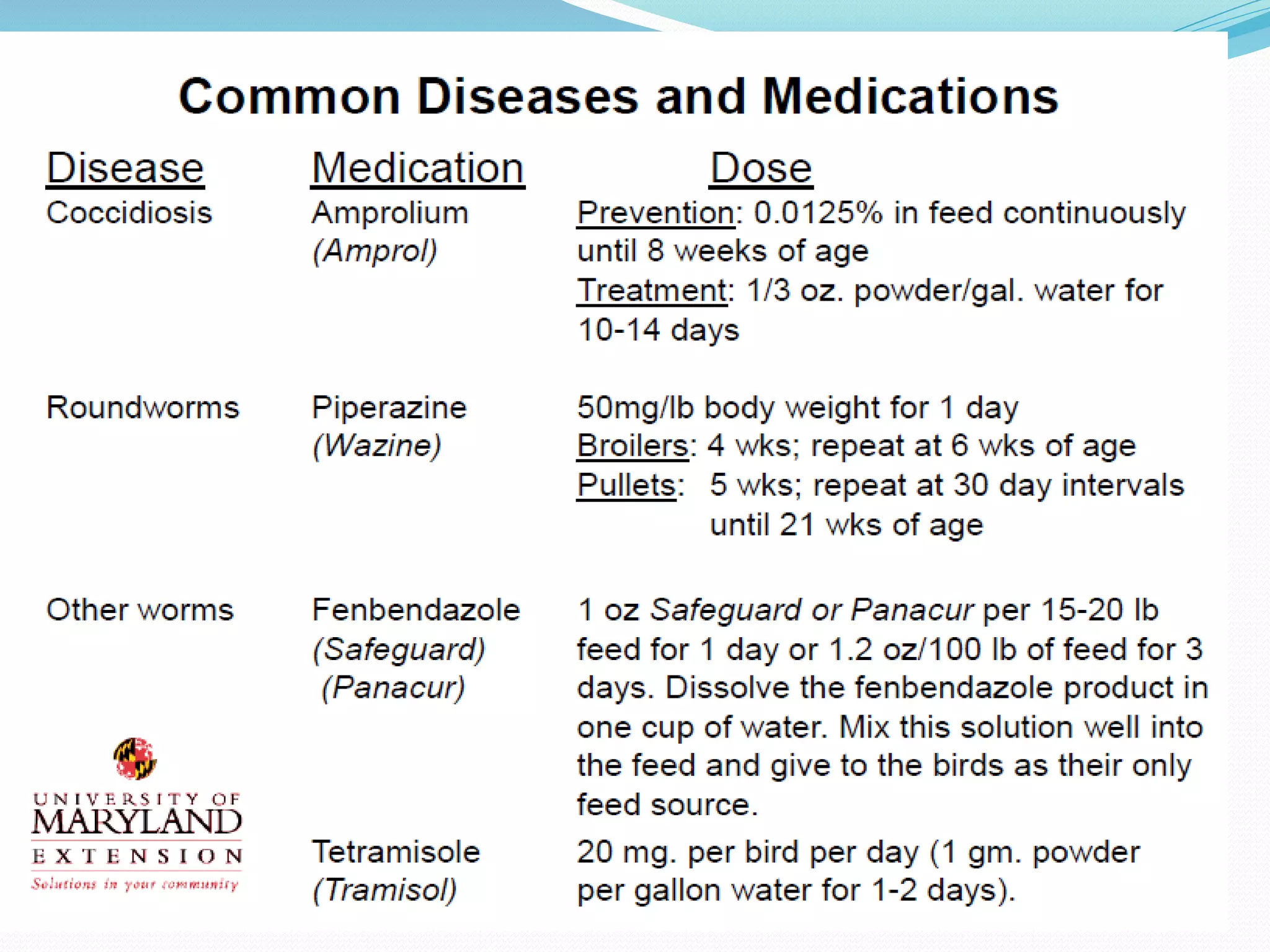
 Coccidiosis: amprolum, nitrofurols
 Anti helmenthics: piperazine,
albendazole,mebendazole, fen, ivermectin
 Aspergillosis: potassium iodide, propionic acid,
cupper sulphate
 Aflatoxicosis : beta-hydroxy quinolin, propionic acid,
gention violet
 Ectoparasites : butox spray, malathion and DDT
General principles of poultry medication

General principles of poultry medication

  • 3.
    Objectives  To knowthe vaccines available in the field, route, dose and cost per bird  To know the commonly used medicines in the Commercial farms and cost.  To familiarize with the trade names or drugs routinely used in field.
  • 5.
    Types of vaccines Live/ activated vaccines  Killed or inactivated vaccines 1)Live/ activated vaccines: they contain live attenuated organisms (attenuation is aprocess by which the pathogenicity/ capability of producing a disease is brought down with out disturbing the immunogenecity. ex: lasota vaccine, F1, R2B, IBD live vaccine
  • 6.
    2) Killed orinactivated vaccines  These vaccines contain pathogens (virus/bacteria) that have been chemically inactivated so that they will produce immunity, but are unable to transmit the disease.  Ex: ND killed vaccine
  • 8.
    Vaccines also classifiedbased on their contents 1)Viral vaccines: ND, IBD, IB vaccine 2) Bacterial vaccines: coryza killed vaccine 3) Parasitic vaccines: coccivin ( againist Coccidiosis)
  • 9.
    Method of administration onfarm 1) Intra occular (I/O) : administerd by putting drops in eye. IBD, IB Live, Lasota 2) Intra nasal : administered through nostrils or mouth. Birds should not be supplied water for 2 hours. Ex: Lasota, IBD Live 3) Drinking water: now a days popular.  the temperature of water brought down to temperature of vaccine by ice and stabilizer like skimmed milk powder. - For 10 litr of water 1 kg ice and 60gm skimmed milk powder used. - Birds made thristy for 2-3 hours before vaccination , so that they drink water immediately. ex: Lasota, IBD Live
  • 10.
     Disadvantage –inactivation of vaccine by organic waste and chlorine. Guidelines for water vaccination  No disinfectant and medication before and after  Cleaning of tank with mild soap  Flush the pipelines with skim milk powder
  • 11.
    Skim milk powder Neutralizes water impurities  Milk protein coats the viral particles. So it acts like an envelope of protection to vaccine.  SMP added 20 mins before addition of vaccine.
  • 17.
    4) Wing web:Fowl pox 5) Vent: vaccine is rubbed to upper part of cloaca with a small glass rod. Ex: ILT 6) Sub cutaneous: deposited under skin by injection with insertion of needle. Ex:marek’s disease 7) Intra muscular: deposited in between muscle fibres by injection. Ex: ND killes, R2B, IBD killed. 8) Aerosal route: vaccine is sprayed in air in the form of fine mist, which is absorbed by birds through nostrils.
  • 18.
     Generally massvaccination was followed in commercial farms  A spray vaccination is more invasive and may give better results than a drinking water vaccination.  And it allows the vaccine to penetrate more deeply into respiratory tract.
  • 19.
    On hatchery 1)In ovo: This method of vaccination is done at the hatchery.  Eggs are transferred at 18 days from the setter to the hatcher.  During transfer the eggs are placed in a machine that aseptically p0uches a hole in the shell and injects vaccine into the 18-day embryonating egg.  Marek’s vaccination.
  • 20.
    2) Spray vaccination: spraycabinets are used. Ex: IB, NCD 3) subcutanious: mareks disease
  • 21.
    Drinking water method Vaccine is reconstituted in distilled water in a small volume.  Then added to the water troughs  Birds consume the vaccine mixed water and gain immunity.  Before going to vaccination, birds have to be deprived of normal water supply for 1-2 hours.
  • 22.
    Vaccination Programme for commercialBroilers 1) O day – Marek’s disease, HVT strain, strictly sub cutaneous. 2) 5 – 7 days of age- Ranikhet Disease, Lasota strain to be given by occulo-nasal method ( one drop each in the eye and nostrils) or drinking water. 3) 14th day – IBD or Gumboro Disease live georgia vaccine (intermediate) by eye drop or drinking water method. 4) 25-28 days of age: RD lasota vaccine through drinking water.
  • 23.
    Sno DISEASE VACCINEAGE ROUTE OF VACCINATION 1 Marek’s disease HVT 0 day S/C or I/M 2 RD Lasota/F 6-7 day I/O OR WATER 3 IBD Georgia 15th day I/O OR WATER 4 RD Lasota/F 22 day I/O OR WATER 5 RD Lasota/F 28th day I/O OR WATER 6 coryza A/B/C Killed 7th week S/C 7 Fowl Pox AP+ 8th week WING WEB METHOD 8 RD R2B/K 10th week I/M 9 Coryza A/B/C Killed 12th week S/C 10 Infectious Bronchitis Ma5 13th week WATER 11 RD K/Killed Lasota 16th week S/C OR I/M VACCINATION FOR LAYERS VACCINATION FOR LAYERS
  • 24.
    Pre vaccination care Vaccinate healthy birds, if birds are sick postpone vaccination  Handle the birds gently  Vaccinate in cool hours of the day  Avoid over crowding  Maintain cold chain. Store vaccine at 4o C  Keep record of all vaccinations, including batch no, brand, manufacturer etc.  Prepare vaccine in suitable diluents, preferably one supplied by manufacturer.  Use sterile glassware, syringe, needles, vaccine guns.  Provide 1 week interval between two vaccinations.  Destroy left over vaccine, empty vials, neeedls etc.
  • 25.
    Pre vaccination care Do not vaccinate the birds in disease.  Avoid nasal vaccination in birds of respiratory problems.  Store vaccine always in deep freeze.  Vaccinate all birds at one time in a house.  Increase the level of antibiotics in water/feed 3-4 days before vaccination.  never mix two vaccines together to save time and labour.  Use only distilled water for reconstitution of vaccine.  Vaccinate birds in the evening so that birds may rest over night.
  • 26.
    Post vaccination care To reduce stress of vaccination anti stress medicines are used (3 days).  Anti stress medicines: vit-A & E, probiotics, antibiotics, liver tonics and glucose.  They are given through water.  In case of vaccine failure give immunostimulants, vit A & E, selenium preparations and probiotics.
  • 28.
    sno Disease Drugused 1 Infectious coryza Sulphaquinoxaline, sulphathiazole 2 Coli bacillosis Furazolidine, OTC,CTC 3 Pullorum (bacillary white diarrhea) Sulphamezathine, auromycin, furazolidine 4 Fowl typhoid Furazolidine, sulphadimidine, trimethprim 5 Fowl paratyphoid -do- 6 Fowl cholera Tetracyclines 7 Avian pseudotuberculosis No 8 Chronic respiratory disease Broad spectrum antibiotics – neomycin, doxycyclin, Thiamutin (tylosin tartarate) 9 Avian tuberculosis No 10 Botulism Epsom salt 11 Omphalitis Antibiotics
  • 29.
     Coccidiosis: amprolum,nitrofurols  Anti helmenthics: piperazine, albendazole,mebendazole, fen, ivermectin  Aspergillosis: potassium iodide, propionic acid, cupper sulphate  Aflatoxicosis : beta-hydroxy quinolin, propionic acid, gention violet  Ectoparasites : butox spray, malathion and DDT