Presentation of Poultry production
Introduction to Poultry
Production
Chapter Overview
LIST OF CONTENTS
 Introduction
 What is Poultry?
 Domestication of Poultry
 Importance of poultry Production
 Preference of poultry over Livestock
 Achievements and Strength of Poultry Industry
 Types of Poultry Birds
 Taxonomy of the domestic fowl(Chicken)
 Classification of Chicken Breeds
 Nomenclature of poultry Breeds
 Breeds of chicken
 Poultry Reproductive Structure
 Male reproductive system
 Female reproductive system
 Egg Structure
Introduction
 Nearly all rural and peri-urban/urban
families in the developing world keep a
flock of poultry, either in a free-range
system or in a small scale confined
system. The birds are mainly chickens.
 In free-range systems, birds are
traditionally owned and managed mostly
by women and children.
Cont’
 The poultry and their products are used
for home consumption, as gifts, or for
religious purposes.
 Additionally they are sold to earn some
income to buy household food items,
such as sugar and salt as well as school
provisions for their children.
What is poultry?
 Poultry is a common term and it
indicates all the domesticated birds
which are reared for production of eggs
and meat for the economic benefits of
human beings.
 Poultry refers to a group of
domesticated birds kept for food (meat
and/or eggs), fiber (feathers),
entertainment (racing, exhibition,
hunting, etc.) or work (messenger
pigeons).
Origin and Domestication of
Poultry
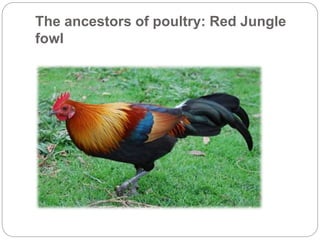
 The wild or red Junglefowl (Gallus
gallus) is the primary ancestor of
domestic.
 Red Jungle fowl (Gallus gallus) was the
chief ancestor of the domestic fowl.
 Domestic fowl are believed to have been
domesticated in Asia around 2500 BC.
 Geese in Egypt 1500 BC.
 Turkey in Mexico 2500 BC
 Ducks in China 2500 BC.
The ancestors of poultry: Red Jungle
fowl
Advantages of poultry keeping
 Essential food items (meat/egg)
 Income throughout the year
 Quick turn-over of capital
 High feed efficiency
 spreading income throughout the year
 Poultry products are cheap and affordable
 Poultry meat is easy digestable.
 There is excellent product acceptance with
respect to social and religious traditions, in
other words no strong taboo against the
eating of poultry product, thereby ensuring
ready market for the products.
 Poultry also gives useful by-product like
feathers and droppings (manure)
 Part time as well as full time occupation
 Can be managed by Ladies and Children
Disadvantages of poultry
keeping
 They can only utilize high quality concentrate
feeds. These are also use as feed for human
making them to be in direct competition with
man.
 They are highly susceptible to extreme
weather conditions and diseases.
Preference of Poultry over
Livestock
 Poultry meat and egg are high quality animal
protein sources. Eggs are the most nutritive
and have the best amino acid profile known to
man.
 Size of bird is smaller than other larger
animals.
 Less land is required due to less space
requirement per bird.
 Birds have shorter maturity period(5-6
months).
 High prolificacy -one layer breeder produces
at least 240 chicks in one year.
 Shorter generation interval
 Poultry is quick and efficient converter of
inputs into out puts.
 Birds have the best feed conversion ratio
(FCR) and feed efficiency.
 Chicken are the most efficient converters of
feed into meat and egg. It hardly requires
1.6 kg of feed to produce 1 kg of body
weight and in case of eggs it requires 1.4 kg
of feed to produce 12 eggs or 2.0 kg of feed
to produce 1 kg of eggs
 Incubation period of chicken is shorter (21
days) while large animals have long
 Dressing percentage is more in poultry as
compared to large animals.
Poultry: 72-75%; Beef: 50-55% and Sheep &
Goat: 40-48%.
DP = (Carcass Weight / Live Weight) x 100
 12. Several crop by-products and
agricultural wastes are used in poultry
feeding.
ACHIEVEMENTS OF POULTRY
INDUSTRY
 High consumer acceptance of eggs and
Broiler meat
 Improved Feed Conversion Ratio (FCR),
quality control, upgraded management.
 Advances in new feed milling technologies
 Purchase of feed raw materials and supply
of better quality materials
 Better breeding stocks with assured price
 Rationalized pricing of breeder and
commercial stocks.
 Availability of feed additives viz. enzyme,
probiotics, prebiotics etc.
 Distribution of feed units in all regions
 Increase in percentage of processed foods
 Effective and fast transport system of raw
and finished products
 Marketing of branded eggs
 Advancement in disease diagnosis and
screening procedures
Factors reponsible for the
development of poultry production
Industry:
 Improvement in genetic potentiality and
productivity of hybrid layers and broilers -
60 per cent of the increase in production of
egg and meat
 Hybrid layers of today - lay on an average
of 310 eggs per year compared to 240-250
eggs 30 years back.
 Genetic improvement - Broilers which
achieved mean body weight of 1500 g at 8
weeks of age during early eighties of 20th
century attain 1.8-2.0 kg mean body weight
at present in about 38 days of age.
 Developing new more productive layer and
broiler strains
 Development of vaccines
 Giving freedom to the poultry farmers for
fixing prices for egg through organizations
 Financing of poultry schemes
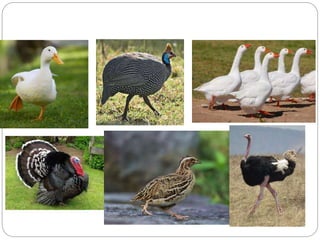
DOMESTICATED SPECIES OF
POULTRY
Poultry is including:
 Domestic fowl (chicken)
 Ducks and geese
 Turkeys
 guinea fowl
 Quails
 Ostrich
 pigeons and doves
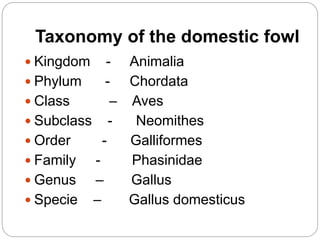
Taxonomy of the domestic fowl
 Kingdom - Animalia
 Phylum - Chordata
 Class – Aves
 Subclass - Neomithes
 Order - Galliformes
 Family - Phasinidae
 Genus – Gallus
 Specie – Gallus domesticus
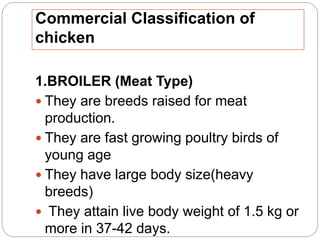
Commercial Classification of
chicken
1.BROILER (Meat Type)
 They are breeds raised for meat
production.
 They are fast growing poultry birds of
young age
 They have large body size(heavy
breeds)
 They attain live body weight of 1.5 kg or
more in 37-42 days.
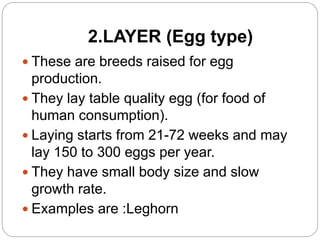
2.LAYER (Egg type)
 These are breeds raised for egg
production.
 They lay table quality egg (for food of
human consumption).
 Laying starts from 21-72 weeks and may
lay 150 to 300 eggs per year.
 They have small body size and slow
growth rate.
 Examples are :Leghorn
3.Dual purposes (meat and
egg)
 These are birds that are raised for both
meat and egg production.
 Example : Rhode Island Red
4. BREEDERS
 Birds of both sexes which are kept for
breeding purpose to obtain fertilized
eggs for hatching to get chicks i.e.
broilers or layers.
Poultry Breeds
Definitions:
 Species: It is a group of living organisms
consisting of similar individuals capable of
exchanging genes or interbreeding, and
considered as the basic unit of taxonomy.
 Class: It indicates group of breeds developed in
a particular geographical area.
 The breeds of chicken are classified into four
classes: American class, English class,
Mediterranean class and Asiatic class.
 Breed: A group of birds which are similar in
shape, size and body conformation, and
descendants of common ancestry is known
as breed.
 Variety: It is the sub-division of a breed
distinguished mainly by colour of plumage,
type of comb, etc. For example, Leghorn
breed of chicken has 12 varieties.
 Strain: It indicates a group of birds with
some special characters within a breed or
variety.
 It is developed by a breeder by introducing
some economic characters like egg size,
growth rate, feed efficiency, laying ability,
mortality, etc. Nowadays strain is more
popular than breed concept.
 For example, Anak-2000, Hubbard,
Caribro-91, Vencob, Starbro are some
broiler strains of chicken.
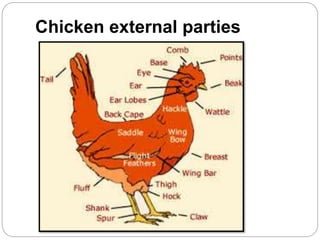
Chicken external parties
CLASSIFICATION OF CHICKEN
 Based on the place of origin (Standard
or official classification)
 Based on utility, economics or
commercial value
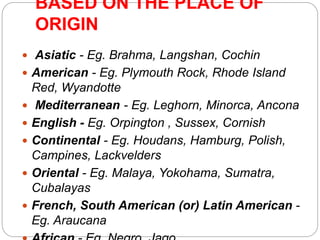
BASED ON THE PLACE OF
ORIGIN
 Asiatic - Eg. Brahma, Langshan, Cochin
 American - Eg. Plymouth Rock, Rhode Island
Red, Wyandotte
 Mediterranean - Eg. Leghorn, Minorca, Ancona
 English - Eg. Orpington , Sussex, Cornish
 Continental - Eg. Houdans, Hamburg, Polish,
Campines, Lackvelders
 Oriental - Eg. Malaya, Yokohama, Sumatra,
Cubalayas
 French, South American (or) Latin American -
Eg. Araucana
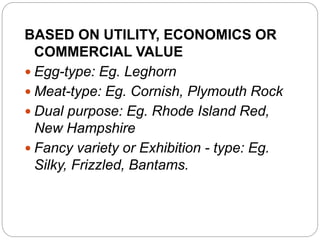
BASED ON UTILITY, ECONOMICS OR
COMMERCIAL VALUE
 Egg-type: Eg. Leghorn
 Meat-type: Eg. Cornish, Plymouth Rock
 Dual purpose: Eg. Rhode Island Red,
New Hampshire
 Fancy variety or Exhibition - type: Eg.
Silky, Frizzled, Bantams.
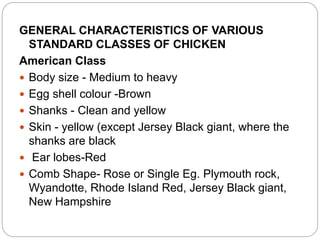
GENERAL CHARACTERISTICS OF VARIOUS
STANDARD CLASSES OF CHICKEN
American Class
 Body size - Medium to heavy
 Egg shell colour -Brown
 Shanks - Clean and yellow
 Skin - yellow (except Jersey Black giant, where the
shanks are black
 Ear lobes-Red
 Comb Shape- Rose or Single Eg. Plymouth rock,
Wyandotte, Rhode Island Red, Jersey Black giant,
New Hampshire
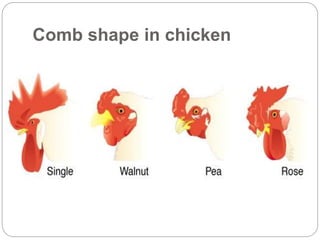
Comb shape in chicken
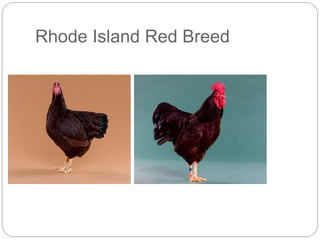
Rhode Island Red Breed
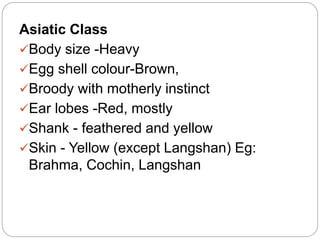
Asiatic Class
Body size -Heavy
Egg shell colour-Brown,
Broody with motherly instinct
Ear lobes -Red, mostly
Shank - feathered and yellow
Skin - Yellow (except Langshan) Eg:
Brahma, Cochin, Langshan
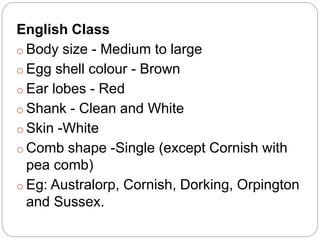
English Class
o Body size - Medium to large
o Egg shell colour - Brown
o Ear lobes - Red
o Shank - Clean and White
o Skin -White
o Comb shape -Single (except Cornish with
pea comb)
o Eg: Australorp, Cornish, Dorking, Orpington
and Sussex.
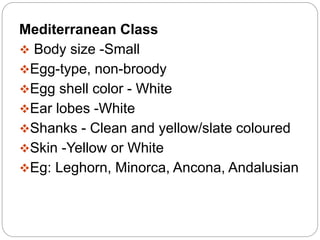
Mediterranean Class
 Body size -Small
Egg-type, non-broody
Egg shell color - White
Ear lobes -White
Shanks - Clean and yellow/slate coloured
Skin -Yellow or White
Eg: Leghorn, Minorca, Ancona, Andalusian
Characteristics of Important
Breeds of Chicken
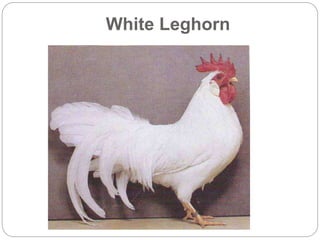
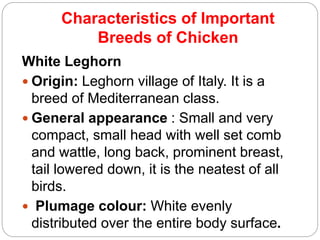
White Leghorn
 Origin: Leghorn village of Italy. It is a
breed of Mediterranean class.
 General appearance : Small and very
compact, small head with well set comb
and wattle, long back, prominent breast,
tail lowered down, it is the neatest of all
birds.
 Plumage colour: White evenly
distributed over the entire body surface.
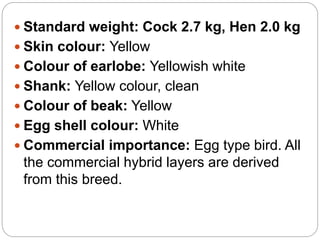
 Standard weight: Cock 2.7 kg, Hen 2.0 kg
 Skin colour: Yellow
 Colour of earlobe: Yellowish white
 Shank: Yellow colour, clean
 Colour of beak: Yellow
 Egg shell colour: White
 Commercial importance: Egg type bird. All
the commercial hybrid layers are derived
from this breed.
White Leghorn
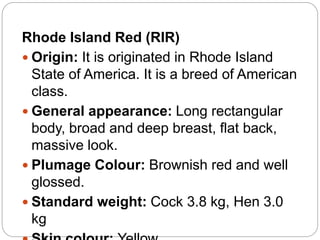
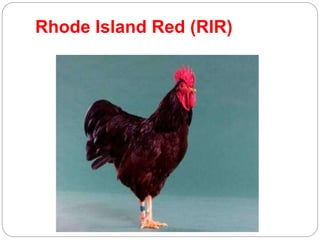
Rhode Island Red (RIR)
 Origin: It is originated in Rhode Island
State of America. It is a breed of American
class.
 General appearance: Long rectangular
body, broad and deep breast, flat back,
massive look.
 Plumage Colour: Brownish red and well
glossed.
 Standard weight: Cock 3.8 kg, Hen 3.0
kg
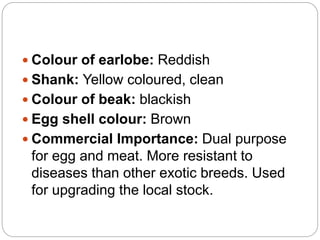
 Colour of earlobe: Reddish
 Shank: Yellow coloured, clean
 Colour of beak: blackish
 Egg shell colour: Brown
 Commercial Importance: Dual purpose
for egg and meat. More resistant to
diseases than other exotic breeds. Used
for upgrading the local stock.
Rhode Island Red (RIR)
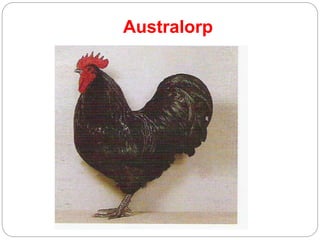
Australorp
 Origin: This breed is developed in
Australia from Black Orpington. It is an
English breed.
 General appearance: Very fleshy, body
slopes gradually towards tail, deep body,
closely feathered, long back, more upright
and less massive look.
 Plumage colour: Black, plumage is
lustrous greenish black in all the sections
of the body.
 Standard weight: Cock 3.8 kg, Hen 3.0
kg
 Skin colour: White
 Colour of earlobe: Red
 Colour of Shank: Black or dark slate
coloured, clean
 Colour of beak: Black
 Egg shell colour: Brown
 Commercial Importance: Dual purpose
for egg and meat. They can maintain
themselves in wet and heavy rainfall
areas.
Australorp
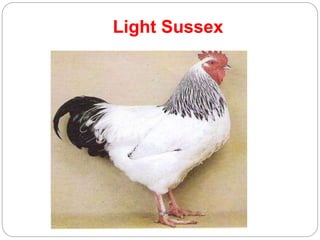
Light Sussex
 Origin: This breed is originated in Sussex
country of England. It is a light variety of
Sussex breed of English class.
 General appearance: Deep body with very
good fleshing quality, broad shoulder.
 Plumage colour: White plumage with
black streaked feathers on neck and tail.
 Standard weight: Cock 4.0 kg, Hen 3.0 kg
 Skin colour: White
 Colour of earlobe: Red
 Shank: White coloured, clean
 Colour of beak: Coloured
 Egg shell colour: Brown
 Commercial importance: Meat type
Light Sussex
Hybrid Chicken
 Nowadays pure breeds of chicken are not
generally used for commercial production
of egg or meat. First, the pure breeds are
replaced by breed crosses, and now breed
crosses are replaced by strain crosses.
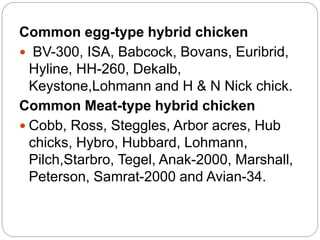
Common egg-type hybrid chicken
 BV-300, ISA, Babcock, Bovans, Euribrid,
Hyline, HH-260, Dekalb,
Keystone,Lohmann and H & N Nick chick.
Common Meat-type hybrid chicken
 Cobb, Ross, Steggles, Arbor acres, Hub
chicks, Hybro, Hubbard, Lohmann,
Pilch,Starbro, Tegel, Anak-2000, Marshall,
Peterson, Samrat-2000 and Avian-34.
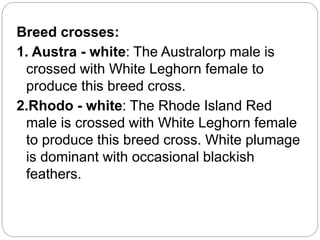
Breed crosses:
1. Austra - white: The Australorp male is
crossed with White Leghorn female to
produce this breed cross.
2.Rhodo - white: The Rhode Island Red
male is crossed with White Leghorn female
to produce this breed cross. White plumage
is dominant with occasional blackish
feathers.
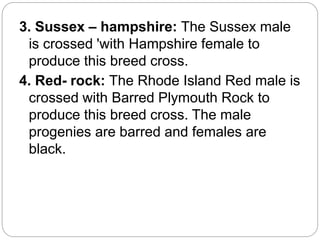
3. Sussex – hampshire: The Sussex male
is crossed 'with Hampshire female to
produce this breed cross.
4. Red- rock: The Rhode Island Red male is
crossed with Barred Plymouth Rock to
produce this breed cross. The male
progenies are barred and females are
black.
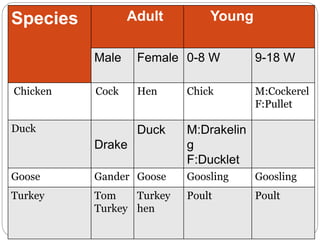
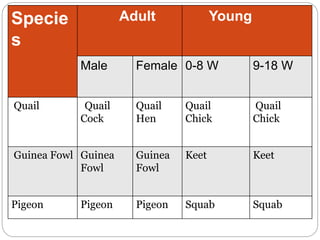
NOMENCLATURE OF DIFFERENT
POULTRY SPECIES
(Age and Sex wise)
Species Adult Young
Male Female 0-8 W 9-18 W
Chicken Cock Hen Chick M:Cockerel
F:Pullet
Duck
Drake
Duck M:Drakelin
g
F:Ducklet
Goose Gander Goose Goosling Goosling
Turkey Tom
Turkey
Turkey
hen
Poult Poult
Specie
s
Adult Young
Male Female 0-8 W 9-18 W
Quail Quail
Cock
Quail
Hen
Quail
Chick
Quail
Chick
Guinea Fowl Guinea
Fowl
Guinea
Fowl
Keet Keet
Pigeon Pigeon Pigeon Squab Squab
REPRODUCTIVE STRUCTURES
OF CHICKEN
MALE REPRODUCTIVE STRUCTURES
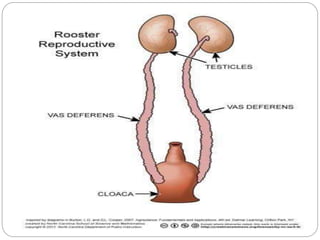
 Male reproductive structures include testes,
vas deferens, cloaca and the rudimentary
copulatory organ.
FUNCTIONS
 Testes are paired, small ovoid structures
lying on the dorsal body wall, on either side
of the vertebral column and anterior to the
kidneys. The testes are reddishyellow in
colour.
 The testis is formed of numerous slender
seminiferous tubules, inside which
spermatogenesis takes place.
 From each tubule arises the vas
deferens(the storage place for the
spermatozoa).
 The epididymis of each side continues
down as the vas deferens and terminates in
the cloaca.
 Puberty in a cockerel (immature male) is
defined as the age when spermatozoa first
appear in ejaculated semen.
 Sperms undergo maturation in the
epididymis and attain the power of motility
here.
 The sperms are carried down with the
seminal secretion into the cloaca from
where they are discharged during
copulation.
 Daily sperm output in cocks is about
2000×10 6 while in toms (turkey male) it is
about less than 1120×106.
 On the ventral portion of the cloaca is a
small button-like structure called copulatory
papilla, which is the rudimentary copulatory
organ.
 During copulation the papilla of male and
female are everted and pressed together so
that sperms are ejected directly into the
female urodeum, from where they are
squeezed into the oviduct by the contraction
of the urodeum (the middle part of the
cloaca).
FEMALE REPRODUCTIVE
SYSTEM
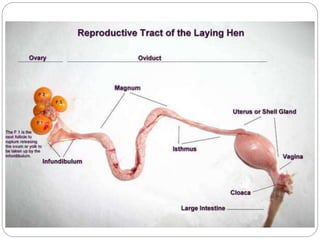
 The female reproductive system consist of
Ovary and Oviduct.
 At the time of early embryonic development,
two ovaries and two oviducts exist.
 But the right set atrophies, leaving only the
left ovary and oviduct.
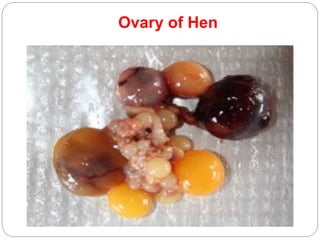
OVARY AND OVIDUCT
Ovary
 The left ovary is situated at dorsal part of
abdominal cavity and the fore end of
kidneys.
 The ovary is responsible for the formation of
yolk only.
Oviduct
 The oviduct is a long zig zag tube
consisting of glandular and muscular parts .
 Oviduct extends from the ovary to the
cloaca. It has 5 distinct parts:
1. Infundibulum (9cm)
2. magnum (33cm),
3. isthmus (10cm),
4. uterus (10-12cm)
5. vagina (12cm)
Infundibulum:
 is the funnel-shaped, anterior portion of
the oviduct, and measures about 9 cm in
the laying hens.
 It is where fertilization takes place.
 The mature ovum immediately after
release from the graffian follicle, is
engulfed by the infundibulum, and remains
there for about 30 minutes before moving
to the magnum.
Magnum:
 About 33 cm in the laying hens is the
largest portion and albumen-secreting
region of the oviduct.
The ovum remains in the magnum for about 2
hrs and 54 min.
Isthmus
 Shell membranes are secreted and egg gets
its shape in this region.
 The ovum stays in isthmus for about 1 hour
and 14 minutes.
Uterus (shell gland)
 Is a pouch-like structure, it is where the egg
shell is added and pigmented
 The ovum stays here for about 20 hours and
40 minutes in the uterus.
Vagina
 is the terminal portion of the oviduct having a
muscular sphincter at the utero-vaginal
junction which helps in expelling the egg
during oviposition.
EGG FORMATION AND
STRUCTURE
PROCESS OF EGG FORMATION
 The yolk is not the true reproductive cell,
but a source of food material from which
the live cell (blastoderm) and its resultant
embryo partially receives its nutrients for
growth.
 Approximately 25 to 26 hours is required
from the time an oocyte is released from
the ovary till the egg is released from the
body.
 The infundibulum helps in egg transport
and is the site of fertilization; has no role in
egg formation.
 The magnum secretes and stores albumen
before the egg formation and releases the
albumen as the ovum passes.
 Two shell membranes are laid down around
the albumen as it passes through the
isthmus.
 The shell gland; it is made up of calcium
carbonate (98%) and glycoproteins (2%);
contains pores to allow gas exchange.
Outside the shell is a proteinaceous layer –
cuticle, which blocks bacterial entry.
 The oviposition or laying of egg, is
through the contraction of uterus.
 The hormones responsible for uterine
contraction and oviposition are oxytocin
and vasotocin released from the
posterior lobe of pituitary.
Ovary of Hen
EGG STRUCTURE
Four Major structures of the egg from
outside to inside are
 Shell
 Shell membranes
 Albumen
 Yolk
EGG SHELL
The egg shell consists of:
Cuticle
Spongy or calcarious layer
Egg Pores
 Average number of pores varies from
8,000-10000 per egg, distributed unevenly
over the shell surface with more number of
pores at the broad end than at the narrow
end.
SHELL MEMBRANE
The shell membrane consists of
 Air cell
 Outer shell membrane
 Inner shell membrane
 Air cell is situated in between the two
membranes at the broad end.
 The outer shell membrane is attached
firmly to the shell by numerous cones on
the shell surface extending into the
membrane.
 The inner shell membrane closely
surrounds the albumen.
ALBUMEN
The albumen consists of 4 layers, namely
 Chalaziferous or inner thick white, which
forms (3%)
 Inner thin albumen (17%)
 Outer thick firm or dense albumen (57%)
 Outer thin albumen (23%) of total albumen
YOLK
The yolk consists of
 Concentric layers of dark and light yolk
material, due to differences in their chemical
composition.
 Latebra is the centre of the yolk, which is a
small, nearly circular core of light
 coloured fluid, which does not completely
harden on boiling.
 In an infertile egg it is unicellular (ovum)
and contains haploid number of
chromosomes, called "Blastodisc". It is
circular in shape, with a diameter of about
3.5 mm and with vacuoles in it.
 Where as in a fertile egg, it is a
multicellular structure having diploid number
of chromosomes, called "Blastoderm". It is
oval in shape, with an average diameter of
about 4.5 mm and with no vacuoles in it.
 "Vitelline membrane" is a semi-
permeable elastic membrane, surrounding
the yolk, separating the yolk material from
FERTILITY AND
HATCHABILITY
Fertility
 Refers to capacity to reproduce. It is the
factor, which determines the successful
offspring that may be obtained from a
given number of eggs.
Factors influencing fertility
 Sex Ratio
 Age of breeders
 Length of duration between mating
 Diseases and management practices.
 Fertility is expressed as % of fertile eggs in a
set of total eggs incubated.
 Fecundity-Producing many offspring.
 Fecundate – To fertilize
Hatchability
Is defined in two ways
 Based on the fertile eggs set (FES)
 Based on the total eggs set (TES)
 Refers to the % of chicks hatched to the
eggs set.
 Size, shape and condition of egg shell are
important for hatching.
 Very large and very small eggs do not
hatch well.
 Eggs having abnormal shape show low
heritability.
 Condition and duration of storage of eggs
prior to incubation as well as setter and
hatcher environment affect hatchability (or)
The quality of fertilized egg to produce
normal embryonic development with normal
emergence of the young when incubated.
FACTORS AFFECTING FERTILITY
 Age of the parent stock: There is an
increase in fertility in a breeder flock
between the ages of 25 to 40 weeks after
which fertility gradually diminishes
 Breed: Lighter breeds like White Leghorn is
more fertile than heavier breeds like the
broiler breeders.
 Genetic factors: Many genes influence
fertility eg: in Wyandotte the gene
responsible for rose comb (RR) lowers
fertility in males.
 Environmental factors: Excessive high and
low temperature reduces fertility due to poor
mating frequency because of the
inactiveness of the birds.
 Disease conditions: Many diseases like
Ranikhet disease, Mycoplasmosis,
Salmonella etc., affect fertility.
 Sex ratio: Both higher and lower males to
female ratio will reduce fertility. The
recommended ratio in lighter breeder is
1:10-12,. In broiler breeder 1:8-10 and in
J.quails 1:1-2
 The semen volume, sperm concentration
and number of successful mating also alter
fertility.
 Inseminating the birds during the after noon
can lower fertility.
 Nutritional factors: Some deficiencies
like vitamin A, E , Biotin, Pantothenic
acid and B2 and minerals like calcium,
phosphorous, sodium, Magnesium,
Manganese, Zinc and Iodine lower
fertility.
 Photo period: A photo period of 16 hrs per
day will give optimum fertility. By either
lowering the length of period to 12 hrs or
increasing it to 18 hours lowers the fertility.
 Male nutrition: Male breeders should be
fed with lower protein levels of 12-14% for
Introduction to poultry production

Introduction to poultry production

  • 1.
    Presentation of Poultryproduction Introduction to Poultry Production
  • 2.
    Chapter Overview LIST OFCONTENTS  Introduction  What is Poultry?  Domestication of Poultry  Importance of poultry Production  Preference of poultry over Livestock  Achievements and Strength of Poultry Industry  Types of Poultry Birds
  • 3.
     Taxonomy ofthe domestic fowl(Chicken)  Classification of Chicken Breeds  Nomenclature of poultry Breeds  Breeds of chicken  Poultry Reproductive Structure  Male reproductive system  Female reproductive system  Egg Structure
  • 4.
    Introduction  Nearly allrural and peri-urban/urban families in the developing world keep a flock of poultry, either in a free-range system or in a small scale confined system. The birds are mainly chickens.  In free-range systems, birds are traditionally owned and managed mostly by women and children.
  • 5.
    Cont’  The poultryand their products are used for home consumption, as gifts, or for religious purposes.  Additionally they are sold to earn some income to buy household food items, such as sugar and salt as well as school provisions for their children.
  • 6.
    What is poultry? Poultry is a common term and it indicates all the domesticated birds which are reared for production of eggs and meat for the economic benefits of human beings.  Poultry refers to a group of domesticated birds kept for food (meat and/or eggs), fiber (feathers), entertainment (racing, exhibition, hunting, etc.) or work (messenger pigeons).
  • 7.
    Origin and Domesticationof Poultry  The wild or red Junglefowl (Gallus gallus) is the primary ancestor of domestic.  Red Jungle fowl (Gallus gallus) was the chief ancestor of the domestic fowl.  Domestic fowl are believed to have been domesticated in Asia around 2500 BC.  Geese in Egypt 1500 BC.  Turkey in Mexico 2500 BC  Ducks in China 2500 BC.
  • 8.
    The ancestors ofpoultry: Red Jungle fowl
  • 9.
    Advantages of poultrykeeping  Essential food items (meat/egg)  Income throughout the year  Quick turn-over of capital  High feed efficiency  spreading income throughout the year  Poultry products are cheap and affordable  Poultry meat is easy digestable.
  • 10.
     There isexcellent product acceptance with respect to social and religious traditions, in other words no strong taboo against the eating of poultry product, thereby ensuring ready market for the products.  Poultry also gives useful by-product like feathers and droppings (manure)  Part time as well as full time occupation  Can be managed by Ladies and Children
  • 11.
    Disadvantages of poultry keeping They can only utilize high quality concentrate feeds. These are also use as feed for human making them to be in direct competition with man.  They are highly susceptible to extreme weather conditions and diseases.
  • 12.
    Preference of Poultryover Livestock  Poultry meat and egg are high quality animal protein sources. Eggs are the most nutritive and have the best amino acid profile known to man.  Size of bird is smaller than other larger animals.  Less land is required due to less space requirement per bird.  Birds have shorter maturity period(5-6 months).  High prolificacy -one layer breeder produces at least 240 chicks in one year.  Shorter generation interval
  • 13.
     Poultry isquick and efficient converter of inputs into out puts.  Birds have the best feed conversion ratio (FCR) and feed efficiency.  Chicken are the most efficient converters of feed into meat and egg. It hardly requires 1.6 kg of feed to produce 1 kg of body weight and in case of eggs it requires 1.4 kg of feed to produce 12 eggs or 2.0 kg of feed to produce 1 kg of eggs  Incubation period of chicken is shorter (21 days) while large animals have long
  • 14.
     Dressing percentageis more in poultry as compared to large animals. Poultry: 72-75%; Beef: 50-55% and Sheep & Goat: 40-48%. DP = (Carcass Weight / Live Weight) x 100  12. Several crop by-products and agricultural wastes are used in poultry feeding.
  • 15.
    ACHIEVEMENTS OF POULTRY INDUSTRY High consumer acceptance of eggs and Broiler meat  Improved Feed Conversion Ratio (FCR), quality control, upgraded management.  Advances in new feed milling technologies  Purchase of feed raw materials and supply of better quality materials  Better breeding stocks with assured price  Rationalized pricing of breeder and commercial stocks.
  • 16.
     Availability offeed additives viz. enzyme, probiotics, prebiotics etc.  Distribution of feed units in all regions  Increase in percentage of processed foods  Effective and fast transport system of raw and finished products  Marketing of branded eggs  Advancement in disease diagnosis and screening procedures
  • 17.
    Factors reponsible forthe development of poultry production Industry:  Improvement in genetic potentiality and productivity of hybrid layers and broilers - 60 per cent of the increase in production of egg and meat  Hybrid layers of today - lay on an average of 310 eggs per year compared to 240-250 eggs 30 years back.
  • 18.
     Genetic improvement- Broilers which achieved mean body weight of 1500 g at 8 weeks of age during early eighties of 20th century attain 1.8-2.0 kg mean body weight at present in about 38 days of age.  Developing new more productive layer and broiler strains  Development of vaccines  Giving freedom to the poultry farmers for fixing prices for egg through organizations  Financing of poultry schemes
  • 19.
    DOMESTICATED SPECIES OF POULTRY Poultryis including:  Domestic fowl (chicken)  Ducks and geese  Turkeys  guinea fowl  Quails  Ostrich  pigeons and doves
  • 21.
    Taxonomy of thedomestic fowl  Kingdom - Animalia  Phylum - Chordata  Class – Aves  Subclass - Neomithes  Order - Galliformes  Family - Phasinidae  Genus – Gallus  Specie – Gallus domesticus
  • 22.
    Commercial Classification of chicken 1.BROILER(Meat Type)  They are breeds raised for meat production.  They are fast growing poultry birds of young age  They have large body size(heavy breeds)  They attain live body weight of 1.5 kg or more in 37-42 days.
  • 23.
    2.LAYER (Egg type) These are breeds raised for egg production.  They lay table quality egg (for food of human consumption).  Laying starts from 21-72 weeks and may lay 150 to 300 eggs per year.  They have small body size and slow growth rate.  Examples are :Leghorn
  • 24.
    3.Dual purposes (meatand egg)  These are birds that are raised for both meat and egg production.  Example : Rhode Island Red
  • 25.
    4. BREEDERS  Birdsof both sexes which are kept for breeding purpose to obtain fertilized eggs for hatching to get chicks i.e. broilers or layers.
  • 26.
    Poultry Breeds Definitions:  Species:It is a group of living organisms consisting of similar individuals capable of exchanging genes or interbreeding, and considered as the basic unit of taxonomy.  Class: It indicates group of breeds developed in a particular geographical area.  The breeds of chicken are classified into four classes: American class, English class, Mediterranean class and Asiatic class.
  • 27.
     Breed: Agroup of birds which are similar in shape, size and body conformation, and descendants of common ancestry is known as breed.  Variety: It is the sub-division of a breed distinguished mainly by colour of plumage, type of comb, etc. For example, Leghorn breed of chicken has 12 varieties.
  • 28.
     Strain: Itindicates a group of birds with some special characters within a breed or variety.  It is developed by a breeder by introducing some economic characters like egg size, growth rate, feed efficiency, laying ability, mortality, etc. Nowadays strain is more popular than breed concept.  For example, Anak-2000, Hubbard, Caribro-91, Vencob, Starbro are some broiler strains of chicken.
  • 29.
  • 30.
    CLASSIFICATION OF CHICKEN Based on the place of origin (Standard or official classification)  Based on utility, economics or commercial value
  • 31.
    BASED ON THEPLACE OF ORIGIN  Asiatic - Eg. Brahma, Langshan, Cochin  American - Eg. Plymouth Rock, Rhode Island Red, Wyandotte  Mediterranean - Eg. Leghorn, Minorca, Ancona  English - Eg. Orpington , Sussex, Cornish  Continental - Eg. Houdans, Hamburg, Polish, Campines, Lackvelders  Oriental - Eg. Malaya, Yokohama, Sumatra, Cubalayas  French, South American (or) Latin American - Eg. Araucana
  • 32.
    BASED ON UTILITY,ECONOMICS OR COMMERCIAL VALUE  Egg-type: Eg. Leghorn  Meat-type: Eg. Cornish, Plymouth Rock  Dual purpose: Eg. Rhode Island Red, New Hampshire  Fancy variety or Exhibition - type: Eg. Silky, Frizzled, Bantams.
  • 33.
    GENERAL CHARACTERISTICS OFVARIOUS STANDARD CLASSES OF CHICKEN American Class  Body size - Medium to heavy  Egg shell colour -Brown  Shanks - Clean and yellow  Skin - yellow (except Jersey Black giant, where the shanks are black  Ear lobes-Red  Comb Shape- Rose or Single Eg. Plymouth rock, Wyandotte, Rhode Island Red, Jersey Black giant, New Hampshire
  • 34.
  • 35.
  • 36.
    Asiatic Class Body size-Heavy Egg shell colour-Brown, Broody with motherly instinct Ear lobes -Red, mostly Shank - feathered and yellow Skin - Yellow (except Langshan) Eg: Brahma, Cochin, Langshan
  • 37.
    English Class o Bodysize - Medium to large o Egg shell colour - Brown o Ear lobes - Red o Shank - Clean and White o Skin -White o Comb shape -Single (except Cornish with pea comb) o Eg: Australorp, Cornish, Dorking, Orpington and Sussex.
  • 38.
    Mediterranean Class  Bodysize -Small Egg-type, non-broody Egg shell color - White Ear lobes -White Shanks - Clean and yellow/slate coloured Skin -Yellow or White Eg: Leghorn, Minorca, Ancona, Andalusian
  • 39.
    Characteristics of Important Breedsof Chicken White Leghorn  Origin: Leghorn village of Italy. It is a breed of Mediterranean class.  General appearance : Small and very compact, small head with well set comb and wattle, long back, prominent breast, tail lowered down, it is the neatest of all birds.  Plumage colour: White evenly distributed over the entire body surface.
  • 40.
     Standard weight:Cock 2.7 kg, Hen 2.0 kg  Skin colour: Yellow  Colour of earlobe: Yellowish white  Shank: Yellow colour, clean  Colour of beak: Yellow  Egg shell colour: White  Commercial importance: Egg type bird. All the commercial hybrid layers are derived from this breed.
  • 41.
  • 42.
    Rhode Island Red(RIR)  Origin: It is originated in Rhode Island State of America. It is a breed of American class.  General appearance: Long rectangular body, broad and deep breast, flat back, massive look.  Plumage Colour: Brownish red and well glossed.  Standard weight: Cock 3.8 kg, Hen 3.0 kg
  • 43.
     Colour ofearlobe: Reddish  Shank: Yellow coloured, clean  Colour of beak: blackish  Egg shell colour: Brown  Commercial Importance: Dual purpose for egg and meat. More resistant to diseases than other exotic breeds. Used for upgrading the local stock.
  • 44.
  • 45.
    Australorp  Origin: Thisbreed is developed in Australia from Black Orpington. It is an English breed.  General appearance: Very fleshy, body slopes gradually towards tail, deep body, closely feathered, long back, more upright and less massive look.  Plumage colour: Black, plumage is lustrous greenish black in all the sections of the body.
  • 46.
     Standard weight:Cock 3.8 kg, Hen 3.0 kg  Skin colour: White  Colour of earlobe: Red  Colour of Shank: Black or dark slate coloured, clean  Colour of beak: Black  Egg shell colour: Brown  Commercial Importance: Dual purpose for egg and meat. They can maintain themselves in wet and heavy rainfall areas.
  • 47.
  • 48.
    Light Sussex  Origin:This breed is originated in Sussex country of England. It is a light variety of Sussex breed of English class.  General appearance: Deep body with very good fleshing quality, broad shoulder.  Plumage colour: White plumage with black streaked feathers on neck and tail.
  • 49.
     Standard weight:Cock 4.0 kg, Hen 3.0 kg  Skin colour: White  Colour of earlobe: Red  Shank: White coloured, clean  Colour of beak: Coloured  Egg shell colour: Brown  Commercial importance: Meat type
  • 50.
  • 51.
    Hybrid Chicken  Nowadayspure breeds of chicken are not generally used for commercial production of egg or meat. First, the pure breeds are replaced by breed crosses, and now breed crosses are replaced by strain crosses.
  • 52.
    Common egg-type hybridchicken  BV-300, ISA, Babcock, Bovans, Euribrid, Hyline, HH-260, Dekalb, Keystone,Lohmann and H & N Nick chick. Common Meat-type hybrid chicken  Cobb, Ross, Steggles, Arbor acres, Hub chicks, Hybro, Hubbard, Lohmann, Pilch,Starbro, Tegel, Anak-2000, Marshall, Peterson, Samrat-2000 and Avian-34.
  • 53.
    Breed crosses: 1. Austra- white: The Australorp male is crossed with White Leghorn female to produce this breed cross. 2.Rhodo - white: The Rhode Island Red male is crossed with White Leghorn female to produce this breed cross. White plumage is dominant with occasional blackish feathers.
  • 54.
    3. Sussex –hampshire: The Sussex male is crossed 'with Hampshire female to produce this breed cross. 4. Red- rock: The Rhode Island Red male is crossed with Barred Plymouth Rock to produce this breed cross. The male progenies are barred and females are black.
  • 55.
    NOMENCLATURE OF DIFFERENT POULTRYSPECIES (Age and Sex wise)
  • 56.
    Species Adult Young MaleFemale 0-8 W 9-18 W Chicken Cock Hen Chick M:Cockerel F:Pullet Duck Drake Duck M:Drakelin g F:Ducklet Goose Gander Goose Goosling Goosling Turkey Tom Turkey Turkey hen Poult Poult
  • 57.
    Specie s Adult Young Male Female0-8 W 9-18 W Quail Quail Cock Quail Hen Quail Chick Quail Chick Guinea Fowl Guinea Fowl Guinea Fowl Keet Keet Pigeon Pigeon Pigeon Squab Squab
  • 58.
    REPRODUCTIVE STRUCTURES OF CHICKEN MALEREPRODUCTIVE STRUCTURES  Male reproductive structures include testes, vas deferens, cloaca and the rudimentary copulatory organ. FUNCTIONS  Testes are paired, small ovoid structures lying on the dorsal body wall, on either side of the vertebral column and anterior to the kidneys. The testes are reddishyellow in colour.
  • 59.
     The testisis formed of numerous slender seminiferous tubules, inside which spermatogenesis takes place.  From each tubule arises the vas deferens(the storage place for the spermatozoa).  The epididymis of each side continues down as the vas deferens and terminates in the cloaca.  Puberty in a cockerel (immature male) is defined as the age when spermatozoa first appear in ejaculated semen.
  • 60.
     Sperms undergomaturation in the epididymis and attain the power of motility here.  The sperms are carried down with the seminal secretion into the cloaca from where they are discharged during copulation.  Daily sperm output in cocks is about 2000×10 6 while in toms (turkey male) it is about less than 1120×106.
  • 61.
     On theventral portion of the cloaca is a small button-like structure called copulatory papilla, which is the rudimentary copulatory organ.  During copulation the papilla of male and female are everted and pressed together so that sperms are ejected directly into the female urodeum, from where they are squeezed into the oviduct by the contraction of the urodeum (the middle part of the cloaca).
  • 63.
    FEMALE REPRODUCTIVE SYSTEM  Thefemale reproductive system consist of Ovary and Oviduct.  At the time of early embryonic development, two ovaries and two oviducts exist.  But the right set atrophies, leaving only the left ovary and oviduct.
  • 64.
    OVARY AND OVIDUCT Ovary The left ovary is situated at dorsal part of abdominal cavity and the fore end of kidneys.  The ovary is responsible for the formation of yolk only.
  • 65.
    Oviduct  The oviductis a long zig zag tube consisting of glandular and muscular parts .  Oviduct extends from the ovary to the cloaca. It has 5 distinct parts: 1. Infundibulum (9cm) 2. magnum (33cm), 3. isthmus (10cm), 4. uterus (10-12cm) 5. vagina (12cm)
  • 66.
    Infundibulum:  is thefunnel-shaped, anterior portion of the oviduct, and measures about 9 cm in the laying hens.  It is where fertilization takes place.  The mature ovum immediately after release from the graffian follicle, is engulfed by the infundibulum, and remains there for about 30 minutes before moving to the magnum.
  • 67.
    Magnum:  About 33cm in the laying hens is the largest portion and albumen-secreting region of the oviduct. The ovum remains in the magnum for about 2 hrs and 54 min. Isthmus  Shell membranes are secreted and egg gets its shape in this region.  The ovum stays in isthmus for about 1 hour and 14 minutes.
  • 68.
    Uterus (shell gland) Is a pouch-like structure, it is where the egg shell is added and pigmented  The ovum stays here for about 20 hours and 40 minutes in the uterus. Vagina  is the terminal portion of the oviduct having a muscular sphincter at the utero-vaginal junction which helps in expelling the egg during oviposition.
  • 69.
    EGG FORMATION AND STRUCTURE PROCESSOF EGG FORMATION  The yolk is not the true reproductive cell, but a source of food material from which the live cell (blastoderm) and its resultant embryo partially receives its nutrients for growth.  Approximately 25 to 26 hours is required from the time an oocyte is released from the ovary till the egg is released from the body.
  • 70.
     The infundibulumhelps in egg transport and is the site of fertilization; has no role in egg formation.  The magnum secretes and stores albumen before the egg formation and releases the albumen as the ovum passes.  Two shell membranes are laid down around the albumen as it passes through the isthmus.
  • 71.
     The shellgland; it is made up of calcium carbonate (98%) and glycoproteins (2%); contains pores to allow gas exchange. Outside the shell is a proteinaceous layer – cuticle, which blocks bacterial entry.  The oviposition or laying of egg, is through the contraction of uterus.  The hormones responsible for uterine contraction and oviposition are oxytocin and vasotocin released from the posterior lobe of pituitary.
  • 73.
  • 74.
    EGG STRUCTURE Four Majorstructures of the egg from outside to inside are  Shell  Shell membranes  Albumen  Yolk
  • 75.
    EGG SHELL The eggshell consists of: Cuticle Spongy or calcarious layer Egg Pores  Average number of pores varies from 8,000-10000 per egg, distributed unevenly over the shell surface with more number of pores at the broad end than at the narrow end.
  • 76.
    SHELL MEMBRANE The shellmembrane consists of  Air cell  Outer shell membrane  Inner shell membrane  Air cell is situated in between the two membranes at the broad end.
  • 77.
     The outershell membrane is attached firmly to the shell by numerous cones on the shell surface extending into the membrane.  The inner shell membrane closely surrounds the albumen.
  • 78.
    ALBUMEN The albumen consistsof 4 layers, namely  Chalaziferous or inner thick white, which forms (3%)  Inner thin albumen (17%)  Outer thick firm or dense albumen (57%)  Outer thin albumen (23%) of total albumen
  • 79.
    YOLK The yolk consistsof  Concentric layers of dark and light yolk material, due to differences in their chemical composition.  Latebra is the centre of the yolk, which is a small, nearly circular core of light  coloured fluid, which does not completely harden on boiling.
  • 80.
     In aninfertile egg it is unicellular (ovum) and contains haploid number of chromosomes, called "Blastodisc". It is circular in shape, with a diameter of about 3.5 mm and with vacuoles in it.  Where as in a fertile egg, it is a multicellular structure having diploid number of chromosomes, called "Blastoderm". It is oval in shape, with an average diameter of about 4.5 mm and with no vacuoles in it.  "Vitelline membrane" is a semi- permeable elastic membrane, surrounding the yolk, separating the yolk material from
  • 81.
    FERTILITY AND HATCHABILITY Fertility  Refersto capacity to reproduce. It is the factor, which determines the successful offspring that may be obtained from a given number of eggs.
  • 82.
    Factors influencing fertility Sex Ratio  Age of breeders  Length of duration between mating  Diseases and management practices.  Fertility is expressed as % of fertile eggs in a set of total eggs incubated.  Fecundity-Producing many offspring.  Fecundate – To fertilize
  • 83.
    Hatchability Is defined intwo ways  Based on the fertile eggs set (FES)  Based on the total eggs set (TES)  Refers to the % of chicks hatched to the eggs set.  Size, shape and condition of egg shell are important for hatching.  Very large and very small eggs do not hatch well.
  • 84.
     Eggs havingabnormal shape show low heritability.  Condition and duration of storage of eggs prior to incubation as well as setter and hatcher environment affect hatchability (or) The quality of fertilized egg to produce normal embryonic development with normal emergence of the young when incubated.
  • 85.
    FACTORS AFFECTING FERTILITY Age of the parent stock: There is an increase in fertility in a breeder flock between the ages of 25 to 40 weeks after which fertility gradually diminishes  Breed: Lighter breeds like White Leghorn is more fertile than heavier breeds like the broiler breeders.  Genetic factors: Many genes influence fertility eg: in Wyandotte the gene responsible for rose comb (RR) lowers fertility in males.
  • 86.
     Environmental factors:Excessive high and low temperature reduces fertility due to poor mating frequency because of the inactiveness of the birds.  Disease conditions: Many diseases like Ranikhet disease, Mycoplasmosis, Salmonella etc., affect fertility.
  • 87.
     Sex ratio:Both higher and lower males to female ratio will reduce fertility. The recommended ratio in lighter breeder is 1:10-12,. In broiler breeder 1:8-10 and in J.quails 1:1-2  The semen volume, sperm concentration and number of successful mating also alter fertility.  Inseminating the birds during the after noon can lower fertility.
  • 88.
     Nutritional factors:Some deficiencies like vitamin A, E , Biotin, Pantothenic acid and B2 and minerals like calcium, phosphorous, sodium, Magnesium, Manganese, Zinc and Iodine lower fertility.  Photo period: A photo period of 16 hrs per day will give optimum fertility. By either lowering the length of period to 12 hrs or increasing it to 18 hours lowers the fertility.  Male nutrition: Male breeders should be fed with lower protein levels of 12-14% for