COMMON POULTRY
DISEASES
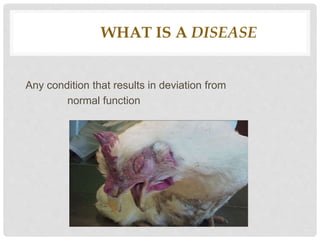
WHAT IS A DISEASE
Any condition that results in deviation from
normal function
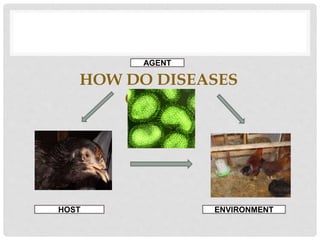
HOW DO DISEASES
OCCUR?
AGENT
ENVIRONMENTHOST
ETIOLOGY
Infectious Agents
Non-infectious agents
• Bacteria
• Viruses
• Parasites
• Fungi
• Chemical
• Physical
• Lack or excess of certain
vitamins and minerals
• Toxins
GENERAL SIGNS OF DISEASE
• Poor appetite
• Huddling
• Depression
• Runting/stunting
• poor uniformity
• Ruffled feathers
• Coughing, sneezing,
• oculo-nasal discharge,
• difficult breathing
• Bloody or wet litter
• Increased mortality
VIRAL DISEASES
• Marek’s disease
• Ranikhet ( new castle) disease
• Infectious bursal disease (IBD) or gumboro
• Infectious bronchitis
• Fowl pox
• Avian encephalomyelitis
• Infectious laryngotracheitis (ILT)
• Lymphoid leucosis
• Inclusion body heapatitis
• Infectious viral arthritis
• Egg drop syndrome
BACTERIAL DISEASES
• Pullorum
• Omphalitis
• Fowl coryza
• Chronic respiratory disease
• Fowl typhoid
• Fowl paratyphoid
• Fowl cholera ( pasturellosis)
• Avian tuberculosis
• Avian paratuberculosis
• Coliform infection
• Clostridial infections (botulinum)
PROTOZOAN DISEASES
• Coccidiosis
• Avian trichomoniasis
• Avian maleria
•FUNGAL DISEASES:
• ASPERGILLOSIS OR BROODER PNUMONIA,
• AFLATOXICOSIS.
PARASITIC DISEASE
1) Internal parasites: round worms. Tape worms, gape
warms, spirachetosis.
2) External parasites: lice, mites, bugs, fleas.
NUTRITIONAL DEFICIENCY DISEASES
• Nutrional roup
• Polyneuritis
• Curled toe paralysis
• Dermatitis
• Encephalo malacia
• Haemarrhagic disease
• Perosis
• Fatty liver kidney syndrome
• Other mineral deficiencies
MISCELLANEOUS
• Cannibolism
• Pasty vents in chicks
• Crop impaction
• Cage layer fatigue
NEW CASTLE DISEASE
• It is one of the most dreaded diseases of poultry
• cause very heavy mortality at a very high speed.
• caused by paramyxo virus
• classified into many serotypes based on the virulence.
• Chicken is the natural host but vast majority of birds are
susceptible to infection including ducks and turkey .
• Signs
• Depression, prostration, loss of appetite
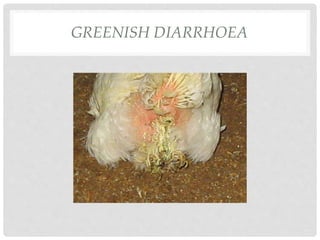
• Greenish/yellowish diarrhea
• Nervous signs like in coordination, twitching of
neck
• Mortality heavy in acute outbreak
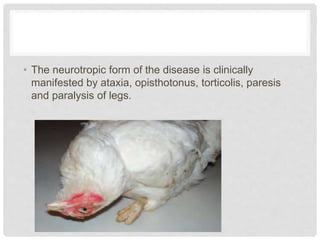
• The neurotropic form of the disease is clinically
manifested by ataxia, opisthotonus, torticolis, paresis
and paralysis of legs.
GREENISH DIARRHOEA
POST MORTEM LESIONS
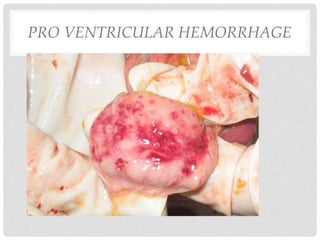
• Pin pointed hemorrhages at the tip of proventricular
glands
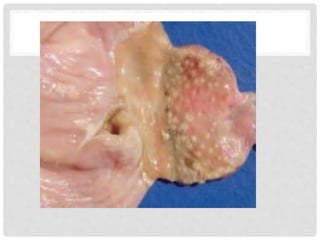
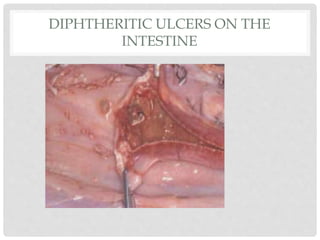
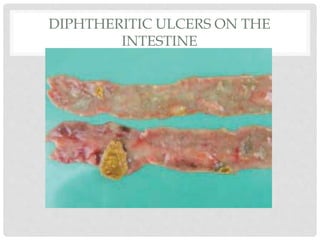
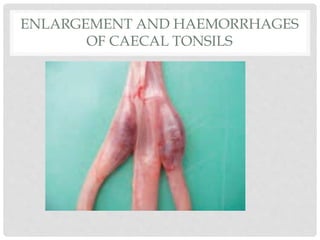
• Hemorrhagic/ diphtheritic ulcers on the intestine and
caecal tonsils
PRO VENTRICULAR HEMORRHAGE
DIPHTHERITIC ULCERS ON THE
INTESTINE
DIPHTHERITIC ULCERS ON THE
INTESTINE
ENLARGEMENT AND HAEMORRHAGES
OF CAECAL TONSILS
DIAGNOSIS
• Typical lesions are diagnostic.
• Laboratory diagnosis with hemagglutination and
Inhibition tests can be used.
PROPHYLACTIC VACCINATION
• Lentogenic strain (F or B1)
• chicks(5 -7 d)
• intranasal
• intraocular route
• drinking water.
• Mesogenic strain (R2B)
• intramuscular
• Subcutaneous route.
AVIAN INFLUENZA (BIRD FLU)
• Highly Pathogenic Avian Influenza(HPAI) is a highly
lethal systemic disease affecting vast majority of birds.
• caused by the Influenza Type A virus.
• H5N1 causes bird flu
• Because of the zoonotic as well as pandemic potential,
the disease gained much public health importance.
• .
• Water birds and migratory birds, ducks act as carriers
and spread the infection
• bird flu is highly contagious among birds and also effects
ducks, and turkeys
SIGNS
• Sudden, heavy and unusual mortality reaching almost
100% without any clinical signs.
• Combs and wattles are cyanotic and oedematous, and
may have petechial or ecchymotic haemorrhages at their
tips.
• Profuse watery diarrhoea is frequently present and birds
are excessively thirsty.
• Respiration may be laboured.
• Haemorrhages may occur on unfeathered areas of skin.
• The mortality rate varies from 50 to 100%.
• Nervous disorders like tremors, torticollis and
opisthotonus
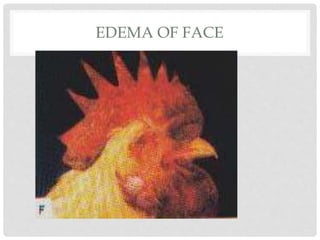
EDEMA OF FACE
• In broilers, the signs of disease are frequently less
obvious with severe depression, lack of appetite, and a
marked increase in mortality.
• Edema of the face and neck and neurological signs such
as torticollis and ataxia may also be seen.
POST MORTEM LESIONS
• Extremely variable depending on the severity.
• Hemorrhagic lesions (petechial to ecchymotic) on all the
visceral organs, serous membranes, skin and muscles in
acute cases
• Lungs pneumonic
• Enteritis, air saculitis, spleenomegali
HUMANS
• The first avian influenza virus to infect humans occurred
in Hong Kong in 1997. The epidemic was linked to
chickens and classified as avian influenza A (H5N1).
• Human cases of avian influenza A (H5N1) have since
been reported in Asia, Africa, Europe, Indonesia,
Vietnman, the Pacific.
THE FOLLOWING PEOPLE HAVE A
HIGHER RISK FOR DEVELOPING THE
BIRD FLU:
• Farmers and others who work with poultry
• Travelers visiting affected countries
• Those who touch an infected bird
• Those who eat raw or undercooked poultry meat,
eggs, or blood from infected birds
• Infection may be spread simply by touching
contaminated surfaces.
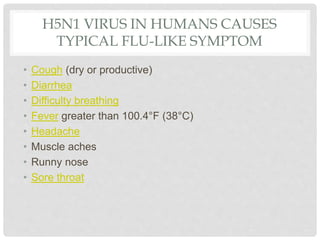
H5N1 VIRUS IN HUMANS CAUSES
TYPICAL FLU-LIKE SYMPTOM
• Cough (dry or productive)
• Diarrhea
• Difficulty breathing
• Fever greater than 100.4°F (38°C)
• Headache
• Muscle aches
• Runny nose
• Sore throat
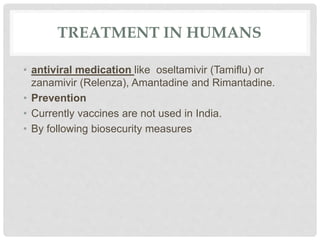
TREATMENT IN HUMANS
• antiviral medication like oseltamivir (Tamiflu) or
zanamivir (Relenza), Amantadine and Rimantadine.
• Prevention
• Currently vaccines are not used in India.
• By following biosecurity measures
INFECTIOUS BRONCHITIS
• It is a highly infectious viral disease of poultry of
worldwide distribution.
• It can affect any age, breed or type. Chicken is the only
bird that is naturally infected by this virus.
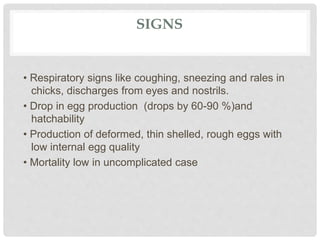
SIGNS
• Respiratory signs like coughing, sneezing and rales in
chicks, discharges from eyes and nostrils.
• Drop in egg production (drops by 60-90 %)and
hatchability
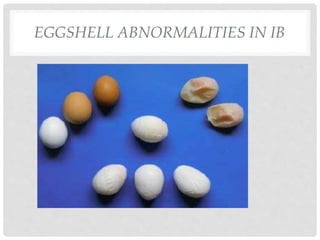
• Production of deformed, thin shelled, rough eggs with
low internal egg quality
• Mortality low in uncomplicated case
EGGSHELL ABNORMALITIES IN IB
POST MORTEM LESIONS
• Catarrhal exudates in nasal cavity, caseous plugs in
bronchi in chicks
• Enlargement of kidney with urates deposition and
distention of ureters with pasty uric acid in uraemic form
• Egg peritonitis in layers
Prevention
• Inactivated or attenuated live Vaccines are available for
prevention.
GUMBORO (IBD)
• Infectious Bursal Disease(IBD) is a highly contagious viral
disease of young chicken causing serious economic losses.
• The virus targets the Bursa of Fabricius, an important part of
immune system making the bird susceptible to other
infections.
• Inflammation of bursa.
• Signs
• Dullness, depression and death
• Whitish diarrhea
• Mortality heavy in the initial out breaks in a farm
• Post Mortem Lesions
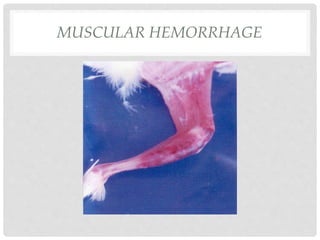
• Hemorrhages in the thigh and pectoral muscles
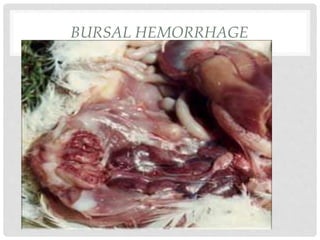
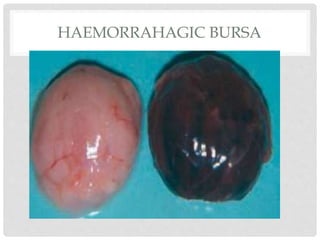
• Bursa enlarged, edematous and hyperemic with
bloody or mucoid contents inside.
• Bursa firm and atrophic in chronic form
• Kidney may show nephrosis and mottling.
VACCINES ARE AVAILABLE FOR PREVENTION
MUSCULAR HEMORRHAGE
BURSAL HEMORRHAGE
HAEMORRAHAGIC BURSA
MAREK’S DISEASE
• Marek’s Disease is an economically important viral
disease but more or less effectively controlled by
vaccination.
• Caused by Herpes virus
• Neoplastic disease ( due to proliferation of lymphoid
tissues).
• It is principally a disease of young chicken but rarely
affects other birds also. Chicken below 3 to 4 months are
more susceptible.
SYMPTOMS
• Dullness, depression and sudden death in acute form
(MD lymphomas).
• Incordination, staggered gait, paralysis of one or more
extremities in classical form (Neural form).
• Unilateral or bilateral blindness with ocular involvement.
POST MORTEM LESIONS
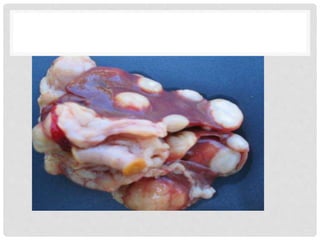
• Tumors (lymphomas) are present in one or more of visceral
organs and tissues. Gonads (ovary), liver, spleen, lungs,
kidney, skin etc may be involved.
• Tumors cause nodular or diffuse enlargement of the affected
organ.
• In classical form, nerves become thickened slightly or as much
as 3 or 4 times the normal and becomes rounded instead of the
normally
striated appearance
PREVENTION
• Preventive vaccination is available.
• Herpes Virus Turkey strain is used in vaccine
• This is live attenuated vaccine
• There is no effective treatment.
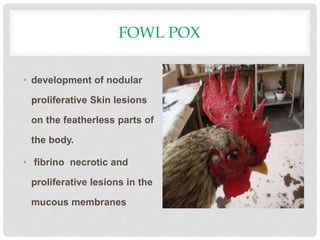
FOWL POX
• development of nodular
proliferative Skin lesions
on the featherless parts of
the body.
• fibrino necrotic and
proliferative lesions in the
mucous membranes
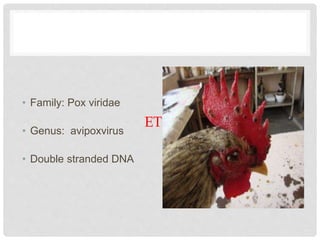
ETIOLOGY
• Family: Pox viridae
• Genus: avipoxvirus
• Double stranded DNA
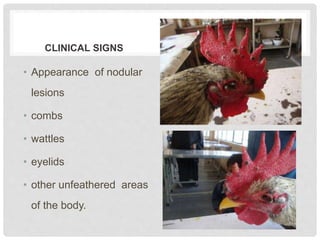
CLINICAL SIGNS
• Appearance of nodular
lesions
• combs
• wattles
• eyelids
• other unfeathered areas
of the body.
PREVENTION AND CONTROL
• Prophylactic vaccination
INCLUSION BODY HEPATITIS (IBH)
• Broilers of 4 to 8 weeks are affected mainly
• Anaemia, depression and sudden mortality
• Hepatitis
• Pale muscles and bone marrow
• Hemorrhages in the muscles
EGG DROP SYNDROME
• Caused by adeno virus
• Sudden and variable drop in egg production (30- 40%) in
laying hens
• Production of depigmented, cracked or shell less eggs
• Disease runs for a few weeks and egg production returns
to normal.
TYPES OF VACCINES
• Live/ activated vaccines
• Killed or inactivated vaccines
1)Live/ activated vaccines: they contain live attenuated
organisms (attenuation is aprocess by which the
pathogenicity/ capability of producing a disease is
brought down with out disturbing the immunogenecity.
ex: lasota vaccine, F1, R2B, IBD live vaccine
2) KILLED OR INACTIVATED
VACCINES
• These vaccines contain pathogens (virus/bacteria) that
have been chemically inactivated so that they will
produce immunity, but are unable to transmit the
disease.
• Ex: ND killed vaccine
VACCINES ALSO CLASSIFIED BASED ON
THEIR CONTENTS
1)Viral vaccines: ND, IBD, IB vaccine
2) Bacterial vaccines: coryza killed vaccine
3) Parasitic vaccines: coccivin ( againist Coccidiosis)
METHOD OF ADMINISTRATION
1) Intra occular (I/O) : administerd by putting drops in eye. IBD,
IB Live, Lasota
2) Intra nasal : administered through nostrils or mouth. Birds
should not be supplied water for 2 hours. Ex: Lasota, IBD
Live
3) Drinking water: now a days popular.
• the temperature of water brought down to temperature of
vaccine by ice and stabilizer like skimmed milk powder.
- For 10 litr of water 1 kg ice and 60gm skimmed milk powder
used.
- Birds made thristy for 2-3 hours before vaccination , so that
they drink water immediately.
ex: Lasota, IBD Live
4) Wing web: Fowl pox
5) Vent: vaccine is rubbed to upper part of cloaca with a
small glass rod. Ex: ILT
6) Sub cutaneous: deposited under skin by injection with
insertion of needle. Ex:marek’s disease
7) Intra muscular: deposited in between muscle fibres by
injection. Ex: ND killes, R2B, IBD killed.
8) Aerosal route: vaccine is sprayed in air in the form of fine
mist, which is absorbed by birds through nostrils.
-mass vaccination for large scale poultry farms
• Generally mass vaccination was followed in commercial
farms
• A spray vaccination is more invasive and may give
better results than a drinking water vaccination.
• And it allows the vaccine to penetrate more deeply into
respiratory tract.
DRINKING WATER METHOD
• Vaccine is reconstituted in distilled water in a small
volume.
• Then added to the water troughs
• Birds consume the vaccine mixed water and gain
immunity.
• Before going to vaccination, birds have to be deprived of
normal water supply for 1-2 hours.
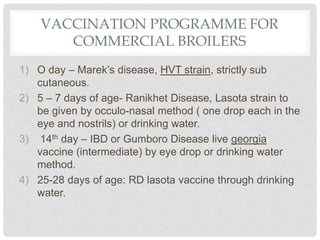
VACCINATION PROGRAMME FOR
COMMERCIAL BROILERS
1) O day – Marek’s disease, HVT strain, strictly sub
cutaneous.
2) 5 – 7 days of age- Ranikhet Disease, Lasota strain to
be given by occulo-nasal method ( one drop each in the
eye and nostrils) or drinking water.
3) 14th day – IBD or Gumboro Disease live georgia
vaccine (intermediate) by eye drop or drinking water
method.
4) 25-28 days of age: RD lasota vaccine through drinking
water.
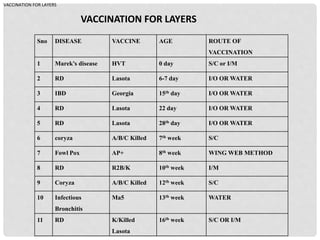
Sno DISEASE VACCINE AGE ROUTE OF
VACCINATION
1 Marek’s disease HVT 0 day S/C or I/M
2 RD Lasota 6-7 day I/O OR WATER
3 IBD Georgia 15th day I/O OR WATER
4 RD Lasota 22 day I/O OR WATER
5 RD Lasota 28th day I/O OR WATER
6 coryza A/B/C Killed 7th week S/C
7 Fowl Pox AP+ 8th week WING WEB METHOD
8 RD R2B/K 10th week I/M
9 Coryza A/B/C Killed 12th week S/C
10 Infectious
Bronchitis
Ma5 13th week WATER
11 RD K/Killed
Lasota
16th week S/C OR I/M
VACCINATION FOR LAYERS
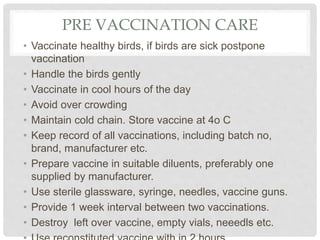
PRE VACCINATION CARE
• Vaccinate healthy birds, if birds are sick postpone
vaccination
• Handle the birds gently
• Vaccinate in cool hours of the day
• Avoid over crowding
• Maintain cold chain. Store vaccine at 4o C
• Keep record of all vaccinations, including batch no,
brand, manufacturer etc.
• Prepare vaccine in suitable diluents, preferably one
supplied by manufacturer.
• Use sterile glassware, syringe, needles, vaccine guns.
• Provide 1 week interval between two vaccinations.
• Destroy left over vaccine, empty vials, neeedls etc.
PRE VACCINATION CARE
• Do not vaccinate the birds in disease.
• Avoid nasal vaccination in birds of respiratory problems.
• Store vaccine always in deep freeze.
• Vaccinate all birds at one time in a house.
• Increase the level of antibiotics in water/feed 3-4 days
before vaccination.
• never mix two vaccines together to save time and
labour.
• Use only distilled water for reconstitution of vaccine.
• Vaccinate birds in the evening so that birds may rest
over night.
• Provide birds with mycotoxin free diets.
POST VACCINATION CARE
• To reduce stress of vaccination anti stress medicines are
used (3 days).
• Anti stress medicines: vit-A & E, probiotics, antibiotics,
liver tonics and glucose.
• They are given through water.
• In case of vaccine failure give immunostimulants, vit A &
E, selenium preparations and probiotics.
FACTORS THAT GOVERN VACCINATION
SCHEDULE
1) Expired vaccines: never use
2) Storage and transport: stored at 2-8 c. never store
above 8 c. and transport in ice cubes or ice water is
good.
3) Avoid direct sunshine on mixed vaccines
4) Do not vaccinate under high temperature: above 30 c
may affect vaccine potency. Vaccinate during cooler
periods of the day.
5) Do not vaccinate sick birds: immune system of sick is
weak.
6) Vaccines administered via drinking water: should be
opened under the water into which it is to be mixed. b/s
vaccines are vaccum sealed.
FACTORS THAT GOVERN VACCINATION
SCHEDULE
7) Health status of flock: should be done on healthy flock
only. Postpone vaccination in event of any disease like
coccidiosis.
8) nutrition: malnutrition like deficiency of protein in ration
and high concentration of aflatoxins reduces response of
birds to a particular disease.
9) stress: reduces production of antibodies in the body.
ASPERGILLOSIS
• Aspergillus fumigatus
• Mostly Effects lungs
• Occurs in brooding stage, so called as brooder
pneumonia
• Transmitted by contaminated litter
• Deep litter system
• High moisture content in litter
• Respiratory distress, gasping, huddling prostration
(reluctant to move)
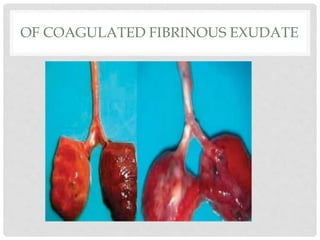
OF COAGULATED FIBRINOUS EXUDATE
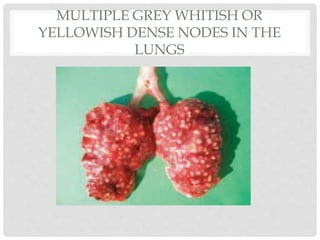
MULTIPLE GREY WHITISH OR
YELLOWISH DENSE NODES IN THE
LUNGS
COCCIDIOSIS
• Eimeria tinella- causes bloody caecal coccidiosis
• E .necatrix, e. brunetti- causes intestinal coccidiosis
• Symptoms are bloody droppings, blood tinged diarrhoea,
reduced feed intake,
• This is litter born disease
BACTERIAL DISEASES
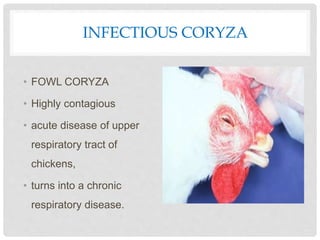
INFECTIOUS CORYZA
• FOWL CORYZA
• Highly contagious
• acute disease of upper
respiratory tract of
chickens,
• turns into a chronic
respiratory disease.
ETIOLOGY
• Haemophilus paragallinarum
• Small cocoid or gram negative rod
• Non motile
• Exhibits bipolar staining
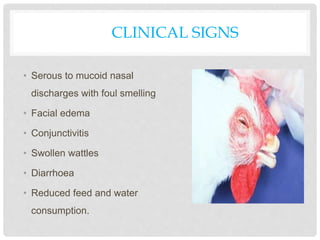
CLINICAL SIGNS
• Serous to mucoid nasal
discharges with foul smelling
• Facial edema
• Conjunctivitis
• Swollen wattles
• Diarrhoea
• Reduced feed and water
consumption.
TREATMENT AND CONTROL
• Gentamicin
• Penicillin
• streptomycin
• delivered in feed or drinking water.
• Proper Disinfection
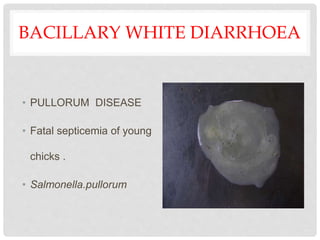
BACILLARY WHITE DIARRHOEA
• PULLORUM DISEASE
• Fatal septicemia of young
chicks .
• Salmonella.pullorum
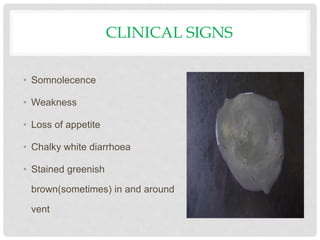
CLINICAL SIGNS
• Somnolecence
• Weakness
• Loss of appetite
• Chalky white diarrhoea
• Stained greenish
brown(sometimes) in and around
vent
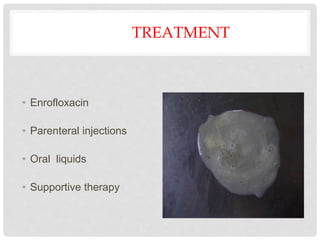
TREATMENT
• Enrofloxacin
• Parenteral injections
• Oral liquids
• Supportive therapy
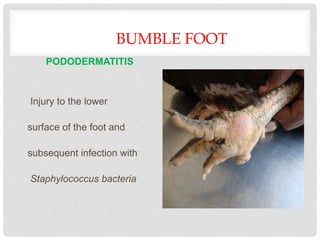
BUMBLE FOOT
PODODERMATITIS
Injury to the lower
surface of the foot and
subsequent infection with
Staphylococcus bacteria
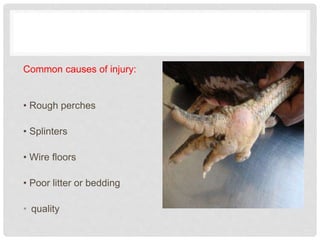
Common causes of injury:
• Rough perches
• Splinters
• Wire floors
• Poor litter or bedding
• quality
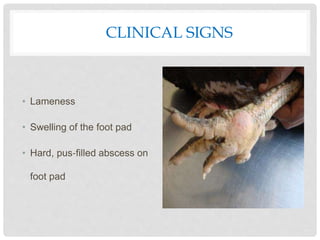
CLINICAL SIGNS
• Lameness
• Swelling of the foot pad
• Hard, pus‐filled abscess on
foot pad
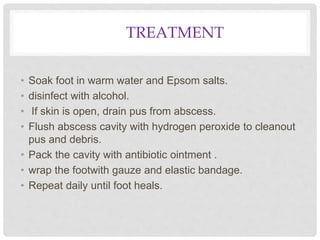
TREATMENT
• Soak foot in warm water and Epsom salts.
• disinfect with alcohol.
• If skin is open, drain pus from abscess.
• Flush abscess cavity with hydrogen peroxide to cleanout
pus and debris.
• Pack the cavity with antibiotic ointment .
• wrap the footwith gauze and elastic bandage.
• Repeat daily until foot heals.
PREVENTION AND CONTROL
• Provide good quality litter or bedding.
• Keep bedding clean, dry, and deep.
• Keep perches less than 18 inches from the
floor to prevent foot damage due to impact
from jumping.
• Remove potential sources of injury such as
sharp objects and/or surfaces.
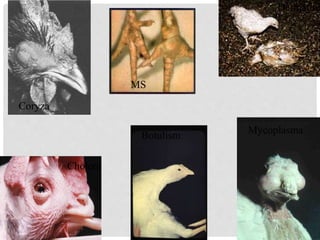
• Fowl Cholera Pasteurella
• Mycoplasma MG MS
• Coryza Hemophilus paragallinarum
• Botulism Botulinum toxin
• Gangrenous Dermatitis Clostridium perfringens
• Fowl Cholera
• Mycoplasma
• MG
• MS
• Coryza
• Botulism
• Dermatitis
• Swollen face, wattles, sinuses
• Pneumonia, Sudden death,
swollen joints, torticollis
• Coughing, swollen face and
sinuses. sticky eye discharge
• Swollen joints and/or footpad
• Sticky eyelids, odor, rales,
nasal discharge
• Limberneck, flaccid paralysis
• Blue.black skin lesions, high
mortality
Dermatitis
Mycoplasma
Cholera
Dermatitis
Botulism
Coryza
MS
DEFECIENCY DISEASES
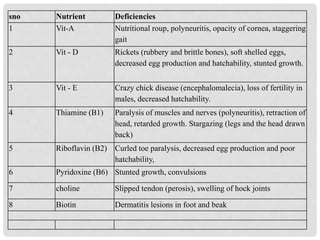
sno Nutrient Deficiencies
1 Vit-A Nutritional roup, polyneuritis, opacity of cornea, staggering
gait
2 Vit - D Rickets (rubbery and brittle bones), soft shelled eggs,
decreased egg production and hatchability, stunted growth.
3 Vit - E Crazy chick disease (encephalomalecia), loss of fertility in
males, decreased hatchability.
4 Thiamine (B1) Paralysis of muscles and nerves (polyneuritis), retraction of
head, retarded growth. Stargazing (legs and the head drawn
back)
5 Riboflavin (B2) Curled toe paralysis, decreased egg production and poor
hatchability,
6 Pyridoxine (B6) Stunted growth, convulsions
7 choline Slipped tendon (perosis), swelling of hock joints
8 Biotin Dermatitis lesions in foot and beak
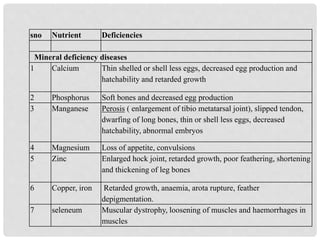
sno Nutrient Deficiencies
Mineral deficiency diseases
1 Calcium Thin shelled or shell less eggs, decreased egg production and
hatchability and retarded growth
2 Phosphorus Soft bones and decreased egg production
3 Manganese Perosis ( enlargement of tibio metatarsal joint), slipped tendon,
dwarfing of long bones, thin or shell less eggs, decreased
hatchability, abnormal embryos
4 Magnesium Loss of appetite, convulsions
5 Zinc Enlarged hock joint, retarded growth, poor feathering, shortening
and thickening of leg bones
6 Copper, iron Retarded growth, anaemia, arota rupture, feather
depigmentation.
7 seleneum Muscular dystrophy, loosening of muscles and haemorrhages in
muscles
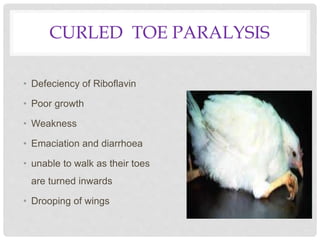
CURLED TOE PARALYSIS
• Defeciency of Riboflavin
• Poor growth
• Weakness
• Emaciation and diarrhoea
• unable to walk as their toes
are turned inwards
• Drooping of wings
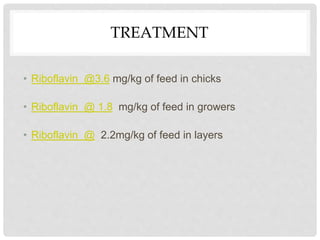
TREATMENT
• Riboflavin @3.6 mg/kg of feed in chicks
• Riboflavin @ 1.8 mg/kg of feed in growers
• Riboflavin @ 2.2mg/kg of feed in layers
THANKYOU

Common Poultry diseases and vaccination

  • 1.
  • 2.
    WHAT IS ADISEASE Any condition that results in deviation from normal function
  • 3.
  • 4.
    ETIOLOGY Infectious Agents Non-infectious agents •Bacteria • Viruses • Parasites • Fungi • Chemical • Physical • Lack or excess of certain vitamins and minerals • Toxins
  • 5.
    GENERAL SIGNS OFDISEASE • Poor appetite • Huddling • Depression • Runting/stunting • poor uniformity • Ruffled feathers • Coughing, sneezing, • oculo-nasal discharge, • difficult breathing • Bloody or wet litter • Increased mortality
  • 6.
    VIRAL DISEASES • Marek’sdisease • Ranikhet ( new castle) disease • Infectious bursal disease (IBD) or gumboro • Infectious bronchitis • Fowl pox • Avian encephalomyelitis • Infectious laryngotracheitis (ILT) • Lymphoid leucosis • Inclusion body heapatitis • Infectious viral arthritis • Egg drop syndrome
  • 7.
    BACTERIAL DISEASES • Pullorum •Omphalitis • Fowl coryza • Chronic respiratory disease • Fowl typhoid • Fowl paratyphoid • Fowl cholera ( pasturellosis) • Avian tuberculosis • Avian paratuberculosis • Coliform infection • Clostridial infections (botulinum)
  • 8.
    PROTOZOAN DISEASES • Coccidiosis •Avian trichomoniasis • Avian maleria •FUNGAL DISEASES: • ASPERGILLOSIS OR BROODER PNUMONIA, • AFLATOXICOSIS.
  • 9.
    PARASITIC DISEASE 1) Internalparasites: round worms. Tape worms, gape warms, spirachetosis. 2) External parasites: lice, mites, bugs, fleas.
  • 10.
    NUTRITIONAL DEFICIENCY DISEASES •Nutrional roup • Polyneuritis • Curled toe paralysis • Dermatitis • Encephalo malacia • Haemarrhagic disease • Perosis • Fatty liver kidney syndrome • Other mineral deficiencies
  • 11.
    MISCELLANEOUS • Cannibolism • Pastyvents in chicks • Crop impaction • Cage layer fatigue
  • 12.
    NEW CASTLE DISEASE •It is one of the most dreaded diseases of poultry • cause very heavy mortality at a very high speed. • caused by paramyxo virus • classified into many serotypes based on the virulence. • Chicken is the natural host but vast majority of birds are susceptible to infection including ducks and turkey .
  • 13.
    • Signs • Depression,prostration, loss of appetite • Greenish/yellowish diarrhea • Nervous signs like in coordination, twitching of neck • Mortality heavy in acute outbreak
  • 14.
    • The neurotropicform of the disease is clinically manifested by ataxia, opisthotonus, torticolis, paresis and paralysis of legs.
  • 15.
  • 16.
    POST MORTEM LESIONS •Pin pointed hemorrhages at the tip of proventricular glands • Hemorrhagic/ diphtheritic ulcers on the intestine and caecal tonsils
  • 17.
  • 19.
  • 20.
  • 21.
  • 22.
    DIAGNOSIS • Typical lesionsare diagnostic. • Laboratory diagnosis with hemagglutination and Inhibition tests can be used.
  • 23.
    PROPHYLACTIC VACCINATION • Lentogenicstrain (F or B1) • chicks(5 -7 d) • intranasal • intraocular route • drinking water. • Mesogenic strain (R2B) • intramuscular • Subcutaneous route.
  • 24.
    AVIAN INFLUENZA (BIRDFLU) • Highly Pathogenic Avian Influenza(HPAI) is a highly lethal systemic disease affecting vast majority of birds. • caused by the Influenza Type A virus. • H5N1 causes bird flu • Because of the zoonotic as well as pandemic potential, the disease gained much public health importance. • .
  • 25.
    • Water birdsand migratory birds, ducks act as carriers and spread the infection • bird flu is highly contagious among birds and also effects ducks, and turkeys
  • 26.
    SIGNS • Sudden, heavyand unusual mortality reaching almost 100% without any clinical signs. • Combs and wattles are cyanotic and oedematous, and may have petechial or ecchymotic haemorrhages at their tips. • Profuse watery diarrhoea is frequently present and birds are excessively thirsty.
  • 27.
    • Respiration maybe laboured. • Haemorrhages may occur on unfeathered areas of skin. • The mortality rate varies from 50 to 100%. • Nervous disorders like tremors, torticollis and opisthotonus
  • 28.
  • 29.
    • In broilers,the signs of disease are frequently less obvious with severe depression, lack of appetite, and a marked increase in mortality. • Edema of the face and neck and neurological signs such as torticollis and ataxia may also be seen.
  • 30.
    POST MORTEM LESIONS •Extremely variable depending on the severity. • Hemorrhagic lesions (petechial to ecchymotic) on all the visceral organs, serous membranes, skin and muscles in acute cases • Lungs pneumonic • Enteritis, air saculitis, spleenomegali
  • 31.
    HUMANS • The firstavian influenza virus to infect humans occurred in Hong Kong in 1997. The epidemic was linked to chickens and classified as avian influenza A (H5N1). • Human cases of avian influenza A (H5N1) have since been reported in Asia, Africa, Europe, Indonesia, Vietnman, the Pacific.
  • 32.
    THE FOLLOWING PEOPLEHAVE A HIGHER RISK FOR DEVELOPING THE BIRD FLU: • Farmers and others who work with poultry • Travelers visiting affected countries • Those who touch an infected bird • Those who eat raw or undercooked poultry meat, eggs, or blood from infected birds • Infection may be spread simply by touching contaminated surfaces.
  • 33.
    H5N1 VIRUS INHUMANS CAUSES TYPICAL FLU-LIKE SYMPTOM • Cough (dry or productive) • Diarrhea • Difficulty breathing • Fever greater than 100.4°F (38°C) • Headache • Muscle aches • Runny nose • Sore throat
  • 34.
    TREATMENT IN HUMANS •antiviral medication like oseltamivir (Tamiflu) or zanamivir (Relenza), Amantadine and Rimantadine. • Prevention • Currently vaccines are not used in India. • By following biosecurity measures
  • 35.
    INFECTIOUS BRONCHITIS • Itis a highly infectious viral disease of poultry of worldwide distribution. • It can affect any age, breed or type. Chicken is the only bird that is naturally infected by this virus.
  • 36.
    SIGNS • Respiratory signslike coughing, sneezing and rales in chicks, discharges from eyes and nostrils. • Drop in egg production (drops by 60-90 %)and hatchability • Production of deformed, thin shelled, rough eggs with low internal egg quality • Mortality low in uncomplicated case
  • 37.
  • 38.
    POST MORTEM LESIONS •Catarrhal exudates in nasal cavity, caseous plugs in bronchi in chicks • Enlargement of kidney with urates deposition and distention of ureters with pasty uric acid in uraemic form • Egg peritonitis in layers Prevention • Inactivated or attenuated live Vaccines are available for prevention.
  • 39.
    GUMBORO (IBD) • InfectiousBursal Disease(IBD) is a highly contagious viral disease of young chicken causing serious economic losses. • The virus targets the Bursa of Fabricius, an important part of immune system making the bird susceptible to other infections. • Inflammation of bursa.
  • 40.
    • Signs • Dullness,depression and death • Whitish diarrhea • Mortality heavy in the initial out breaks in a farm • Post Mortem Lesions • Hemorrhages in the thigh and pectoral muscles • Bursa enlarged, edematous and hyperemic with bloody or mucoid contents inside. • Bursa firm and atrophic in chronic form • Kidney may show nephrosis and mottling. VACCINES ARE AVAILABLE FOR PREVENTION
  • 41.
  • 42.
  • 43.
  • 44.
    MAREK’S DISEASE • Marek’sDisease is an economically important viral disease but more or less effectively controlled by vaccination. • Caused by Herpes virus • Neoplastic disease ( due to proliferation of lymphoid tissues). • It is principally a disease of young chicken but rarely affects other birds also. Chicken below 3 to 4 months are more susceptible.
  • 45.
    SYMPTOMS • Dullness, depressionand sudden death in acute form (MD lymphomas). • Incordination, staggered gait, paralysis of one or more extremities in classical form (Neural form). • Unilateral or bilateral blindness with ocular involvement.
  • 46.
    POST MORTEM LESIONS •Tumors (lymphomas) are present in one or more of visceral organs and tissues. Gonads (ovary), liver, spleen, lungs, kidney, skin etc may be involved. • Tumors cause nodular or diffuse enlargement of the affected organ. • In classical form, nerves become thickened slightly or as much as 3 or 4 times the normal and becomes rounded instead of the normally striated appearance
  • 48.
    PREVENTION • Preventive vaccinationis available. • Herpes Virus Turkey strain is used in vaccine • This is live attenuated vaccine • There is no effective treatment.
  • 49.
    FOWL POX • developmentof nodular proliferative Skin lesions on the featherless parts of the body. • fibrino necrotic and proliferative lesions in the mucous membranes
  • 50.
    ETIOLOGY • Family: Poxviridae • Genus: avipoxvirus • Double stranded DNA
  • 51.
    CLINICAL SIGNS • Appearanceof nodular lesions • combs • wattles • eyelids • other unfeathered areas of the body.
  • 52.
    PREVENTION AND CONTROL •Prophylactic vaccination
  • 53.
    INCLUSION BODY HEPATITIS(IBH) • Broilers of 4 to 8 weeks are affected mainly • Anaemia, depression and sudden mortality • Hepatitis • Pale muscles and bone marrow • Hemorrhages in the muscles
  • 54.
    EGG DROP SYNDROME •Caused by adeno virus • Sudden and variable drop in egg production (30- 40%) in laying hens • Production of depigmented, cracked or shell less eggs • Disease runs for a few weeks and egg production returns to normal.
  • 55.
    TYPES OF VACCINES •Live/ activated vaccines • Killed or inactivated vaccines 1)Live/ activated vaccines: they contain live attenuated organisms (attenuation is aprocess by which the pathogenicity/ capability of producing a disease is brought down with out disturbing the immunogenecity. ex: lasota vaccine, F1, R2B, IBD live vaccine
  • 56.
    2) KILLED ORINACTIVATED VACCINES • These vaccines contain pathogens (virus/bacteria) that have been chemically inactivated so that they will produce immunity, but are unable to transmit the disease. • Ex: ND killed vaccine
  • 57.
    VACCINES ALSO CLASSIFIEDBASED ON THEIR CONTENTS 1)Viral vaccines: ND, IBD, IB vaccine 2) Bacterial vaccines: coryza killed vaccine 3) Parasitic vaccines: coccivin ( againist Coccidiosis)
  • 58.
    METHOD OF ADMINISTRATION 1)Intra occular (I/O) : administerd by putting drops in eye. IBD, IB Live, Lasota 2) Intra nasal : administered through nostrils or mouth. Birds should not be supplied water for 2 hours. Ex: Lasota, IBD Live 3) Drinking water: now a days popular. • the temperature of water brought down to temperature of vaccine by ice and stabilizer like skimmed milk powder. - For 10 litr of water 1 kg ice and 60gm skimmed milk powder used. - Birds made thristy for 2-3 hours before vaccination , so that they drink water immediately. ex: Lasota, IBD Live
  • 59.
    4) Wing web:Fowl pox 5) Vent: vaccine is rubbed to upper part of cloaca with a small glass rod. Ex: ILT 6) Sub cutaneous: deposited under skin by injection with insertion of needle. Ex:marek’s disease 7) Intra muscular: deposited in between muscle fibres by injection. Ex: ND killes, R2B, IBD killed. 8) Aerosal route: vaccine is sprayed in air in the form of fine mist, which is absorbed by birds through nostrils. -mass vaccination for large scale poultry farms
  • 60.
    • Generally massvaccination was followed in commercial farms • A spray vaccination is more invasive and may give better results than a drinking water vaccination. • And it allows the vaccine to penetrate more deeply into respiratory tract.
  • 61.
    DRINKING WATER METHOD •Vaccine is reconstituted in distilled water in a small volume. • Then added to the water troughs • Birds consume the vaccine mixed water and gain immunity. • Before going to vaccination, birds have to be deprived of normal water supply for 1-2 hours.
  • 62.
    VACCINATION PROGRAMME FOR COMMERCIALBROILERS 1) O day – Marek’s disease, HVT strain, strictly sub cutaneous. 2) 5 – 7 days of age- Ranikhet Disease, Lasota strain to be given by occulo-nasal method ( one drop each in the eye and nostrils) or drinking water. 3) 14th day – IBD or Gumboro Disease live georgia vaccine (intermediate) by eye drop or drinking water method. 4) 25-28 days of age: RD lasota vaccine through drinking water.
  • 63.
    Sno DISEASE VACCINEAGE ROUTE OF VACCINATION 1 Marek’s disease HVT 0 day S/C or I/M 2 RD Lasota 6-7 day I/O OR WATER 3 IBD Georgia 15th day I/O OR WATER 4 RD Lasota 22 day I/O OR WATER 5 RD Lasota 28th day I/O OR WATER 6 coryza A/B/C Killed 7th week S/C 7 Fowl Pox AP+ 8th week WING WEB METHOD 8 RD R2B/K 10th week I/M 9 Coryza A/B/C Killed 12th week S/C 10 Infectious Bronchitis Ma5 13th week WATER 11 RD K/Killed Lasota 16th week S/C OR I/M VACCINATION FOR LAYERS VACCINATION FOR LAYERS
  • 64.
    PRE VACCINATION CARE •Vaccinate healthy birds, if birds are sick postpone vaccination • Handle the birds gently • Vaccinate in cool hours of the day • Avoid over crowding • Maintain cold chain. Store vaccine at 4o C • Keep record of all vaccinations, including batch no, brand, manufacturer etc. • Prepare vaccine in suitable diluents, preferably one supplied by manufacturer. • Use sterile glassware, syringe, needles, vaccine guns. • Provide 1 week interval between two vaccinations. • Destroy left over vaccine, empty vials, neeedls etc.
  • 65.
    PRE VACCINATION CARE •Do not vaccinate the birds in disease. • Avoid nasal vaccination in birds of respiratory problems. • Store vaccine always in deep freeze. • Vaccinate all birds at one time in a house. • Increase the level of antibiotics in water/feed 3-4 days before vaccination. • never mix two vaccines together to save time and labour. • Use only distilled water for reconstitution of vaccine. • Vaccinate birds in the evening so that birds may rest over night. • Provide birds with mycotoxin free diets.
  • 66.
    POST VACCINATION CARE •To reduce stress of vaccination anti stress medicines are used (3 days). • Anti stress medicines: vit-A & E, probiotics, antibiotics, liver tonics and glucose. • They are given through water. • In case of vaccine failure give immunostimulants, vit A & E, selenium preparations and probiotics.
  • 67.
    FACTORS THAT GOVERNVACCINATION SCHEDULE 1) Expired vaccines: never use 2) Storage and transport: stored at 2-8 c. never store above 8 c. and transport in ice cubes or ice water is good. 3) Avoid direct sunshine on mixed vaccines 4) Do not vaccinate under high temperature: above 30 c may affect vaccine potency. Vaccinate during cooler periods of the day. 5) Do not vaccinate sick birds: immune system of sick is weak. 6) Vaccines administered via drinking water: should be opened under the water into which it is to be mixed. b/s vaccines are vaccum sealed.
  • 68.
    FACTORS THAT GOVERNVACCINATION SCHEDULE 7) Health status of flock: should be done on healthy flock only. Postpone vaccination in event of any disease like coccidiosis. 8) nutrition: malnutrition like deficiency of protein in ration and high concentration of aflatoxins reduces response of birds to a particular disease. 9) stress: reduces production of antibodies in the body.
  • 69.
    ASPERGILLOSIS • Aspergillus fumigatus •Mostly Effects lungs • Occurs in brooding stage, so called as brooder pneumonia • Transmitted by contaminated litter • Deep litter system • High moisture content in litter • Respiratory distress, gasping, huddling prostration (reluctant to move)
  • 70.
  • 71.
    MULTIPLE GREY WHITISHOR YELLOWISH DENSE NODES IN THE LUNGS
  • 72.
    COCCIDIOSIS • Eimeria tinella-causes bloody caecal coccidiosis • E .necatrix, e. brunetti- causes intestinal coccidiosis • Symptoms are bloody droppings, blood tinged diarrhoea, reduced feed intake, • This is litter born disease
  • 73.
  • 74.
    INFECTIOUS CORYZA • FOWLCORYZA • Highly contagious • acute disease of upper respiratory tract of chickens, • turns into a chronic respiratory disease.
  • 75.
    ETIOLOGY • Haemophilus paragallinarum •Small cocoid or gram negative rod • Non motile • Exhibits bipolar staining
  • 76.
    CLINICAL SIGNS • Serousto mucoid nasal discharges with foul smelling • Facial edema • Conjunctivitis • Swollen wattles • Diarrhoea • Reduced feed and water consumption.
  • 77.
    TREATMENT AND CONTROL •Gentamicin • Penicillin • streptomycin • delivered in feed or drinking water. • Proper Disinfection
  • 78.
    BACILLARY WHITE DIARRHOEA •PULLORUM DISEASE • Fatal septicemia of young chicks . • Salmonella.pullorum
  • 79.
    CLINICAL SIGNS • Somnolecence •Weakness • Loss of appetite • Chalky white diarrhoea • Stained greenish brown(sometimes) in and around vent
  • 80.
    TREATMENT • Enrofloxacin • Parenteralinjections • Oral liquids • Supportive therapy
  • 81.
    BUMBLE FOOT PODODERMATITIS Injury tothe lower surface of the foot and subsequent infection with Staphylococcus bacteria
  • 82.
    Common causes ofinjury: • Rough perches • Splinters • Wire floors • Poor litter or bedding • quality
  • 83.
    CLINICAL SIGNS • Lameness •Swelling of the foot pad • Hard, pus‐filled abscess on foot pad
  • 84.
    TREATMENT • Soak footin warm water and Epsom salts. • disinfect with alcohol. • If skin is open, drain pus from abscess. • Flush abscess cavity with hydrogen peroxide to cleanout pus and debris. • Pack the cavity with antibiotic ointment . • wrap the footwith gauze and elastic bandage. • Repeat daily until foot heals.
  • 85.
    PREVENTION AND CONTROL •Provide good quality litter or bedding. • Keep bedding clean, dry, and deep. • Keep perches less than 18 inches from the floor to prevent foot damage due to impact from jumping. • Remove potential sources of injury such as sharp objects and/or surfaces.
  • 86.
    • Fowl CholeraPasteurella • Mycoplasma MG MS • Coryza Hemophilus paragallinarum • Botulism Botulinum toxin • Gangrenous Dermatitis Clostridium perfringens
  • 87.
    • Fowl Cholera •Mycoplasma • MG • MS • Coryza • Botulism • Dermatitis • Swollen face, wattles, sinuses • Pneumonia, Sudden death, swollen joints, torticollis • Coughing, swollen face and sinuses. sticky eye discharge • Swollen joints and/or footpad • Sticky eyelids, odor, rales, nasal discharge • Limberneck, flaccid paralysis • Blue.black skin lesions, high mortality
  • 88.
  • 89.
  • 90.
    sno Nutrient Deficiencies 1Vit-A Nutritional roup, polyneuritis, opacity of cornea, staggering gait 2 Vit - D Rickets (rubbery and brittle bones), soft shelled eggs, decreased egg production and hatchability, stunted growth. 3 Vit - E Crazy chick disease (encephalomalecia), loss of fertility in males, decreased hatchability. 4 Thiamine (B1) Paralysis of muscles and nerves (polyneuritis), retraction of head, retarded growth. Stargazing (legs and the head drawn back) 5 Riboflavin (B2) Curled toe paralysis, decreased egg production and poor hatchability, 6 Pyridoxine (B6) Stunted growth, convulsions 7 choline Slipped tendon (perosis), swelling of hock joints 8 Biotin Dermatitis lesions in foot and beak
  • 91.
    sno Nutrient Deficiencies Mineraldeficiency diseases 1 Calcium Thin shelled or shell less eggs, decreased egg production and hatchability and retarded growth 2 Phosphorus Soft bones and decreased egg production 3 Manganese Perosis ( enlargement of tibio metatarsal joint), slipped tendon, dwarfing of long bones, thin or shell less eggs, decreased hatchability, abnormal embryos 4 Magnesium Loss of appetite, convulsions 5 Zinc Enlarged hock joint, retarded growth, poor feathering, shortening and thickening of leg bones 6 Copper, iron Retarded growth, anaemia, arota rupture, feather depigmentation. 7 seleneum Muscular dystrophy, loosening of muscles and haemorrhages in muscles
  • 92.
    CURLED TOE PARALYSIS •Defeciency of Riboflavin • Poor growth • Weakness • Emaciation and diarrhoea • unable to walk as their toes are turned inwards • Drooping of wings
  • 93.
    TREATMENT • Riboflavin @3.6mg/kg of feed in chicks • Riboflavin @ 1.8 mg/kg of feed in growers • Riboflavin @ 2.2mg/kg of feed in layers
  • 94.