 Mixture of chicken manure and bedding
material.
 Poultry litter is used in confinement buildings
for raising broilers, turkeys and other birds.
 Is a soft, fibrous plant material which absorbs
moisture and is harmless to the birds.
Litter materials:
Ricehusk, sawdust, ground nut hulls, ground
maize cobs,wood shavings, chopped straw,
sugarcane bagasse, peanut hulls.
 .
 Provides media for absorbing moisture from
faecal matter
 Protects the feet of the birds from direct
exposure to the floor ( cushion like)
 Bumble foot
 Foot sores
 Must absorb moisture from dropings.
 Release moisture and dries up rapidly.
 Free from mould growth
 Non toxic
 Locally available
 Biodegradable
 a concrete floor is advised for a perfect
disinfection at the end of each batch.
 About 3-5” of litter should be put into the house
initially and, as this breaks down, more should be
added till a depth of about 8-12” is reached.
 Before adding fresh litter material, remove the
caked up and wet litter material.
 Rack the litter thoroughly to break the clumps
with the help of the litter racker and allow it to
dry.
 Sprinkle a mixture of wood ash and fertilizer
grade superphosphate in the ratio of 4:1, at
the ratio of 5 kg per 10 m2 area, before
racking the litter to prevent ammonia gas
release from litter.
 Addition of slaked lime may be avoided that
will increase the pH of the litter which in turn
release more ammonia from the litter and
also favours the growth of E. coli, the most
common pathogen of poultry
 At the beginning the litter contains only 12%
moisture.
 If the moisture level exceeds 30% due to poor
ventilation, too many birds, irregular stirring or
damp floor, the litter will cease to function
efficiently. Because the manure digesting bacteria
can be active only within 30% moisture level of
the litter.
 Some time many birds will bear “balls” made of
litter materials at their claw tips. Ball formation is
a sign of bad litter management.
 Built-up litter has a very important role in
providing warmth to the birds in winter.
 In winter the litter depth can be increased to
10-12” while in summer it may be reduced to
2.5-4”.
 The amount of moisture in poultry
bedding affects performance, health and even
fuel costs.
 Ideally, moisture levels should not exceed
25-30% and RH% should be managed
constantly between 50-70%.
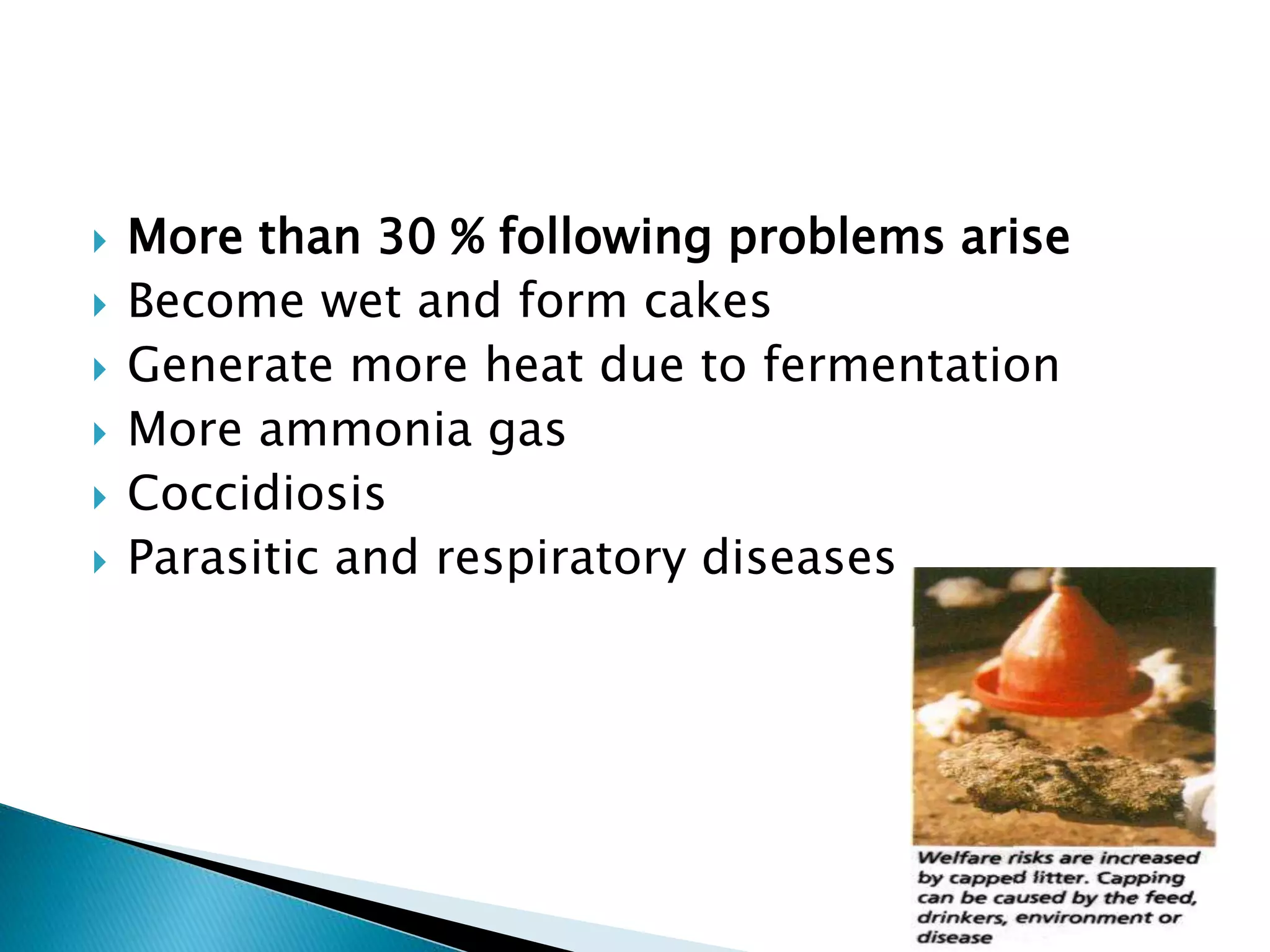
 More than 30 % following problems arise
 Become wet and form cakes
 Generate more heat due to fermentation
 More ammonia gas
 Coccidiosis
 Parasitic and respiratory diseases
 More humidity – wet litter – leads to
coccidiosis, warm burden
 Less humidity – dusty litter - respiratory
distress
 Litter should be properly mixed daily
 Ammonia level produced by litter should not
exceed 25ppm
 More ammonia level causes irritaion of eyes,
stunted growth, drop in egg production and
immune suppression
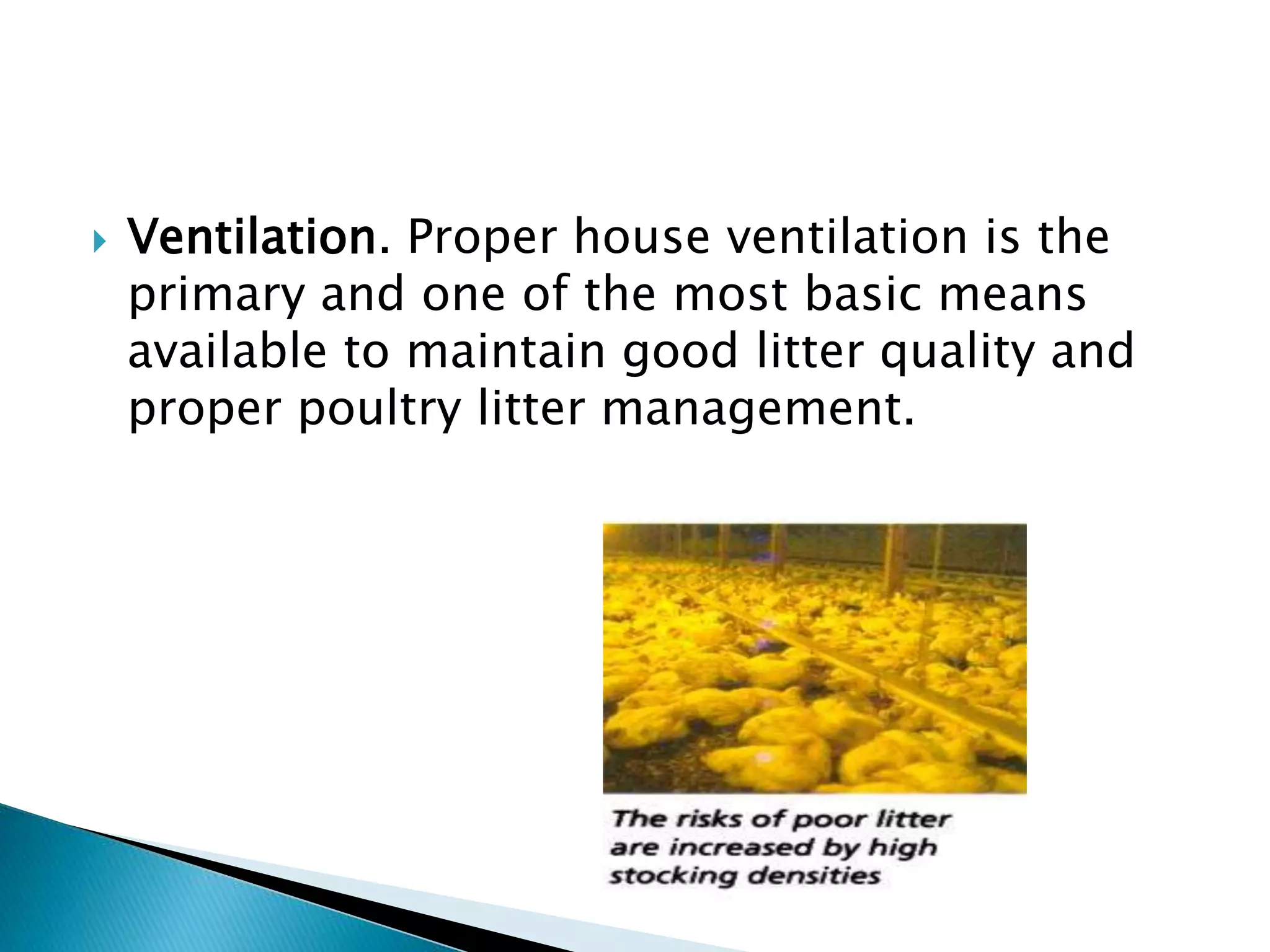
 Ventilation. Proper house ventilation is the
primary and one of the most basic means
available to maintain good litter quality and
proper poultry litter management.
 PH-alkaline (atleast 8)
 Few bacteria and moulds can survive
 Fermentation---heat-drying of litter
 Coccidiosis
 Colibacillosis
 Aflatoxicosis
 Aspergillosis (brooder pneumonia)
 Diseases such as pododermatitis, hock burn
and breast blisters are all a consequence of
poor litter.
 In turkeys "shaky leg syndrome" sometimes
follows foot ulceration associated with poor
litter quality.
 These disorders cause unnecessary suffering
to the birds and can also result in
downgrading of the end product at the
slaughterhouse.
 The dropping from chicken when mixed with litter
synthesizes Riboflavin (Vitamin B2) and Vitamin B12
by the chemical and bacterial actions.
 The built-up litter also contains niacin, phosphorus,
potassium, magnesium, sodium and calcium.
 Deep litter bird often pecks and eats a small quantity
of litter material which contains above nutrients. This
phenomenon is known as recycling.
 Even if the poultry feed is slightly deficient in some of
the nutrients, the deep litter birds will not show any
deficiency symptoms due the recycling of nutrients
 Poultry industry produces 2 million tonns of litter
per year.
 Compared with cow dung poultry mannure 10
times rich in fertilizer constituents.
 NPK – 3:2:2
 Layer bird produces 16 kg dried mannure in a
year in cage
 18 kg in deep litter
 Broiler - 1.5 kg mannure
 Increases soil fertility
 NPK per tonne of litter is 60-50-45
 Micro nutrients like magnesium, manganese,
boran, zinc and sulphur.
 It contains fair amount of protein and energy
it can be used as cattle, pig & poultry feed
ingredient.
 Can be safely used upto 10% in poultry
rations, 20 % in cattle rations.
 Dried poultry mannure contain 26 % cp and
ME 800 kal/kg
 Wet poultry mannure used as fish feed.
 Used for production of bio-gas which may be
used as generation of electricity.
 Oxidation ditches: aerobic fermentation of
mannure occurs in open ditches.
 Bacteria decompose organic matter into
simpler substances like CH4/NH4, sludge and
liquid mannure.
 Liquid portion has NPK & can be used as
fertilizer in field.
 Solid sludge contain Vit. B12 and minerals,
which can be used in the animal feed up to 3-
10 %.
 Spread :
mannure is scattered on ground in thin layer
which dries fast and can be applied to soil.
 Dig in pits with compression: heat is
generated making the material sterile to use
as fertilizer.
 Shallow covered ponds in which mannure is
dumped along with liquid waste.
 Here, anaerobic fermentation decomposes
mannure and after 2-3 months enriched
mannure can be obtained.
 Deep stacking of poultry waste produces
considerable heat and had been shown to
destroy coliforms. The maximum
temperature was attained in 4-8 days and
destroys the pathogenic organisms.

Litter management and Litter born Diseases

  • 2.
     Mixture ofchicken manure and bedding material.  Poultry litter is used in confinement buildings for raising broilers, turkeys and other birds.  Is a soft, fibrous plant material which absorbs moisture and is harmless to the birds. Litter materials: Ricehusk, sawdust, ground nut hulls, ground maize cobs,wood shavings, chopped straw, sugarcane bagasse, peanut hulls.  .
  • 3.
     Provides mediafor absorbing moisture from faecal matter  Protects the feet of the birds from direct exposure to the floor ( cushion like)  Bumble foot  Foot sores
  • 4.
     Must absorbmoisture from dropings.  Release moisture and dries up rapidly.  Free from mould growth  Non toxic  Locally available  Biodegradable
  • 5.
     a concretefloor is advised for a perfect disinfection at the end of each batch.  About 3-5” of litter should be put into the house initially and, as this breaks down, more should be added till a depth of about 8-12” is reached.  Before adding fresh litter material, remove the caked up and wet litter material.  Rack the litter thoroughly to break the clumps with the help of the litter racker and allow it to dry.
  • 6.
     Sprinkle amixture of wood ash and fertilizer grade superphosphate in the ratio of 4:1, at the ratio of 5 kg per 10 m2 area, before racking the litter to prevent ammonia gas release from litter.  Addition of slaked lime may be avoided that will increase the pH of the litter which in turn release more ammonia from the litter and also favours the growth of E. coli, the most common pathogen of poultry
  • 7.
     At thebeginning the litter contains only 12% moisture.  If the moisture level exceeds 30% due to poor ventilation, too many birds, irregular stirring or damp floor, the litter will cease to function efficiently. Because the manure digesting bacteria can be active only within 30% moisture level of the litter.  Some time many birds will bear “balls” made of litter materials at their claw tips. Ball formation is a sign of bad litter management.
  • 8.
     Built-up litterhas a very important role in providing warmth to the birds in winter.  In winter the litter depth can be increased to 10-12” while in summer it may be reduced to 2.5-4”.
  • 10.
     The amountof moisture in poultry bedding affects performance, health and even fuel costs.  Ideally, moisture levels should not exceed 25-30% and RH% should be managed constantly between 50-70%.
  • 11.
     More than30 % following problems arise  Become wet and form cakes  Generate more heat due to fermentation  More ammonia gas  Coccidiosis  Parasitic and respiratory diseases
  • 12.
     More humidity– wet litter – leads to coccidiosis, warm burden  Less humidity – dusty litter - respiratory distress  Litter should be properly mixed daily  Ammonia level produced by litter should not exceed 25ppm  More ammonia level causes irritaion of eyes, stunted growth, drop in egg production and immune suppression
  • 13.
     Ventilation. Properhouse ventilation is the primary and one of the most basic means available to maintain good litter quality and proper poultry litter management.
  • 14.
     PH-alkaline (atleast8)  Few bacteria and moulds can survive  Fermentation---heat-drying of litter
  • 15.
     Coccidiosis  Colibacillosis Aflatoxicosis  Aspergillosis (brooder pneumonia)
  • 16.
     Diseases suchas pododermatitis, hock burn and breast blisters are all a consequence of poor litter.  In turkeys "shaky leg syndrome" sometimes follows foot ulceration associated with poor litter quality.  These disorders cause unnecessary suffering to the birds and can also result in downgrading of the end product at the slaughterhouse.
  • 19.
     The droppingfrom chicken when mixed with litter synthesizes Riboflavin (Vitamin B2) and Vitamin B12 by the chemical and bacterial actions.  The built-up litter also contains niacin, phosphorus, potassium, magnesium, sodium and calcium.  Deep litter bird often pecks and eats a small quantity of litter material which contains above nutrients. This phenomenon is known as recycling.  Even if the poultry feed is slightly deficient in some of the nutrients, the deep litter birds will not show any deficiency symptoms due the recycling of nutrients
  • 20.
     Poultry industryproduces 2 million tonns of litter per year.  Compared with cow dung poultry mannure 10 times rich in fertilizer constituents.  NPK – 3:2:2  Layer bird produces 16 kg dried mannure in a year in cage  18 kg in deep litter  Broiler - 1.5 kg mannure  Increases soil fertility  NPK per tonne of litter is 60-50-45  Micro nutrients like magnesium, manganese, boran, zinc and sulphur.
  • 21.
     It containsfair amount of protein and energy it can be used as cattle, pig & poultry feed ingredient.  Can be safely used upto 10% in poultry rations, 20 % in cattle rations.  Dried poultry mannure contain 26 % cp and ME 800 kal/kg  Wet poultry mannure used as fish feed.  Used for production of bio-gas which may be used as generation of electricity.
  • 23.
     Oxidation ditches:aerobic fermentation of mannure occurs in open ditches.  Bacteria decompose organic matter into simpler substances like CH4/NH4, sludge and liquid mannure.  Liquid portion has NPK & can be used as fertilizer in field.  Solid sludge contain Vit. B12 and minerals, which can be used in the animal feed up to 3- 10 %.
  • 24.
     Spread : mannureis scattered on ground in thin layer which dries fast and can be applied to soil.  Dig in pits with compression: heat is generated making the material sterile to use as fertilizer.
  • 25.
     Shallow coveredponds in which mannure is dumped along with liquid waste.  Here, anaerobic fermentation decomposes mannure and after 2-3 months enriched mannure can be obtained.
  • 26.
     Deep stackingof poultry waste produces considerable heat and had been shown to destroy coliforms. The maximum temperature was attained in 4-8 days and destroys the pathogenic organisms.