

FACTORS AFFECTING
EGG QUALITY
•Many factors affect egg quality. Sometimes the cause is not a single
factor but a combination of factors.
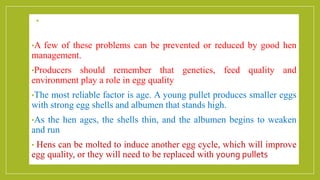
•A few of these problems can be prevented or reduced by good hen
management.
•Producers should remember that genetics, feed quality and
environment play a role in egg quality.
•The most reliable factor is age. A young pullet produces smaller eggs
with strong egg shells and albumen that stands high.
•As the hen ages, the shells thin, and the albumen begins to weaken
and run.
• Hens can be molted to induce another egg cycle, which will improve
egg quality, or they will need to be replaced with young pullets
A..THE SHELL
Condition Causes Corrective Measures
1. Thin, sandy,
misshapen,
rough, ridged or soft
i. Age of hens Replace after 12 to 14 months of lay.
ii. Arasan (Tetrame
Thylthiuram Disulfide); used to control mold
and fungus growth.
Do not include arasan treated grains
in the diet of layers. Law requires
that treated grain be dyed.
iii. Sulfanilamide (sulfa drugs) Use according to accepted
recommendations
iv. High constant temperatures Control temperature. Provide plenty
of water.
v. Respiratory diseases (Newcastle,infectious
bronchitis and laryngotracheitis)
Follow a recommended program for
vaccination and disease prevention
in poultry.
Condition Causes Corrective Measures
Thin, sandy,
misshapen,
rough, ridged or
soft
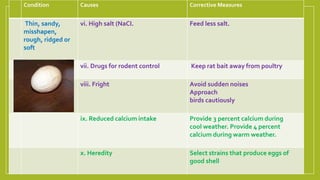
vi. High salt (NaCI. Feed less salt.
vii. Drugs for rodent control Keep rat bait away from poultry
viii. Fright Avoid sudden noises
Approach
birds cautiously
ix. Reduced calcium intake Provide 3 percent calcium during
cool weather. Provide 4 percent
calcium during warm weather.
x. Heredity Select strains that produce eggs of
good shell
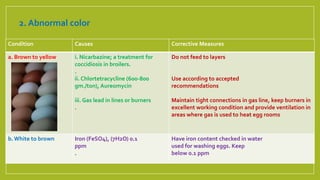
Condition Causes Corrective Measures
a. Brown to yellow i. Nicarbazine; a treatment for
coccidiosis in broilers.
.
ii. Chlortetracycline (600-800
gm./ton), Aureomycin
iii. Gas lead in lines or burners
.
Do not feed to layers
Use according to accepted
recommendations
Maintain tight connections in gas line, keep burners in
excellent working condition and provide ventilation in
areas where gas is used to heat egg rooms
b.White to brown Iron (FeSO4), (7H2O) 0.1
ppm
.
Have iron content checked in water
used for washing eggs. Keep
below 0.1 ppm
2. Abnormal color
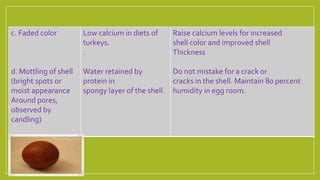
c. Faded color
d. Mottling of shell
(bright spots or
moist appearance
Around pores,
observed by
candling)
Low calcium in diets of
turkeys.
.
Water retained by
protein in
spongy layer of the shell.
Raise calcium levels for increased
shell color and improved shell
Thickness
Do not mistake for a crack or
cracks in the shell. Maintain 80 percent
humidity in egg room.
3. Porosity Age and breed of hens,
environmental temperatures,
and season of year.
Keep hen house cooler, hold eggs
in cool place, sell hens after 12 to
14 months of lay or molt, and
select strain bred for good shell
texture.
4. Tremulous or
moving air cell
(observed by
candling)
Rough handling Observe and make necessary
alterations in egg- handling
practices.
5. Tainted shells Paradichlorbenzene (moth repellant) Do not feed to birds
B.THE WHITE (ALBUMEN)
1. Pink egg whites Cottonseed meal (often
found in cattle rations)
Avoid using in the diet of layers
2. Flecks or spots in
albumen
i. Partially cooked
ii. Blood and meat spots
Avoid excessive heat when washing eggs
Select strains known for clear
egg whites (albumen).
3. Green rot and
other types of
microbial
spoilage.
Microorganisms, including
bacteria, molds, and fungi
Maintain clean nesting materials. Gather eggs
frequently (three to five times day). Use clean water
for washing eggs. Maintain temperature of egg wash
water(100 to 120°F.) above that of the egg at all
times. Use recommended amounts of detergents and
sanitizers. Keep equipment clean. Use clean packing
materials. Keep eggs refrigerated. Green rot is easily
detected with an ultraviolet lamp candler. Other
types of advanced spoilage are easily detected with
regular candling techniques. Egg wash water
containing 0.4 ppm of iron can promote bacterial
spoilage.
Condition Causes Corrective Measures
4. Weak, thin or
watery whites
i. Age of hens
ii. Ammonia from droppings
iii. Increased alkalinity, (pH)-
Loss of CO2
iv. Respiratory diseases
(Newcastle, infectious
bronchitis, and
Laryngo tracheitis)
v. Heredity.
Replace hens after 12 to 14 months of lay.
Better ventilation, use superphosphate on
litter and manure and remove droppings
regularly.
Use a shell coating such as oil
or refrigerated temperatures (40
to 55°F).
Follow a recommended
program for vaccination and
disease prevention in poultry.
Select strains of known egg
white (albumen) quality
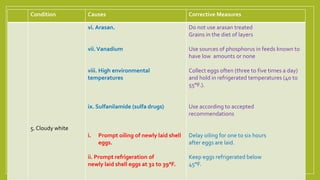
Condition Causes Corrective Measures
5. Cloudy white
vi. Arasan.
vii.Vanadium
viii. High environmental
temperatures
ix. Sulfanilamide (sulfa drugs)
i. Prompt oiling of newly laid shell
eggs.
ii. Prompt refrigeration of
newly laid shell eggs at 32 to 39°F.
Do not use arasan treated
Grains in the diet of layers
Use sources of phosphorus in feeds known to
have low amounts or none
Collect eggs often (three to five times a day)
and hold in refrigerated temperatures (40 to
55°F.).
Use according to accepted
recommendations
Delay oiling for one to six hours
after eggs are laid.
Keep eggs refrigerated below
45°F.
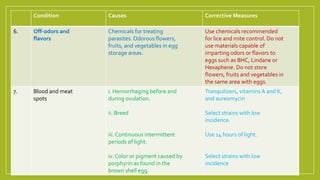
Condition Causes Corrective Measures
6. Off-odors and
flavors
Chemicals for treating
parasites. Odorous flowers,
fruits, and vegetables in egg
storage areas.
Use chemicals recommended
for lice and mite control. Do not
use materials capable of
imparting odors or flavors to
eggs such as BHC, Lindane or
Hexaphene. Do not store
flowers, fruits and vegetables in
the same area with eggs.
7. Blood and meat
spots
i. Hemorrhaging before and
during ovulation.
ii. Breed
iii.Continuous intermittent
periods of light.
iv. Color or pigment caused by
porphyrin as found in the
brown shell egg.
Tranquilizers, vitamins A and K,
and aureomycin
Select strains with low
incidence.
Use 14 hours of light.
Select strains with low
incidence
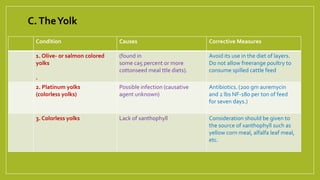
Condition Causes Corrective Measures
1. Olive- or salmon colored
yolks
.
(found in
some ca5 percent or more
cottonseed meal ttle diets).
Avoid its use in the diet of layers.
Do not allow freerange poultry to
consume spilled cattle feed
2. Platinum yolks
(colorless yolks)
Possible infection (causative
agent unknown)
Antibiotics. (200 gm auremycin
and 2 lbs NF-180 per ton of feed
for seven days.)
3. Colorless yolks Lack of xanthophyll Consideration should be given to
the source of xanthophyll such as
yellow corn meal, alfalfa leaf meal,
etc.
C.TheYolk
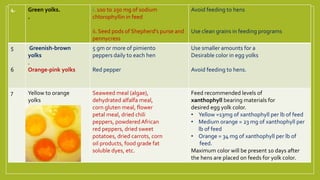
4. Green yolks.
.
i. 100 to 250 mg of sodium
chlorophyllin in feed
ii. Seed pods of Shepherd’s purse and
pennycress
Avoid feeding to hens
Use clean grains in feeding programs
5
6
Greenish-brown
yolks
.
Orange-pink yolks
5 gm or more of pimiento
peppers daily to each hen
Red pepper
Use smaller amounts for a
Desirable color in egg yolks
Avoid feeding to hens.
7 Yellow to orange
yolks
Seaweed meal (algae),
dehydrated alfalfa meal,
corn gluten meal, flower
petal meal, dried chili
peppers, powderedAfrican
red peppers, dried sweet
potatoes, dried carrots, corn
oil products, food grade fat
soluble dyes, etc.
Feed recommended levels of
xanthophyll bearing materials for
desired egg yolk color.
• Yellow =13mg of xanthophyll per lb of feed
• Medium orange = 23 mg of xanthophyll per
lb of feed
• Orange = 34 mg of xanthophyll per lb of
feed.
Maximum color will be present 10 days after
the hens are placed on feeds for yolk color.
Condition Causes Corrective Measures
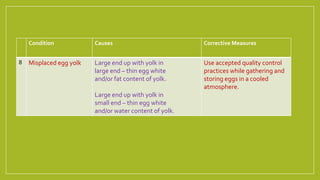
8 Misplaced egg yolk Large end up with yolk in
large end – thin egg white
and/or fat content of yolk.
Large end up with yolk in
small end – thin egg white
and/or water content of yolk.
Use accepted quality control
practices while gathering and
storing eggs in a cooled
atmosphere.
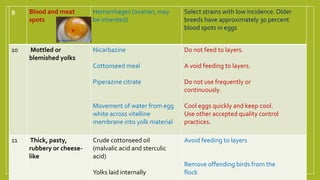
9 Blood and meat
spots
Hemorrhages (ovarian, may
be inherited)
Select strains with low incidence. Older
breeds have approximately 30 percent
blood spots in eggs
10 Mottled or
blemished yolks
Nicarbazine
Cottonseed meal
Piperazine citrate
Movement of water from egg
white across vitelline
membrane into yolk material
Do not feed to layers.
A void feeding to layers.
Do not use frequently or
continuously.
Cool eggs quickly and keep cool.
Use other accepted quality control
practices.
11 Thick, pasty,
rubbery or cheese-
like
Crude cottonseed oil
(malvalic acid and sterculic
acid)
Yolks laid internally
Avoid feeding to layers
Remove offending birds from the
flock
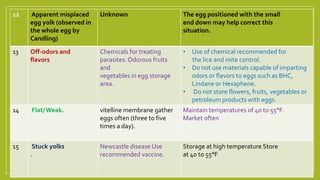
12 Apparent misplaced
egg yolk (observed in
the whole egg by
Candling)
Unknown The egg positioned with the small
end down may help correct this
situation.
13 Off-odors and
flavors
Chemicals for treating
parasites.Odorous fruits
and
vegetables in egg storage
area.
• Use of chemical recommended for
the lice and mite control.
• Do not use materials capable of imparting
odors or flavors to eggs such as BHC,
Lindane or Hexaphene.
• Do not store flowers, fruits, vegetables or
petroleum products with eggs.
14 Flat/Weak. vitelline membrane gather
eggs often (three to five
times a day).
Maintain temperatures of 40 to 55°F.
Market often
15 Stuck yolks
.
Newcastle disease Use
recommended vaccine.
Storage at high temperature Store
at 40 to 55°F
Factors affecting egg quality

Factors affecting egg quality

  • 1.
  • 2.
    •Many factors affectegg quality. Sometimes the cause is not a single factor but a combination of factors. •A few of these problems can be prevented or reduced by good hen management. •Producers should remember that genetics, feed quality and environment play a role in egg quality. •The most reliable factor is age. A young pullet produces smaller eggs with strong egg shells and albumen that stands high. •As the hen ages, the shells thin, and the albumen begins to weaken and run. • Hens can be molted to induce another egg cycle, which will improve egg quality, or they will need to be replaced with young pullets
  • 3.
    A..THE SHELL Condition CausesCorrective Measures 1. Thin, sandy, misshapen, rough, ridged or soft i. Age of hens Replace after 12 to 14 months of lay. ii. Arasan (Tetrame Thylthiuram Disulfide); used to control mold and fungus growth. Do not include arasan treated grains in the diet of layers. Law requires that treated grain be dyed. iii. Sulfanilamide (sulfa drugs) Use according to accepted recommendations iv. High constant temperatures Control temperature. Provide plenty of water. v. Respiratory diseases (Newcastle,infectious bronchitis and laryngotracheitis) Follow a recommended program for vaccination and disease prevention in poultry.
  • 4.
    Condition Causes CorrectiveMeasures Thin, sandy, misshapen, rough, ridged or soft vi. High salt (NaCI. Feed less salt. vii. Drugs for rodent control Keep rat bait away from poultry viii. Fright Avoid sudden noises Approach birds cautiously ix. Reduced calcium intake Provide 3 percent calcium during cool weather. Provide 4 percent calcium during warm weather. x. Heredity Select strains that produce eggs of good shell
  • 5.
    Condition Causes CorrectiveMeasures a. Brown to yellow i. Nicarbazine; a treatment for coccidiosis in broilers. . ii. Chlortetracycline (600-800 gm./ton), Aureomycin iii. Gas lead in lines or burners . Do not feed to layers Use according to accepted recommendations Maintain tight connections in gas line, keep burners in excellent working condition and provide ventilation in areas where gas is used to heat egg rooms b.White to brown Iron (FeSO4), (7H2O) 0.1 ppm . Have iron content checked in water used for washing eggs. Keep below 0.1 ppm 2. Abnormal color
  • 6.
    c. Faded color d.Mottling of shell (bright spots or moist appearance Around pores, observed by candling) Low calcium in diets of turkeys. . Water retained by protein in spongy layer of the shell. Raise calcium levels for increased shell color and improved shell Thickness Do not mistake for a crack or cracks in the shell. Maintain 80 percent humidity in egg room.
  • 7.
    3. Porosity Ageand breed of hens, environmental temperatures, and season of year. Keep hen house cooler, hold eggs in cool place, sell hens after 12 to 14 months of lay or molt, and select strain bred for good shell texture. 4. Tremulous or moving air cell (observed by candling) Rough handling Observe and make necessary alterations in egg- handling practices. 5. Tainted shells Paradichlorbenzene (moth repellant) Do not feed to birds
  • 8.
    B.THE WHITE (ALBUMEN) 1.Pink egg whites Cottonseed meal (often found in cattle rations) Avoid using in the diet of layers 2. Flecks or spots in albumen i. Partially cooked ii. Blood and meat spots Avoid excessive heat when washing eggs Select strains known for clear egg whites (albumen). 3. Green rot and other types of microbial spoilage. Microorganisms, including bacteria, molds, and fungi Maintain clean nesting materials. Gather eggs frequently (three to five times day). Use clean water for washing eggs. Maintain temperature of egg wash water(100 to 120°F.) above that of the egg at all times. Use recommended amounts of detergents and sanitizers. Keep equipment clean. Use clean packing materials. Keep eggs refrigerated. Green rot is easily detected with an ultraviolet lamp candler. Other types of advanced spoilage are easily detected with regular candling techniques. Egg wash water containing 0.4 ppm of iron can promote bacterial spoilage.
  • 9.
    Condition Causes CorrectiveMeasures 4. Weak, thin or watery whites i. Age of hens ii. Ammonia from droppings iii. Increased alkalinity, (pH)- Loss of CO2 iv. Respiratory diseases (Newcastle, infectious bronchitis, and Laryngo tracheitis) v. Heredity. Replace hens after 12 to 14 months of lay. Better ventilation, use superphosphate on litter and manure and remove droppings regularly. Use a shell coating such as oil or refrigerated temperatures (40 to 55°F). Follow a recommended program for vaccination and disease prevention in poultry. Select strains of known egg white (albumen) quality
  • 10.
    Condition Causes CorrectiveMeasures 5. Cloudy white vi. Arasan. vii.Vanadium viii. High environmental temperatures ix. Sulfanilamide (sulfa drugs) i. Prompt oiling of newly laid shell eggs. ii. Prompt refrigeration of newly laid shell eggs at 32 to 39°F. Do not use arasan treated Grains in the diet of layers Use sources of phosphorus in feeds known to have low amounts or none Collect eggs often (three to five times a day) and hold in refrigerated temperatures (40 to 55°F.). Use according to accepted recommendations Delay oiling for one to six hours after eggs are laid. Keep eggs refrigerated below 45°F.
  • 11.
    Condition Causes CorrectiveMeasures 6. Off-odors and flavors Chemicals for treating parasites. Odorous flowers, fruits, and vegetables in egg storage areas. Use chemicals recommended for lice and mite control. Do not use materials capable of imparting odors or flavors to eggs such as BHC, Lindane or Hexaphene. Do not store flowers, fruits and vegetables in the same area with eggs. 7. Blood and meat spots i. Hemorrhaging before and during ovulation. ii. Breed iii.Continuous intermittent periods of light. iv. Color or pigment caused by porphyrin as found in the brown shell egg. Tranquilizers, vitamins A and K, and aureomycin Select strains with low incidence. Use 14 hours of light. Select strains with low incidence
  • 12.
    Condition Causes CorrectiveMeasures 1. Olive- or salmon colored yolks . (found in some ca5 percent or more cottonseed meal ttle diets). Avoid its use in the diet of layers. Do not allow freerange poultry to consume spilled cattle feed 2. Platinum yolks (colorless yolks) Possible infection (causative agent unknown) Antibiotics. (200 gm auremycin and 2 lbs NF-180 per ton of feed for seven days.) 3. Colorless yolks Lack of xanthophyll Consideration should be given to the source of xanthophyll such as yellow corn meal, alfalfa leaf meal, etc. C.TheYolk
  • 13.
    4. Green yolks. . i.100 to 250 mg of sodium chlorophyllin in feed ii. Seed pods of Shepherd’s purse and pennycress Avoid feeding to hens Use clean grains in feeding programs 5 6 Greenish-brown yolks . Orange-pink yolks 5 gm or more of pimiento peppers daily to each hen Red pepper Use smaller amounts for a Desirable color in egg yolks Avoid feeding to hens. 7 Yellow to orange yolks Seaweed meal (algae), dehydrated alfalfa meal, corn gluten meal, flower petal meal, dried chili peppers, powderedAfrican red peppers, dried sweet potatoes, dried carrots, corn oil products, food grade fat soluble dyes, etc. Feed recommended levels of xanthophyll bearing materials for desired egg yolk color. • Yellow =13mg of xanthophyll per lb of feed • Medium orange = 23 mg of xanthophyll per lb of feed • Orange = 34 mg of xanthophyll per lb of feed. Maximum color will be present 10 days after the hens are placed on feeds for yolk color.
  • 14.
    Condition Causes CorrectiveMeasures 8 Misplaced egg yolk Large end up with yolk in large end – thin egg white and/or fat content of yolk. Large end up with yolk in small end – thin egg white and/or water content of yolk. Use accepted quality control practices while gathering and storing eggs in a cooled atmosphere.
  • 15.
    9 Blood andmeat spots Hemorrhages (ovarian, may be inherited) Select strains with low incidence. Older breeds have approximately 30 percent blood spots in eggs 10 Mottled or blemished yolks Nicarbazine Cottonseed meal Piperazine citrate Movement of water from egg white across vitelline membrane into yolk material Do not feed to layers. A void feeding to layers. Do not use frequently or continuously. Cool eggs quickly and keep cool. Use other accepted quality control practices. 11 Thick, pasty, rubbery or cheese- like Crude cottonseed oil (malvalic acid and sterculic acid) Yolks laid internally Avoid feeding to layers Remove offending birds from the flock
  • 16.
    12 Apparent misplaced eggyolk (observed in the whole egg by Candling) Unknown The egg positioned with the small end down may help correct this situation. 13 Off-odors and flavors Chemicals for treating parasites.Odorous fruits and vegetables in egg storage area. • Use of chemical recommended for the lice and mite control. • Do not use materials capable of imparting odors or flavors to eggs such as BHC, Lindane or Hexaphene. • Do not store flowers, fruits, vegetables or petroleum products with eggs. 14 Flat/Weak. vitelline membrane gather eggs often (three to five times a day). Maintain temperatures of 40 to 55°F. Market often 15 Stuck yolks . Newcastle disease Use recommended vaccine. Storage at high temperature Store at 40 to 55°F