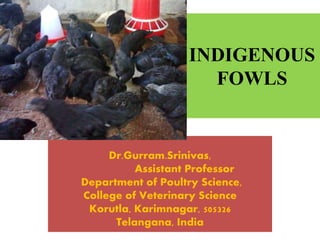
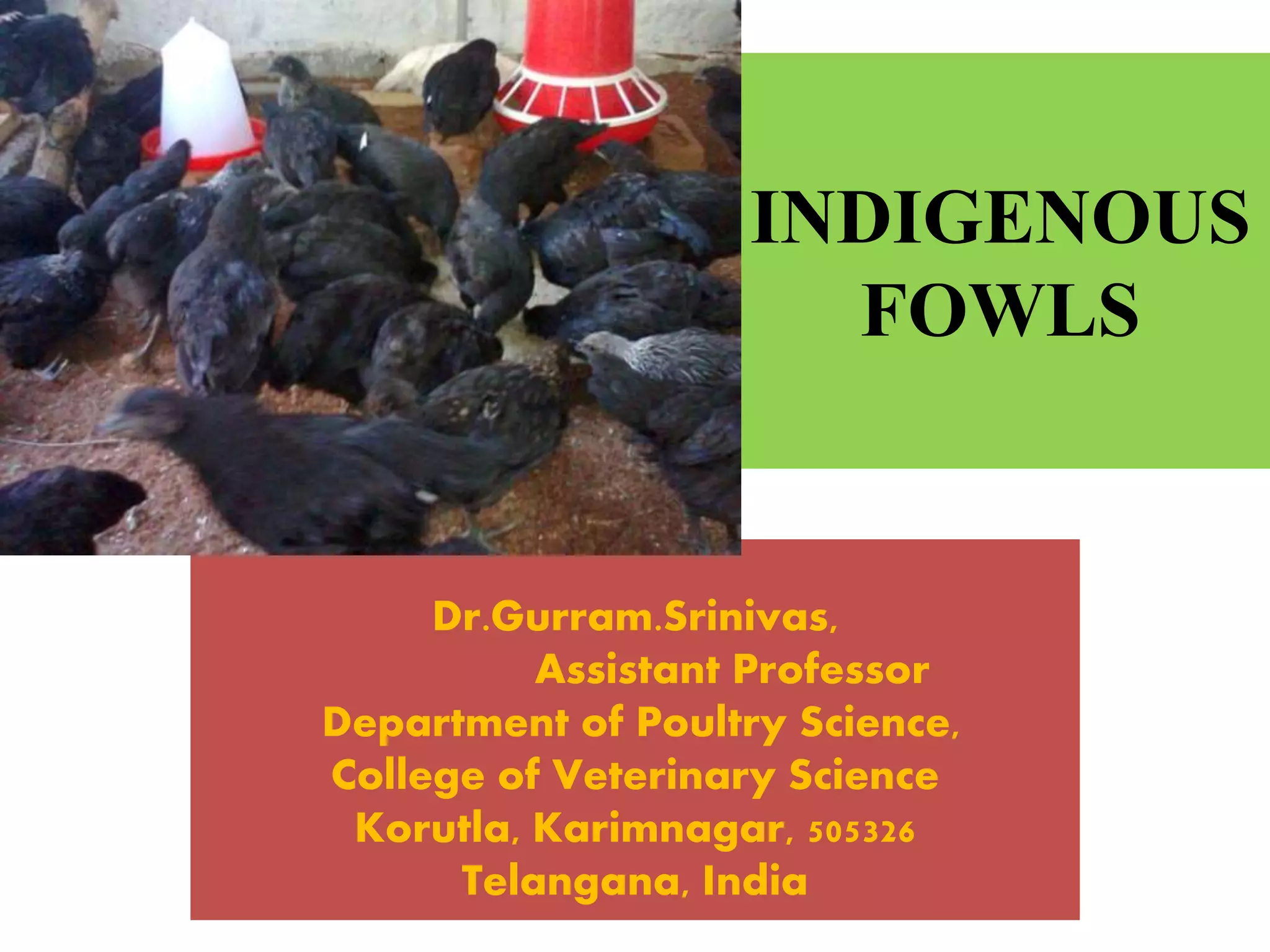
INDIGENOUS
FOWLS
Dr.Gurram.Srinivas,
Assistant Professor
Department of Poultry Science,
College of Veterinary Science
Korutla, Karimnagar, 505326
Telangana, India
INDIGENOUS FOWLS
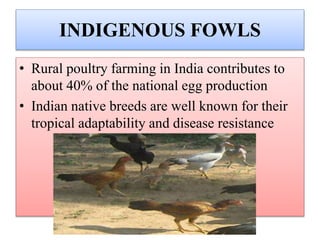
• Rural poultry farming in India contributes to
about 40% of the national egg production
• Indian native breeds are well known for their
tropical adaptability and disease resistance
• Jungli Murgi - Jungli murgi or Red Jungle fowl -
Gallus Gallus
• Domesticated fowl – Gallus domesticus
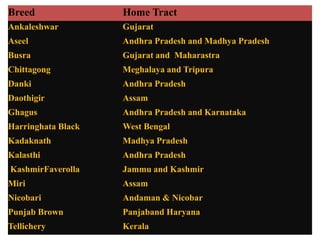
Breed Home Tract
Ankaleshwar Gujarat
Aseel Andhra Pradesh and Madhya Pradesh
Busra Gujarat and Maharastra
Chittagong Meghalaya and Tripura
Danki Andhra Pradesh
Daothigir Assam
Ghagus Andhra Pradesh and Karnataka
Harringhata Black West Bengal
Kadaknath Madhya Pradesh
Kalasthi Andhra Pradesh
KashmirFaverolla Jammu and Kashmir
Miri Assam
Nicobari Andaman & Nicobar
Punjab Brown Panjaband Haryana
Tellichery Kerala
• These with Chittagong, Aseel, Langshan
or Brahma blood in them are bigger in size
and better in meat quality than the common
flows.
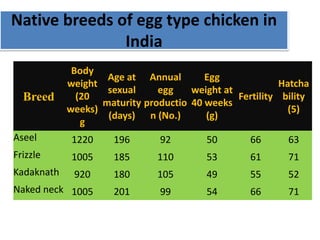
Native breeds of egg type chicken in
India
Breed
Body
weight
(20
weeks)
g
Age at
sexual
maturity
(days)
Annual
egg
productio
n (No.)
Egg
weight at
40 weeks
(g)
Fertility
Hatcha
bility
(5)
Aseel 1220 196 92 50 66 63
Frizzle 1005 185 110 53 61 71
Kadaknath 920 180 105 49 55 52
Naked neck 1005 201 99 54 66 71
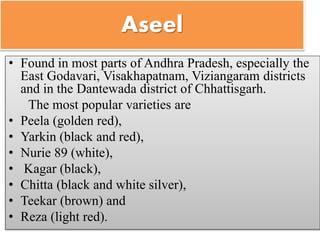
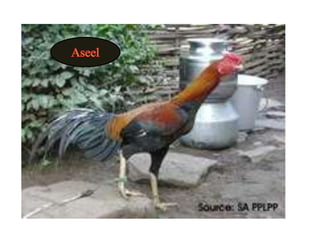
Aseel
• Found in most parts of Andhra Pradesh, especially the
East Godavari, Visakhapatnam, Viziangaram districts
and in the Dantewada district of Chhattisgarh.
The most popular varieties are
• Peela (golden red),
• Yarkin (black and red),
• Nurie 89 (white),
• Kagar (black),
• Chitta (black and white silver),
• Teekar (brown) and
• Reza (light red).
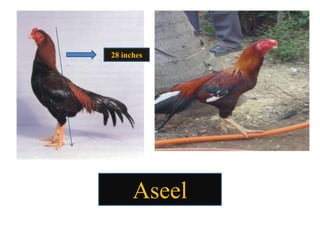
Aseel
28 inches
Aseel
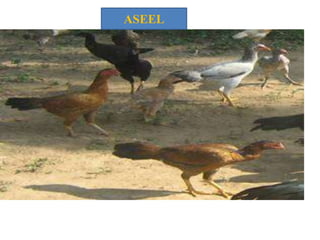
• The literal meaning of Aseel is real or pure.
• Aseel is well known for its pugnacity, high stamina, majestic
gait and fighting qualities.
• Game bird
• cock-fighting
• Its outstanding feature is its thick and long neck, long and
slender face without feathers, short beak, short and small
comb, ear lobes and the absence of wattles.
• Its legs are long, strong and straight and the bird has an upright
and majestic gait
• The wattles are rudimentary and almost imperceptible. The
eyes are compact, well set and present bold looks.
• The hen matures and begins to lay eggs
between 5-6 months of age, and lays 3-4
clutches per year, with each clutch having 10-12
eggs (36-60 eggs laid per year).
• The Cornish inherited from the Aseel its meaty,
well-muscled body, sturdy frame and yellow
skin and legs.
• Aseel meat is highly valued ,with prices per kg
live weight being 50-100% higher than the
broiler because of its superior taste and texture
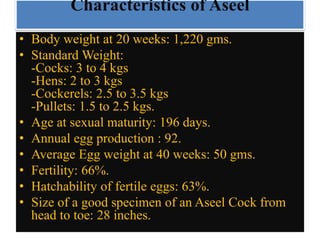
Characteristics of Aseel
• Body weight at 20 weeks: 1,220 gms.
• Standard Weight:
-Cocks: 3 to 4 kgs
-Hens: 2 to 3 kgs
-Cockerels: 2.5 to 3.5 kgs
-Pullets: 1.5 to 2.5 kgs.
• Age at sexual maturity: 196 days.
• Annual egg production : 92.
• Average Egg weight at 40 weeks: 50 gms.
• Fertility: 66%.
• Hatchability of fertile eggs: 63%.
• Size of a good specimen of an Aseel Cock from
head to toe: 28 inches.
ASEEL
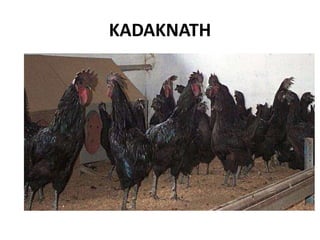
KADAKNATH
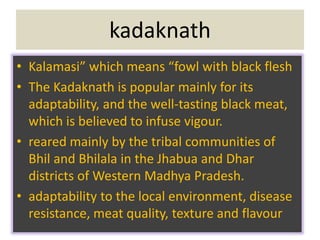
kadaknath
• Kalamasi” which means “fowl with black flesh
• The Kadaknath is popular mainly for its
adaptability, and the well-tasting black meat,
which is believed to infuse vigour.
• reared mainly by the tribal communities of
Bhil and Bhilala in the Jhabua and Dhar
districts of Western Madhya Pradesh.
• adaptability to the local environment, disease
resistance, meat quality, texture and flavour
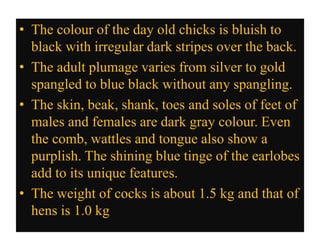
• The colour of the day old chicks is bluish to
black with irregular dark stripes over the back.
• The adult plumage varies from silver to gold
spangled to blue black without any spangling.
• The skin, beak, shank, toes and soles of feet of
males and females are dark gray colour. Even
the comb, wattles and tongue also show a
purplish. The shining blue tinge of the earlobes
add to its unique features.
• The weight of cocks is about 1.5 kg and that of
hens is 1.0 kg
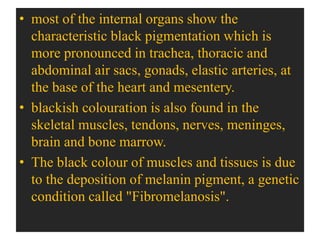
• most of the internal organs show the
characteristic black pigmentation which is
more pronounced in trachea, thoracic and
abdominal air sacs, gonads, elastic arteries, at
the base of the heart and mesentery.
• blackish colouration is also found in the
skeletal muscles, tendons, nerves, meninges,
brain and bone marrow.
• The black colour of muscles and tissues is due
to the deposition of melanin pigment, a genetic
condition called "Fibromelanosis".
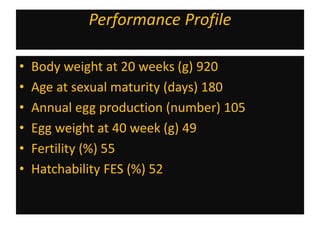
Performance Profile
• Body weight at 20 weeks (g) 920
• Age at sexual maturity (days) 180
• Annual egg production (number) 105
• Egg weight at 40 week (g) 49
• Fertility (%) 55
• Hatchability FES (%) 52
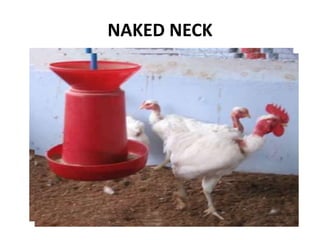
NAKED NECK
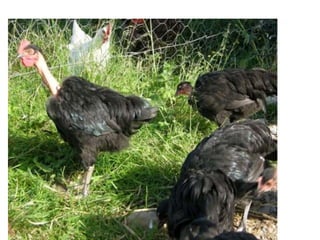
NAKED NECK
Naked neck
• Trivandrum region of Kerala is considered to
be the homeland of Naked neck but it is
available throughout hot and humid coastal
area including Andman and Nicobar island and
North-Eastern states of the country in small
numbers.
• People of these regions have great affinity for
Naked neck birds due to their better
adaptability to the hot and humid climatic
conditions as well as for better taste and
flavour of meat.
Naked neck
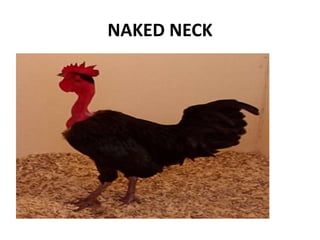
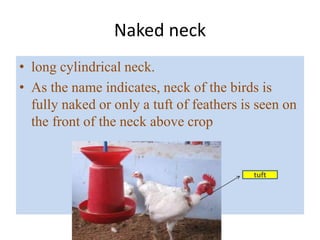
• long cylindrical neck.
• As the name indicates, neck of the birds is
fully naked or only a tuft of feathers is seen on
the front of the neck above crop
tuft
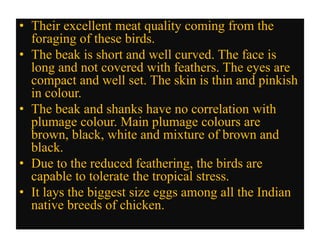
• Their excellent meat quality coming from the
foraging of these birds.
• The beak is short and well curved. The face is
long and not covered with feathers. The eyes are
compact and well set. The skin is thin and pinkish
in colour.
• The beak and shanks have no correlation with
plumage colour. Main plumage colours are
brown, black, white and mixture of brown and
black.
• Due to the reduced feathering, the birds are
capable to tolerate the tropical stress.
• It lays the biggest size eggs among all the Indian
native breeds of chicken.
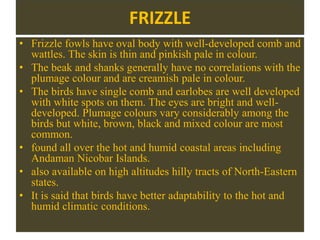
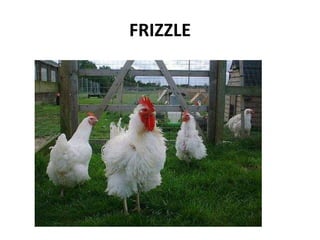
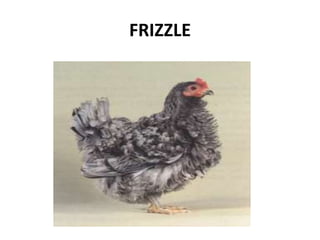
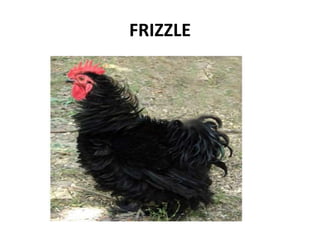
FRIZZLE
• Frizzle fowls have oval body with well-developed comb and
wattles. The skin is thin and pinkish pale in colour.
• The beak and shanks generally have no correlations with the
plumage colour and are creamish pale in colour.
• The birds have single comb and earlobes are well developed
with white spots on them. The eyes are bright and well-
developed. Plumage colours vary considerably among the
birds but white, brown, black and mixed colour are most
common.
• found all over the hot and humid coastal areas including
Andaman Nicobar Islands.
• also available on high altitudes hilly tracts of North-Eastern
states.
• It is said that birds have better adaptability to the hot and
humid climatic conditions.
FRIZZLE
FRIZZLE
FRIZZLE
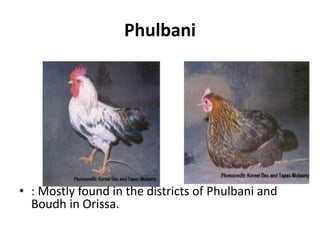
Phulbani
• : Mostly found in the districts of Phulbani and
Boudh in Orissa.
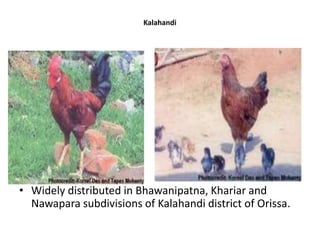
Kalahandi
• Widely distributed in Bhawanipatna, Khariar and
Nawapara subdivisions of Kalahandi district of Orissa.
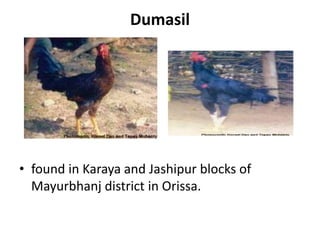
Dumasil
• found in Karaya and Jashipur blocks of
Mayurbhanj district in Orissa.
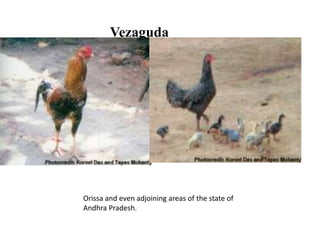
Vezaguda
Orissa and even adjoining areas of the state of
Andhra Pradesh.
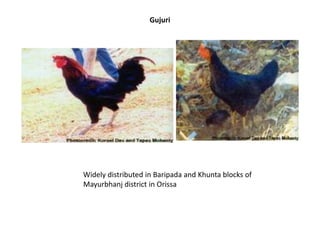
Gujuri
Widely distributed in Baripada and Khunta blocks of
Mayurbhanj district in Orissa
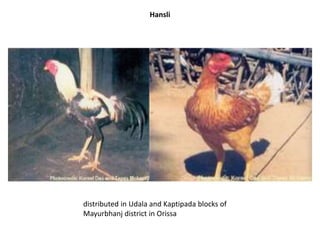
Hansli
distributed in Udala and Kaptipada blocks of
Mayurbhanj district in Orissa
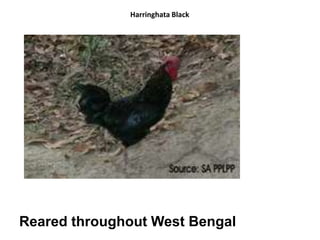
Harringhata Black
Reared throughout West Bengal
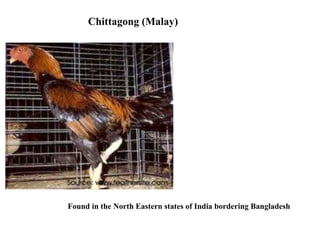
Chittagong (Malay)
Found in the North Eastern states of India bordering Bangladesh
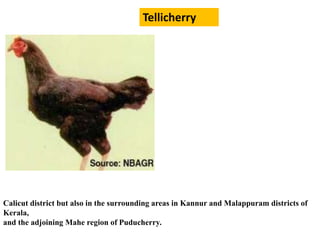
Tellicherry
Calicut district but also in the surrounding areas in Kannur and Malappuram districts of
Kerala,
and the adjoining Mahe region of Puducherry.
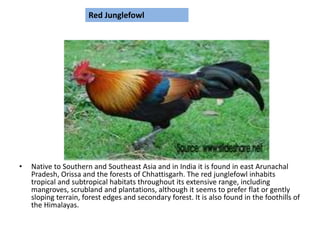
Red Junglefowl
• Native to Southern and Southeast Asia and in India it is found in east Arunachal
Pradesh, Orissa and the forests of Chhattisgarh. The red junglefowl inhabits
tropical and subtropical habitats throughout its extensive range, including
mangroves, scrubland and plantations, although it seems to prefer flat or gently
sloping terrain, forest edges and secondary forest. It is also found in the foothills of
the Himalayas.
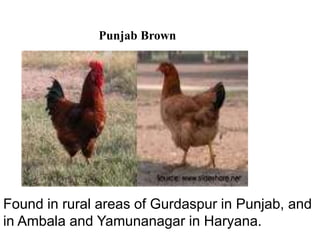
Punjab Brown
Found in rural areas of Gurdaspur in Punjab, and
in Ambala and Yamunanagar in Haryana.
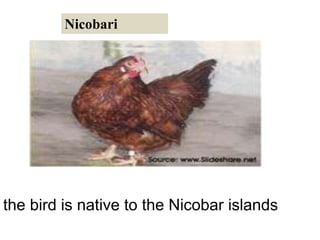
Nicobari
the bird is native to the Nicobar islands
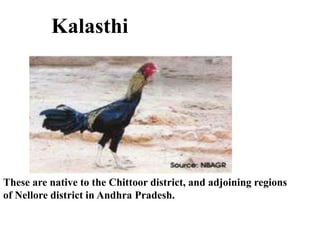
Kalasthi
These are native to the Chittoor district, and adjoining regions
of Nellore district in Andhra Pradesh.
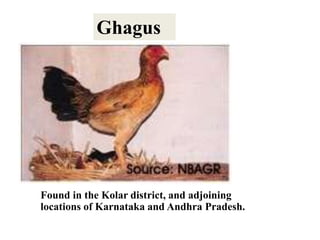
Ghagus
Found in the Kolar district, and adjoining
locations of Karnataka and Andhra Pradesh.
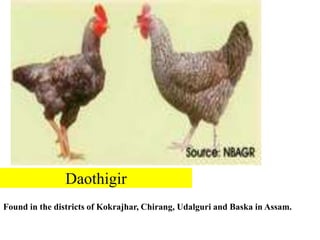
Daothigir
Found in the districts of Kokrajhar, Chirang, Udalguri and Baska in Assam.
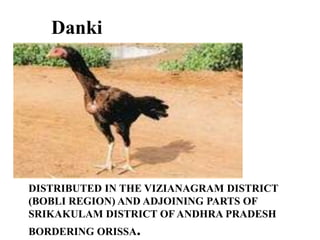
Danki
DISTRIBUTED IN THE VIZIANAGRAM DISTRICT
(BOBLI REGION) AND ADJOINING PARTS OF
SRIKAKULAM DISTRICT OF ANDHRA PRADESH
BORDERING ORISSA.
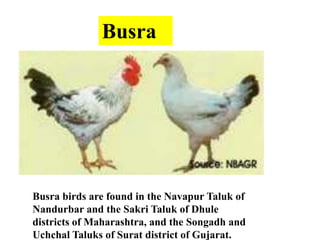
Busra
Busra birds are found in the Navapur Taluk of
Nandurbar and the Sakri Taluk of Dhule
districts of Maharashtra, and the Songadh and
Uchchal Taluks of Surat district of Gujarat.
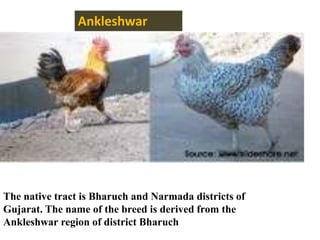
Ankleshwar
The native tract is Bharuch and Narmada districts of
Gujarat. The name of the breed is derived from the
Ankleshwar region of district Bharuch
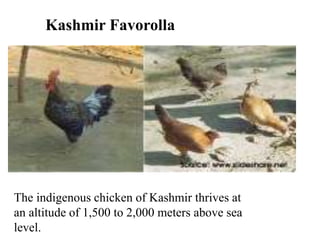
Kashmir Favorolla
The indigenous chicken of Kashmir thrives at
an altitude of 1,500 to 2,000 meters above sea
level.

Indigenous fowl in india

  • 1.
    INDIGENOUS FOWLS Dr.Gurram.Srinivas, Assistant Professor Department ofPoultry Science, College of Veterinary Science Korutla, Karimnagar, 505326 Telangana, India
  • 2.
    INDIGENOUS FOWLS • Ruralpoultry farming in India contributes to about 40% of the national egg production • Indian native breeds are well known for their tropical adaptability and disease resistance
  • 3.
    • Jungli Murgi- Jungli murgi or Red Jungle fowl - Gallus Gallus • Domesticated fowl – Gallus domesticus
  • 4.
    Breed Home Tract AnkaleshwarGujarat Aseel Andhra Pradesh and Madhya Pradesh Busra Gujarat and Maharastra Chittagong Meghalaya and Tripura Danki Andhra Pradesh Daothigir Assam Ghagus Andhra Pradesh and Karnataka Harringhata Black West Bengal Kadaknath Madhya Pradesh Kalasthi Andhra Pradesh KashmirFaverolla Jammu and Kashmir Miri Assam Nicobari Andaman & Nicobar Punjab Brown Panjaband Haryana Tellichery Kerala
  • 5.
    • These withChittagong, Aseel, Langshan or Brahma blood in them are bigger in size and better in meat quality than the common flows.
  • 6.
    Native breeds ofegg type chicken in India Breed Body weight (20 weeks) g Age at sexual maturity (days) Annual egg productio n (No.) Egg weight at 40 weeks (g) Fertility Hatcha bility (5) Aseel 1220 196 92 50 66 63 Frizzle 1005 185 110 53 61 71 Kadaknath 920 180 105 49 55 52 Naked neck 1005 201 99 54 66 71
  • 7.
    Aseel • Found inmost parts of Andhra Pradesh, especially the East Godavari, Visakhapatnam, Viziangaram districts and in the Dantewada district of Chhattisgarh. The most popular varieties are • Peela (golden red), • Yarkin (black and red), • Nurie 89 (white), • Kagar (black), • Chitta (black and white silver), • Teekar (brown) and • Reza (light red).
  • 9.
  • 10.
    Aseel • The literalmeaning of Aseel is real or pure. • Aseel is well known for its pugnacity, high stamina, majestic gait and fighting qualities. • Game bird • cock-fighting • Its outstanding feature is its thick and long neck, long and slender face without feathers, short beak, short and small comb, ear lobes and the absence of wattles. • Its legs are long, strong and straight and the bird has an upright and majestic gait • The wattles are rudimentary and almost imperceptible. The eyes are compact, well set and present bold looks.
  • 11.
    • The henmatures and begins to lay eggs between 5-6 months of age, and lays 3-4 clutches per year, with each clutch having 10-12 eggs (36-60 eggs laid per year). • The Cornish inherited from the Aseel its meaty, well-muscled body, sturdy frame and yellow skin and legs. • Aseel meat is highly valued ,with prices per kg live weight being 50-100% higher than the broiler because of its superior taste and texture
  • 12.
    Characteristics of Aseel •Body weight at 20 weeks: 1,220 gms. • Standard Weight: -Cocks: 3 to 4 kgs -Hens: 2 to 3 kgs -Cockerels: 2.5 to 3.5 kgs -Pullets: 1.5 to 2.5 kgs. • Age at sexual maturity: 196 days. • Annual egg production : 92. • Average Egg weight at 40 weeks: 50 gms. • Fertility: 66%. • Hatchability of fertile eggs: 63%. • Size of a good specimen of an Aseel Cock from head to toe: 28 inches.
  • 13.
  • 14.
  • 15.
    kadaknath • Kalamasi” whichmeans “fowl with black flesh • The Kadaknath is popular mainly for its adaptability, and the well-tasting black meat, which is believed to infuse vigour. • reared mainly by the tribal communities of Bhil and Bhilala in the Jhabua and Dhar districts of Western Madhya Pradesh. • adaptability to the local environment, disease resistance, meat quality, texture and flavour
  • 16.
    • The colourof the day old chicks is bluish to black with irregular dark stripes over the back. • The adult plumage varies from silver to gold spangled to blue black without any spangling. • The skin, beak, shank, toes and soles of feet of males and females are dark gray colour. Even the comb, wattles and tongue also show a purplish. The shining blue tinge of the earlobes add to its unique features. • The weight of cocks is about 1.5 kg and that of hens is 1.0 kg
  • 17.
    • most ofthe internal organs show the characteristic black pigmentation which is more pronounced in trachea, thoracic and abdominal air sacs, gonads, elastic arteries, at the base of the heart and mesentery. • blackish colouration is also found in the skeletal muscles, tendons, nerves, meninges, brain and bone marrow. • The black colour of muscles and tissues is due to the deposition of melanin pigment, a genetic condition called "Fibromelanosis".
  • 18.
    Performance Profile • Bodyweight at 20 weeks (g) 920 • Age at sexual maturity (days) 180 • Annual egg production (number) 105 • Egg weight at 40 week (g) 49 • Fertility (%) 55 • Hatchability FES (%) 52
  • 19.
  • 20.
  • 22.
    Naked neck • Trivandrumregion of Kerala is considered to be the homeland of Naked neck but it is available throughout hot and humid coastal area including Andman and Nicobar island and North-Eastern states of the country in small numbers. • People of these regions have great affinity for Naked neck birds due to their better adaptability to the hot and humid climatic conditions as well as for better taste and flavour of meat.
  • 23.
    Naked neck • longcylindrical neck. • As the name indicates, neck of the birds is fully naked or only a tuft of feathers is seen on the front of the neck above crop tuft
  • 24.
    • Their excellentmeat quality coming from the foraging of these birds. • The beak is short and well curved. The face is long and not covered with feathers. The eyes are compact and well set. The skin is thin and pinkish in colour. • The beak and shanks have no correlation with plumage colour. Main plumage colours are brown, black, white and mixture of brown and black. • Due to the reduced feathering, the birds are capable to tolerate the tropical stress. • It lays the biggest size eggs among all the Indian native breeds of chicken.
  • 25.
    FRIZZLE • Frizzle fowlshave oval body with well-developed comb and wattles. The skin is thin and pinkish pale in colour. • The beak and shanks generally have no correlations with the plumage colour and are creamish pale in colour. • The birds have single comb and earlobes are well developed with white spots on them. The eyes are bright and well- developed. Plumage colours vary considerably among the birds but white, brown, black and mixed colour are most common. • found all over the hot and humid coastal areas including Andaman Nicobar Islands. • also available on high altitudes hilly tracts of North-Eastern states. • It is said that birds have better adaptability to the hot and humid climatic conditions.
  • 26.
  • 27.
  • 28.
  • 29.
    Phulbani • : Mostlyfound in the districts of Phulbani and Boudh in Orissa.
  • 30.
    Kalahandi • Widely distributedin Bhawanipatna, Khariar and Nawapara subdivisions of Kalahandi district of Orissa.
  • 31.
    Dumasil • found inKaraya and Jashipur blocks of Mayurbhanj district in Orissa.
  • 32.
    Vezaguda Orissa and evenadjoining areas of the state of Andhra Pradesh.
  • 33.
    Gujuri Widely distributed inBaripada and Khunta blocks of Mayurbhanj district in Orissa
  • 34.
    Hansli distributed in Udalaand Kaptipada blocks of Mayurbhanj district in Orissa
  • 35.
  • 36.
    Chittagong (Malay) Found inthe North Eastern states of India bordering Bangladesh
  • 37.
    Tellicherry Calicut district butalso in the surrounding areas in Kannur and Malappuram districts of Kerala, and the adjoining Mahe region of Puducherry.
  • 38.
    Red Junglefowl • Nativeto Southern and Southeast Asia and in India it is found in east Arunachal Pradesh, Orissa and the forests of Chhattisgarh. The red junglefowl inhabits tropical and subtropical habitats throughout its extensive range, including mangroves, scrubland and plantations, although it seems to prefer flat or gently sloping terrain, forest edges and secondary forest. It is also found in the foothills of the Himalayas.
  • 39.
    Punjab Brown Found inrural areas of Gurdaspur in Punjab, and in Ambala and Yamunanagar in Haryana.
  • 40.
    Nicobari the bird isnative to the Nicobar islands
  • 41.
    Kalasthi These are nativeto the Chittoor district, and adjoining regions of Nellore district in Andhra Pradesh.
  • 42.
    Ghagus Found in theKolar district, and adjoining locations of Karnataka and Andhra Pradesh.
  • 43.
    Daothigir Found in thedistricts of Kokrajhar, Chirang, Udalguri and Baska in Assam.
  • 44.
    Danki DISTRIBUTED IN THEVIZIANAGRAM DISTRICT (BOBLI REGION) AND ADJOINING PARTS OF SRIKAKULAM DISTRICT OF ANDHRA PRADESH BORDERING ORISSA.
  • 45.
    Busra Busra birds arefound in the Navapur Taluk of Nandurbar and the Sakri Taluk of Dhule districts of Maharashtra, and the Songadh and Uchchal Taluks of Surat district of Gujarat.
  • 46.
    Ankleshwar The native tractis Bharuch and Narmada districts of Gujarat. The name of the breed is derived from the Ankleshwar region of district Bharuch
  • 47.
    Kashmir Favorolla The indigenouschicken of Kashmir thrives at an altitude of 1,500 to 2,000 meters above sea level.