HOUSING /NIGHT SHELTERANDBROODING
OPERATIONS IN BACKYARDPOULTRY
PRODUCTION
PRESENTEDBY
M.G.NIKAM
Department of Poultry Science
INTRODUCTION
“THE HITECH SYSTEMS WHICH DOMINATE IN
DEVELOPED COUNTRIESARENOT NECESSARILY
BE APPROPRIATE AND MAY NOT WORK IN
DENSELY POPULATED DEVELOPING
COUNTRIES”.
DR. YAMANDA
FORMERPRESIDENT
WPSA
( at 19th
WPC at Amsterdam)
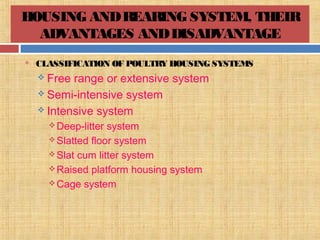
HOUSING ANDREARING SYSTEM, THEIR
ADVANTAGES ANDDISADVANTAGE
 CLASSIFICATION OF POULTRY HOUSING SYSTEMS
 Free range or extensive system
 Semi-intensive system
 Intensive system
Deep-litter system
Slatted floor system
Slat cum litter system
Raised platform housing system
Cage system
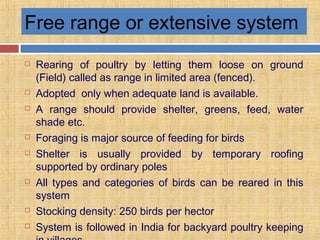
Free range or extensive system
 Rearing of poultry by letting them loose on ground
(Field) called as range in limited area (fenced).
 Adopted only when adequate land is available.
 A range should provide shelter, greens, feed, water
shade etc.
 Foraging is major source of feeding for birds
 Shelter is usually provided by temporary roofing
supported by ordinary poles
 All types and categories of birds can be reared in this
system
 Stocking density: 250 birds per hector
 System is followed in India for backyard poultry keeping
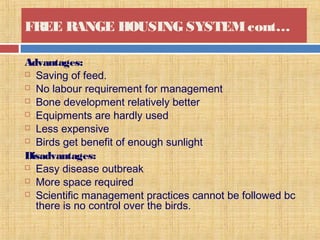
FREE RANGE HOUSING SYSTEMcont…
Advantages:
 Saving of feed.
 No labour requirement for management
 Bone development relatively better
 Equipments are hardly used
 Less expensive
 Birds get benefit of enough sunlight
Disadvantages:
 Easy disease outbreak
 More space required
 Scientific management practices cannot be followed bc
there is no control over the birds.
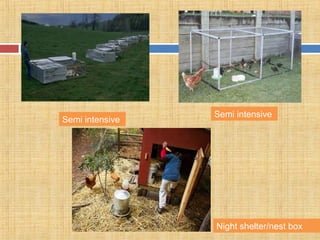
SEMI-INTENSIVE HOUSING
 Birds are half way reared in houses and half way on ground
or range.
 Birds are confined to houses in night or as per the need
they are also given access to runs.
 The houses are with solid floors while runs are fields only.
 Stocking density: 150-200 birds in a night shelter of 25
m.sq. and run area of 500 m.sq.
 Generally growers and cocks, ducks are maintained
ADVANTAGES:
 This system is low in cost.
DISADVANTAGES:
 Losses may be encountered by birds of prey and from
failure to find eggs laid in bushy areas. The poultry run
requires a considerable amount of fencing.
INTENSIVE SYSTEM
 Birds are totally confined
 Most efficient
 Convenient and economical system for modern
poultry production
DEEPLITTERHOUSING SYSTEM
ADVANTAGES:
 Litter material absorb moisture
 Provide dust bath to birds (decrease
ectoparasite)
 Easy removal of dropping
 Provide vit. B2 and Animal Protein Factor
 Built up litter- good organic fertilizer
DISADVANTAGES:
 Litter born diseases

SLAT SYSTEM OF HOUSING
ALL SLAT SYSTEM:
 Floor raised with wooden slats
 Slats- wooden pieces of 2.5-5 cm wide placed
2.5 cm apart running through the length of
house
 Slats placed 3 ft above the ground floor to allow
accumulation of dropping
Advantages:
 No chance of litter born diseases
 Easy collection of dropping
SLAT ANDLITTERSYSTEM
60% slat area and 40% litter area
Slats on either side of house against each side wall leaving central
portion for litter floor.
Used for broilers, growers, breeders
Advantages:
Avoid wetting of litter during rainy season
Easy handling operations from slat are
CAGE HOUSING SYSTEM
Types of cages:
 Californian cages
 Battery cages
 Flat deck cages
Depending up on type of birds housed:
 Brooder cage,
 Grower cage,
 Layer cage
Depending up on bird density:
 Single bird cage,
 Multiple bird cages,
 Colony cages
ADVANTAGES OF CAGE HOUSING
SYSTEM
 Less space requirement
 Birds under complete control
 Individual records are possible
 Inspection and culling is easy
 Labour utilized more efficiently
 High stocking density
 Better performance and feed efficiency
 Clean egg production
 Scientific managemental practices can be followed
 Uniform growth of birds
 Egg breakage reduced to minimum
 Litter problems are eliminated
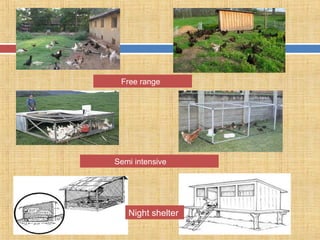
Free range
Semi intensive
Night shelter
Semi intensive
Night shelter/nest box
Semi intensive
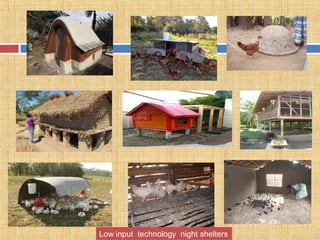
Low input technology night shelters
Housing of ducks
 Ducks do not require elaborate houses.
 The house should be well ventilated, dry and rat proof.
 It may have solid orwire floors.
 The wire floors are not popularwith breeders.
 Undersemi-intensive systemthe proportion of night
shelterto outside run is 1/4:3/4. The run should gently
slope away from the houses to provide drainage.
 Normally a continuous waterchannel of size 50 cm.
(20”) wide and 15-20cms. (6-8”) deep is constructed at
the farend, on both sides, parallel to the night shelter,
in the rearing orlayerhouse.
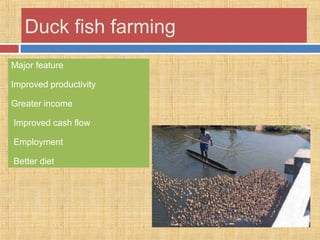
Duck fish farming
Major feature
Improved productivity
Greater income
Improved cash flow
Employment
Better diet
Brooding management
What is brooding?
The management with due care of baby chicks till two
weeks in broilers and 6 to 8 weeks in egg type birds is
known as brooding.
What is Brooder?
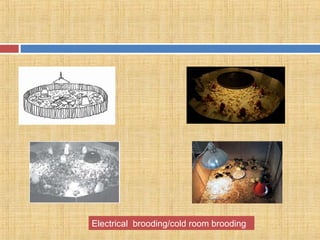
The device or equipment used for providing artificial heat
to baby chicks is known as brooder.
Methods of brooding
1. Natural method of brooding
2. Artificial method of brooding
Cold room brooding
Hot room brooding
Types of brooder:
Battery brooder
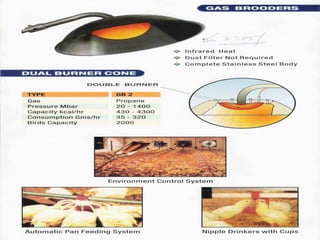
Gas
Infra red
Electrical
Charcoal
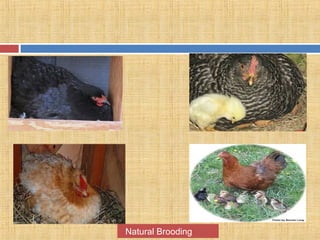
Natural Brooding
Electrical brooding/cold room brooding
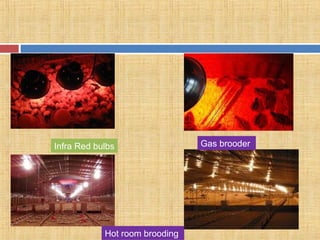
Infra Red bulbs Gas brooder
Hot room brooding
Cont…
Location of brooderhouse
 Distance between brooder house and other poultry
house should not be less than 100 meters.
Preparation of brooderhouse
 Cleaning and washing of brooder house
 Cleaning and washing of equipments
 Burning of cracks and crevices
 White wash
 Fumigation
 Arrangements of chick guards
 Arrangements of litter
 Arrangement of hover
 Paper arrangements for first 3 days
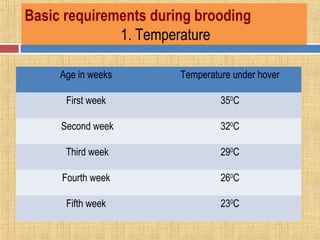
Basic requirements during brooding
1. Temperature
Age in weeks Temperature under hover
First week 350
C
Second week 320
C
Third week 290
C
Fourth week 260
C
Fifth week 230
C
Cont..
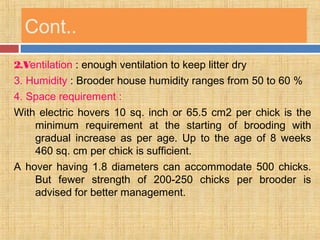
2.Ventilation : enough ventilation to keep litter dry
3. Humidity : Brooder house humidity ranges from 50 to 60 %
4. Space requirement :
With electric hovers 10 sq. inch or 65.5 cm2 per chick is the
minimum requirement at the starting of brooding with
gradual increase as per age. Up to the age of 8 weeks
460 sq. cm per chick is sufficient.
A hover having 1.8 diameters can accommodate 500 chicks.
But fewer strength of 200-250 chicks per brooder is
advised for better management.
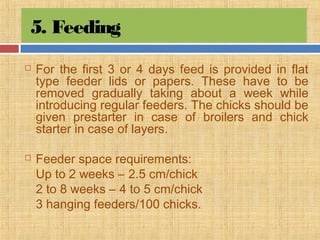
5. Feeding
 For the first 3 or 4 days feed is provided in flat
type feeder lids or papers. These have to be
removed gradually taking about a week while
introducing regular feeders. The chicks should be
given prestarter in case of broilers and chick
starter in case of layers.
 Feeder space requirements:
Up to 2 weeks – 2.5 cm/chick
2 to 8 weeks – 4 to 5 cm/chick
3 hanging feeders/100 chicks.
Cont..
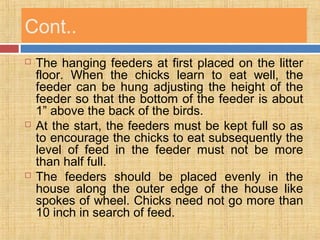
 The hanging feeders at first placed on the litter
floor. When the chicks learn to eat well, the
feeder can be hung adjusting the height of the
feeder so that the bottom of the feeder is about
1” above the back of the birds.
 At the start, the feeders must be kept full so as
to encourage the chicks to eat subsequently the
level of feed in the feeder must not be more
than half full.
 The feeders should be placed evenly in the
house along the outer edge of the house like
spokes of wheel. Chicks need not go more than
10 inch in search of feed.
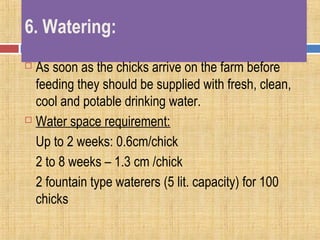
6. Watering:
 As soon as the chicks arrive on the farm before
feeding they should be supplied with fresh, clean,
cool and potable drinking water.
 Water space requirement:
Up to 2 weeks: 0.6cm/chick
2 to 8 weeks – 1.3 cm /chick
2 fountain type waterers (5 lit. capacity) for 100
chicks
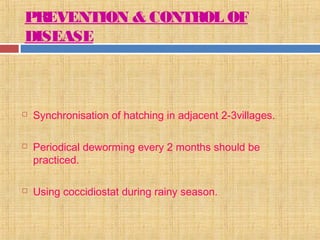
PREVENTION & CONTROL OF
DISEASE
 Synchronisation of hatching in adjacent 2-3villages.
 Periodical deworming every 2 months should be
practiced.
 Using coccidiostat during rainy season.
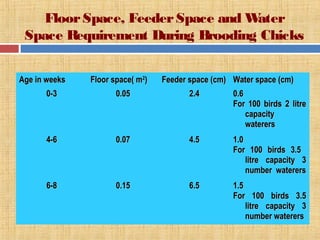
FloorSpace, FeederSpace and Water
Space Requirement During Brooding Chicks
Age in weeksAge in weeks Floor space( mFloor space( m22
)) Feeder space (cm)Feeder space (cm) Water space (cm)Water space (cm)
0-30-3 0.050.05 2.42.4 0.60.6
For 100 birds 2 litreFor 100 birds 2 litre
capacitycapacity
watererswaterers
4-64-6 0.070.07 4.54.5 1.01.0
For 100 birds 3.5For 100 birds 3.5
litre capacity 3litre capacity 3
number waterersnumber waterers
6-86-8 0.150.15 6.56.5 1.51.5
For 100 birds 3.5For 100 birds 3.5
litre capacity 3litre capacity 3
number waterersnumber waterers
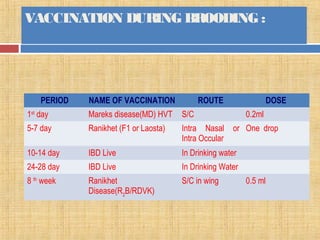
VACCINATION DURING BROODING :
PERIOD NAME OF VACCINATION ROUTE DOSE
1st
day Mareks disease(MD) HVT S/C 0.2ml
5-7 day Ranikhet (F1 or Laosta) Intra Nasal or
Intra Occular
One drop
10-14 day IBD Live In Drinking water
24-28 day IBD Live In Drinking Water
8 th
week Ranikhet
Disease(R2
B/RDVK)
S/C in wing 0.5 ml
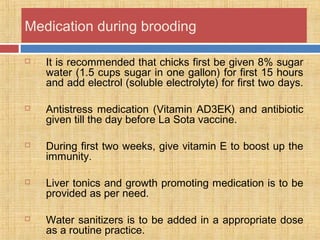
Medication during brooding
 It is recommended that chicks first be given 8% sugar
water (1.5 cups sugar in one gallon) for first 15 hours
and add electrol (soluble electrolyte) for first two days.
 Antistress medication (Vitamin AD3EK) and antibiotic
given till the day before La Sota vaccine.
 During first two weeks, give vitamin E to boost up the
immunity.
 Liver tonics and growth promoting medication is to be
provided as per need.
 Water sanitizers is to be added in a appropriate dose
as a routine practice.
Thank You
Thank you

Backyard poultry production

  • 1.
    HOUSING /NIGHT SHELTERANDBROODING OPERATIONSIN BACKYARDPOULTRY PRODUCTION PRESENTEDBY M.G.NIKAM Department of Poultry Science
  • 2.
    INTRODUCTION “THE HITECH SYSTEMSWHICH DOMINATE IN DEVELOPED COUNTRIESARENOT NECESSARILY BE APPROPRIATE AND MAY NOT WORK IN DENSELY POPULATED DEVELOPING COUNTRIES”. DR. YAMANDA FORMERPRESIDENT WPSA ( at 19th WPC at Amsterdam)
  • 3.
    HOUSING ANDREARING SYSTEM,THEIR ADVANTAGES ANDDISADVANTAGE  CLASSIFICATION OF POULTRY HOUSING SYSTEMS  Free range or extensive system  Semi-intensive system  Intensive system Deep-litter system Slatted floor system Slat cum litter system Raised platform housing system Cage system
  • 4.
    Free range orextensive system  Rearing of poultry by letting them loose on ground (Field) called as range in limited area (fenced).  Adopted only when adequate land is available.  A range should provide shelter, greens, feed, water shade etc.  Foraging is major source of feeding for birds  Shelter is usually provided by temporary roofing supported by ordinary poles  All types and categories of birds can be reared in this system  Stocking density: 250 birds per hector  System is followed in India for backyard poultry keeping
  • 5.
    FREE RANGE HOUSINGSYSTEMcont… Advantages:  Saving of feed.  No labour requirement for management  Bone development relatively better  Equipments are hardly used  Less expensive  Birds get benefit of enough sunlight Disadvantages:  Easy disease outbreak  More space required  Scientific management practices cannot be followed bc there is no control over the birds.
  • 6.
    SEMI-INTENSIVE HOUSING  Birdsare half way reared in houses and half way on ground or range.  Birds are confined to houses in night or as per the need they are also given access to runs.  The houses are with solid floors while runs are fields only.  Stocking density: 150-200 birds in a night shelter of 25 m.sq. and run area of 500 m.sq.  Generally growers and cocks, ducks are maintained ADVANTAGES:  This system is low in cost. DISADVANTAGES:  Losses may be encountered by birds of prey and from failure to find eggs laid in bushy areas. The poultry run requires a considerable amount of fencing.
  • 7.
    INTENSIVE SYSTEM  Birdsare totally confined  Most efficient  Convenient and economical system for modern poultry production
  • 8.
    DEEPLITTERHOUSING SYSTEM ADVANTAGES:  Littermaterial absorb moisture  Provide dust bath to birds (decrease ectoparasite)  Easy removal of dropping  Provide vit. B2 and Animal Protein Factor  Built up litter- good organic fertilizer DISADVANTAGES:  Litter born diseases 
  • 9.
    SLAT SYSTEM OFHOUSING ALL SLAT SYSTEM:  Floor raised with wooden slats  Slats- wooden pieces of 2.5-5 cm wide placed 2.5 cm apart running through the length of house  Slats placed 3 ft above the ground floor to allow accumulation of dropping Advantages:  No chance of litter born diseases  Easy collection of dropping
  • 10.
    SLAT ANDLITTERSYSTEM 60% slatarea and 40% litter area Slats on either side of house against each side wall leaving central portion for litter floor. Used for broilers, growers, breeders Advantages: Avoid wetting of litter during rainy season Easy handling operations from slat are
  • 11.
    CAGE HOUSING SYSTEM Typesof cages:  Californian cages  Battery cages  Flat deck cages Depending up on type of birds housed:  Brooder cage,  Grower cage,  Layer cage Depending up on bird density:  Single bird cage,  Multiple bird cages,  Colony cages
  • 12.
    ADVANTAGES OF CAGEHOUSING SYSTEM  Less space requirement  Birds under complete control  Individual records are possible  Inspection and culling is easy  Labour utilized more efficiently  High stocking density  Better performance and feed efficiency  Clean egg production  Scientific managemental practices can be followed  Uniform growth of birds  Egg breakage reduced to minimum  Litter problems are eliminated
  • 13.
  • 14.
  • 15.
    Low input technologynight shelters
  • 16.
    Housing of ducks Ducks do not require elaborate houses.  The house should be well ventilated, dry and rat proof.  It may have solid orwire floors.  The wire floors are not popularwith breeders.  Undersemi-intensive systemthe proportion of night shelterto outside run is 1/4:3/4. The run should gently slope away from the houses to provide drainage.  Normally a continuous waterchannel of size 50 cm. (20”) wide and 15-20cms. (6-8”) deep is constructed at the farend, on both sides, parallel to the night shelter, in the rearing orlayerhouse.
  • 18.
    Duck fish farming Majorfeature Improved productivity Greater income Improved cash flow Employment Better diet
  • 19.
    Brooding management What isbrooding? The management with due care of baby chicks till two weeks in broilers and 6 to 8 weeks in egg type birds is known as brooding. What is Brooder? The device or equipment used for providing artificial heat to baby chicks is known as brooder.
  • 20.
    Methods of brooding 1.Natural method of brooding 2. Artificial method of brooding Cold room brooding Hot room brooding Types of brooder: Battery brooder Gas Infra red Electrical Charcoal
  • 21.
  • 22.
  • 23.
    Infra Red bulbsGas brooder Hot room brooding
  • 25.
    Cont… Location of brooderhouse Distance between brooder house and other poultry house should not be less than 100 meters. Preparation of brooderhouse  Cleaning and washing of brooder house  Cleaning and washing of equipments  Burning of cracks and crevices  White wash  Fumigation  Arrangements of chick guards  Arrangements of litter  Arrangement of hover  Paper arrangements for first 3 days
  • 26.
    Basic requirements duringbrooding 1. Temperature Age in weeks Temperature under hover First week 350 C Second week 320 C Third week 290 C Fourth week 260 C Fifth week 230 C
  • 27.
    Cont.. 2.Ventilation : enoughventilation to keep litter dry 3. Humidity : Brooder house humidity ranges from 50 to 60 % 4. Space requirement : With electric hovers 10 sq. inch or 65.5 cm2 per chick is the minimum requirement at the starting of brooding with gradual increase as per age. Up to the age of 8 weeks 460 sq. cm per chick is sufficient. A hover having 1.8 diameters can accommodate 500 chicks. But fewer strength of 200-250 chicks per brooder is advised for better management.
  • 28.
    5. Feeding  Forthe first 3 or 4 days feed is provided in flat type feeder lids or papers. These have to be removed gradually taking about a week while introducing regular feeders. The chicks should be given prestarter in case of broilers and chick starter in case of layers.  Feeder space requirements: Up to 2 weeks – 2.5 cm/chick 2 to 8 weeks – 4 to 5 cm/chick 3 hanging feeders/100 chicks.
  • 29.
    Cont..  The hangingfeeders at first placed on the litter floor. When the chicks learn to eat well, the feeder can be hung adjusting the height of the feeder so that the bottom of the feeder is about 1” above the back of the birds.  At the start, the feeders must be kept full so as to encourage the chicks to eat subsequently the level of feed in the feeder must not be more than half full.  The feeders should be placed evenly in the house along the outer edge of the house like spokes of wheel. Chicks need not go more than 10 inch in search of feed.
  • 30.
    6. Watering:  Assoon as the chicks arrive on the farm before feeding they should be supplied with fresh, clean, cool and potable drinking water.  Water space requirement: Up to 2 weeks: 0.6cm/chick 2 to 8 weeks – 1.3 cm /chick 2 fountain type waterers (5 lit. capacity) for 100 chicks
  • 31.
    PREVENTION & CONTROLOF DISEASE  Synchronisation of hatching in adjacent 2-3villages.  Periodical deworming every 2 months should be practiced.  Using coccidiostat during rainy season.
  • 32.
    FloorSpace, FeederSpace andWater Space Requirement During Brooding Chicks Age in weeksAge in weeks Floor space( mFloor space( m22 )) Feeder space (cm)Feeder space (cm) Water space (cm)Water space (cm) 0-30-3 0.050.05 2.42.4 0.60.6 For 100 birds 2 litreFor 100 birds 2 litre capacitycapacity watererswaterers 4-64-6 0.070.07 4.54.5 1.01.0 For 100 birds 3.5For 100 birds 3.5 litre capacity 3litre capacity 3 number waterersnumber waterers 6-86-8 0.150.15 6.56.5 1.51.5 For 100 birds 3.5For 100 birds 3.5 litre capacity 3litre capacity 3 number waterersnumber waterers
  • 33.
    VACCINATION DURING BROODING: PERIOD NAME OF VACCINATION ROUTE DOSE 1st day Mareks disease(MD) HVT S/C 0.2ml 5-7 day Ranikhet (F1 or Laosta) Intra Nasal or Intra Occular One drop 10-14 day IBD Live In Drinking water 24-28 day IBD Live In Drinking Water 8 th week Ranikhet Disease(R2 B/RDVK) S/C in wing 0.5 ml
  • 34.
    Medication during brooding It is recommended that chicks first be given 8% sugar water (1.5 cups sugar in one gallon) for first 15 hours and add electrol (soluble electrolyte) for first two days.  Antistress medication (Vitamin AD3EK) and antibiotic given till the day before La Sota vaccine.  During first two weeks, give vitamin E to boost up the immunity.  Liver tonics and growth promoting medication is to be provided as per need.  Water sanitizers is to be added in a appropriate dose as a routine practice.
  • 35.