Prepared by
Dr. Harshini Alapati (M.V.Sc Poultry science)
Contractual Teaching Faculty
Dept of LFC
Veterinary College, Hassan
KVAFSU, Karnataka
HOUSING SYSTEMS FOR INTENSIVE
REARING OF POULTRY
 Birds are completely confined in the
houses either on floor (ground or
slatted floor) or in the cages.
 Most efficient system for the
commercial or modern poultry
production in huge numbers.
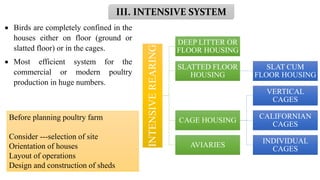
III. INTENSIVE SYSTEM
Before planning poultry farm
Consider ---selection of site
Orientation of houses
Layout of operations
Design and construction of sheds
INTENSIVE
REARING
DEEP LITTER OR
FLOOR HOUSING
SLATTED FLOOR
HOUSING
SLAT CUM
FLOOR HOUSING
CAGE HOUSING
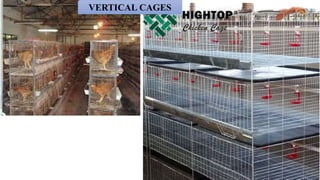
VERTICAL
CAGES
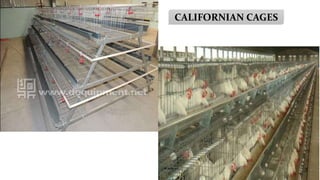
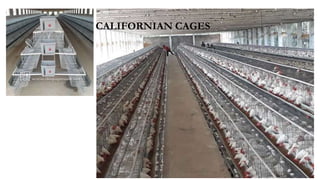
CALIFORNIAN
CAGES
INDIVIDUAL
CAGES
AVIARIES
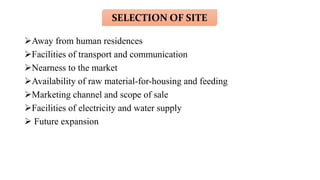
Away from human residences
Facilities of transport and communication
Nearness to the market
Availability of raw material-for-housing and feeding
Marketing channel and scope of sale
Facilities of electricity and water supply
 Future expansion
SELECTION OF SITE
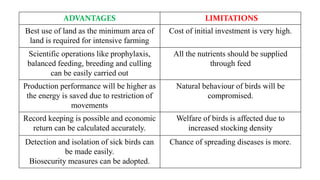
ADVANTAGES LIMITATIONS
Best use of land as the minimum area of
land is required for intensive farming
Cost of initial investment is very high.
Scientific operations like prophylaxis,
balanced feeding, breeding and culling
can be easily carried out
All the nutrients should be supplied
through feed
Production performance will be higher as
the energy is saved due to restriction of
movements
Natural behaviour of birds will be
compromised.
Record keeping is possible and economic
return can be calculated accurately.
Welfare of birds is affected due to
increased stocking density
Detection and isolation of sick birds can
be made easily.
Biosecurity measures can be adopted.
Chance of spreading diseases is more.
• Birds are housed on floor by placing over suitable litter material.
Characteristics of ideal litter material –
DEEP LITTER SYSTEM
 Light in weight
 Medium particle size
 Highly adsorbent
 Rapid drying
 Soft and compressible
 Low thermal conductivity
 Less expensive and easily available
 Biodegradable
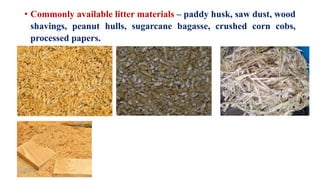
• Commonly available litter materials – paddy husk, saw dust, wood
shavings, peanut hulls, sugarcane bagasse, crushed corn cobs,
processed papers.
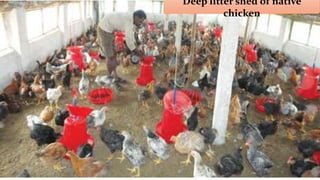
Deep litter shed of native
chicken
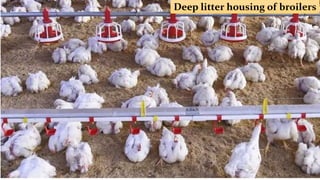
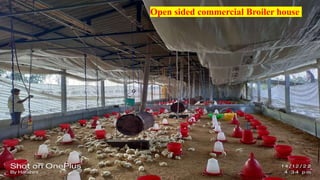
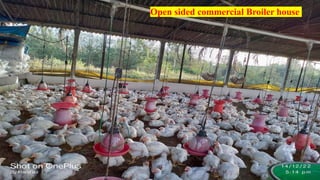
Deep litter housing of broilers
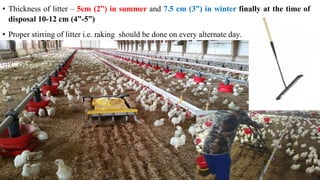
• Thickness of litter – 5cm (2”) in summer and 7.5 cm (3”) in winter finally at the time of
disposal 10-12 cm (4”-5”)
• Proper stirring of litter i.e. raking should be done on every alternate day.
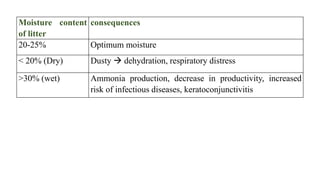
Moisture content
of litter
consequences
20-25% Optimum moisture
< 20% (Dry) Dusty  dehydration, respiratory distress
>30% (wet) Ammonia production, decrease in productivity, increased
risk of infectious diseases, keratoconjunctivitis
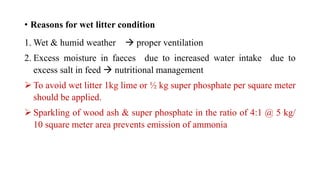
• Reasons for wet litter condition
1. Wet & humid weather  proper ventilation
2. Excess moisture in faeces due to increased water intake due to
excess salt in feed  nutritional management
 To avoid wet litter 1kg lime or ½ kg super phosphate per square meter
should be applied.
 Sparkling of wood ash & super phosphate in the ratio of 4:1 @ 5 kg/
10 square meter area prevents emission of ammonia
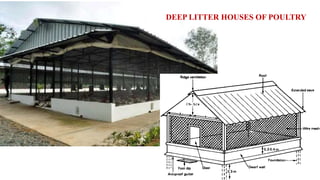
DEEP LITTER HOUSES OF POULTRY
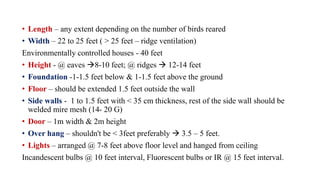
• Length – any extent depending on the number of birds reared
• Width – 22 to 25 feet ( > 25 feet – ridge ventilation)
Environmentally controlled houses - 40 feet
• Height - @ eaves 8-10 feet; @ ridges  12-14 feet
• Foundation -1-1.5 feet below & 1-1.5 feet above the ground
• Floor – should be extended 1.5 feet outside the wall
• Side walls - 1 to 1.5 feet with < 35 cm thickness, rest of the side wall should be
welded mire mesh (14- 20 G)
• Door – 1m width & 2m height
• Over hang – shouldn't be < 3feet preferably  3.5 – 5 feet.
• Lights – arranged @ 7-8 feet above floor level and hanged from ceiling
Incandescent bulbs @ 10 feet interval, Fluorescent bulbs or IR @ 15 feet interval.
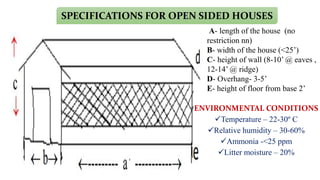
SPECIFICATIONS FOR OPEN SIDED HOUSES
A- length of the house (no
restriction nn)
B- width of the house (<25’)
C- height of wall (8-10’ @ eaves ,
12-14’ @ ridge)
D- Overhang- 3-5’
E- height of floor from base 2’
ENVIRONMENTAL CONDITIONS
Temperature – 22-30º C
Relative humidity – 30-60%
Ammonia -<25 ppm
Litter moisture – 20%
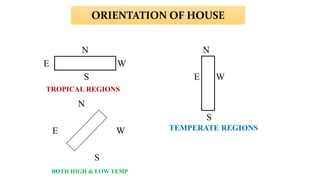
ORIENTATION OF HOUSE
N N
E W
S E W
N
S
E W
S
TEMPERATE REGIONS
TROPICAL REGIONS
BOTH HIGH & LOW TEMP
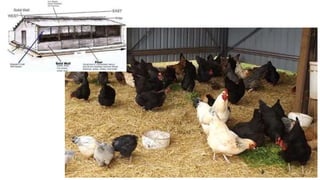
Open sided commercial Broiler house
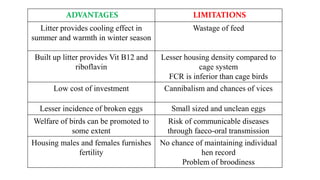
ADVANTAGES LIMITATIONS
Litter provides cooling effect in
summer and warmth in winter season
Wastage of feed
Built up litter provides Vit B12 and
riboflavin
Lesser housing density compared to
cage system
FCR is inferior than cage birds
Low cost of investment Cannibalism and chances of vices
Lesser incidence of broken eggs Small sized and unclean eggs
Welfare of birds can be promoted to
some extent
Risk of communicable diseases
through faeco-oral transmission
Housing males and females furnishes
fertility
No chance of maintaining individual
hen record
Problem of broodiness
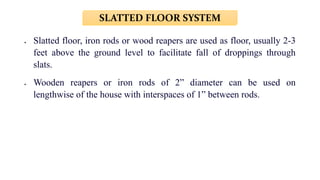
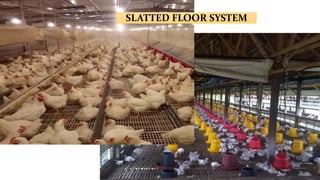
 Slatted floor, iron rods or wood reapers are used as floor, usually 2-3
feet above the ground level to facilitate fall of droppings through
slats.
 Wooden reapers or iron rods of 2” diameter can be used on
lengthwise of the house with interspaces of 1” between rods.
SLATTED FLOOR SYSTEM
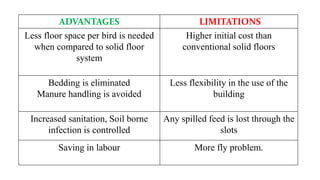
ADVANTAGES LIMITATIONS
Less floor space per bird is needed
when compared to solid floor
system
Higher initial cost than
conventional solid floors
Bedding is eliminated
Manure handling is avoided
Less flexibility in the use of the
building
Increased sanitation, Soil borne
infection is controlled
Any spilled feed is lost through the
slots
Saving in labour More fly problem.
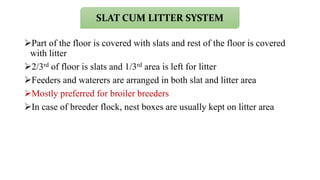
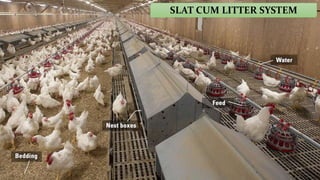
Part of the floor is covered with slats and rest of the floor is covered
with litter
2/3rd of floor is slats and 1/3rd area is left for litter
Feeders and waterers are arranged in both slat and litter area
Mostly preferred for broiler breeders
In case of breeder flock, nest boxes are usually kept on litter area
SLAT CUM LITTER SYSTEM
ADVANTAGES LIMITATIONS
More eggs can be produced per
unit of floor space than all solid
floors.
Housing investment is higher with
the slat cum litter house than with
the all-litter house.
Fertility is better with the slat
cum litter house than with the all-
slat house
Manure beneath the slats
commonly results in fly problems.
 This system involves rearing of poultry on raised wire netting floor in smaller
compartments, called cages.
 Very efficient for LAYERS.
 Feeders and waterers are attached to cages from outside except nipple
waterers, for which pipeline is installed through or above cages.
 Auto-operated feeding trolleys and egg collection belts can also be used in
this rearing system.
 The droppings are either collected in trays underneath cages or on belts or on
the floor or deep pit under cages, depending on type of cages.
CAGE SYSTEM
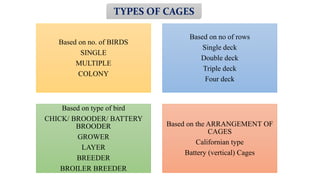
Based on no. of BIRDS
SINGLE
MULTIPLE
COLONY
Based on no of rows
Single deck
Double deck
Triple deck
Four deck
Based on type of bird
CHICK/ BROODER/ BATTERY
BROODER
GROWER
LAYER
BREEDER
BROILER BREEDER
Based on the ARRANGEMENT OF
CAGES
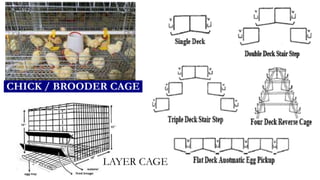
Californian type
Battery (vertical) Cages
TYPES OF CAGES
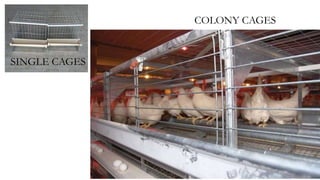
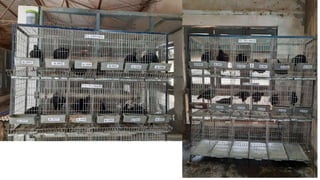
SINGLE CAGES
COLONY CAGES
VERTICAL CAGES
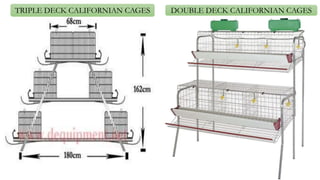
CALIFORNIAN CAGES
CALIFORNIAN CAGES
DOUBLE DECK CALIFORNIAN CAGES
TRIPLE DECK CALIFORNIAN CAGES
CHICK / BROODER CAGE
LAYER CAGE
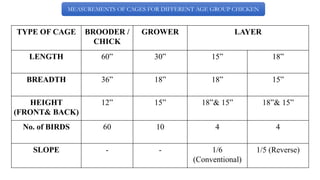
TYPE OF CAGE BROODER /
CHICK
GROWER LAYER
LENGTH 60” 30” 15” 18”
BREADTH 36” 18” 18” 15”
HEIGHT
(FRONT& BACK)
12” 15” 18”& 15” 18”& 15”
No. of BIRDS 60 10 4 4
SLOPE - - 1/6
(Conventional)
1/5 (Reverse)
MEASUREMENTS OF CAGES FOR DIFFERENT AGE GROUP CHICKEN
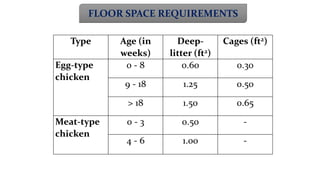
Type Age (in
weeks)
Deep-
litter (ft2)
Cages (ft2)
Egg-type
chicken
0 - 8 0.60 0.30
9 - 18 1.25 0.50
> 18 1.50 0.65
Meat-type
chicken
0 - 3 0.50 -
4 - 6 1.00 -
FLOOR SPACE REQUIREMENTS
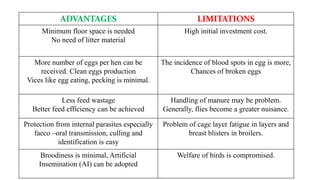
ADVANTAGES LIMITATIONS
Minimum floor space is needed
No need of litter material
High initial investment cost.
More number of eggs per hen can be
received. Clean eggs production
Vices like egg eating, pecking is minimal.
The incidence of blood spots in egg is more,
Chances of broken eggs
Less feed wastage
Better feed efficiency can be achieved
Handling of manure may be problem.
Generally, flies become a greater nuisance.
Protection from internal parasites especially
faeco –oral transmission, culling and
identification is easy
Problem of cage layer fatigue in layers and
breast blisters in broilers.
Broodiness is minimal, Artificial
Insemination (AI) can be adopted
Welfare of birds is compromised.
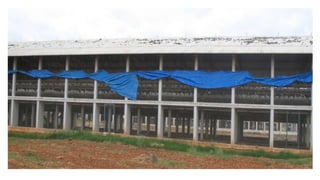
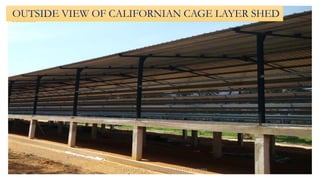
OUTSIDE VIEW OF CALIFORNIAN CAGE LAYER SHED
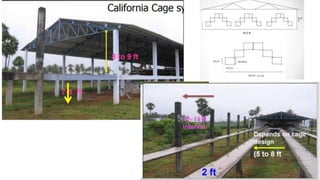
 The height of the shed is raised by 6-7 feet using concrete pillars.
 The distance between two pillars is 10 feet.
 Two feet wide concrete platforms are made over the pillars. When 3 ‘M’ type cages
are arranged 4 platforms are needed.
 In case of 2 ‘M’ and 2 ‘L’ type cages are arranged 3 platforms are needed.
 When constructing platforms projecting angles or iron rods to be provided to fix
the cages.
 The inter-platform distance is 6-7 feet depending upon the type of the cages used.
 The total height of the house is 20-25 feet and the width is 30-33 feet. This type of
houses provides sufficient ventilation in tropical countries.
ELEVATED CAGE LAYER HOUSE
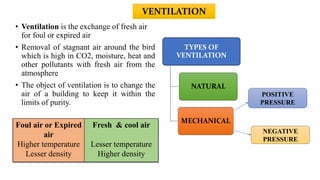
• Ventilation is the exchange of fresh air
for foul or expired air
• Removal of stagnant air around the bird
which is high in CO2, moisture, heat and
other pollutants with fresh air from the
atmosphere
• The object of ventilation is to change the
air of a building to keep it within the
limits of purity.
VENTILATION
Foul air or Expired
air
Higher temperature
Lesser density
Fresh & cool air
Lesser temperature
Higher density
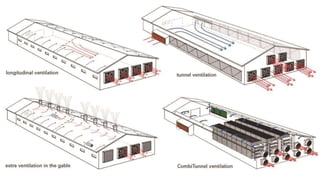
TYPES OF
VENTILATION
NATURAL
MECHANICAL
POSITIVE
PRESSURE
NEGATIVE
PRESSURE
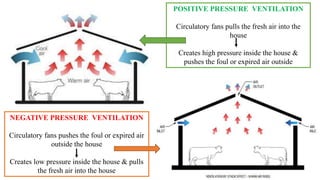
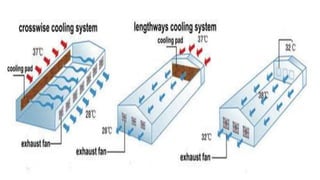
POSITIVE PRESSURE VENTILATION
Circulatory fans pulls the fresh air into the
house
Creates high pressure inside the house &
pushes the foul or expired air outside
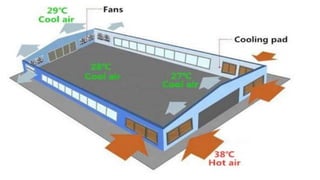
NEGATIVE PRESSURE VENTILATION
Circulatory fans pushes the foul or expired air
outside the house
Creates low pressure inside the house & pulls
the fresh air into the house
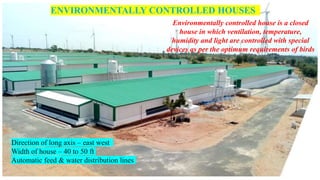
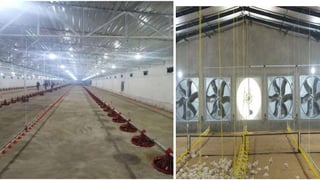
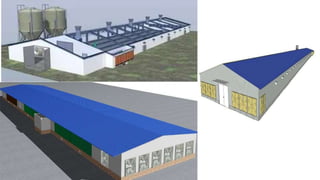
ENVIRONMENTALLY CONTROLLED HOUSES
Environmentally controlled house is a closed
house in which ventilation, temperature,
humidity and light are controlled with special
devices as per the optimum requirements of birds
Direction of long axis – east west
Width of house – 40 to 50 ft
Automatic feed & water distribution lines
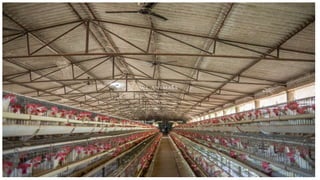
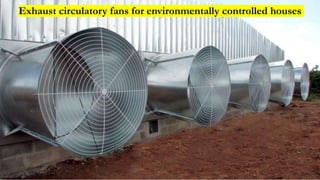
Exhaust circulatory fans for environmentally controlled houses
Intensive Housing systems for Poultry.pptx

Intensive Housing systems for Poultry.pptx

  • 1.
    Prepared by Dr. HarshiniAlapati (M.V.Sc Poultry science) Contractual Teaching Faculty Dept of LFC Veterinary College, Hassan KVAFSU, Karnataka HOUSING SYSTEMS FOR INTENSIVE REARING OF POULTRY
  • 2.
     Birds arecompletely confined in the houses either on floor (ground or slatted floor) or in the cages.  Most efficient system for the commercial or modern poultry production in huge numbers. III. INTENSIVE SYSTEM Before planning poultry farm Consider ---selection of site Orientation of houses Layout of operations Design and construction of sheds INTENSIVE REARING DEEP LITTER OR FLOOR HOUSING SLATTED FLOOR HOUSING SLAT CUM FLOOR HOUSING CAGE HOUSING VERTICAL CAGES CALIFORNIAN CAGES INDIVIDUAL CAGES AVIARIES
  • 3.
    Away from humanresidences Facilities of transport and communication Nearness to the market Availability of raw material-for-housing and feeding Marketing channel and scope of sale Facilities of electricity and water supply  Future expansion SELECTION OF SITE
  • 4.
    ADVANTAGES LIMITATIONS Best useof land as the minimum area of land is required for intensive farming Cost of initial investment is very high. Scientific operations like prophylaxis, balanced feeding, breeding and culling can be easily carried out All the nutrients should be supplied through feed Production performance will be higher as the energy is saved due to restriction of movements Natural behaviour of birds will be compromised. Record keeping is possible and economic return can be calculated accurately. Welfare of birds is affected due to increased stocking density Detection and isolation of sick birds can be made easily. Biosecurity measures can be adopted. Chance of spreading diseases is more.
  • 5.
    • Birds arehoused on floor by placing over suitable litter material. Characteristics of ideal litter material – DEEP LITTER SYSTEM  Light in weight  Medium particle size  Highly adsorbent  Rapid drying  Soft and compressible  Low thermal conductivity  Less expensive and easily available  Biodegradable
  • 6.
    • Commonly availablelitter materials – paddy husk, saw dust, wood shavings, peanut hulls, sugarcane bagasse, crushed corn cobs, processed papers.
  • 7.
    Deep litter shedof native chicken
  • 8.
  • 9.
    • Thickness oflitter – 5cm (2”) in summer and 7.5 cm (3”) in winter finally at the time of disposal 10-12 cm (4”-5”) • Proper stirring of litter i.e. raking should be done on every alternate day.
  • 10.
    Moisture content of litter consequences 20-25%Optimum moisture < 20% (Dry) Dusty  dehydration, respiratory distress >30% (wet) Ammonia production, decrease in productivity, increased risk of infectious diseases, keratoconjunctivitis
  • 11.
    • Reasons forwet litter condition 1. Wet & humid weather  proper ventilation 2. Excess moisture in faeces due to increased water intake due to excess salt in feed  nutritional management  To avoid wet litter 1kg lime or ½ kg super phosphate per square meter should be applied.  Sparkling of wood ash & super phosphate in the ratio of 4:1 @ 5 kg/ 10 square meter area prevents emission of ammonia
  • 12.
  • 13.
    • Length –any extent depending on the number of birds reared • Width – 22 to 25 feet ( > 25 feet – ridge ventilation) Environmentally controlled houses - 40 feet • Height - @ eaves 8-10 feet; @ ridges  12-14 feet • Foundation -1-1.5 feet below & 1-1.5 feet above the ground • Floor – should be extended 1.5 feet outside the wall • Side walls - 1 to 1.5 feet with < 35 cm thickness, rest of the side wall should be welded mire mesh (14- 20 G) • Door – 1m width & 2m height • Over hang – shouldn't be < 3feet preferably  3.5 – 5 feet. • Lights – arranged @ 7-8 feet above floor level and hanged from ceiling Incandescent bulbs @ 10 feet interval, Fluorescent bulbs or IR @ 15 feet interval.
  • 14.
    SPECIFICATIONS FOR OPENSIDED HOUSES A- length of the house (no restriction nn) B- width of the house (<25’) C- height of wall (8-10’ @ eaves , 12-14’ @ ridge) D- Overhang- 3-5’ E- height of floor from base 2’ ENVIRONMENTAL CONDITIONS Temperature – 22-30º C Relative humidity – 30-60% Ammonia -<25 ppm Litter moisture – 20%
  • 15.
    ORIENTATION OF HOUSE NN E W S E W N S E W S TEMPERATE REGIONS TROPICAL REGIONS BOTH HIGH & LOW TEMP
  • 17.
    Open sided commercialBroiler house
  • 18.
    Open sided commercialBroiler house
  • 19.
    ADVANTAGES LIMITATIONS Litter providescooling effect in summer and warmth in winter season Wastage of feed Built up litter provides Vit B12 and riboflavin Lesser housing density compared to cage system FCR is inferior than cage birds Low cost of investment Cannibalism and chances of vices Lesser incidence of broken eggs Small sized and unclean eggs Welfare of birds can be promoted to some extent Risk of communicable diseases through faeco-oral transmission Housing males and females furnishes fertility No chance of maintaining individual hen record Problem of broodiness
  • 20.
     Slatted floor,iron rods or wood reapers are used as floor, usually 2-3 feet above the ground level to facilitate fall of droppings through slats.  Wooden reapers or iron rods of 2” diameter can be used on lengthwise of the house with interspaces of 1” between rods. SLATTED FLOOR SYSTEM
  • 21.
  • 22.
    ADVANTAGES LIMITATIONS Less floorspace per bird is needed when compared to solid floor system Higher initial cost than conventional solid floors Bedding is eliminated Manure handling is avoided Less flexibility in the use of the building Increased sanitation, Soil borne infection is controlled Any spilled feed is lost through the slots Saving in labour More fly problem.
  • 23.
    Part of thefloor is covered with slats and rest of the floor is covered with litter 2/3rd of floor is slats and 1/3rd area is left for litter Feeders and waterers are arranged in both slat and litter area Mostly preferred for broiler breeders In case of breeder flock, nest boxes are usually kept on litter area SLAT CUM LITTER SYSTEM
  • 24.
  • 25.
    ADVANTAGES LIMITATIONS More eggscan be produced per unit of floor space than all solid floors. Housing investment is higher with the slat cum litter house than with the all-litter house. Fertility is better with the slat cum litter house than with the all- slat house Manure beneath the slats commonly results in fly problems.
  • 26.
     This systeminvolves rearing of poultry on raised wire netting floor in smaller compartments, called cages.  Very efficient for LAYERS.  Feeders and waterers are attached to cages from outside except nipple waterers, for which pipeline is installed through or above cages.  Auto-operated feeding trolleys and egg collection belts can also be used in this rearing system.  The droppings are either collected in trays underneath cages or on belts or on the floor or deep pit under cages, depending on type of cages. CAGE SYSTEM
  • 27.
    Based on no.of BIRDS SINGLE MULTIPLE COLONY Based on no of rows Single deck Double deck Triple deck Four deck Based on type of bird CHICK/ BROODER/ BATTERY BROODER GROWER LAYER BREEDER BROILER BREEDER Based on the ARRANGEMENT OF CAGES Californian type Battery (vertical) Cages TYPES OF CAGES
  • 28.
  • 29.
  • 31.
  • 32.
  • 33.
    DOUBLE DECK CALIFORNIANCAGES TRIPLE DECK CALIFORNIAN CAGES
  • 34.
    CHICK / BROODERCAGE LAYER CAGE
  • 35.
    TYPE OF CAGEBROODER / CHICK GROWER LAYER LENGTH 60” 30” 15” 18” BREADTH 36” 18” 18” 15” HEIGHT (FRONT& BACK) 12” 15” 18”& 15” 18”& 15” No. of BIRDS 60 10 4 4 SLOPE - - 1/6 (Conventional) 1/5 (Reverse) MEASUREMENTS OF CAGES FOR DIFFERENT AGE GROUP CHICKEN
  • 36.
    Type Age (in weeks) Deep- litter(ft2) Cages (ft2) Egg-type chicken 0 - 8 0.60 0.30 9 - 18 1.25 0.50 > 18 1.50 0.65 Meat-type chicken 0 - 3 0.50 - 4 - 6 1.00 - FLOOR SPACE REQUIREMENTS
  • 37.
    ADVANTAGES LIMITATIONS Minimum floorspace is needed No need of litter material High initial investment cost. More number of eggs per hen can be received. Clean eggs production Vices like egg eating, pecking is minimal. The incidence of blood spots in egg is more, Chances of broken eggs Less feed wastage Better feed efficiency can be achieved Handling of manure may be problem. Generally, flies become a greater nuisance. Protection from internal parasites especially faeco –oral transmission, culling and identification is easy Problem of cage layer fatigue in layers and breast blisters in broilers. Broodiness is minimal, Artificial Insemination (AI) can be adopted Welfare of birds is compromised.
  • 39.
    OUTSIDE VIEW OFCALIFORNIAN CAGE LAYER SHED
  • 42.
     The heightof the shed is raised by 6-7 feet using concrete pillars.  The distance between two pillars is 10 feet.  Two feet wide concrete platforms are made over the pillars. When 3 ‘M’ type cages are arranged 4 platforms are needed.  In case of 2 ‘M’ and 2 ‘L’ type cages are arranged 3 platforms are needed.  When constructing platforms projecting angles or iron rods to be provided to fix the cages.  The inter-platform distance is 6-7 feet depending upon the type of the cages used.  The total height of the house is 20-25 feet and the width is 30-33 feet. This type of houses provides sufficient ventilation in tropical countries. ELEVATED CAGE LAYER HOUSE
  • 44.
    • Ventilation isthe exchange of fresh air for foul or expired air • Removal of stagnant air around the bird which is high in CO2, moisture, heat and other pollutants with fresh air from the atmosphere • The object of ventilation is to change the air of a building to keep it within the limits of purity. VENTILATION Foul air or Expired air Higher temperature Lesser density Fresh & cool air Lesser temperature Higher density TYPES OF VENTILATION NATURAL MECHANICAL POSITIVE PRESSURE NEGATIVE PRESSURE
  • 45.
    POSITIVE PRESSURE VENTILATION Circulatoryfans pulls the fresh air into the house Creates high pressure inside the house & pushes the foul or expired air outside NEGATIVE PRESSURE VENTILATION Circulatory fans pushes the foul or expired air outside the house Creates low pressure inside the house & pulls the fresh air into the house
  • 46.
    ENVIRONMENTALLY CONTROLLED HOUSES Environmentallycontrolled house is a closed house in which ventilation, temperature, humidity and light are controlled with special devices as per the optimum requirements of birds Direction of long axis – east west Width of house – 40 to 50 ft Automatic feed & water distribution lines
  • 48.
    Exhaust circulatory fansfor environmentally controlled houses