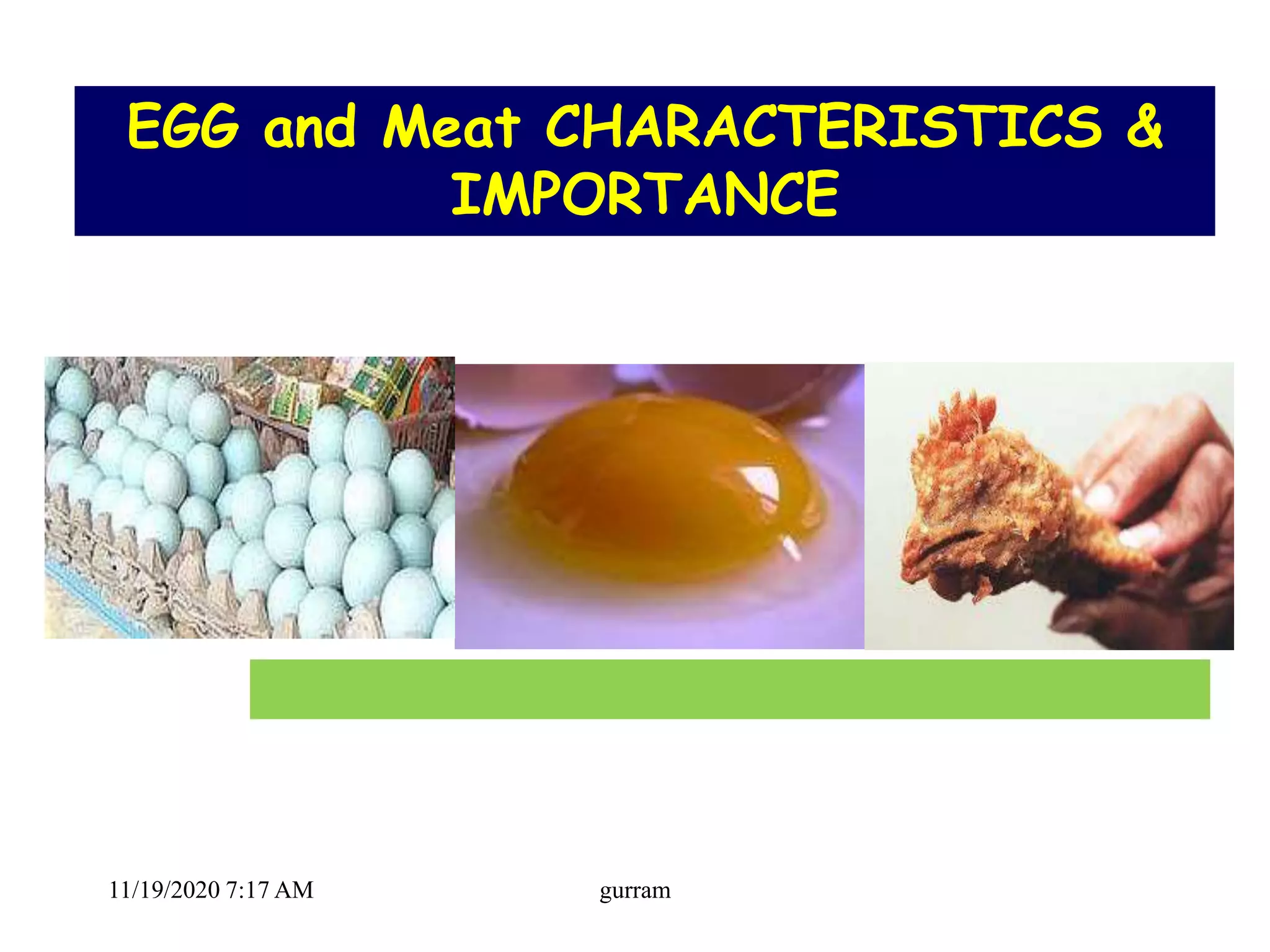
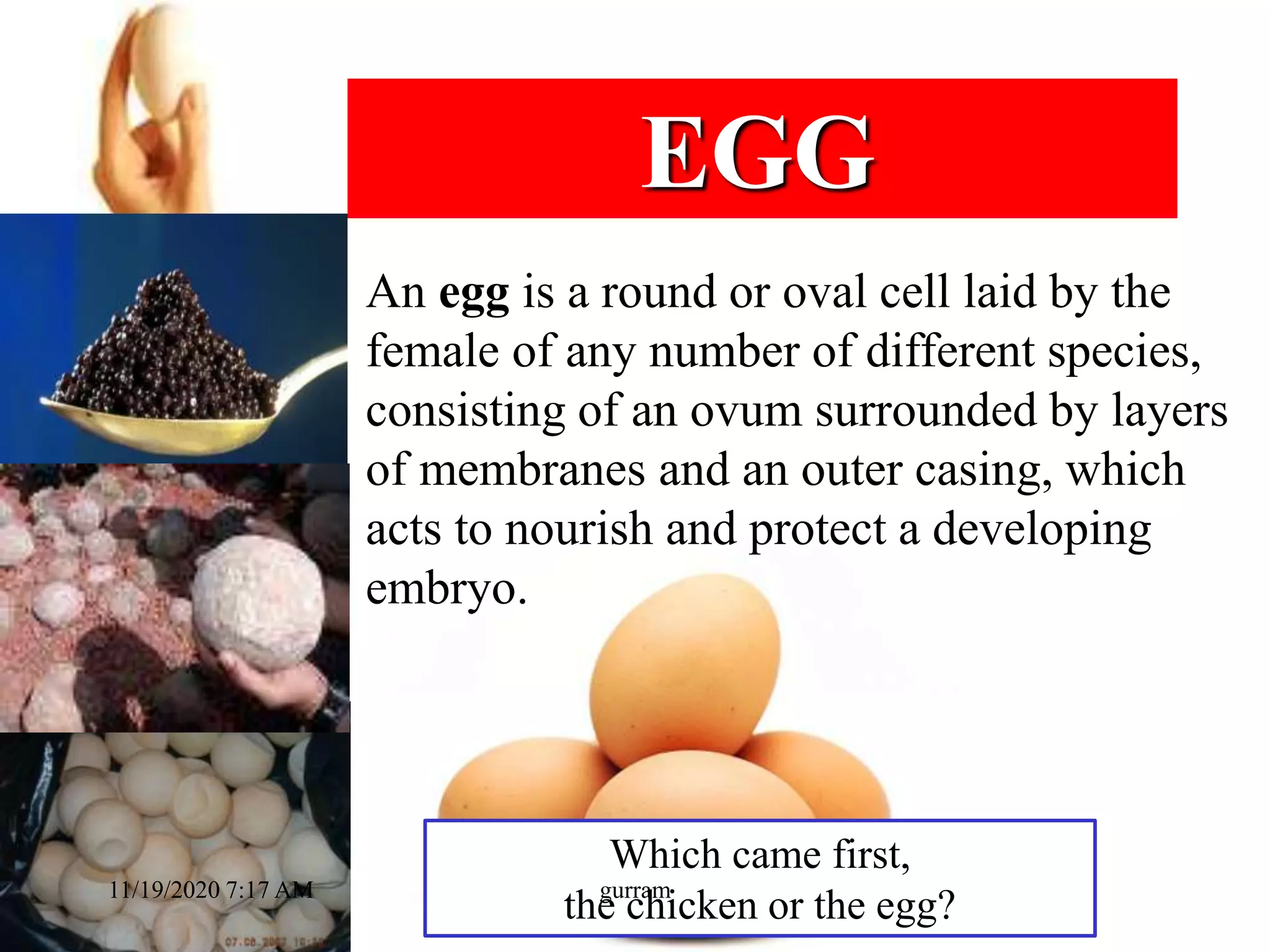
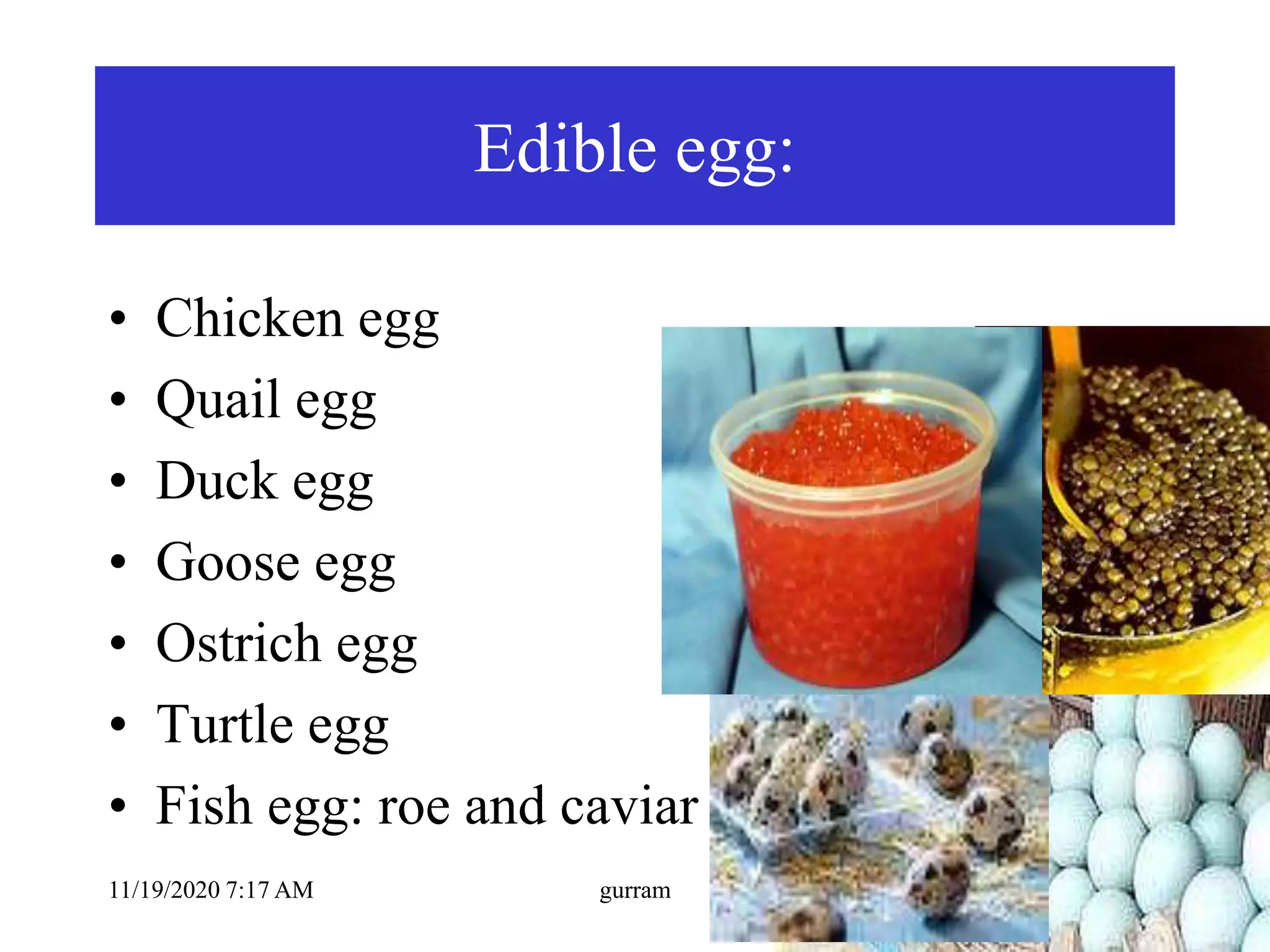
EGG and Meat CHARACTERISTICS &
IMPORTANCE
11/19/2020 7:17 AM gurram
EGG
An egg is a round or oval cell laid by the
female of any number of different species,
consisting of an ovum surrounded by layers
of membranes and an outer casing, which
acts to nourish and protect a developing
embryo.
Which came first,
the chicken or the egg?11/19/2020 7:17 AM gurram
Edible egg:
• Chicken egg
• Quail egg
• Duck egg
• Goose egg
• Ostrich egg
• Turtle egg
• Fish egg: roe and caviar
11/19/2020 7:17 AM gurram
Commercial Egg:
• These are hen eggs in shell,
suitable for consumption in the
state, or use by food industries,
excluding broken eggs and
boiled eggs (CEE Regulation
No. 1907/90).
• Most laying hens are White
Leghorns .
11/19/2020 7:17 AM gurram
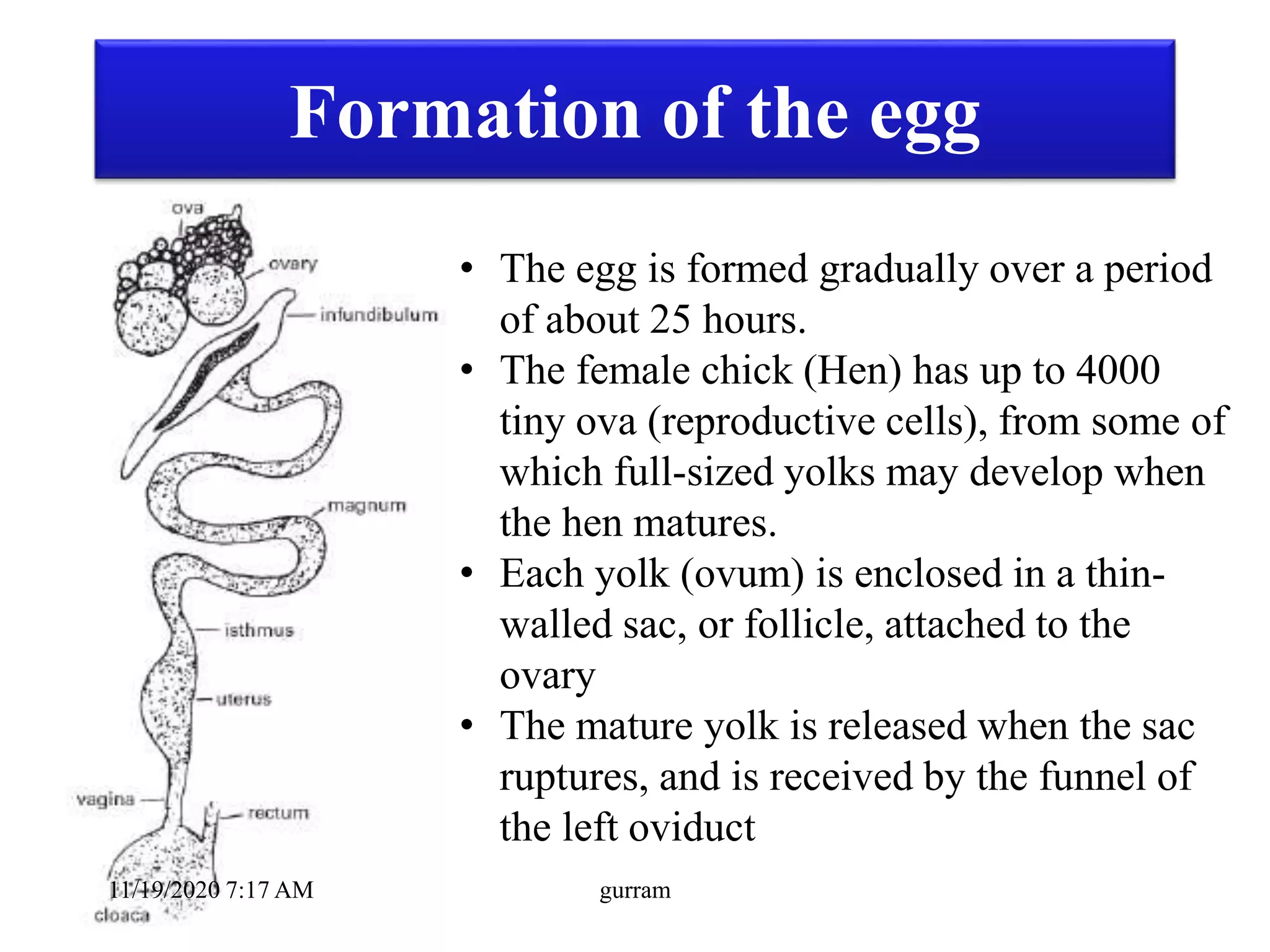
Formation of the egg
• The egg is formed gradually over a period
of about 25 hours.
• The female chick (Hen) has up to 4000
tiny ova (reproductive cells), from some of
which full-sized yolks may develop when
the hen matures.
• Each yolk (ovum) is enclosed in a thin-
walled sac, or follicle, attached to the
ovary
• The mature yolk is released when the sac
ruptures, and is received by the funnel of
the left oviduct
11/19/2020 7:17 AM gurram
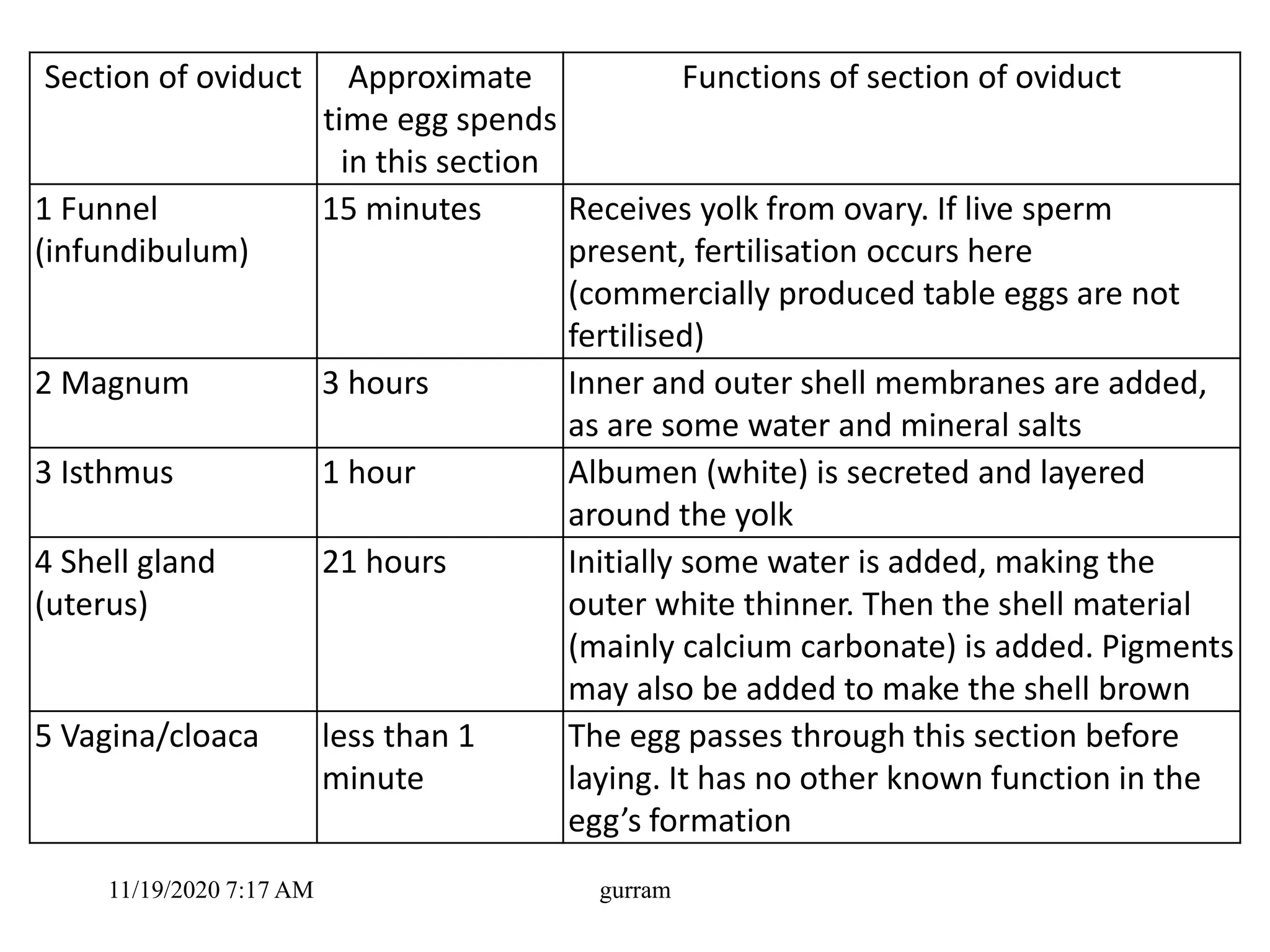
Section of oviduct Approximate
time egg spends
in this section
Functions of section of oviduct
1 Funnel
(infundibulum)
15 minutes Receives yolk from ovary. If live sperm
present, fertilisation occurs here
(commercially produced table eggs are not
fertilised)
2 Magnum 3 hours Inner and outer shell membranes are added,
as are some water and mineral salts
3 Isthmus 1 hour Albumen (white) is secreted and layered
around the yolk
4 Shell gland
(uterus)
21 hours Initially some water is added, making the
outer white thinner. Then the shell material
(mainly calcium carbonate) is added. Pigments
may also be added to make the shell brown
5 Vagina/cloaca less than 1
minute
The egg passes through this section before
laying. It has no other known function in the
egg’s formation
11/19/2020 7:17 AM gurram
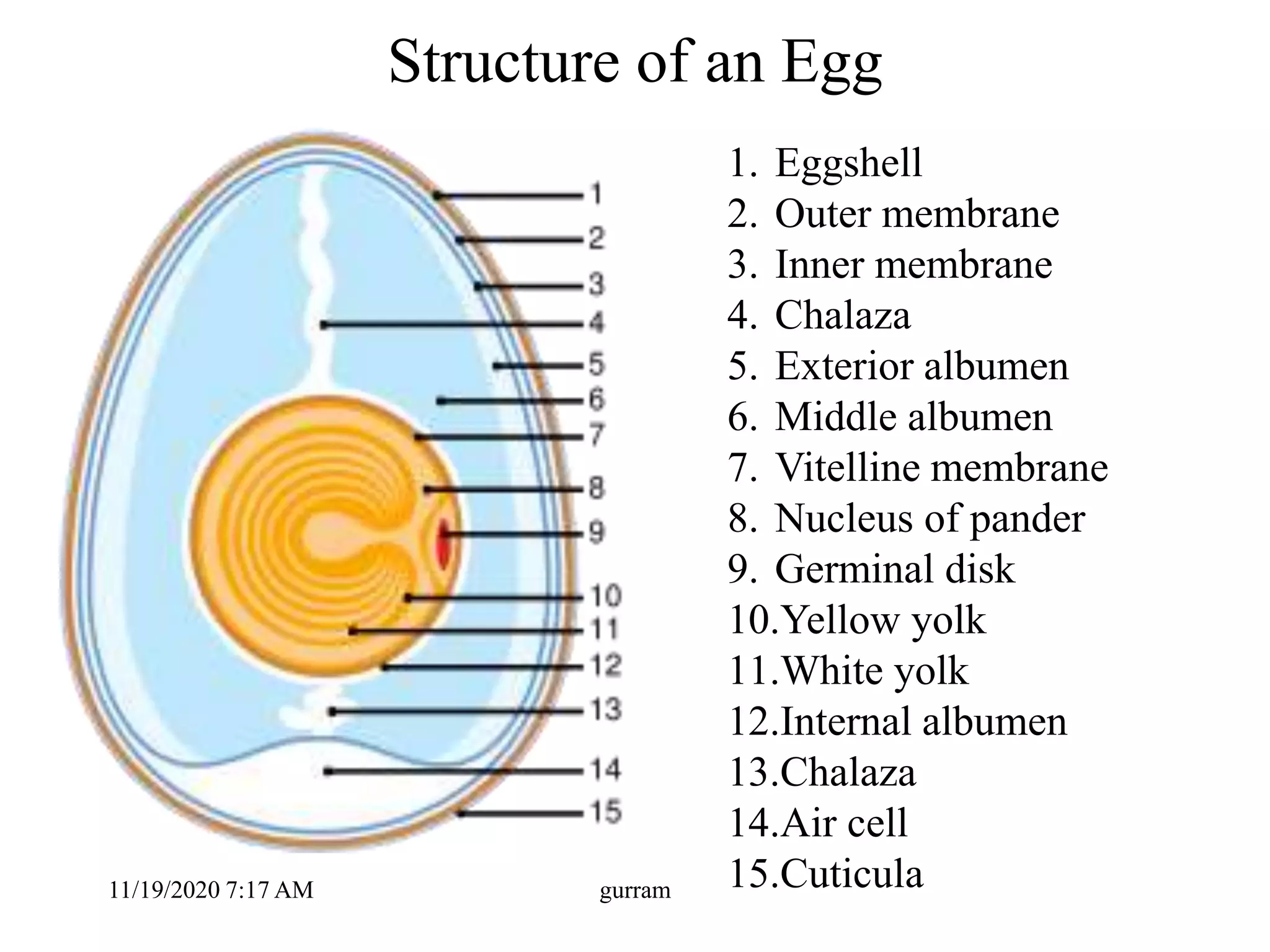
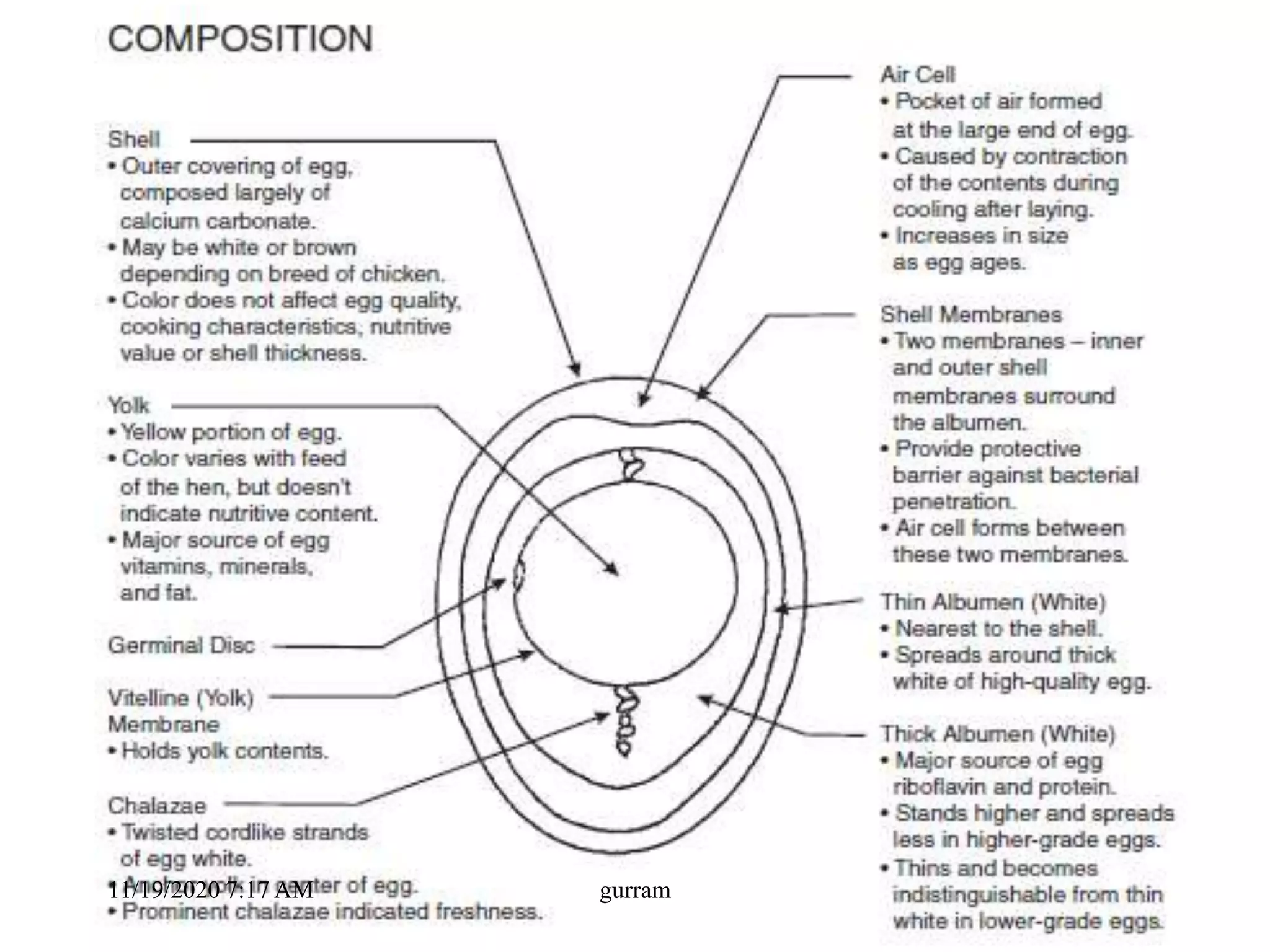
Structure of an Egg
1. Eggshell
2. Outer membrane
3. Inner membrane
4. Chalaza
5. Exterior albumen
6. Middle albumen
7. Vitelline membrane
8. Nucleus of pander
9. Germinal disk
10.Yellow yolk
11.White yolk
12.Internal albumen
13.Chalaza
14.Air cell
15.Cuticula11/19/2020 7:17 AM gurram
11/19/2020 7:17 AM gurram
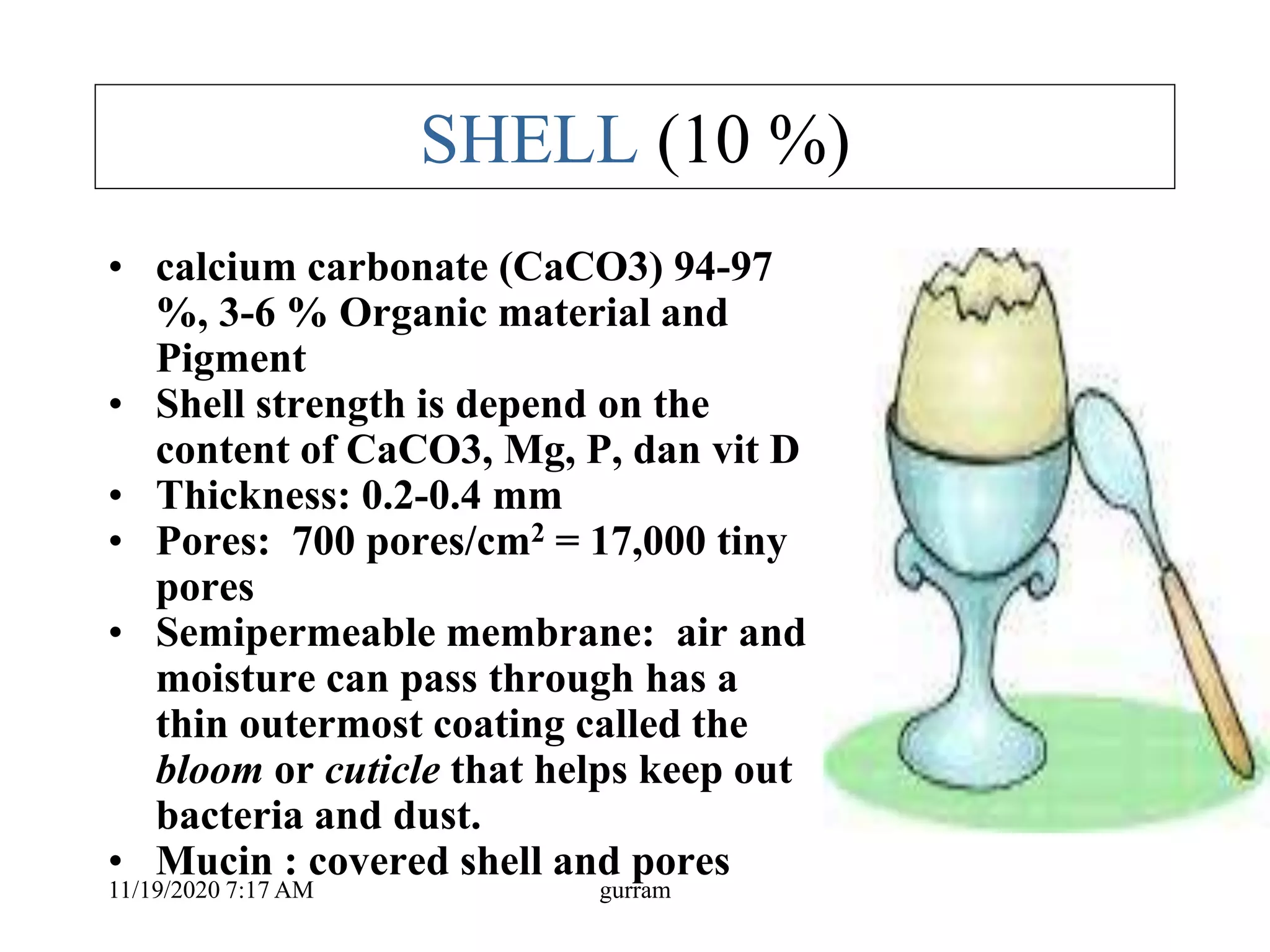
SHELL (10 %)
• calcium carbonate (CaCO3) 94-97
%, 3-6 % Organic material and
Pigment
• Shell strength is depend on the
content of CaCO3, Mg, P, dan vit D
• Thickness: 0.2-0.4 mm
• Pores: 700 pores/cm2 = 17,000 tiny
pores
• Semipermeable membrane: air and
moisture can pass through has a
thin outermost coating called the
bloom or cuticle that helps keep out
bacteria and dust.
• Mucin : covered shell and pores
11/19/2020 7:17 AM gurram
INNER AND OUTER
MEMBRANES AND AIR CELL
INNER AND OUTER MEMBRANES Lye between
the eggshell and egg white, these two transparent
protein membranes provide efficient defense
against bacterial invasion. If you give these layers
a tug, you’ll find they’re surprisingly strong.
They’re made partly of keratin, a protein that’s
also in human hair.
AIR CELL
• An air space forms when the contents of the egg
cool and contract after the egg is laid
11/19/2020 7:17 AM gurram
ALBUMEN (60 %)
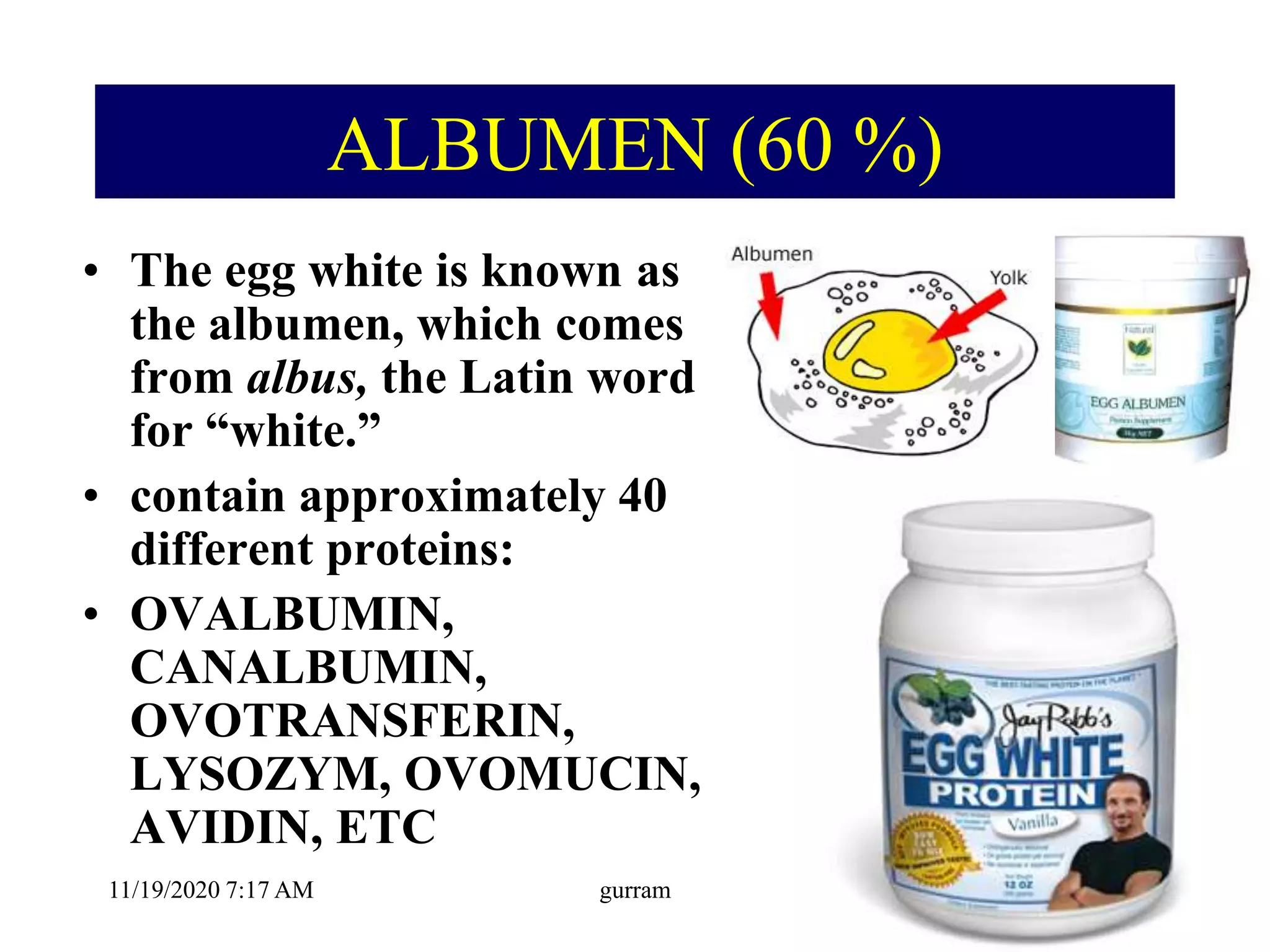
• The egg white is known as
the albumen, which comes
from albus, the Latin word
for “white.”
• contain approximately 40
different proteins:
• OVALBUMIN,
CANALBUMIN,
OVOTRANSFERIN,
LYSOZYM, OVOMUCIN,
AVIDIN, ETC
11/19/2020 7:17 AM gurram
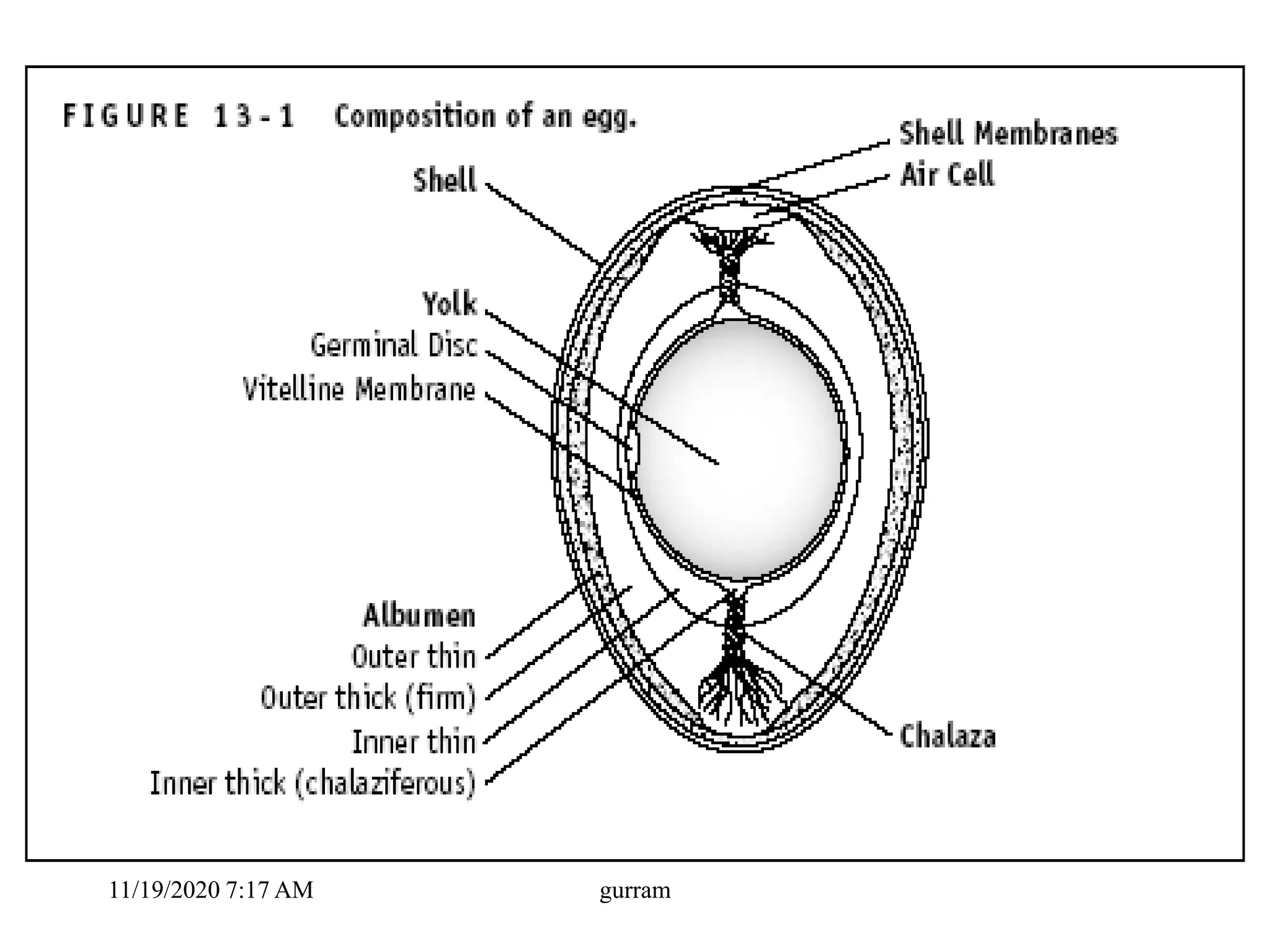
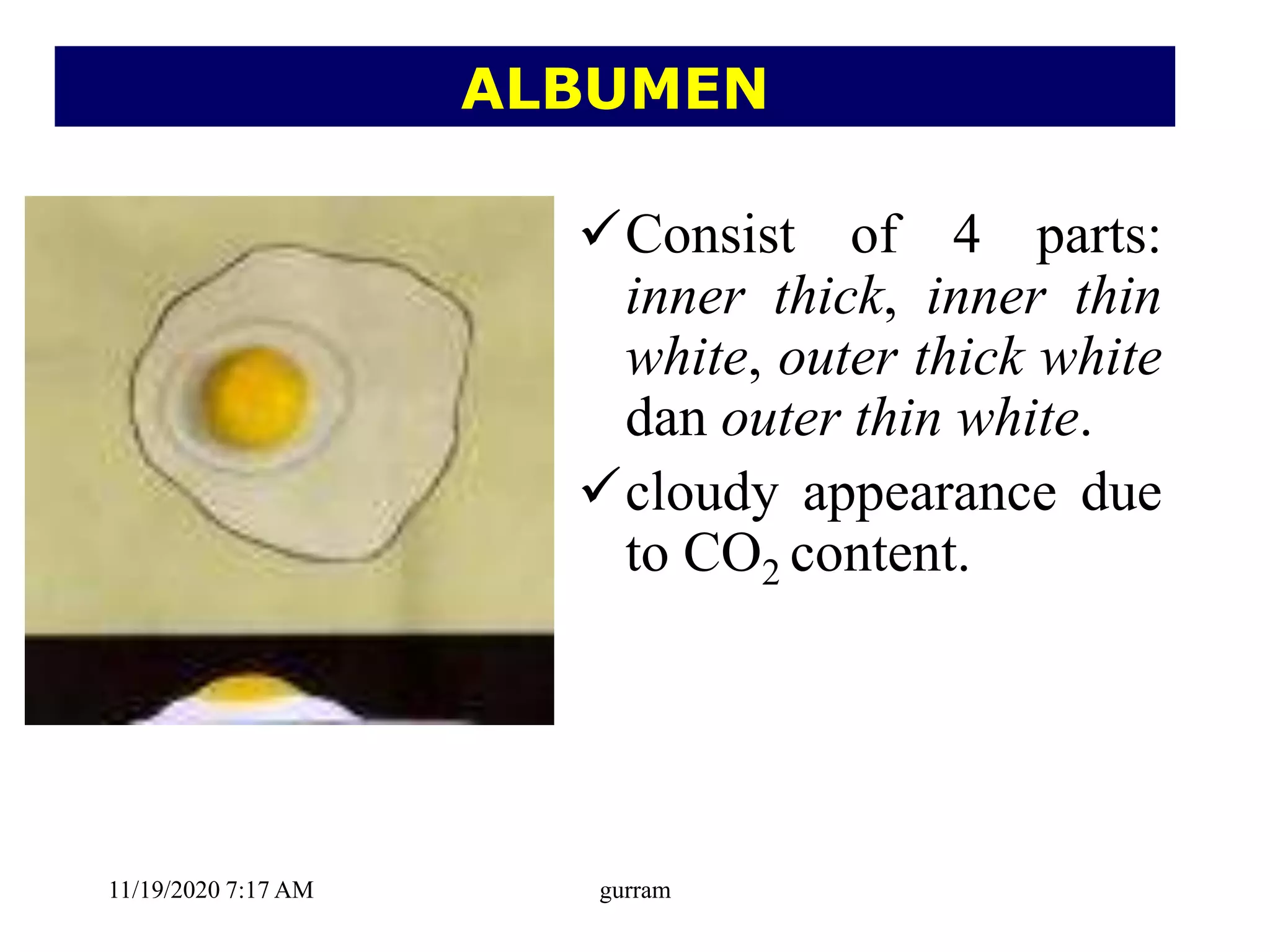
Consist of 4 parts:
inner thick, inner thin
white, outer thick white
dan outer thin white.
cloudy appearance due
to CO2 content.
ALBUMEN
11/19/2020 7:17 AM gurram
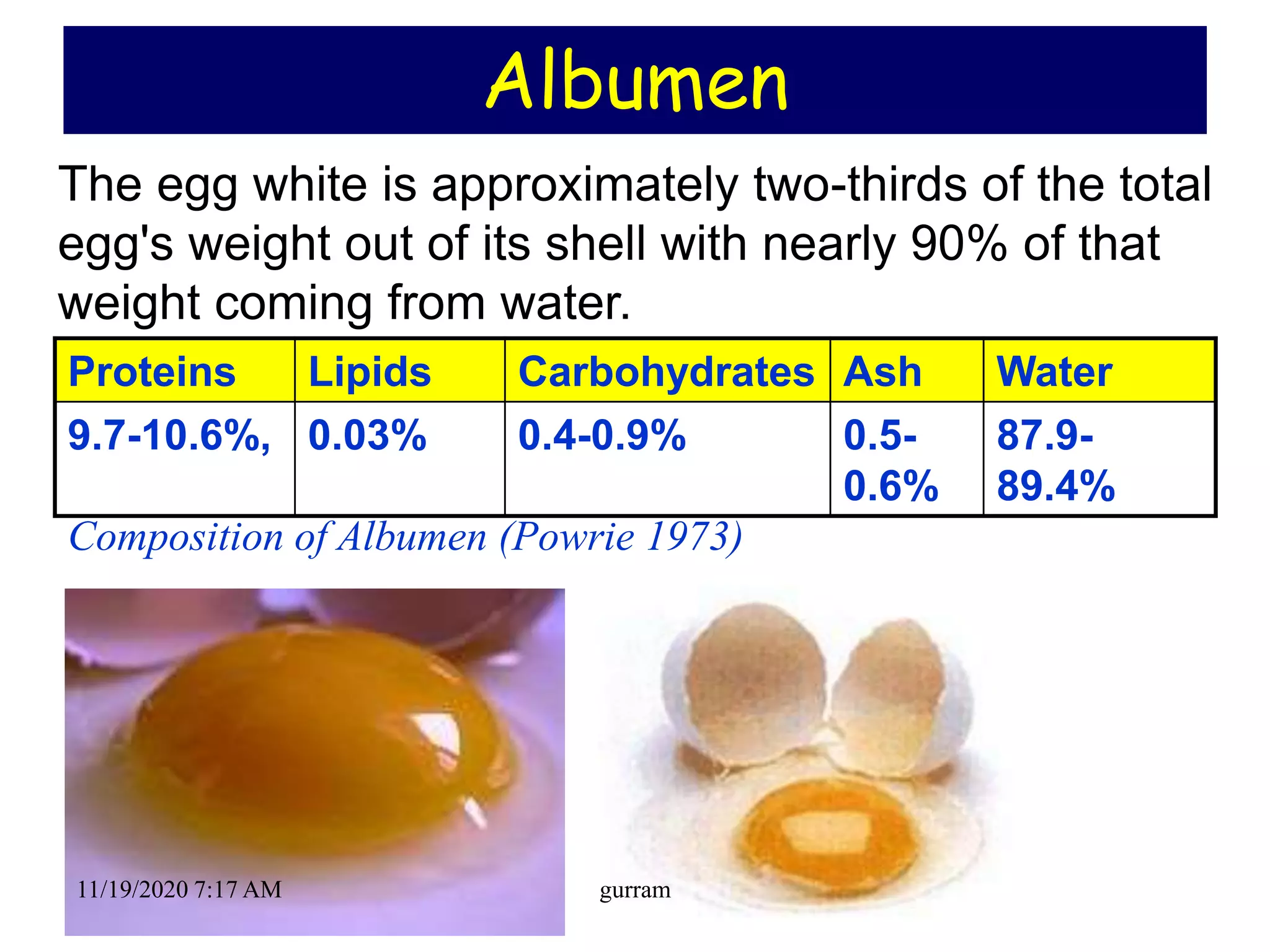
Albumen
Proteins Lipids Carbohydrates Ash Water
9.7-10.6%, 0.03% 0.4-0.9% 0.5-
0.6%
87.9-
89.4%
Composition of Albumen (Powrie 1973)
The egg white is approximately two-thirds of the total
egg's weight out of its shell with nearly 90% of that
weight coming from water.
11/19/2020 7:17 AM gurram
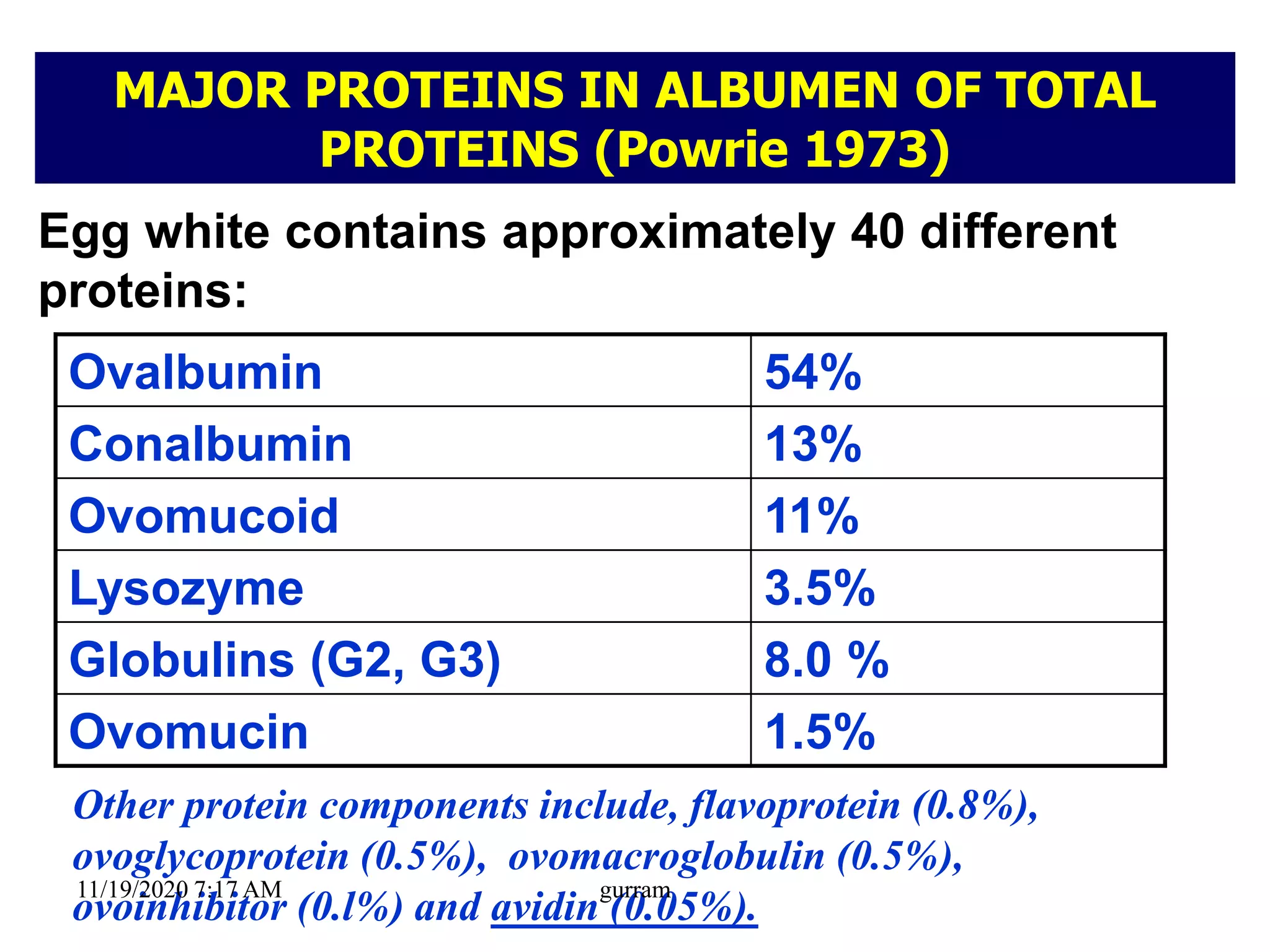
Ovalbumin 54%
Conalbumin 13%
Ovomucoid 11%
Lysozyme 3.5%
Globulins (G2, G3) 8.0 %
Ovomucin 1.5%
Other protein components include, flavoprotein (0.8%),
ovoglycoprotein (0.5%), ovomacroglobulin (0.5%),
ovoinhibitor (0.l%) and avidin (0.05%).
MAJOR PROTEINS IN ALBUMEN OF TOTAL
PROTEINS (Powrie 1973)
Egg white contains approximately 40 different
proteins:
11/19/2020 7:17 AM gurram
YOLK
• Less water, more protein and fat than the
white egg
• Contains most of the vitamins and
minerals of the egg, including Fe, vitamin
A, vitamin D, phosphorus, calcium,
thiamine, and riboflavin.
• Source of lecithin (emulsifier).
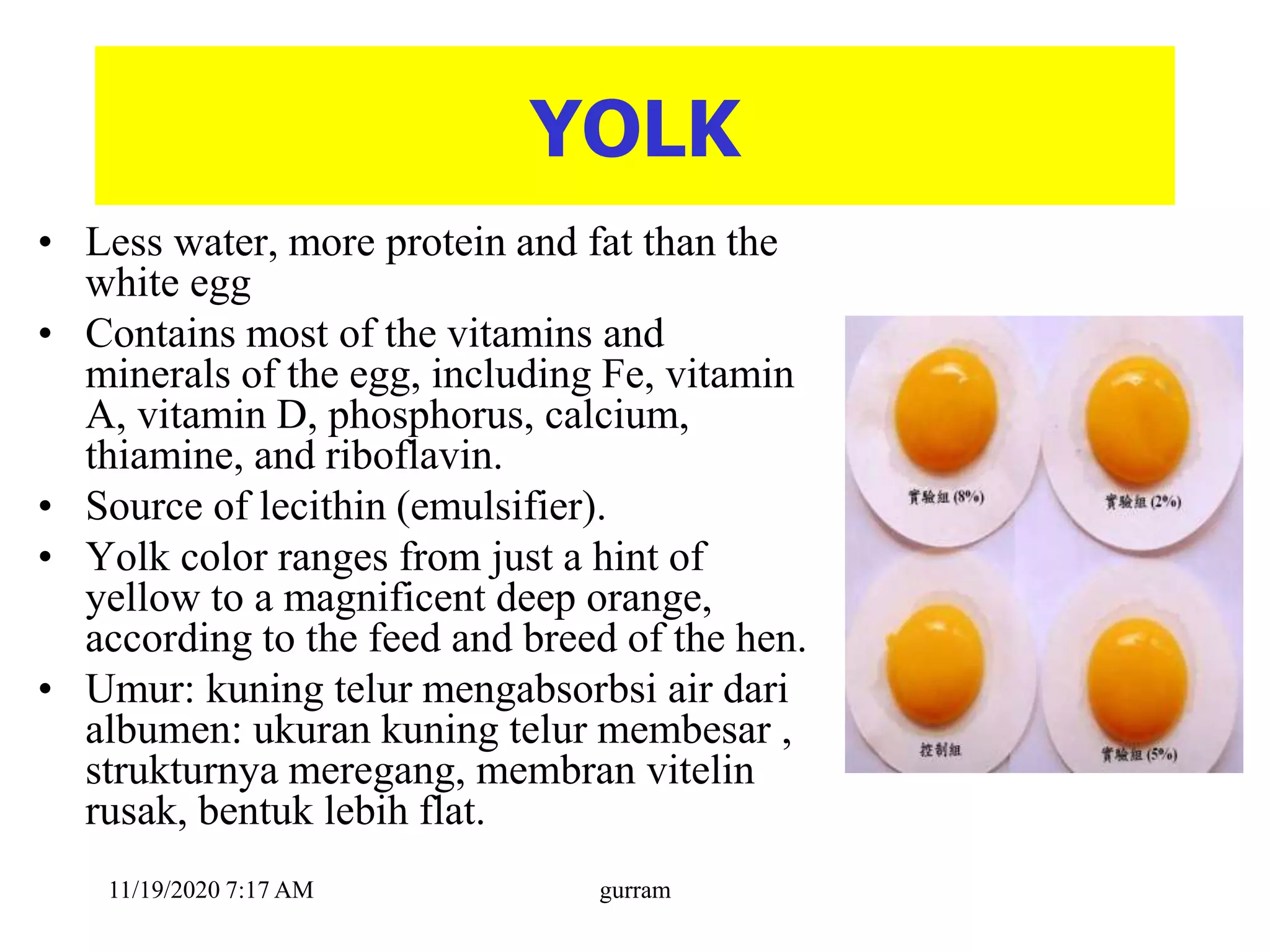
• Yolk color ranges from just a hint of
yellow to a magnificent deep orange,
according to the feed and breed of the hen.
• Umur: kuning telur mengabsorbsi air dari
albumen: ukuran kuning telur membesar ,
strukturnya meregang, membran vitelin
rusak, bentuk lebih flat.
11/19/2020 7:17 AM gurram
CHALAZAE
AND VITELIN
CHALAZAE
• Opaque ropes of egg white, the chalazae
hold the yolk in the center of the egg. Like
little anchors, they attach the yolk’s casing
to the membrane lining the eggshell. The
more prominent they are, the fresher the
egg.
Vitelline Membrane
• The clear casing that encloses the yolk.
11/19/2020 7:17 AM gurram
CHEMICAL COMPOSITION
OF EGG
11/19/2020 7:17 AM gurram
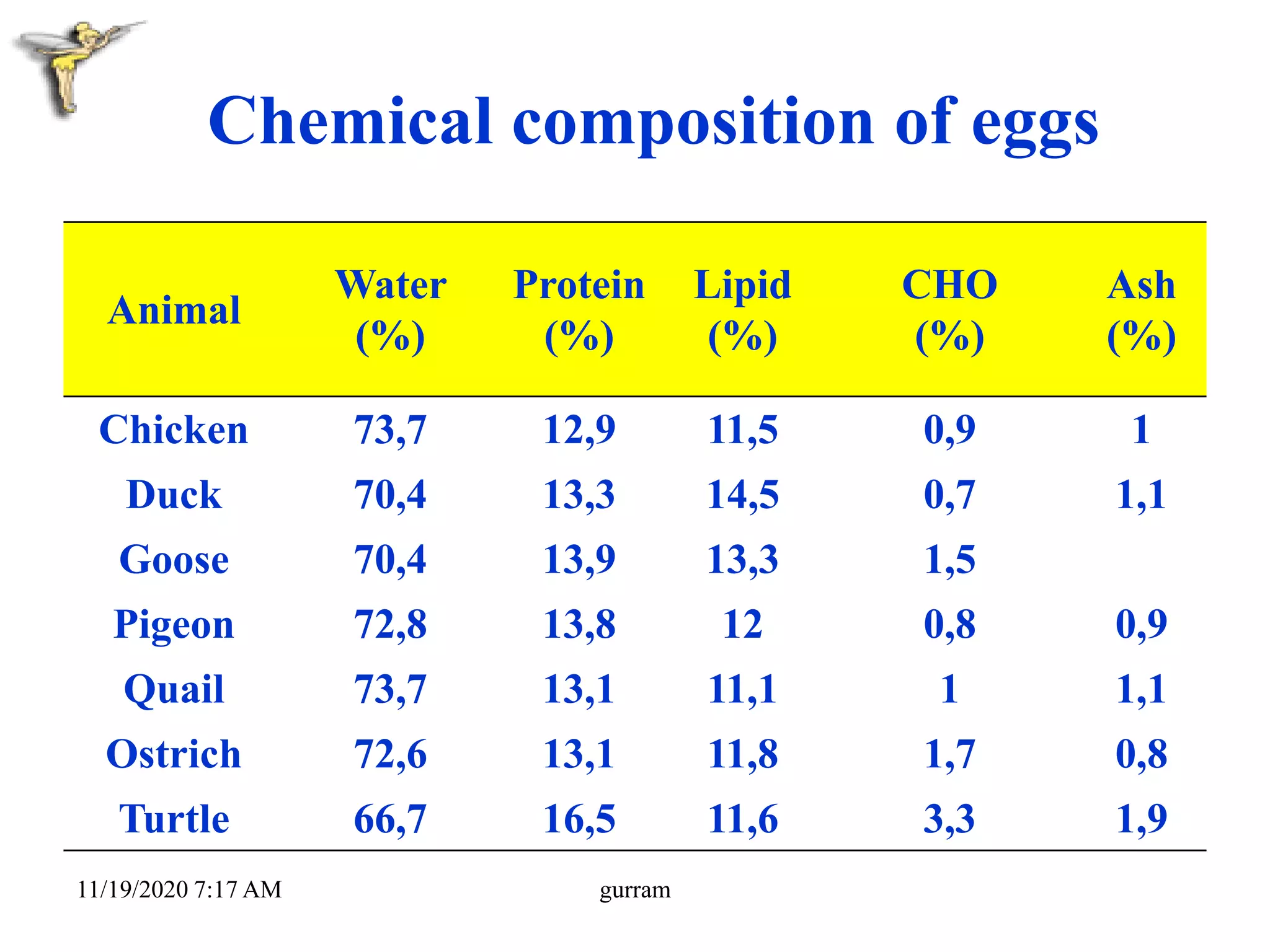
Chemical composition of eggs
Animal
Water
(%)
Protein
(%)
Lipid
(%)
CHO
(%)
Ash
(%)
Chicken 73,7 12,9 11,5 0,9 1
Duck 70,4 13,3 14,5 0,7 1,1
Goose 70,4 13,9 13,3 1,5
Pigeon 72,8 13,8 12 0,8 0,9
Quail 73,7 13,1 11,1 1 1,1
Ostrich 72,6 13,1 11,8 1,7 0,8
Turtle 66,7 16,5 11,6 3,3 1,9
11/19/2020 7:17 AM gurram
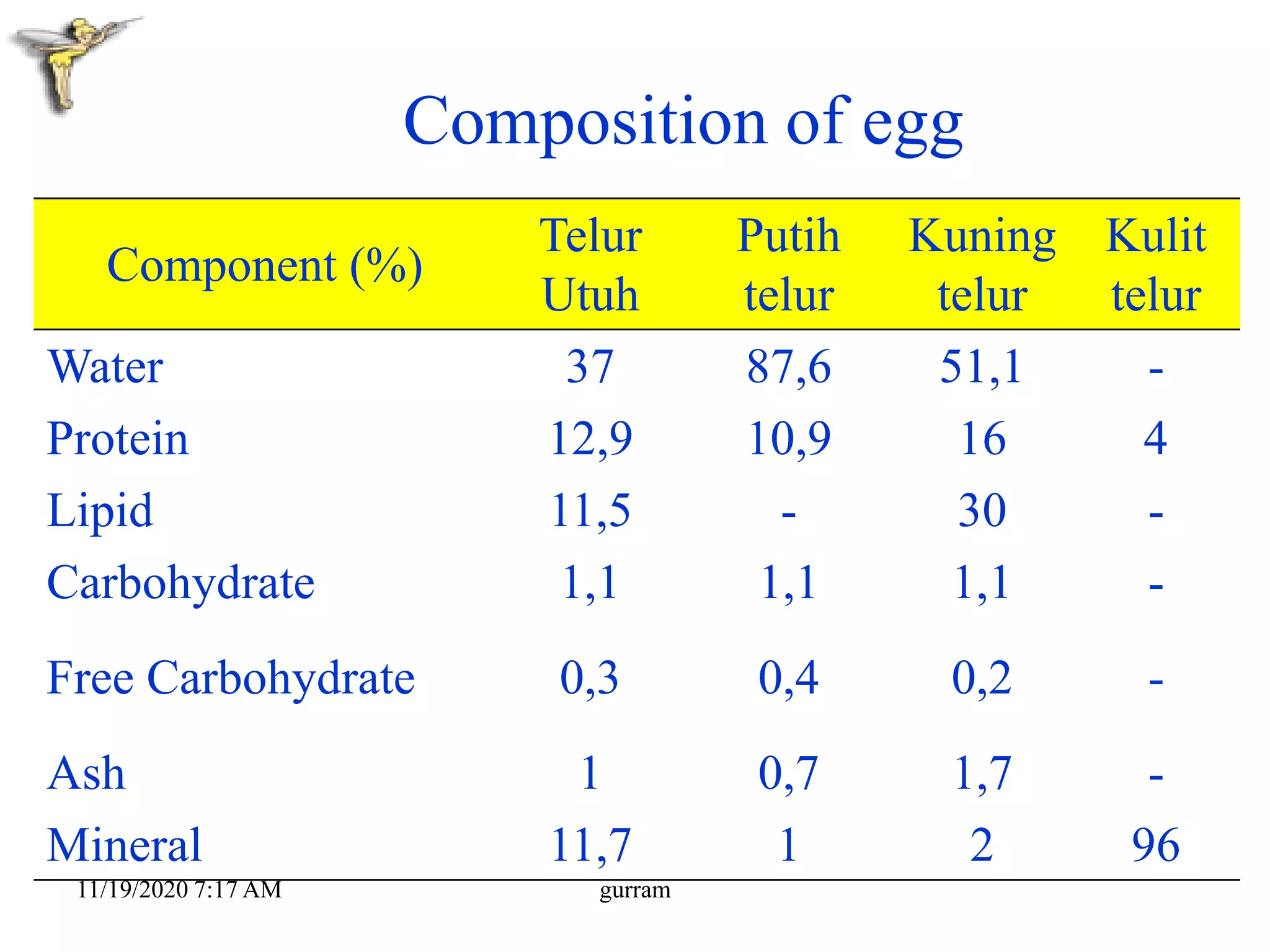
Composition of egg
Component (%)
Telur
Utuh
Putih
telur
Kuning
telur
Kulit
telur
Water 37 87,6 51,1 -
Protein 12,9 10,9 16 4
Lipid 11,5 - 30 -
Carbohydrate 1,1 1,1 1,1 -
Free Carbohydrate 0,3 0,4 0,2 -
Ash 1 0,7 1,7 -
Mineral 11,7 1 2 96
11/19/2020 7:17 AM gurram
Vitamin
contain most of the recognised vitamins
with the exception of vitamin C
11/19/2020 7:17 AM gurram
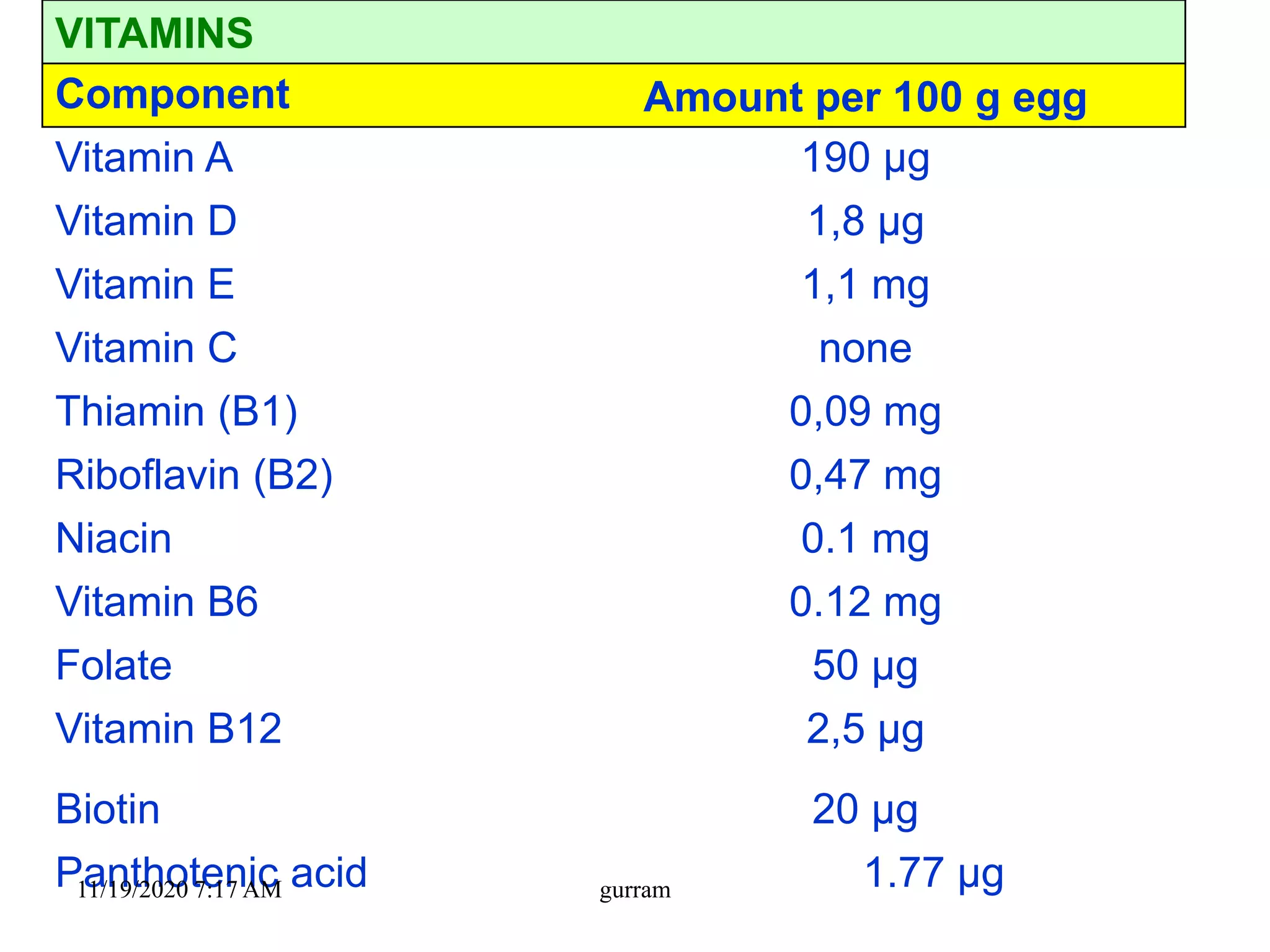
VITAMINS
Component Amount per 100 g egg
Vitamin A 190 µg
Vitamin D 1,8 µg
Vitamin E 1,1 mg
Vitamin C none
Thiamin (B1) 0,09 mg
Riboflavin (B2) 0,47 mg
Niacin 0.1 mg
Vitamin B6 0.12 mg
Folate 50 µg
Vitamin B12 2,5 µg
Biotin 20 µg
Panthotenic acid 1.77 µg11/19/2020 7:17 AM gurram
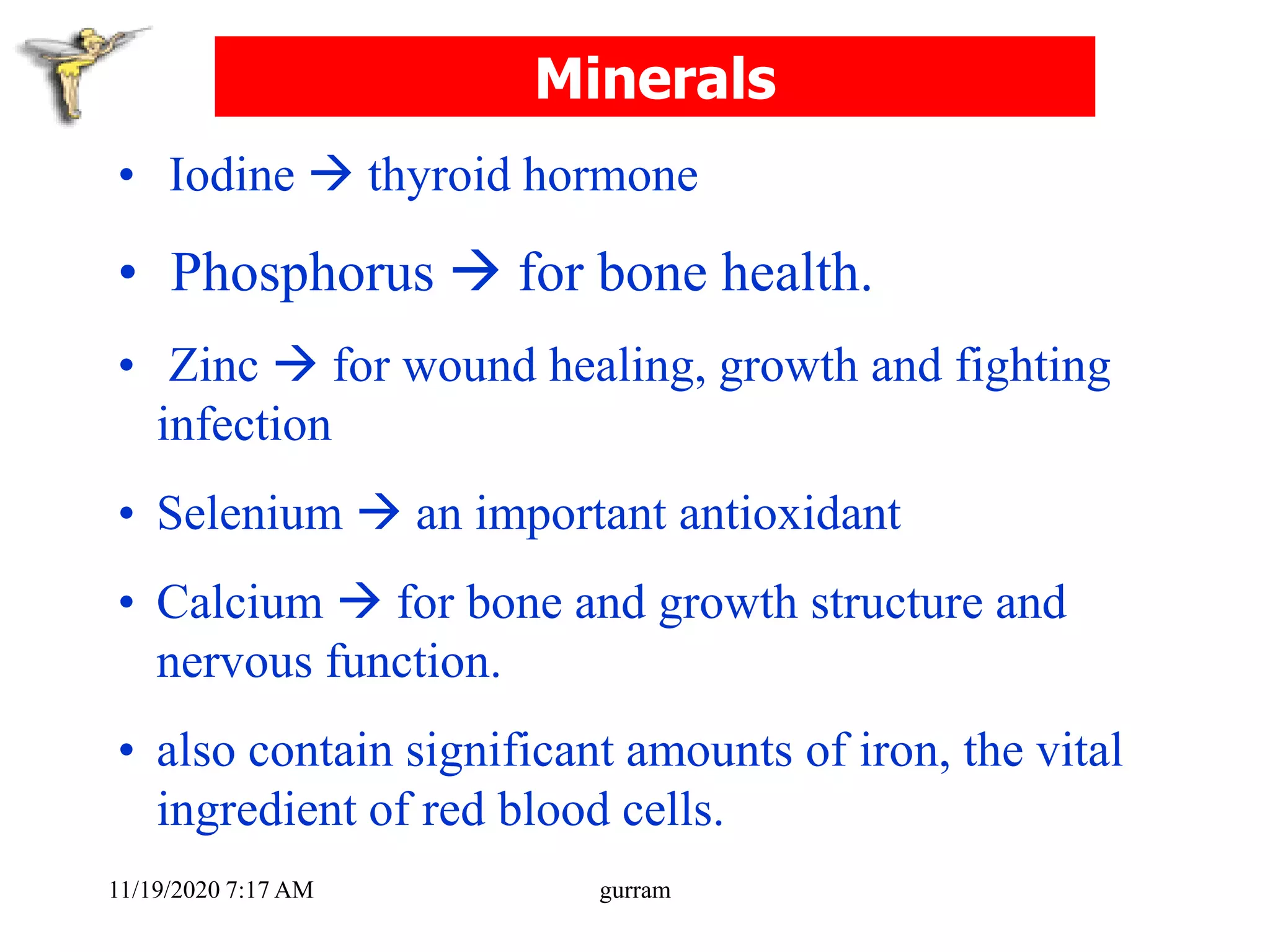
Minerals
• Iodine  thyroid hormone
• Phosphorus  for bone health.
• Zinc  for wound healing, growth and fighting
infection
• Selenium  an important antioxidant
• Calcium  for bone and growth structure and
nervous function.
• also contain significant amounts of iron, the vital
ingredient of red blood cells.
11/19/2020 7:17 AM gurram
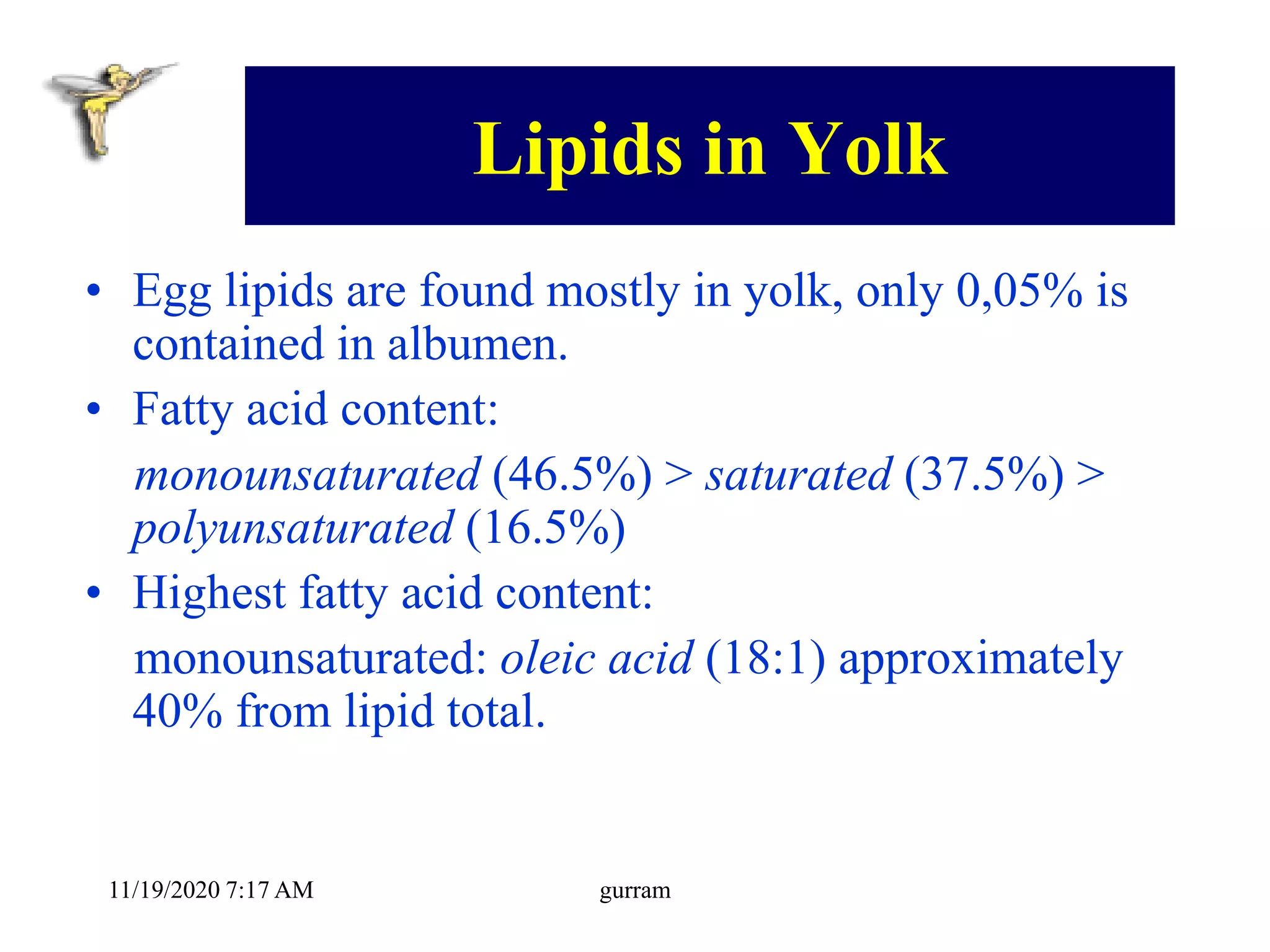
Lipids in Yolk
• Egg lipids are found mostly in yolk, only 0,05% is
contained in albumen.
• Fatty acid content:
monounsaturated (46.5%) > saturated (37.5%) >
polyunsaturated (16.5%)
• Highest fatty acid content:
monounsaturated: oleic acid (18:1) approximately
40% from lipid total.
11/19/2020 7:17 AM gurram
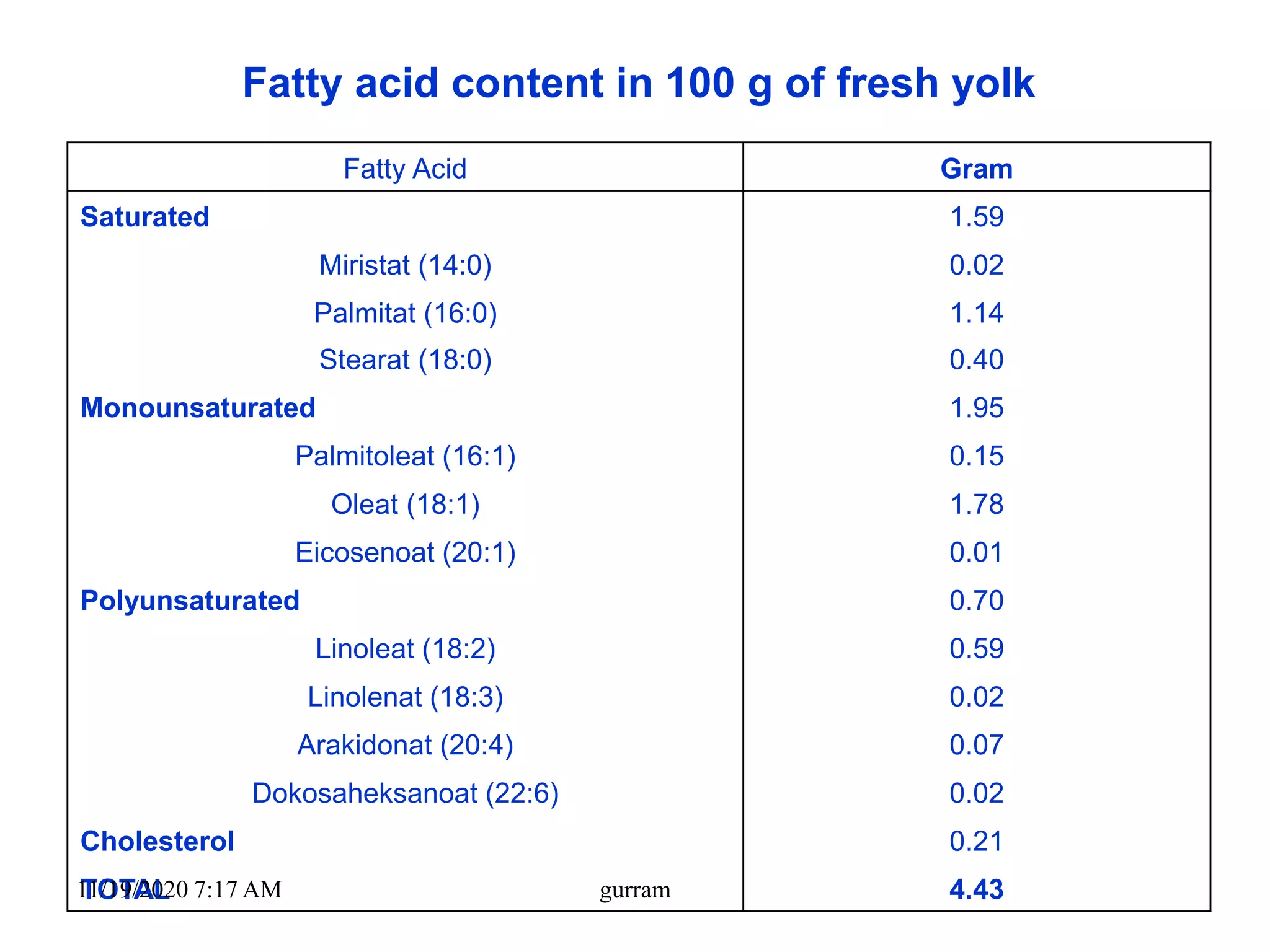
Fatty acid content in 100 g of fresh yolk
Fatty Acid Gram
Saturated 1.59
Miristat (14:0) 0.02
Palmitat (16:0) 1.14
Stearat (18:0) 0.40
Monounsaturated 1.95
Palmitoleat (16:1) 0.15
Oleat (18:1) 1.78
Eicosenoat (20:1) 0.01
Polyunsaturated 0.70
Linoleat (18:2) 0.59
Linolenat (18:3) 0.02
Arakidonat (20:4) 0.07
Dokosaheksanoat (22:6) 0.02
Cholesterol 0.21
TOTAL 4.4311/19/2020 7:17 AM gurram
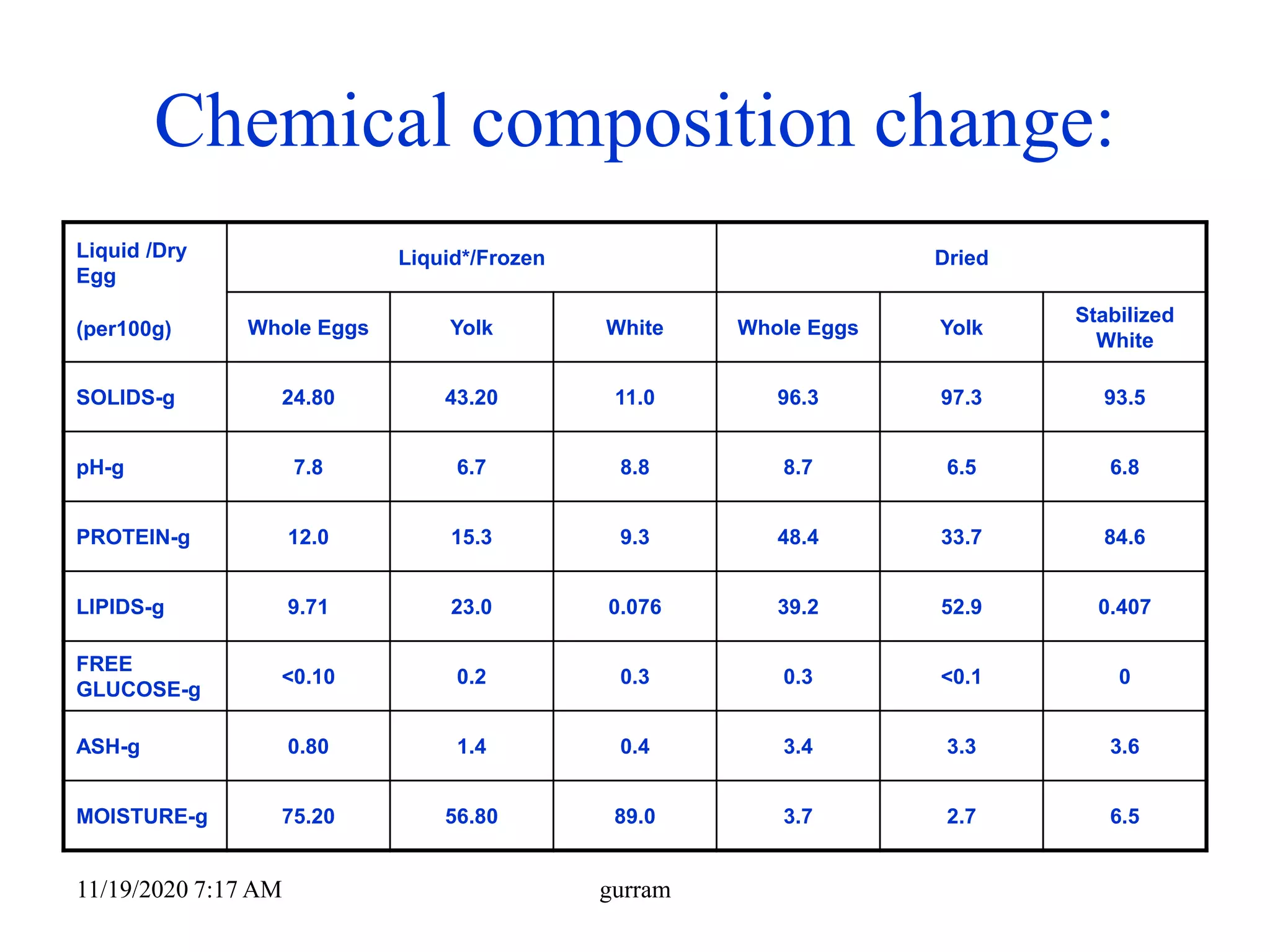
Chemical composition change:
Liquid /Dry
Egg
(per100g)
Liquid*/Frozen Dried
Whole Eggs Yolk White Whole Eggs Yolk
Stabilized
White
SOLIDS-g 24.80 43.20 11.0 96.3 97.3 93.5
pH-g 7.8 6.7 8.8 8.7 6.5 6.8
PROTEIN-g 12.0 15.3 9.3 48.4 33.7 84.6
LIPIDS-g 9.71 23.0 0.076 39.2 52.9 0.407
FREE
GLUCOSE-g
<0.10 0.2 0.3 0.3 <0.1 0
ASH-g 0.80 1.4 0.4 3.4 3.3 3.6
MOISTURE-g 75.20 56.80 89.0 3.7 2.7 6.5
11/19/2020 7:17 AM gurram
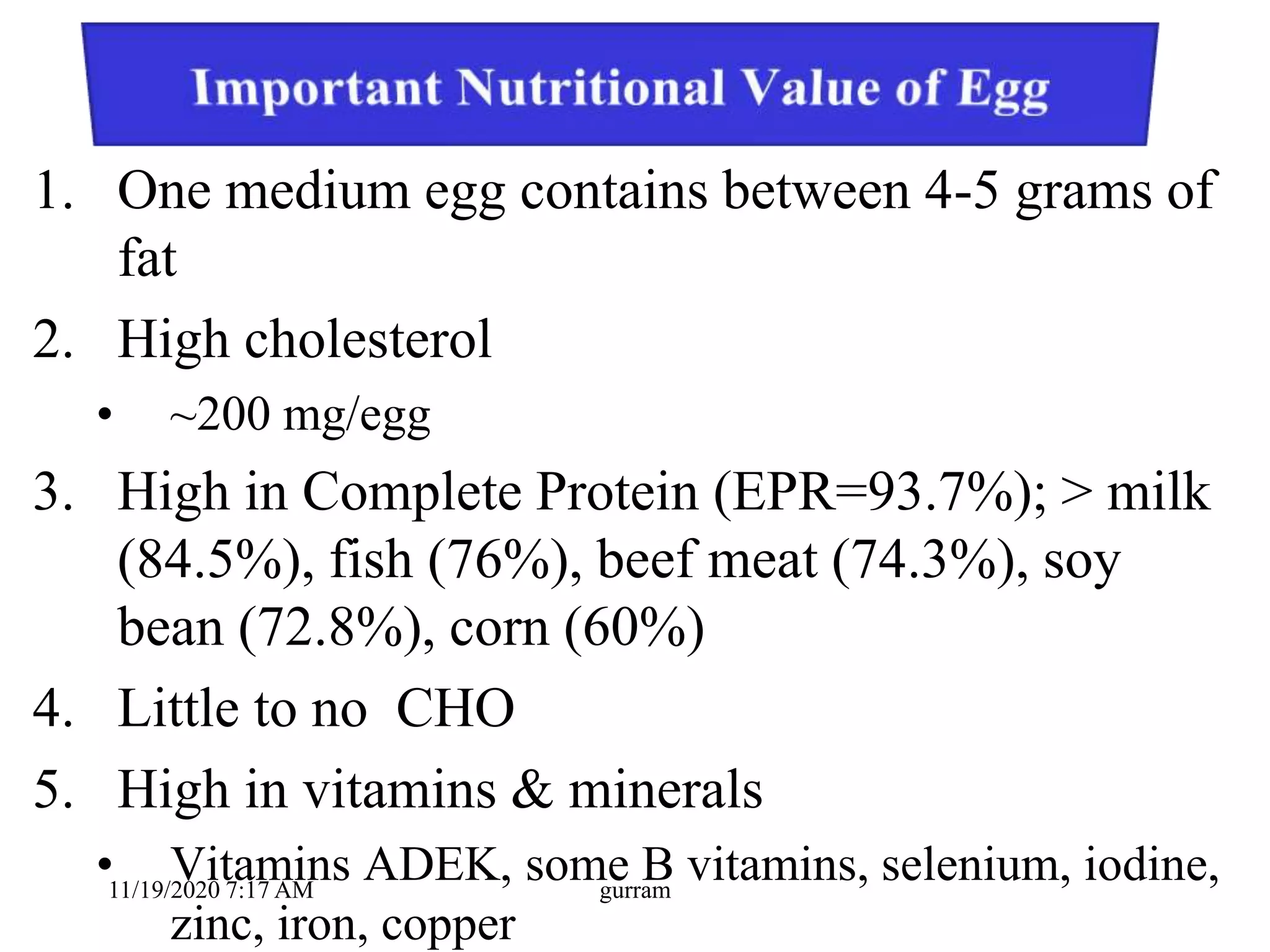
1. One medium egg contains between 4-5 grams of
fat
2. High cholesterol
• ~200 mg/egg
3. High in Complete Protein (EPR=93.7%); > milk
(84.5%), fish (76%), beef meat (74.3%), soy
bean (72.8%), corn (60%)
4. Little to no CHO
5. High in vitamins & minerals
• Vitamins ADEK, some B vitamins, selenium, iodine,
zinc, iron, copper
11/19/2020 7:17 AM gurram
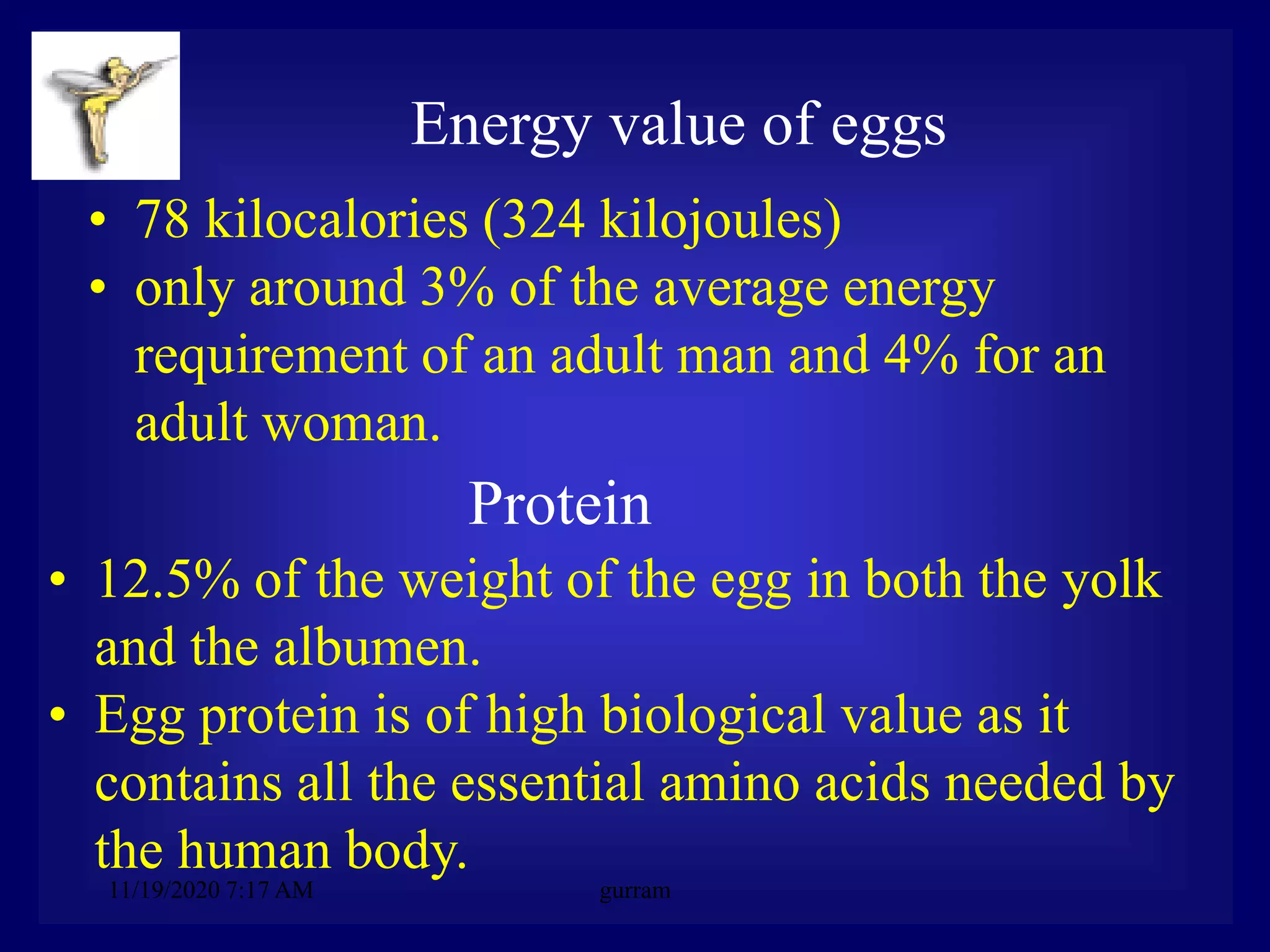
Energy value of eggs
• 78 kilocalories (324 kilojoules)
• only around 3% of the average energy
requirement of an adult man and 4% for an
adult woman.
Protein
• 12.5% of the weight of the egg in both the yolk
and the albumen.
• Egg protein is of high biological value as it
contains all the essential amino acids needed by
the human body.
11/19/2020 7:17 AM gurram
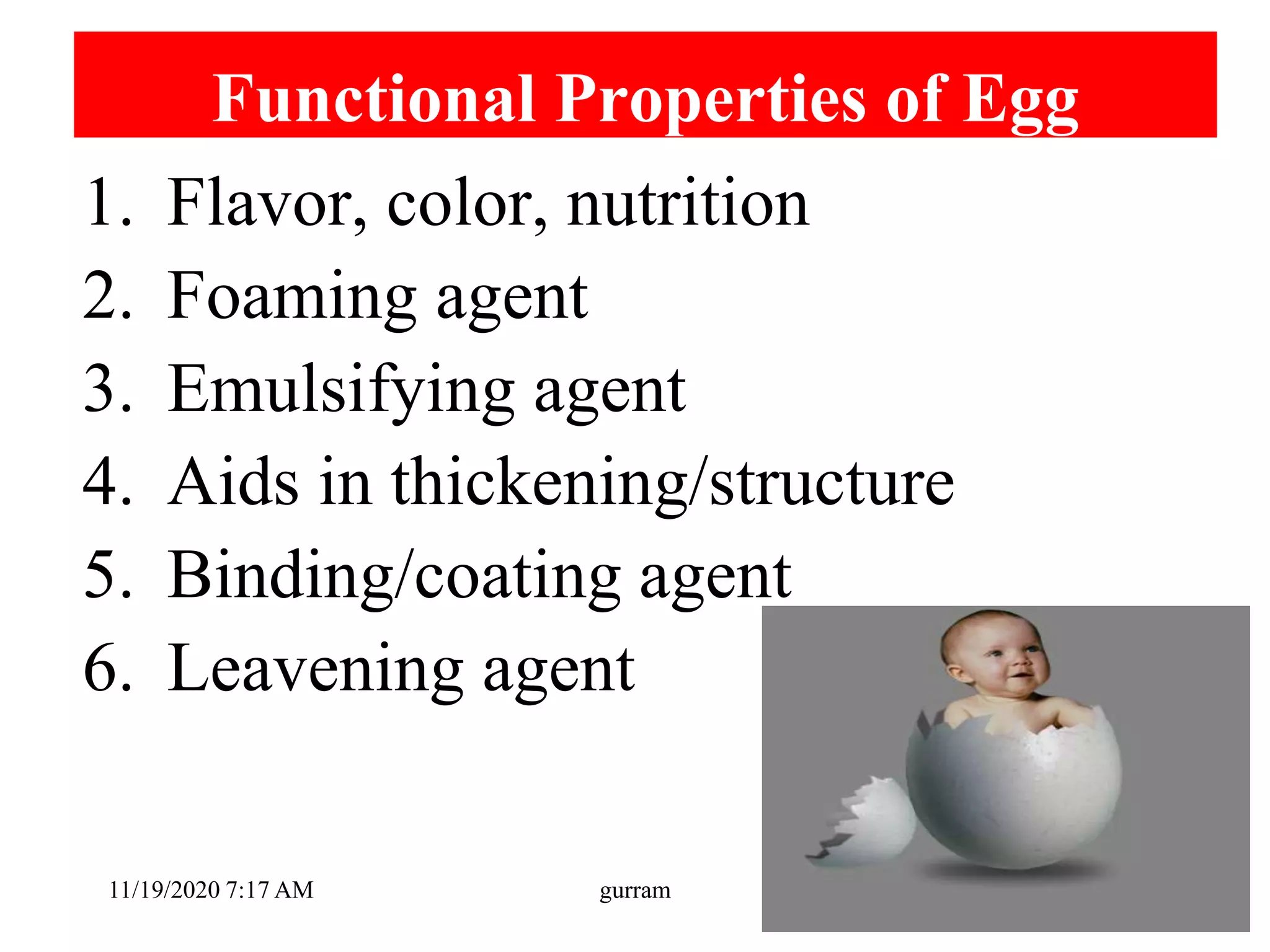
Functional Properties of Egg
1. Flavor, color, nutrition
2. Foaming agent
3. Emulsifying agent
4. Aids in thickening/structure
5. Binding/coating agent
6. Leavening agent
11/19/2020 7:17 AM gurram
FOAMING PROPERTIES
1. Air trapped in a liquid
2. In egg foam, air trapped by
protein.
3. Denatured and then
coagulates
4. Heat expands protein/air
• Important to souffles,
meringues, omelet, and
sponge cake.
11/19/2020 7:17 AM gurram
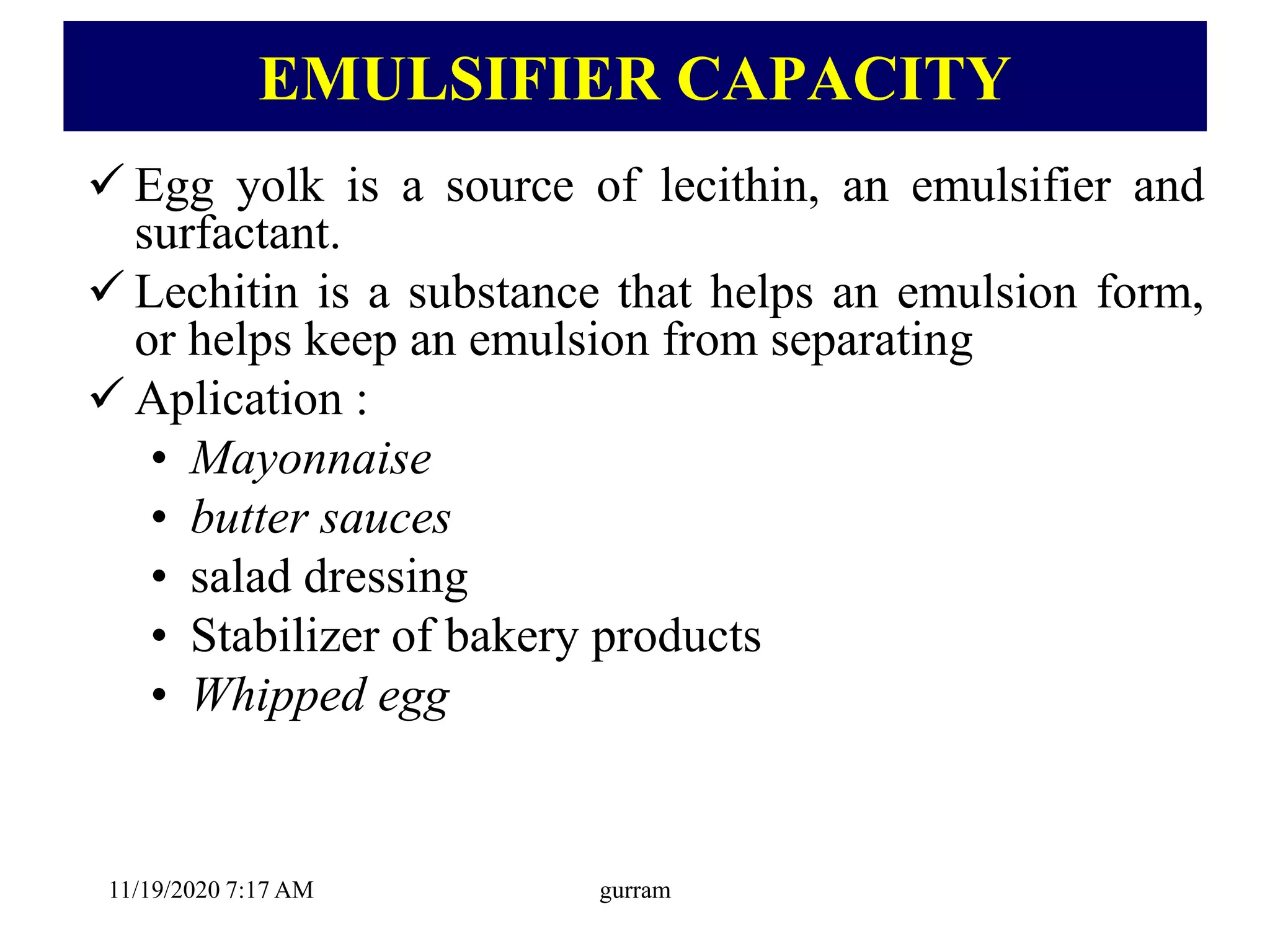
EMULSIFIER CAPACITY
 Egg yolk is a source of lecithin, an emulsifier and
surfactant.
 Lechitin is a substance that helps an emulsion form,
or helps keep an emulsion from separating
 Aplication :
• Mayonnaise
• butter sauces
• salad dressing
• Stabilizer of bakery products
• Whipped egg
11/19/2020 7:17 AM gurram
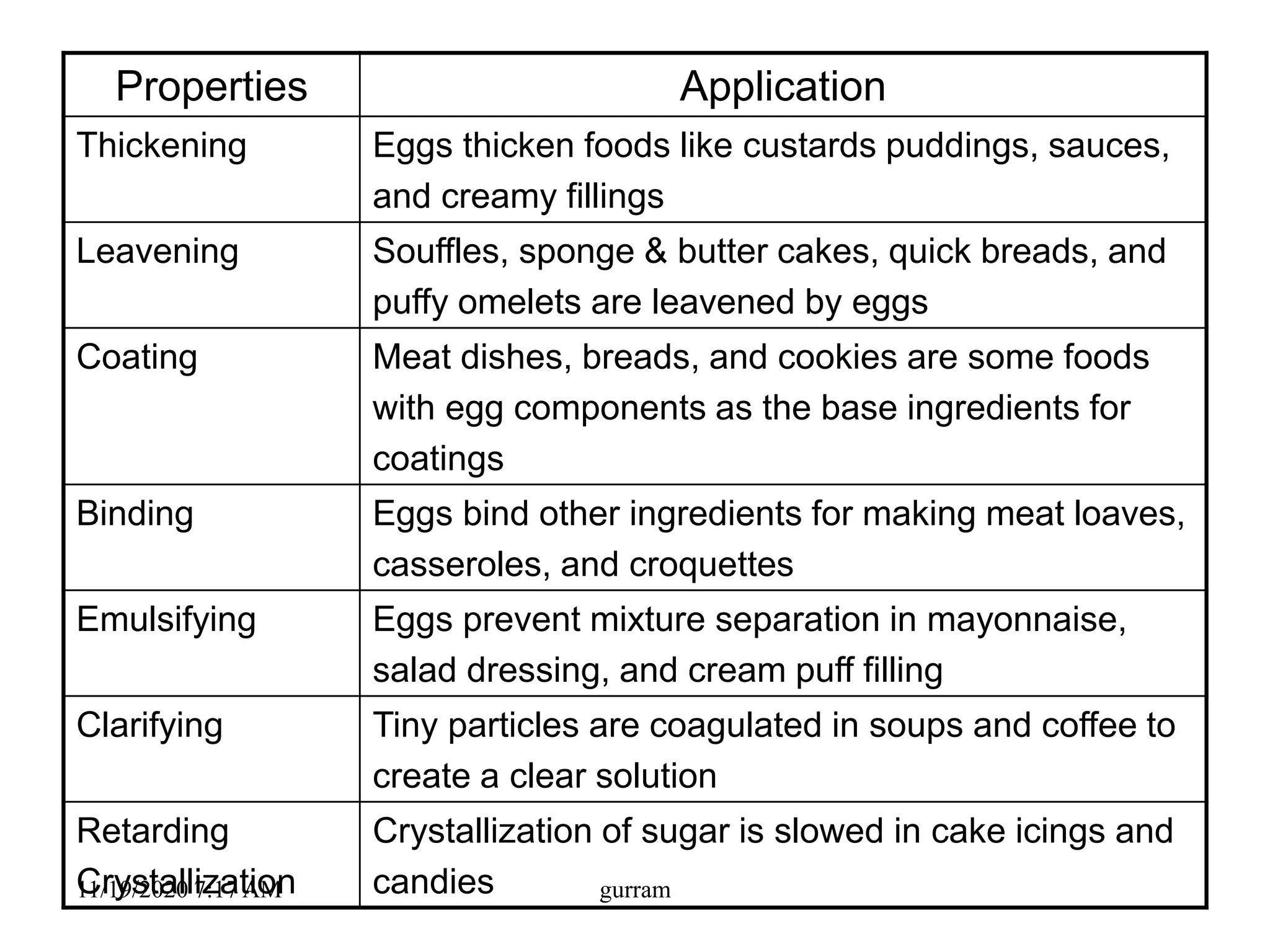
Properties Application
Thickening Eggs thicken foods like custards puddings, sauces,
and creamy fillings
Leavening Souffles, sponge & butter cakes, quick breads, and
puffy omelets are leavened by eggs
Coating Meat dishes, breads, and cookies are some foods
with egg components as the base ingredients for
coatings
Binding Eggs bind other ingredients for making meat loaves,
casseroles, and croquettes
Emulsifying Eggs prevent mixture separation in mayonnaise,
salad dressing, and cream puff filling
Clarifying Tiny particles are coagulated in soups and coffee to
create a clear solution
Retarding
Crystallization
Crystallization of sugar is slowed in cake icings and
candies11/19/2020 7:17 AM gurram
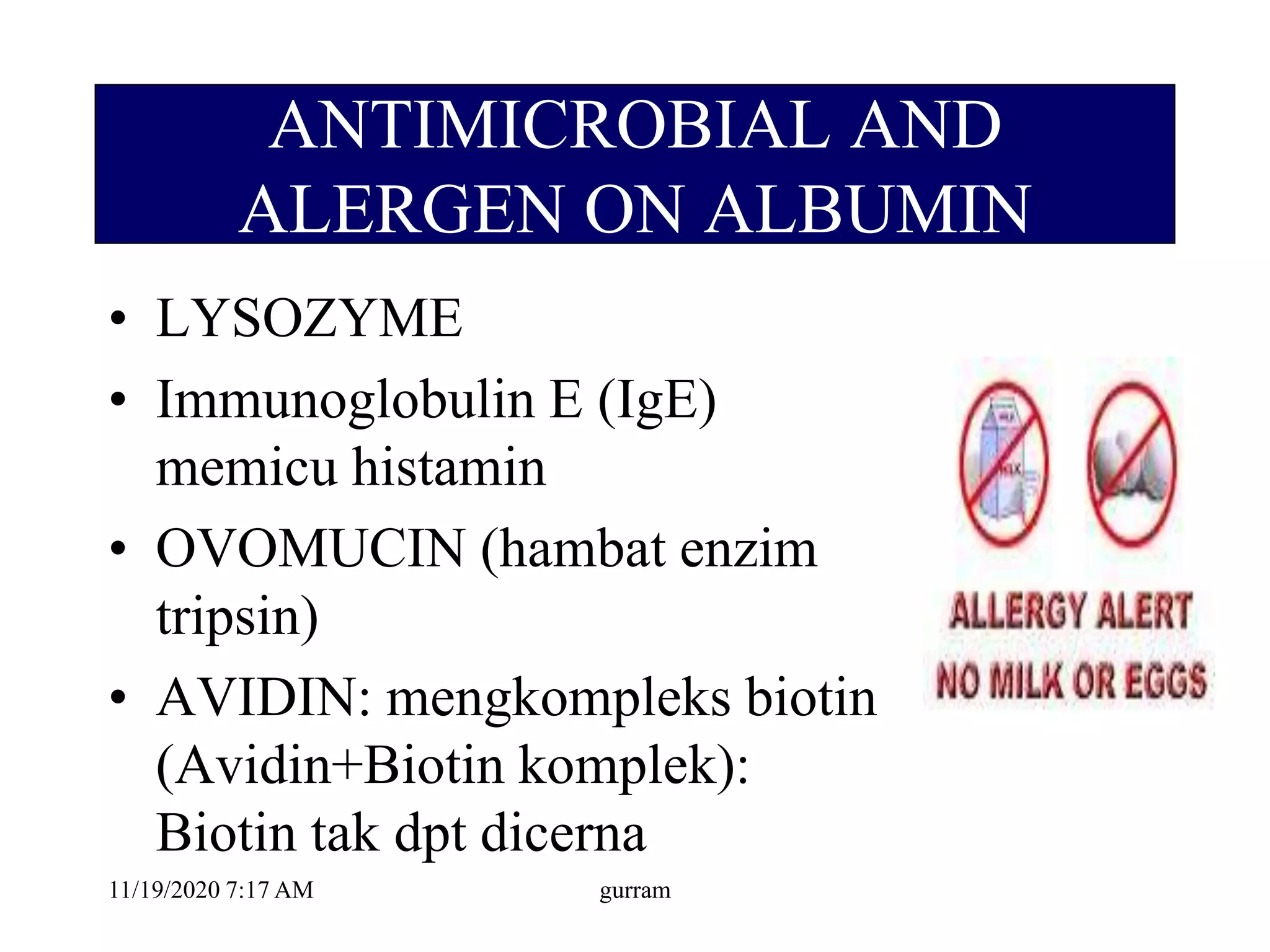
ANTIMICROBIAL AND
ALERGEN ON ALBUMIN
• LYSOZYME
• Immunoglobulin E (IgE)
memicu histamin
• OVOMUCIN (hambat enzim
tripsin)
• AVIDIN: mengkompleks biotin
(Avidin+Biotin komplek):
Biotin tak dpt dicerna
11/19/2020 7:17 AM gurram
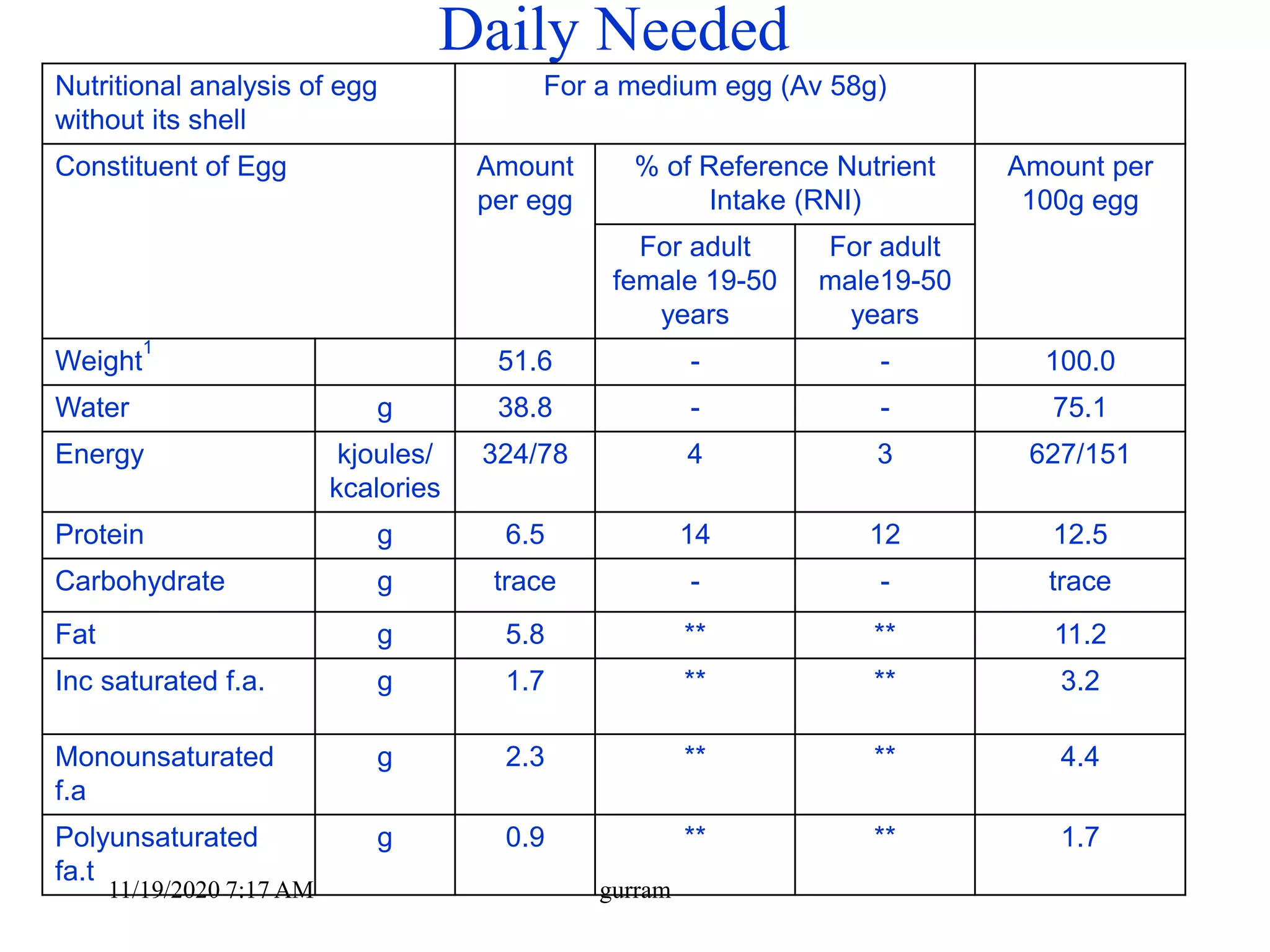
Daily Needed
Nutritional analysis of egg
without its shell
For a medium egg (Av 58g)
Constituent of Egg Amount
per egg
% of Reference Nutrient
Intake (RNI)
Amount per
100g egg
For adult
female 19-50
years
For adult
male19-50
years
Weight
1
51.6 - - 100.0
Water g 38.8 - - 75.1
Energy kjoules/
kcalories
324/78 4 3 627/151
Protein g 6.5 14 12 12.5
Carbohydrate g trace - - trace
Fat g 5.8 ** ** 11.2
Inc saturated f.a. g 1.7 ** ** 3.2
Monounsaturated
f.a
g 2.3 ** ** 4.4
Polyunsaturated
fa.t
g 0.9 ** ** 1.7
11/19/2020 7:17 AM gurram
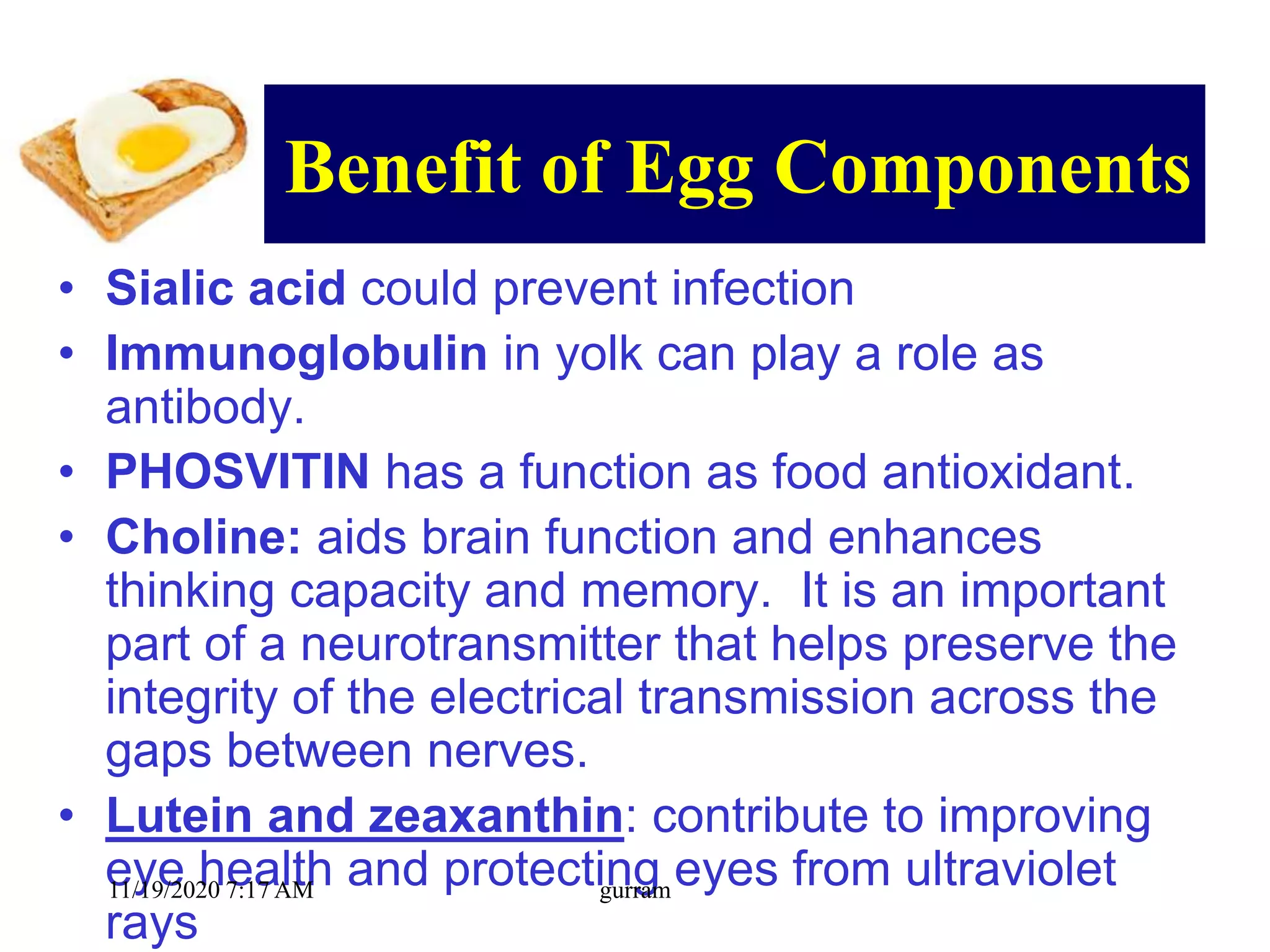
Benefit of Egg Components
• Sialic acid could prevent infection
• Immunoglobulin in yolk can play a role as
antibody.
• PHOSVITIN has a function as food antioxidant.
• Choline: aids brain function and enhances
thinking capacity and memory. It is an important
part of a neurotransmitter that helps preserve the
integrity of the electrical transmission across the
gaps between nerves.
• Lutein and zeaxanthin: contribute to improving
eye health and protecting eyes from ultraviolet
rays
11/19/2020 7:17 AM gurram
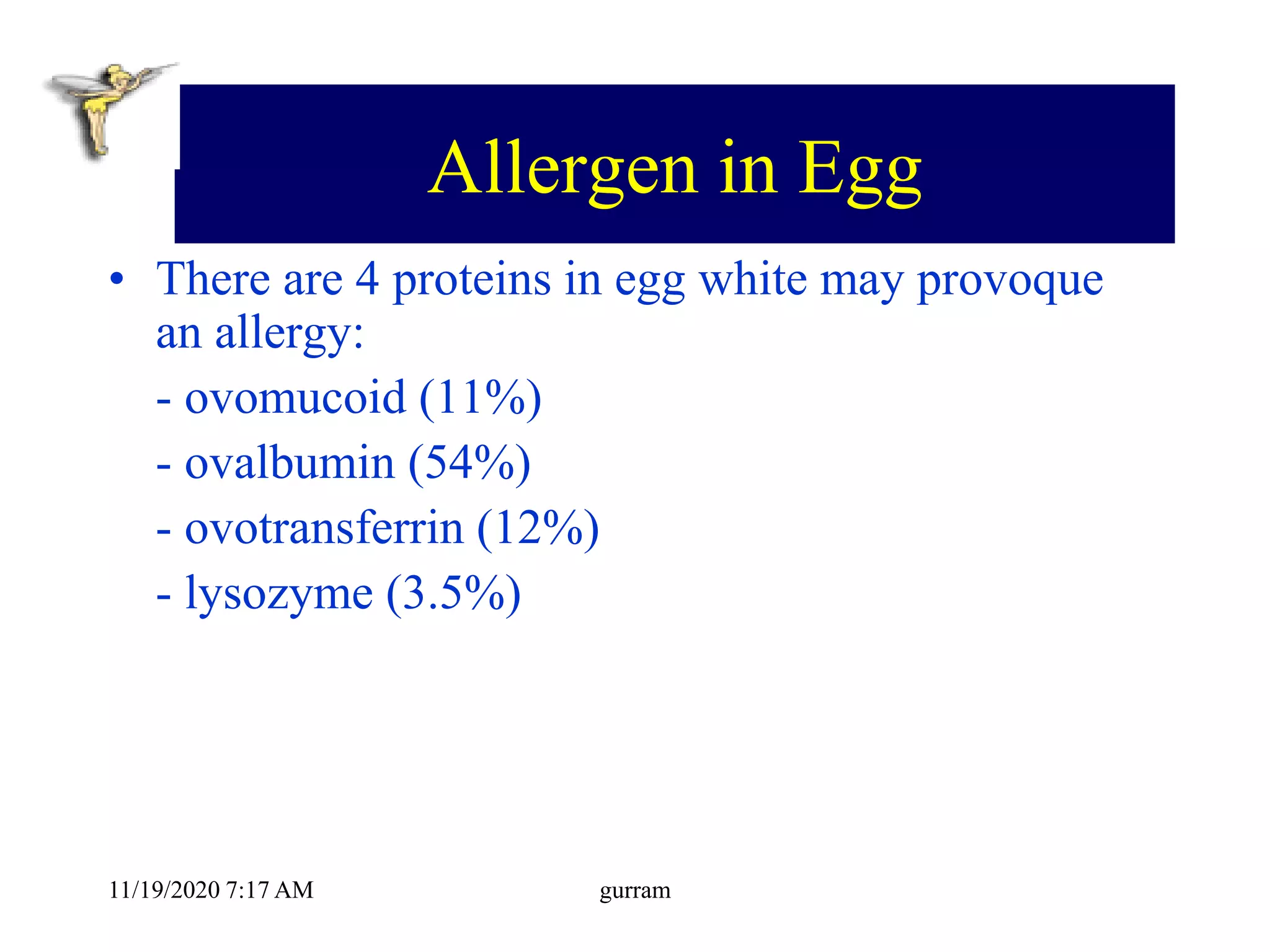
Allergen in Egg
• There are 4 proteins in egg white may provoque
an allergy:
- ovomucoid (11%)
- ovalbumin (54%)
- ovotransferrin (12%)
- lysozyme (3.5%)
11/19/2020 7:17 AM gurram
Egg Allergy Symptoms
 Egg allergy is like most food allergy reactions: It usually
happens within minutes to hours after eating eggs.
• the skin - in the form of red, bumpy rashes (hives),
eczema, or redness and swelling around the mouth
• the gastrointestinal tract - in the form of belly cramps,
diarrhea, nausea, or vomiting
• the respiratory tract - symptoms can range from a runny
nose, itchy, watery eyes, and sneezing to the triggering of
asthma with coughing and wheezing
11/19/2020 7:17 AM gurram
Valve addition
• The United States Department of Agriculture
defines value added products as
1) A change in the physical state or form of the
products and production of a product in a manner
that enhances its value
2) The physical segregation of commodity or
product in a manner that result in the enhancement
of the value of that commodity or product
11/19/2020 7:17 AM gurram
Why valve addition?
• To increase demand and marketability and meet life
style requirements
• To utilize different carcasses beneficially and to
utilize different byproducts
• To combine and compliment different meats with
advantage and increases the shelf life of products
• To incorporate non meat ingredients for quality and
economy
11/19/2020 7:17 AM gurram
• To facilitate export of meat products and compete
with imports
• To promote entrepreneur ventures and employment
11/19/2020 7:17 AM gurram
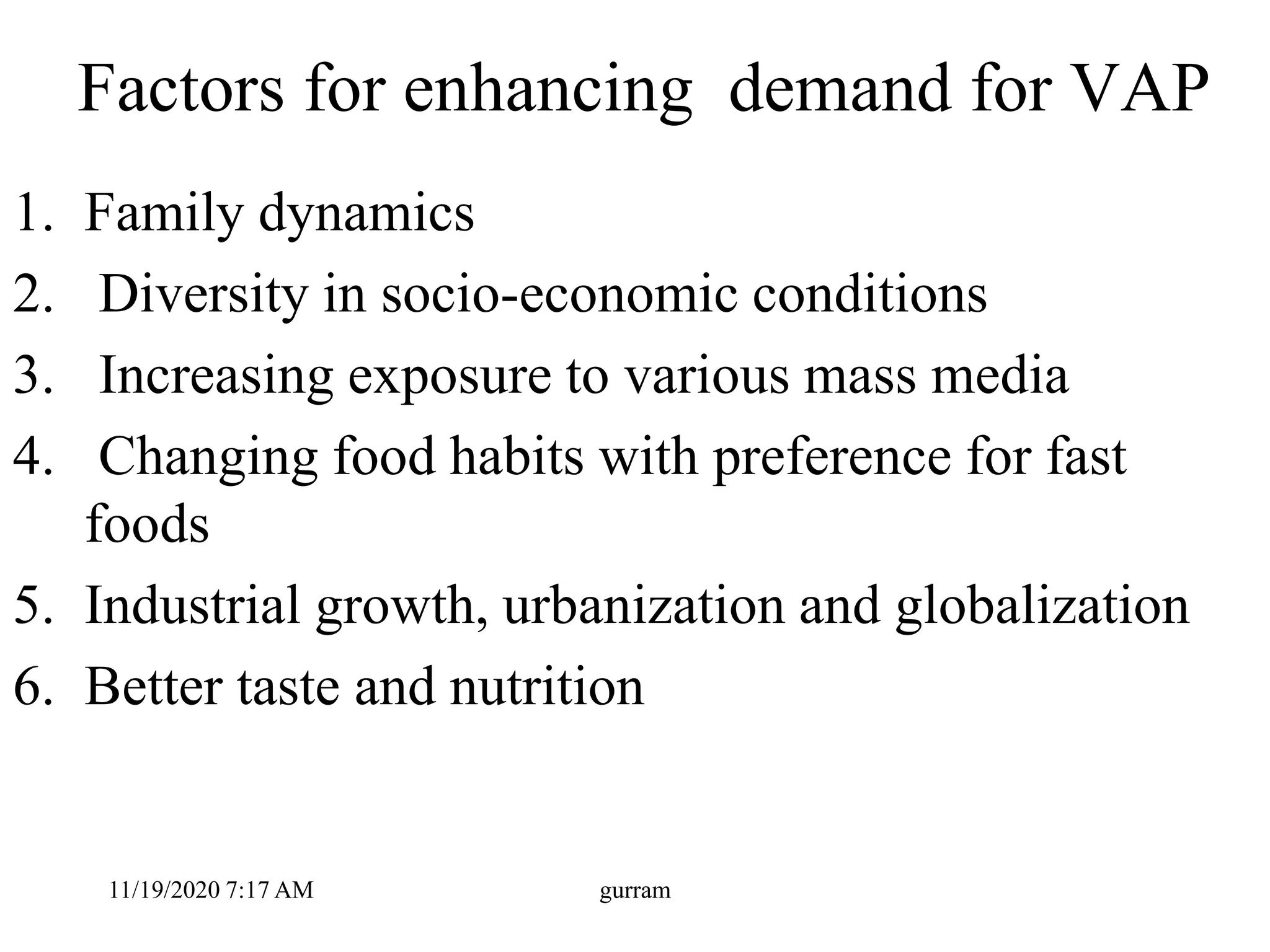
Factors for enhancing demand for VAP
1. Family dynamics
2. Diversity in socio-economic conditions
3. Increasing exposure to various mass media
4. Changing food habits with preference for fast
foods
5. Industrial growth, urbanization and globalization
6. Better taste and nutrition
11/19/2020 7:17 AM gurram
Valve addition major types
• In case of poultry products, there are two types of
value addition
1. Pre-slaughter or pre-ovipositional valve addition
(value addition before the product is produced)
examples: organic / designer / functional eggs and
meat
2. Post slaughter or post ovipositional valve
addition(post harvest technology)
11/19/2020 7:17 AM gurram
Pre-Oviposition Value Added Eggs
• Organic and cage-free eggs are the earliest pre-
oviposition value added eggs.
• According to the American Egg Board (AEB),
organic eggs are those obtained from hens fed
rations having ingredients
1. Without pesticides, fungicides, herbicides or
commercial fertilizers.
2. Without performance enhancers .
3. Hens which are reared free from cages
11/19/2020 7:17 AM gurram
History of Designer eggs
• Dyerberg and Bang (1979) reported that n-3 fatty
acids would protect the heart from Cardiovascular
Diseases (CVD).
• In the late 80s, Sim, Jiang and their associates in the
University of Alberta, Canada, have blended these
ideas together and developed a Designer Egg, rich
in n-3 fatty acids and antioxidants. They have
patented this egg as Professor Sim's Designer Egg.
11/19/2020 7:17 AM gurram
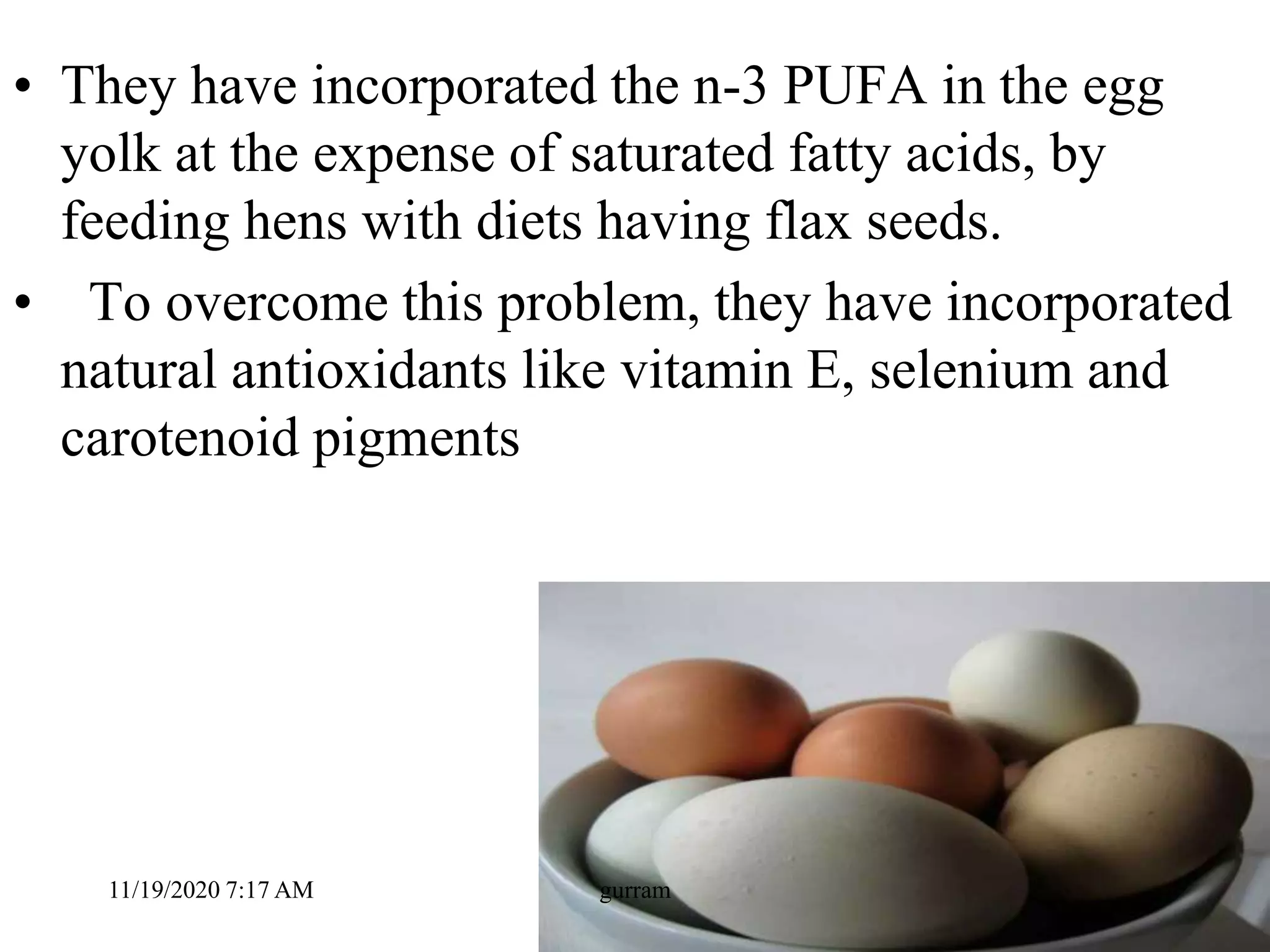
• They have incorporated the n-3 PUFA in the egg
yolk at the expense of saturated fatty acids, by
feeding hens with diets having flax seeds.
• To overcome this problem, they have incorporated
natural antioxidants like vitamin E, selenium and
carotenoid pigments
11/19/2020 7:17 AM gurram
• Later in Australia, Farell (1998) enriched the eggs
with folic acid and iron; which are good for anemic
patients.
• In Canada, Leeson (2004) produced lutein-
enriched eggs; which will act as a retinal tonic, by
preventing Macular Degeneration and Retinitis
Pigmentosa
11/19/2020 7:17 AM gurram
• In India, Narahari (2004) has developed Herbal
Enriched Designer Eggs (HEDE), which are not
only rich in n-3 PUFA, vitamin E, selenium,
carotenoids, certain B complex vitamins and trace
minerals;
but also rich in herbal active principles like,
Allicin, Betaine, Euginol, Lumiflavin, Lutein,
Sulforaphane, Taurine and many more active
principles of the herbs, depending upon the herbs
fed to the hens
11/19/2020 7:17 AM gurram
Immunomodulating Egg Production
• Chicken egg is abundant in antibodies like "IgY";
which is cheaper and better than mammalian
immunoglobulin "IgG".
• In a 6-week period, a hen produces about 298mg of
specific antibodies, compared with only 17mg from
a rabbit.
• This "IgY" can be used to treat human rotavirus,
E.coli, Streptococcus, Pseudomonas,
Staphylococcus and Salmonella infections
11/19/2020 7:17 AM gurram
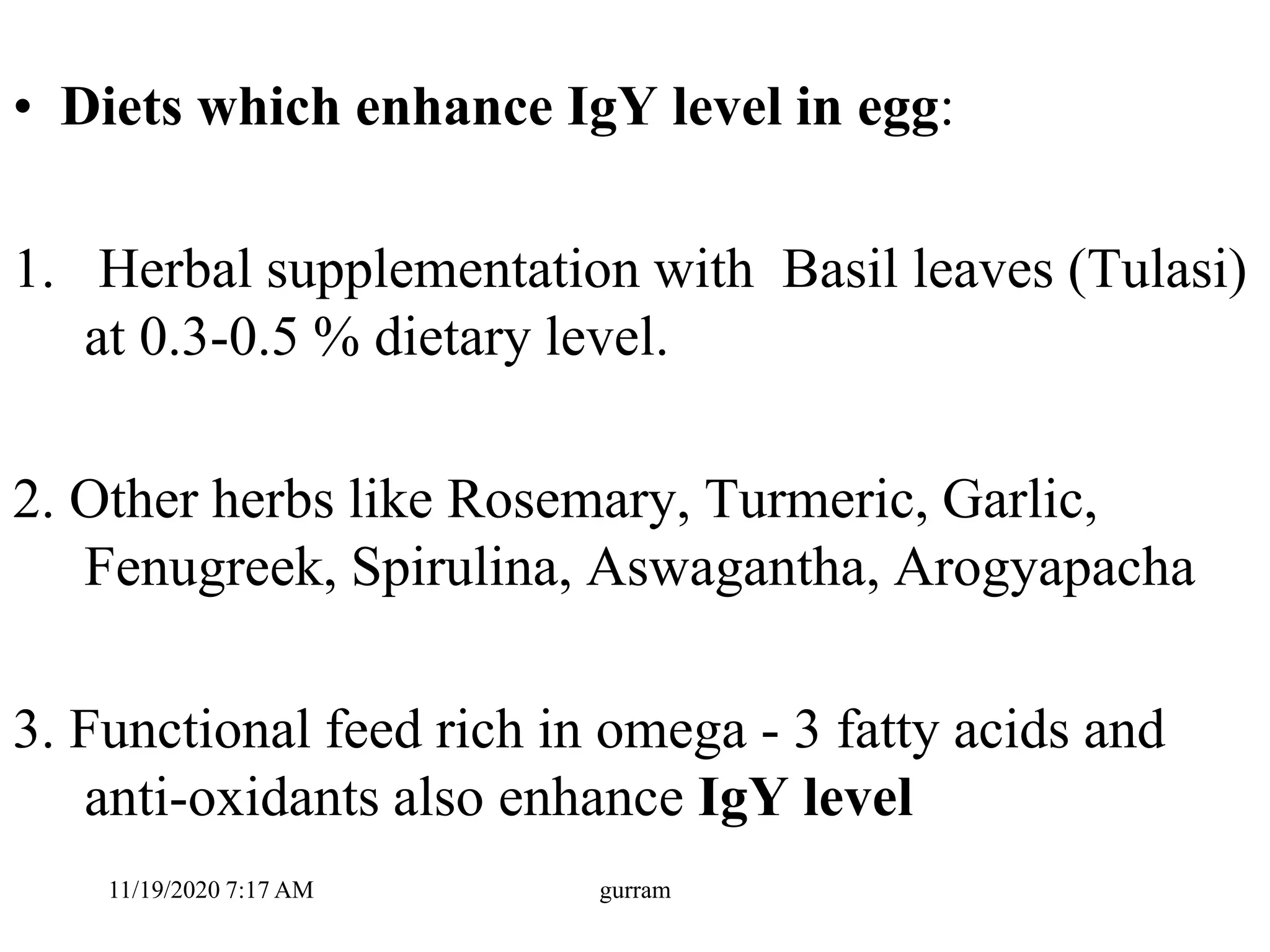
• Diets which enhance IgY level in egg:
1. Herbal supplementation with Basil leaves (Tulasi)
at 0.3-0.5 % dietary level.
2. Other herbs like Rosemary, Turmeric, Garlic,
Fenugreek, Spirulina, Aswagantha, Arogyapacha
3. Functional feed rich in omega - 3 fatty acids and
anti-oxidants also enhance IgY level
11/19/2020 7:17 AM gurram
Dietary Manipulation
• Dietary Manipulation is the major step in producing
the pre-oviposition/pre-slaughter value added
poultry products.
• Various nutritional manipulations to the chicken diet
will be done to produce different types of value
added products.
11/19/2020 7:17 AM gurram
W -3 Fatty Acids enrichment
• The total fat content in the egg yolk cannot be
altered; but its fatty acid composition can be altered,
by changing the type of oil used in the hens' diet
• Sources : Flax seed (linseed), marine algae, fish oil
and rape seed oil
11/19/2020 7:17 AM gurram
Anti Oxidants in eggs and meat
• The advantages of enrichment of the egg and
meat with anti oxidants include:
• Decreased susceptibility to lipid peroxidation
• Prevention of fishy odour to the product
• Designer foods could be a good source of
antioxidants in human diet
• Prevents destruction of fat-soluble vitamins
• Prevents denaturation of natural fat-soluble
pigments
• Promotes the overall health of the consumers
11/19/2020 7:17 AM gurram
Production of lean meat or reduction
of abdominal fat in broiler
• By narrowing down the calorie
• Feeding diet adequate in critical A.A
• Feeding low energy feed
• By feeding drugs like thyroxin
11/19/2020 7:17 AM gurram
• Egg based value added products
11/19/2020 7:17 AM gurram
Albumen rings
• Low fat egg snack food prepared by steam cooling
blended egg albumen in ring molds, battering and
breading the coagulated albumen and deep fat frying
• Nutrition : 11.5% protein and merely 3.2% fat
• Shelf life: refrigeration (4 degrees) for 18 days in
vacuum and 12 days In aerobic pack
(CARI 2011)
11/19/2020 7:17 AM gurram
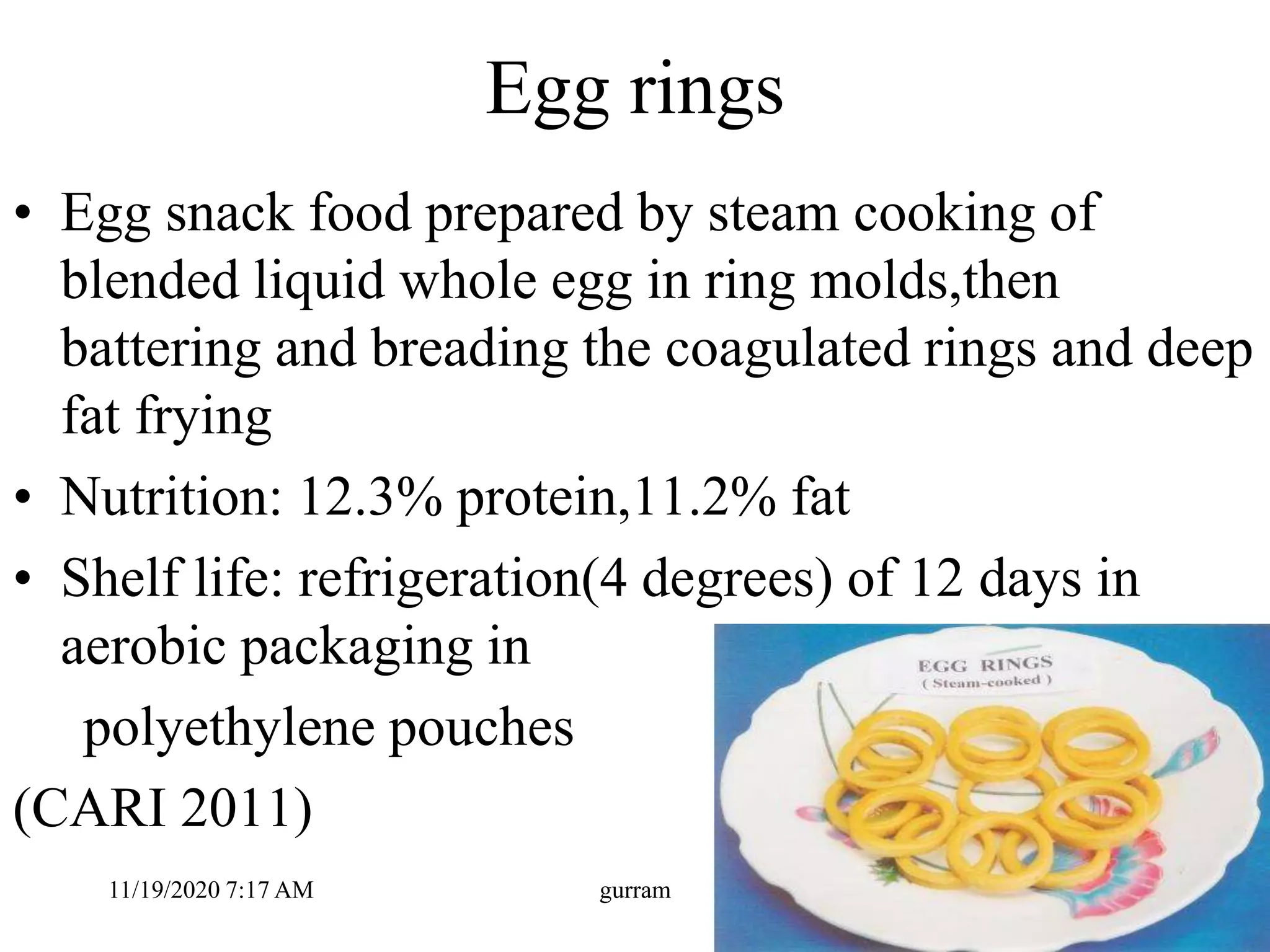
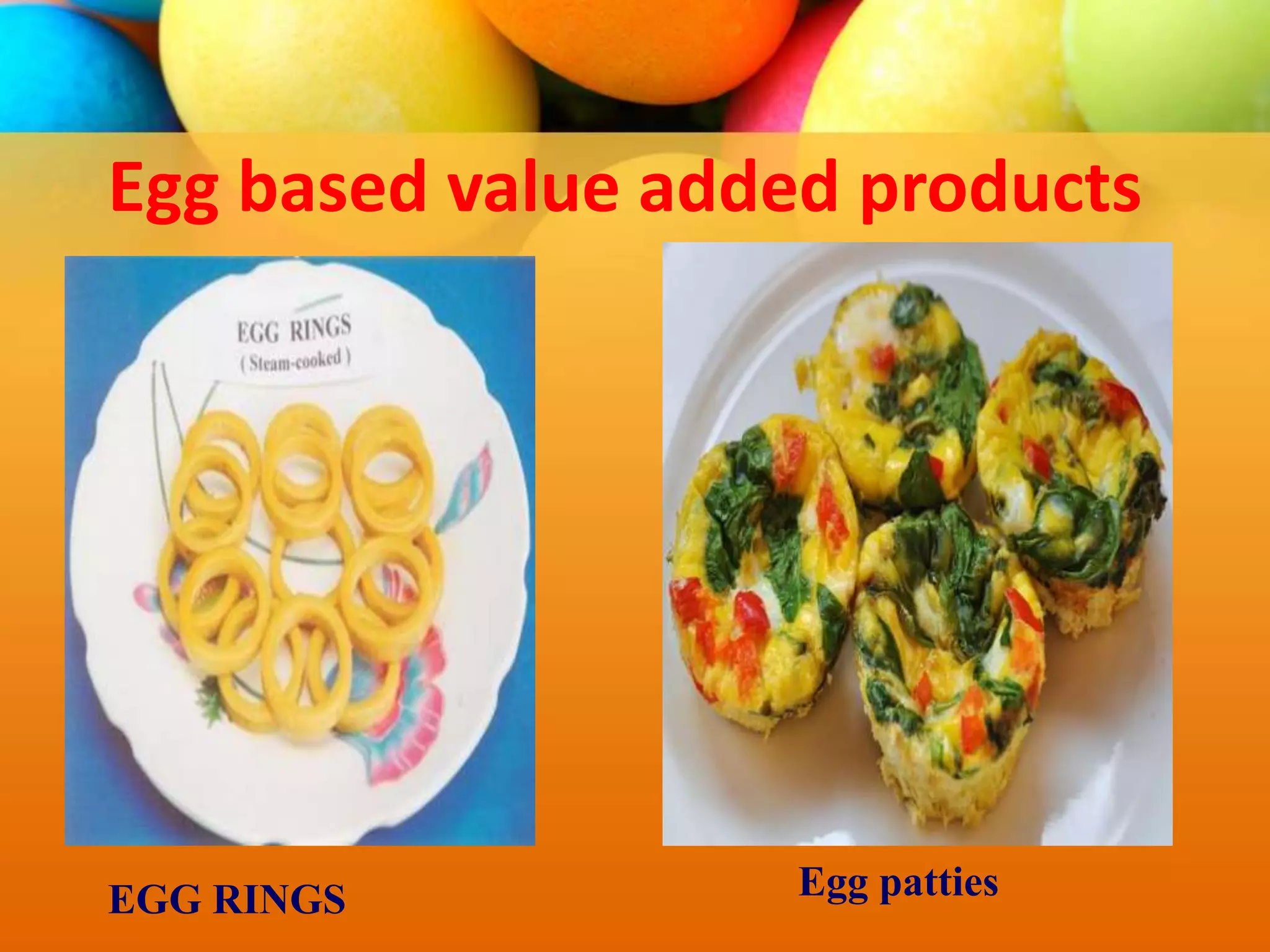
Egg rings
• Egg snack food prepared by steam cooking of
blended liquid whole egg in ring molds,then
battering and breading the coagulated rings and deep
fat frying
• Nutrition: 12.3% protein,11.2% fat
• Shelf life: refrigeration(4 degrees) of 12 days in
aerobic packaging in
polyethylene pouches
(CARI 2011)
11/19/2020 7:17 AM gurram
Egg pancakes
• Popularized as complete breakfast meal
• Ingredients: liquid whole egg, milk, wheat flour,
sugar and baking powder
• Shelf life: 12 days in vacuum packaging
(CARI 2011)
11/19/2020 7:17 AM gurram
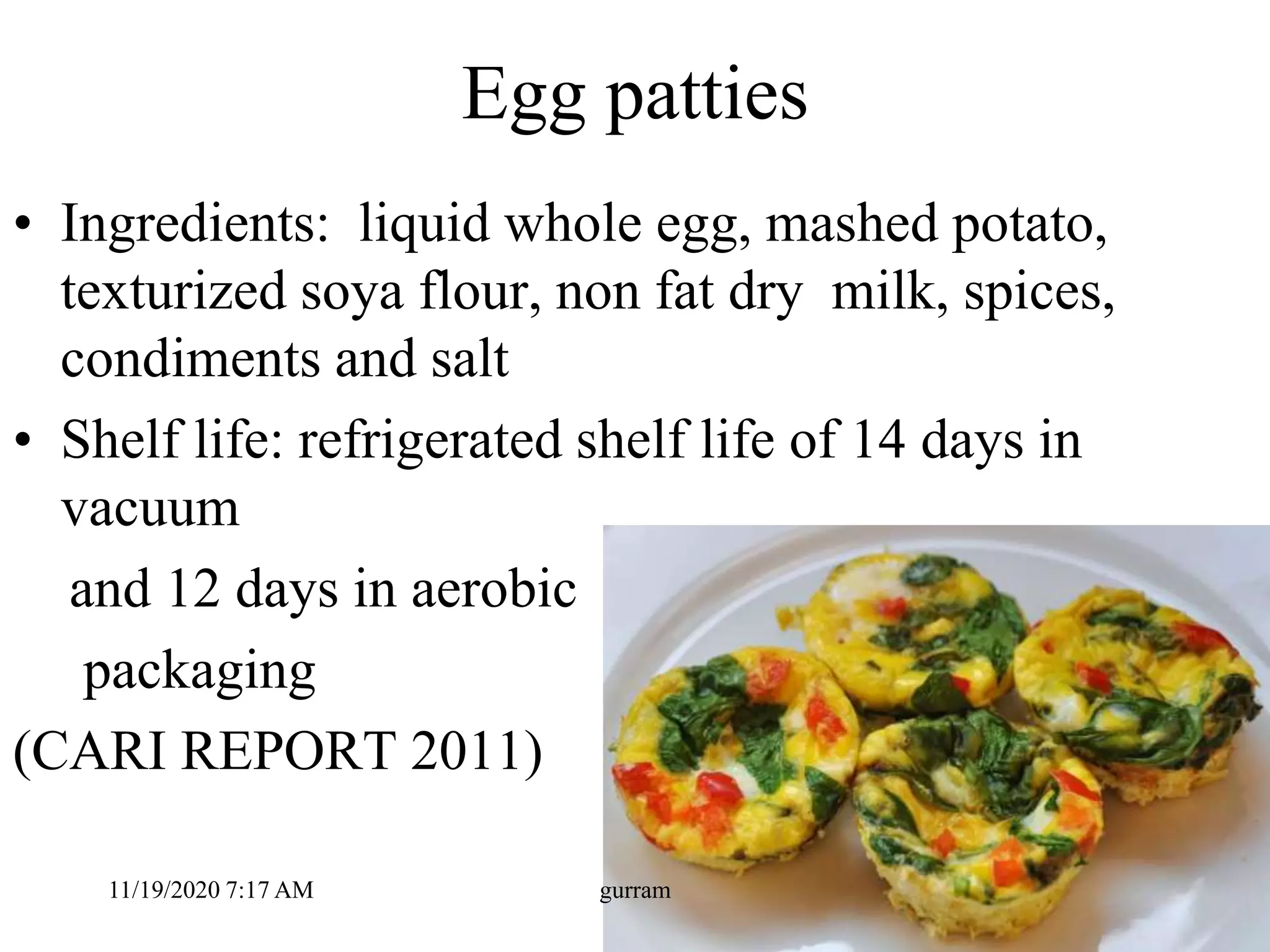
Egg patties
• Ingredients: liquid whole egg, mashed potato,
texturized soya flour, non fat dry milk, spices,
condiments and salt
• Shelf life: refrigerated shelf life of 14 days in
vacuum
and 12 days in aerobic
packaging
(CARI REPORT 2011)
11/19/2020 7:17 AM gurram
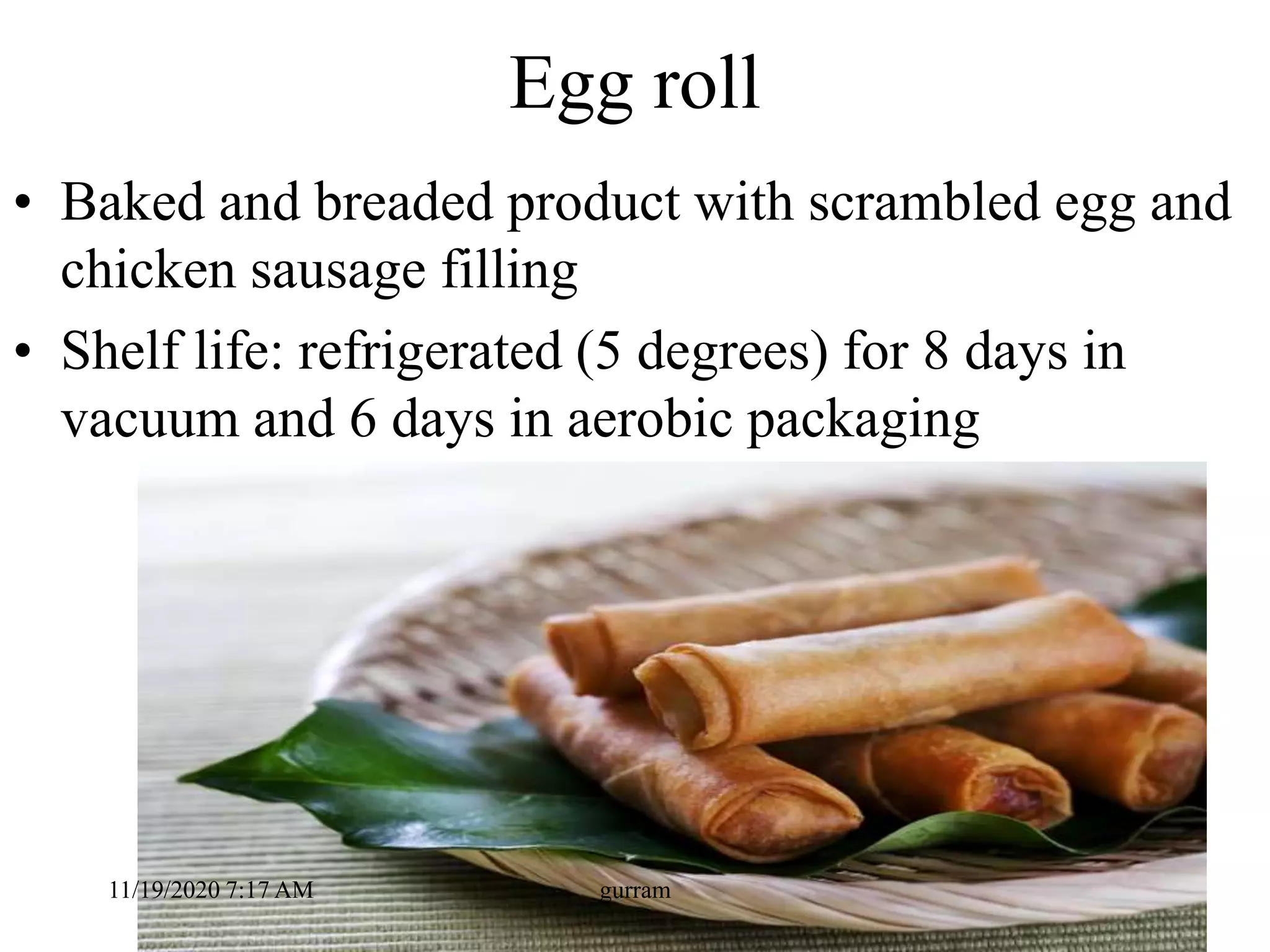
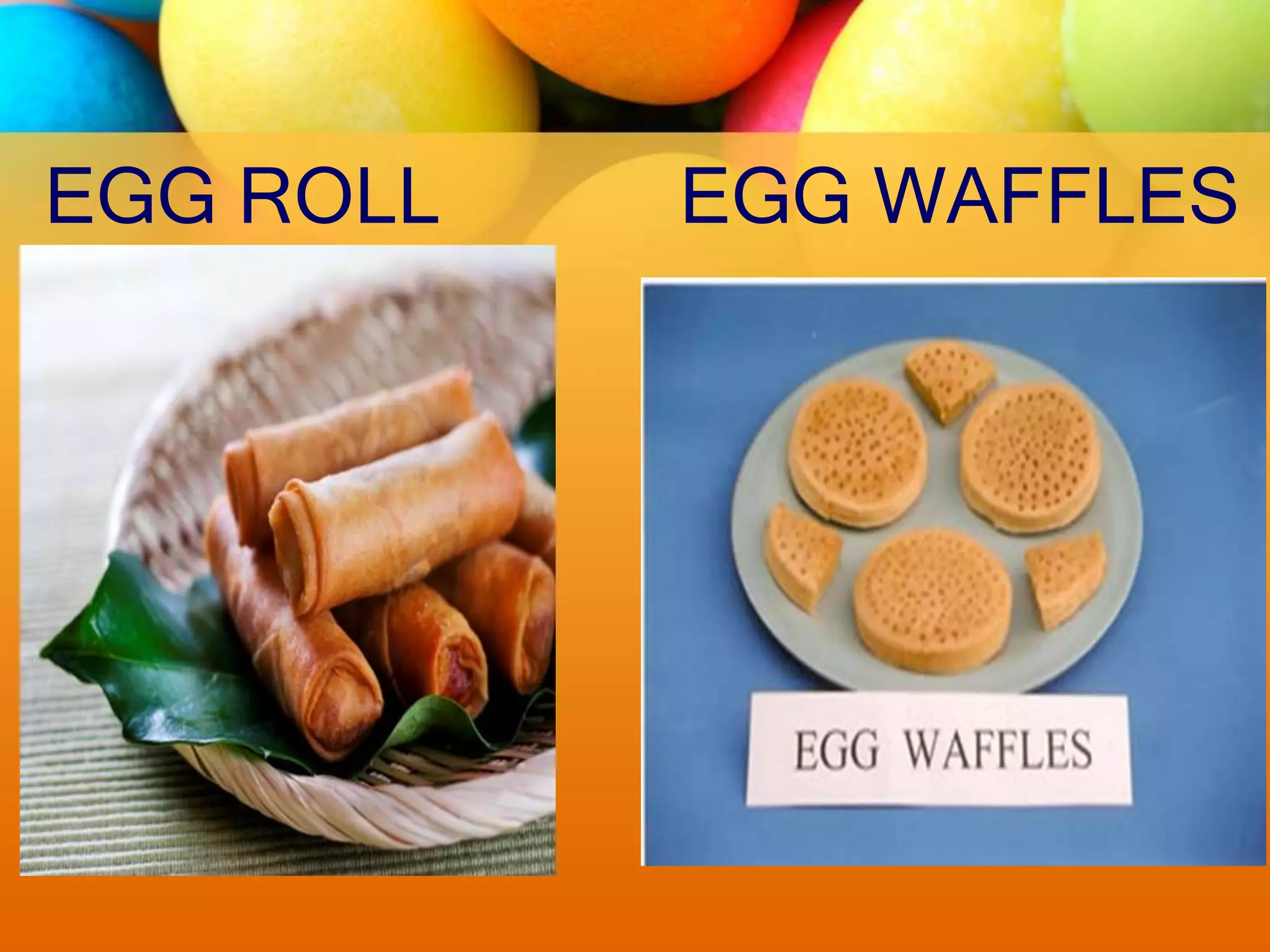
Egg roll
• Baked and breaded product with scrambled egg and
chicken sausage filling
• Shelf life: refrigerated (5 degrees) for 8 days in
vacuum and 6 days in aerobic packaging
11/19/2020 7:17 AM gurram
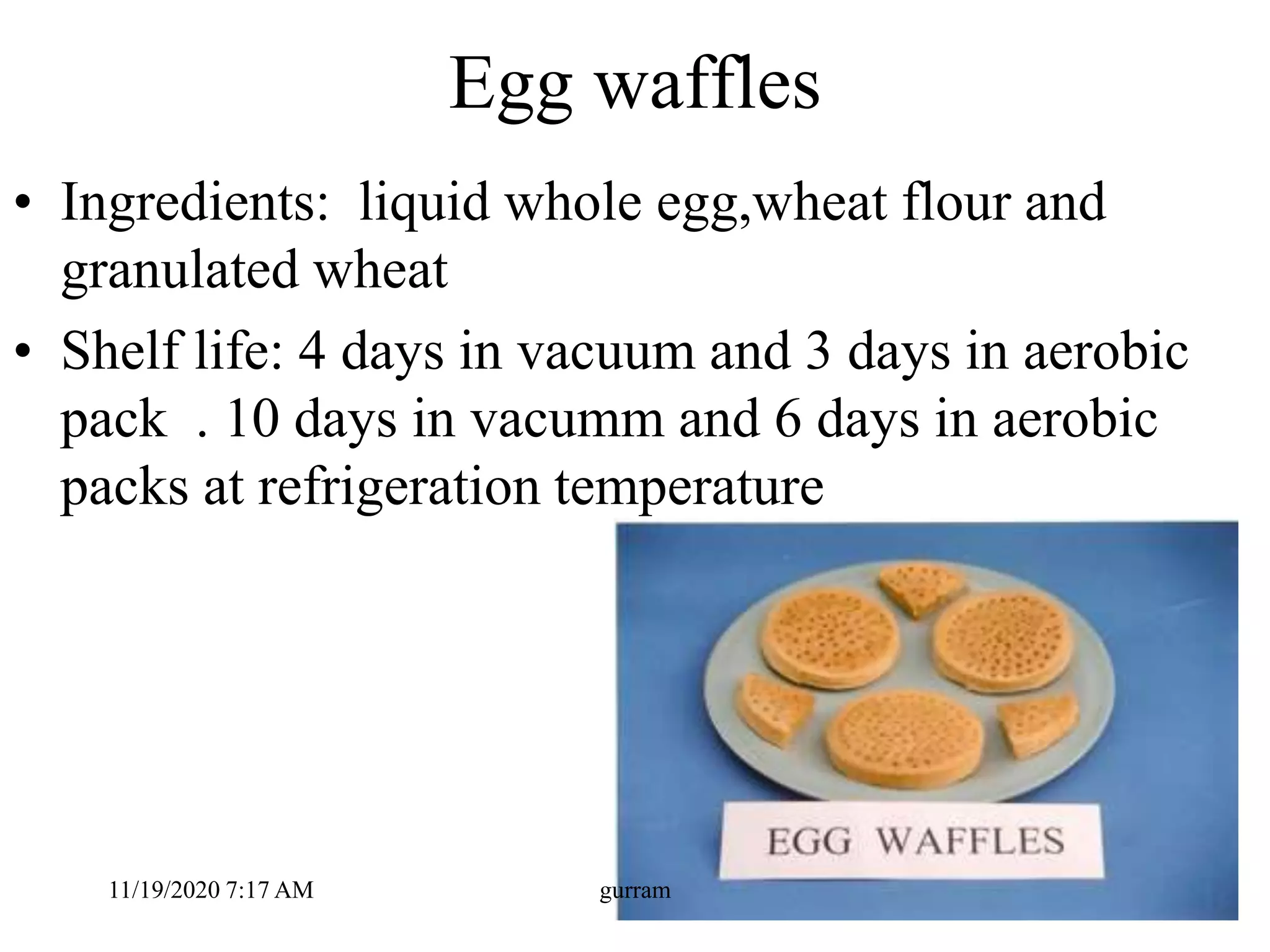
Egg waffles
• Ingredients: liquid whole egg,wheat flour and
granulated wheat
• Shelf life: 4 days in vacuum and 3 days in aerobic
pack . 10 days in vacumm and 6 days in aerobic
packs at refrigeration temperature
11/19/2020 7:17 AM gurram
Designer and Specialty Eggs
• "Designer eggs" are those in which the
content has been modified from the
standard egg.
• Developed due to problems arising out
of HIGH CHOLESTROL LEVEL and
SALMONELLA.
• The concept was put forward by Dr. J.
Sim of University of Alberta , N.A.
DESIGNER EGGS
Production of Designer Eggs
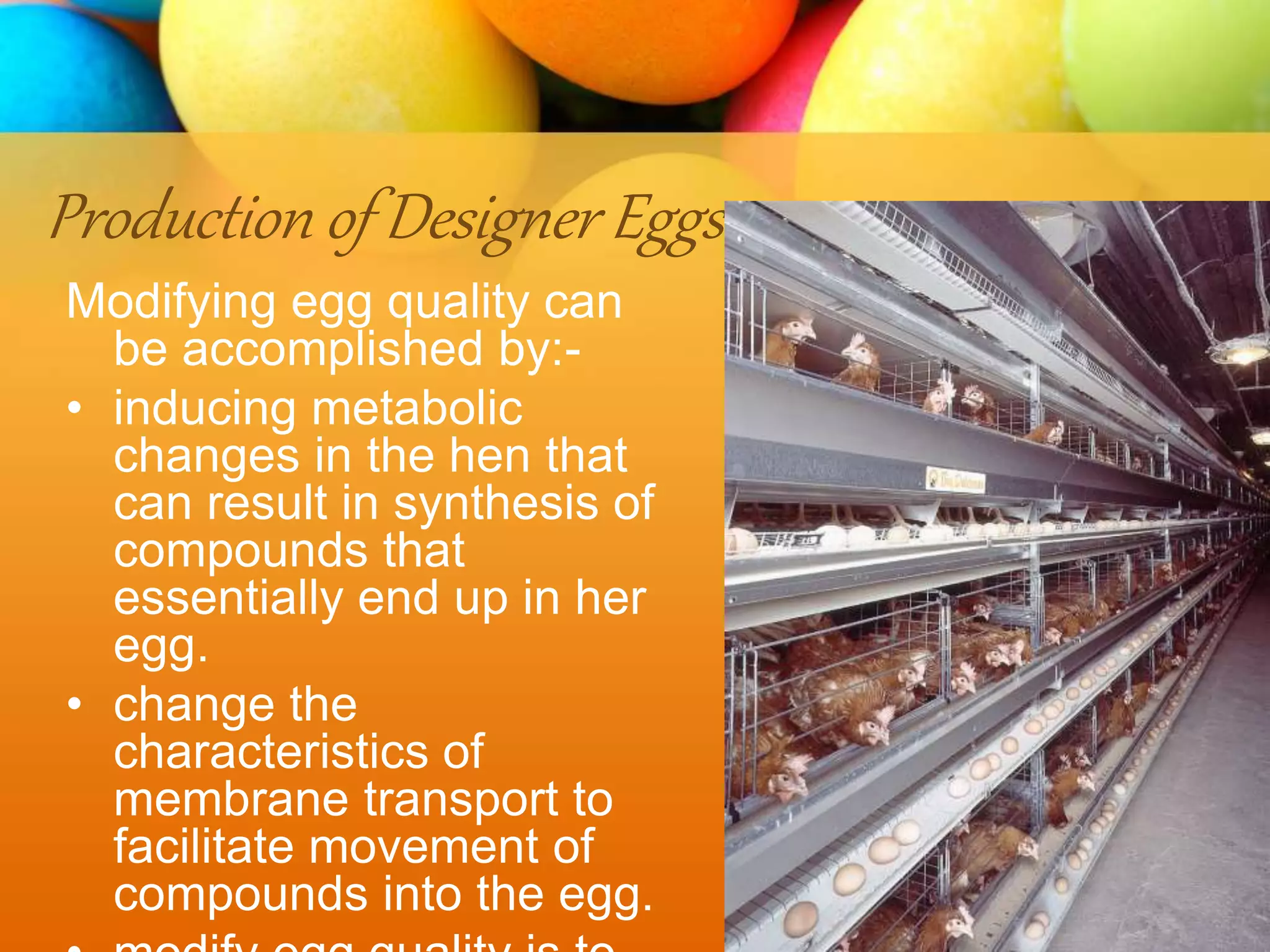
Modifying egg quality can
be accomplished by:-
• inducing metabolic
changes in the hen that
can result in synthesis of
compounds that
essentially end up in her
egg.
• change the
characteristics of
membrane transport to
facilitate movement of
compounds into the egg.
Nutrient Content
• Vitamin content
• Lowered Choleste
• Fat content
• Mineral content
• Pigment content
• Pharmaceutical co
Vitamin content
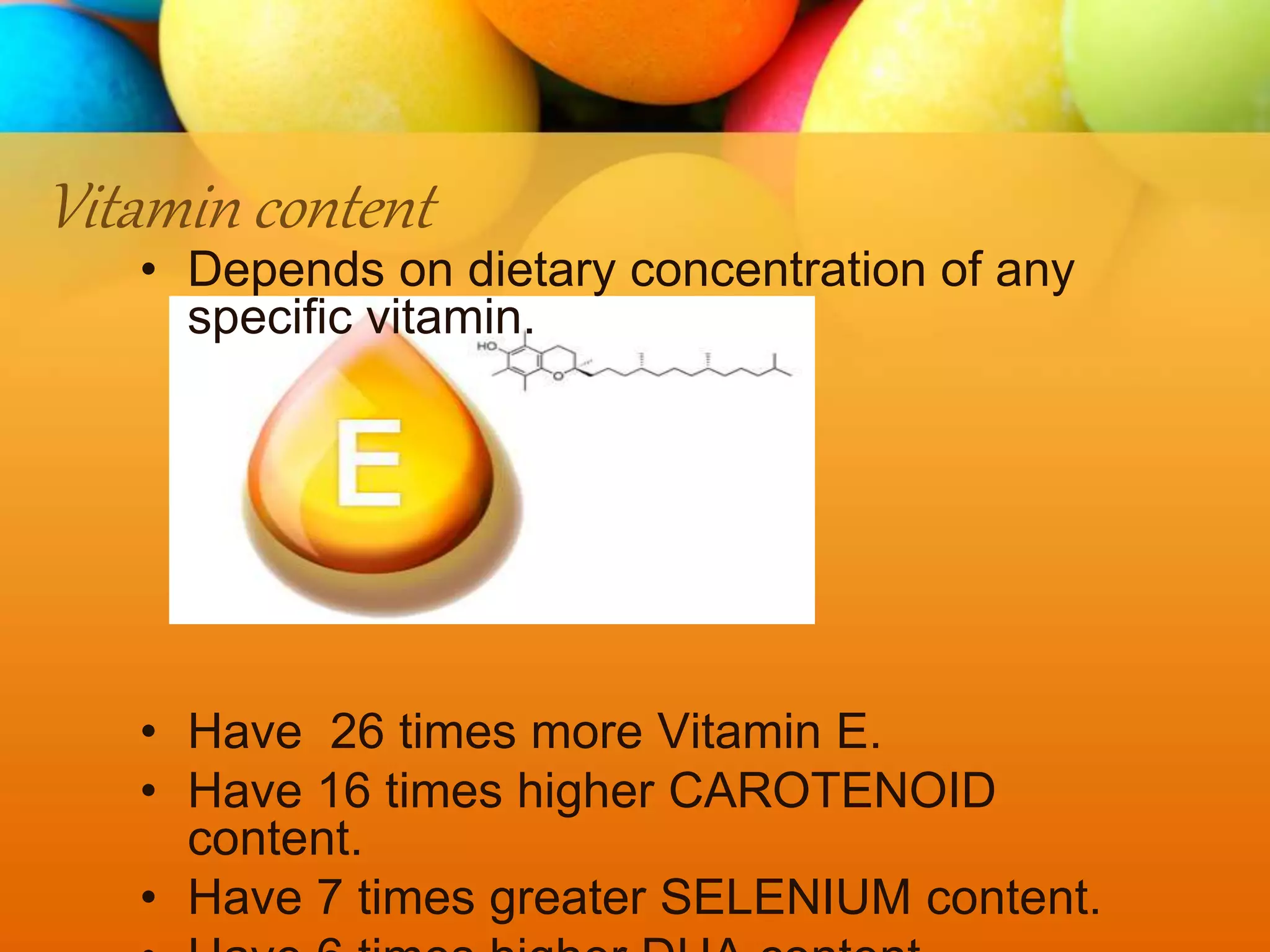
• Depends on dietary concentration of any
specific vitamin.
• Have 26 times more Vitamin E.
• Have 16 times higher CAROTENOID
content.
• Have 7 times greater SELENIUM content.
Lowered Cholesterol
• Depends on diet and
Pharmacological
Intervention.
• Drugs like PROBUCOL
have lowered the egg
cholesterol by 50 %.
• Such eggs have 29%
less saturated fat.
• Other methods
• -Chromium
supplementation.
• -Lowering the
Fat content
• Depends on feed of
flaxseed ,marine algae
,fish oil and vegetable oil.
• Have higher amount of
omega-3 fatty acid.
• High amount of Iodine.
• Have lowered saturated to
unsaturated fatty acid
ratio.
Mineral Content
• Done by feeding diet rich
in zinc, copper, iodine,
chromium and selenium
content.
• Calcium and phosphorus
content of the shell is
enhanced in these eggs.
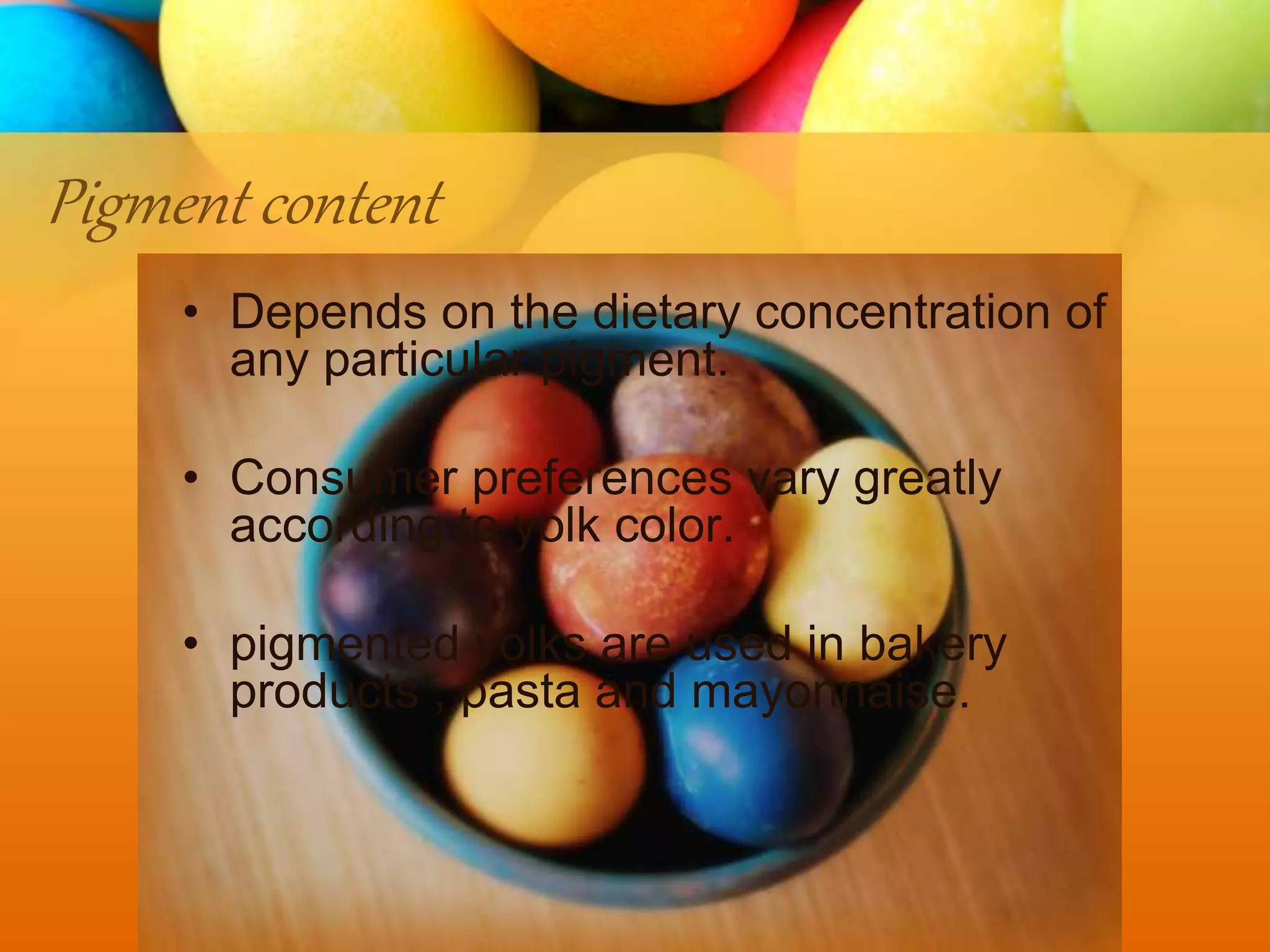
Pigment content
• Depends on the dietary concentration of
any particular pigment.
• Consumer preferences vary greatly
according to yolk color.
• pigmented yolks are used in bakery
products , pasta and mayonnaise.
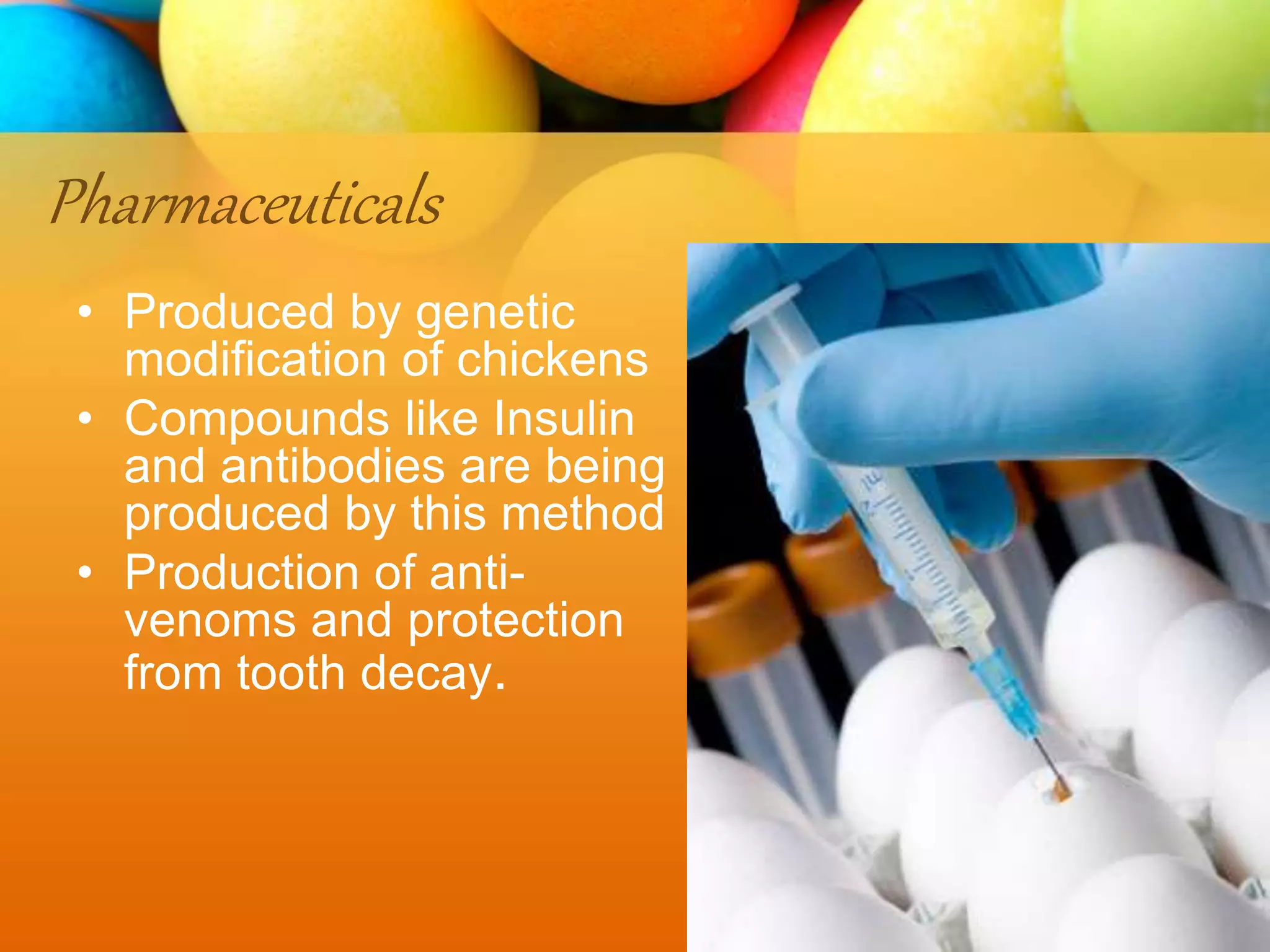
Pharmaceuticals
• Produced by genetic
modification of chickens
• Compounds like Insulin
and antibodies are being
produced by this method
• Production of anti-
venoms and protection
from tooth decay.
• Alternative choices to consumers with
special needs and preferences.
• Nutrient content of an egg can be
changed only by altering the hen’s feed.
• Nutrient content cannot be altered by
changing environmental conditions.
• Due to higher production costs,
specialty eggs are usually more
expensive than generic shell eggs.
Specialty Eggs
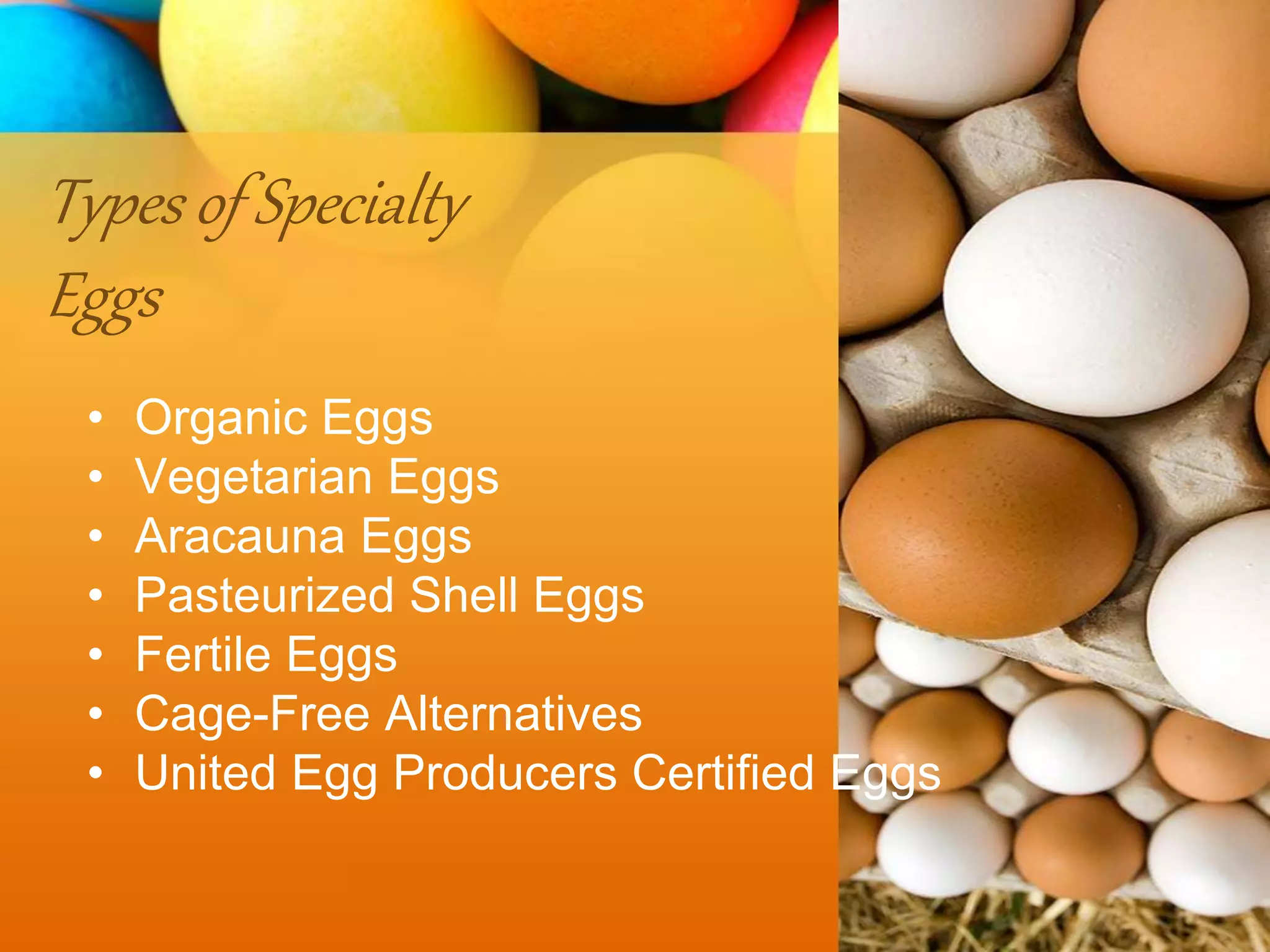
Types of Specialty
Eggs
• Organic Eggs
• Vegetarian Eggs
• Aracauna Eggs
• Pasteurized Shell Eggs
• Fertile Eggs
• Cage-Free Alternatives
• United Egg Producers Certified Eggs
Organic eggs
• The National Organic Standard
Board (USDA)in October 2002 set
national guidelines for producers.
• Produced by hens given feed
grown without most conventional
pesticides , fungicides, herbicides,
or commercial fertilizers.
• Use of growth hormones and
antibiotics is prohibited.
• Produced by free roaming hens
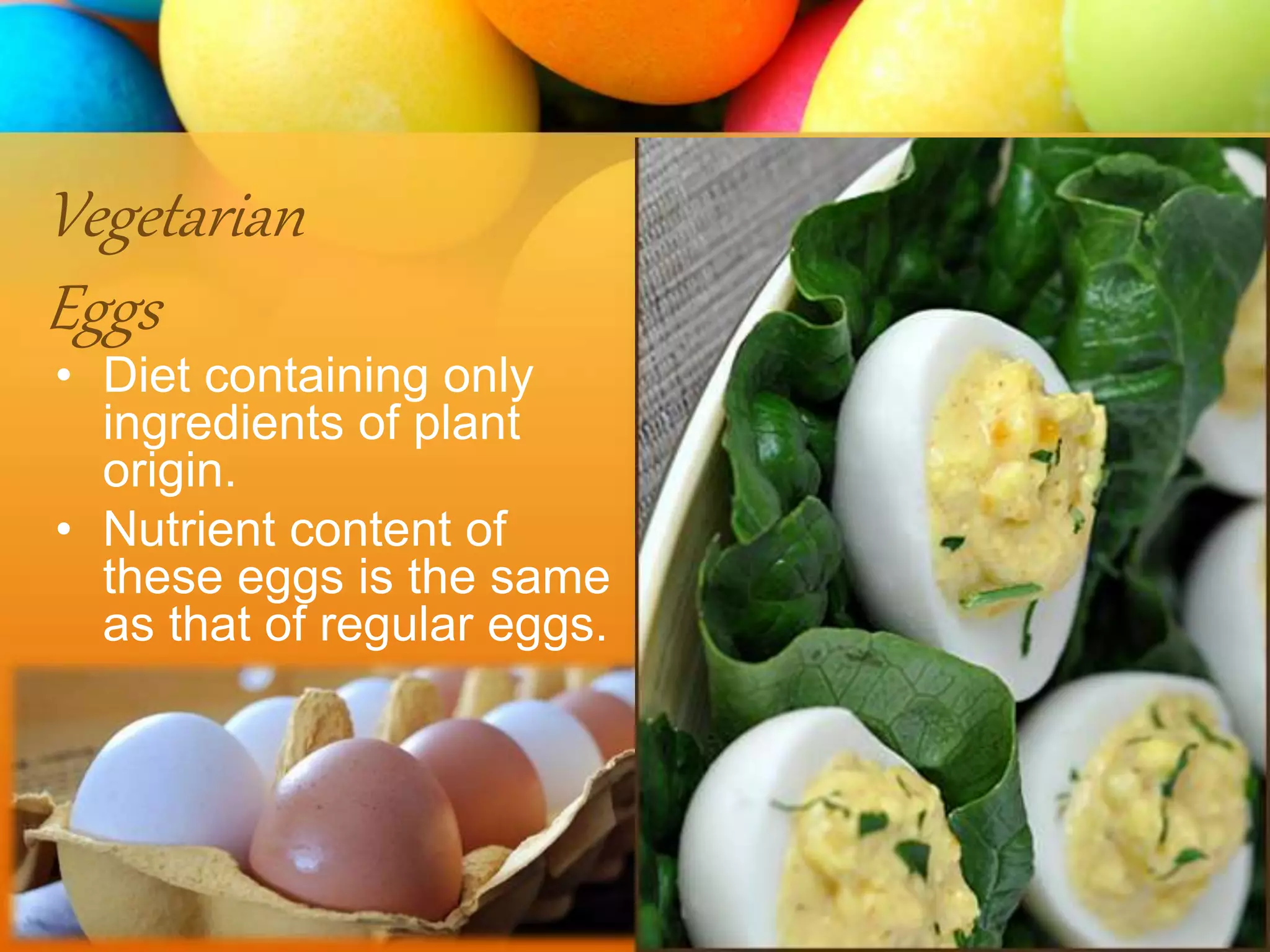
Vegetarian
Eggs
• Diet containing only
ingredients of plant
origin.
• Nutrient content of
these eggs is the same
as that of regular eggs.
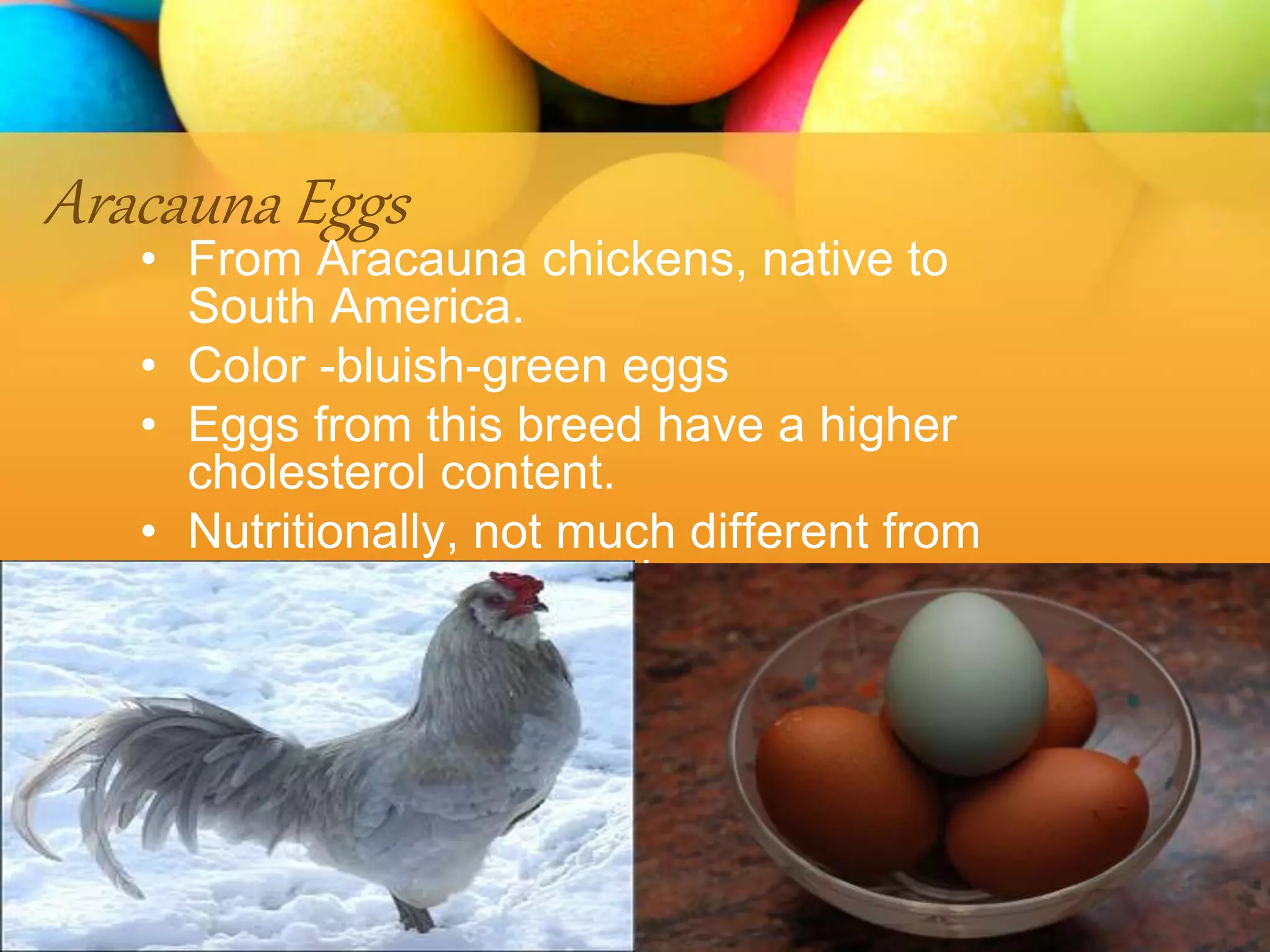
Aracauna Eggs
• From Aracauna chickens, native to
South America.
• Color -bluish-green eggs
• Eggs from this breed have a higher
cholesterol content.
• Nutritionally, not much different from
traditional white and brown eggs.
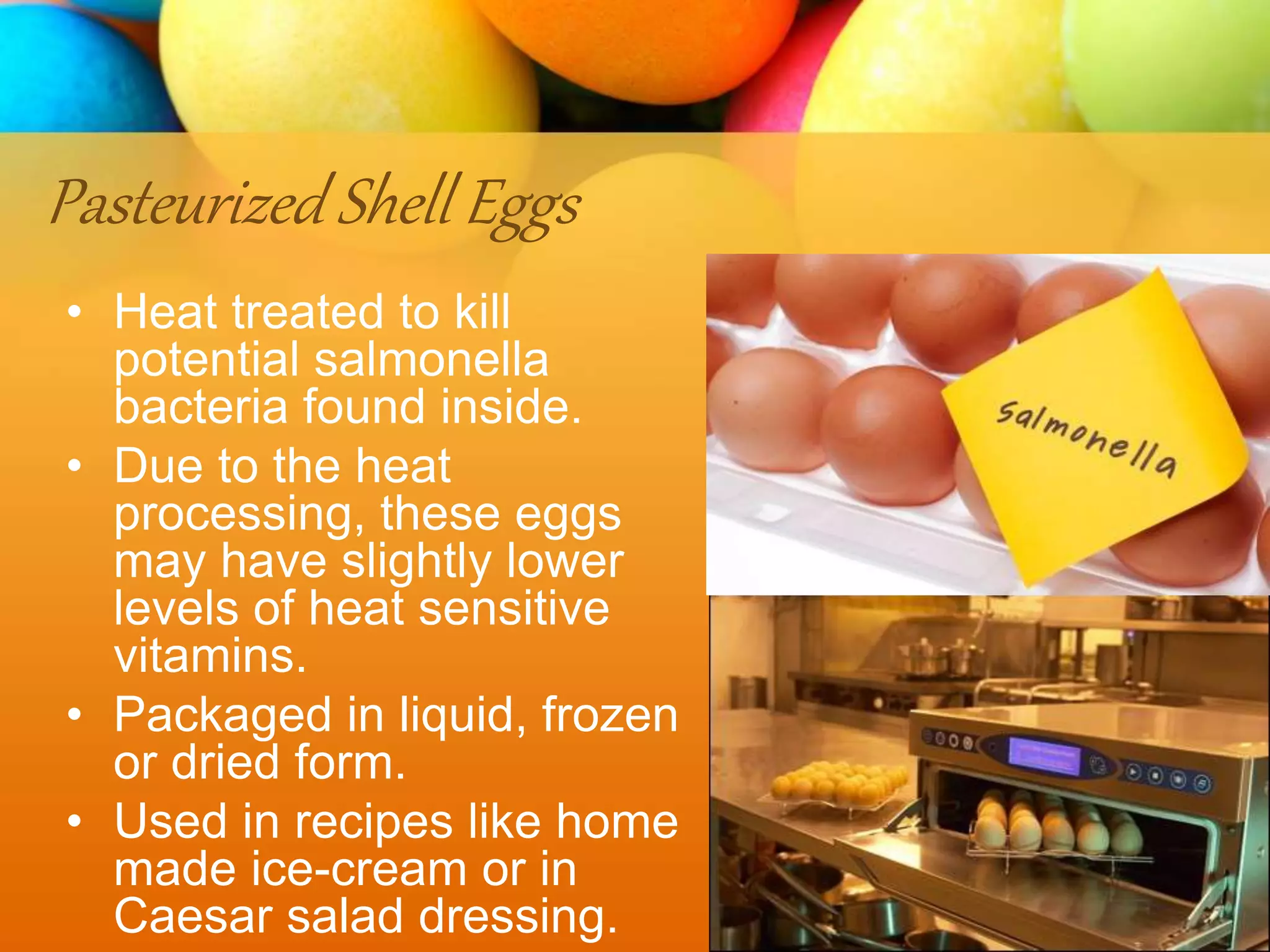
Pasteurized Shell Eggs
• Heat treated to kill
potential salmonella
bacteria found inside.
• Due to the heat
processing, these eggs
may have slightly lower
levels of heat sensitive
vitamins.
• Packaged in liquid, frozen
or dried form.
• Used in recipes like home
made ice-cream or in
Caesar salad dressing.
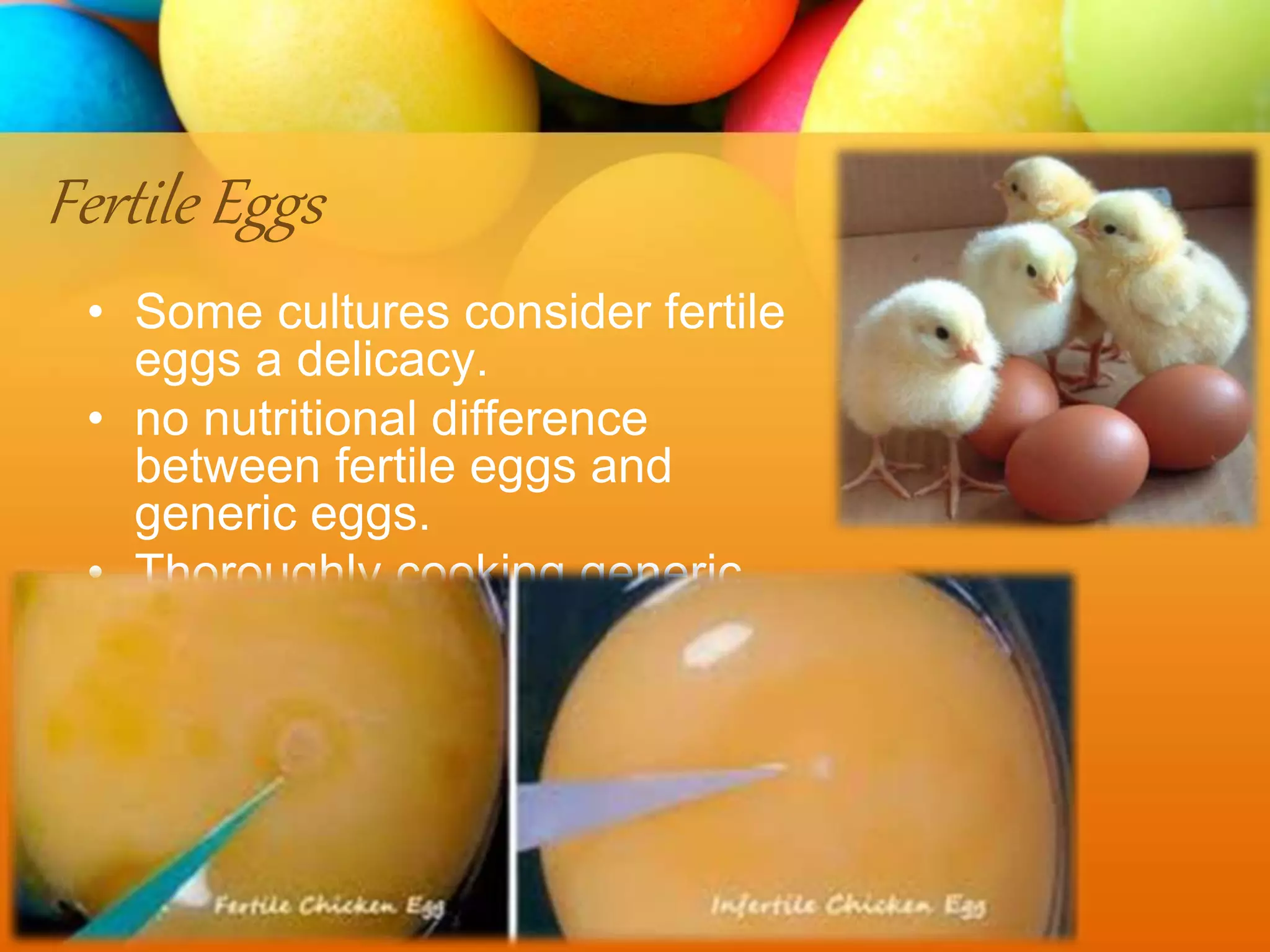
Fertile Eggs
• Some cultures consider fertile
eggs a delicacy.
• no nutritional difference
between fertile eggs and
generic eggs.
• Thoroughly cooking generic
shell eggs destroy any potential
salmonella bacteria in the egg.
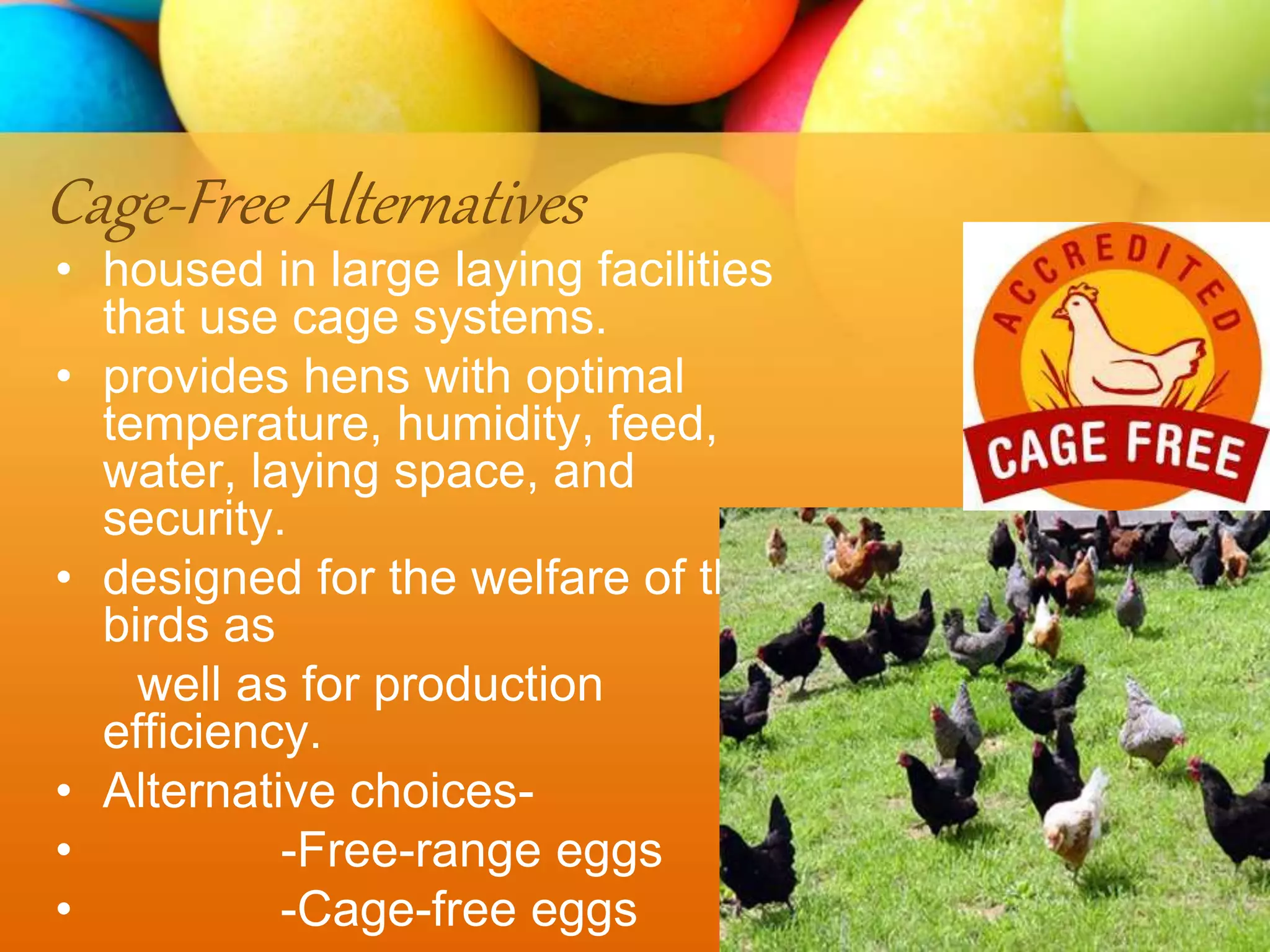
Cage-Free Alternatives
• housed in large laying facilities
that use cage systems.
• provides hens with optimal
temperature, humidity, feed,
water, laying space, and
security.
• designed for the welfare of the
birds as
well as for production
efficiency.
• Alternative choices-
• -Free-range eggs
• -Cage-free eggs
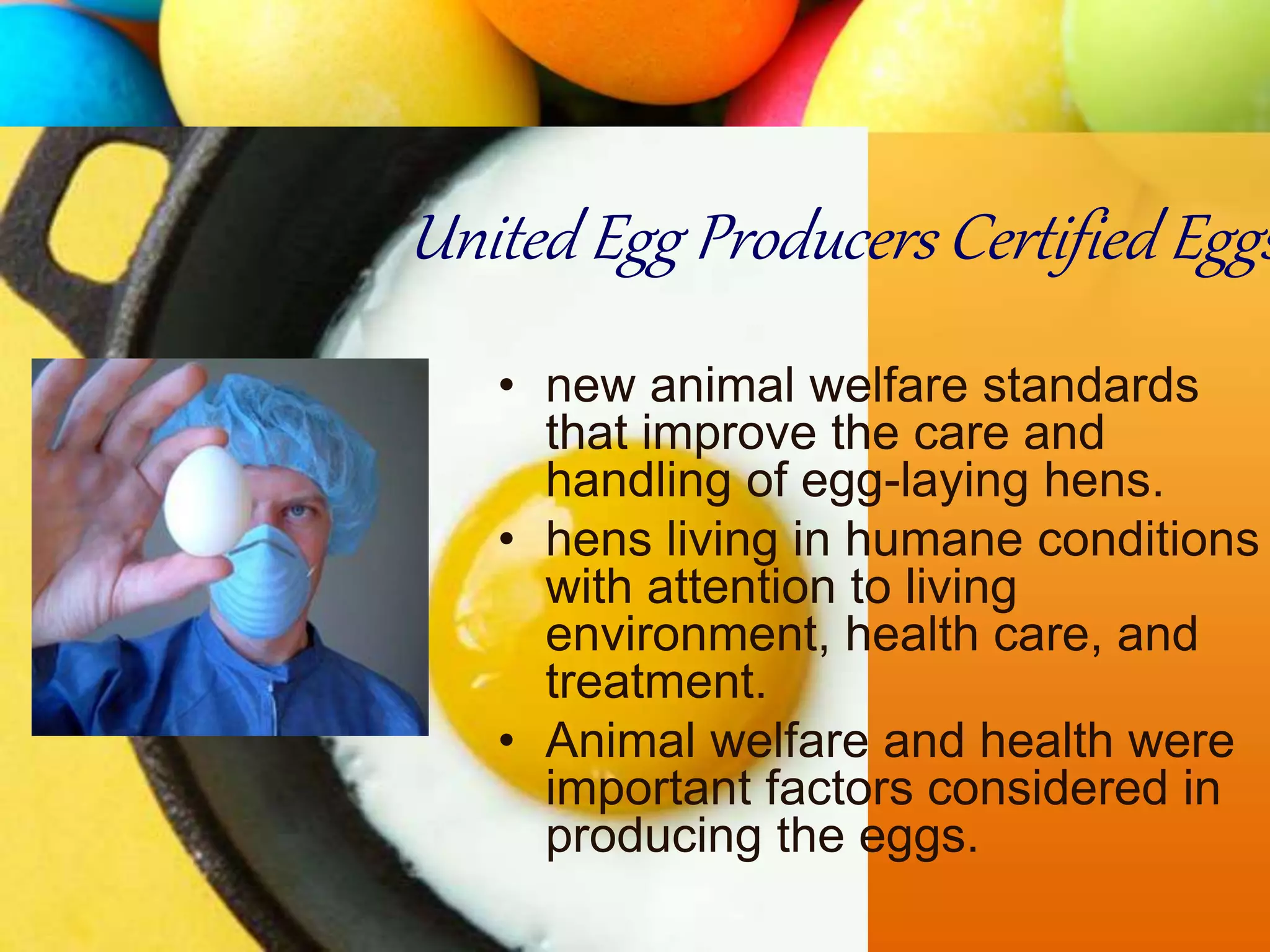
United Egg Producers Certified Eggs
• new animal welfare standards
that improve the care and
handling of egg-laying hens.
• hens living in humane conditions
with attention to living
environment, health care, and
treatment.
• Animal welfare and health were
important factors considered in
producing the eggs.
Egg based value added products
Egg pattiesEGG RINGS
EGG ROLL EGG WAFFLES
EGG QUALITY
11/19/2020 7:17 AM gurram
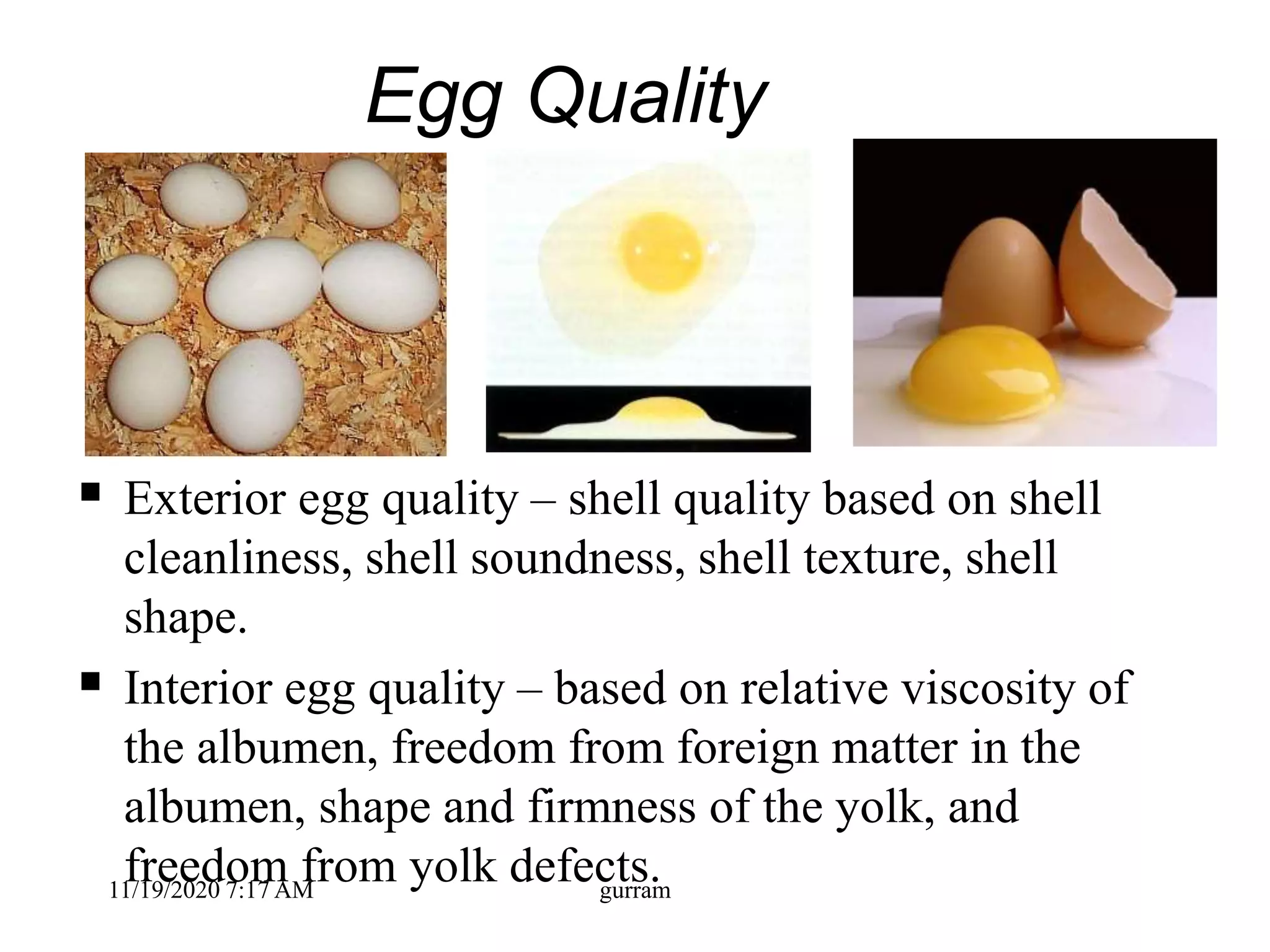
Egg Quality
 Exterior egg quality – shell quality based on shell
cleanliness, shell soundness, shell texture, shell
shape.
 Interior egg quality – based on relative viscosity of
the albumen, freedom from foreign matter in the
albumen, shape and firmness of the yolk, and
freedom from yolk defects.11/19/2020 7:17 AM gurram
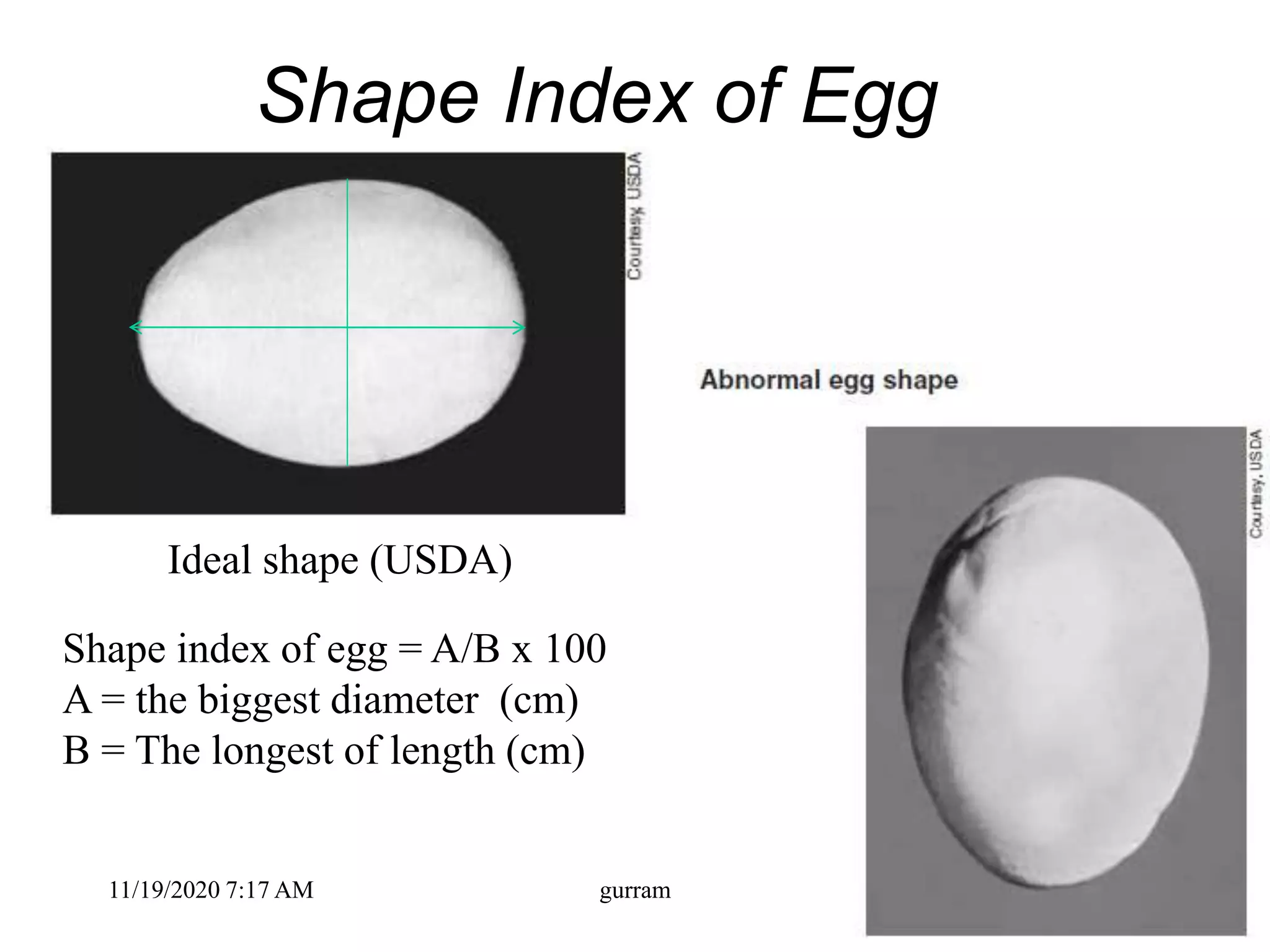
Shape Index of Egg
Ideal shape (USDA)
Shape index of egg = A/B x 100
A = the biggest diameter (cm)
B = The longest of length (cm)
11/19/2020 7:17 AM gurram
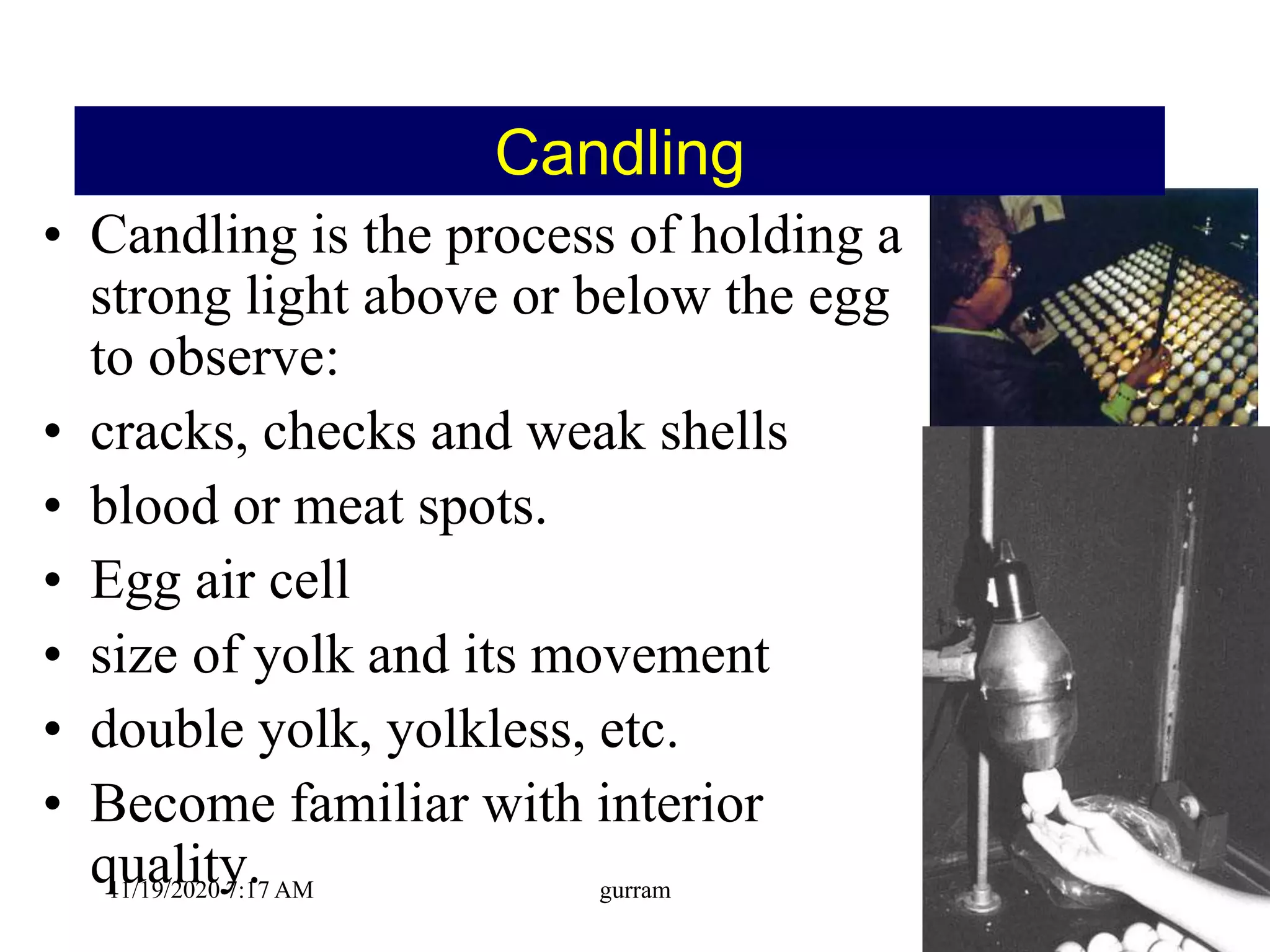
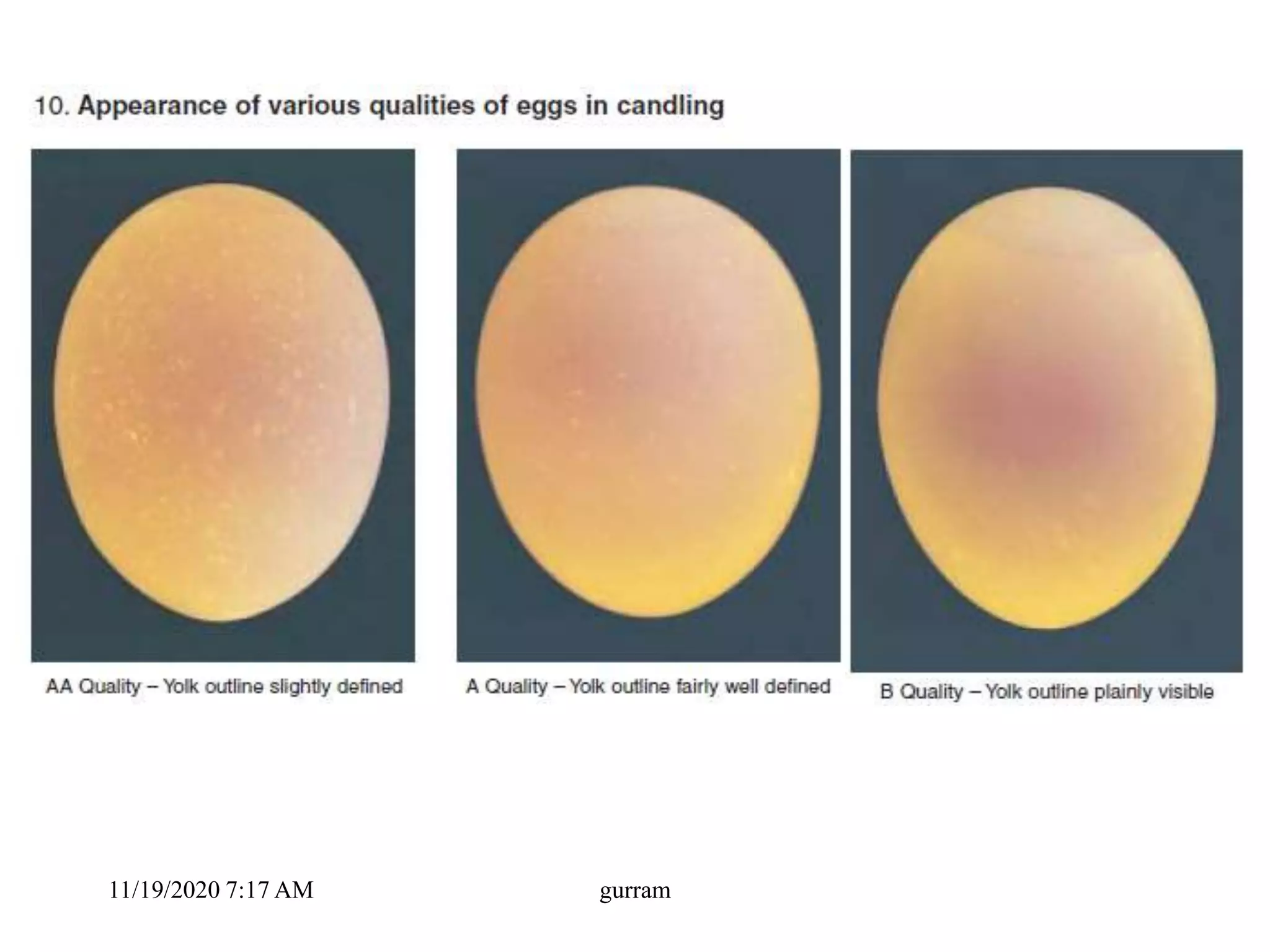
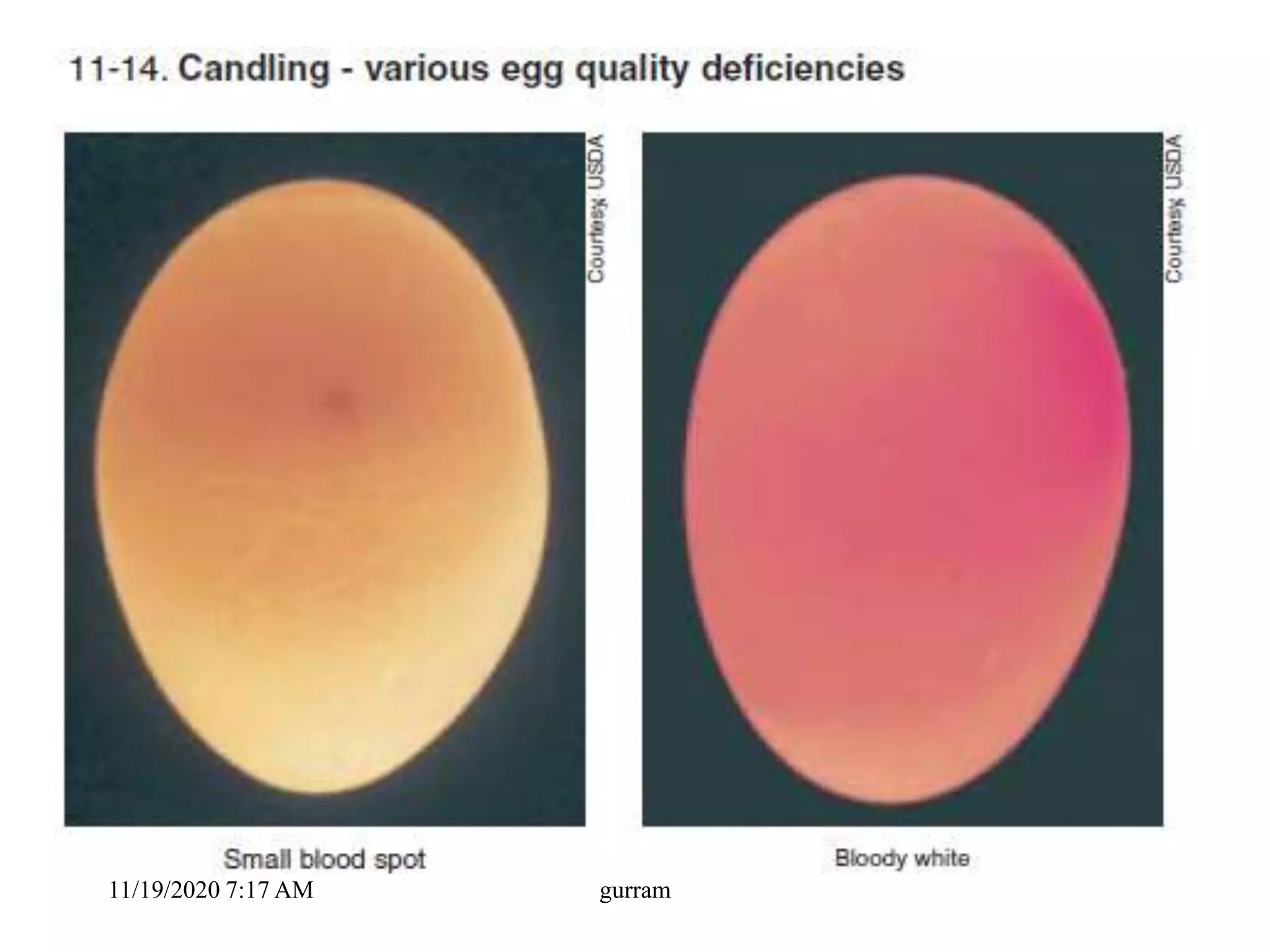
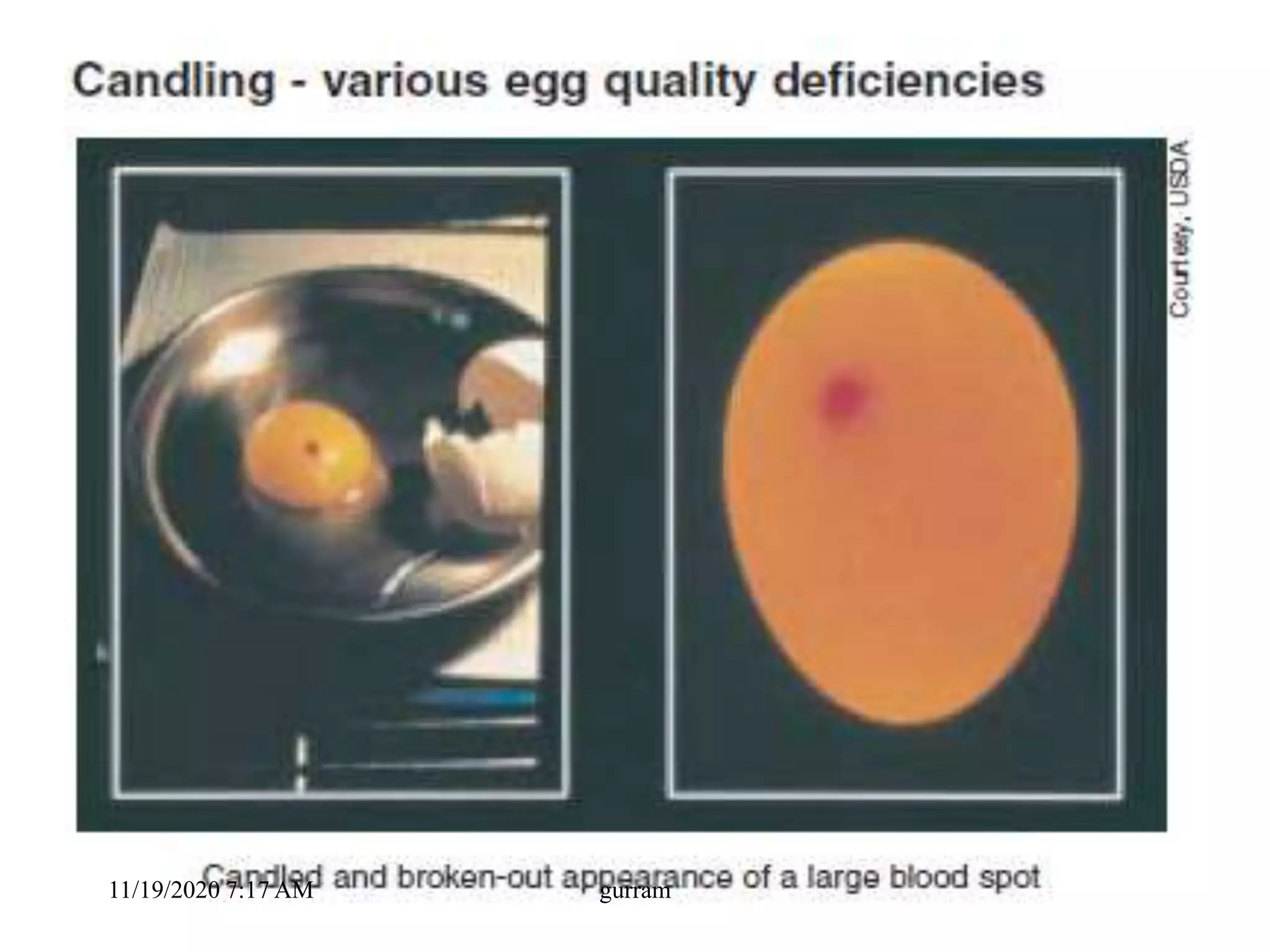
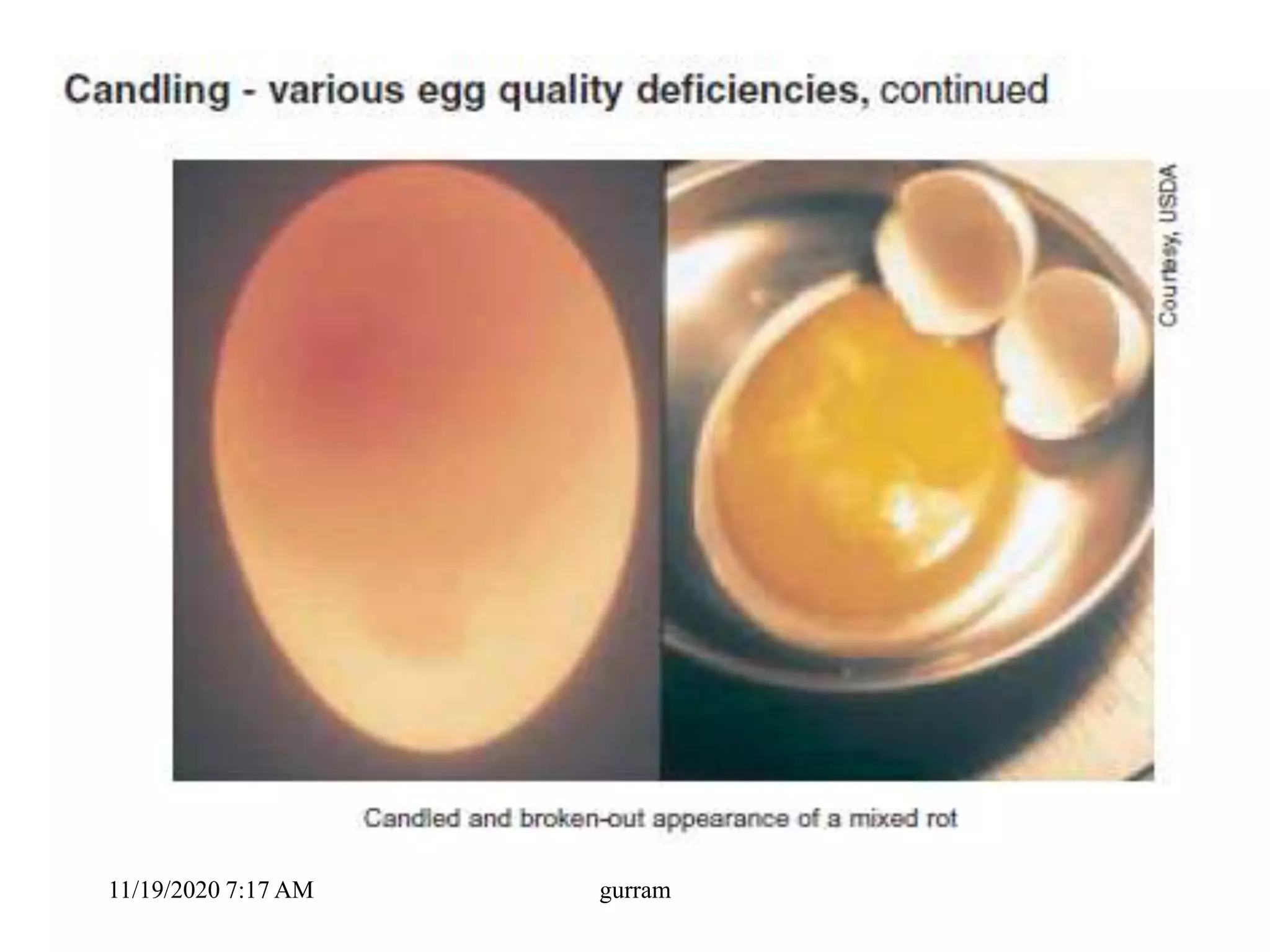
Candling
• Candling is the process of holding a
strong light above or below the egg
to observe:
• cracks, checks and weak shells
• blood or meat spots.
• Egg air cell
• size of yolk and its movement
• double yolk, yolkless, etc.
• Become familiar with interior
quality.11/19/2020 7:17 AM gurram
11/19/2020 7:17 AM gurram
Egg Grading
Grade
size
11/19/2020 7:17 AM gurram
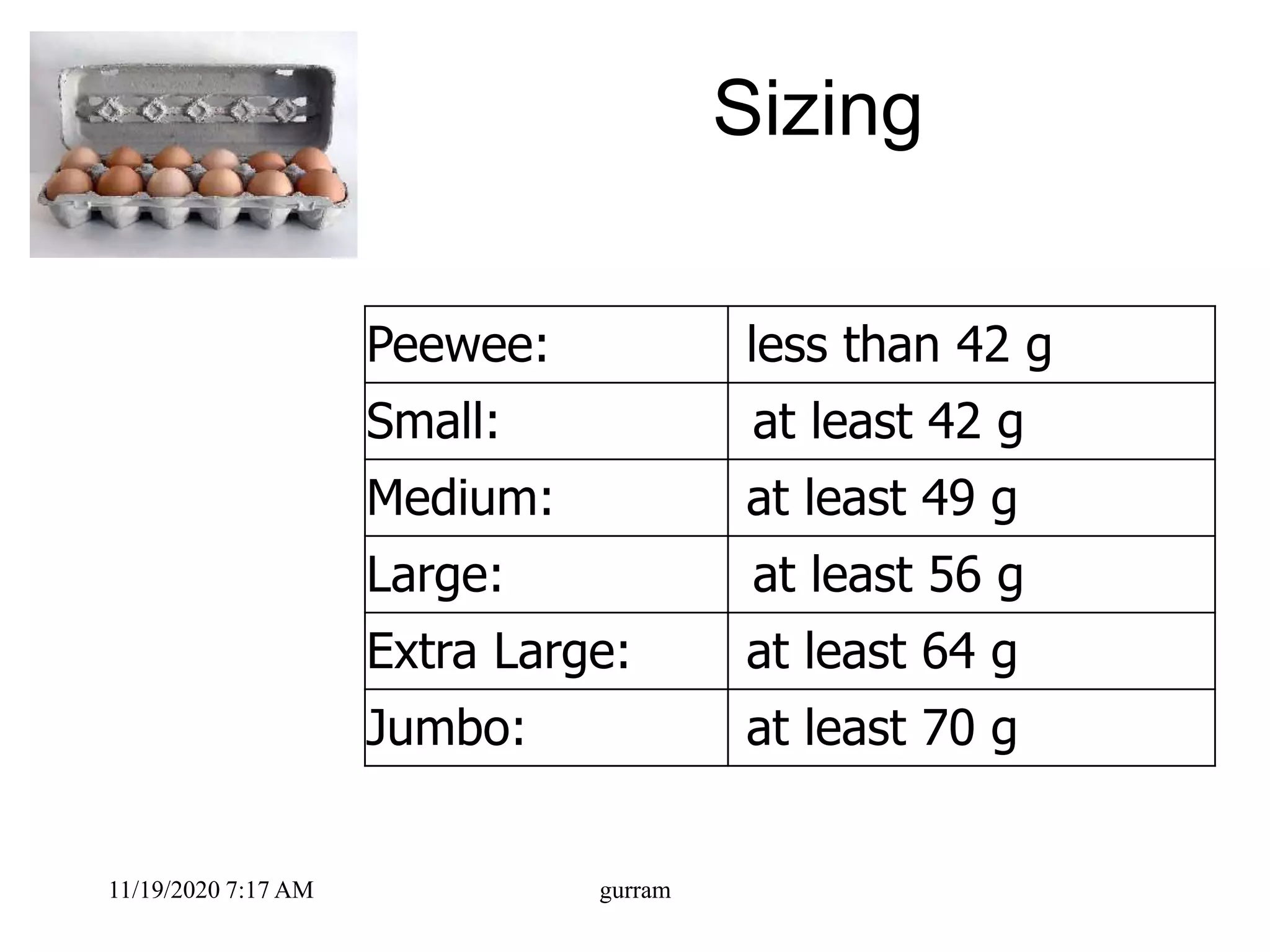
Sizing
Peewee: less than 42 g
Small: at least 42 g
Medium: at least 49 g
Large: at least 56 g
Extra Large: at least 64 g
Jumbo: at least 70 g
11/19/2020 7:17 AM gurram
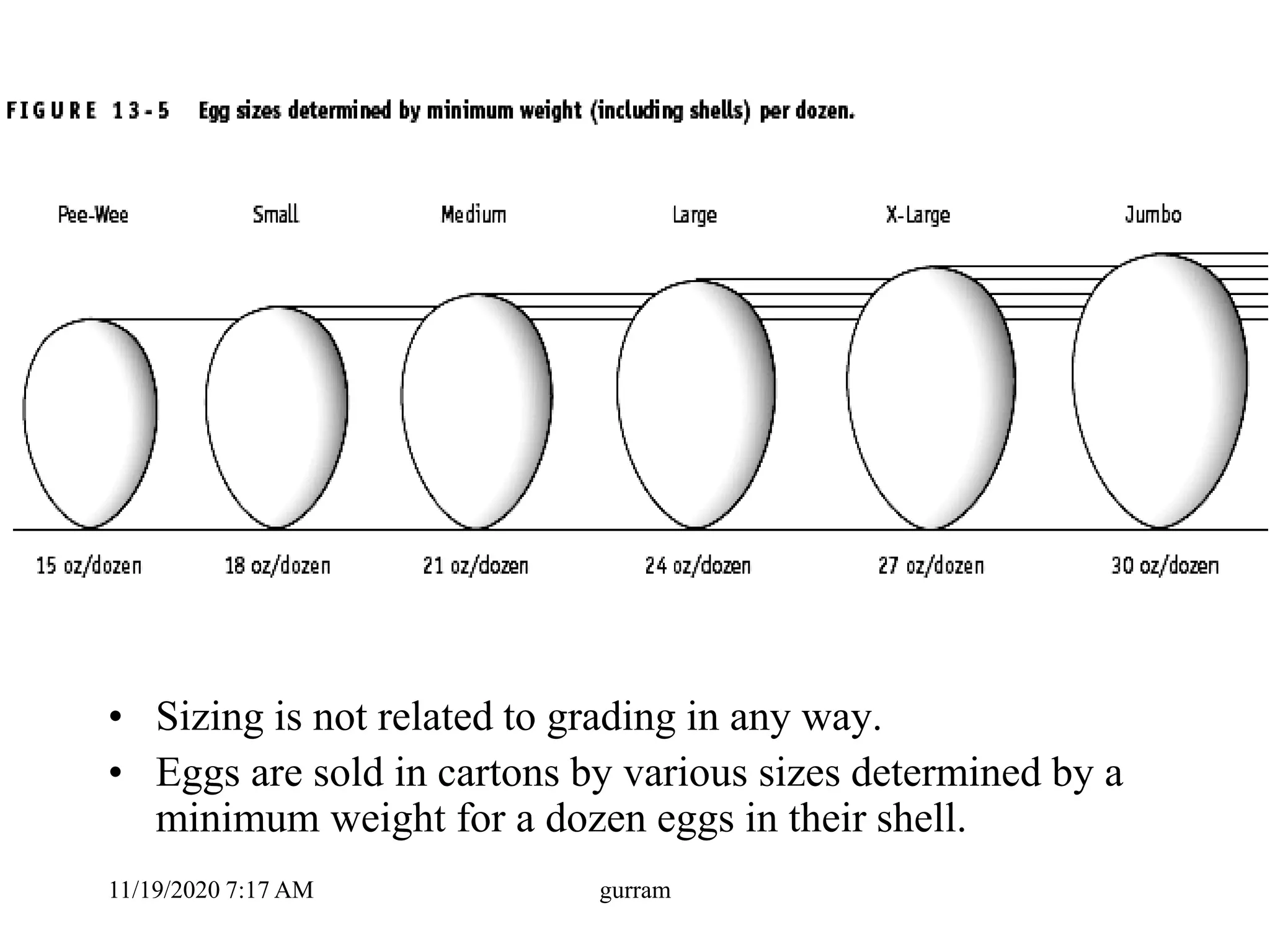
• Sizing is not related to grading in any way.
• Eggs are sold in cartons by various sizes determined by a
minimum weight for a dozen eggs in their shell.
11/19/2020 7:17 AM gurram
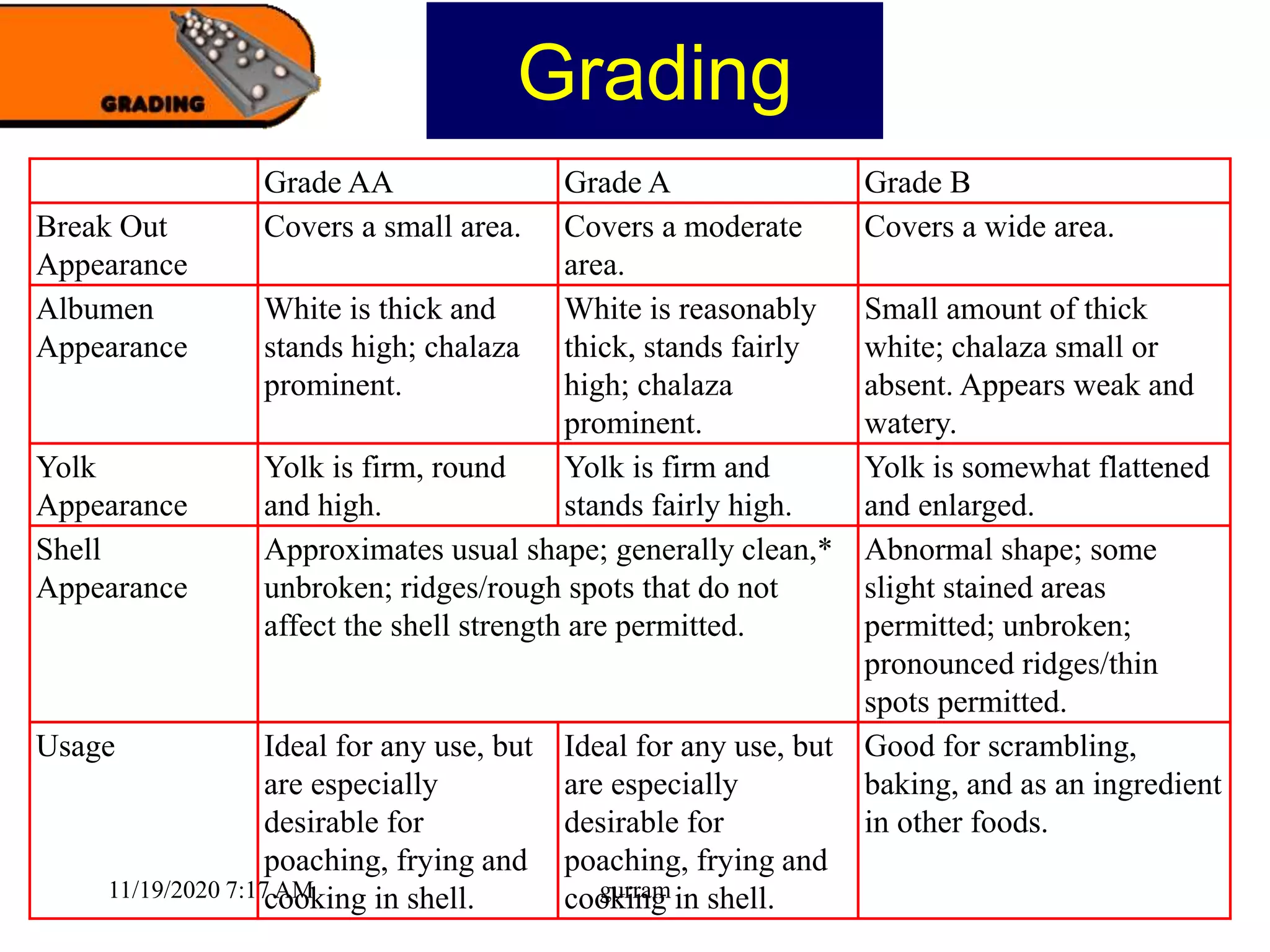
Grading
Grade AA Grade A Grade B
Break Out
Appearance
Covers a small area. Covers a moderate
area.
Covers a wide area.
Albumen
Appearance
White is thick and
stands high; chalaza
prominent.
White is reasonably
thick, stands fairly
high; chalaza
prominent.
Small amount of thick
white; chalaza small or
absent. Appears weak and
watery.
Yolk
Appearance
Yolk is firm, round
and high.
Yolk is firm and
stands fairly high.
Yolk is somewhat flattened
and enlarged.
Shell
Appearance
Approximates usual shape; generally clean,*
unbroken; ridges/rough spots that do not
affect the shell strength are permitted.
Abnormal shape; some
slight stained areas
permitted; unbroken;
pronounced ridges/thin
spots permitted.
Usage Ideal for any use, but
are especially
desirable for
poaching, frying and
cooking in shell.
Ideal for any use, but
are especially
desirable for
poaching, frying and
cooking in shell.
Good for scrambling,
baking, and as an ingredient
in other foods.
11/19/2020 7:17 AM gurram
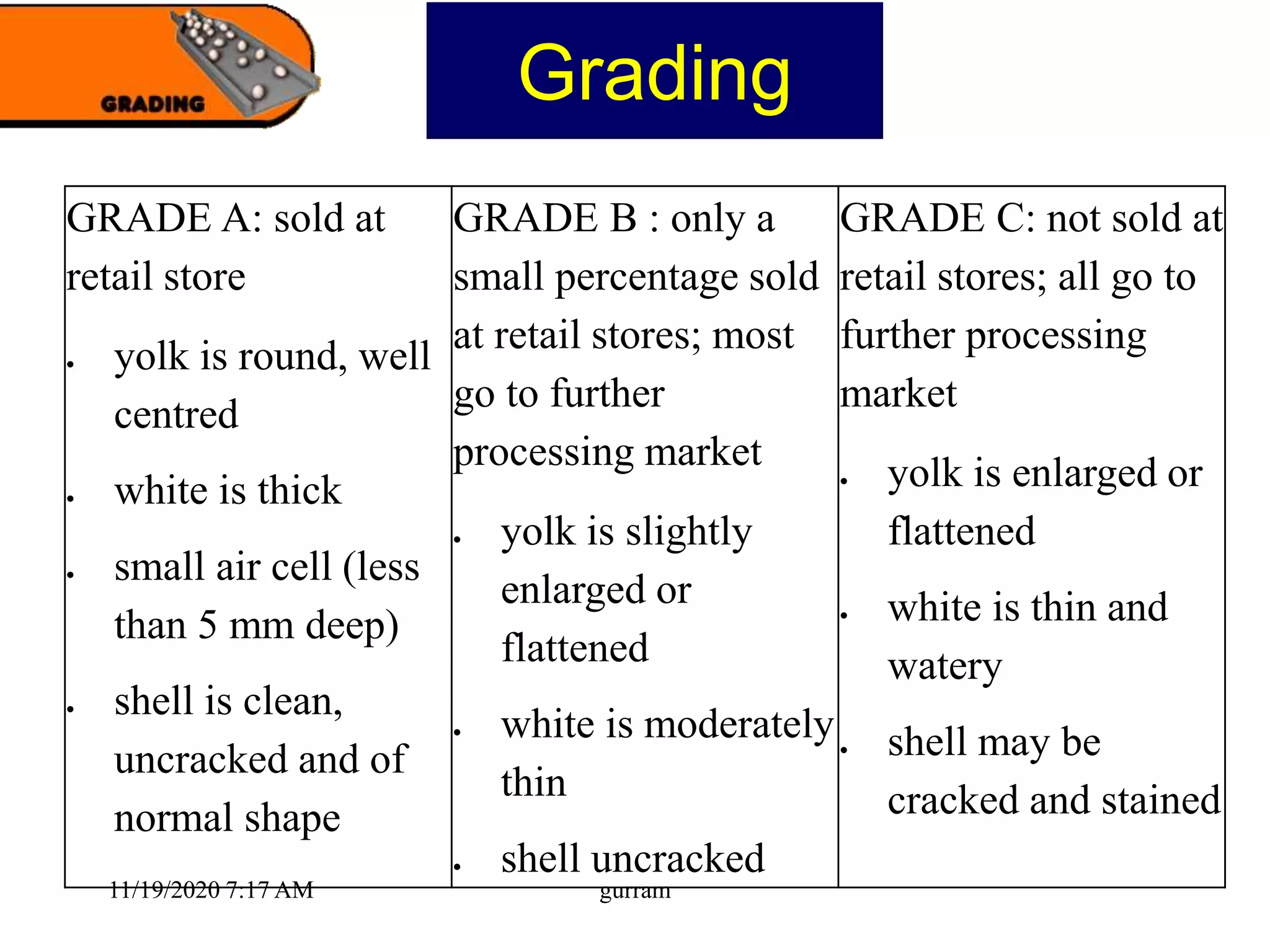
Grading
GRADE A: sold at
retail store
 yolk is round, well
centred
 white is thick
 small air cell (less
than 5 mm deep)
 shell is clean,
uncracked and of
normal shape
GRADE B : only a
small percentage sold
at retail stores; most
go to further
processing market
 yolk is slightly
enlarged or
flattened
 white is moderately
thin
 shell uncracked
GRADE C: not sold at
retail stores; all go to
further processing
market
 yolk is enlarged or
flattened
 white is thin and
watery
 shell may be
cracked and stained
11/19/2020 7:17 AM gurram
Grade
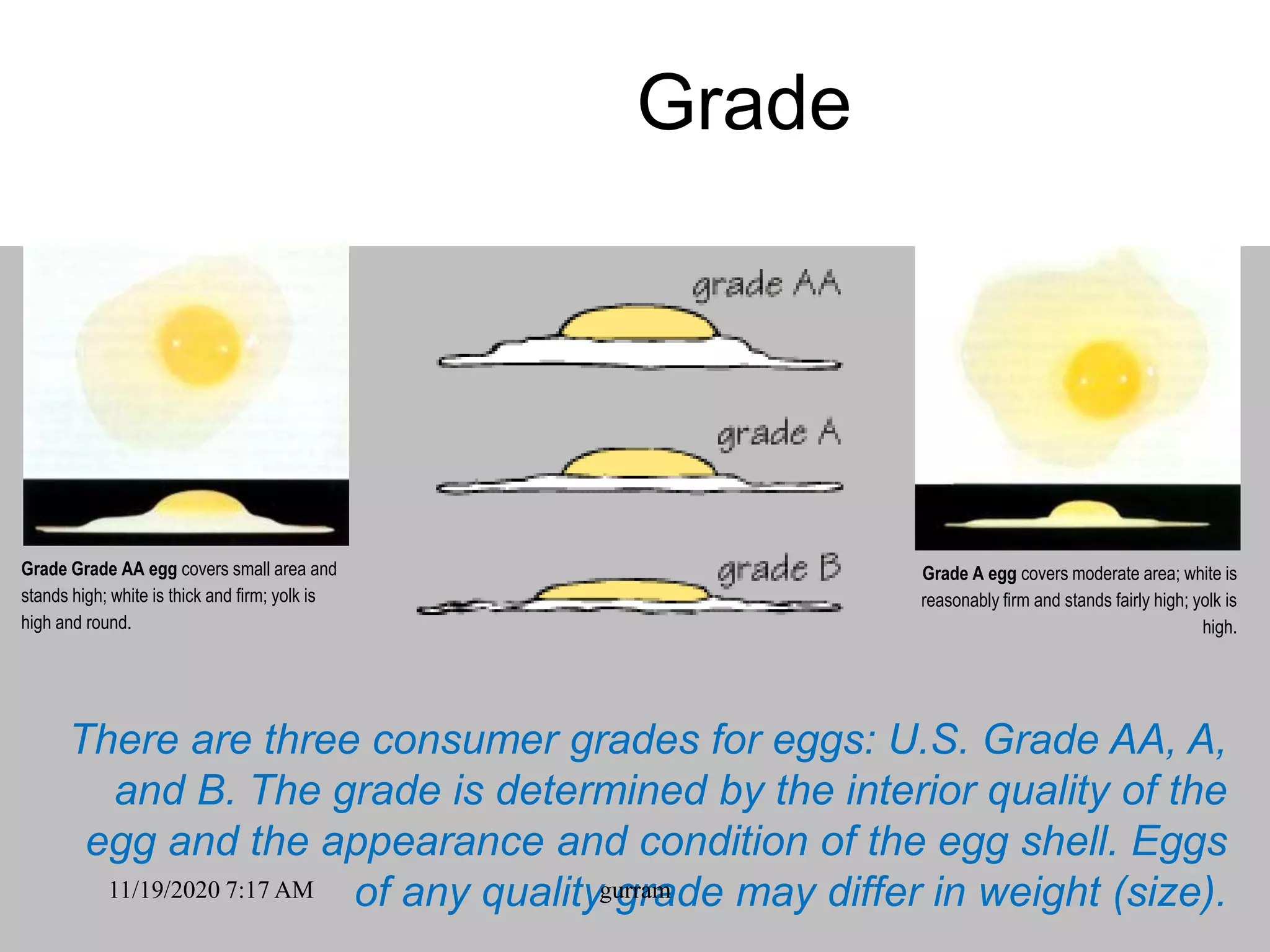
Grade Grade AA egg covers small area and
stands high; white is thick and firm; yolk is
high and round.
Grade A egg covers moderate area; white is
reasonably firm and stands fairly high; yolk is
high.
There are three consumer grades for eggs: U.S. Grade AA, A,
and B. The grade is determined by the interior quality of the
egg and the appearance and condition of the egg shell. Eggs
of any quality grade may differ in weight (size).11/19/2020 7:17 AM gurram
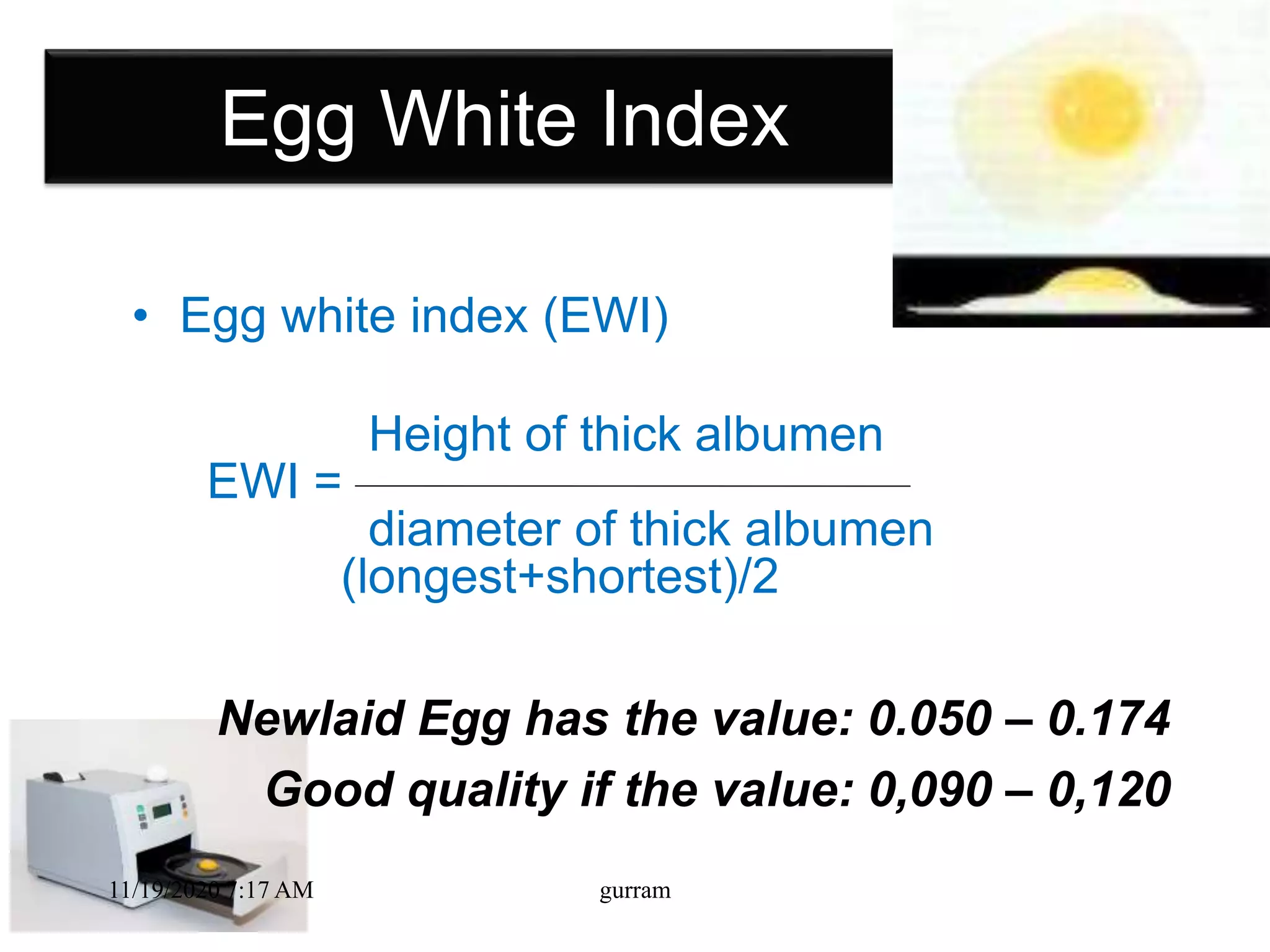
Egg White Index
• Egg white index (EWI)
Height of thick albumen
EWI =
diameter of thick albumen
(longest+shortest)/2
Newlaid Egg has the value: 0.050 – 0.174
Good quality if the value: 0,090 – 0,120
11/19/2020 7:17 AM gurram
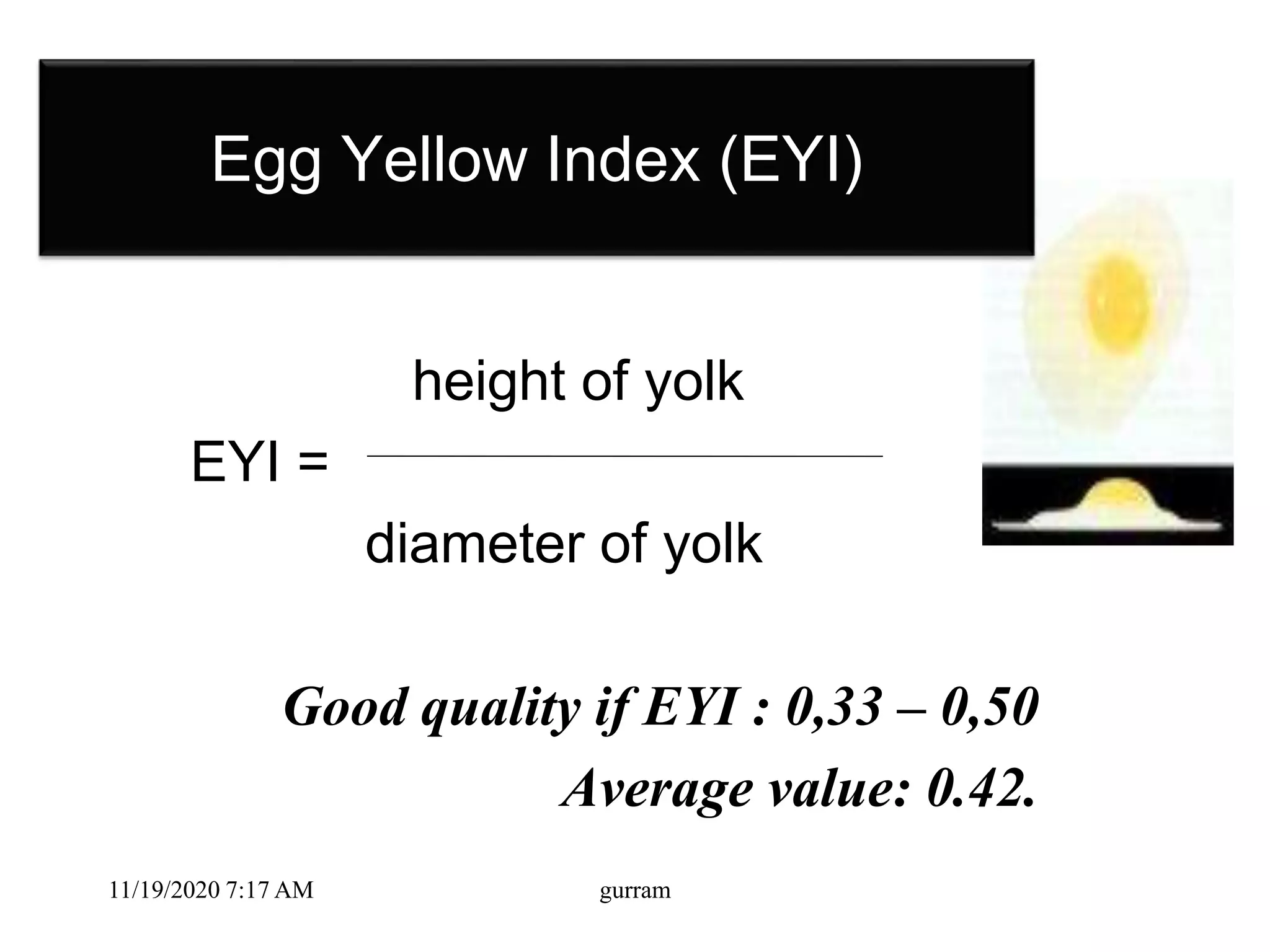
Egg Yellow Index (EYI)
height of yolk
EYI =
diameter of yolk
Good quality if EYI : 0,33 – 0,50
Average value: 0.42.
11/19/2020 7:17 AM gurram
Haugh Unit
• Haugh unit (HU)
HU= 100 log [h-(√G(3w0.37-100)+1,9]
100
HU= Haugh unit
h = heigh of thick albumen (mm)
G= 32,2
w= whole egg weight (g)
Fresh egg: HU=100
Good quality: HU = 75; acceptable until 50
Bad quality (Spoiled egg): HU < 50
11/19/2020 7:17 AM gurram
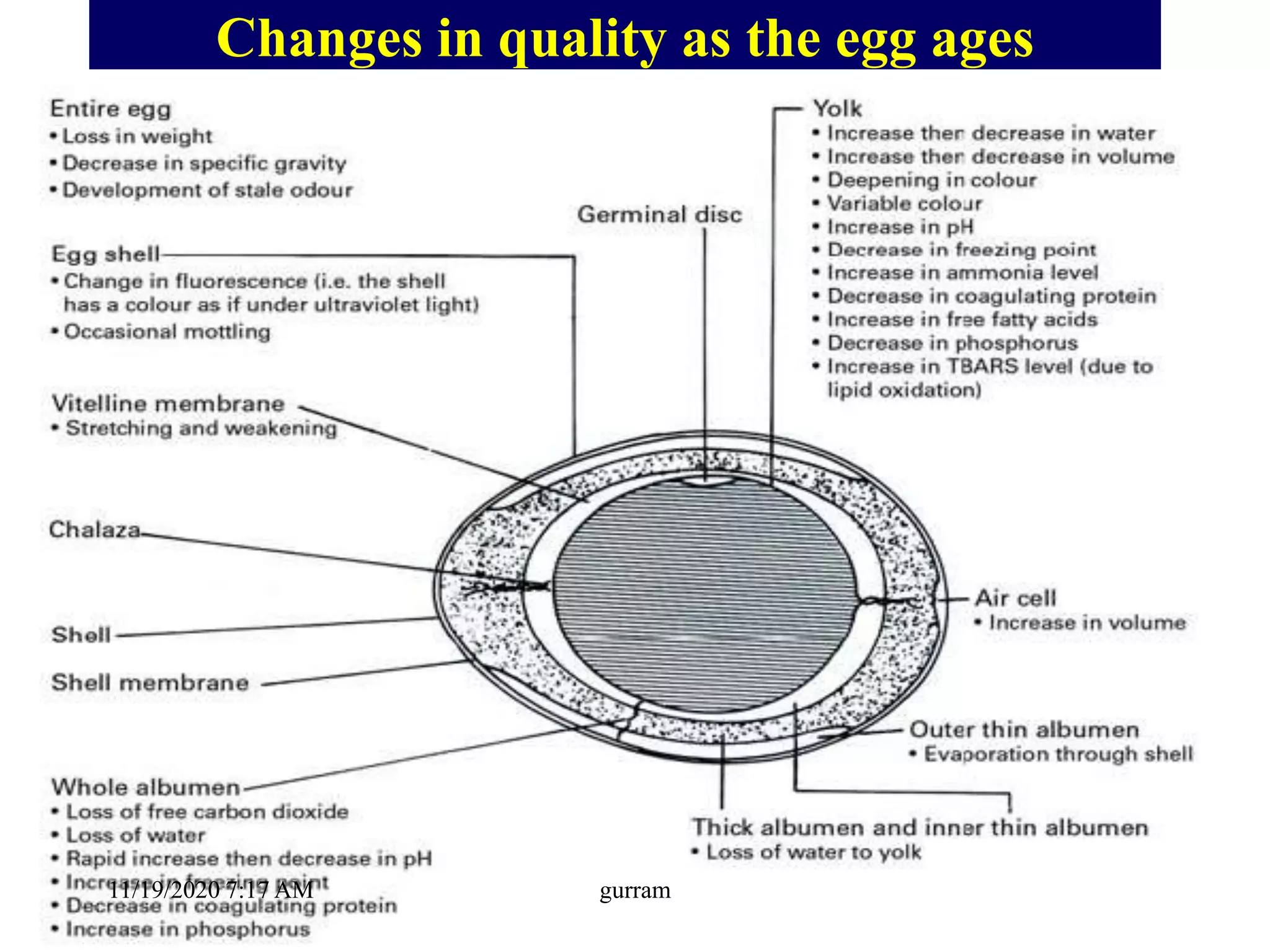
Changes in quality as the egg ages
11/19/2020 7:17 AM gurram
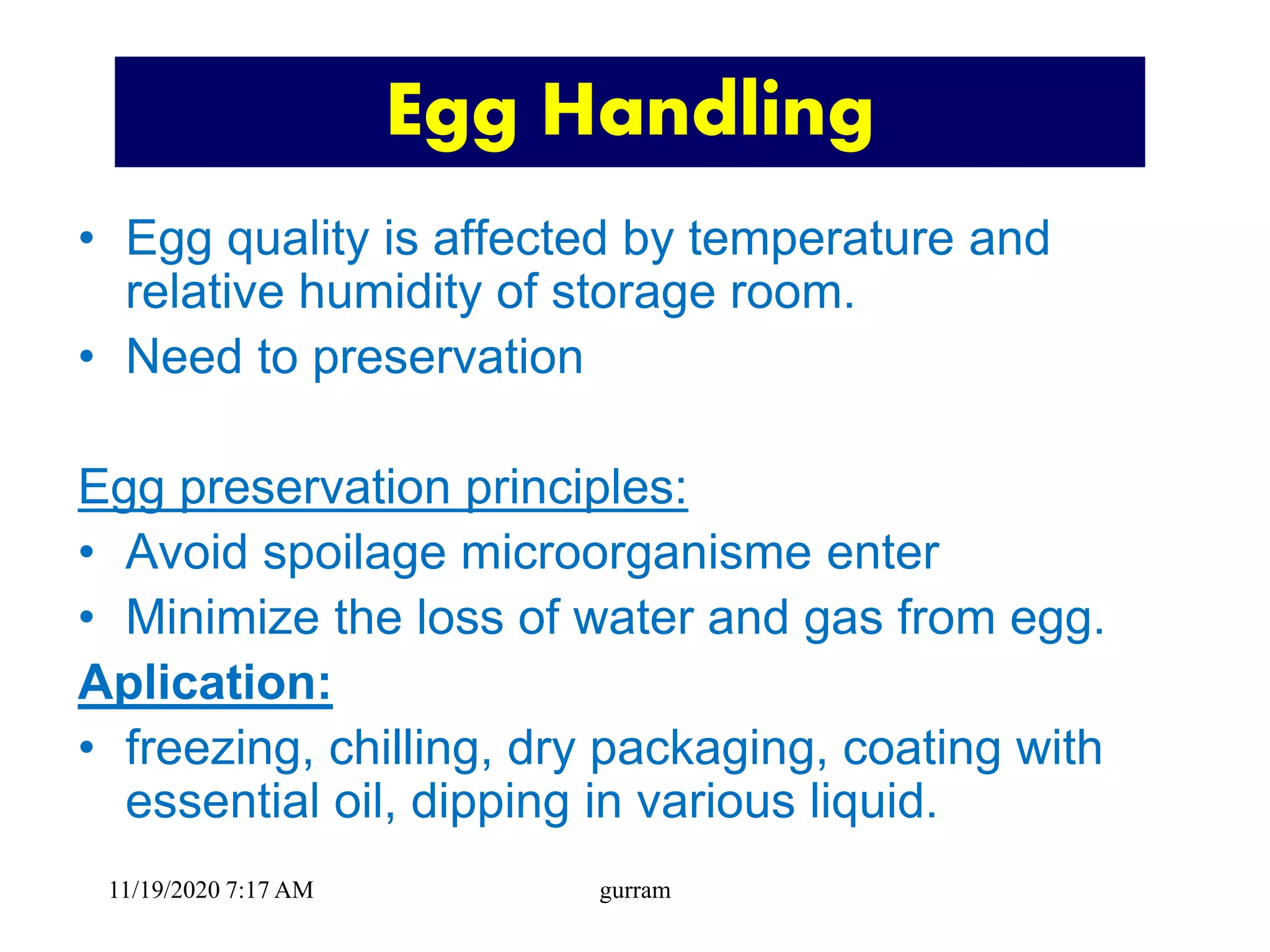
Egg Handling
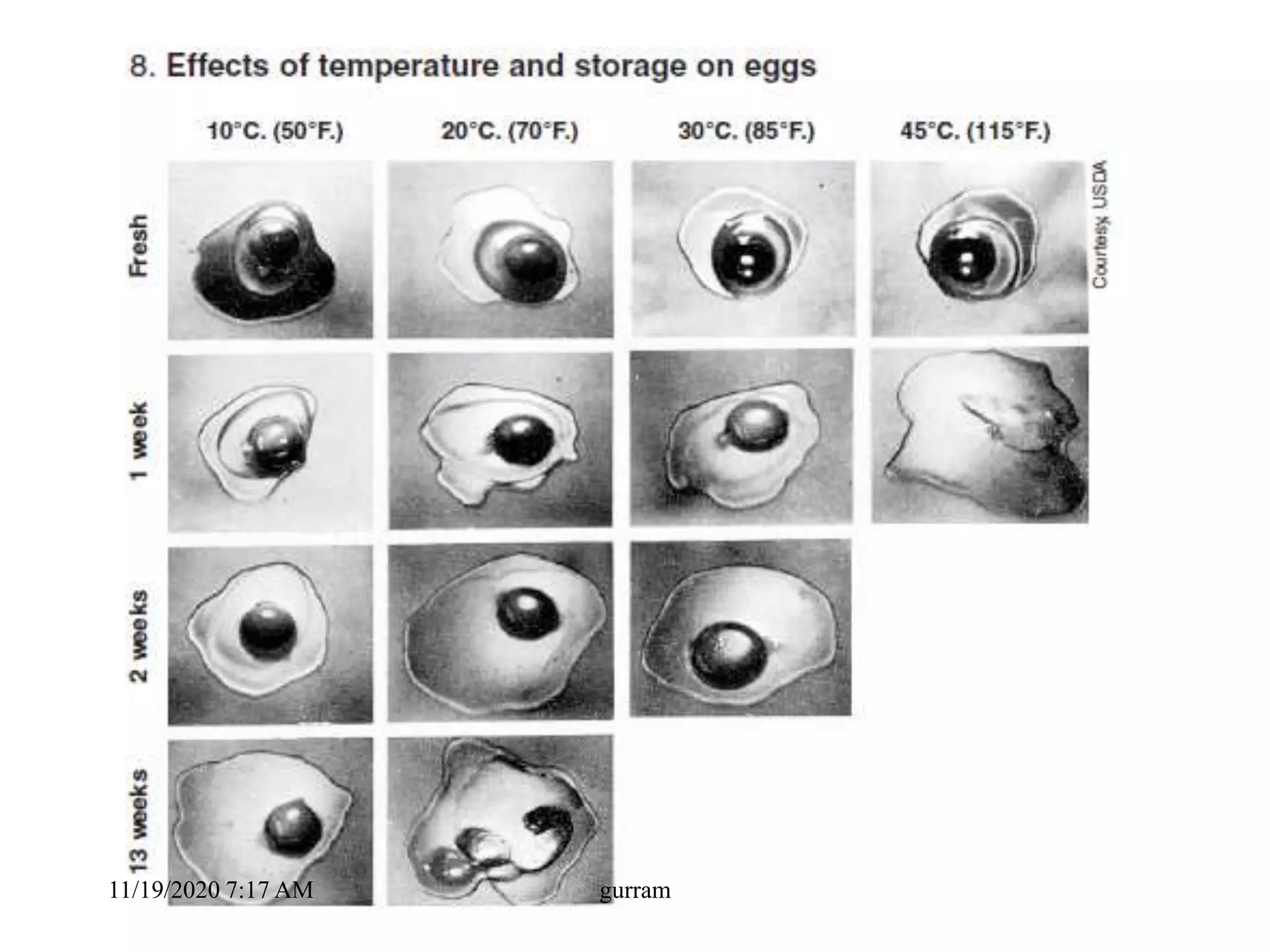
• Egg quality is affected by temperature and
relative humidity of storage room.
• Need to preservation
Egg preservation principles:
• Avoid spoilage microorganisme enter
• Minimize the loss of water and gas from egg.
Aplication:
• freezing, chilling, dry packaging, coating with
essential oil, dipping in various liquid.
11/19/2020 7:17 AM gurram
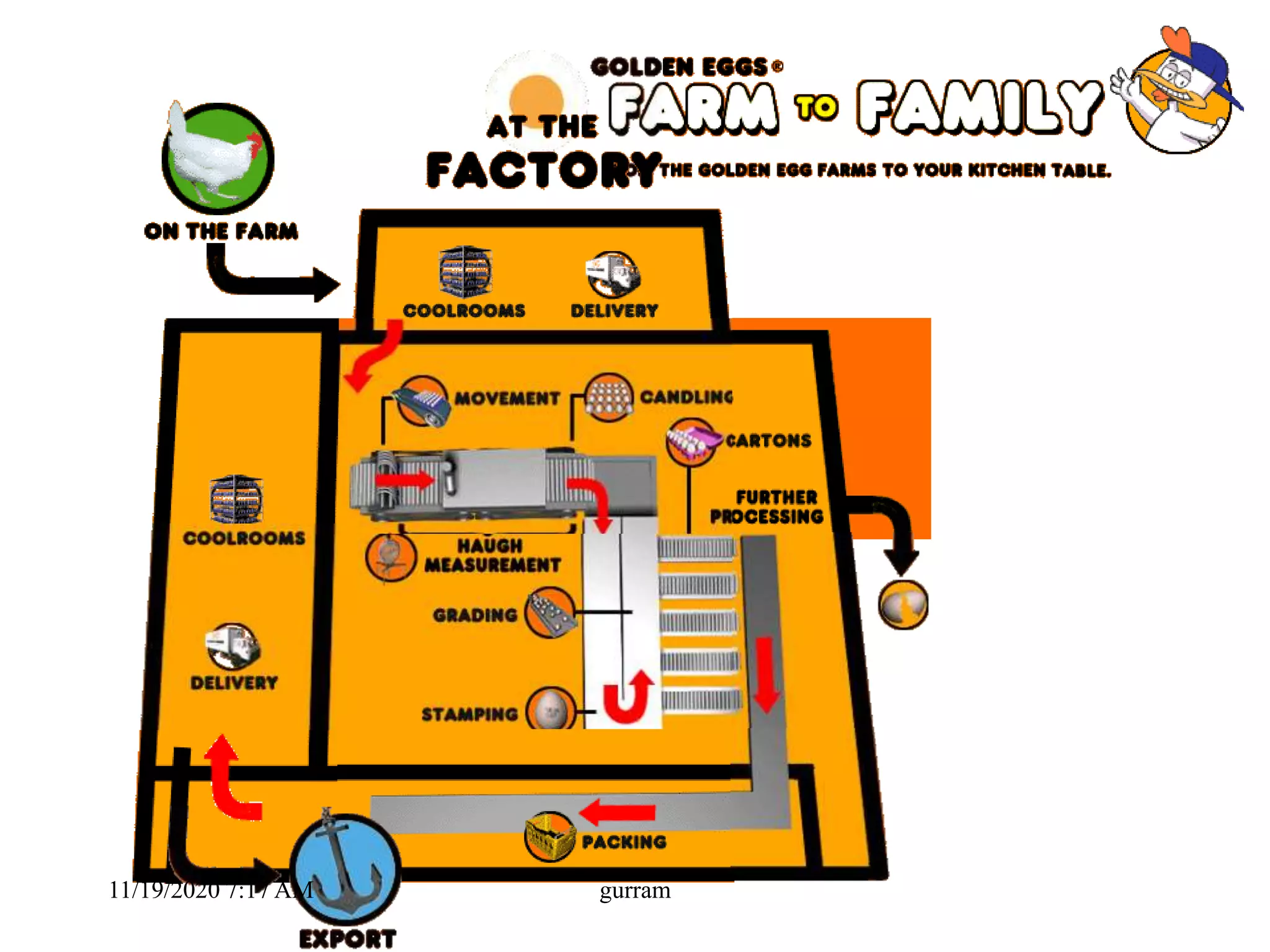
Commercial Egg Production and
Processing
Courtesy of Ryan A. Meunier & Dr. Mickey A. Latour; Purdue University11/19/2020 7:17 AM gurram
Egg Production
 The objective of this presentation is to provide a general
overview of commercial egg production and processing.
 The slides are ordered in a sequential series as they occur
in the production cycle.
 This particular egg production facility is considered an “in-
line” operation. This means the eggs are produced and
packaged for shipping to retail markets on the farm. There
are also many “off-line” operations that produce eggs in
one location and transport them to another location for
processing.
Courtesy of Ryan A. Meunier & Dr. Mickey A. Latour; Purdue University11/19/2020 7:17 AM gurram
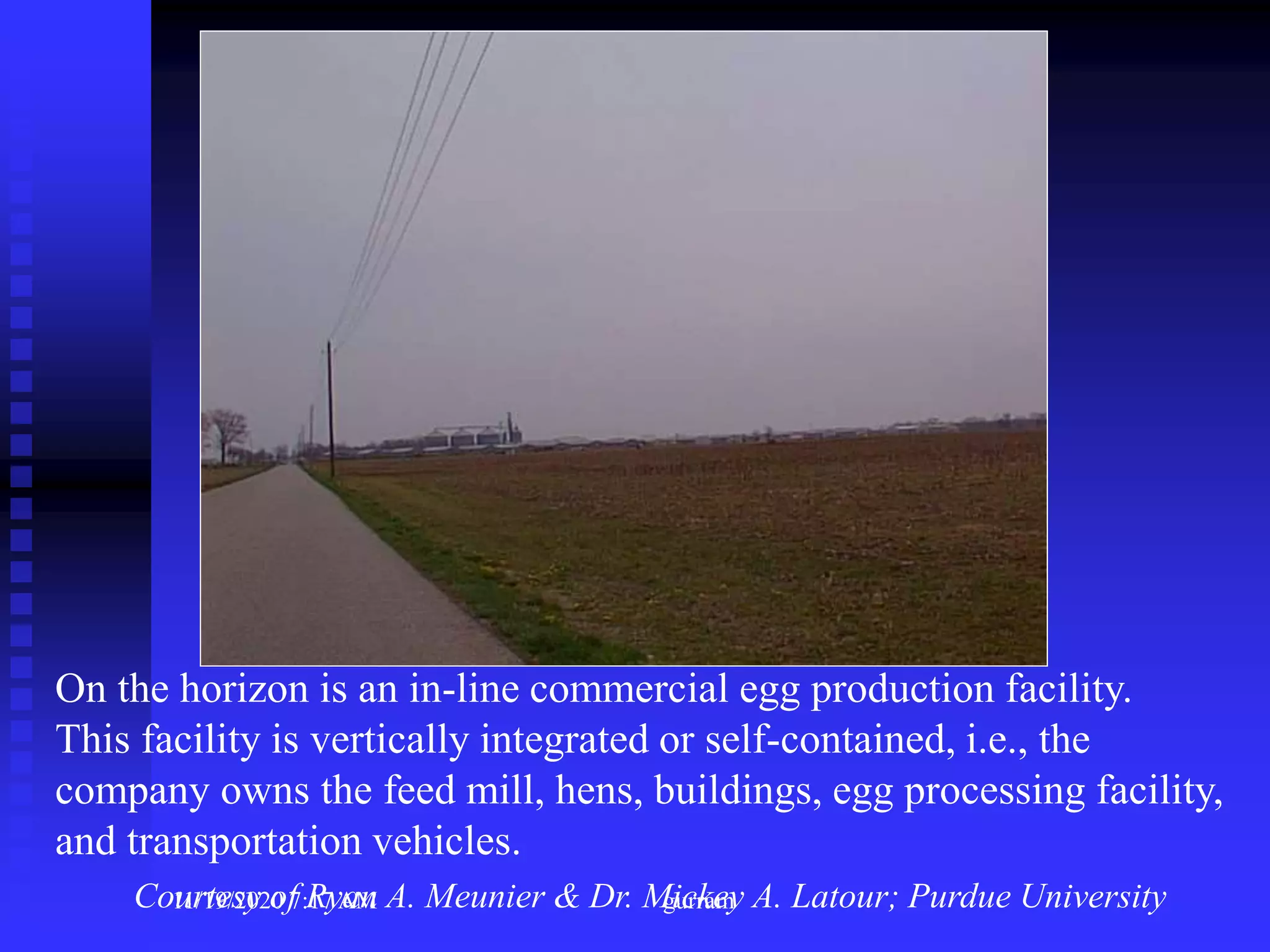
On the horizon is an in-line commercial egg production facility.
This facility is vertically integrated or self-contained, i.e., the
company owns the feed mill, hens, buildings, egg processing facility,
and transportation vehicles.
Courtesy of Ryan A. Meunier & Dr. Mickey A. Latour; Purdue University11/19/2020 7:17 AM gurram
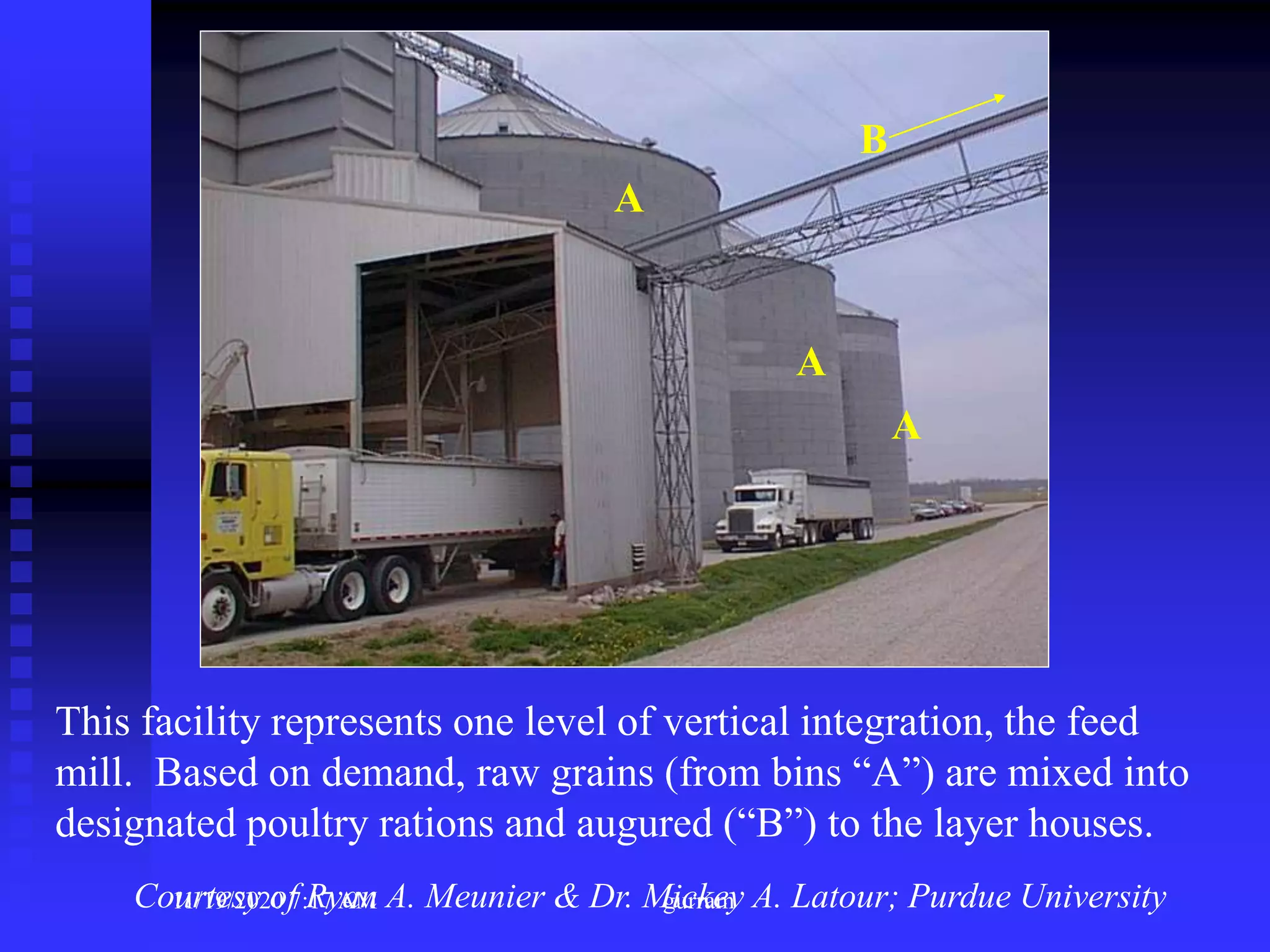
A
A
A
This facility represents one level of vertical integration, the feed
mill. Based on demand, raw grains (from bins “A”) are mixed into
designated poultry rations and augured (“B”) to the layer houses.
B
Courtesy of Ryan A. Meunier & Dr. Mickey A. Latour; Purdue University11/19/2020 7:17 AM gurram
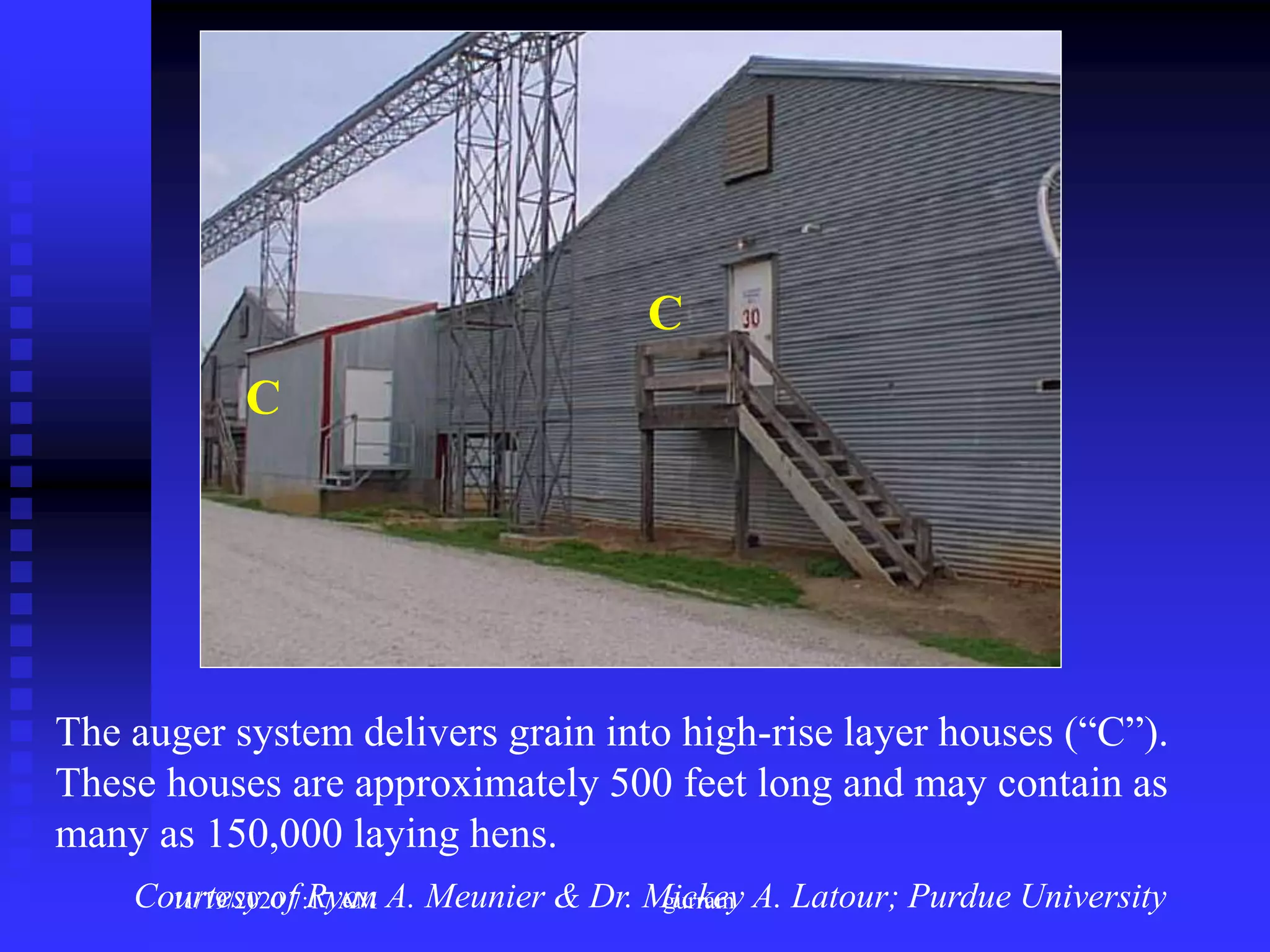
The auger system delivers grain into high-rise layer houses (“C”).
These houses are approximately 500 feet long and may contain as
many as 150,000 laying hens.
C
C
Courtesy of Ryan A. Meunier & Dr. Mickey A. Latour; Purdue University11/19/2020 7:17 AM gurram
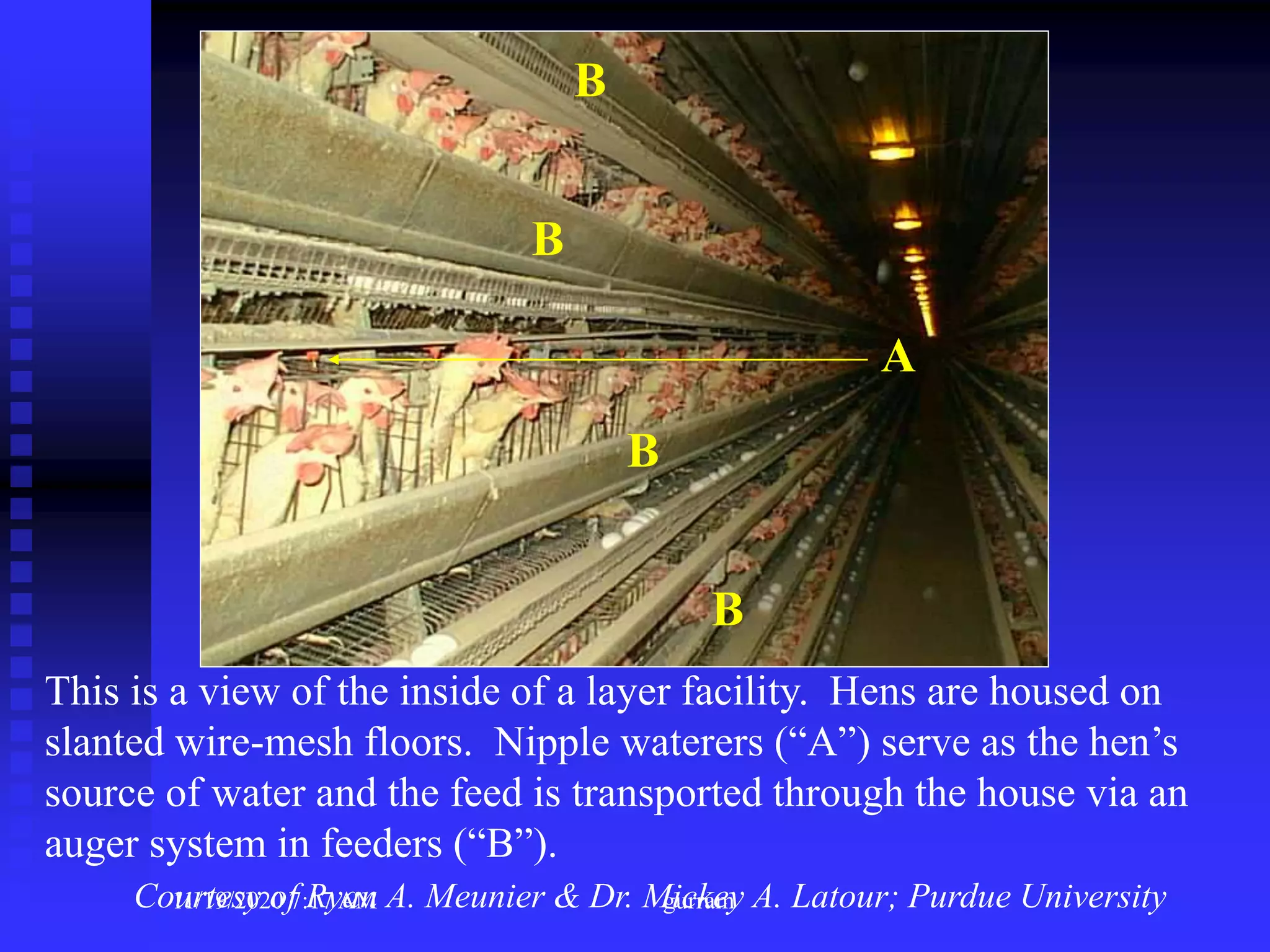
This is a view of the inside of a layer facility. Hens are housed on
slanted wire-mesh floors. Nipple waterers (“A”) serve as the hen’s
source of water and the feed is transported through the house via an
auger system in feeders (“B”).
B
B
B
A
B
Courtesy of Ryan A. Meunier & Dr. Mickey A. Latour; Purdue University11/19/2020 7:17 AM gurram
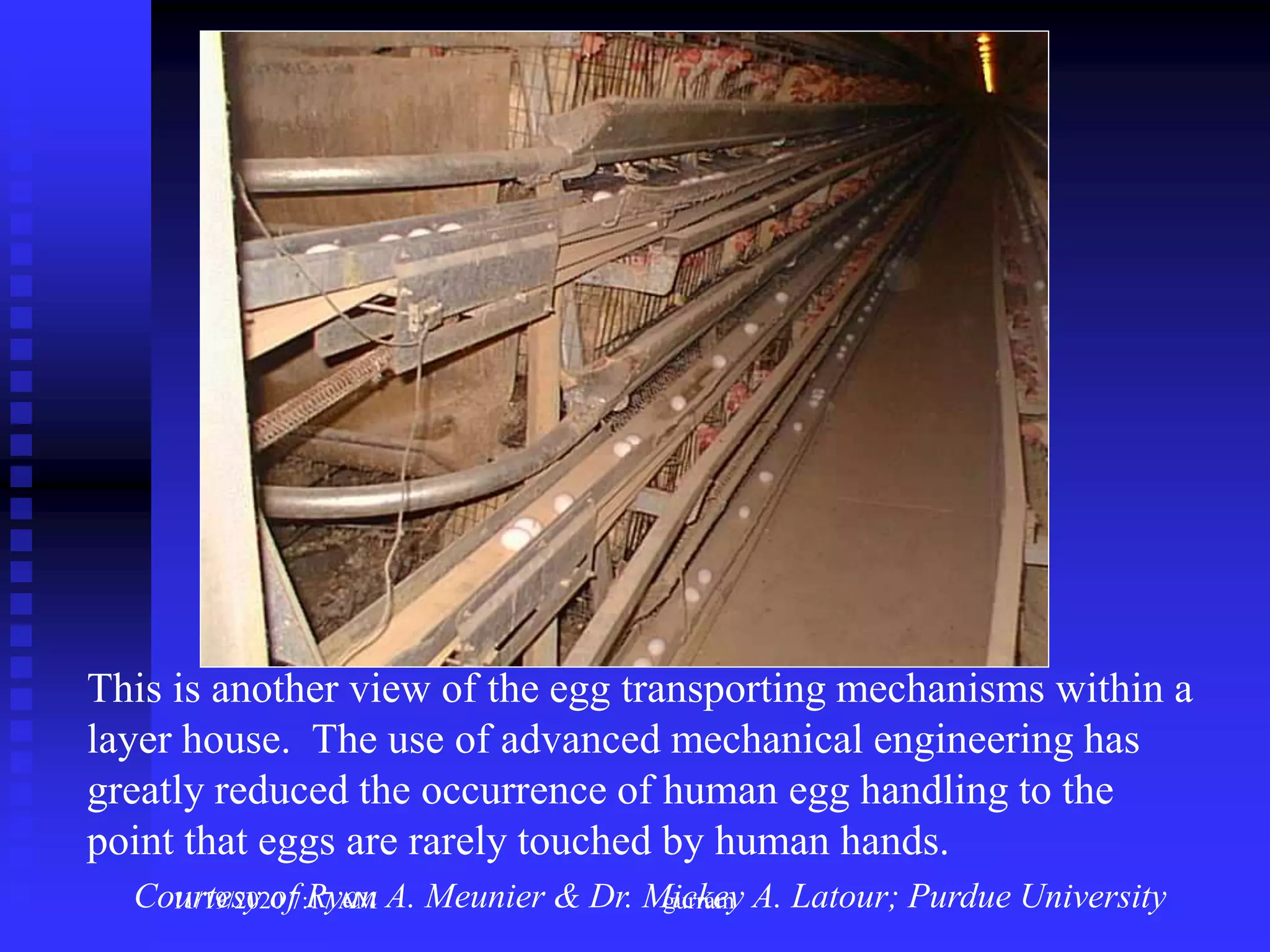
This is another view of the egg transporting mechanisms within a
layer house. The use of advanced mechanical engineering has
greatly reduced the occurrence of human egg handling to the
point that eggs are rarely touched by human hands.
Courtesy of Ryan A. Meunier & Dr. Mickey A. Latour; Purdue University11/19/2020 7:17 AM gurram
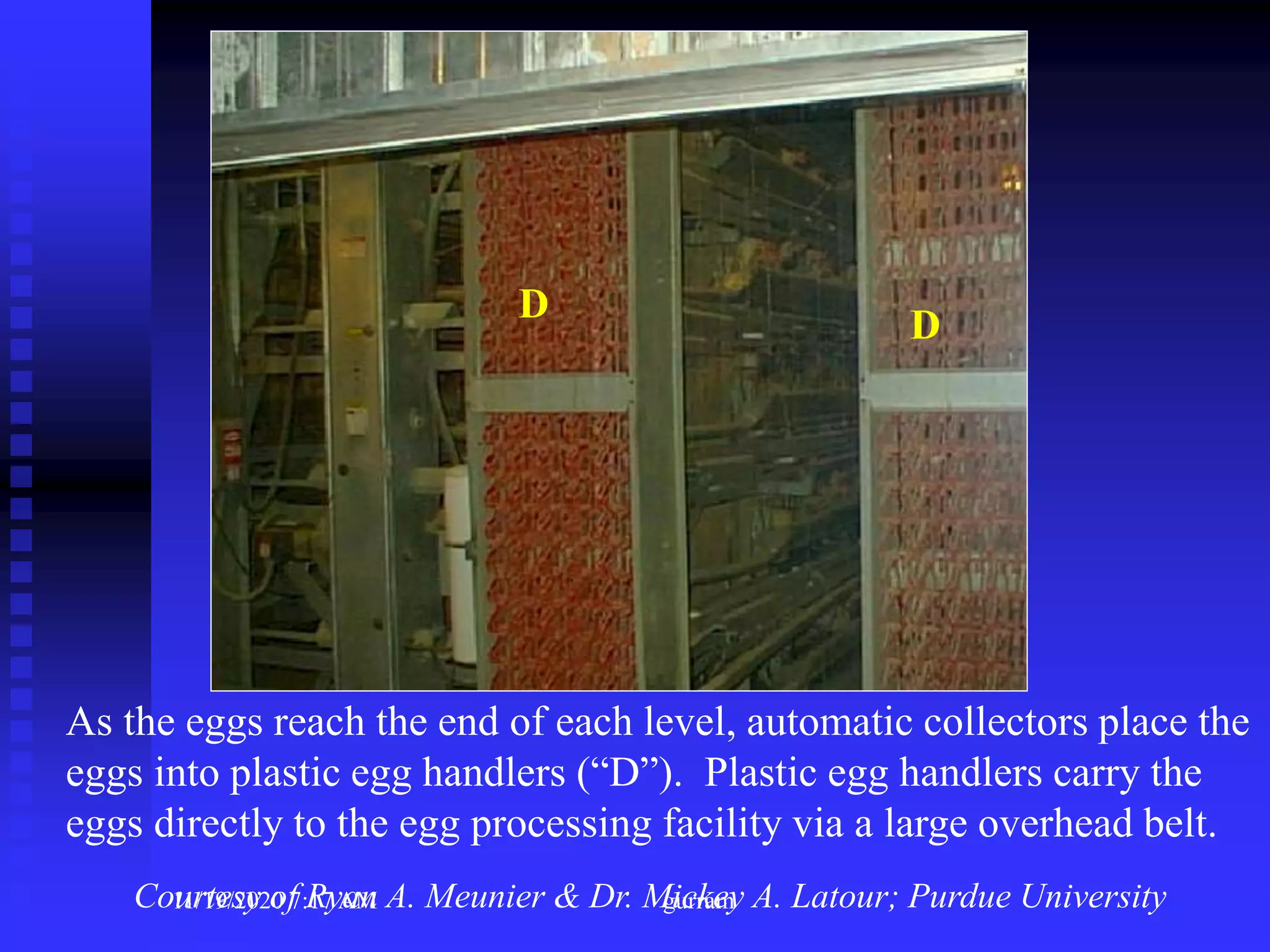
As the eggs reach the end of each level, automatic collectors place the
eggs into plastic egg handlers (“D”). Plastic egg handlers carry the
eggs directly to the egg processing facility via a large overhead belt.
DD
D
Courtesy of Ryan A. Meunier & Dr. Mickey A. Latour; Purdue University11/19/2020 7:17 AM gurram
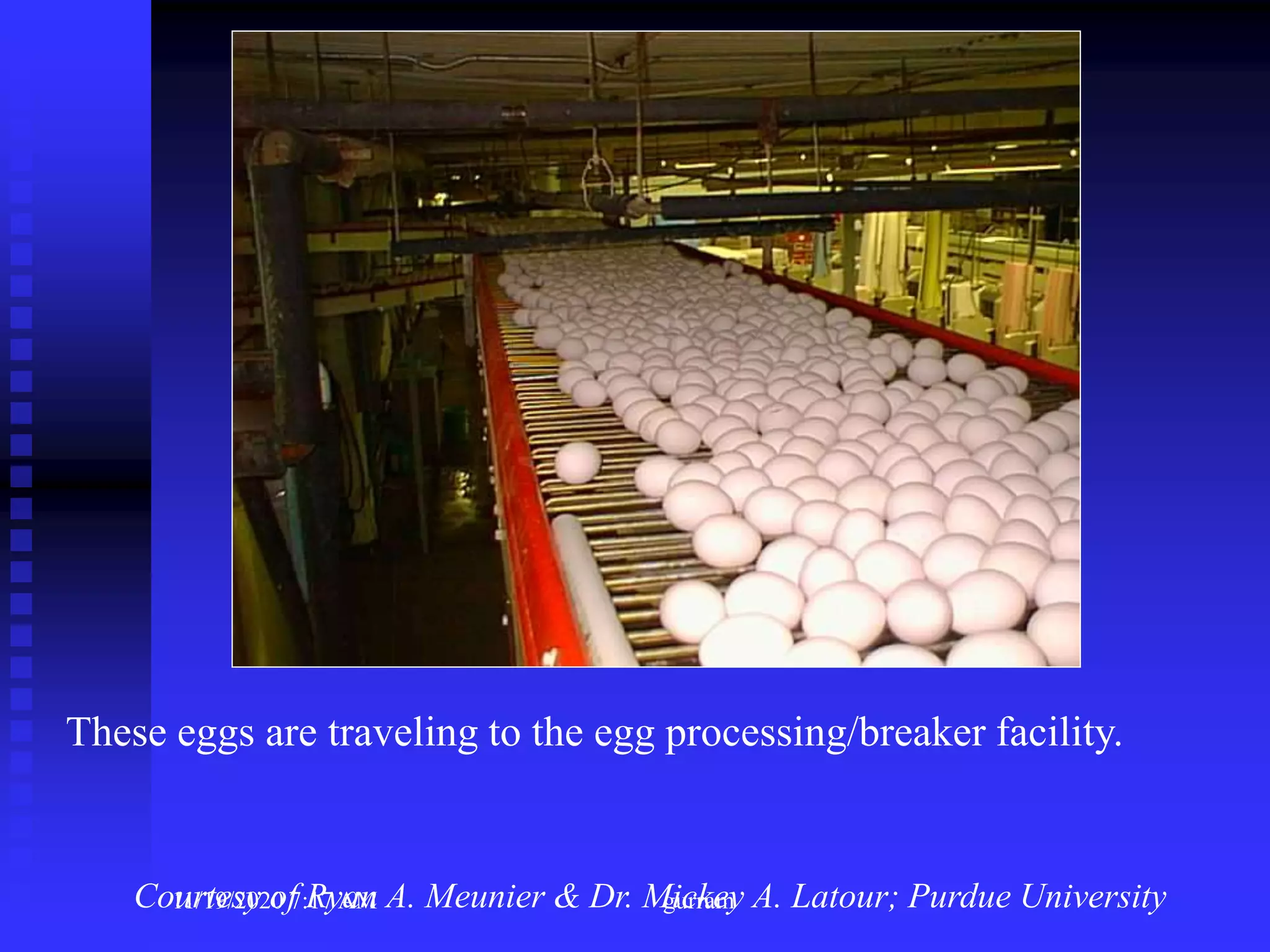
These eggs are traveling to the egg processing/breaker facility.
Courtesy of Ryan A. Meunier & Dr. Mickey A. Latour; Purdue University11/19/2020 7:17 AM gurram
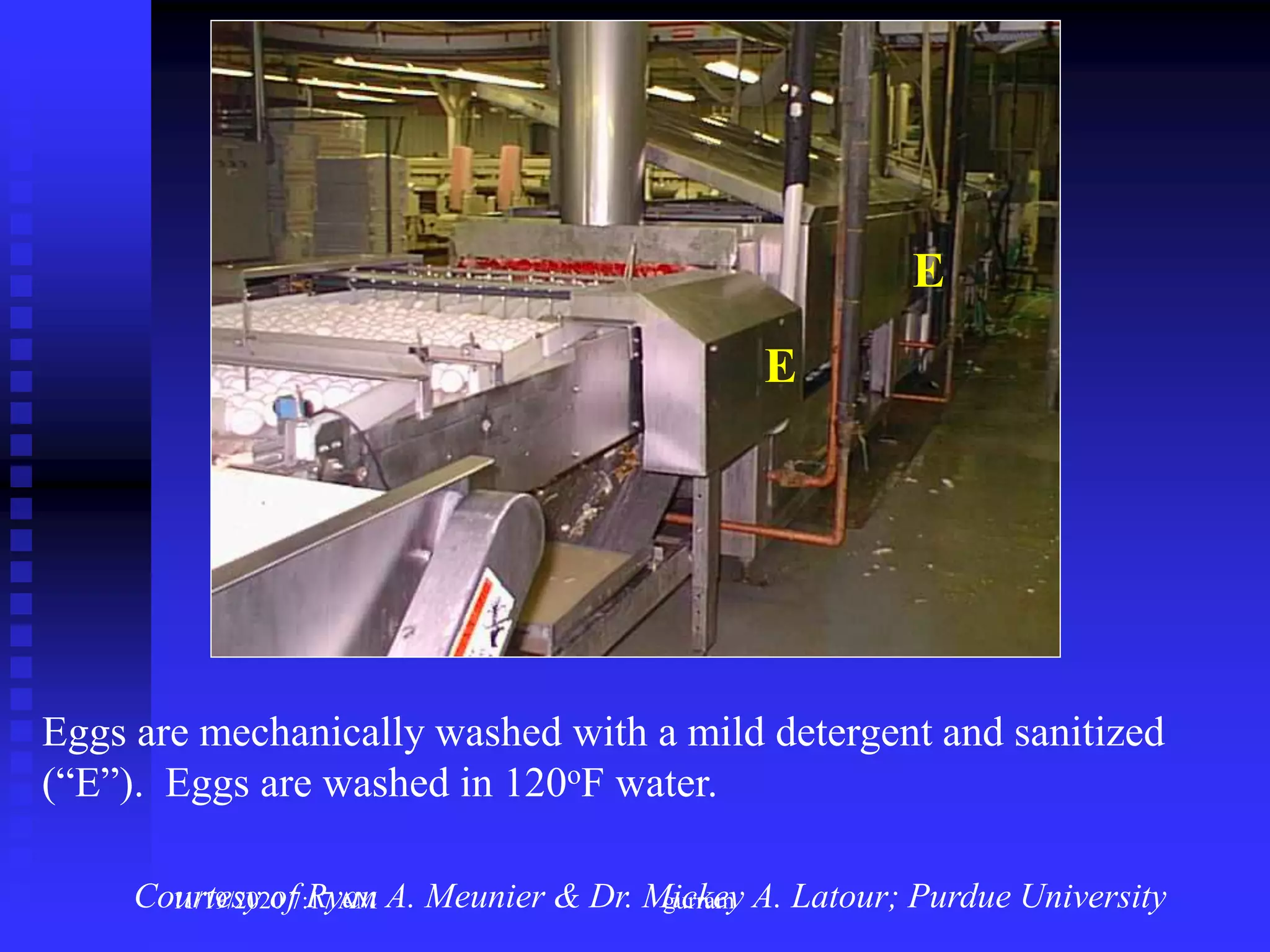
Eggs are mechanically washed with a mild detergent and sanitized
(“E”). Eggs are washed in 120oF water.
E
E
Courtesy of Ryan A. Meunier & Dr. Mickey A. Latour; Purdue University11/19/2020 7:17 AM gurram
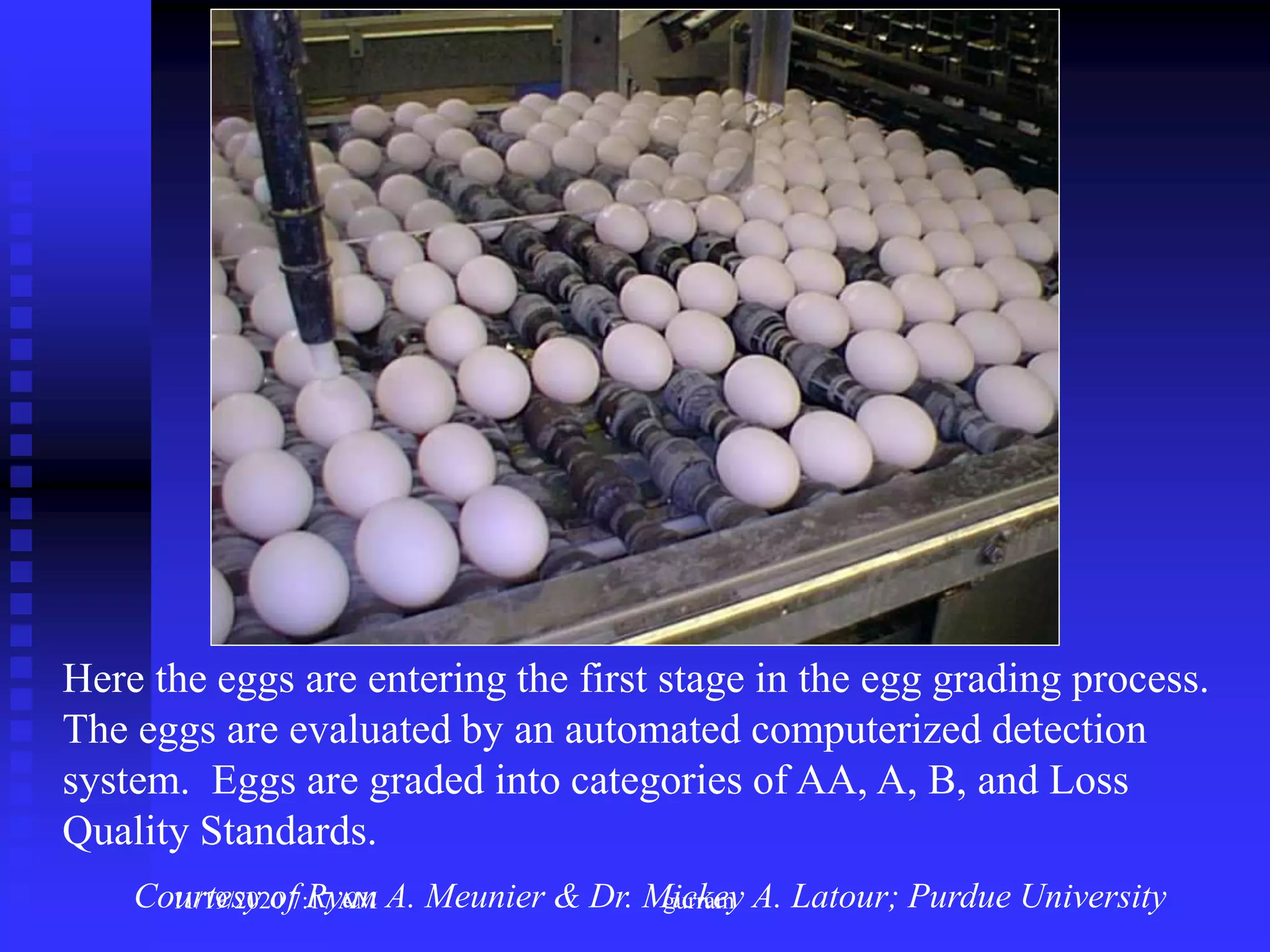
Here the eggs are entering the first stage in the egg grading process.
The eggs are evaluated by an automated computerized detection
system. Eggs are graded into categories of AA, A, B, and Loss
Quality Standards.
Courtesy of Ryan A. Meunier & Dr. Mickey A. Latour; Purdue University11/19/2020 7:17 AM gurram
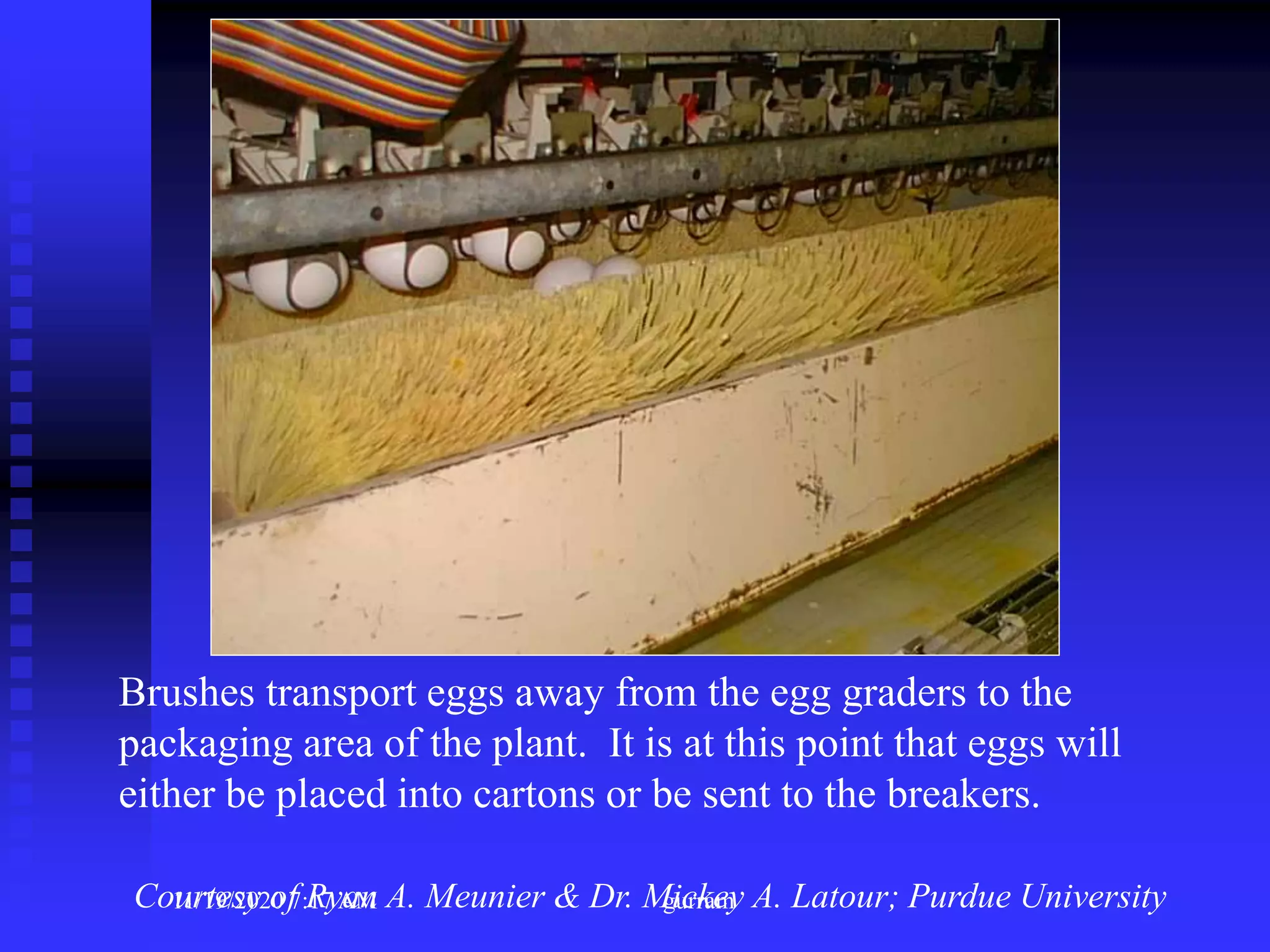
Brushes transport eggs away from the egg graders to the
packaging area of the plant. It is at this point that eggs will
either be placed into cartons or be sent to the breakers.
Courtesy of Ryan A. Meunier & Dr. Mickey A. Latour; Purdue University11/19/2020 7:17 AM gurram
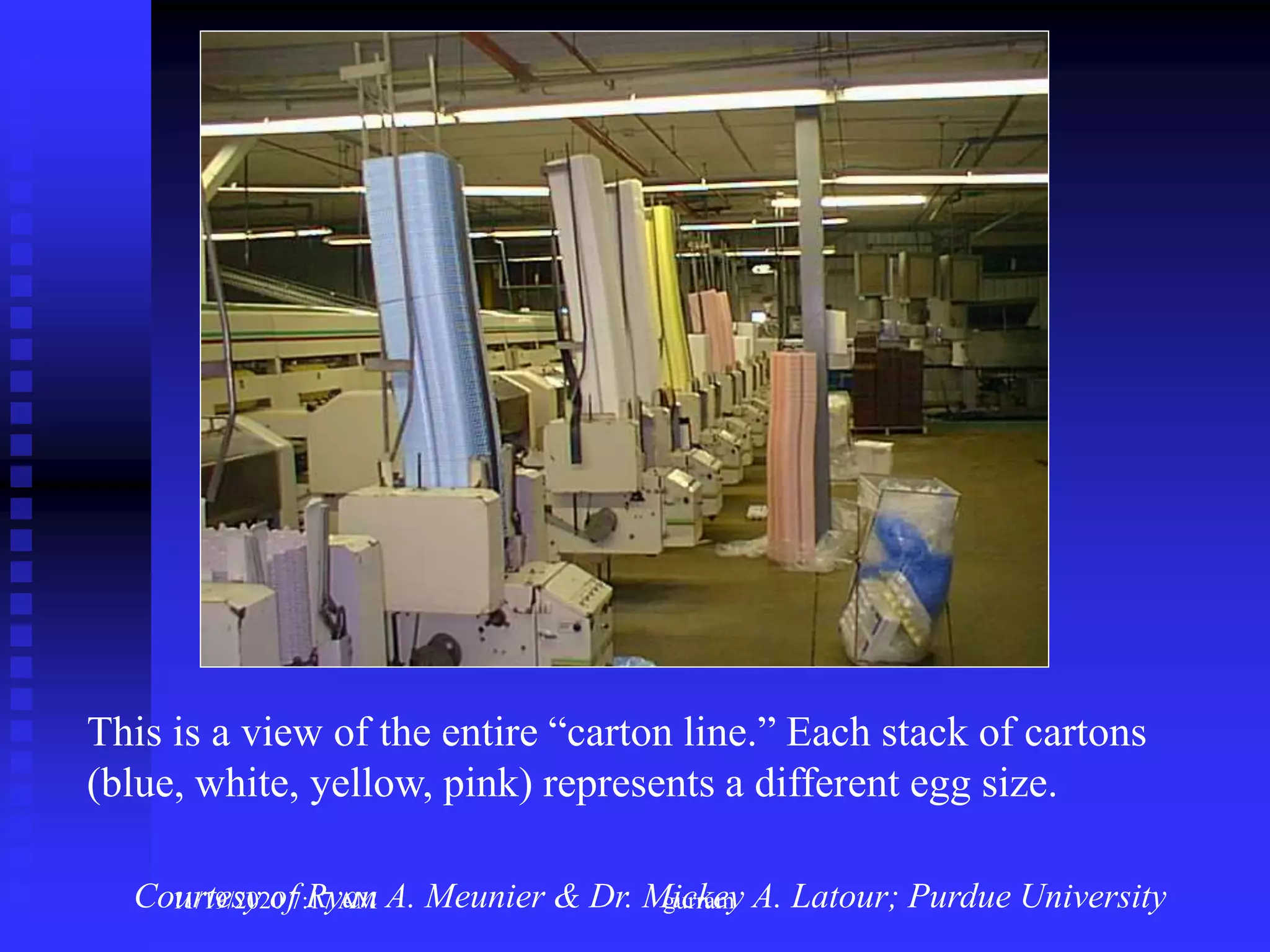
This is a view of the entire “carton line.” Each stack of cartons
(blue, white, yellow, pink) represents a different egg size.
Courtesy of Ryan A. Meunier & Dr. Mickey A. Latour; Purdue University11/19/2020 7:17 AM gurram
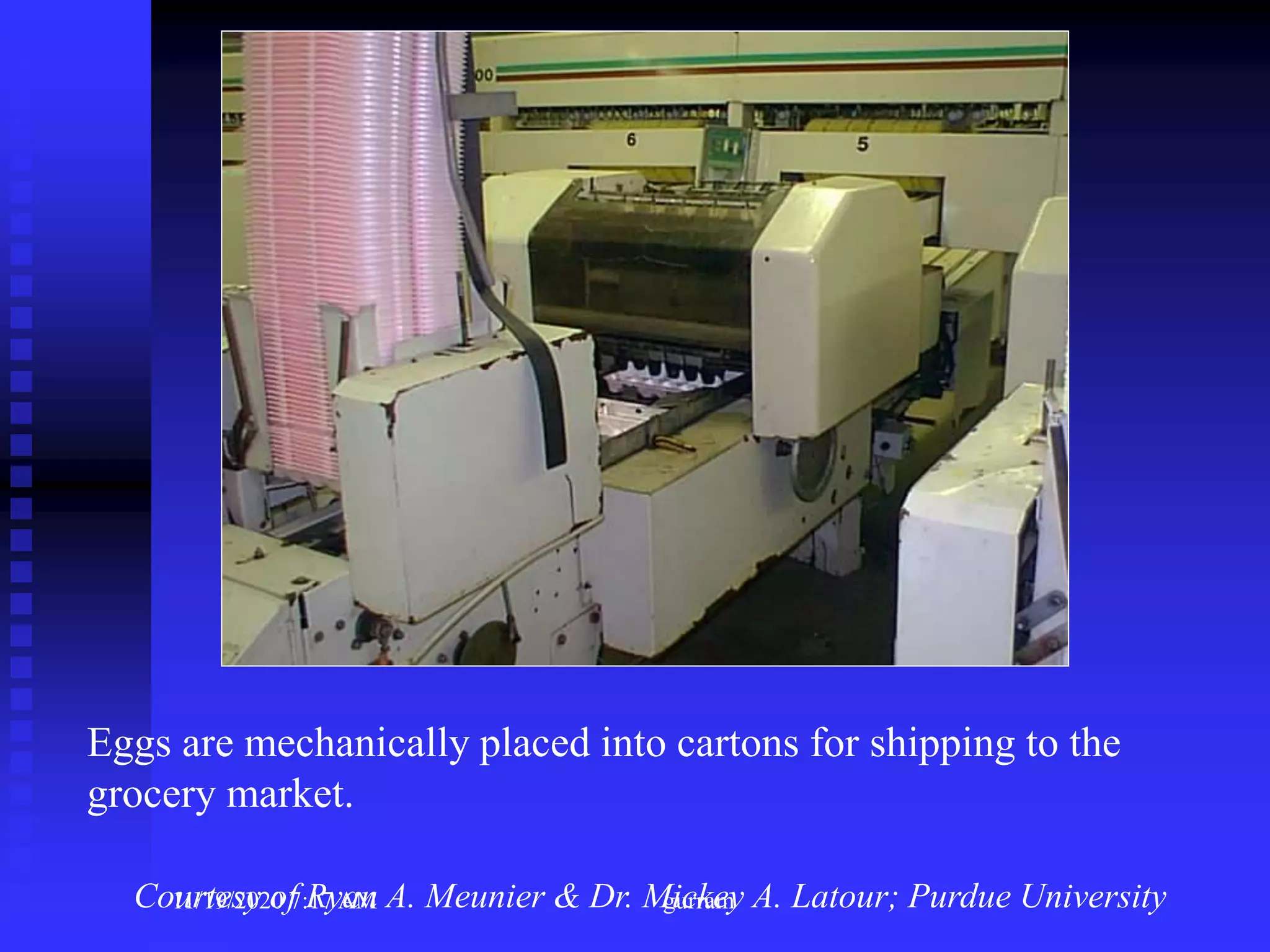
Eggs are mechanically placed into cartons for shipping to the
grocery market.
Courtesy of Ryan A. Meunier & Dr. Mickey A. Latour; Purdue University11/19/2020 7:17 AM gurram
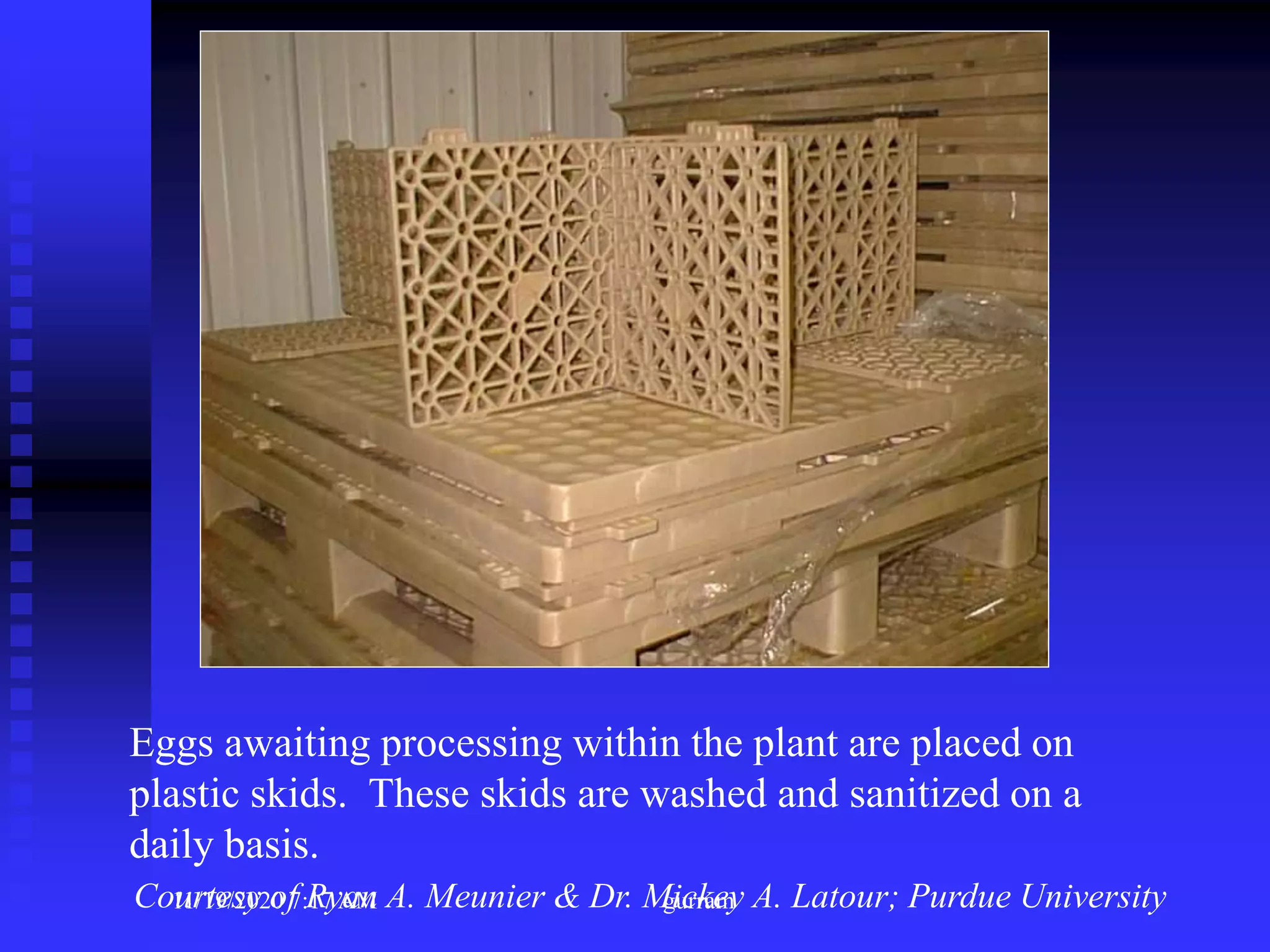
Eggs awaiting processing within the plant are placed on
plastic skids. These skids are washed and sanitized on a
daily basis.
Courtesy of Ryan A. Meunier & Dr. Mickey A. Latour; Purdue University11/19/2020 7:17 AM gurram
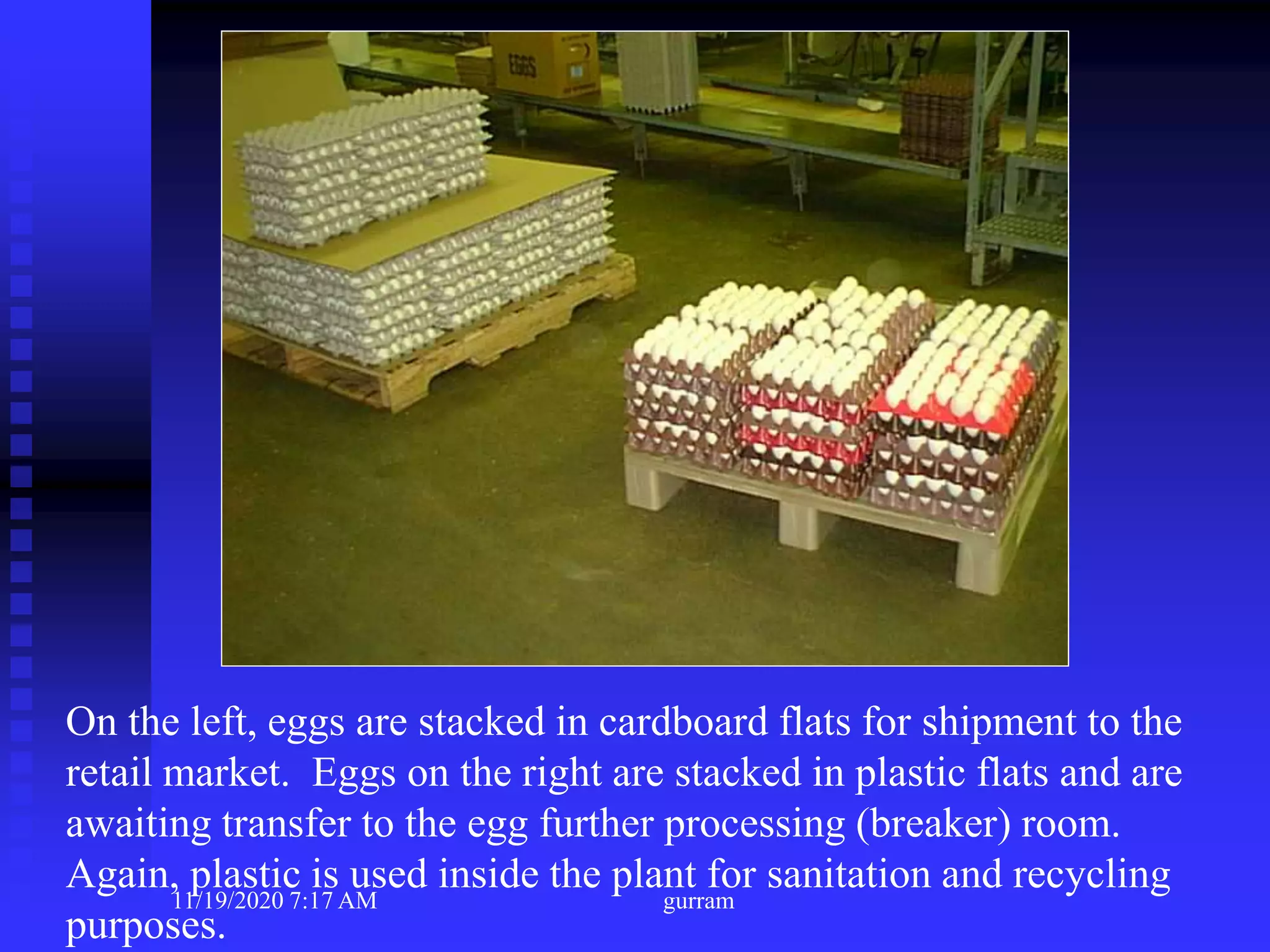
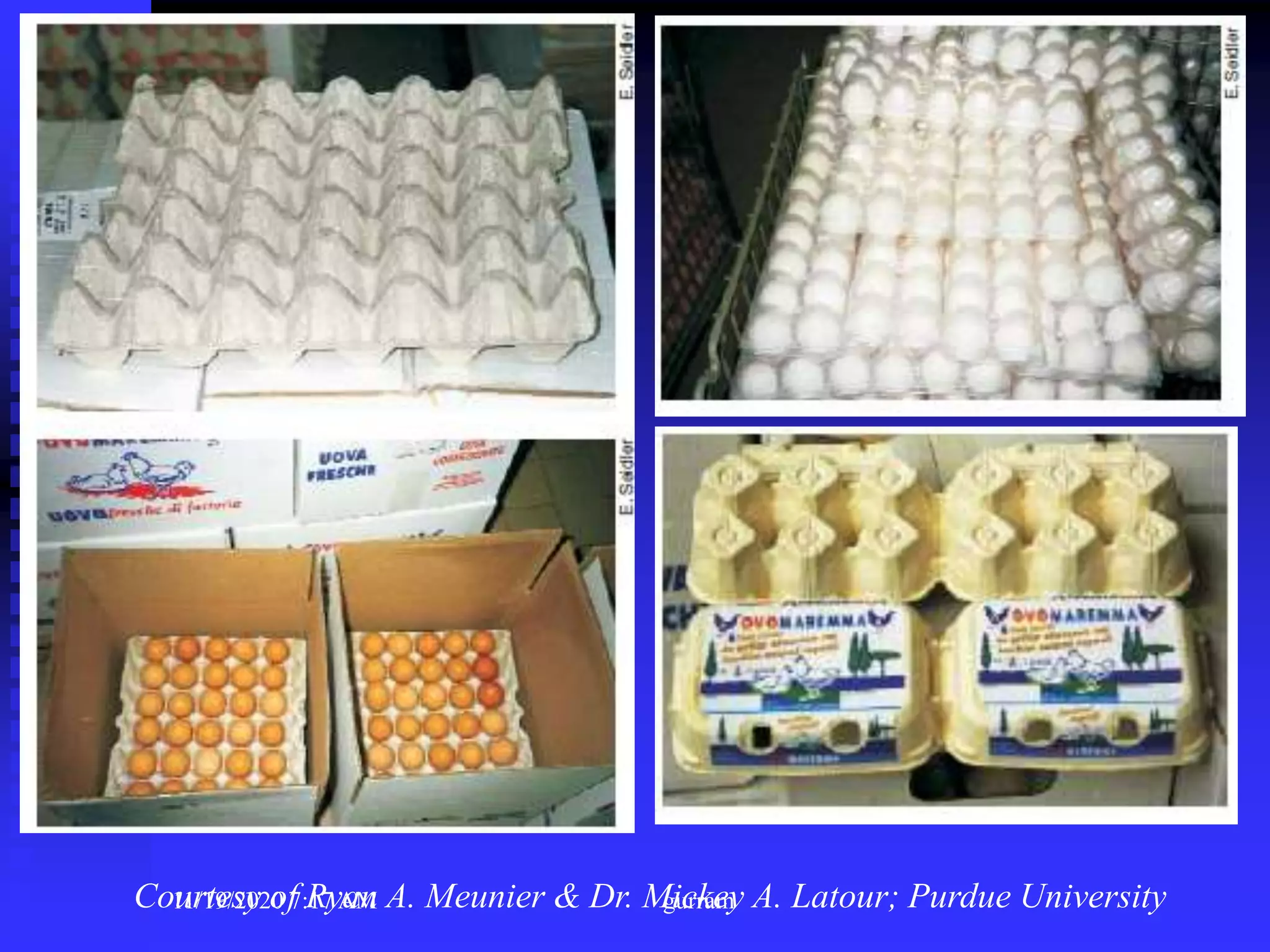
On the left, eggs are stacked in cardboard flats for shipment to the
retail market. Eggs on the right are stacked in plastic flats and are
awaiting transfer to the egg further processing (breaker) room.
Again, plastic is used inside the plant for sanitation and recycling
purposes.
11/19/2020 7:17 AM gurram
Courtesy of Ryan A. Meunier & Dr. Mickey A. Latour; Purdue University11/19/2020 7:17 AM gurram
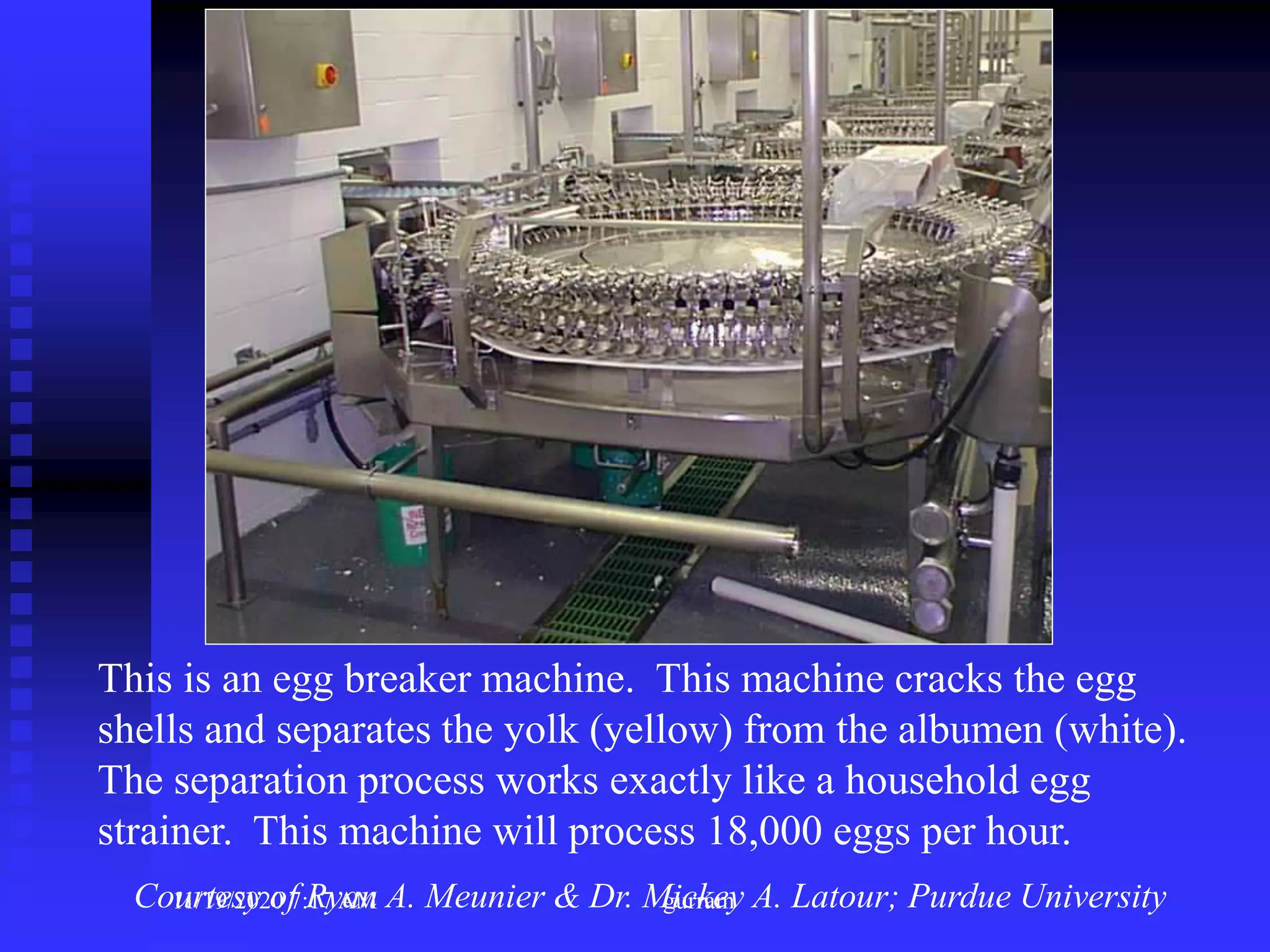
This is an egg breaker machine. This machine cracks the egg
shells and separates the yolk (yellow) from the albumen (white).
The separation process works exactly like a household egg
strainer. This machine will process 18,000 eggs per hour.
Courtesy of Ryan A. Meunier & Dr. Mickey A. Latour; Purdue University11/19/2020 7:17 AM gurram
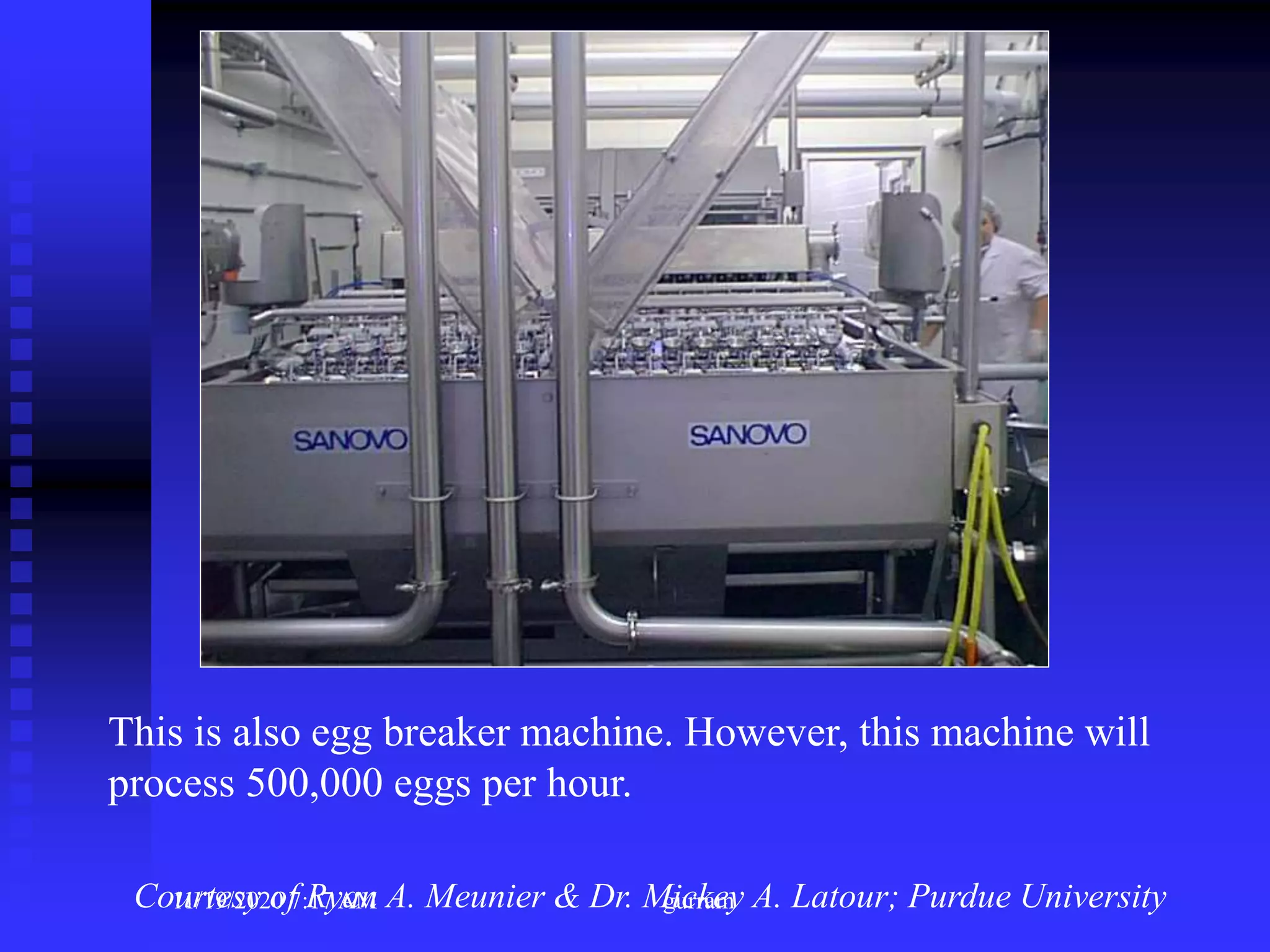
This is also egg breaker machine. However, this machine will
process 500,000 eggs per hour.
Courtesy of Ryan A. Meunier & Dr. Mickey A. Latour; Purdue University11/19/2020 7:17 AM gurram
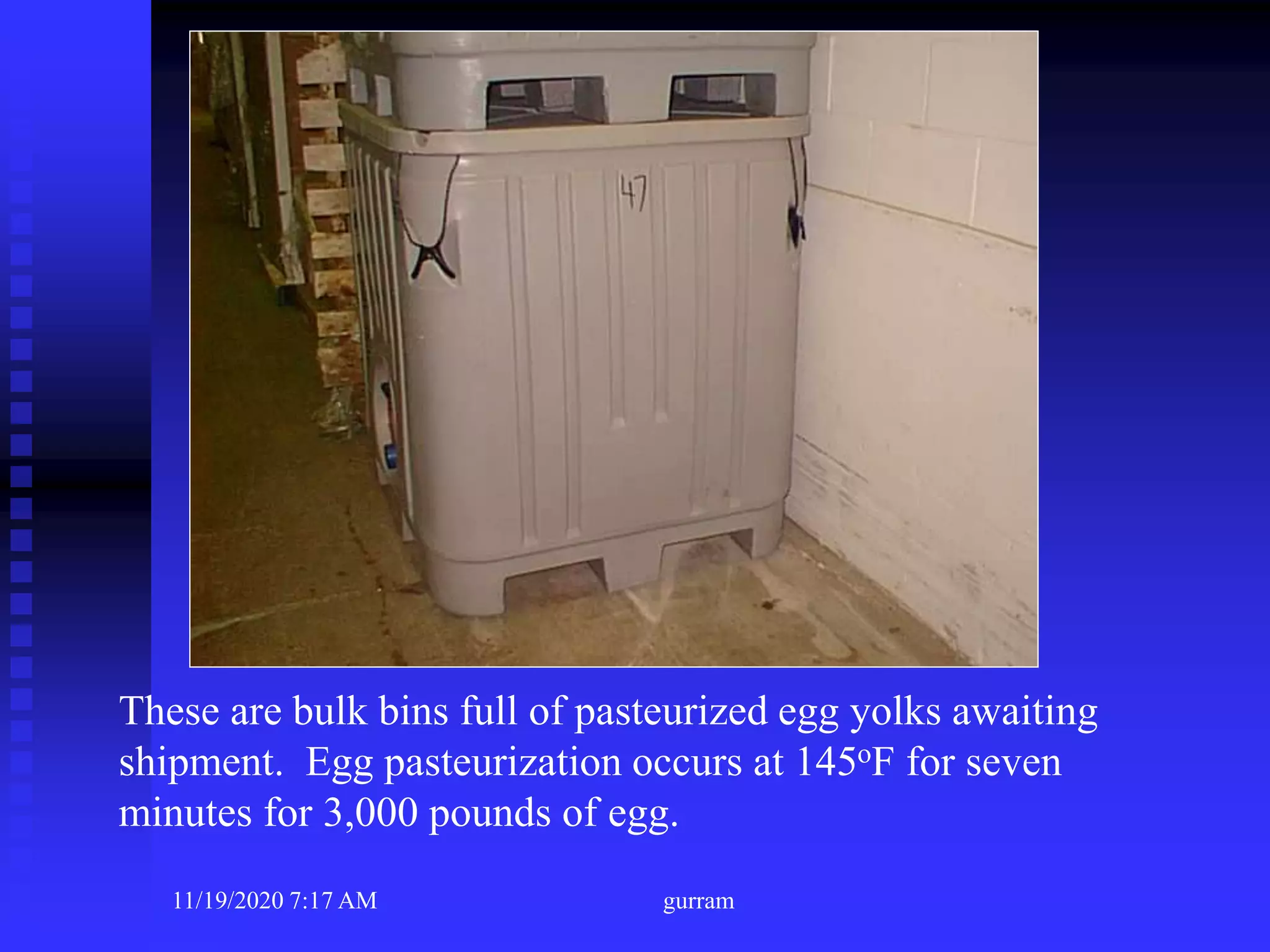
These are bulk bins full of pasteurized egg yolks awaiting
shipment. Egg pasteurization occurs at 145oF for seven
minutes for 3,000 pounds of egg.
11/19/2020 7:17 AM gurram
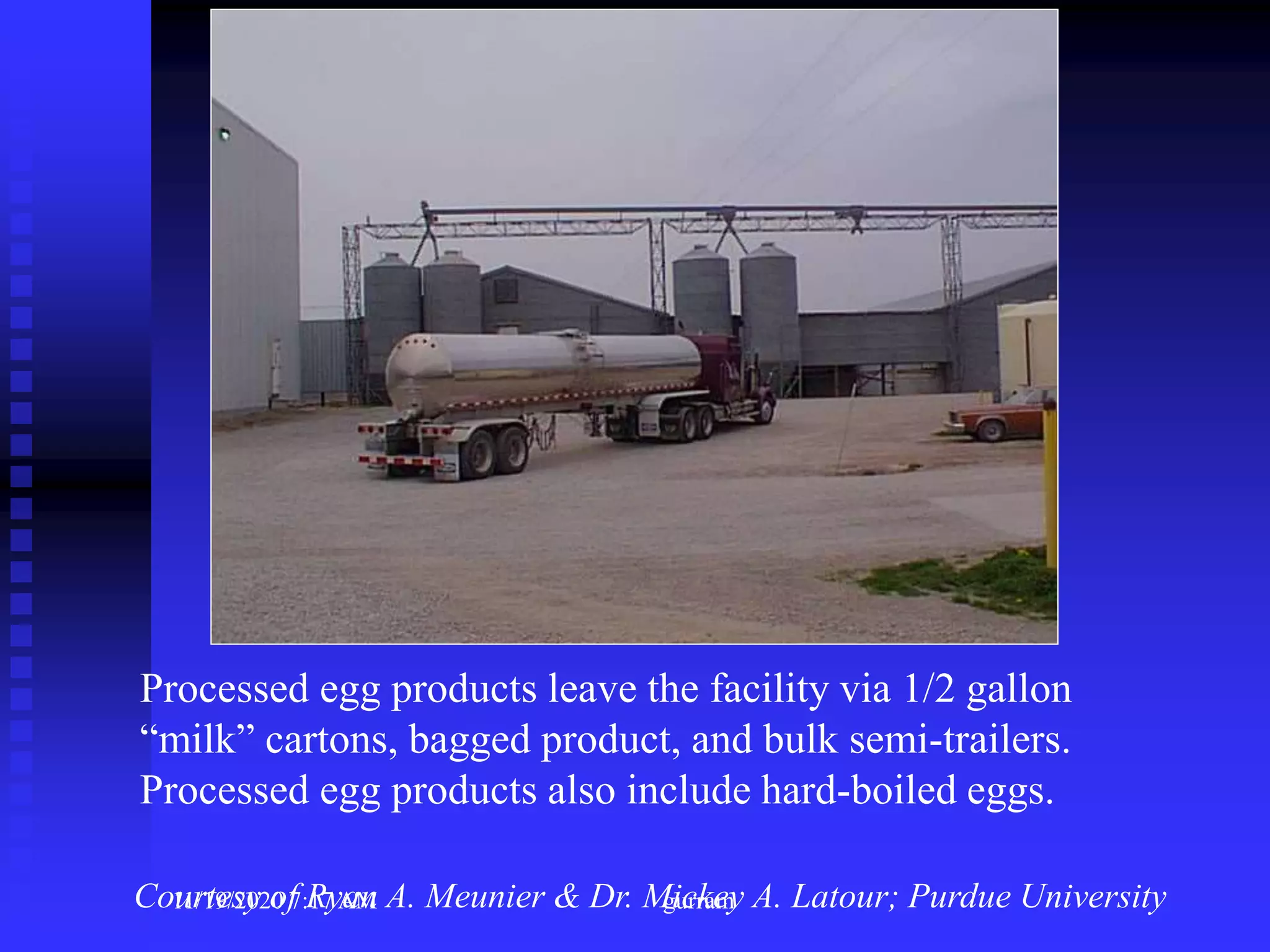
Processed egg products leave the facility via 1/2 gallon
“milk” cartons, bagged product, and bulk semi-trailers.
Processed egg products also include hard-boiled eggs.
Courtesy of Ryan A. Meunier & Dr. Mickey A. Latour; Purdue University11/19/2020 7:17 AM gurram
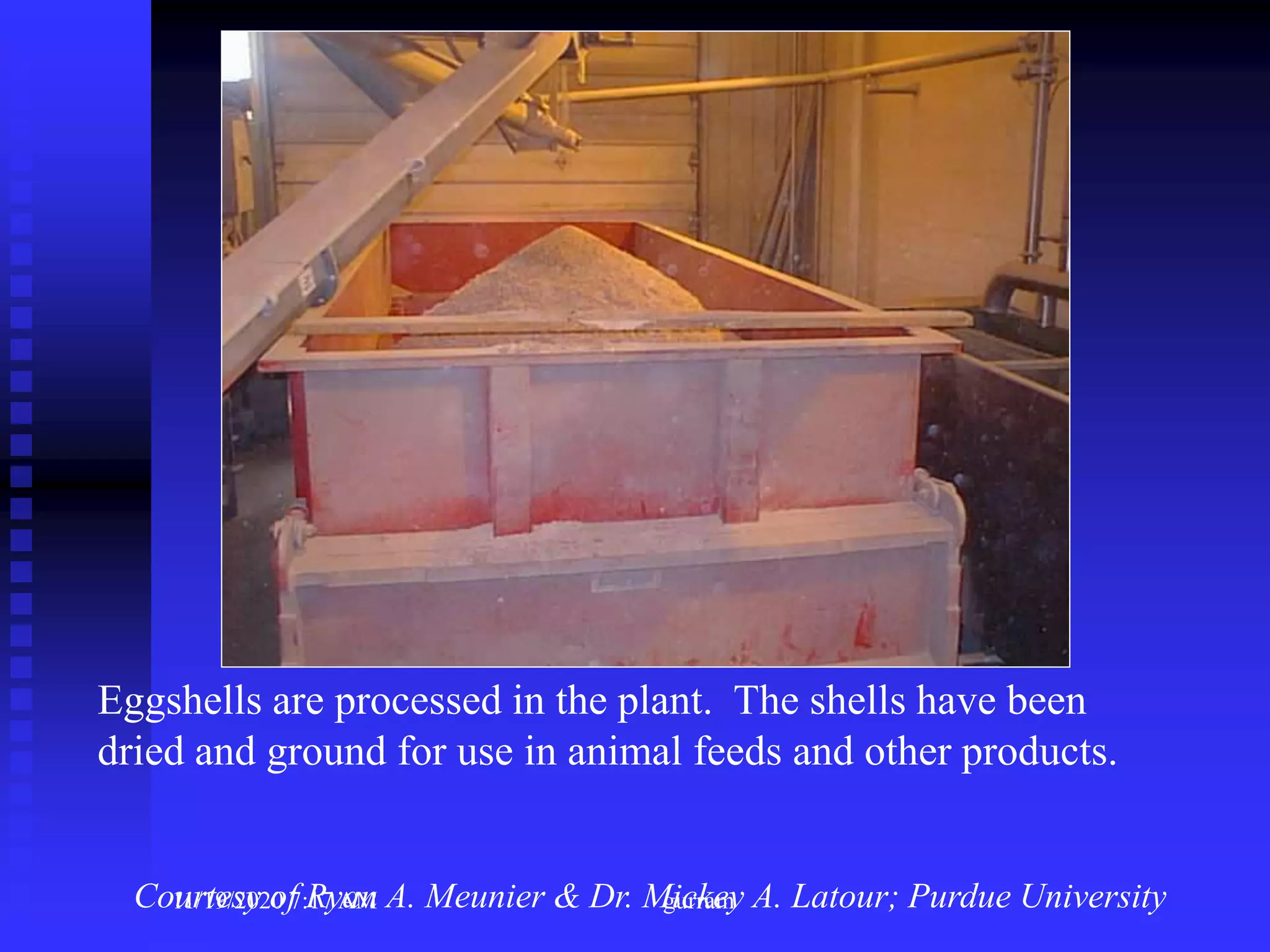
Eggshells are processed in the plant. The shells have been
dried and ground for use in animal feeds and other products.
Courtesy of Ryan A. Meunier & Dr. Mickey A. Latour; Purdue University11/19/2020 7:17 AM gurram
11/19/2020 7:17 AM gurram
•Poultry meat has wider regional acceptance and
is low in price compared to mutton, fish and
other meats.
•Poultry meat is the best meat suitable for sick
and convalescing patients because it can be
easily digested.
• There are cultural and religious restrictions on
consumption of pork and beef, while poultry
meat has no such limitations.
• Poultry meat has higher protein content (18-23
%) than most of the red meats (16-18%).
•This protein is of very superior quality with
respect to biological value and essential amino
acid contents.
11/19/2020 7:17 AM gurram
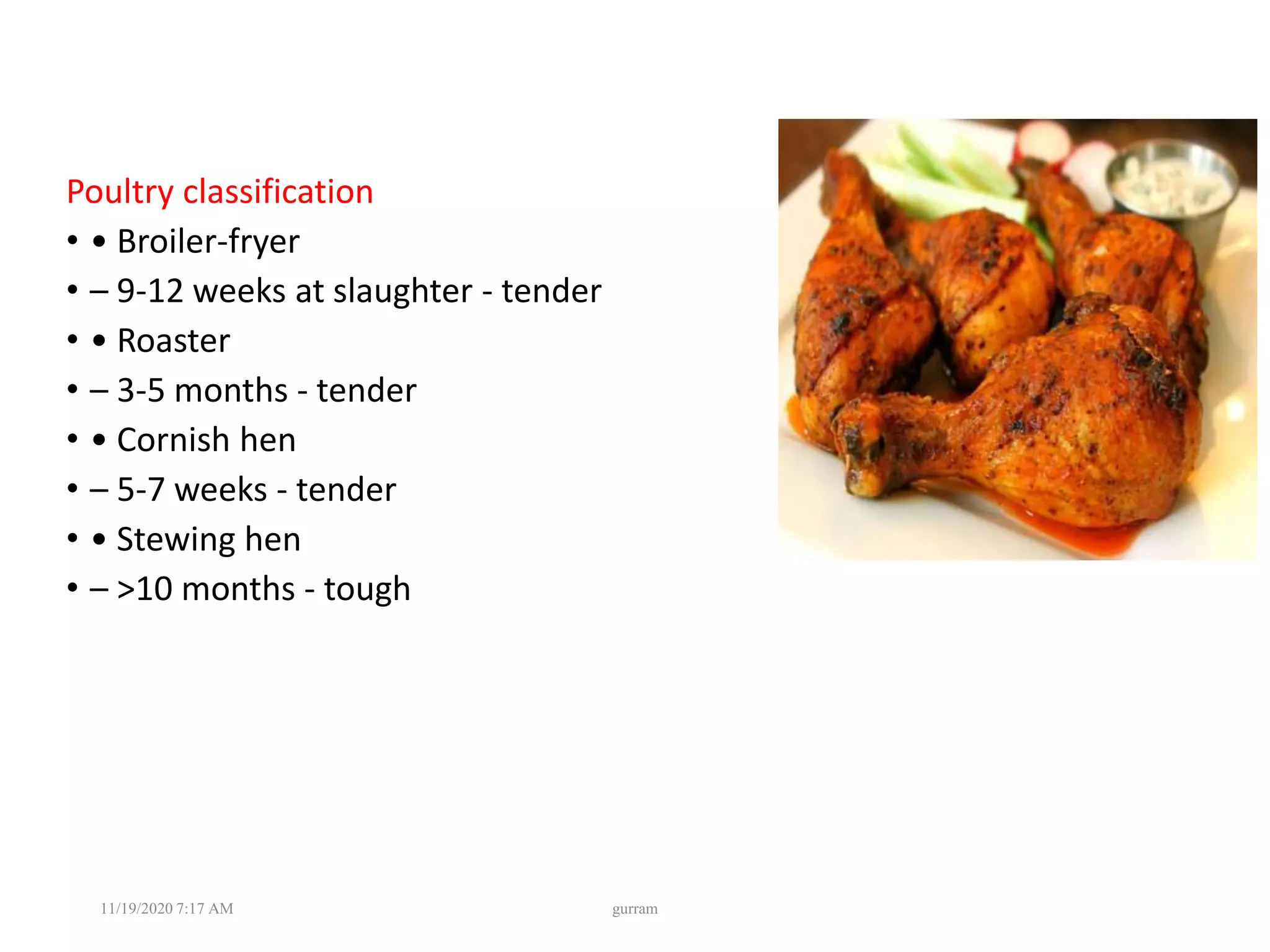
Poultry classification
• • Broiler-fryer
• – 9-12 weeks at slaughter - tender
• • Roaster
• – 3-5 months - tender
• • Cornish hen
• – 5-7 weeks - tender
• • Stewing hen
• – >10 months - tough
11/19/2020 7:17 AM gurram
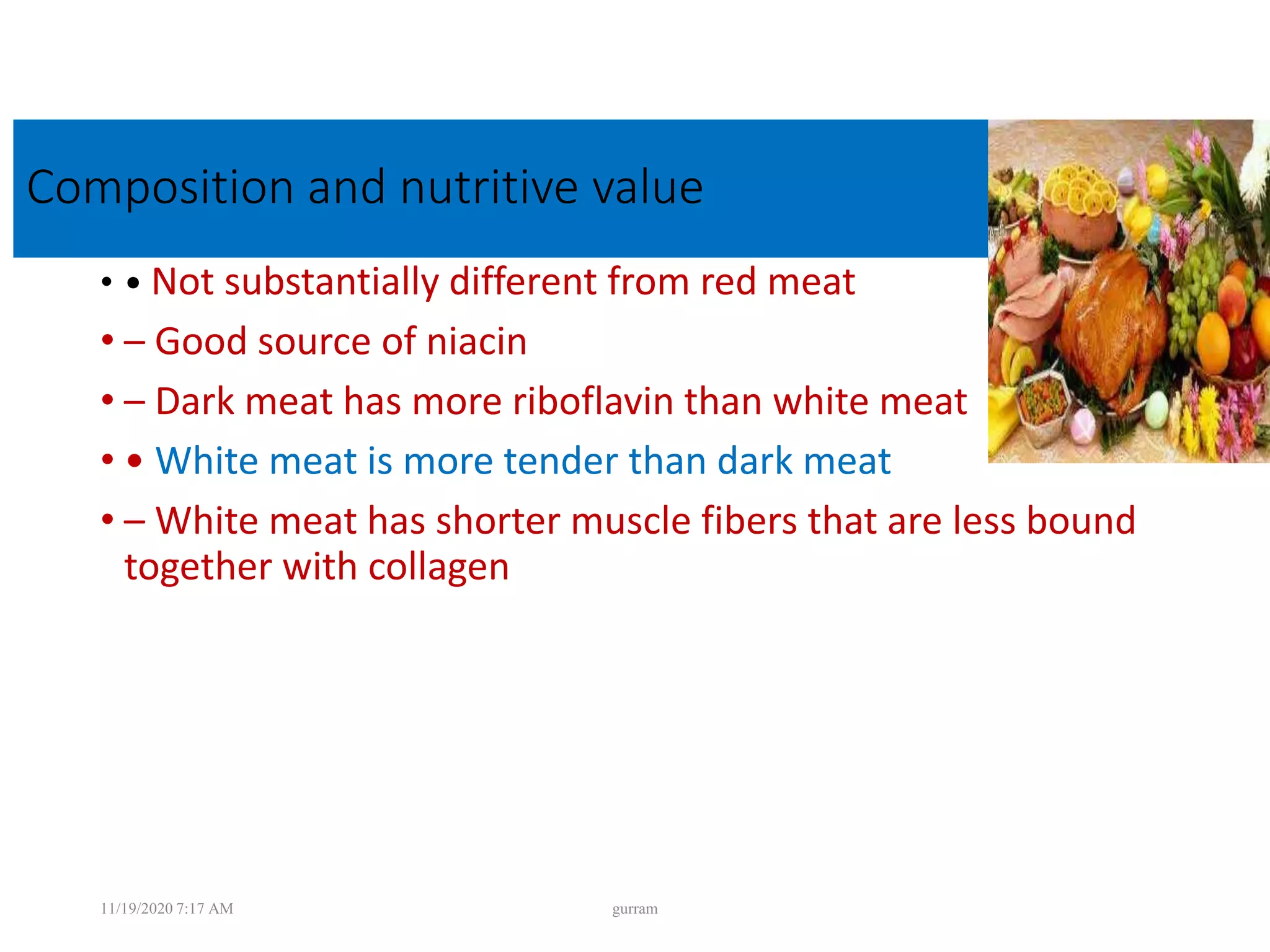
Composition and nutritive value
• • Not substantially different from red meat
• – Good source of niacin
• – Dark meat has more riboflavin than white meat
• • White meat is more tender than dark meat
• – White meat has shorter muscle fibers that are less bound
together with collagen
11/19/2020 7:17 AM gurram
Composition and nutritive value
• • Connective tissue
• – Little in young birds, more in older birds
• • Fat
• – For chicken and turkey it is less than for beef
• – But the fat content of other fowl usually higher than
for chicken, e.g., young goose, 36% carcass fat
11/19/2020 7:17 AM gurram
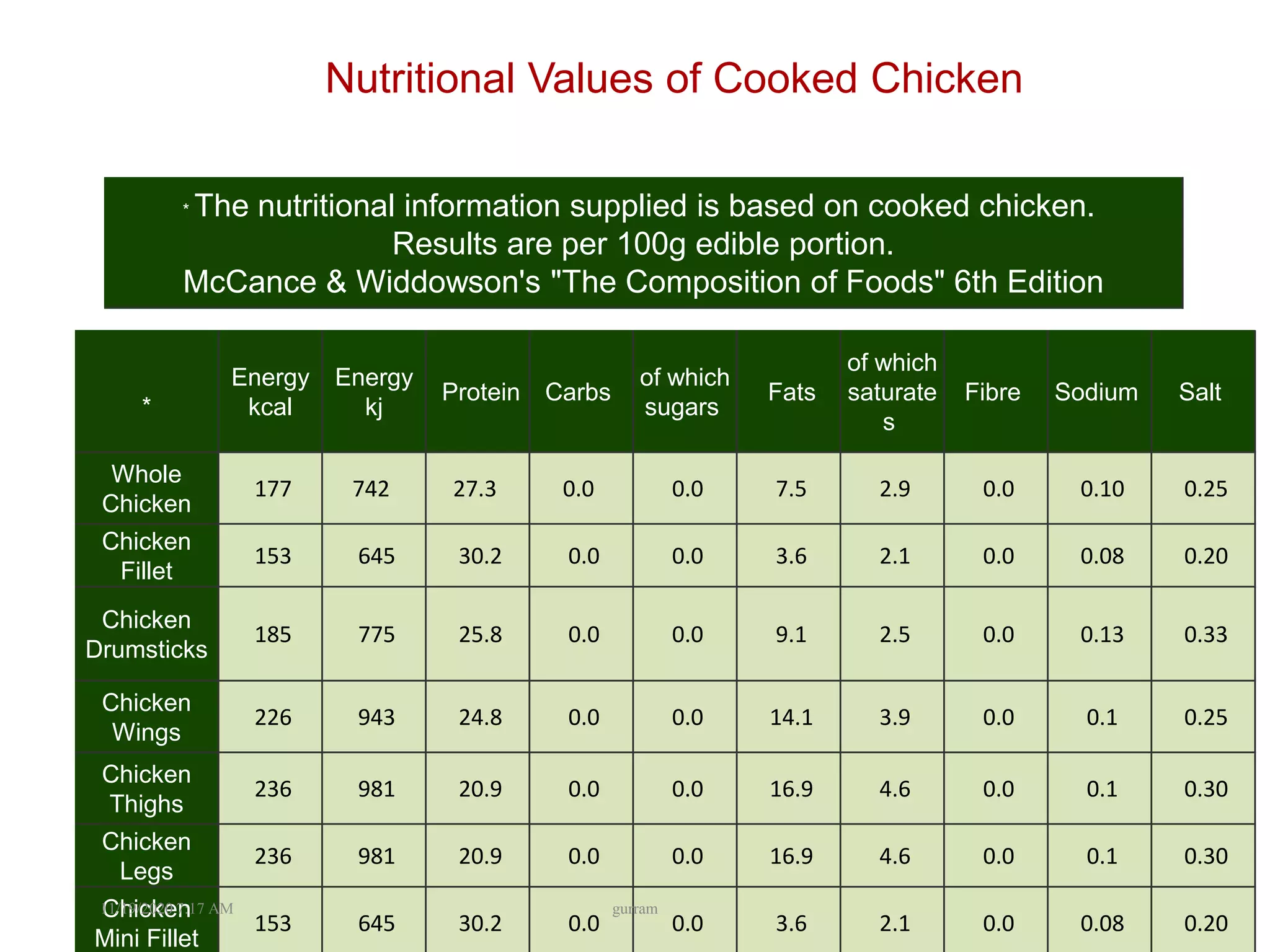
*
Energy
kcal
Energy
kj
Protein Carbs
of which
sugars
Fats
of which
saturate
s
Fibre Sodium Salt
Whole
Chicken
177 742 27.3 0.0 0.0 7.5 2.9 0.0 0.10 0.25
Chicken
Fillet
153 645 30.2 0.0 0.0 3.6 2.1 0.0 0.08 0.20
Chicken
Drumsticks
185 775 25.8 0.0 0.0 9.1 2.5 0.0 0.13 0.33
Chicken
Wings
226 943 24.8 0.0 0.0 14.1 3.9 0.0 0.1 0.25
Chicken
Thighs
236 981 20.9 0.0 0.0 16.9 4.6 0.0 0.1 0.30
Chicken
Legs
236 981 20.9 0.0 0.0 16.9 4.6 0.0 0.1 0.30
Chicken
Mini Fillet
153 645 30.2 0.0 0.0 3.6 2.1 0.0 0.08 0.20
* The nutritional information supplied is based on cooked chicken.
Results are per 100g edible portion.
McCance & Widdowson's "The Composition of Foods" 6th Edition
Nutritional Values of Cooked Chicken
11/19/2020 7:17 AM gurram
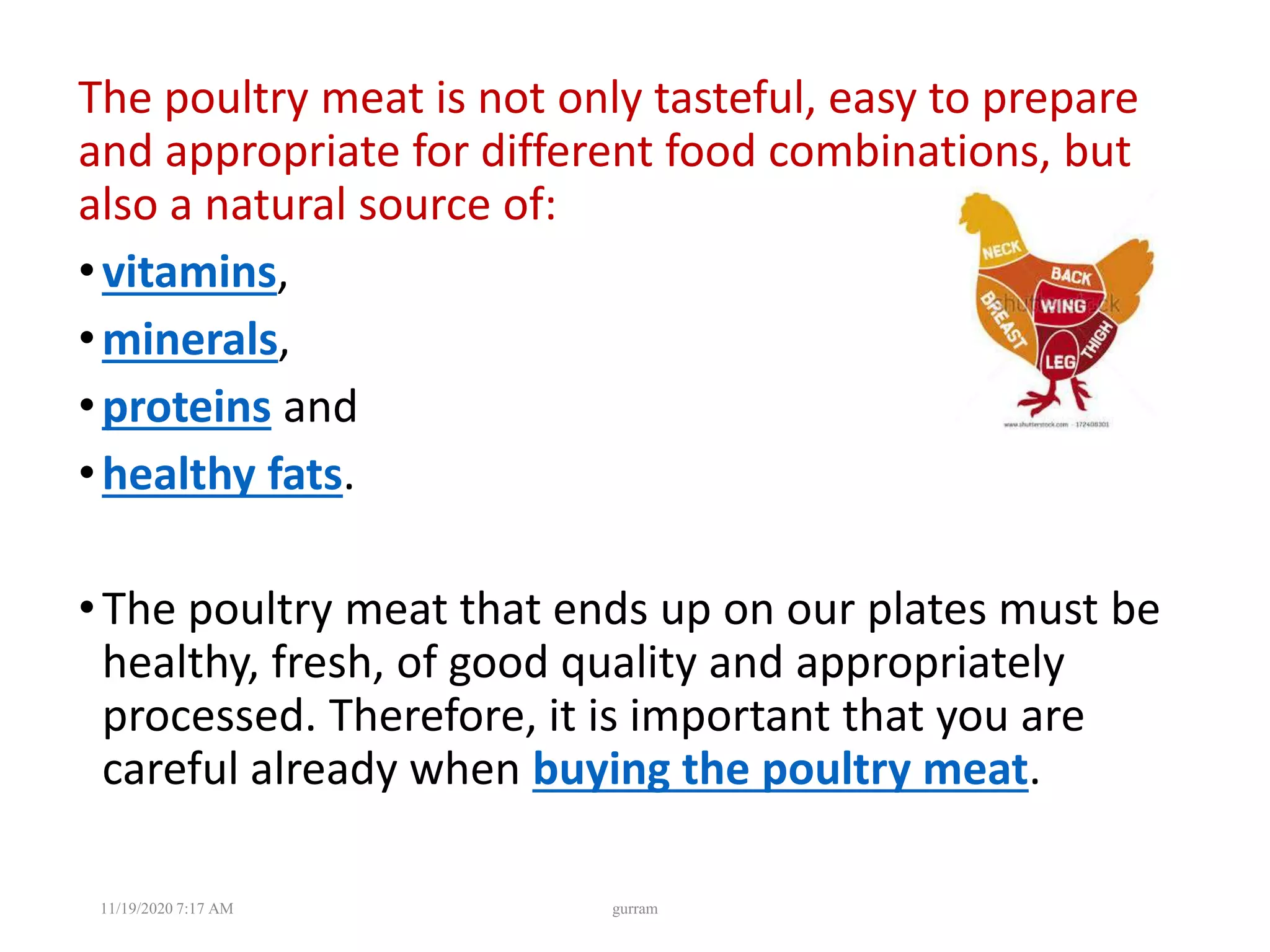
The poultry meat is not only tasteful, easy to prepare
and appropriate for different food combinations, but
also a natural source of:
•vitamins,
•minerals,
•proteins and
•healthy fats.
•The poultry meat that ends up on our plates must be
healthy, fresh, of good quality and appropriately
processed. Therefore, it is important that you are
careful already when buying the poultry meat.
11/19/2020 7:17 AM gurram
•When selecting the foods, be careful of
their origin and select products, bearing
the marks of quality and protection of
health.
•The producer must guarantee that the food
you eat is indeed healthy and faultless.
•However, when preparing the meat, avoid
the excessive heat processing, because it
influences the loss of nutritious substances
and may even be harmful to health.
•In the proper diet pyramid, designed by
the experts of the World Health
Organization, the poultry meat occupies an
important segment.11/19/2020 7:17 AM gurram
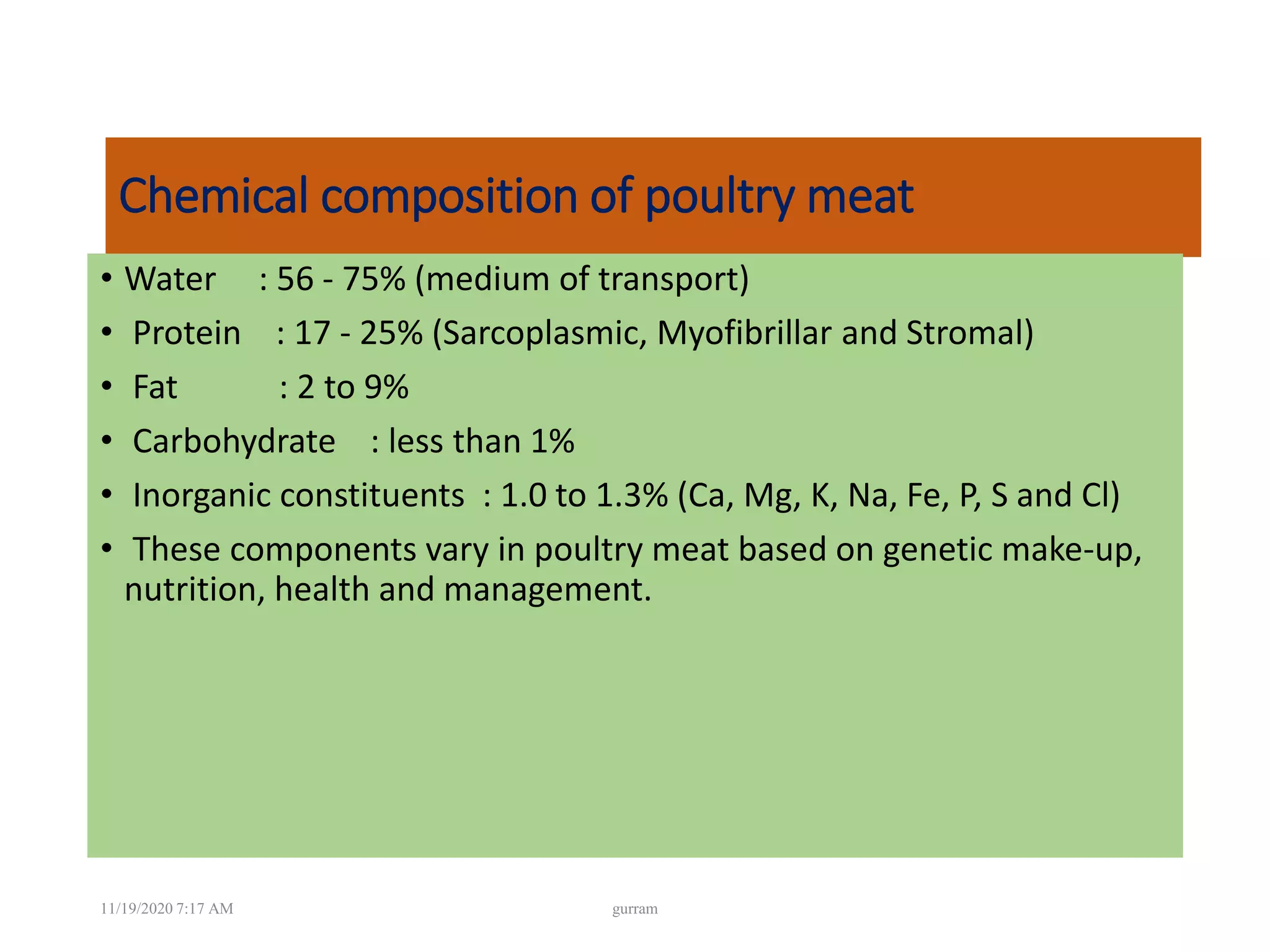
Chemical composition of poultry meat
• Water : 56 - 75% (medium of transport)
• Protein : 17 - 25% (Sarcoplasmic, Myofibrillar and Stromal)
• Fat : 2 to 9%
• Carbohydrate : less than 1%
• Inorganic constituents : 1.0 to 1.3% (Ca, Mg, K, Na, Fe, P, S and Cl)
• These components vary in poultry meat based on genetic make-up,
nutrition, health and management.
11/19/2020 7:17 AM gurram
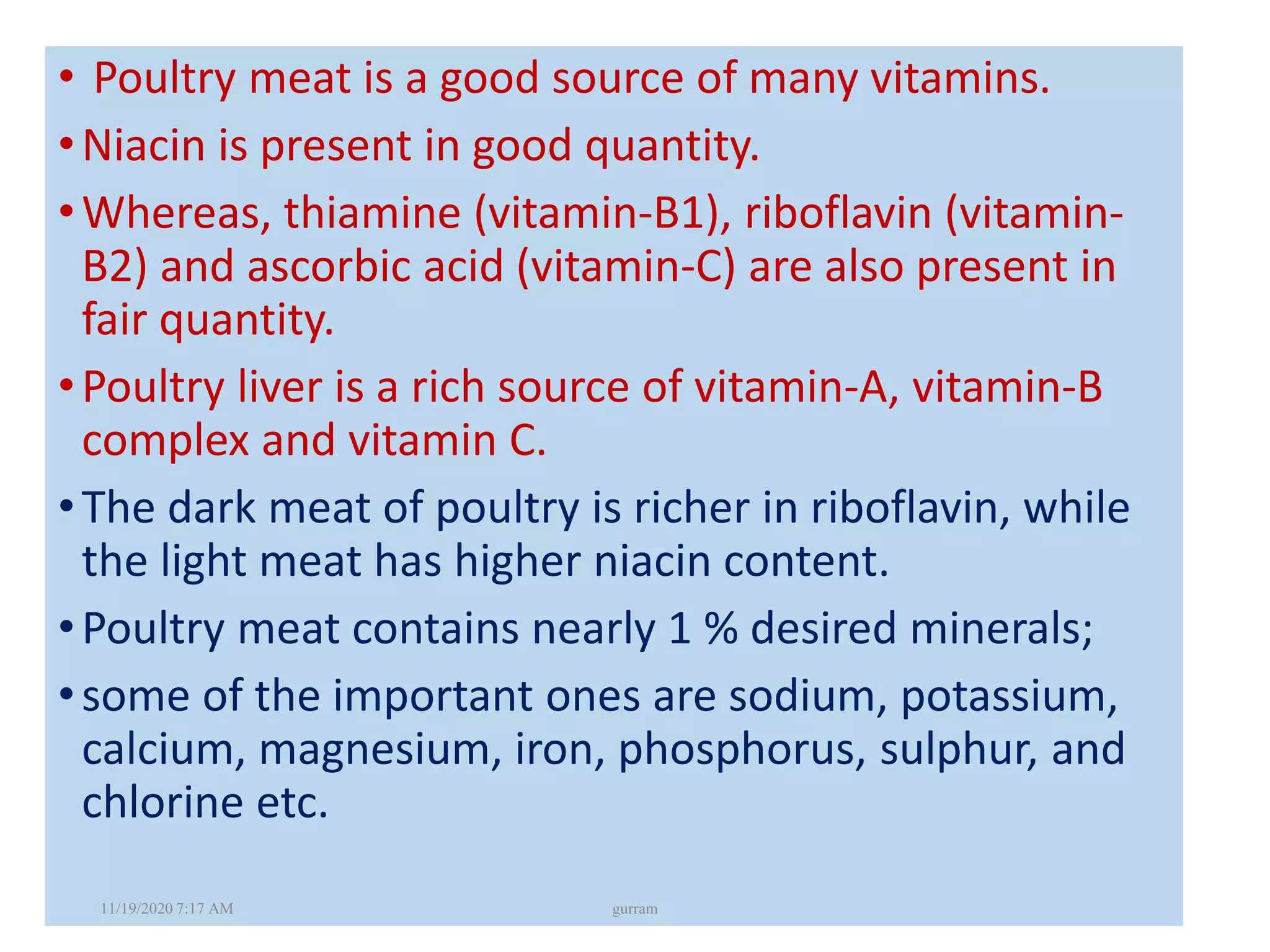
• Poultry meat is a good source of many vitamins.
•Niacin is present in good quantity.
•Whereas, thiamine (vitamin-B1), riboflavin (vitamin-
B2) and ascorbic acid (vitamin-C) are also present in
fair quantity.
•Poultry liver is a rich source of vitamin-A, vitamin-B
complex and vitamin C.
•The dark meat of poultry is richer in riboflavin, while
the light meat has higher niacin content.
•Poultry meat contains nearly 1 % desired minerals;
•some of the important ones are sodium, potassium,
calcium, magnesium, iron, phosphorus, sulphur, and
chlorine etc.
11/19/2020 7:17 AM gurram
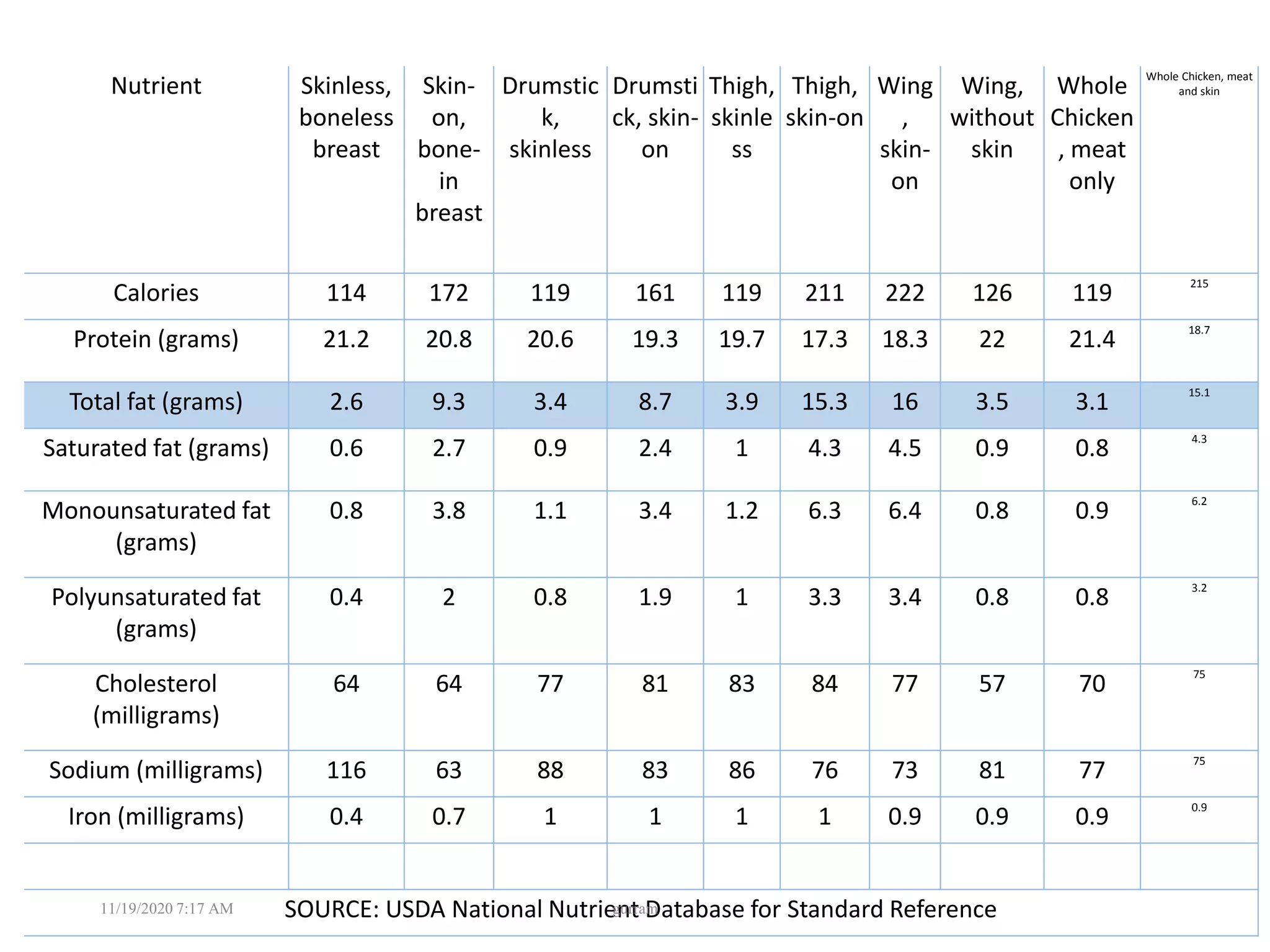
Nutrient Skinless,
boneless
breast
Skin-
on,
bone-
in
breast
Drumstic
k,
skinless
Drumsti
ck, skin-
on
Thigh,
skinle
ss
Thigh,
skin-on
Wing
,
skin-
on
Wing,
without
skin
Whole
Chicken
, meat
only
Whole Chicken, meat
and skin
Calories 114 172 119 161 119 211 222 126 119
215
Protein (grams) 21.2 20.8 20.6 19.3 19.7 17.3 18.3 22 21.4
18.7
Total fat (grams) 2.6 9.3 3.4 8.7 3.9 15.3 16 3.5 3.1
15.1
Saturated fat (grams) 0.6 2.7 0.9 2.4 1 4.3 4.5 0.9 0.8
4.3
Monounsaturated fat
(grams)
0.8 3.8 1.1 3.4 1.2 6.3 6.4 0.8 0.9
6.2
Polyunsaturated fat
(grams)
0.4 2 0.8 1.9 1 3.3 3.4 0.8 0.8
3.2
Cholesterol
(milligrams)
64 64 77 81 83 84 77 57 70
75
Sodium (milligrams) 116 63 88 83 86 76 73 81 77
75
Iron (milligrams) 0.4 0.7 1 1 1 1 0.9 0.9 0.9
0.9
SOURCE: USDA National Nutrient Database for Standard Reference11/19/2020 7:17 AM gurram
The relationship between
red meat consumption
and disease risk
11/19/2020 7:17 AM gurram
Red meat and cancer
• The most studied cancer in relation to red and processed
meat intake is colorectal cancer (CRC)
• Most of the evidence of the association between red meat and
CRC shows an increase in risk of CRC in the highest consumers
of red meat compared to the lowest consumers, although
most studies have not reached statistical significance
11/19/2020 7:17 AM gurram
Red meat and cancer
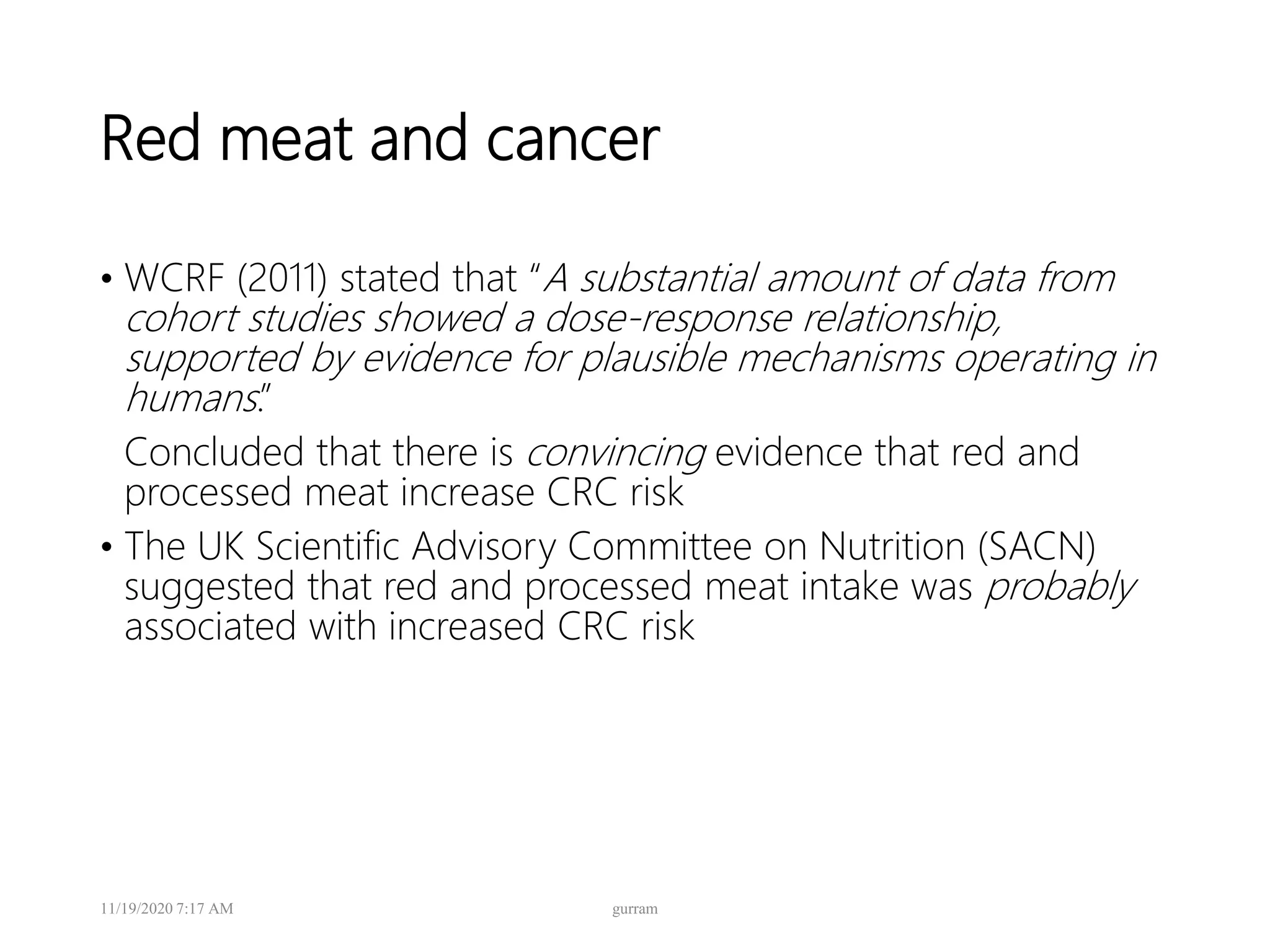
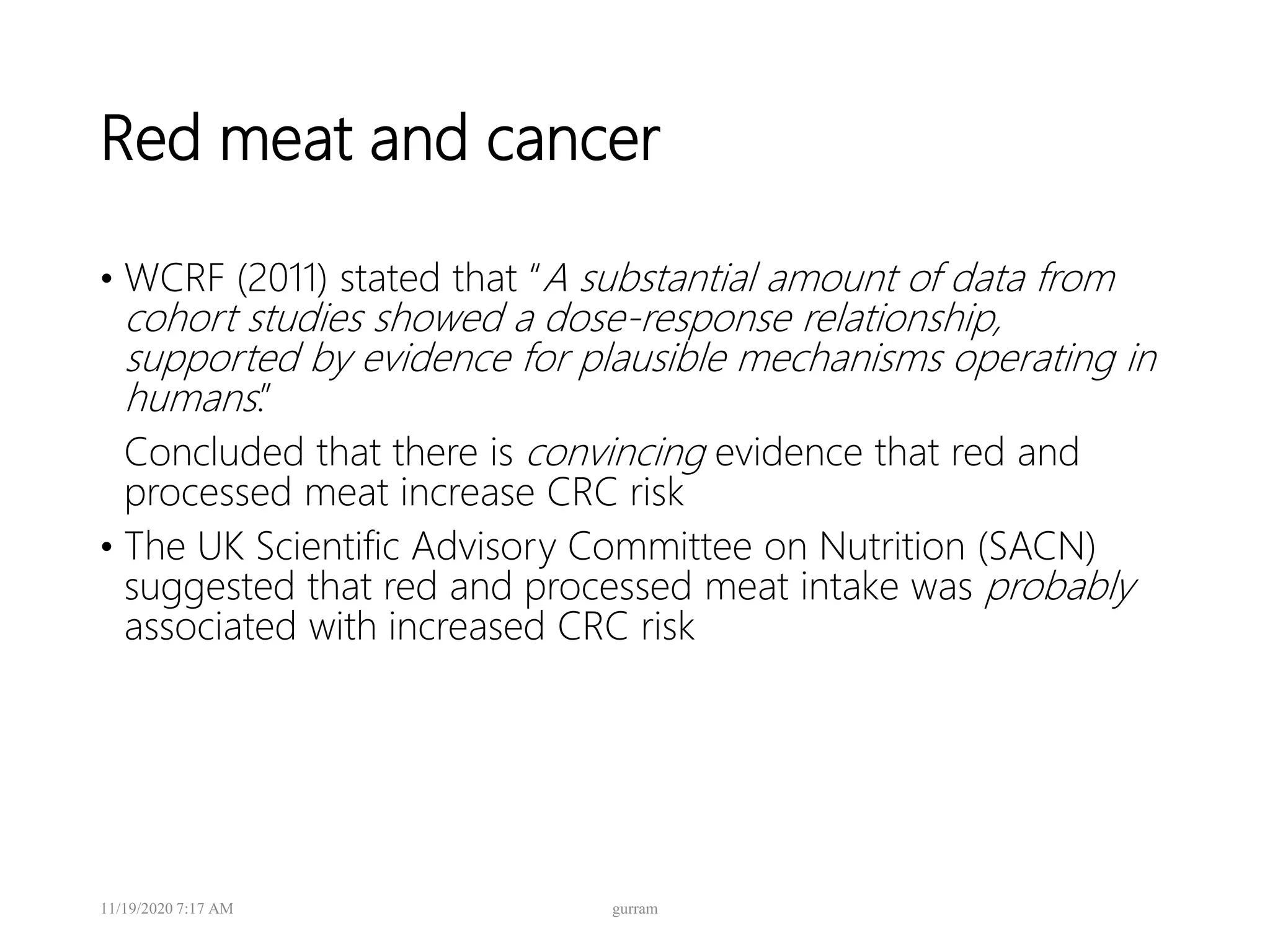
• WCRF (2011) stated that “A substantial amount of data from
cohort studies showed a dose-response relationship,
supported by evidence for plausible mechanisms operating in
humans.”
Concluded that there is convincing evidence that red and
processed meat increase CRC risk
• The UK Scientific Advisory Committee on Nutrition (SACN)
suggested that red and processed meat intake was probably
associated with increased CRC risk
11/19/2020 7:17 AM gurram
Red meat and
Cardiovascular disease (CVD
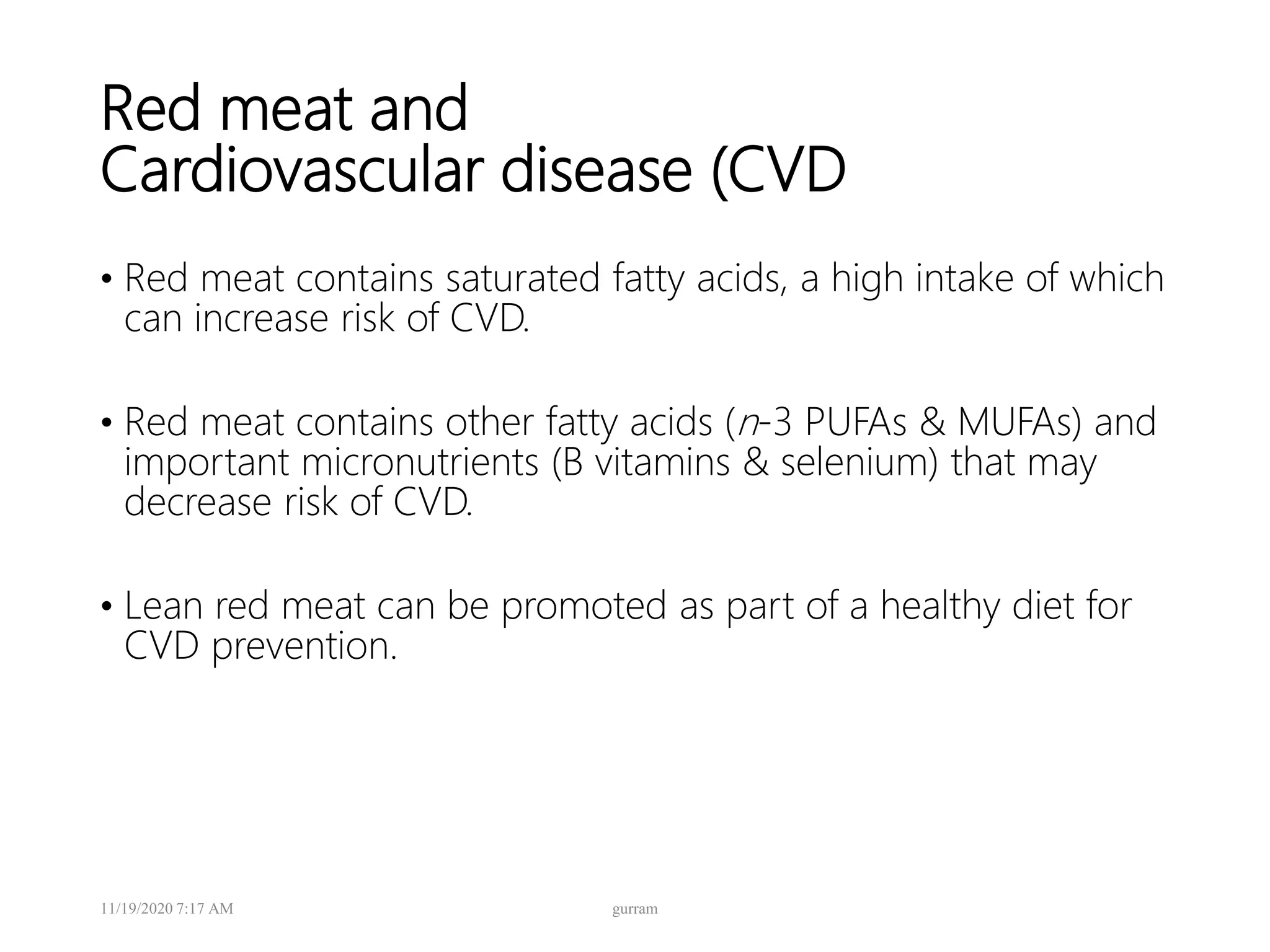
• Red meat contains saturated fatty acids, a high intake of which
can increase risk of CVD.
• Red meat contains other fatty acids (n-3 PUFAs & MUFAs) and
important micronutrients (B vitamins & selenium) that may
decrease risk of CVD.
• Lean red meat can be promoted as part of a healthy diet for
CVD prevention.
11/19/2020 7:17 AM gurram
Red meat and cancer
• WCRF (2011) stated that “A substantial amount of data from
cohort studies showed a dose-response relationship,
supported by evidence for plausible mechanisms operating in
humans.”
Concluded that there is convincing evidence that red and
processed meat increase CRC risk
• The UK Scientific Advisory Committee on Nutrition (SACN)
suggested that red and processed meat intake was probably
associated with increased CRC risk
11/19/2020 7:17 AM gurram
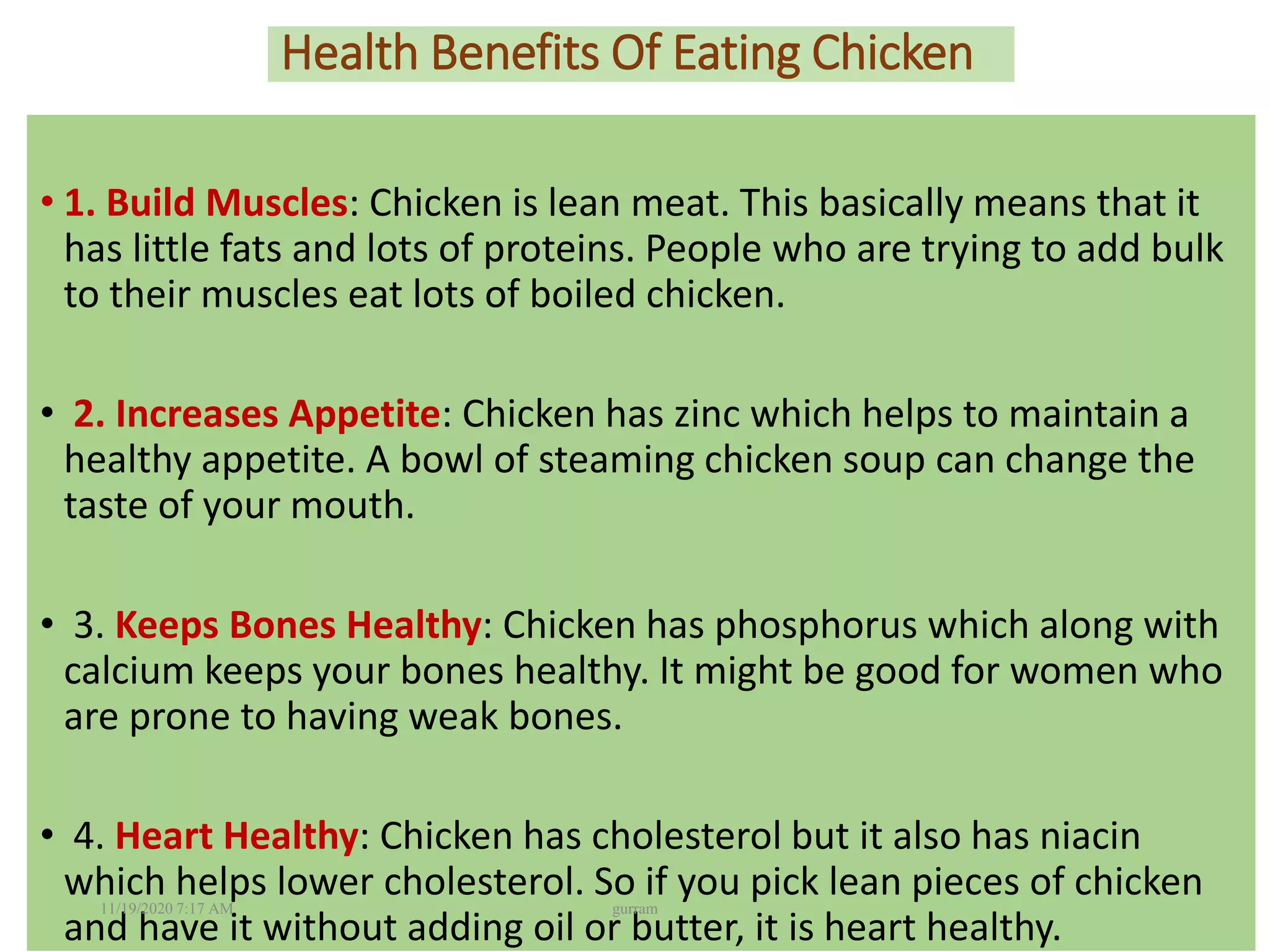
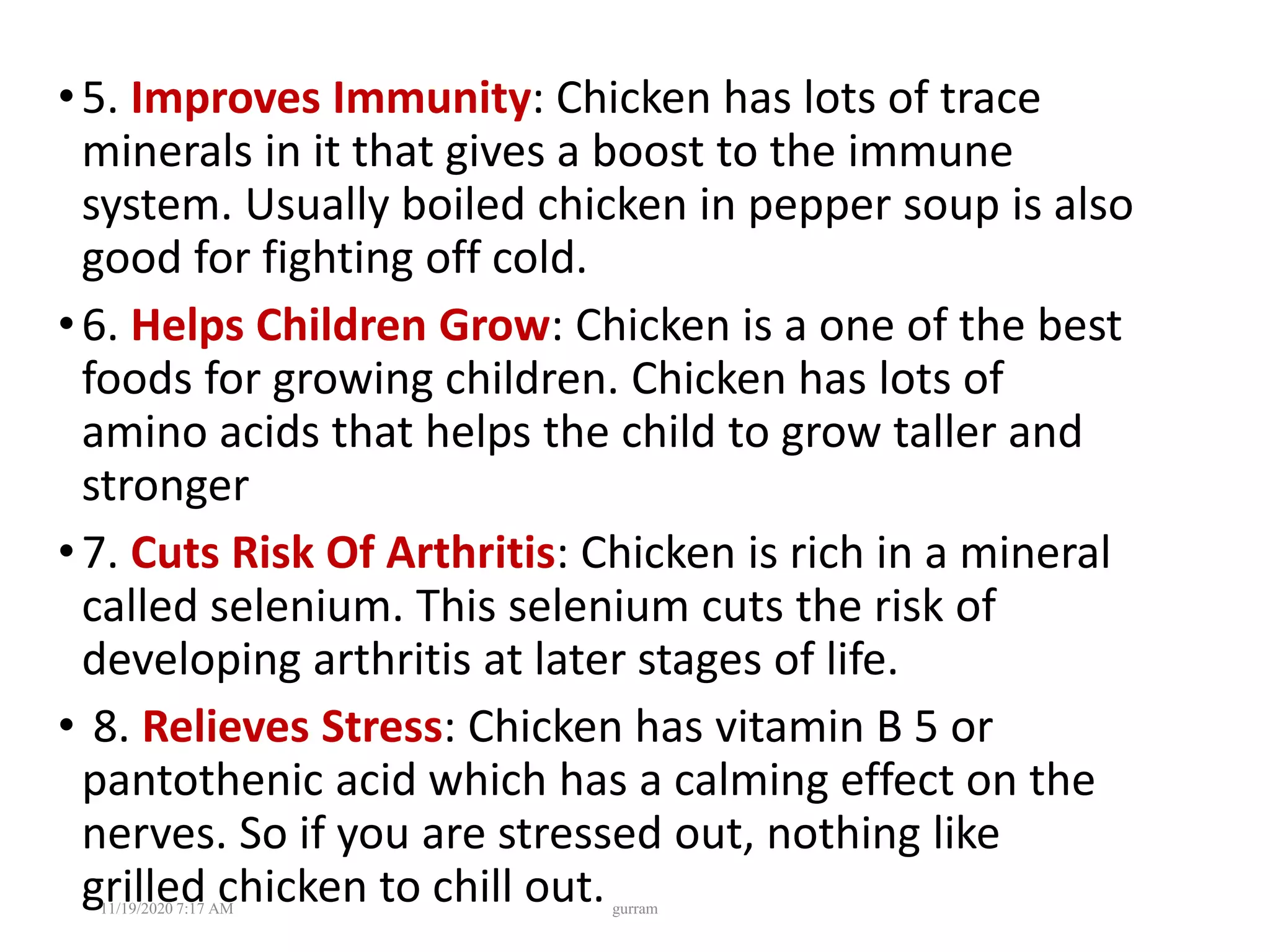
Health Benefits Of Eating Chicken
• 1. Build Muscles: Chicken is lean meat. This basically means that it
has little fats and lots of proteins. People who are trying to add bulk
to their muscles eat lots of boiled chicken.
• 2. Increases Appetite: Chicken has zinc which helps to maintain a
healthy appetite. A bowl of steaming chicken soup can change the
taste of your mouth.
• 3. Keeps Bones Healthy: Chicken has phosphorus which along with
calcium keeps your bones healthy. It might be good for women who
are prone to having weak bones.
• 4. Heart Healthy: Chicken has cholesterol but it also has niacin
which helps lower cholesterol. So if you pick lean pieces of chicken
and have it without adding oil or butter, it is heart healthy.
11/19/2020 7:17 AM gurram
•5. Improves Immunity: Chicken has lots of trace
minerals in it that gives a boost to the immune
system. Usually boiled chicken in pepper soup is also
good for fighting off cold.
•6. Helps Children Grow: Chicken is a one of the best
foods for growing children. Chicken has lots of
amino acids that helps the child to grow taller and
stronger
•7. Cuts Risk Of Arthritis: Chicken is rich in a mineral
called selenium. This selenium cuts the risk of
developing arthritis at later stages of life.
• 8. Relieves Stress: Chicken has vitamin B 5 or
pantothenic acid which has a calming effect on the
nerves. So if you are stressed out, nothing like
grilled chicken to chill out.11/19/2020 7:17 AM gurram
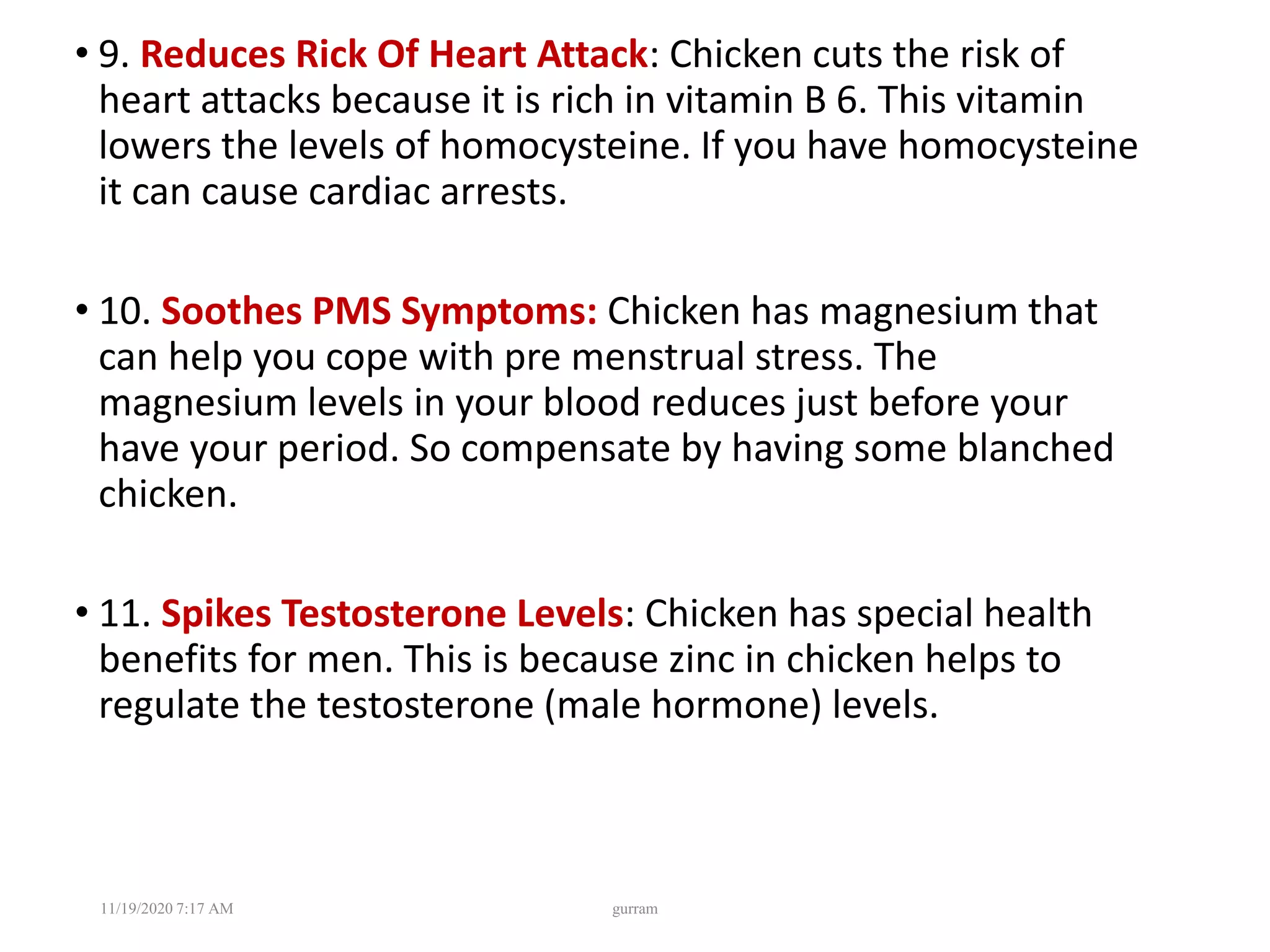
• 9. Reduces Rick Of Heart Attack: Chicken cuts the risk of
heart attacks because it is rich in vitamin B 6. This vitamin
lowers the levels of homocysteine. If you have homocysteine
it can cause cardiac arrests.
• 10. Soothes PMS Symptoms: Chicken has magnesium that
can help you cope with pre menstrual stress. The
magnesium levels in your blood reduces just before your
have your period. So compensate by having some blanched
chicken.
• 11. Spikes Testosterone Levels: Chicken has special health
benefits for men. This is because zinc in chicken helps to
regulate the testosterone (male hormone) levels.
11/19/2020 7:17 AM gurram
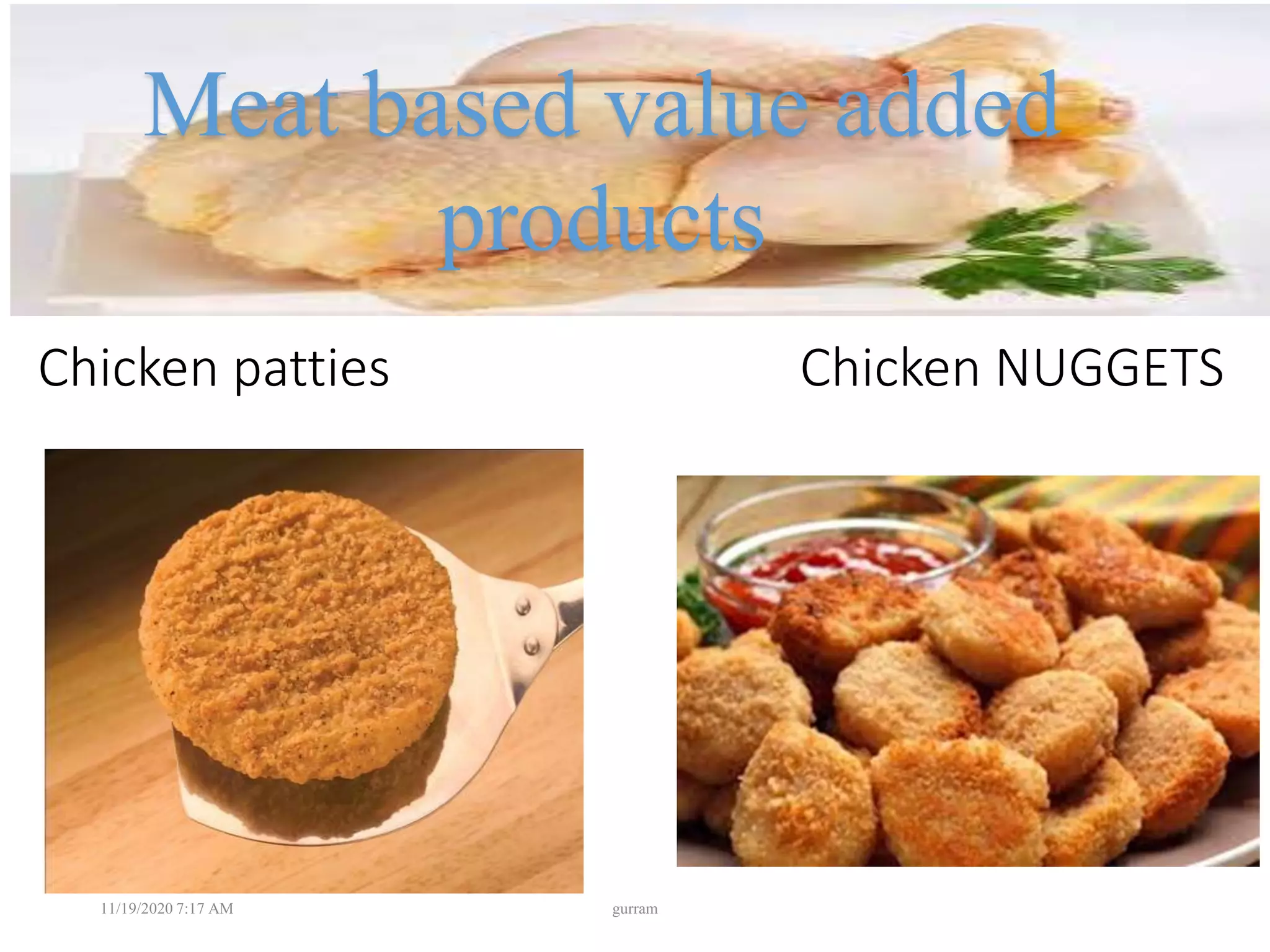
Chicken patties Chicken NUGGETS
Meat based value added
products
11/19/2020 7:17 AM gurram
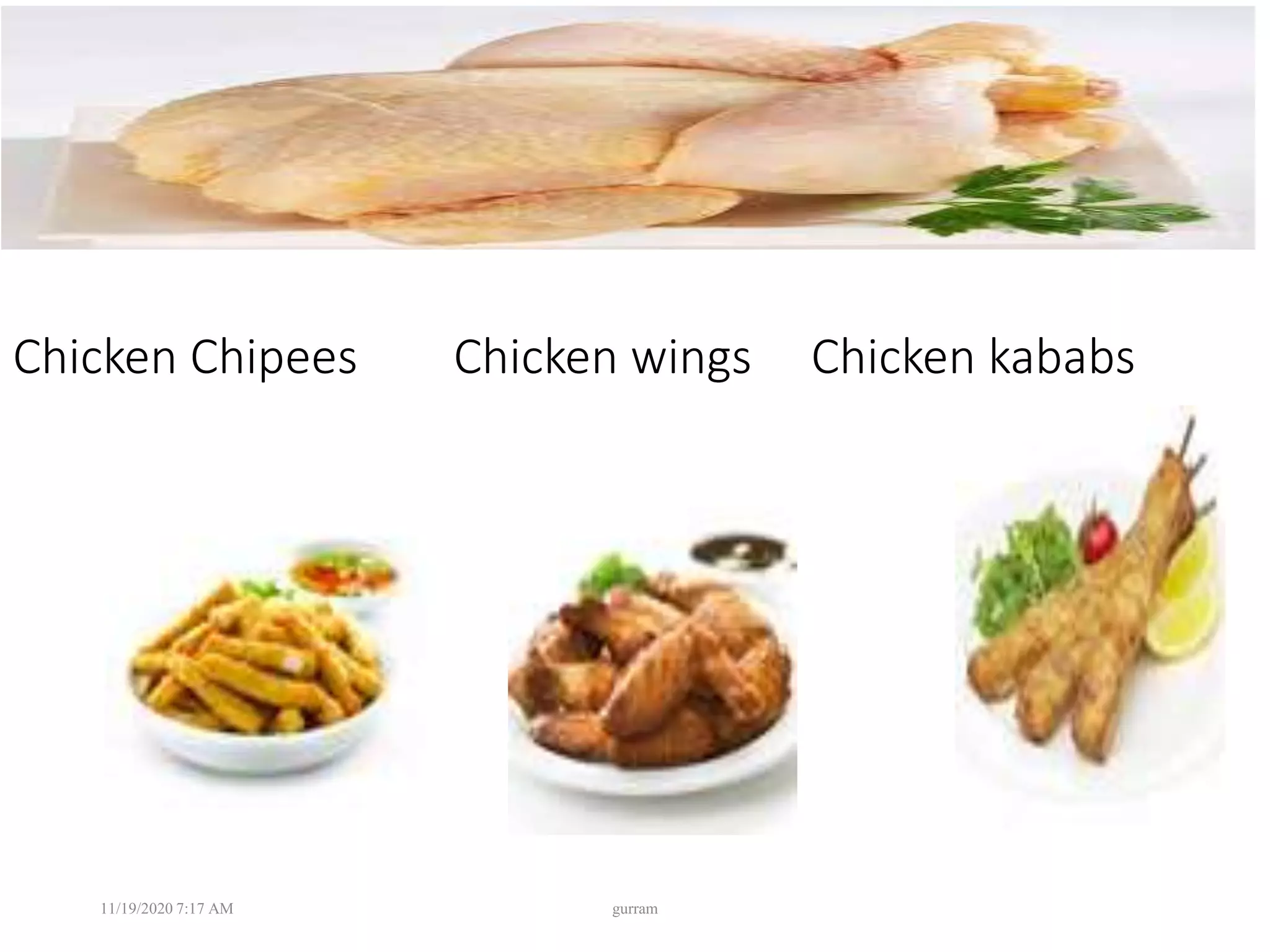
Chicken Chipees Chicken wings Chicken kababs
11/19/2020 7:17 AM gurram

Importance of egg and meat, egg quality, value addition and egg products

  • 1.
    EGG and MeatCHARACTERISTICS & IMPORTANCE 11/19/2020 7:17 AM gurram
  • 2.
    EGG An egg isa round or oval cell laid by the female of any number of different species, consisting of an ovum surrounded by layers of membranes and an outer casing, which acts to nourish and protect a developing embryo. Which came first, the chicken or the egg?11/19/2020 7:17 AM gurram
  • 3.
    Edible egg: • Chickenegg • Quail egg • Duck egg • Goose egg • Ostrich egg • Turtle egg • Fish egg: roe and caviar 11/19/2020 7:17 AM gurram
  • 4.
    Commercial Egg: • Theseare hen eggs in shell, suitable for consumption in the state, or use by food industries, excluding broken eggs and boiled eggs (CEE Regulation No. 1907/90). • Most laying hens are White Leghorns . 11/19/2020 7:17 AM gurram
  • 5.
    Formation of theegg • The egg is formed gradually over a period of about 25 hours. • The female chick (Hen) has up to 4000 tiny ova (reproductive cells), from some of which full-sized yolks may develop when the hen matures. • Each yolk (ovum) is enclosed in a thin- walled sac, or follicle, attached to the ovary • The mature yolk is released when the sac ruptures, and is received by the funnel of the left oviduct 11/19/2020 7:17 AM gurram
  • 6.
    Section of oviductApproximate time egg spends in this section Functions of section of oviduct 1 Funnel (infundibulum) 15 minutes Receives yolk from ovary. If live sperm present, fertilisation occurs here (commercially produced table eggs are not fertilised) 2 Magnum 3 hours Inner and outer shell membranes are added, as are some water and mineral salts 3 Isthmus 1 hour Albumen (white) is secreted and layered around the yolk 4 Shell gland (uterus) 21 hours Initially some water is added, making the outer white thinner. Then the shell material (mainly calcium carbonate) is added. Pigments may also be added to make the shell brown 5 Vagina/cloaca less than 1 minute The egg passes through this section before laying. It has no other known function in the egg’s formation 11/19/2020 7:17 AM gurram
  • 7.
    Structure of anEgg 1. Eggshell 2. Outer membrane 3. Inner membrane 4. Chalaza 5. Exterior albumen 6. Middle albumen 7. Vitelline membrane 8. Nucleus of pander 9. Germinal disk 10.Yellow yolk 11.White yolk 12.Internal albumen 13.Chalaza 14.Air cell 15.Cuticula11/19/2020 7:17 AM gurram
  • 8.
  • 9.
  • 10.
    SHELL (10 %) •calcium carbonate (CaCO3) 94-97 %, 3-6 % Organic material and Pigment • Shell strength is depend on the content of CaCO3, Mg, P, dan vit D • Thickness: 0.2-0.4 mm • Pores: 700 pores/cm2 = 17,000 tiny pores • Semipermeable membrane: air and moisture can pass through has a thin outermost coating called the bloom or cuticle that helps keep out bacteria and dust. • Mucin : covered shell and pores 11/19/2020 7:17 AM gurram
  • 11.
    INNER AND OUTER MEMBRANESAND AIR CELL INNER AND OUTER MEMBRANES Lye between the eggshell and egg white, these two transparent protein membranes provide efficient defense against bacterial invasion. If you give these layers a tug, you’ll find they’re surprisingly strong. They’re made partly of keratin, a protein that’s also in human hair. AIR CELL • An air space forms when the contents of the egg cool and contract after the egg is laid 11/19/2020 7:17 AM gurram
  • 12.
    ALBUMEN (60 %) •The egg white is known as the albumen, which comes from albus, the Latin word for “white.” • contain approximately 40 different proteins: • OVALBUMIN, CANALBUMIN, OVOTRANSFERIN, LYSOZYM, OVOMUCIN, AVIDIN, ETC 11/19/2020 7:17 AM gurram
  • 13.
    Consist of 4parts: inner thick, inner thin white, outer thick white dan outer thin white. cloudy appearance due to CO2 content. ALBUMEN 11/19/2020 7:17 AM gurram
  • 14.
    Albumen Proteins Lipids CarbohydratesAsh Water 9.7-10.6%, 0.03% 0.4-0.9% 0.5- 0.6% 87.9- 89.4% Composition of Albumen (Powrie 1973) The egg white is approximately two-thirds of the total egg's weight out of its shell with nearly 90% of that weight coming from water. 11/19/2020 7:17 AM gurram
  • 15.
    Ovalbumin 54% Conalbumin 13% Ovomucoid11% Lysozyme 3.5% Globulins (G2, G3) 8.0 % Ovomucin 1.5% Other protein components include, flavoprotein (0.8%), ovoglycoprotein (0.5%), ovomacroglobulin (0.5%), ovoinhibitor (0.l%) and avidin (0.05%). MAJOR PROTEINS IN ALBUMEN OF TOTAL PROTEINS (Powrie 1973) Egg white contains approximately 40 different proteins: 11/19/2020 7:17 AM gurram
  • 16.
    YOLK • Less water,more protein and fat than the white egg • Contains most of the vitamins and minerals of the egg, including Fe, vitamin A, vitamin D, phosphorus, calcium, thiamine, and riboflavin. • Source of lecithin (emulsifier). • Yolk color ranges from just a hint of yellow to a magnificent deep orange, according to the feed and breed of the hen. • Umur: kuning telur mengabsorbsi air dari albumen: ukuran kuning telur membesar , strukturnya meregang, membran vitelin rusak, bentuk lebih flat. 11/19/2020 7:17 AM gurram
  • 17.
    CHALAZAE AND VITELIN CHALAZAE • Opaqueropes of egg white, the chalazae hold the yolk in the center of the egg. Like little anchors, they attach the yolk’s casing to the membrane lining the eggshell. The more prominent they are, the fresher the egg. Vitelline Membrane • The clear casing that encloses the yolk. 11/19/2020 7:17 AM gurram
  • 18.
  • 19.
    Chemical composition ofeggs Animal Water (%) Protein (%) Lipid (%) CHO (%) Ash (%) Chicken 73,7 12,9 11,5 0,9 1 Duck 70,4 13,3 14,5 0,7 1,1 Goose 70,4 13,9 13,3 1,5 Pigeon 72,8 13,8 12 0,8 0,9 Quail 73,7 13,1 11,1 1 1,1 Ostrich 72,6 13,1 11,8 1,7 0,8 Turtle 66,7 16,5 11,6 3,3 1,9 11/19/2020 7:17 AM gurram
  • 20.
    Composition of egg Component(%) Telur Utuh Putih telur Kuning telur Kulit telur Water 37 87,6 51,1 - Protein 12,9 10,9 16 4 Lipid 11,5 - 30 - Carbohydrate 1,1 1,1 1,1 - Free Carbohydrate 0,3 0,4 0,2 - Ash 1 0,7 1,7 - Mineral 11,7 1 2 96 11/19/2020 7:17 AM gurram
  • 21.
    Vitamin contain most ofthe recognised vitamins with the exception of vitamin C 11/19/2020 7:17 AM gurram
  • 22.
    VITAMINS Component Amount per100 g egg Vitamin A 190 µg Vitamin D 1,8 µg Vitamin E 1,1 mg Vitamin C none Thiamin (B1) 0,09 mg Riboflavin (B2) 0,47 mg Niacin 0.1 mg Vitamin B6 0.12 mg Folate 50 µg Vitamin B12 2,5 µg Biotin 20 µg Panthotenic acid 1.77 µg11/19/2020 7:17 AM gurram
  • 23.
    Minerals • Iodine thyroid hormone • Phosphorus  for bone health. • Zinc  for wound healing, growth and fighting infection • Selenium  an important antioxidant • Calcium  for bone and growth structure and nervous function. • also contain significant amounts of iron, the vital ingredient of red blood cells. 11/19/2020 7:17 AM gurram
  • 24.
    Lipids in Yolk •Egg lipids are found mostly in yolk, only 0,05% is contained in albumen. • Fatty acid content: monounsaturated (46.5%) > saturated (37.5%) > polyunsaturated (16.5%) • Highest fatty acid content: monounsaturated: oleic acid (18:1) approximately 40% from lipid total. 11/19/2020 7:17 AM gurram
  • 25.
    Fatty acid contentin 100 g of fresh yolk Fatty Acid Gram Saturated 1.59 Miristat (14:0) 0.02 Palmitat (16:0) 1.14 Stearat (18:0) 0.40 Monounsaturated 1.95 Palmitoleat (16:1) 0.15 Oleat (18:1) 1.78 Eicosenoat (20:1) 0.01 Polyunsaturated 0.70 Linoleat (18:2) 0.59 Linolenat (18:3) 0.02 Arakidonat (20:4) 0.07 Dokosaheksanoat (22:6) 0.02 Cholesterol 0.21 TOTAL 4.4311/19/2020 7:17 AM gurram
  • 26.
    Chemical composition change: Liquid/Dry Egg (per100g) Liquid*/Frozen Dried Whole Eggs Yolk White Whole Eggs Yolk Stabilized White SOLIDS-g 24.80 43.20 11.0 96.3 97.3 93.5 pH-g 7.8 6.7 8.8 8.7 6.5 6.8 PROTEIN-g 12.0 15.3 9.3 48.4 33.7 84.6 LIPIDS-g 9.71 23.0 0.076 39.2 52.9 0.407 FREE GLUCOSE-g <0.10 0.2 0.3 0.3 <0.1 0 ASH-g 0.80 1.4 0.4 3.4 3.3 3.6 MOISTURE-g 75.20 56.80 89.0 3.7 2.7 6.5 11/19/2020 7:17 AM gurram
  • 27.
    1. One mediumegg contains between 4-5 grams of fat 2. High cholesterol • ~200 mg/egg 3. High in Complete Protein (EPR=93.7%); > milk (84.5%), fish (76%), beef meat (74.3%), soy bean (72.8%), corn (60%) 4. Little to no CHO 5. High in vitamins & minerals • Vitamins ADEK, some B vitamins, selenium, iodine, zinc, iron, copper 11/19/2020 7:17 AM gurram
  • 28.
    Energy value ofeggs • 78 kilocalories (324 kilojoules) • only around 3% of the average energy requirement of an adult man and 4% for an adult woman. Protein • 12.5% of the weight of the egg in both the yolk and the albumen. • Egg protein is of high biological value as it contains all the essential amino acids needed by the human body. 11/19/2020 7:17 AM gurram
  • 29.
    Functional Properties ofEgg 1. Flavor, color, nutrition 2. Foaming agent 3. Emulsifying agent 4. Aids in thickening/structure 5. Binding/coating agent 6. Leavening agent 11/19/2020 7:17 AM gurram
  • 30.
    FOAMING PROPERTIES 1. Airtrapped in a liquid 2. In egg foam, air trapped by protein. 3. Denatured and then coagulates 4. Heat expands protein/air • Important to souffles, meringues, omelet, and sponge cake. 11/19/2020 7:17 AM gurram
  • 31.
    EMULSIFIER CAPACITY  Eggyolk is a source of lecithin, an emulsifier and surfactant.  Lechitin is a substance that helps an emulsion form, or helps keep an emulsion from separating  Aplication : • Mayonnaise • butter sauces • salad dressing • Stabilizer of bakery products • Whipped egg 11/19/2020 7:17 AM gurram
  • 32.
    Properties Application Thickening Eggsthicken foods like custards puddings, sauces, and creamy fillings Leavening Souffles, sponge & butter cakes, quick breads, and puffy omelets are leavened by eggs Coating Meat dishes, breads, and cookies are some foods with egg components as the base ingredients for coatings Binding Eggs bind other ingredients for making meat loaves, casseroles, and croquettes Emulsifying Eggs prevent mixture separation in mayonnaise, salad dressing, and cream puff filling Clarifying Tiny particles are coagulated in soups and coffee to create a clear solution Retarding Crystallization Crystallization of sugar is slowed in cake icings and candies11/19/2020 7:17 AM gurram
  • 33.
    ANTIMICROBIAL AND ALERGEN ONALBUMIN • LYSOZYME • Immunoglobulin E (IgE) memicu histamin • OVOMUCIN (hambat enzim tripsin) • AVIDIN: mengkompleks biotin (Avidin+Biotin komplek): Biotin tak dpt dicerna 11/19/2020 7:17 AM gurram
  • 34.
    Daily Needed Nutritional analysisof egg without its shell For a medium egg (Av 58g) Constituent of Egg Amount per egg % of Reference Nutrient Intake (RNI) Amount per 100g egg For adult female 19-50 years For adult male19-50 years Weight 1 51.6 - - 100.0 Water g 38.8 - - 75.1 Energy kjoules/ kcalories 324/78 4 3 627/151 Protein g 6.5 14 12 12.5 Carbohydrate g trace - - trace Fat g 5.8 ** ** 11.2 Inc saturated f.a. g 1.7 ** ** 3.2 Monounsaturated f.a g 2.3 ** ** 4.4 Polyunsaturated fa.t g 0.9 ** ** 1.7 11/19/2020 7:17 AM gurram
  • 35.
    Benefit of EggComponents • Sialic acid could prevent infection • Immunoglobulin in yolk can play a role as antibody. • PHOSVITIN has a function as food antioxidant. • Choline: aids brain function and enhances thinking capacity and memory. It is an important part of a neurotransmitter that helps preserve the integrity of the electrical transmission across the gaps between nerves. • Lutein and zeaxanthin: contribute to improving eye health and protecting eyes from ultraviolet rays 11/19/2020 7:17 AM gurram
  • 36.
    Allergen in Egg •There are 4 proteins in egg white may provoque an allergy: - ovomucoid (11%) - ovalbumin (54%) - ovotransferrin (12%) - lysozyme (3.5%) 11/19/2020 7:17 AM gurram
  • 37.
    Egg Allergy Symptoms Egg allergy is like most food allergy reactions: It usually happens within minutes to hours after eating eggs. • the skin - in the form of red, bumpy rashes (hives), eczema, or redness and swelling around the mouth • the gastrointestinal tract - in the form of belly cramps, diarrhea, nausea, or vomiting • the respiratory tract - symptoms can range from a runny nose, itchy, watery eyes, and sneezing to the triggering of asthma with coughing and wheezing 11/19/2020 7:17 AM gurram
  • 38.
    Valve addition • TheUnited States Department of Agriculture defines value added products as 1) A change in the physical state or form of the products and production of a product in a manner that enhances its value 2) The physical segregation of commodity or product in a manner that result in the enhancement of the value of that commodity or product 11/19/2020 7:17 AM gurram
  • 39.
    Why valve addition? •To increase demand and marketability and meet life style requirements • To utilize different carcasses beneficially and to utilize different byproducts • To combine and compliment different meats with advantage and increases the shelf life of products • To incorporate non meat ingredients for quality and economy 11/19/2020 7:17 AM gurram
  • 40.
    • To facilitateexport of meat products and compete with imports • To promote entrepreneur ventures and employment 11/19/2020 7:17 AM gurram
  • 41.
    Factors for enhancingdemand for VAP 1. Family dynamics 2. Diversity in socio-economic conditions 3. Increasing exposure to various mass media 4. Changing food habits with preference for fast foods 5. Industrial growth, urbanization and globalization 6. Better taste and nutrition 11/19/2020 7:17 AM gurram
  • 42.
    Valve addition majortypes • In case of poultry products, there are two types of value addition 1. Pre-slaughter or pre-ovipositional valve addition (value addition before the product is produced) examples: organic / designer / functional eggs and meat 2. Post slaughter or post ovipositional valve addition(post harvest technology) 11/19/2020 7:17 AM gurram
  • 43.
    Pre-Oviposition Value AddedEggs • Organic and cage-free eggs are the earliest pre- oviposition value added eggs. • According to the American Egg Board (AEB), organic eggs are those obtained from hens fed rations having ingredients 1. Without pesticides, fungicides, herbicides or commercial fertilizers. 2. Without performance enhancers . 3. Hens which are reared free from cages 11/19/2020 7:17 AM gurram
  • 44.
    History of Designereggs • Dyerberg and Bang (1979) reported that n-3 fatty acids would protect the heart from Cardiovascular Diseases (CVD). • In the late 80s, Sim, Jiang and their associates in the University of Alberta, Canada, have blended these ideas together and developed a Designer Egg, rich in n-3 fatty acids and antioxidants. They have patented this egg as Professor Sim's Designer Egg. 11/19/2020 7:17 AM gurram
  • 45.
    • They haveincorporated the n-3 PUFA in the egg yolk at the expense of saturated fatty acids, by feeding hens with diets having flax seeds. • To overcome this problem, they have incorporated natural antioxidants like vitamin E, selenium and carotenoid pigments 11/19/2020 7:17 AM gurram
  • 46.
    • Later inAustralia, Farell (1998) enriched the eggs with folic acid and iron; which are good for anemic patients. • In Canada, Leeson (2004) produced lutein- enriched eggs; which will act as a retinal tonic, by preventing Macular Degeneration and Retinitis Pigmentosa 11/19/2020 7:17 AM gurram
  • 47.
    • In India,Narahari (2004) has developed Herbal Enriched Designer Eggs (HEDE), which are not only rich in n-3 PUFA, vitamin E, selenium, carotenoids, certain B complex vitamins and trace minerals; but also rich in herbal active principles like, Allicin, Betaine, Euginol, Lumiflavin, Lutein, Sulforaphane, Taurine and many more active principles of the herbs, depending upon the herbs fed to the hens 11/19/2020 7:17 AM gurram
  • 48.
    Immunomodulating Egg Production •Chicken egg is abundant in antibodies like "IgY"; which is cheaper and better than mammalian immunoglobulin "IgG". • In a 6-week period, a hen produces about 298mg of specific antibodies, compared with only 17mg from a rabbit. • This "IgY" can be used to treat human rotavirus, E.coli, Streptococcus, Pseudomonas, Staphylococcus and Salmonella infections 11/19/2020 7:17 AM gurram
  • 49.
    • Diets whichenhance IgY level in egg: 1. Herbal supplementation with Basil leaves (Tulasi) at 0.3-0.5 % dietary level. 2. Other herbs like Rosemary, Turmeric, Garlic, Fenugreek, Spirulina, Aswagantha, Arogyapacha 3. Functional feed rich in omega - 3 fatty acids and anti-oxidants also enhance IgY level 11/19/2020 7:17 AM gurram
  • 50.
    Dietary Manipulation • DietaryManipulation is the major step in producing the pre-oviposition/pre-slaughter value added poultry products. • Various nutritional manipulations to the chicken diet will be done to produce different types of value added products. 11/19/2020 7:17 AM gurram
  • 51.
    W -3 FattyAcids enrichment • The total fat content in the egg yolk cannot be altered; but its fatty acid composition can be altered, by changing the type of oil used in the hens' diet • Sources : Flax seed (linseed), marine algae, fish oil and rape seed oil 11/19/2020 7:17 AM gurram
  • 52.
    Anti Oxidants ineggs and meat • The advantages of enrichment of the egg and meat with anti oxidants include: • Decreased susceptibility to lipid peroxidation • Prevention of fishy odour to the product • Designer foods could be a good source of antioxidants in human diet • Prevents destruction of fat-soluble vitamins • Prevents denaturation of natural fat-soluble pigments • Promotes the overall health of the consumers 11/19/2020 7:17 AM gurram
  • 53.
    Production of leanmeat or reduction of abdominal fat in broiler • By narrowing down the calorie • Feeding diet adequate in critical A.A • Feeding low energy feed • By feeding drugs like thyroxin 11/19/2020 7:17 AM gurram
  • 54.
    • Egg basedvalue added products 11/19/2020 7:17 AM gurram
  • 55.
    Albumen rings • Lowfat egg snack food prepared by steam cooling blended egg albumen in ring molds, battering and breading the coagulated albumen and deep fat frying • Nutrition : 11.5% protein and merely 3.2% fat • Shelf life: refrigeration (4 degrees) for 18 days in vacuum and 12 days In aerobic pack (CARI 2011) 11/19/2020 7:17 AM gurram
  • 56.
    Egg rings • Eggsnack food prepared by steam cooking of blended liquid whole egg in ring molds,then battering and breading the coagulated rings and deep fat frying • Nutrition: 12.3% protein,11.2% fat • Shelf life: refrigeration(4 degrees) of 12 days in aerobic packaging in polyethylene pouches (CARI 2011) 11/19/2020 7:17 AM gurram
  • 57.
    Egg pancakes • Popularizedas complete breakfast meal • Ingredients: liquid whole egg, milk, wheat flour, sugar and baking powder • Shelf life: 12 days in vacuum packaging (CARI 2011) 11/19/2020 7:17 AM gurram
  • 58.
    Egg patties • Ingredients:liquid whole egg, mashed potato, texturized soya flour, non fat dry milk, spices, condiments and salt • Shelf life: refrigerated shelf life of 14 days in vacuum and 12 days in aerobic packaging (CARI REPORT 2011) 11/19/2020 7:17 AM gurram
  • 59.
    Egg roll • Bakedand breaded product with scrambled egg and chicken sausage filling • Shelf life: refrigerated (5 degrees) for 8 days in vacuum and 6 days in aerobic packaging 11/19/2020 7:17 AM gurram
  • 60.
    Egg waffles • Ingredients:liquid whole egg,wheat flour and granulated wheat • Shelf life: 4 days in vacuum and 3 days in aerobic pack . 10 days in vacumm and 6 days in aerobic packs at refrigeration temperature 11/19/2020 7:17 AM gurram
  • 61.
  • 62.
    • "Designer eggs"are those in which the content has been modified from the standard egg. • Developed due to problems arising out of HIGH CHOLESTROL LEVEL and SALMONELLA. • The concept was put forward by Dr. J. Sim of University of Alberta , N.A. DESIGNER EGGS
  • 63.
    Production of DesignerEggs Modifying egg quality can be accomplished by:- • inducing metabolic changes in the hen that can result in synthesis of compounds that essentially end up in her egg. • change the characteristics of membrane transport to facilitate movement of compounds into the egg.
  • 64.
    Nutrient Content • Vitamincontent • Lowered Choleste • Fat content • Mineral content • Pigment content • Pharmaceutical co
  • 65.
    Vitamin content • Dependson dietary concentration of any specific vitamin. • Have 26 times more Vitamin E. • Have 16 times higher CAROTENOID content. • Have 7 times greater SELENIUM content.
  • 66.
    Lowered Cholesterol • Dependson diet and Pharmacological Intervention. • Drugs like PROBUCOL have lowered the egg cholesterol by 50 %. • Such eggs have 29% less saturated fat. • Other methods • -Chromium supplementation. • -Lowering the
  • 67.
    Fat content • Dependson feed of flaxseed ,marine algae ,fish oil and vegetable oil. • Have higher amount of omega-3 fatty acid. • High amount of Iodine. • Have lowered saturated to unsaturated fatty acid ratio.
  • 68.
    Mineral Content • Doneby feeding diet rich in zinc, copper, iodine, chromium and selenium content. • Calcium and phosphorus content of the shell is enhanced in these eggs.
  • 69.
    Pigment content • Dependson the dietary concentration of any particular pigment. • Consumer preferences vary greatly according to yolk color. • pigmented yolks are used in bakery products , pasta and mayonnaise.
  • 70.
    Pharmaceuticals • Produced bygenetic modification of chickens • Compounds like Insulin and antibodies are being produced by this method • Production of anti- venoms and protection from tooth decay.
  • 71.
    • Alternative choicesto consumers with special needs and preferences. • Nutrient content of an egg can be changed only by altering the hen’s feed. • Nutrient content cannot be altered by changing environmental conditions. • Due to higher production costs, specialty eggs are usually more expensive than generic shell eggs. Specialty Eggs
  • 72.
    Types of Specialty Eggs •Organic Eggs • Vegetarian Eggs • Aracauna Eggs • Pasteurized Shell Eggs • Fertile Eggs • Cage-Free Alternatives • United Egg Producers Certified Eggs
  • 73.
    Organic eggs • TheNational Organic Standard Board (USDA)in October 2002 set national guidelines for producers. • Produced by hens given feed grown without most conventional pesticides , fungicides, herbicides, or commercial fertilizers. • Use of growth hormones and antibiotics is prohibited. • Produced by free roaming hens
  • 74.
    Vegetarian Eggs • Diet containingonly ingredients of plant origin. • Nutrient content of these eggs is the same as that of regular eggs.
  • 75.
    Aracauna Eggs • FromAracauna chickens, native to South America. • Color -bluish-green eggs • Eggs from this breed have a higher cholesterol content. • Nutritionally, not much different from traditional white and brown eggs.
  • 76.
    Pasteurized Shell Eggs •Heat treated to kill potential salmonella bacteria found inside. • Due to the heat processing, these eggs may have slightly lower levels of heat sensitive vitamins. • Packaged in liquid, frozen or dried form. • Used in recipes like home made ice-cream or in Caesar salad dressing.
  • 77.
    Fertile Eggs • Somecultures consider fertile eggs a delicacy. • no nutritional difference between fertile eggs and generic eggs. • Thoroughly cooking generic shell eggs destroy any potential salmonella bacteria in the egg.
  • 78.
    Cage-Free Alternatives • housedin large laying facilities that use cage systems. • provides hens with optimal temperature, humidity, feed, water, laying space, and security. • designed for the welfare of the birds as well as for production efficiency. • Alternative choices- • -Free-range eggs • -Cage-free eggs
  • 79.
    United Egg ProducersCertified Eggs • new animal welfare standards that improve the care and handling of egg-laying hens. • hens living in humane conditions with attention to living environment, health care, and treatment. • Animal welfare and health were important factors considered in producing the eggs.
  • 80.
    Egg based valueadded products Egg pattiesEGG RINGS
  • 81.
    EGG ROLL EGGWAFFLES
  • 82.
  • 83.
    Egg Quality  Exterioregg quality – shell quality based on shell cleanliness, shell soundness, shell texture, shell shape.  Interior egg quality – based on relative viscosity of the albumen, freedom from foreign matter in the albumen, shape and firmness of the yolk, and freedom from yolk defects.11/19/2020 7:17 AM gurram
  • 84.
    Shape Index ofEgg Ideal shape (USDA) Shape index of egg = A/B x 100 A = the biggest diameter (cm) B = The longest of length (cm) 11/19/2020 7:17 AM gurram
  • 85.
    Candling • Candling isthe process of holding a strong light above or below the egg to observe: • cracks, checks and weak shells • blood or meat spots. • Egg air cell • size of yolk and its movement • double yolk, yolkless, etc. • Become familiar with interior quality.11/19/2020 7:17 AM gurram
  • 86.
  • 87.
  • 88.
  • 89.
  • 90.
  • 91.
    Sizing Peewee: less than42 g Small: at least 42 g Medium: at least 49 g Large: at least 56 g Extra Large: at least 64 g Jumbo: at least 70 g 11/19/2020 7:17 AM gurram
  • 92.
    • Sizing isnot related to grading in any way. • Eggs are sold in cartons by various sizes determined by a minimum weight for a dozen eggs in their shell. 11/19/2020 7:17 AM gurram
  • 93.
    Grading Grade AA GradeA Grade B Break Out Appearance Covers a small area. Covers a moderate area. Covers a wide area. Albumen Appearance White is thick and stands high; chalaza prominent. White is reasonably thick, stands fairly high; chalaza prominent. Small amount of thick white; chalaza small or absent. Appears weak and watery. Yolk Appearance Yolk is firm, round and high. Yolk is firm and stands fairly high. Yolk is somewhat flattened and enlarged. Shell Appearance Approximates usual shape; generally clean,* unbroken; ridges/rough spots that do not affect the shell strength are permitted. Abnormal shape; some slight stained areas permitted; unbroken; pronounced ridges/thin spots permitted. Usage Ideal for any use, but are especially desirable for poaching, frying and cooking in shell. Ideal for any use, but are especially desirable for poaching, frying and cooking in shell. Good for scrambling, baking, and as an ingredient in other foods. 11/19/2020 7:17 AM gurram
  • 94.
    Grading GRADE A: soldat retail store  yolk is round, well centred  white is thick  small air cell (less than 5 mm deep)  shell is clean, uncracked and of normal shape GRADE B : only a small percentage sold at retail stores; most go to further processing market  yolk is slightly enlarged or flattened  white is moderately thin  shell uncracked GRADE C: not sold at retail stores; all go to further processing market  yolk is enlarged or flattened  white is thin and watery  shell may be cracked and stained 11/19/2020 7:17 AM gurram
  • 95.
    Grade Grade Grade AAegg covers small area and stands high; white is thick and firm; yolk is high and round. Grade A egg covers moderate area; white is reasonably firm and stands fairly high; yolk is high. There are three consumer grades for eggs: U.S. Grade AA, A, and B. The grade is determined by the interior quality of the egg and the appearance and condition of the egg shell. Eggs of any quality grade may differ in weight (size).11/19/2020 7:17 AM gurram
  • 96.
    Egg White Index •Egg white index (EWI) Height of thick albumen EWI = diameter of thick albumen (longest+shortest)/2 Newlaid Egg has the value: 0.050 – 0.174 Good quality if the value: 0,090 – 0,120 11/19/2020 7:17 AM gurram
  • 97.
    Egg Yellow Index(EYI) height of yolk EYI = diameter of yolk Good quality if EYI : 0,33 – 0,50 Average value: 0.42. 11/19/2020 7:17 AM gurram
  • 98.
    Haugh Unit • Haughunit (HU) HU= 100 log [h-(√G(3w0.37-100)+1,9] 100 HU= Haugh unit h = heigh of thick albumen (mm) G= 32,2 w= whole egg weight (g) Fresh egg: HU=100 Good quality: HU = 75; acceptable until 50 Bad quality (Spoiled egg): HU < 50 11/19/2020 7:17 AM gurram
  • 99.
    Changes in qualityas the egg ages 11/19/2020 7:17 AM gurram
  • 100.
    Egg Handling • Eggquality is affected by temperature and relative humidity of storage room. • Need to preservation Egg preservation principles: • Avoid spoilage microorganisme enter • Minimize the loss of water and gas from egg. Aplication: • freezing, chilling, dry packaging, coating with essential oil, dipping in various liquid. 11/19/2020 7:17 AM gurram
  • 101.
  • 102.
  • 103.
    Commercial Egg Productionand Processing Courtesy of Ryan A. Meunier & Dr. Mickey A. Latour; Purdue University11/19/2020 7:17 AM gurram
  • 104.
    Egg Production  Theobjective of this presentation is to provide a general overview of commercial egg production and processing.  The slides are ordered in a sequential series as they occur in the production cycle.  This particular egg production facility is considered an “in- line” operation. This means the eggs are produced and packaged for shipping to retail markets on the farm. There are also many “off-line” operations that produce eggs in one location and transport them to another location for processing. Courtesy of Ryan A. Meunier & Dr. Mickey A. Latour; Purdue University11/19/2020 7:17 AM gurram
  • 105.
    On the horizonis an in-line commercial egg production facility. This facility is vertically integrated or self-contained, i.e., the company owns the feed mill, hens, buildings, egg processing facility, and transportation vehicles. Courtesy of Ryan A. Meunier & Dr. Mickey A. Latour; Purdue University11/19/2020 7:17 AM gurram
  • 106.
    A A A This facility representsone level of vertical integration, the feed mill. Based on demand, raw grains (from bins “A”) are mixed into designated poultry rations and augured (“B”) to the layer houses. B Courtesy of Ryan A. Meunier & Dr. Mickey A. Latour; Purdue University11/19/2020 7:17 AM gurram
  • 107.
    The auger systemdelivers grain into high-rise layer houses (“C”). These houses are approximately 500 feet long and may contain as many as 150,000 laying hens. C C Courtesy of Ryan A. Meunier & Dr. Mickey A. Latour; Purdue University11/19/2020 7:17 AM gurram
  • 108.
    This is aview of the inside of a layer facility. Hens are housed on slanted wire-mesh floors. Nipple waterers (“A”) serve as the hen’s source of water and the feed is transported through the house via an auger system in feeders (“B”). B B B A B Courtesy of Ryan A. Meunier & Dr. Mickey A. Latour; Purdue University11/19/2020 7:17 AM gurram
  • 109.
    This is anotherview of the egg transporting mechanisms within a layer house. The use of advanced mechanical engineering has greatly reduced the occurrence of human egg handling to the point that eggs are rarely touched by human hands. Courtesy of Ryan A. Meunier & Dr. Mickey A. Latour; Purdue University11/19/2020 7:17 AM gurram
  • 110.
    As the eggsreach the end of each level, automatic collectors place the eggs into plastic egg handlers (“D”). Plastic egg handlers carry the eggs directly to the egg processing facility via a large overhead belt. DD D Courtesy of Ryan A. Meunier & Dr. Mickey A. Latour; Purdue University11/19/2020 7:17 AM gurram
  • 111.
    These eggs aretraveling to the egg processing/breaker facility. Courtesy of Ryan A. Meunier & Dr. Mickey A. Latour; Purdue University11/19/2020 7:17 AM gurram
  • 112.
    Eggs are mechanicallywashed with a mild detergent and sanitized (“E”). Eggs are washed in 120oF water. E E Courtesy of Ryan A. Meunier & Dr. Mickey A. Latour; Purdue University11/19/2020 7:17 AM gurram
  • 113.
    Here the eggsare entering the first stage in the egg grading process. The eggs are evaluated by an automated computerized detection system. Eggs are graded into categories of AA, A, B, and Loss Quality Standards. Courtesy of Ryan A. Meunier & Dr. Mickey A. Latour; Purdue University11/19/2020 7:17 AM gurram
  • 114.
    Brushes transport eggsaway from the egg graders to the packaging area of the plant. It is at this point that eggs will either be placed into cartons or be sent to the breakers. Courtesy of Ryan A. Meunier & Dr. Mickey A. Latour; Purdue University11/19/2020 7:17 AM gurram
  • 115.
    This is aview of the entire “carton line.” Each stack of cartons (blue, white, yellow, pink) represents a different egg size. Courtesy of Ryan A. Meunier & Dr. Mickey A. Latour; Purdue University11/19/2020 7:17 AM gurram
  • 116.
    Eggs are mechanicallyplaced into cartons for shipping to the grocery market. Courtesy of Ryan A. Meunier & Dr. Mickey A. Latour; Purdue University11/19/2020 7:17 AM gurram
  • 117.
    Eggs awaiting processingwithin the plant are placed on plastic skids. These skids are washed and sanitized on a daily basis. Courtesy of Ryan A. Meunier & Dr. Mickey A. Latour; Purdue University11/19/2020 7:17 AM gurram
  • 118.
    On the left,eggs are stacked in cardboard flats for shipment to the retail market. Eggs on the right are stacked in plastic flats and are awaiting transfer to the egg further processing (breaker) room. Again, plastic is used inside the plant for sanitation and recycling purposes. 11/19/2020 7:17 AM gurram
  • 119.
    Courtesy of RyanA. Meunier & Dr. Mickey A. Latour; Purdue University11/19/2020 7:17 AM gurram
  • 120.
    This is anegg breaker machine. This machine cracks the egg shells and separates the yolk (yellow) from the albumen (white). The separation process works exactly like a household egg strainer. This machine will process 18,000 eggs per hour. Courtesy of Ryan A. Meunier & Dr. Mickey A. Latour; Purdue University11/19/2020 7:17 AM gurram
  • 121.
    This is alsoegg breaker machine. However, this machine will process 500,000 eggs per hour. Courtesy of Ryan A. Meunier & Dr. Mickey A. Latour; Purdue University11/19/2020 7:17 AM gurram
  • 122.
    These are bulkbins full of pasteurized egg yolks awaiting shipment. Egg pasteurization occurs at 145oF for seven minutes for 3,000 pounds of egg. 11/19/2020 7:17 AM gurram
  • 123.
    Processed egg productsleave the facility via 1/2 gallon “milk” cartons, bagged product, and bulk semi-trailers. Processed egg products also include hard-boiled eggs. Courtesy of Ryan A. Meunier & Dr. Mickey A. Latour; Purdue University11/19/2020 7:17 AM gurram
  • 124.
    Eggshells are processedin the plant. The shells have been dried and ground for use in animal feeds and other products. Courtesy of Ryan A. Meunier & Dr. Mickey A. Latour; Purdue University11/19/2020 7:17 AM gurram
  • 125.
  • 126.
    •Poultry meat haswider regional acceptance and is low in price compared to mutton, fish and other meats. •Poultry meat is the best meat suitable for sick and convalescing patients because it can be easily digested. • There are cultural and religious restrictions on consumption of pork and beef, while poultry meat has no such limitations. • Poultry meat has higher protein content (18-23 %) than most of the red meats (16-18%). •This protein is of very superior quality with respect to biological value and essential amino acid contents. 11/19/2020 7:17 AM gurram
  • 127.
    Poultry classification • •Broiler-fryer • – 9-12 weeks at slaughter - tender • • Roaster • – 3-5 months - tender • • Cornish hen • – 5-7 weeks - tender • • Stewing hen • – >10 months - tough 11/19/2020 7:17 AM gurram
  • 128.
    Composition and nutritivevalue • • Not substantially different from red meat • – Good source of niacin • – Dark meat has more riboflavin than white meat • • White meat is more tender than dark meat • – White meat has shorter muscle fibers that are less bound together with collagen 11/19/2020 7:17 AM gurram
  • 129.
    Composition and nutritivevalue • • Connective tissue • – Little in young birds, more in older birds • • Fat • – For chicken and turkey it is less than for beef • – But the fat content of other fowl usually higher than for chicken, e.g., young goose, 36% carcass fat 11/19/2020 7:17 AM gurram
  • 130.
    * Energy kcal Energy kj Protein Carbs of which sugars Fats ofwhich saturate s Fibre Sodium Salt Whole Chicken 177 742 27.3 0.0 0.0 7.5 2.9 0.0 0.10 0.25 Chicken Fillet 153 645 30.2 0.0 0.0 3.6 2.1 0.0 0.08 0.20 Chicken Drumsticks 185 775 25.8 0.0 0.0 9.1 2.5 0.0 0.13 0.33 Chicken Wings 226 943 24.8 0.0 0.0 14.1 3.9 0.0 0.1 0.25 Chicken Thighs 236 981 20.9 0.0 0.0 16.9 4.6 0.0 0.1 0.30 Chicken Legs 236 981 20.9 0.0 0.0 16.9 4.6 0.0 0.1 0.30 Chicken Mini Fillet 153 645 30.2 0.0 0.0 3.6 2.1 0.0 0.08 0.20 * The nutritional information supplied is based on cooked chicken. Results are per 100g edible portion. McCance & Widdowson's "The Composition of Foods" 6th Edition Nutritional Values of Cooked Chicken 11/19/2020 7:17 AM gurram
  • 131.
    The poultry meatis not only tasteful, easy to prepare and appropriate for different food combinations, but also a natural source of: •vitamins, •minerals, •proteins and •healthy fats. •The poultry meat that ends up on our plates must be healthy, fresh, of good quality and appropriately processed. Therefore, it is important that you are careful already when buying the poultry meat. 11/19/2020 7:17 AM gurram
  • 132.
    •When selecting thefoods, be careful of their origin and select products, bearing the marks of quality and protection of health. •The producer must guarantee that the food you eat is indeed healthy and faultless. •However, when preparing the meat, avoid the excessive heat processing, because it influences the loss of nutritious substances and may even be harmful to health. •In the proper diet pyramid, designed by the experts of the World Health Organization, the poultry meat occupies an important segment.11/19/2020 7:17 AM gurram
  • 133.
    Chemical composition ofpoultry meat • Water : 56 - 75% (medium of transport) • Protein : 17 - 25% (Sarcoplasmic, Myofibrillar and Stromal) • Fat : 2 to 9% • Carbohydrate : less than 1% • Inorganic constituents : 1.0 to 1.3% (Ca, Mg, K, Na, Fe, P, S and Cl) • These components vary in poultry meat based on genetic make-up, nutrition, health and management. 11/19/2020 7:17 AM gurram
  • 134.
    • Poultry meatis a good source of many vitamins. •Niacin is present in good quantity. •Whereas, thiamine (vitamin-B1), riboflavin (vitamin- B2) and ascorbic acid (vitamin-C) are also present in fair quantity. •Poultry liver is a rich source of vitamin-A, vitamin-B complex and vitamin C. •The dark meat of poultry is richer in riboflavin, while the light meat has higher niacin content. •Poultry meat contains nearly 1 % desired minerals; •some of the important ones are sodium, potassium, calcium, magnesium, iron, phosphorus, sulphur, and chlorine etc. 11/19/2020 7:17 AM gurram
  • 135.
    Nutrient Skinless, boneless breast Skin- on, bone- in breast Drumstic k, skinless Drumsti ck, skin- on Thigh, skinle ss Thigh, skin-on Wing , skin- on Wing, without skin Whole Chicken ,meat only Whole Chicken, meat and skin Calories 114 172 119 161 119 211 222 126 119 215 Protein (grams) 21.2 20.8 20.6 19.3 19.7 17.3 18.3 22 21.4 18.7 Total fat (grams) 2.6 9.3 3.4 8.7 3.9 15.3 16 3.5 3.1 15.1 Saturated fat (grams) 0.6 2.7 0.9 2.4 1 4.3 4.5 0.9 0.8 4.3 Monounsaturated fat (grams) 0.8 3.8 1.1 3.4 1.2 6.3 6.4 0.8 0.9 6.2 Polyunsaturated fat (grams) 0.4 2 0.8 1.9 1 3.3 3.4 0.8 0.8 3.2 Cholesterol (milligrams) 64 64 77 81 83 84 77 57 70 75 Sodium (milligrams) 116 63 88 83 86 76 73 81 77 75 Iron (milligrams) 0.4 0.7 1 1 1 1 0.9 0.9 0.9 0.9 SOURCE: USDA National Nutrient Database for Standard Reference11/19/2020 7:17 AM gurram
  • 136.
    The relationship between redmeat consumption and disease risk 11/19/2020 7:17 AM gurram
  • 137.
    Red meat andcancer • The most studied cancer in relation to red and processed meat intake is colorectal cancer (CRC) • Most of the evidence of the association between red meat and CRC shows an increase in risk of CRC in the highest consumers of red meat compared to the lowest consumers, although most studies have not reached statistical significance 11/19/2020 7:17 AM gurram
  • 138.
    Red meat andcancer • WCRF (2011) stated that “A substantial amount of data from cohort studies showed a dose-response relationship, supported by evidence for plausible mechanisms operating in humans.” Concluded that there is convincing evidence that red and processed meat increase CRC risk • The UK Scientific Advisory Committee on Nutrition (SACN) suggested that red and processed meat intake was probably associated with increased CRC risk 11/19/2020 7:17 AM gurram
  • 139.
    Red meat and Cardiovasculardisease (CVD • Red meat contains saturated fatty acids, a high intake of which can increase risk of CVD. • Red meat contains other fatty acids (n-3 PUFAs & MUFAs) and important micronutrients (B vitamins & selenium) that may decrease risk of CVD. • Lean red meat can be promoted as part of a healthy diet for CVD prevention. 11/19/2020 7:17 AM gurram
  • 140.
    Red meat andcancer • WCRF (2011) stated that “A substantial amount of data from cohort studies showed a dose-response relationship, supported by evidence for plausible mechanisms operating in humans.” Concluded that there is convincing evidence that red and processed meat increase CRC risk • The UK Scientific Advisory Committee on Nutrition (SACN) suggested that red and processed meat intake was probably associated with increased CRC risk 11/19/2020 7:17 AM gurram
  • 141.
  • 142.
    Health Benefits OfEating Chicken • 1. Build Muscles: Chicken is lean meat. This basically means that it has little fats and lots of proteins. People who are trying to add bulk to their muscles eat lots of boiled chicken. • 2. Increases Appetite: Chicken has zinc which helps to maintain a healthy appetite. A bowl of steaming chicken soup can change the taste of your mouth. • 3. Keeps Bones Healthy: Chicken has phosphorus which along with calcium keeps your bones healthy. It might be good for women who are prone to having weak bones. • 4. Heart Healthy: Chicken has cholesterol but it also has niacin which helps lower cholesterol. So if you pick lean pieces of chicken and have it without adding oil or butter, it is heart healthy. 11/19/2020 7:17 AM gurram
  • 143.
    •5. Improves Immunity:Chicken has lots of trace minerals in it that gives a boost to the immune system. Usually boiled chicken in pepper soup is also good for fighting off cold. •6. Helps Children Grow: Chicken is a one of the best foods for growing children. Chicken has lots of amino acids that helps the child to grow taller and stronger •7. Cuts Risk Of Arthritis: Chicken is rich in a mineral called selenium. This selenium cuts the risk of developing arthritis at later stages of life. • 8. Relieves Stress: Chicken has vitamin B 5 or pantothenic acid which has a calming effect on the nerves. So if you are stressed out, nothing like grilled chicken to chill out.11/19/2020 7:17 AM gurram
  • 144.
    • 9. ReducesRick Of Heart Attack: Chicken cuts the risk of heart attacks because it is rich in vitamin B 6. This vitamin lowers the levels of homocysteine. If you have homocysteine it can cause cardiac arrests. • 10. Soothes PMS Symptoms: Chicken has magnesium that can help you cope with pre menstrual stress. The magnesium levels in your blood reduces just before your have your period. So compensate by having some blanched chicken. • 11. Spikes Testosterone Levels: Chicken has special health benefits for men. This is because zinc in chicken helps to regulate the testosterone (male hormone) levels. 11/19/2020 7:17 AM gurram
  • 145.
  • 146.
    Chicken patties ChickenNUGGETS Meat based value added products 11/19/2020 7:17 AM gurram
  • 147.
    Chicken Chipees Chickenwings Chicken kababs 11/19/2020 7:17 AM gurram
  • 148.
  • 149.
  • 150.