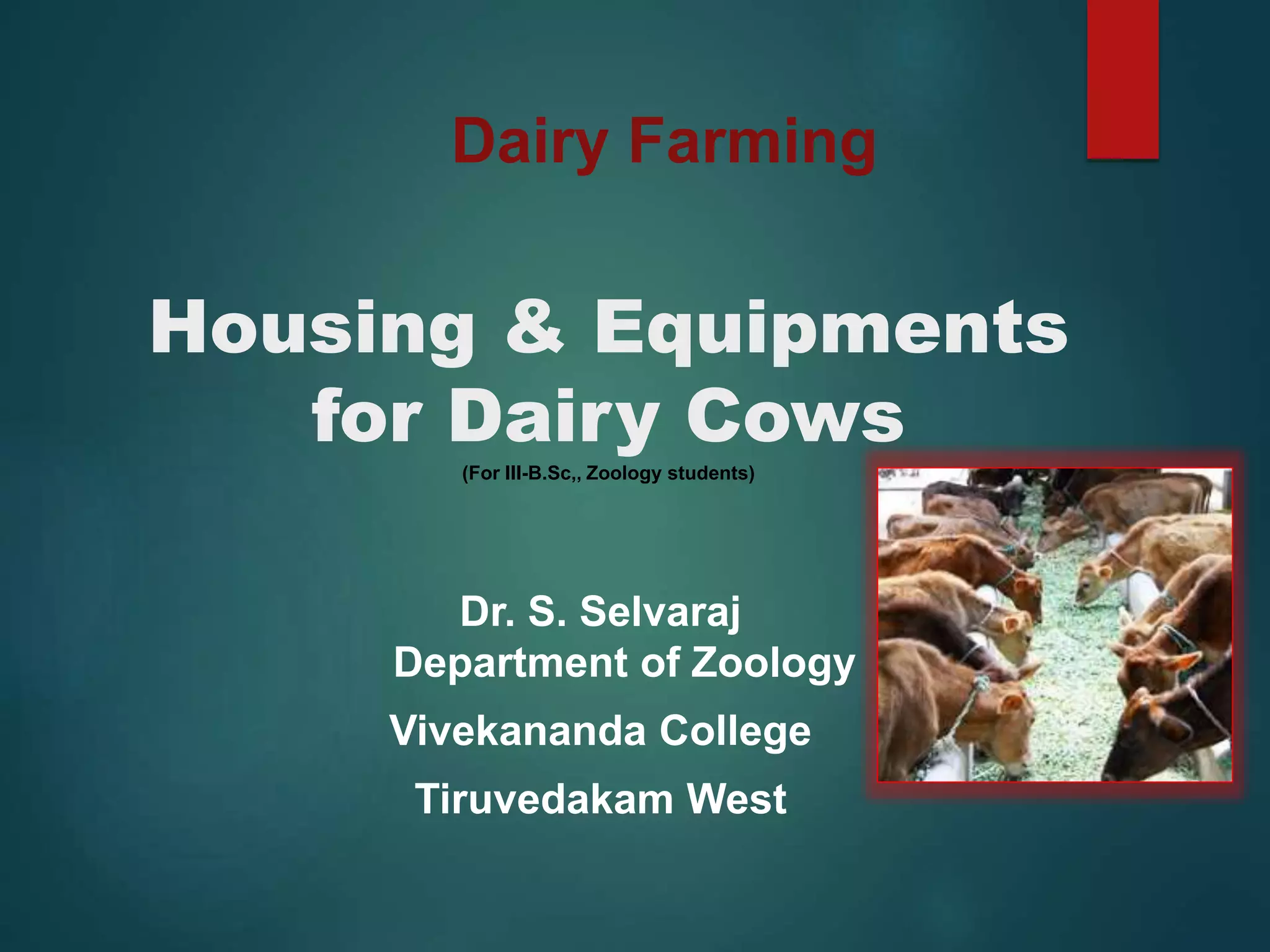


Housing & Equipments
for Dairy Cows
(For III-B.Sc,, Zoology students)
Dr. S. Selvaraj
Department of Zoology
Vivekananda College
Tiruvedakam West
Dairy Farming
Introduction
An efficient management of cattle will be incomplete without a
well-planned and adequate housing of cattle. Improper planning in the
arrangement of animal housing may result in additional labour charges
and that curtail the profit of the owner. During erection of a house for
dairy cattle, care should be taken to provide comfortable
accommodation for individual cattle. No less important is the proper
sanitation, durability and arrangements for the production of clean
milk under convenient and economic conditions, etc.
Location of dairy buildings
Topography and Drainage: A dairy building should be at a higher
elevation than the surrounding ground to offer a good slope for rainfall
and drainage for the wastes of the dairy to avoid stagnation within. A
leveled area requires less site preparation and thus lesser cost of
building. Low lands and depressions and proximity to places of bad
odor should be avoided.
Soil Type : Fertile soil should be spared for cultivation. Foundation soils
as far as possible should not be too dehydrated or desiccated. Such a soil is
susceptible to considerable swelling during rainy season and exhibit
numerous cracks and fissures.
Exposure to the sun and protection from wind: A dairy building should
be located to a maximum exposure to the sun in the north and minimum
exposure to the sun in the south and protection from prevailing strong
wind currents whether hot or cold. Buildings should be placed so that
direct sunlight can reach the platforms, gutters and mangers in the cattle
shed. As far as possible, the long axis of the dairy barns should be set in the
north-south direction to have the maximum benefit of the sun.
Accessibility : Easy accessibility to the buildings is always desirable.
Situation of a cattle shed by the side of the main road preferably at a
distance of about 100 meters should be aimed at.
Durability and attractiveness : It is always attractive when the buildings
open up to a scenic view and add to the grandeur of the scenery. Along
with this, durability of the structure is obviously an important criterion in
building dairy.
 Water supply : Abundant supply of fresh, clean and soft water should .be
available at a cheap rate.
 Surroundings: Areas infested with wild animals and dacoits should be
avoided. Narrow gates, high manger curbs, loose hinges, protruding nails,
smooth finished floor in the areas where the cows move and other such
hazards should be eliminated.
 Labour : Honest, economic and regular supply of labour is available.
 Marketing : Dairy buildings should only be in those areas from where the
owner can sell his products profitably and regularly. He should be in a
position to satisfy the needs of the farm within no time and at reasonable
price.
 Electricity: Electricity is the most important sanitary method of lighting a
dairy. Since a modem dairy always handles electric equipment’s which are
also economical, it is desirable to have an adequate supply of electricity.
1.Loose housing system 2. Conventional dairy barn.
1. Loose housing may be defined as a system where animals are kept loose
except milking and at the time of treatment. The system is most
economical. Some features of loose housing system are as follows.
 Cost of construction is significantly lower than conventional type.
 It is possible to make further expansion without change Facilitate easy
detection of animal in heat.
 Animals feel free and therefore, proves more profitable with even
minimum grazing.
 Animals get optimum excise which is extremely important for better
health production.
 Over all better management can be rendered.
2.Conventional Dairy Barn : The conventional dairy barns are
comparatively costly and are now becoming less popular day by day.
However, by this system cattle are more protected from adverse climatic
condition.
Types of Housing
 Dairy Stock in the Farm: 1.Cow houses or sheds 2.Calving box
3.Isolation box 4.Sheds for young stocks 5.Bull or bullock sheds
 Cow Sheds: Cow sheds can be arranged in a single row if the
numbers of cows are small. Say less than 10 or in a double row if the
herd is a large one. Ordinarily, not more than 80 to 100 cows should
be placed in one building. In double row housing, the stable should be
so arranged that the cows face out (tails to tail system) or face in
(head to head system) as preferred.
 Advantages of tail to tail system
Under the average conditions, 125 to 150 man hours of labour are
required per cow per year. Study of time:
 Time motion studies in dairies showed that 40% of the expended time
is spent in front of the cow, and 25% in other parts of the barn and
the milk house, and 60% of the time is spent behind the cows.
 Time spent at the back of the cows is 4 times more than the time spent
in front of them. In cleaning and milking the cows, the wide middle
alley is of great advantage.
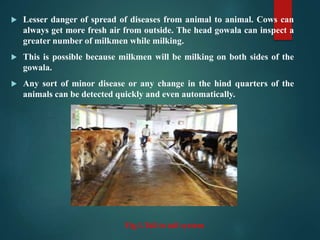
 Lesser danger of spread of diseases from animal to animal. Cows can
always get more fresh air from outside. The head gowala can inspect a
greater number of milkmen while milking.
 This is possible because milkmen will be milking on both sides of the
gowala.
 Any sort of minor disease or any change in the hind quarters of the
animals can be detected quickly and even automatically.
Fig.1.Tail to tail system
Advantages of face to face system
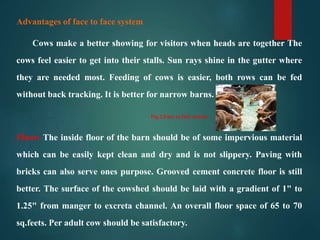
Cows make a better showing for visitors when heads are together The
cows feel easier to get into their stalls. Sun rays shine in the gutter where
they are needed most. Feeding of cows is easier, both rows can be fed
without back tracking. It is better for narrow barns.
Floor: The inside floor of the barn should be of some impervious material
which can be easily kept clean and dry and is not slippery. Paving with
bricks can also serve ones purpose. Grooved cement concrete floor is still
better. The surface of the cowshed should be laid with a gradient of 1" to
1.25" from manger to excreta channel. An overall floor space of 65 to 70
sq.feets. Per adult cow should be satisfactory.
Fig.2.Face to face system
Walls
The inside of the walls should have a smooth hard· finish of cement, which
will not allow any lodgment of dust and moisture. Comers should be round.
For plains, dwarf walls about 4 to 5 feet in height and roofs supported by
masonry work or iron pillars will be best or more suitable. The open space in
between supporting pillars will serve for light and air circulation.
Roof
Roof of the barn may be of asbestos sheet or tiles. Corrugated iron sheets
have the disadvantage of making extreme fluctuations in the inside
temperature of the barn in different seasons. However, iron sheets with
aluminum painted tops to reflect sun rays and bottoms provided with
wooden insulated ceilings can also achieve the objective. A height of 8 feet at
the sides and 15 feet at the ridge will be sufficient to give the necessary air
space to the cows. An adult cow requires at least about 800 cubic feet of air
space under tropical conditions. To make ventilation more effective a
continuous ridge ventilation is considered most desirable.
Manger
Cement concrete continuous manger with removable partitions is the
best from the point of view of durability and cleanliness. A height of 1'-4"
for a high front manger and 6" to 9" for a low front manger is considered
sufficient. Low front mangers are more comfortable for cattle but high
front mangers prevent feed wastage. The height at the back of the manger
should be kept at 2'-6" to 3". An overall width of 2' to 2.5' is sufficient for
a good manger.
Alleys
The central walk should have a width of 5'-6' exclusive of gutters
when cows face out, and 4'-5' when they face in. The feed alley, in case of a
face out system should be 4' wide, and the central walk should show a
slope of 1" from the center towards the two gutters running parallel to
each other, thus forming a crown at the center.
Manure Gutter
The manure gutter should be wide enough to hold all dung without
getting blocked, and be easy to clean/ Suitable dimensions are 2" width
with a cross-fall of 1" away from standing. The gutter should have a
gradient of 1" for every 10' length. This will permit a free flow of liquid
excreta.
Doors
The doors of a single range cowshed should be 5" wide with a height of
7', and for double row shed the width should not be less than 8" to 9'. All
doors of the barn should lie flat against the external wall when fully open.
Calving Boxes
 It leads to in sanitary in milk production and spread of disease like
contagious abortion in the herd. Special accommodation in the form of
loose-boxes enclosed from all sides with a door should be furnished to all
parturient cows. It should have an area of about 100 to 150 sq.ft. With
ample soft bedding, it should be provided with sufficient ventilation
through windows and ridge vent.
Isolation Boxes
 Animals suffering from infectious disease must be segregated soon from
the rest of the herd. Loose boxes of about 150 sq. feet. are very suitable
for this purpose. They sh9uld be situated at some distance from the
other barns. Every isolation box should be self-contained and should
have separate connection to the drainage disposal system.
Sheds For Young Stocks
 Calves should never be accommodated with adults in the cow shed.
 The calf house must have provision for daylight ventilation and proper
drainage.
 Damp and ill-drained floors cause respiratory trouble in calves to which
they are susceptible.
 For an efficient management and housing, the young stock should be
divided into three groups, viz., young calves aged tip to one year bull
calves, female calves.
 Each group should be sheltered in a separate calf house or calf shed. As
far as possible the shed for the young calves should be quite close to the
cow shed.
 Each calf shed should have an open paddock or exercise yard. An area of
100 square feet per head for a stock of 10 calves and an increase of 50
square feet for every additional calf will make a good paddock.
 It is useful to classify the calves below one year into three age groups,
viz., and calves below the age of 3 months, 3-6 months old calves and
those over 6 months for a better allocation of the resting area.
 An overall covered space of: 20-25 square feet per calf below the age of 3
months, 25 -30 square feet per calf from the age of 3-6 months, 30-40
square feet per calf from the age of 6-12 months and over, and 40-45
square feet for every calf above one year, should be made available for
the sheltering such climatic conditions.
 A suitable interior lay-out of a calf shed will be to arrange the standing
space along each side of a 4 feet wide central passage having a shallow
gutter along its length on both sides.
 Provision of water troughs inside each calf shed and exercise yard
should never be neglected.
Bull or Bullock Shed
 Safety and ease in handling a comfortable shed protection from
weather and a provision for exercise are the key points while
planning accommodation for bulls or bullocks.
 A bull should never be kept in confinement particularly on hard
floors. Such a confinement without adequate exercise leads to
overgrowth of the hoofs creating difficulty in mounting and loss in
the breeding power of the bull.
 A loose box with rough cement concrete floor about 15' by 10' in
dimensions having an adequate arrangement of light and ventilation
and an entrance 4' in width and 7' in height will make a comfortable
housing for a bull.
 The shed should have a manger and a water trough. If possible,
the arrangement should be such that water and feed can be
served without actually entering the bull house.
 The bull should have a free access to an exercise yard provided
with a strong fence or a boundary wall of about 2' in height, i.e.,
too high for the bull to jump over.
 From the bull yard, the bull should be able to view the other
animals of the herd so that it does not feel isolated.
 The exercise yard should also communicate with a service crate
via a swing gate which saves the use of an attendant to bring the
bull to the service crate.
Thank you

Housing & Equipments for dairy cows

  • 1.
    Housing & Equipments forDairy Cows (For III-B.Sc,, Zoology students) Dr. S. Selvaraj Department of Zoology Vivekananda College Tiruvedakam West Dairy Farming
  • 2.
    Introduction An efficient managementof cattle will be incomplete without a well-planned and adequate housing of cattle. Improper planning in the arrangement of animal housing may result in additional labour charges and that curtail the profit of the owner. During erection of a house for dairy cattle, care should be taken to provide comfortable accommodation for individual cattle. No less important is the proper sanitation, durability and arrangements for the production of clean milk under convenient and economic conditions, etc. Location of dairy buildings Topography and Drainage: A dairy building should be at a higher elevation than the surrounding ground to offer a good slope for rainfall and drainage for the wastes of the dairy to avoid stagnation within. A leveled area requires less site preparation and thus lesser cost of building. Low lands and depressions and proximity to places of bad odor should be avoided.
  • 3.
    Soil Type :Fertile soil should be spared for cultivation. Foundation soils as far as possible should not be too dehydrated or desiccated. Such a soil is susceptible to considerable swelling during rainy season and exhibit numerous cracks and fissures. Exposure to the sun and protection from wind: A dairy building should be located to a maximum exposure to the sun in the north and minimum exposure to the sun in the south and protection from prevailing strong wind currents whether hot or cold. Buildings should be placed so that direct sunlight can reach the platforms, gutters and mangers in the cattle shed. As far as possible, the long axis of the dairy barns should be set in the north-south direction to have the maximum benefit of the sun. Accessibility : Easy accessibility to the buildings is always desirable. Situation of a cattle shed by the side of the main road preferably at a distance of about 100 meters should be aimed at. Durability and attractiveness : It is always attractive when the buildings open up to a scenic view and add to the grandeur of the scenery. Along with this, durability of the structure is obviously an important criterion in building dairy.
  • 4.
     Water supply: Abundant supply of fresh, clean and soft water should .be available at a cheap rate.  Surroundings: Areas infested with wild animals and dacoits should be avoided. Narrow gates, high manger curbs, loose hinges, protruding nails, smooth finished floor in the areas where the cows move and other such hazards should be eliminated.  Labour : Honest, economic and regular supply of labour is available.  Marketing : Dairy buildings should only be in those areas from where the owner can sell his products profitably and regularly. He should be in a position to satisfy the needs of the farm within no time and at reasonable price.  Electricity: Electricity is the most important sanitary method of lighting a dairy. Since a modem dairy always handles electric equipment’s which are also economical, it is desirable to have an adequate supply of electricity.
  • 5.
    1.Loose housing system2. Conventional dairy barn. 1. Loose housing may be defined as a system where animals are kept loose except milking and at the time of treatment. The system is most economical. Some features of loose housing system are as follows.  Cost of construction is significantly lower than conventional type.  It is possible to make further expansion without change Facilitate easy detection of animal in heat.  Animals feel free and therefore, proves more profitable with even minimum grazing.  Animals get optimum excise which is extremely important for better health production.  Over all better management can be rendered. 2.Conventional Dairy Barn : The conventional dairy barns are comparatively costly and are now becoming less popular day by day. However, by this system cattle are more protected from adverse climatic condition. Types of Housing
  • 6.
     Dairy Stockin the Farm: 1.Cow houses or sheds 2.Calving box 3.Isolation box 4.Sheds for young stocks 5.Bull or bullock sheds  Cow Sheds: Cow sheds can be arranged in a single row if the numbers of cows are small. Say less than 10 or in a double row if the herd is a large one. Ordinarily, not more than 80 to 100 cows should be placed in one building. In double row housing, the stable should be so arranged that the cows face out (tails to tail system) or face in (head to head system) as preferred.  Advantages of tail to tail system Under the average conditions, 125 to 150 man hours of labour are required per cow per year. Study of time:  Time motion studies in dairies showed that 40% of the expended time is spent in front of the cow, and 25% in other parts of the barn and the milk house, and 60% of the time is spent behind the cows.  Time spent at the back of the cows is 4 times more than the time spent in front of them. In cleaning and milking the cows, the wide middle alley is of great advantage.
  • 7.
     Lesser dangerof spread of diseases from animal to animal. Cows can always get more fresh air from outside. The head gowala can inspect a greater number of milkmen while milking.  This is possible because milkmen will be milking on both sides of the gowala.  Any sort of minor disease or any change in the hind quarters of the animals can be detected quickly and even automatically. Fig.1.Tail to tail system
  • 8.
    Advantages of faceto face system Cows make a better showing for visitors when heads are together The cows feel easier to get into their stalls. Sun rays shine in the gutter where they are needed most. Feeding of cows is easier, both rows can be fed without back tracking. It is better for narrow barns. Floor: The inside floor of the barn should be of some impervious material which can be easily kept clean and dry and is not slippery. Paving with bricks can also serve ones purpose. Grooved cement concrete floor is still better. The surface of the cowshed should be laid with a gradient of 1" to 1.25" from manger to excreta channel. An overall floor space of 65 to 70 sq.feets. Per adult cow should be satisfactory. Fig.2.Face to face system
  • 9.
    Walls The inside ofthe walls should have a smooth hard· finish of cement, which will not allow any lodgment of dust and moisture. Comers should be round. For plains, dwarf walls about 4 to 5 feet in height and roofs supported by masonry work or iron pillars will be best or more suitable. The open space in between supporting pillars will serve for light and air circulation. Roof Roof of the barn may be of asbestos sheet or tiles. Corrugated iron sheets have the disadvantage of making extreme fluctuations in the inside temperature of the barn in different seasons. However, iron sheets with aluminum painted tops to reflect sun rays and bottoms provided with wooden insulated ceilings can also achieve the objective. A height of 8 feet at the sides and 15 feet at the ridge will be sufficient to give the necessary air space to the cows. An adult cow requires at least about 800 cubic feet of air space under tropical conditions. To make ventilation more effective a continuous ridge ventilation is considered most desirable.
  • 10.
    Manger Cement concrete continuousmanger with removable partitions is the best from the point of view of durability and cleanliness. A height of 1'-4" for a high front manger and 6" to 9" for a low front manger is considered sufficient. Low front mangers are more comfortable for cattle but high front mangers prevent feed wastage. The height at the back of the manger should be kept at 2'-6" to 3". An overall width of 2' to 2.5' is sufficient for a good manger. Alleys The central walk should have a width of 5'-6' exclusive of gutters when cows face out, and 4'-5' when they face in. The feed alley, in case of a face out system should be 4' wide, and the central walk should show a slope of 1" from the center towards the two gutters running parallel to each other, thus forming a crown at the center.
  • 11.
    Manure Gutter The manuregutter should be wide enough to hold all dung without getting blocked, and be easy to clean/ Suitable dimensions are 2" width with a cross-fall of 1" away from standing. The gutter should have a gradient of 1" for every 10' length. This will permit a free flow of liquid excreta. Doors The doors of a single range cowshed should be 5" wide with a height of 7', and for double row shed the width should not be less than 8" to 9'. All doors of the barn should lie flat against the external wall when fully open.
  • 12.
    Calving Boxes  Itleads to in sanitary in milk production and spread of disease like contagious abortion in the herd. Special accommodation in the form of loose-boxes enclosed from all sides with a door should be furnished to all parturient cows. It should have an area of about 100 to 150 sq.ft. With ample soft bedding, it should be provided with sufficient ventilation through windows and ridge vent. Isolation Boxes  Animals suffering from infectious disease must be segregated soon from the rest of the herd. Loose boxes of about 150 sq. feet. are very suitable for this purpose. They sh9uld be situated at some distance from the other barns. Every isolation box should be self-contained and should have separate connection to the drainage disposal system.
  • 13.
    Sheds For YoungStocks  Calves should never be accommodated with adults in the cow shed.  The calf house must have provision for daylight ventilation and proper drainage.  Damp and ill-drained floors cause respiratory trouble in calves to which they are susceptible.  For an efficient management and housing, the young stock should be divided into three groups, viz., young calves aged tip to one year bull calves, female calves.  Each group should be sheltered in a separate calf house or calf shed. As far as possible the shed for the young calves should be quite close to the cow shed.  Each calf shed should have an open paddock or exercise yard. An area of 100 square feet per head for a stock of 10 calves and an increase of 50 square feet for every additional calf will make a good paddock.
  • 14.
     It isuseful to classify the calves below one year into three age groups, viz., and calves below the age of 3 months, 3-6 months old calves and those over 6 months for a better allocation of the resting area.  An overall covered space of: 20-25 square feet per calf below the age of 3 months, 25 -30 square feet per calf from the age of 3-6 months, 30-40 square feet per calf from the age of 6-12 months and over, and 40-45 square feet for every calf above one year, should be made available for the sheltering such climatic conditions.  A suitable interior lay-out of a calf shed will be to arrange the standing space along each side of a 4 feet wide central passage having a shallow gutter along its length on both sides.  Provision of water troughs inside each calf shed and exercise yard should never be neglected.
  • 15.
    Bull or BullockShed  Safety and ease in handling a comfortable shed protection from weather and a provision for exercise are the key points while planning accommodation for bulls or bullocks.  A bull should never be kept in confinement particularly on hard floors. Such a confinement without adequate exercise leads to overgrowth of the hoofs creating difficulty in mounting and loss in the breeding power of the bull.  A loose box with rough cement concrete floor about 15' by 10' in dimensions having an adequate arrangement of light and ventilation and an entrance 4' in width and 7' in height will make a comfortable housing for a bull.
  • 16.
     The shedshould have a manger and a water trough. If possible, the arrangement should be such that water and feed can be served without actually entering the bull house.  The bull should have a free access to an exercise yard provided with a strong fence or a boundary wall of about 2' in height, i.e., too high for the bull to jump over.  From the bull yard, the bull should be able to view the other animals of the herd so that it does not feel isolated.  The exercise yard should also communicate with a service crate via a swing gate which saves the use of an attendant to bring the bull to the service crate.
  • 17.