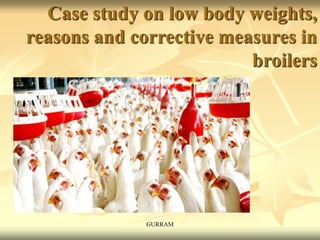















Case study on low body weights,
reasons and corrective measures in
broilers
GURRAM
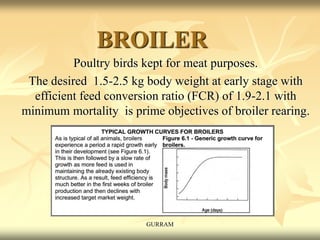
BROILER
Poultry birds kept for meat purposes.
The desired 1.5-2.5 kg body weight at early stage with
efficient feed conversion ratio (FCR) of 1.9-2.1 with
minimum mortality is prime objectives of broiler rearing.
GURRAM
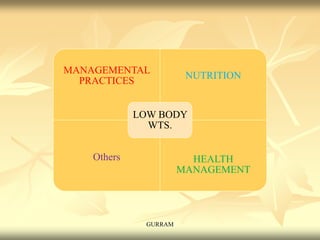
LOW
BODY WT.
MANAGEMENTAL
PRACTICES
NUTRITION
Others HEALTH
MANAGEMENT
LOW BODY
WTS.
GURRAM
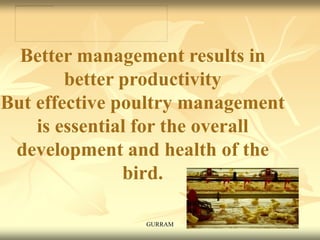
Better management results in
better productivity
But effective poultry management
is essential for the overall
development and health of the
bird.
GURRAM
Brooder Management
The overall broiler performance is dependent
on several management practices.
Brooder management is one of the important
aspects of broiler rearing and management.
The early / developmental stage becomes
critical for the overall result and growth of the
bird. Hence, care should be taken right from
day one.
GURRAM
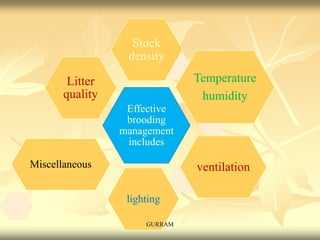
Effective
brooding
management
includes
Stock
density
Temperature
humidity
Miscellaneous ventilation
lighting
Litter
quality
GURRAM
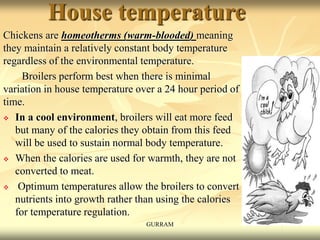
House temperature
Chickens are homeotherms (warm-blooded) meaning
they maintain a relatively constant body temperature
regardless of the environmental temperature.
Broilers perform best when there is minimal
variation in house temperature over a 24 hour period of
time.
 In a cool environment, broilers will eat more feed
but many of the calories they obtain from this feed
will be used to sustain normal body temperature.
 When the calories are used for warmth, they are not
converted to meat.
 Optimum temperatures allow the broilers to convert
nutrients into growth rather than using the calories
for temperature regulation.
GURRAM
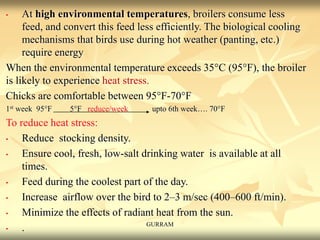
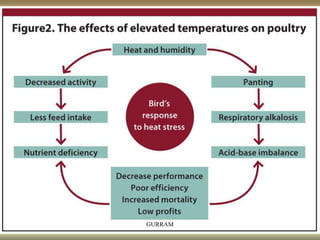
• At high environmental temperatures, broilers consume less
feed, and convert this feed less efficiently. The biological cooling
mechanisms that birds use during hot weather (panting, etc.)
require energy
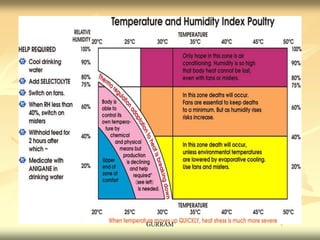
When the environmental temperature exceeds 35°C (95°F), the broiler
is likely to experience heat stress.
Chicks are comfortable between 95°F-70°F
1st week 95°F 5°F reduce/week upto 6th week…. 70°F
To reduce heat stress:
• Reduce stocking density.
• Ensure cool, fresh, low-salt drinking water is available at all
times.
• Feed during the coolest part of the day.
• Increase airflow over the bird to 2–3 m/sec (400–600 ft/min).
• Minimize the effects of radiant heat from the sun.
• . GURRAM
Chilling of chicks or low temperature
Causes :
• Paralysis of breathing apparatus
• Crowding or hurdling together of chicks lead to a condition called smothering
(difficulty in respiration)
• May cause diarrhea
• Makes chicks unthrifty
• Retards growth
• May even cause mortality
• Lethal internal body temp.of chicks at day old age 62°F
• Lethal internal body temp.of chicks at 2 weeks of age 65-67°F
• Lethal internal body temp.of chicks at maturity 73°F
• If temperature is high ,the chicks move away from heat sources, they by chicks
may not die. however, if they are confined very close to heat sources they may
die.
• High lethal body temperature for chicks is 117°F
GURRAM
GURRAM
Humidity
Both high and low humidity are undesirable.
Optimum humidity of 50-60% may be suitable
High Humidity leads to
• Wet litter condition
• Certain diseases like parasitic,coccidiosis..
Low humidity leads to
• Very dried up atm.can be observed in the brooder
results dusty litter- respiratory disease.
• Poor feathering
GURRAM
GURRAM
GURRAM
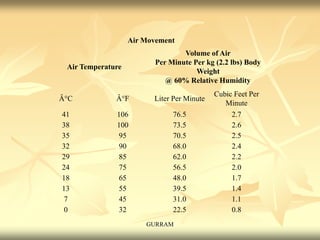
Ventilation
Ventilation is required for maintain fresh/ good air quality for
poultry and appropriate moisture for healthy environment.
Air exchange is necessary to remove CO2,ammonia from poultry
houses and to bring O2.
A con.of 0.01% of CO in air can initiate slow process of
poisioning
Because of ill ventilation Ammonical fumes are produced
which are irritating to chicks.
Types : natural or open house
Mechanical/Tunnel Ventilations
GURRAM
Air Movement
Air Temperature
Volume of Air
Per Minute Per kg (2.2 lbs) Body
Weight
@ 60% Relative Humidity
°C °F Liter Per Minute
Cubic Feet Per
Minute
41 106 76.5 2.7
38 100 73.5 2.6
35 95 70.5 2.5
32 90 68.0 2.4
29 85 62.0 2.2
24 75 56.5 2.0
18 65 48.0 1.7
13 55 39.5 1.4
7 45 31.0 1.1
0 32 22.5 0.8
GURRAM
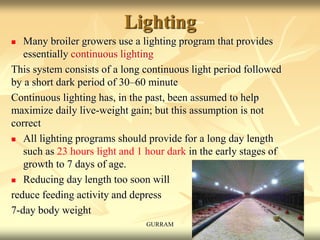
Lighting
 Many broiler growers use a lighting program that provides
essentially continuous lighting
This system consists of a long continuous light period followed
by a short dark period of 30–60 minute
Continuous lighting has, in the past, been assumed to help
maximize daily live-weight gain; but this assumption is not
correct
 All lighting programs should provide for a long day length
such as 23 hours light and 1 hour dark in the early stages of
growth to 7 days of age.
 Reducing day length too soon will
reduce feeding activity and depress
7-day body weight
GURRAM
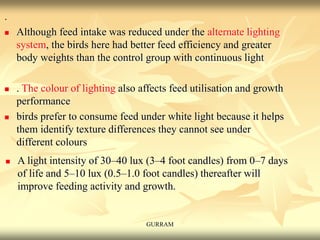
.
 Although feed intake was reduced under the alternate lighting
system, the birds here had better feed efficiency and greater
body weights than the control group with continuous light
 . The colour of lighting also affects feed utilisation and growth
performance
 birds prefer to consume feed under white light because it helps
them identify texture differences they cannot see under
different colours
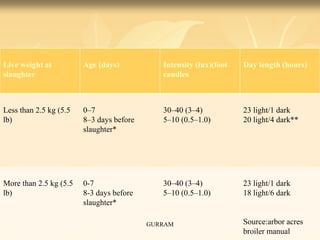
 A light intensity of 30–40 lux (3–4 foot candles) from 0–7 days
of life and 5–10 lux (0.5–1.0 foot candles) thereafter will
improve feeding activity and growth.
GURRAM
Live weight at
slaughter
Age (days) Intensity (lux)(foot
candles
Day length (hours)
Less than 2.5 kg (5.5
lb)
0–7
8–3 days before
slaughter*
30–40 (3–4)
5–10 (0.5–1.0)
23 light/1 dark
20 light/4 dark**
More than 2.5 kg (5.5
lb)
0-7
8-3 days before
slaughter*
30–40 (3–4)
5–10 (0.5–1.0)
23 light/1 dark
18 light/6 dark
Source:arbor acres
broiler manual
GURRAM
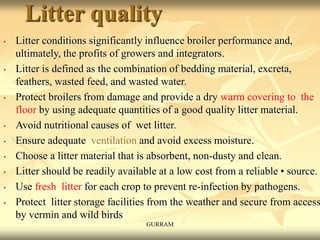
Litter quality
• Litter conditions significantly influence broiler performance and,
ultimately, the profits of growers and integrators.
• Litter is defined as the combination of bedding material, excreta,
feathers, wasted feed, and wasted water.
• Protect broilers from damage and provide a dry warm covering to the
floor by using adequate quantities of a good quality litter material.
• Avoid nutritional causes of wet litter.
• Ensure adequate ventilation and avoid excess moisture.
• Choose a litter material that is absorbent, non-dusty and clean.
• Litter should be readily available at a low cost from a reliable • source.
• Use fresh litter for each crop to prevent re-infection by pathogens.
• Protect litter storage facilities from the weather and secure from access
by vermin and wild birds
GURRAM
GURRAM
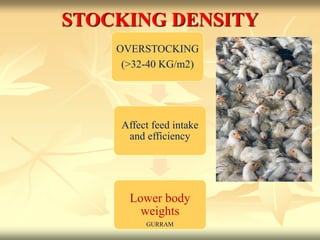
STOCKING DENSITY
OVERSTOCKING
(>32-40 KG/m2)
Affect feed intake
and efficiency
Lower body
weights
GURRAM
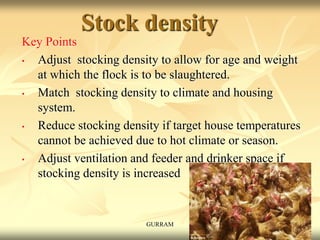
Stock density
Key Points
• Adjust stocking density to allow for age and weight
at which the flock is to be slaughtered.
• Match stocking density to climate and housing
system.
• Reduce stocking density if target house temperatures
cannot be achieved due to hot climate or season.
• Adjust ventilation and feeder and drinker space if
stocking density is increased
GURRAM
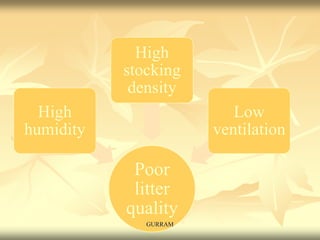
Poor
litter
quality
High
humidity
High
stocking
density
Low
ventilation
GURRAM
Floor space
Should be increased with age of chicks
 0-4 weeks …..0.5 sq.ft/chick
 5-8 weeks……1 sq.ft /chick
 Hover space ..7-10 sq.cm
GURRAM
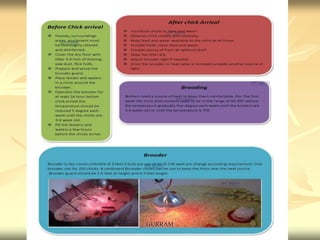
Key points in brooding management are:
 Clean, disinfect and fumigate the shed and equipment well
before the arrival of the chicks
 Check for the right temperature and humidity levels 24
hours prior to the arrival of the birds
 Ensure chicks have immediate access to fresh water and
feed
 Use chick behavior as an indicator of satisfactory
temperature levels
 Replenish feed constantly during the brooding period
 Monitor and ensure chicks feeding by crop fill scores
GURRAM
These activities when followed collectively will
result in good early development of
 skeletal size,
 immune system and
 cardiovascular system and also
 improves appetite.
GURRAM
GROWER AND FINISHER
MANAGEMENT
The grower stage is between the 14th and 28th
day of the birds life cycle. During this stage, the
management objectives are to help the birds
develop their immune system, uniform growth,
sexual maturity and production. The important
functions of this stage is grading of the birds on
the basis of their weight, check and maintain body
weight on a weekly basis, feed and water
management and vaccination. The birds above
28th day of age till lifting are termed finisher
GURRAM
NUITRIENT REQUIREMENTS
FOR MAINTENANCE AND
PRODUCTION IN BROILERS
&
VARIOUS FACTORS AFFECTING
NUTRIENT REQUIREMENTS
AND PRODUCTION IN
BROILERS
GURRAM
. NUTRIENT REQUIREMENTS
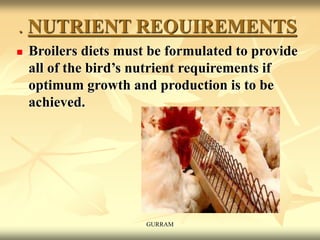
 Broilers diets must be formulated to provide
all of the bird’s nutrient requirements if
optimum growth and production is to be
achieved.
GURRAM
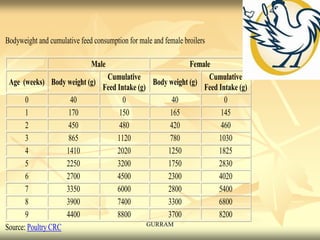
Bodyweight and cumulative feed consumption for male and female broilers
Male Female
Age (weeks) Body weight (g)
Cumulative
Feed Intake (g)
Body weight (g)
Cumulative
Feed Intake (g)
0 40 0 40 0
1 170 150 165 145
2 450 480 420 460
3 865 1120 780 1030
4 1410 2020 1250 1825
5 2250 3200 1750 2830
6 2700 4500 2300 4020
7 3350 6000 2800 5400
8 3900 7400 3300 6800
9 4400 8800 3700 8200
Source: Poultry CRC GURRAM
Classes of Nutrients
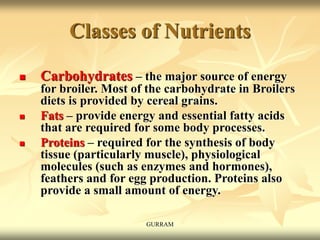
 Carbohydrates – the major source of energy
for broiler. Most of the carbohydrate in Broilers
diets is provided by cereal grains.
 Fats – provide energy and essential fatty acids
that are required for some body processes.
 Proteins – required for the synthesis of body
tissue (particularly muscle), physiological
molecules (such as enzymes and hormones),
feathers and for egg production. Proteins also
provide a small amount of energy.
GURRAM
Classes of Nutrients
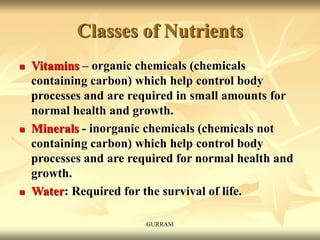
 Vitamins – organic chemicals (chemicals
containing carbon) which help control body
processes and are required in small amounts for
normal health and growth.
 Minerals - inorganic chemicals (chemicals not
containing carbon) which help control body
processes and are required for normal health and
growth.
 Water: Required for the survival of life.
GURRAM
Water
Water is of vital importance and is
considered an essential nutrient. Water
deprivation for ≥12 hr has an adverse
effect on growth of young poultry; water
deprivation for ≥36 hr results in a marked
increase in mortality of both young and
mature poultry. Cool, clean water must be
available at all times.
GURRAM
Protein and Amino acids
 Poultry can synthesize glycine but often not in
sufficient amounts. Cystine and tyrosine are
considered essential even though they can be
synthesized from methionine and
phenylalanine, respectively.
 In practical feed formulation, Methionine can
spare choline as a methyl donor, and
tryptophan can be used to synthesize niacin.
These relationships are important because the
2 vitamins can be supplied in diets more
economically than the 2 amino acids.
GURRAM
Vitamins
 One IU of Vitamin A activity is equivalent to
1.3 µg of pure retinol. However, young chicks
are not efficient in using β-carotene.
 Requirements for Vitamin D are expressed in
IU. Birds use vitamin D3 from fish oils and
irradiated animal sterols quite effectively but
cannot use vitamin D2 . Metabolic forms of
vitamin D have been isolated and synthesized;
these are 25-hydroxy vitamin D3, which is
synthesized in the liver, and 1,25-dihydroxy
vitamin D3, which is synthesized in the
kidneys. GURRAM
Vitamin
 Choline is required as an integral part of the
body phospholipid, as a part of acetylcholine,
and as a source of methyl groups. Growing
chickens can use betaine as a methylating
agent, but betaine cannot replace choline in
preventing perosis. Betaine is widely
distributed in practical feedstuffs and may be
important in sparing choline. Adequate dietary
vitamin B12 helps pullets develop the ability
to biosynthesize choline. The choline
requirement values apply to diets containing
the specified levels of vitamin B12.
GURRAM
Minerals
 Ca,P,Mg,K,Na,Cl,S
 Mn,Fe,Cu,Zn,Co,Se.
GURRAM
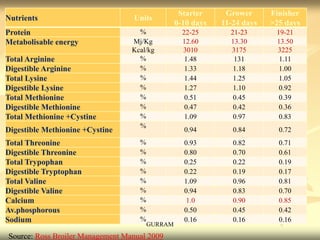
Nutrients Units
Starter
0-10 days
Grower
11-24 days
Finisher
>25 days
Protein % 22-25 21-23 19-21
Metabolisable energy Mj/Kg 12.60 13.30 13.50
Kcal/kg 3010 3175 3225
Total Arginine % 1.48 131 1.11
Digestible Arginine % 1.33 1.18 1.00
Total Lysine % 1.44 1.25 1.05
Digestible Lysine % 1.27 1.10 0.92
Total Methionine % 0.51 0.45 0.39
Digestible Methionine % 0.47 0.42 0.36
Total Methionine +Cystine % 1.09 0.97 0.83
Digestible Methionine +Cystine
%
0.94 0.84 0.72
Total Threonine % 0.93 0.82 0.71
Digestible Threonine % 0.80 0.70 0.61
Total Trypophan % 0.25 0.22 0.19
Digestible Tryptophan % 0.22 0.19 0.17
Total Valine % 1.09 0.96 0.81
Digestible Valine % 0.94 0.83 0.70
Calcium % 1.0 0.90 0.85
Av.phosphorous % 0.50 0.45 0.42
Sodium % 0.16 0.16 0.16
Source: Ross Broiler Management Manual 2009
GURRAM
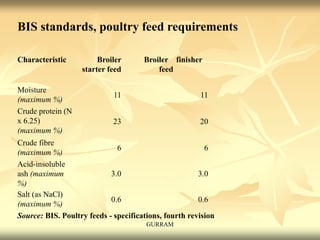
BIS standards, poultry feed requirements
Characteristic Broiler
starter feed
Broiler finisher
feed
Moisture
(maximum %)
11 11
Crude protein (N
x 6.25)
(maximum %)
23 20
Crude fibre
(maximum %)
6 6
Acid-insoluble
ash (maximum
%)
3.0 3.0
Salt (as NaCl)
(maximum %)
0.6 0.6
Source: BIS. Poultry feeds - specifications, fourth revision
GURRAM
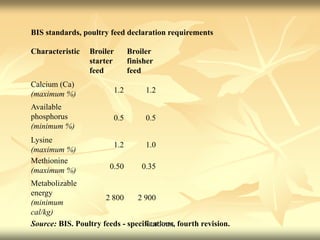
BIS standards, poultry feed declaration requirements
Characteristic Broiler
starter
feed
Broiler
finisher
feed
Calcium (Ca)
(maximum %) 1.2 1.2
Available
phosphorus
(minimum %)
0.5 0.5
Lysine
(maximum %)
1.2 1.0
Methionine
(maximum %) 0.50 0.35
Metabolizable
energy
(minimum
cal/kg)
2 800 2 900
Source: BIS. Poultry feeds - specifications, fourth revision.
GURRAM
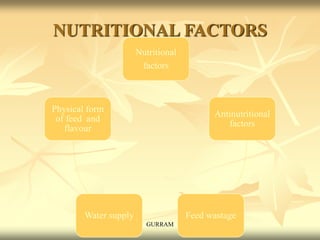
NUTRITIONAL FACTORS
Nutritional
factors
Antinutritional
factors
Feed wastage
Water supply
Physical form
of feed and
flavour
GURRAM
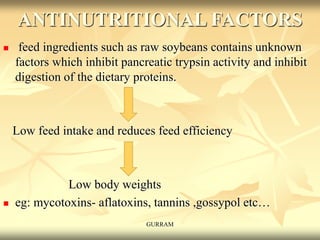
ANTINUTRITIONAL FACTORS
 feed ingredients such as raw soybeans contains unknown
factors which inhibit pancreatic trypsin activity and inhibit
digestion of the dietary proteins.
Low feed intake and reduces feed efficiency
Low body weights
 eg: mycotoxins- aflatoxins, tannins ,gossypol etc…
GURRAM
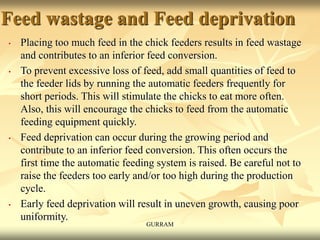
Feed wastage and Feed deprivation
• Placing too much feed in the chick feeders results in feed wastage
and contributes to an inferior feed conversion.
• To prevent excessive loss of feed, add small quantities of feed to
the feeder lids by running the automatic feeders frequently for
short periods. This will stimulate the chicks to eat more often.
Also, this will encourage the chicks to feed from the automatic
feeding equipment quickly.
• Feed deprivation can occur during the growing period and
contribute to an inferior feed conversion. This often occurs the
first time the automatic feeding system is raised. Be careful not to
raise the feeders too early and/or too high during the production
cycle.
• Early feed deprivation will result in uneven growth, causing poor
uniformity.
GURRAM
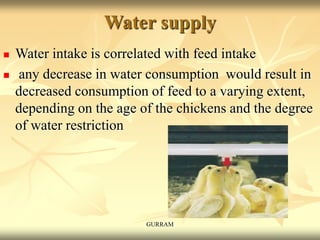
Water supply
 Water intake is correlated with feed intake
 any decrease in water consumption would result in
decreased consumption of feed to a varying extent,
depending on the age of the chickens and the degree
of water restriction
GURRAM
FACTORS AFFECTING THE
NUTRIENT REQUIREMENTS OF
BROILERS
 Genetics
 Age
 Sex
 Productive state
 Ambient temperature
 Housing systems
 Health status
 Production aims. GURRAM
Factors Affecting Nutrient
Requirements
Sex
 Prior to sexual maturity the sexes have only small
differences in their nutrient requirements and males
and females can usually be fed the same
“compromise” diet to achieve acceptable growth
rates. Differences in nutrient requirements are larger
following the onset of sexual maturity and
significantly different diet formulations are then
required for each sex.
Reproductive state
 The level of reproductivity in broiler breeders and
sexual activity in males will affect nutrient
requirements. GURRAM
Factors Affecting Nutrient
Requirements
Ambient temperature
 Poultry have increased energy requirements to maintain
normal body temperature in cold ambient temperatures and the
opposite in hot ambient temperatures. The process of digestion
of food produces body heat and the amount of heat produced
will vary according to the nutrient composition of the diet.
This is called the heat increment of the diet. In cold
temperatures it may be desirable to formulate a diet with a
higher heat increment and the opposite in hot temperatures.
Housing system
 The type of housing system will influence the level of activity
of the birds and therefore their energy requirements.
GURRAM
Factors Affecting Nutrient
Requirements
Health status
 Birds experiencing a disease challenge may benefit
from an increase in the intake of some nutrients, most
commonly vitamins.
Production aims
 Optimal nutrient composition of the diet will vary
according to production aims, such as optimising
weight gain or carcass composition, egg numbers or
egg size. Poultry that are raised for breeding purposes
may need to have their energy intake restricted to
ensure that they do not become obese.
GURRAM
Physical form of feed and flavour
• Feeds that has been ground too fine can greatly reduce
consumption
• In hot climate a correct particle size (0.5 to 3.2 mm) will
help to reduce the underfeeding
• Pelleted feed better than mash feed.
• Certain natural feedstuffs are relatively unsuitable for
chickens because they are not palatable. For example,
chickens tend to
• avoid diets high in barley, rye or buckwheat in
comparison with similar diets containing yellow corn.
GURRAM
Monitoring live wt and uniformity of
performance
 Key Points
 Birds in more uniform flocks will be more likely to
meet the required target live weight.
 Variability in performance increases the flock CV%,
which influences both flock profitability and
processing plant efficiency.
 Minimize flock variability by monitoring and
managing flock uniformity.
 Uniform flocks (low CV %) are more predictable in
performance than uneven flocks
GURRAM
Health
 Bird health is of extreme importance in broiler
production
 Poor chick health will have a negative impact on all
aspects of production and flock management
including growth rate, feed conversion efficiency,
condemnations, livability, and processing traits
 The general health of a flock influences feed
conversions. Sick broilers do not perform well.
GURRAM
• Obviously an unhealthy broiler is likely to have poor feed
efficiency. The main reason for this is that feed intake is reduced,
and so again proportionally more feed is directed towards
maintenance.
• With enteric diseases there can be more subtle changes in feed
utilization because various parasites and microbes can reduce the
efficiency of digestion and absorption of nutrients.
• A broiler with sub-clinical coccidiosis is not likely to absorb
nutrients with optimum efficiency, because the oocytes will destroy
some of the cells lining the cut.
• More recently the phenomenon of so-called ‘feed-passage’ has
been observed in broilers. Undigested feed particles are seen in the
excreta, and so consequently feed efficiency will be affected.
• The exact cause of this problem is unknown, but is most likely the
consequences of a microbial challenge
GURRAM
GURRAM
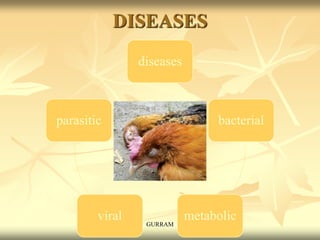
DISEASES
diseases
bacterial
metabolic
viral
parasitic
GURRAM
GURRAM
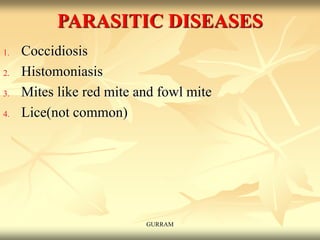
PARASITIC DISEASES
1. Coccidiosis
2. Histomoniasis
3. Mites like red mite and fowl mite
4. Lice(not common)
GURRAM
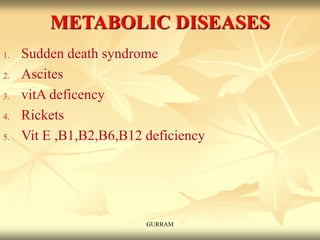
METABOLIC DISEASES
1. Sudden death syndrome
2. Ascites
3. vitA deficency
4. Rickets
5. Vit E ,B1,B2,B6,B12 deficiency
GURRAM
VIRAL DISEASES
1. Newcastle disease
2. Avian influenza
3. IB virus
4. ILT
GURRAM
BACTERIAL DISEASES
1. Fowl typhoid
2. Pullorum
3. Mycoplasmosis
4. colibacillosis
GURRAM
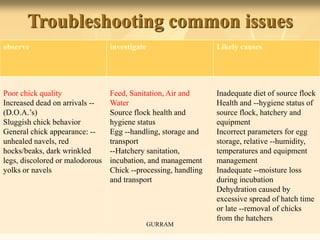
Troubleshooting common issues
observe investigate Likely causes
Poor chick quality
Increased dead on arrivals --
(D.O.A.’s)
Sluggish chick behavior
General chick appearance: --
unhealed navels, red
hocks/beaks, dark wrinkled
legs, discolored or malodorous
yolks or navels
Feed, Sanitation, Air and
Water
Source flock health and
hygiene status
Egg --handling, storage and
transport
--Hatchery sanitation,
incubation, and management
Chick --processing, handling
and transport
Inadequate diet of source flock
Health and --hygiene status of
source flock, hatchery and
equipment
Incorrect parameters for egg
storage, relative --humidity,
temperatures and equipment
management
Inadequate --moisture loss
during incubation
Dehydration caused by
excessive spread of hatch time
or late --removal of chicks
from the hatchers
GURRAM
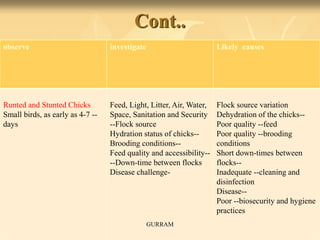
Cont..
observe investigate Likely causes
Runted and Stunted Chicks
Small birds, as early as 4-7 --
days
Feed, Light, Litter, Air, Water,
Space, Sanitation and Security
--Flock source
Hydration status of chicks--
Brooding conditions--
Feed quality and accessibility--
--Down-time between flocks
Disease challenge-
Flock source variation
Dehydration of the chicks--
Poor quality --feed
Poor quality --brooding
conditions
Short down-times between
flocks--
Inadequate --cleaning and
disinfection
Disease--
Poor --biosecurity and hygiene
practices
GURRAM
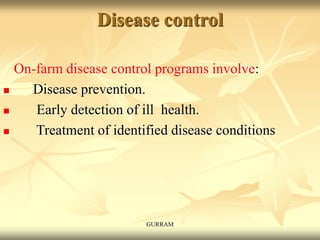
Disease control
On-farm disease control programs involve:
 Disease prevention.
 Early detection of ill health.
 Treatment of identified disease conditions
GURRAM
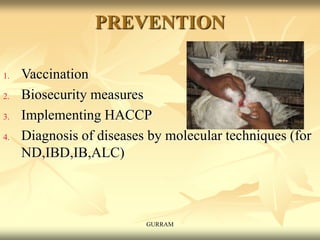
PREVENTION
1. Vaccination
2. Biosecurity measures
3. Implementing HACCP
4. Diagnosis of diseases by molecular techniques (for
ND,IBD,IB,ALC)
GURRAM
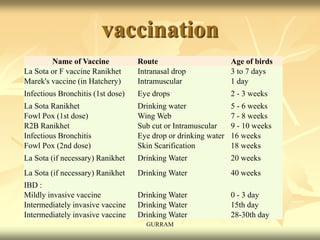
vaccination
Name of Vaccine Route Age of birds
La Sota or F vaccine Ranikhet Intranasal drop 3 to 7 days
Marek's vaccine (in Hatchery) Intramuscular 1 day
Infectious Bronchitis (1st dose) Eye drops 2 - 3 weeks
La Sota Ranikhet Drinking water 5 - 6 weeks
Fowl Pox (1st dose) Wing Web 7 - 8 weeks
R2B Ranikhet Sub cut or Intramuscular 9 - 10 weeks
Infectious Bronchitis Eye drop or drinking water 16 weeks
Fowl Pox (2nd dose) Skin Scarification 18 weeks
La Sota (if necessary) Ranikhet Drinking Water 20 weeks
La Sota (if necessary) Ranikhet Drinking Water 40 weeks
IBD :
Mildly invasive vaccine Drinking Water 0 - 3 day
Intermediately invasive vaccine Drinking Water 15th day
Intermediately invasive vaccine Drinking Water 28-30th day
GURRAM
GURRAM
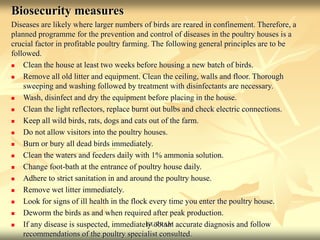
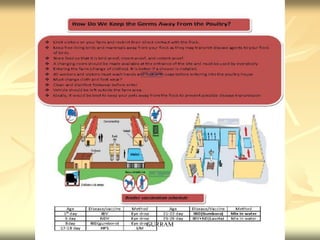
Biosecurity measures
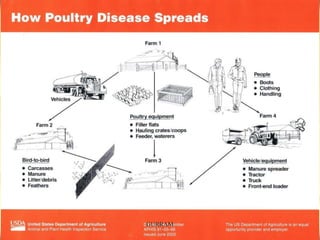
Diseases are likely where larger numbers of birds are reared in confinement. Therefore, a
planned programme for the prevention and control of diseases in the poultry houses is a
crucial factor in profitable poultry farming. The following general principles are to be
followed.
 Clean the house at least two weeks before housing a new batch of birds.
 Remove all old litter and equipment. Clean the ceiling, walls and floor. Thorough
sweeping and washing followed by treatment with disinfectants are necessary.
 Wash, disinfect and dry the equipment before placing in the house.
 Clean the light reflectors, replace burnt out bulbs and check electric connections.
 Keep all wild birds, rats, dogs and cats out of the farm.
 Do not allow visitors into the poultry houses.
 Burn or bury all dead birds immediately.
 Clean the waters and feeders daily with 1% ammonia solution.
 Change foot-bath at the entrance of poultry house daily.
 Adhere to strict sanitation in and around the poultry house.
 Remove wet litter immediately.
 Look for signs of ill health in the flock every time you enter the poultry house.
 Deworm the birds as and when required after peak production.
 If any disease is suspected, immediately obtain accurate diagnosis and follow
recommendations of the poultry specialist consulted.
GURRAM
GURRAM
Disinfectants and their use
1.Lysol: Used as a 1-2% solution. Effective general
disinfectant, suitable for instrument; poultry equipments,
foot-bath etc;
2.Lime (CaOH powder): An inexpensive general
disinfectant can be used as a white wash to walls. 2-5%
solution will destroy most pathogenic organisms and
their spores. Highly corrosive to skin.
3.Bleaching powder: May be used as floor disinfectant
in empty houses.
4.Phenols (Cresol): Less toxic but costly. Usually used
as a 2-4% solution for disinfecting poultry houses and
equipments.
GURRAM
Other factors
Body Factors
• A number of body factors have been shown to be closely correlated
with feed intake (R2 value ranging from 0.7 to 0.9),
• Taste buds- Despite the fewer taste buds present in chickens relative
to the mammalian species, the response of these buds to feed
• ingredients of low-palatability may vary among different lines, with a
resulting differences in feed intake
• This aspect is genetically-medicated and could be used for control of
feed intake through selection among chicken lines
GURRAM
Genes and hormones- The increased amount of leptin, a
gene product originally produced in the adipose tissues,
helps regulate appetite through its action at specific
hypothalamic sites.
Similar action has been noted with some thyroid hormones
such as T3. The increased amount of T3 circulating in the
blood stream is often associated with increased intake, as
evidenced by the low T3 level at fasting.
GURRAM
Feather cover
Some hens lose their feathers over large parts of their body due to
feather pecking, poor beak trimming, abrasion, and/or moulting.
As a result, there is a decline in their natural heat insulation and
increase in heat loss from the bird.
This aspect is more pronounced with poor feather cover on the neck
and back, since these parts are more exposed to the environment
compared to the breast or the legs.
In this case, there is an increase in feed intake to compensate for the
amount of feed energy lost as heat, coupled with low egg production
and poor feed efficiency, expressed as the amount of feed per dozen
of eggs (Table 7). This is particularly true in cases where chickens are
exposed to temperatures below 20ºC for 50% of the time they are
housed.
.
GURRAM
To avoid these problems, it is
important to keep birds warm in
winter and not to emphasise only on
keeping them cool in summer. For
this to be valid, the heating cost
should first be balanced out against
the expected increase in feed because
of the poor feather cover
GURRAM
Human factors
• In this study, the behavioral response of broilers to
humans was used in the study as a measure of broilers’
fear of humans.
• A significant positive correction was observed between
speed of movement and first week mortality, which
would appear to be mediated by broiler fear levels.
• This would indicate that very young broilers may be
susceptible to stressors such as the stockperson’s speed
of movement.
• However, this susceptibility may be reduced as the
broilers grow and become habituated to stockperson
behavior.
GURRAM
References
 Scientific poultry production – P.V.Sreenivasaiah.
 Arbour acres broiler management guide 2009
 Poultry
vet.com(http://www.worldpoultry.net/Broilers/Nutrit
ion/2013/3/Factors-affecting-feed-intake-of-
chickens-1172230W/)
 http://www.growelagrovet.com
 Suguna broiler management.
 UK Ag-Kentucky foundation chapter 6.
GURRAM
GURRAM
GURRAM
GURRAM
GURRAM
GURRAM
GURRAM
FACTORS AFFECTING THE
NUTRIENT REQUIREMENTS OF
BROILERS
 Genetics
 Age
 Sex
 Productive state
 Ambient temperature
 Housing systems
 Health status
 Production aims. GURRAM
Factors Affecting Nutrient
Requirements
Genetics
 Different species, breeds or strains of bird have different
average body sizes, growth rates and production levels and
will also absorb and utilise nutrients from feed with different
levels of efficiency, leading to different nutrient requirements.
As the genetics of commercial poultry is constantly changing
so are their nutrient requirements. Consequently, breeders of
commercial poultry provide information on the specific
nutrient requirements for the birds they sell.
Age
 Nutrient requirements are related to both body weight and the
stage of maturity.
GURRAM
BROILER HOUSING
 Site selection
 Barn construction
 Manure System
 Heating System
 Ventilation System
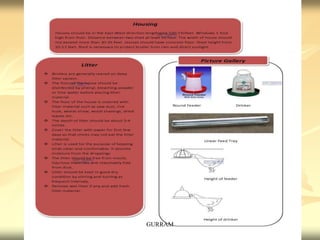
 Feeding and Watering System
GURRAM
Site Selection
 Regardless of the type of commercial poultry production being
considered, a relatively large building site is a key
requirement. Future expansion should always be considered.
 The proposed building site should be reasonably level to
accommodate manure handling, and load out. Good drainge
away from the building is also required. Depending on the
number of barns and the desired layout, space must be
provided in the poultry yard for manure storage and between
the barns for proper ventilation, fire safety and snow and wind
control. A distance of 15 to 30 m (50 to 100 ft) is usually
adequate and still practicle.
 A good water source that has both asequate quantity and
quality is another criticle factor to consider in selecting a
building site. A well should have a capacity of 1 to 1 ½ gallons
per minute per 10,000 birds and have total dissolved solids of
less than 2500 ppm. Nitrate and nitrites should be less than
100 ppm and alkalininty should be less than 1000 ppm.
GURRAM
BARN CONSTRUCTION
 Broiler barns are single or multi-storey barns constructed by
either the pole-frame or stud wall method. Today the most
common types being constructed are two storey frame and
single storey stud frame. Both balloon and platform framing
methods are used for two storey construction.
 Two or three storey barns are popular because of lower
construction costs and heat savings. Barn construction costs
can be reduced by about 15% per floor if a multi-storey barn is
built, and energy costs can be reduced as much as 20% to 50%
depending on the age of the broilers. Most barns are 10.9 to
12.2 m (36 to 40 ft.) in width but some are 17 to 18.3 m (56 to
60 ft.) wide.
GURRAM
HEATING SYSTEMS
 Heat in the broiler house comes from three different sources:
from the birds themselves; from the heating sytem; and from
lights, motors and solar heat. Broilers produce a significant
amount of their own heat in the form of sensible heat that is
useful in helping to maintain barn temperature in cooler
weather.
 The heating system used in most broiler barns is a hot water
broiler and 50 mm (2 in.) black iron pipes which serve as the
heat radiators. Water temeperatures of 93 to 98 C (200 to 208
F) produce approximately 200 watts/m of pipe. The pipes are
usually hung on one wall, running the length of the barn at
about 200 to 300 mm oc.
GURRAM
VENTILATION SYSTEMS
 Ventilation confinement rearing places the
responsibility on the operator of providing his
birds with a satisfactory air environment,
ideally within their “comfort zone”. This zone
is dependant on the age and weight of the birds
and is achieved by the proper temperature,
relative humidity, better moisture and air
speeds for that group of birds.
GURRAM
FEEDING AND WATERING
SYSTEMS
 The usual feeding system used for broilers is the suspended automatic
chain and trough feeder or the suspended automatic chain and pan feeder
system. These systems normally make a complete circuit within the broiler
barn, ensuring that enough feeder space is available if the birds are on ftAl
feed. If a restricted feeding program is used, additional feeder space has to
be provided.
 Waterers are usually the hanging automatic bell type or the newer nipple
style drinkers. The automatic trough type and the hanging water cups are
also available for floor or cage reared broilers. An ample, clean source of
water is required. Birds have no stomach so their water retaining capacity is
very low. They must drink freely and often as they require 0.9 to 1.4
kilograms (2 to 3 Ibs) of water to efficiently utilize 0.45 kilograms (1 lb) of
feed. The water source should be low in minerals and particularly low in
salt as excess salt leads to watery droppings and consequently wet litter.
GURRAM
THANKS
GURRAM

Case study on low body weights, reasons and corrective measures in broilers.ppt

  • 1.
    Case study onlow body weights, reasons and corrective measures in broilers GURRAM
  • 2.
    BROILER Poultry birds keptfor meat purposes. The desired 1.5-2.5 kg body weight at early stage with efficient feed conversion ratio (FCR) of 1.9-2.1 with minimum mortality is prime objectives of broiler rearing. GURRAM
  • 3.
  • 4.
    Better management resultsin better productivity But effective poultry management is essential for the overall development and health of the bird. GURRAM
  • 5.
    Brooder Management The overallbroiler performance is dependent on several management practices. Brooder management is one of the important aspects of broiler rearing and management. The early / developmental stage becomes critical for the overall result and growth of the bird. Hence, care should be taken right from day one. GURRAM
  • 6.
  • 7.
    House temperature Chickens arehomeotherms (warm-blooded) meaning they maintain a relatively constant body temperature regardless of the environmental temperature. Broilers perform best when there is minimal variation in house temperature over a 24 hour period of time.  In a cool environment, broilers will eat more feed but many of the calories they obtain from this feed will be used to sustain normal body temperature.  When the calories are used for warmth, they are not converted to meat.  Optimum temperatures allow the broilers to convert nutrients into growth rather than using the calories for temperature regulation. GURRAM
  • 8.
    • At highenvironmental temperatures, broilers consume less feed, and convert this feed less efficiently. The biological cooling mechanisms that birds use during hot weather (panting, etc.) require energy When the environmental temperature exceeds 35°C (95°F), the broiler is likely to experience heat stress. Chicks are comfortable between 95°F-70°F 1st week 95°F 5°F reduce/week upto 6th week…. 70°F To reduce heat stress: • Reduce stocking density. • Ensure cool, fresh, low-salt drinking water is available at all times. • Feed during the coolest part of the day. • Increase airflow over the bird to 2–3 m/sec (400–600 ft/min). • Minimize the effects of radiant heat from the sun. • . GURRAM
  • 9.
    Chilling of chicksor low temperature Causes : • Paralysis of breathing apparatus • Crowding or hurdling together of chicks lead to a condition called smothering (difficulty in respiration) • May cause diarrhea • Makes chicks unthrifty • Retards growth • May even cause mortality • Lethal internal body temp.of chicks at day old age 62°F • Lethal internal body temp.of chicks at 2 weeks of age 65-67°F • Lethal internal body temp.of chicks at maturity 73°F • If temperature is high ,the chicks move away from heat sources, they by chicks may not die. however, if they are confined very close to heat sources they may die. • High lethal body temperature for chicks is 117°F GURRAM
  • 10.
  • 11.
    Humidity Both high andlow humidity are undesirable. Optimum humidity of 50-60% may be suitable High Humidity leads to • Wet litter condition • Certain diseases like parasitic,coccidiosis.. Low humidity leads to • Very dried up atm.can be observed in the brooder results dusty litter- respiratory disease. • Poor feathering GURRAM
  • 12.
  • 13.
  • 14.
    Ventilation Ventilation is requiredfor maintain fresh/ good air quality for poultry and appropriate moisture for healthy environment. Air exchange is necessary to remove CO2,ammonia from poultry houses and to bring O2. A con.of 0.01% of CO in air can initiate slow process of poisioning Because of ill ventilation Ammonical fumes are produced which are irritating to chicks. Types : natural or open house Mechanical/Tunnel Ventilations GURRAM
  • 15.
    Air Movement Air Temperature Volumeof Air Per Minute Per kg (2.2 lbs) Body Weight @ 60% Relative Humidity °C °F Liter Per Minute Cubic Feet Per Minute 41 106 76.5 2.7 38 100 73.5 2.6 35 95 70.5 2.5 32 90 68.0 2.4 29 85 62.0 2.2 24 75 56.5 2.0 18 65 48.0 1.7 13 55 39.5 1.4 7 45 31.0 1.1 0 32 22.5 0.8 GURRAM
  • 16.
    Lighting  Many broilergrowers use a lighting program that provides essentially continuous lighting This system consists of a long continuous light period followed by a short dark period of 30–60 minute Continuous lighting has, in the past, been assumed to help maximize daily live-weight gain; but this assumption is not correct  All lighting programs should provide for a long day length such as 23 hours light and 1 hour dark in the early stages of growth to 7 days of age.  Reducing day length too soon will reduce feeding activity and depress 7-day body weight GURRAM
  • 17.
    .  Although feedintake was reduced under the alternate lighting system, the birds here had better feed efficiency and greater body weights than the control group with continuous light  . The colour of lighting also affects feed utilisation and growth performance  birds prefer to consume feed under white light because it helps them identify texture differences they cannot see under different colours  A light intensity of 30–40 lux (3–4 foot candles) from 0–7 days of life and 5–10 lux (0.5–1.0 foot candles) thereafter will improve feeding activity and growth. GURRAM
  • 18.
    Live weight at slaughter Age(days) Intensity (lux)(foot candles Day length (hours) Less than 2.5 kg (5.5 lb) 0–7 8–3 days before slaughter* 30–40 (3–4) 5–10 (0.5–1.0) 23 light/1 dark 20 light/4 dark** More than 2.5 kg (5.5 lb) 0-7 8-3 days before slaughter* 30–40 (3–4) 5–10 (0.5–1.0) 23 light/1 dark 18 light/6 dark Source:arbor acres broiler manual GURRAM
  • 19.
    Litter quality • Litterconditions significantly influence broiler performance and, ultimately, the profits of growers and integrators. • Litter is defined as the combination of bedding material, excreta, feathers, wasted feed, and wasted water. • Protect broilers from damage and provide a dry warm covering to the floor by using adequate quantities of a good quality litter material. • Avoid nutritional causes of wet litter. • Ensure adequate ventilation and avoid excess moisture. • Choose a litter material that is absorbent, non-dusty and clean. • Litter should be readily available at a low cost from a reliable • source. • Use fresh litter for each crop to prevent re-infection by pathogens. • Protect litter storage facilities from the weather and secure from access by vermin and wild birds GURRAM
  • 20.
  • 21.
    STOCKING DENSITY OVERSTOCKING (>32-40 KG/m2) Affectfeed intake and efficiency Lower body weights GURRAM
  • 22.
    Stock density Key Points •Adjust stocking density to allow for age and weight at which the flock is to be slaughtered. • Match stocking density to climate and housing system. • Reduce stocking density if target house temperatures cannot be achieved due to hot climate or season. • Adjust ventilation and feeder and drinker space if stocking density is increased GURRAM
  • 23.
  • 24.
    Floor space Should beincreased with age of chicks  0-4 weeks …..0.5 sq.ft/chick  5-8 weeks……1 sq.ft /chick  Hover space ..7-10 sq.cm GURRAM
  • 25.
    Key points inbrooding management are:  Clean, disinfect and fumigate the shed and equipment well before the arrival of the chicks  Check for the right temperature and humidity levels 24 hours prior to the arrival of the birds  Ensure chicks have immediate access to fresh water and feed  Use chick behavior as an indicator of satisfactory temperature levels  Replenish feed constantly during the brooding period  Monitor and ensure chicks feeding by crop fill scores GURRAM
  • 26.
    These activities whenfollowed collectively will result in good early development of  skeletal size,  immune system and  cardiovascular system and also  improves appetite. GURRAM
  • 27.
    GROWER AND FINISHER MANAGEMENT Thegrower stage is between the 14th and 28th day of the birds life cycle. During this stage, the management objectives are to help the birds develop their immune system, uniform growth, sexual maturity and production. The important functions of this stage is grading of the birds on the basis of their weight, check and maintain body weight on a weekly basis, feed and water management and vaccination. The birds above 28th day of age till lifting are termed finisher GURRAM
  • 28.
    NUITRIENT REQUIREMENTS FOR MAINTENANCEAND PRODUCTION IN BROILERS & VARIOUS FACTORS AFFECTING NUTRIENT REQUIREMENTS AND PRODUCTION IN BROILERS GURRAM
  • 29.
    . NUTRIENT REQUIREMENTS Broilers diets must be formulated to provide all of the bird’s nutrient requirements if optimum growth and production is to be achieved. GURRAM
  • 30.
    Bodyweight and cumulativefeed consumption for male and female broilers Male Female Age (weeks) Body weight (g) Cumulative Feed Intake (g) Body weight (g) Cumulative Feed Intake (g) 0 40 0 40 0 1 170 150 165 145 2 450 480 420 460 3 865 1120 780 1030 4 1410 2020 1250 1825 5 2250 3200 1750 2830 6 2700 4500 2300 4020 7 3350 6000 2800 5400 8 3900 7400 3300 6800 9 4400 8800 3700 8200 Source: Poultry CRC GURRAM
  • 31.
    Classes of Nutrients Carbohydrates – the major source of energy for broiler. Most of the carbohydrate in Broilers diets is provided by cereal grains.  Fats – provide energy and essential fatty acids that are required for some body processes.  Proteins – required for the synthesis of body tissue (particularly muscle), physiological molecules (such as enzymes and hormones), feathers and for egg production. Proteins also provide a small amount of energy. GURRAM
  • 32.
    Classes of Nutrients Vitamins – organic chemicals (chemicals containing carbon) which help control body processes and are required in small amounts for normal health and growth.  Minerals - inorganic chemicals (chemicals not containing carbon) which help control body processes and are required for normal health and growth.  Water: Required for the survival of life. GURRAM
  • 33.
    Water Water is ofvital importance and is considered an essential nutrient. Water deprivation for ≥12 hr has an adverse effect on growth of young poultry; water deprivation for ≥36 hr results in a marked increase in mortality of both young and mature poultry. Cool, clean water must be available at all times. GURRAM
  • 34.
    Protein and Aminoacids  Poultry can synthesize glycine but often not in sufficient amounts. Cystine and tyrosine are considered essential even though they can be synthesized from methionine and phenylalanine, respectively.  In practical feed formulation, Methionine can spare choline as a methyl donor, and tryptophan can be used to synthesize niacin. These relationships are important because the 2 vitamins can be supplied in diets more economically than the 2 amino acids. GURRAM
  • 35.
    Vitamins  One IUof Vitamin A activity is equivalent to 1.3 µg of pure retinol. However, young chicks are not efficient in using β-carotene.  Requirements for Vitamin D are expressed in IU. Birds use vitamin D3 from fish oils and irradiated animal sterols quite effectively but cannot use vitamin D2 . Metabolic forms of vitamin D have been isolated and synthesized; these are 25-hydroxy vitamin D3, which is synthesized in the liver, and 1,25-dihydroxy vitamin D3, which is synthesized in the kidneys. GURRAM
  • 36.
    Vitamin  Choline isrequired as an integral part of the body phospholipid, as a part of acetylcholine, and as a source of methyl groups. Growing chickens can use betaine as a methylating agent, but betaine cannot replace choline in preventing perosis. Betaine is widely distributed in practical feedstuffs and may be important in sparing choline. Adequate dietary vitamin B12 helps pullets develop the ability to biosynthesize choline. The choline requirement values apply to diets containing the specified levels of vitamin B12. GURRAM
  • 37.
  • 38.
    Nutrients Units Starter 0-10 days Grower 11-24days Finisher >25 days Protein % 22-25 21-23 19-21 Metabolisable energy Mj/Kg 12.60 13.30 13.50 Kcal/kg 3010 3175 3225 Total Arginine % 1.48 131 1.11 Digestible Arginine % 1.33 1.18 1.00 Total Lysine % 1.44 1.25 1.05 Digestible Lysine % 1.27 1.10 0.92 Total Methionine % 0.51 0.45 0.39 Digestible Methionine % 0.47 0.42 0.36 Total Methionine +Cystine % 1.09 0.97 0.83 Digestible Methionine +Cystine % 0.94 0.84 0.72 Total Threonine % 0.93 0.82 0.71 Digestible Threonine % 0.80 0.70 0.61 Total Trypophan % 0.25 0.22 0.19 Digestible Tryptophan % 0.22 0.19 0.17 Total Valine % 1.09 0.96 0.81 Digestible Valine % 0.94 0.83 0.70 Calcium % 1.0 0.90 0.85 Av.phosphorous % 0.50 0.45 0.42 Sodium % 0.16 0.16 0.16 Source: Ross Broiler Management Manual 2009 GURRAM
  • 39.
    BIS standards, poultryfeed requirements Characteristic Broiler starter feed Broiler finisher feed Moisture (maximum %) 11 11 Crude protein (N x 6.25) (maximum %) 23 20 Crude fibre (maximum %) 6 6 Acid-insoluble ash (maximum %) 3.0 3.0 Salt (as NaCl) (maximum %) 0.6 0.6 Source: BIS. Poultry feeds - specifications, fourth revision GURRAM
  • 40.
    BIS standards, poultryfeed declaration requirements Characteristic Broiler starter feed Broiler finisher feed Calcium (Ca) (maximum %) 1.2 1.2 Available phosphorus (minimum %) 0.5 0.5 Lysine (maximum %) 1.2 1.0 Methionine (maximum %) 0.50 0.35 Metabolizable energy (minimum cal/kg) 2 800 2 900 Source: BIS. Poultry feeds - specifications, fourth revision. GURRAM
  • 41.
  • 42.
    ANTINUTRITIONAL FACTORS  feedingredients such as raw soybeans contains unknown factors which inhibit pancreatic trypsin activity and inhibit digestion of the dietary proteins. Low feed intake and reduces feed efficiency Low body weights  eg: mycotoxins- aflatoxins, tannins ,gossypol etc… GURRAM
  • 43.
    Feed wastage andFeed deprivation • Placing too much feed in the chick feeders results in feed wastage and contributes to an inferior feed conversion. • To prevent excessive loss of feed, add small quantities of feed to the feeder lids by running the automatic feeders frequently for short periods. This will stimulate the chicks to eat more often. Also, this will encourage the chicks to feed from the automatic feeding equipment quickly. • Feed deprivation can occur during the growing period and contribute to an inferior feed conversion. This often occurs the first time the automatic feeding system is raised. Be careful not to raise the feeders too early and/or too high during the production cycle. • Early feed deprivation will result in uneven growth, causing poor uniformity. GURRAM
  • 44.
    Water supply  Waterintake is correlated with feed intake  any decrease in water consumption would result in decreased consumption of feed to a varying extent, depending on the age of the chickens and the degree of water restriction GURRAM
  • 45.
    FACTORS AFFECTING THE NUTRIENTREQUIREMENTS OF BROILERS  Genetics  Age  Sex  Productive state  Ambient temperature  Housing systems  Health status  Production aims. GURRAM
  • 46.
    Factors Affecting Nutrient Requirements Sex Prior to sexual maturity the sexes have only small differences in their nutrient requirements and males and females can usually be fed the same “compromise” diet to achieve acceptable growth rates. Differences in nutrient requirements are larger following the onset of sexual maturity and significantly different diet formulations are then required for each sex. Reproductive state  The level of reproductivity in broiler breeders and sexual activity in males will affect nutrient requirements. GURRAM
  • 47.
    Factors Affecting Nutrient Requirements Ambienttemperature  Poultry have increased energy requirements to maintain normal body temperature in cold ambient temperatures and the opposite in hot ambient temperatures. The process of digestion of food produces body heat and the amount of heat produced will vary according to the nutrient composition of the diet. This is called the heat increment of the diet. In cold temperatures it may be desirable to formulate a diet with a higher heat increment and the opposite in hot temperatures. Housing system  The type of housing system will influence the level of activity of the birds and therefore their energy requirements. GURRAM
  • 48.
    Factors Affecting Nutrient Requirements Healthstatus  Birds experiencing a disease challenge may benefit from an increase in the intake of some nutrients, most commonly vitamins. Production aims  Optimal nutrient composition of the diet will vary according to production aims, such as optimising weight gain or carcass composition, egg numbers or egg size. Poultry that are raised for breeding purposes may need to have their energy intake restricted to ensure that they do not become obese. GURRAM
  • 49.
    Physical form offeed and flavour • Feeds that has been ground too fine can greatly reduce consumption • In hot climate a correct particle size (0.5 to 3.2 mm) will help to reduce the underfeeding • Pelleted feed better than mash feed. • Certain natural feedstuffs are relatively unsuitable for chickens because they are not palatable. For example, chickens tend to • avoid diets high in barley, rye or buckwheat in comparison with similar diets containing yellow corn. GURRAM
  • 50.
    Monitoring live wtand uniformity of performance  Key Points  Birds in more uniform flocks will be more likely to meet the required target live weight.  Variability in performance increases the flock CV%, which influences both flock profitability and processing plant efficiency.  Minimize flock variability by monitoring and managing flock uniformity.  Uniform flocks (low CV %) are more predictable in performance than uneven flocks GURRAM
  • 51.
    Health  Bird healthis of extreme importance in broiler production  Poor chick health will have a negative impact on all aspects of production and flock management including growth rate, feed conversion efficiency, condemnations, livability, and processing traits  The general health of a flock influences feed conversions. Sick broilers do not perform well. GURRAM
  • 52.
    • Obviously anunhealthy broiler is likely to have poor feed efficiency. The main reason for this is that feed intake is reduced, and so again proportionally more feed is directed towards maintenance. • With enteric diseases there can be more subtle changes in feed utilization because various parasites and microbes can reduce the efficiency of digestion and absorption of nutrients. • A broiler with sub-clinical coccidiosis is not likely to absorb nutrients with optimum efficiency, because the oocytes will destroy some of the cells lining the cut. • More recently the phenomenon of so-called ‘feed-passage’ has been observed in broilers. Undigested feed particles are seen in the excreta, and so consequently feed efficiency will be affected. • The exact cause of this problem is unknown, but is most likely the consequences of a microbial challenge GURRAM
  • 53.
  • 54.
  • 55.
  • 56.
    PARASITIC DISEASES 1. Coccidiosis 2.Histomoniasis 3. Mites like red mite and fowl mite 4. Lice(not common) GURRAM
  • 57.
    METABOLIC DISEASES 1. Suddendeath syndrome 2. Ascites 3. vitA deficency 4. Rickets 5. Vit E ,B1,B2,B6,B12 deficiency GURRAM
  • 58.
    VIRAL DISEASES 1. Newcastledisease 2. Avian influenza 3. IB virus 4. ILT GURRAM
  • 59.
    BACTERIAL DISEASES 1. Fowltyphoid 2. Pullorum 3. Mycoplasmosis 4. colibacillosis GURRAM
  • 60.
    Troubleshooting common issues observeinvestigate Likely causes Poor chick quality Increased dead on arrivals -- (D.O.A.’s) Sluggish chick behavior General chick appearance: -- unhealed navels, red hocks/beaks, dark wrinkled legs, discolored or malodorous yolks or navels Feed, Sanitation, Air and Water Source flock health and hygiene status Egg --handling, storage and transport --Hatchery sanitation, incubation, and management Chick --processing, handling and transport Inadequate diet of source flock Health and --hygiene status of source flock, hatchery and equipment Incorrect parameters for egg storage, relative --humidity, temperatures and equipment management Inadequate --moisture loss during incubation Dehydration caused by excessive spread of hatch time or late --removal of chicks from the hatchers GURRAM
  • 61.
    Cont.. observe investigate Likelycauses Runted and Stunted Chicks Small birds, as early as 4-7 -- days Feed, Light, Litter, Air, Water, Space, Sanitation and Security --Flock source Hydration status of chicks-- Brooding conditions-- Feed quality and accessibility-- --Down-time between flocks Disease challenge- Flock source variation Dehydration of the chicks-- Poor quality --feed Poor quality --brooding conditions Short down-times between flocks-- Inadequate --cleaning and disinfection Disease-- Poor --biosecurity and hygiene practices GURRAM
  • 62.
    Disease control On-farm diseasecontrol programs involve:  Disease prevention.  Early detection of ill health.  Treatment of identified disease conditions GURRAM
  • 63.
    PREVENTION 1. Vaccination 2. Biosecuritymeasures 3. Implementing HACCP 4. Diagnosis of diseases by molecular techniques (for ND,IBD,IB,ALC) GURRAM
  • 64.
    vaccination Name of VaccineRoute Age of birds La Sota or F vaccine Ranikhet Intranasal drop 3 to 7 days Marek's vaccine (in Hatchery) Intramuscular 1 day Infectious Bronchitis (1st dose) Eye drops 2 - 3 weeks La Sota Ranikhet Drinking water 5 - 6 weeks Fowl Pox (1st dose) Wing Web 7 - 8 weeks R2B Ranikhet Sub cut or Intramuscular 9 - 10 weeks Infectious Bronchitis Eye drop or drinking water 16 weeks Fowl Pox (2nd dose) Skin Scarification 18 weeks La Sota (if necessary) Ranikhet Drinking Water 20 weeks La Sota (if necessary) Ranikhet Drinking Water 40 weeks IBD : Mildly invasive vaccine Drinking Water 0 - 3 day Intermediately invasive vaccine Drinking Water 15th day Intermediately invasive vaccine Drinking Water 28-30th day GURRAM
  • 65.
  • 66.
    Biosecurity measures Diseases arelikely where larger numbers of birds are reared in confinement. Therefore, a planned programme for the prevention and control of diseases in the poultry houses is a crucial factor in profitable poultry farming. The following general principles are to be followed.  Clean the house at least two weeks before housing a new batch of birds.  Remove all old litter and equipment. Clean the ceiling, walls and floor. Thorough sweeping and washing followed by treatment with disinfectants are necessary.  Wash, disinfect and dry the equipment before placing in the house.  Clean the light reflectors, replace burnt out bulbs and check electric connections.  Keep all wild birds, rats, dogs and cats out of the farm.  Do not allow visitors into the poultry houses.  Burn or bury all dead birds immediately.  Clean the waters and feeders daily with 1% ammonia solution.  Change foot-bath at the entrance of poultry house daily.  Adhere to strict sanitation in and around the poultry house.  Remove wet litter immediately.  Look for signs of ill health in the flock every time you enter the poultry house.  Deworm the birds as and when required after peak production.  If any disease is suspected, immediately obtain accurate diagnosis and follow recommendations of the poultry specialist consulted. GURRAM
  • 67.
  • 68.
    Disinfectants and theiruse 1.Lysol: Used as a 1-2% solution. Effective general disinfectant, suitable for instrument; poultry equipments, foot-bath etc; 2.Lime (CaOH powder): An inexpensive general disinfectant can be used as a white wash to walls. 2-5% solution will destroy most pathogenic organisms and their spores. Highly corrosive to skin. 3.Bleaching powder: May be used as floor disinfectant in empty houses. 4.Phenols (Cresol): Less toxic but costly. Usually used as a 2-4% solution for disinfecting poultry houses and equipments. GURRAM
  • 69.
    Other factors Body Factors •A number of body factors have been shown to be closely correlated with feed intake (R2 value ranging from 0.7 to 0.9), • Taste buds- Despite the fewer taste buds present in chickens relative to the mammalian species, the response of these buds to feed • ingredients of low-palatability may vary among different lines, with a resulting differences in feed intake • This aspect is genetically-medicated and could be used for control of feed intake through selection among chicken lines GURRAM
  • 70.
    Genes and hormones-The increased amount of leptin, a gene product originally produced in the adipose tissues, helps regulate appetite through its action at specific hypothalamic sites. Similar action has been noted with some thyroid hormones such as T3. The increased amount of T3 circulating in the blood stream is often associated with increased intake, as evidenced by the low T3 level at fasting. GURRAM
  • 71.
    Feather cover Some henslose their feathers over large parts of their body due to feather pecking, poor beak trimming, abrasion, and/or moulting. As a result, there is a decline in their natural heat insulation and increase in heat loss from the bird. This aspect is more pronounced with poor feather cover on the neck and back, since these parts are more exposed to the environment compared to the breast or the legs. In this case, there is an increase in feed intake to compensate for the amount of feed energy lost as heat, coupled with low egg production and poor feed efficiency, expressed as the amount of feed per dozen of eggs (Table 7). This is particularly true in cases where chickens are exposed to temperatures below 20ºC for 50% of the time they are housed. . GURRAM
  • 72.
    To avoid theseproblems, it is important to keep birds warm in winter and not to emphasise only on keeping them cool in summer. For this to be valid, the heating cost should first be balanced out against the expected increase in feed because of the poor feather cover GURRAM
  • 73.
    Human factors • Inthis study, the behavioral response of broilers to humans was used in the study as a measure of broilers’ fear of humans. • A significant positive correction was observed between speed of movement and first week mortality, which would appear to be mediated by broiler fear levels. • This would indicate that very young broilers may be susceptible to stressors such as the stockperson’s speed of movement. • However, this susceptibility may be reduced as the broilers grow and become habituated to stockperson behavior. GURRAM
  • 74.
    References  Scientific poultryproduction – P.V.Sreenivasaiah.  Arbour acres broiler management guide 2009  Poultry vet.com(http://www.worldpoultry.net/Broilers/Nutrit ion/2013/3/Factors-affecting-feed-intake-of- chickens-1172230W/)  http://www.growelagrovet.com  Suguna broiler management.  UK Ag-Kentucky foundation chapter 6. GURRAM
  • 75.
  • 76.
  • 77.
  • 78.
  • 79.
  • 80.
  • 81.
    FACTORS AFFECTING THE NUTRIENTREQUIREMENTS OF BROILERS  Genetics  Age  Sex  Productive state  Ambient temperature  Housing systems  Health status  Production aims. GURRAM
  • 82.
    Factors Affecting Nutrient Requirements Genetics Different species, breeds or strains of bird have different average body sizes, growth rates and production levels and will also absorb and utilise nutrients from feed with different levels of efficiency, leading to different nutrient requirements. As the genetics of commercial poultry is constantly changing so are their nutrient requirements. Consequently, breeders of commercial poultry provide information on the specific nutrient requirements for the birds they sell. Age  Nutrient requirements are related to both body weight and the stage of maturity. GURRAM
  • 83.
    BROILER HOUSING  Siteselection  Barn construction  Manure System  Heating System  Ventilation System  Feeding and Watering System GURRAM
  • 84.
    Site Selection  Regardlessof the type of commercial poultry production being considered, a relatively large building site is a key requirement. Future expansion should always be considered.  The proposed building site should be reasonably level to accommodate manure handling, and load out. Good drainge away from the building is also required. Depending on the number of barns and the desired layout, space must be provided in the poultry yard for manure storage and between the barns for proper ventilation, fire safety and snow and wind control. A distance of 15 to 30 m (50 to 100 ft) is usually adequate and still practicle.  A good water source that has both asequate quantity and quality is another criticle factor to consider in selecting a building site. A well should have a capacity of 1 to 1 ½ gallons per minute per 10,000 birds and have total dissolved solids of less than 2500 ppm. Nitrate and nitrites should be less than 100 ppm and alkalininty should be less than 1000 ppm. GURRAM
  • 85.
    BARN CONSTRUCTION  Broilerbarns are single or multi-storey barns constructed by either the pole-frame or stud wall method. Today the most common types being constructed are two storey frame and single storey stud frame. Both balloon and platform framing methods are used for two storey construction.  Two or three storey barns are popular because of lower construction costs and heat savings. Barn construction costs can be reduced by about 15% per floor if a multi-storey barn is built, and energy costs can be reduced as much as 20% to 50% depending on the age of the broilers. Most barns are 10.9 to 12.2 m (36 to 40 ft.) in width but some are 17 to 18.3 m (56 to 60 ft.) wide. GURRAM
  • 86.
    HEATING SYSTEMS  Heatin the broiler house comes from three different sources: from the birds themselves; from the heating sytem; and from lights, motors and solar heat. Broilers produce a significant amount of their own heat in the form of sensible heat that is useful in helping to maintain barn temperature in cooler weather.  The heating system used in most broiler barns is a hot water broiler and 50 mm (2 in.) black iron pipes which serve as the heat radiators. Water temeperatures of 93 to 98 C (200 to 208 F) produce approximately 200 watts/m of pipe. The pipes are usually hung on one wall, running the length of the barn at about 200 to 300 mm oc. GURRAM
  • 87.
    VENTILATION SYSTEMS  Ventilationconfinement rearing places the responsibility on the operator of providing his birds with a satisfactory air environment, ideally within their “comfort zone”. This zone is dependant on the age and weight of the birds and is achieved by the proper temperature, relative humidity, better moisture and air speeds for that group of birds. GURRAM
  • 88.
    FEEDING AND WATERING SYSTEMS The usual feeding system used for broilers is the suspended automatic chain and trough feeder or the suspended automatic chain and pan feeder system. These systems normally make a complete circuit within the broiler barn, ensuring that enough feeder space is available if the birds are on ftAl feed. If a restricted feeding program is used, additional feeder space has to be provided.  Waterers are usually the hanging automatic bell type or the newer nipple style drinkers. The automatic trough type and the hanging water cups are also available for floor or cage reared broilers. An ample, clean source of water is required. Birds have no stomach so their water retaining capacity is very low. They must drink freely and often as they require 0.9 to 1.4 kilograms (2 to 3 Ibs) of water to efficiently utilize 0.45 kilograms (1 lb) of feed. The water source should be low in minerals and particularly low in salt as excess salt leads to watery droppings and consequently wet litter. GURRAM
  • 89.