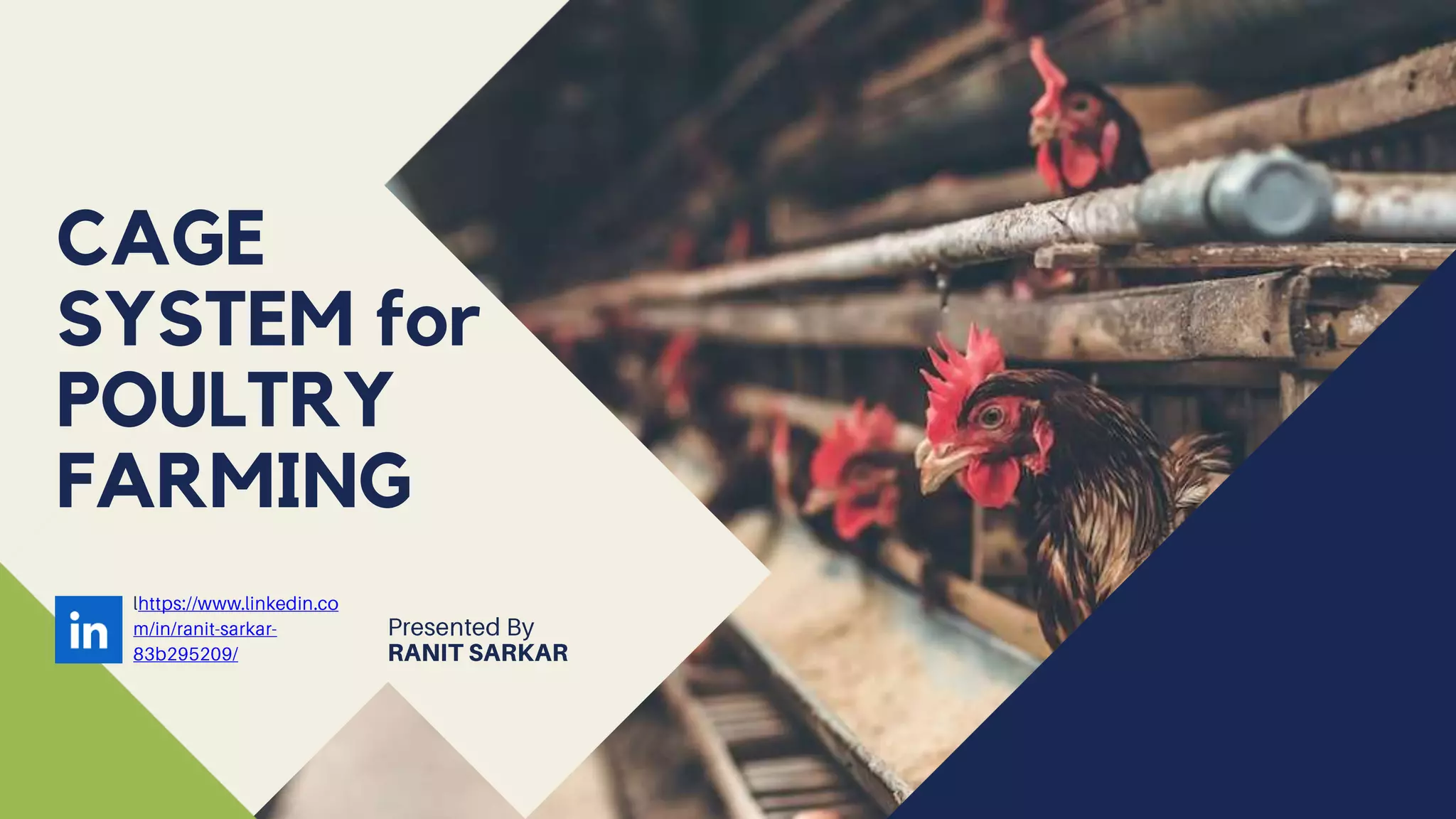
CAGE
SYSTEM for
POULTRY
FARMING
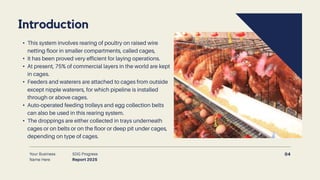
•
•
•
•
•
•
Introduction
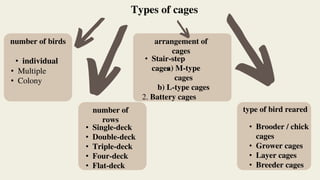
Types of cages
number of birds
number of
rows
arrangement of
cages
type of bird reared
• individual
• Multiple
• Colony
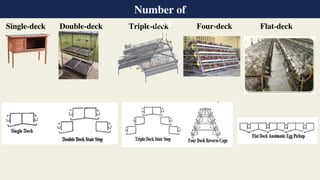
• Single-deck
• Double-deck
• Triple-deck
• Four-deck
• Flat-deck
• Stair-step
cages
2. Battery cages
a) M-type
cages
b) L-type cages
• Brooder / chick
cages
• Grower cages
• Layer cages
• Breeder cages
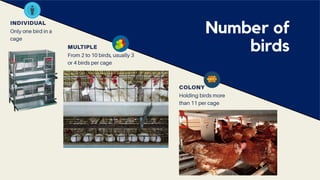
Number of
birds
Single-deck Double-deck Triple-deck Four-deck Flat-deck
Number of
rows
Battery Cage
System
“
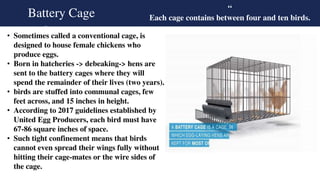
Each cage contains between four and ten birds.
• Sometimes called a conventional cage, is
designed to house female chickens who
produce eggs.
• Born in hatcheries -> debeaking-> hens are
sent to the battery cages where they will
spend the remainder of their lives (two years).
• birds are stuffed into communal cages, few
feet across, and 15 inches in height.
• According to 2017 guidelines established by
United Egg Producers, each bird must have
67-86 square inches of space.
• Such tight confinement means that birds
cannot even spread their wings fully without
hitting their cage-mates or the wire sides of
the cage.
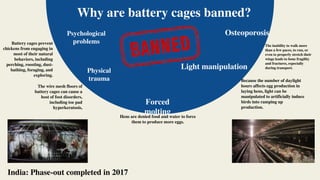
Why are battery cages banned?
Psychological
problems
Physical
trauma
Forced
molting
Light manipulation
Osteoporosis
Battery cages prevent
chickens from engaging in
most of their natural
behaviors, including
perching, roosting, dust-
bathing, foraging, and
exploring.
The wire mesh floors of
battery cages can cause a
host of foot disorders,
including toe pad
hyperkeratosis,
Hens are denied food and water to force
them to produce more eggs.
Because the number of daylight
hours affects egg production in
laying hens, light can be
manipulated to artificially induce
birds into ramping up
production.
The inability to walk more
than a few paces, to run, or
even to properly stretch their
wings leads to bone fragility
and fractures, especially
during transport.
India: Phase-out completed in 2017
on the basis
of type of
bird reared
Specifications
• Front feeding length : 60 inch
• Front & Back height : 12 inch
• Depth : 36 inch
• No. of chicks (0-8 weeks) per box : 60
• The need to provide auxiliary heat for the animals is called brooding.
• The chick are housed at a temperature between 87 – 92° F (30 – 33° C), at a
relative humidity between 40 – 60%.
• Chick cages are arranged either as single deck or double deck system.
• Feed is usually provided inside the cage during the first week of Grower cage
Brooder cage/chick cage
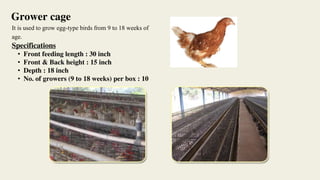
It is used to grow egg-type birds from 9 to 18 weeks of
age.
Specifications
• Front feeding length : 30 inch
• Front & Back height : 15 inch
• Depth : 18 inch
• No. of growers (9 to 18 weeks) per box : 10
Grower cage
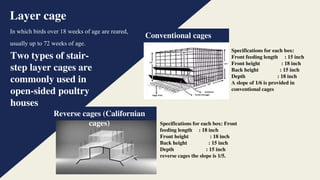
Layer cage
Two types of stair-
step layer cages are
commonly used in
open-sided poultry
houses
Conventional cages
Reverse cages (Californian
cages)
Specifications for each box:
Front feeding length : 15 inch
Front height : 18 inch
Back height : 15 inch
Depth : 18 inch
A slope of 1/6 is provided in
conventional cages
Specifications for each box: Front
feeding length : 18 inch
Front height : 18 inch
Back height : 15 inch
Depth : 15 inch
reverse cages the slope is 1/5.
In which birds over 18 weeks of age are reared,
usually up to 72 weeks of age.
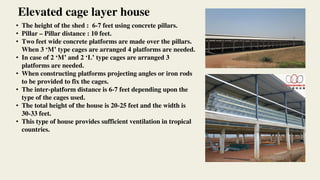
Elevated cage layer house
• The height of the shed : 6-7 feet using concrete pillars.
• Pillar – Pillar distance : 10 feet.
• Two feet wide concrete platforms are made over the pillars.
When 3 ‘M’ type cages are arranged 4 platforms are needed.
• In case of 2 ‘M’ and 2 ‘L’ type cages are arranged 3
platforms are needed.
• When constructing platforms projecting angles or iron rods
to be provided to fix the cages.
• The inter-platform distance is 6-7 feet depending upon the
type of the cages used.
• The total height of the house is 20-25 feet and the width is
30-33 feet.
• This type of house provides sufficient ventilation in tropical
countries.
Advantages
• Increased intensity of bird
• Correct maintenance of records
• Identifying poor producers and prompt culling
• Control of vices of poultry cannibalism and egg eating
• It helps in production of clean eggs
• Removal of stress factors
• Easy control of parasitic disease like coccidiosis and worm infestation
• Prompt steps to control feed wastage.
• The cage method of housing is ideal for the area of moderated climate conditions where the
day temperature in summer does not high and temperature does not fall too low.
• Egg production of caged layer was reported to be more then those kept in deep litter system.
• Feed efficiency and egg weight were better in caged birds than the laying flock under deep
litter system.
• Difficulties in ensuring proper ventilation to birds especially in summer season and
under very high densed conditions.
• Incidence of leg problem, cage layer fatigue, fatty liver syndrome, flies and
obnoxious gases in the house will be on increases
• Hysteresis of chicks
Disadvantages:
Conclusion
Email : ranitSarkar71@gmail.com
Telegram : https://t.me/Ranit_0_1
Contact me :
THANK
YOU

CAGE SYSTEM for POULTRY FARMING.pptx.pptx

  • 1.
  • 2.
  • 3.
    Types of cages numberof birds number of rows arrangement of cages type of bird reared • individual • Multiple • Colony • Single-deck • Double-deck • Triple-deck • Four-deck • Flat-deck • Stair-step cages 2. Battery cages a) M-type cages b) L-type cages • Brooder / chick cages • Grower cages • Layer cages • Breeder cages
  • 4.
  • 5.
    Single-deck Double-deck Triple-deckFour-deck Flat-deck Number of rows
  • 6.
    Battery Cage System “ Each cagecontains between four and ten birds. • Sometimes called a conventional cage, is designed to house female chickens who produce eggs. • Born in hatcheries -> debeaking-> hens are sent to the battery cages where they will spend the remainder of their lives (two years). • birds are stuffed into communal cages, few feet across, and 15 inches in height. • According to 2017 guidelines established by United Egg Producers, each bird must have 67-86 square inches of space. • Such tight confinement means that birds cannot even spread their wings fully without hitting their cage-mates or the wire sides of the cage.
  • 7.
    Why are batterycages banned? Psychological problems Physical trauma Forced molting Light manipulation Osteoporosis Battery cages prevent chickens from engaging in most of their natural behaviors, including perching, roosting, dust- bathing, foraging, and exploring. The wire mesh floors of battery cages can cause a host of foot disorders, including toe pad hyperkeratosis, Hens are denied food and water to force them to produce more eggs. Because the number of daylight hours affects egg production in laying hens, light can be manipulated to artificially induce birds into ramping up production. The inability to walk more than a few paces, to run, or even to properly stretch their wings leads to bone fragility and fractures, especially during transport. India: Phase-out completed in 2017
  • 8.
    on the basis oftype of bird reared
  • 9.
    Specifications • Front feedinglength : 60 inch • Front & Back height : 12 inch • Depth : 36 inch • No. of chicks (0-8 weeks) per box : 60 • The need to provide auxiliary heat for the animals is called brooding. • The chick are housed at a temperature between 87 – 92° F (30 – 33° C), at a relative humidity between 40 – 60%. • Chick cages are arranged either as single deck or double deck system. • Feed is usually provided inside the cage during the first week of Grower cage Brooder cage/chick cage
  • 10.
    It is usedto grow egg-type birds from 9 to 18 weeks of age. Specifications • Front feeding length : 30 inch • Front & Back height : 15 inch • Depth : 18 inch • No. of growers (9 to 18 weeks) per box : 10 Grower cage
  • 11.
    Layer cage Two typesof stair- step layer cages are commonly used in open-sided poultry houses Conventional cages Reverse cages (Californian cages) Specifications for each box: Front feeding length : 15 inch Front height : 18 inch Back height : 15 inch Depth : 18 inch A slope of 1/6 is provided in conventional cages Specifications for each box: Front feeding length : 18 inch Front height : 18 inch Back height : 15 inch Depth : 15 inch reverse cages the slope is 1/5. In which birds over 18 weeks of age are reared, usually up to 72 weeks of age.
  • 12.
    Elevated cage layerhouse • The height of the shed : 6-7 feet using concrete pillars. • Pillar – Pillar distance : 10 feet. • Two feet wide concrete platforms are made over the pillars. When 3 ‘M’ type cages are arranged 4 platforms are needed. • In case of 2 ‘M’ and 2 ‘L’ type cages are arranged 3 platforms are needed. • When constructing platforms projecting angles or iron rods to be provided to fix the cages. • The inter-platform distance is 6-7 feet depending upon the type of the cages used. • The total height of the house is 20-25 feet and the width is 30-33 feet. • This type of house provides sufficient ventilation in tropical countries.
  • 13.
    Advantages • Increased intensityof bird • Correct maintenance of records • Identifying poor producers and prompt culling • Control of vices of poultry cannibalism and egg eating • It helps in production of clean eggs • Removal of stress factors • Easy control of parasitic disease like coccidiosis and worm infestation • Prompt steps to control feed wastage. • The cage method of housing is ideal for the area of moderated climate conditions where the day temperature in summer does not high and temperature does not fall too low. • Egg production of caged layer was reported to be more then those kept in deep litter system. • Feed efficiency and egg weight were better in caged birds than the laying flock under deep litter system.
  • 14.
    • Difficulties inensuring proper ventilation to birds especially in summer season and under very high densed conditions. • Incidence of leg problem, cage layer fatigue, fatty liver syndrome, flies and obnoxious gases in the house will be on increases • Hysteresis of chicks Disadvantages:
  • 15.
  • 16.
    Email : ranitSarkar71@gmail.com Telegram: https://t.me/Ranit_0_1 Contact me :
  • 17.