
ORIGIN AND GENETIC CLASSIFICATION
OF POULTRY
11/19/2020 GURRAM SRINIVAS
Species Period Country
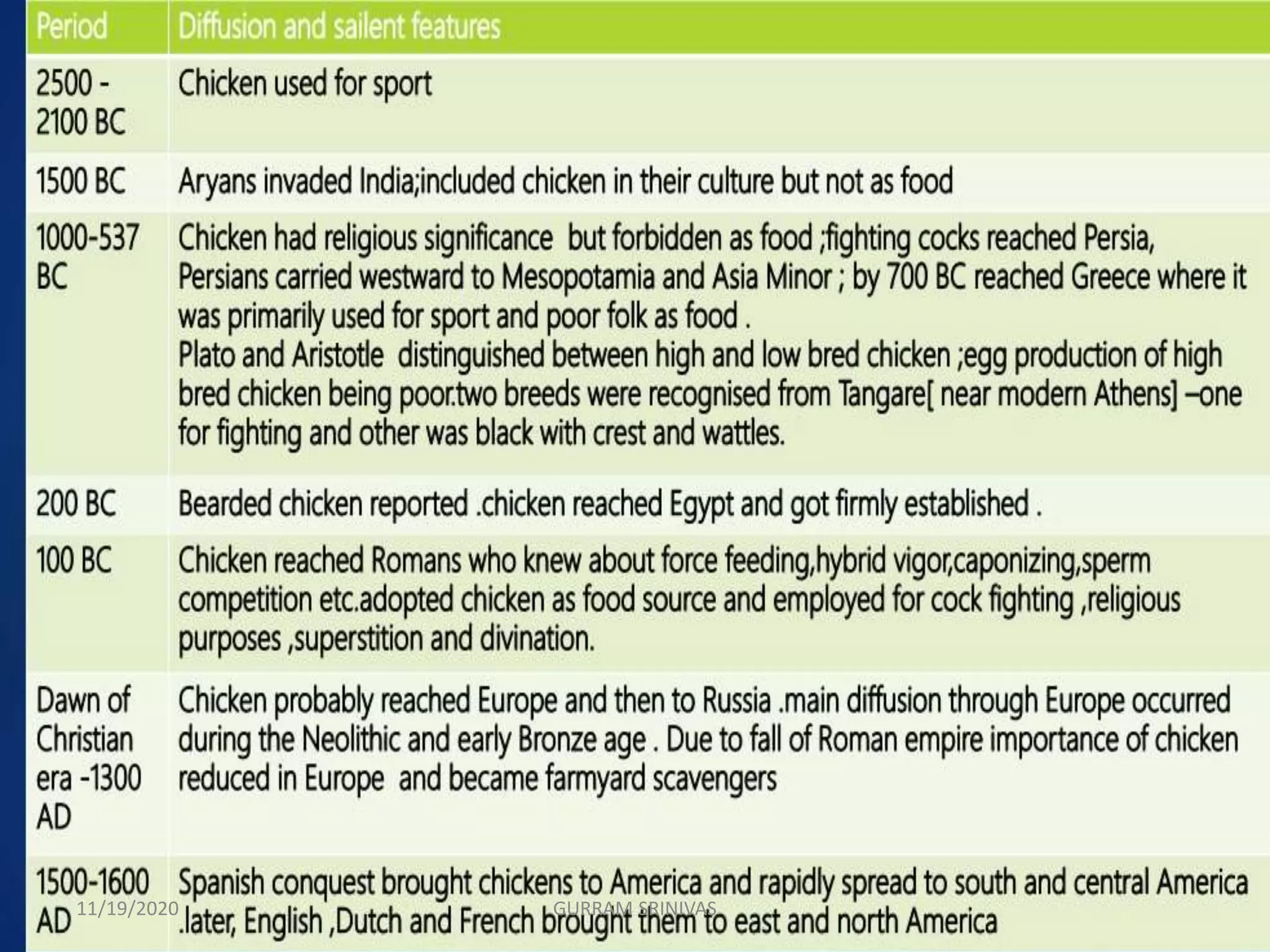
Chicken 5400 BC
2500-2100 BC
China
From Harappan Culture:
may be main source of
diffusion to the world
Geese and Mallard ducks 2500 BC
1500 BC
China
Egypt- separately
domesticated. In west
mallard duck was not till
middle age
Ring necked pheasants 1300 BC Greece
Turkey 200 BC to 700 AD Mexico
Muscovy ducks 16th century Columbia, Peru
Japanese quail 11th century Japan, China, Korea
Guinea fowl West African birds
introduced by Portugese
11/19/2020 GURRAM SRINIVAS
Effects of domestication
• Seed/grass eating species are preferred.
• Reproduction in captivity: Reproduction became less
dependent on climatic and environmental factors.
• Development of social order.
11/19/2020 GURRAM SRINIVAS
Consequences
• Increase in bone length.
• Noticeable changes in plumage.
• Alteration to the limbs involving length, muscle
attachments and joint structure.
• Changes in skin covering, fat deposition and brain
size.
11/19/2020 GURRAM SRINIVAS
Purpose and utilization of domestic
birds
• Initially used primarily for cultural needs, decorative
arts and entertainment.
• Later used as human food
i. In ancient rome; geese were sacred initially
and later on became a table delicacy.
ii. In spain & Turkey – Cultural activities
iii. Japanese quails – Song birds
11/19/2020 GURRAM SRINIVAS
Domestication – chicken or domestic
fowl
• Only 3 fossils of Gallus species have been recorded .
• Two of them from UK and one from Greece & Black
sea region .
• Fossil from UK is coracoid bone resembling Gallus
gallus. Assigned to new species gallus europaeus .
• Fossil from Greece and Black sea region is tarso-
metatarsus bone similar to Gallus gallus & coracoid
bone much longer.
• Assigned to new species Gallus aesculapi .
• Totally 4 species are known to modern ornithology .
11/19/2020 GURRAM SRINIVAS
Genetic classification
• Kingdom: Animalia
• Phylum : chordate
• Class : aves
• Order : Galliformes
• sub order : Galli
• Family : phasianidae
• Sub family : phasianinae
• Tribe : phasianini
• Genus : Gallus
11/19/2020 GURRAM SRINIVAS
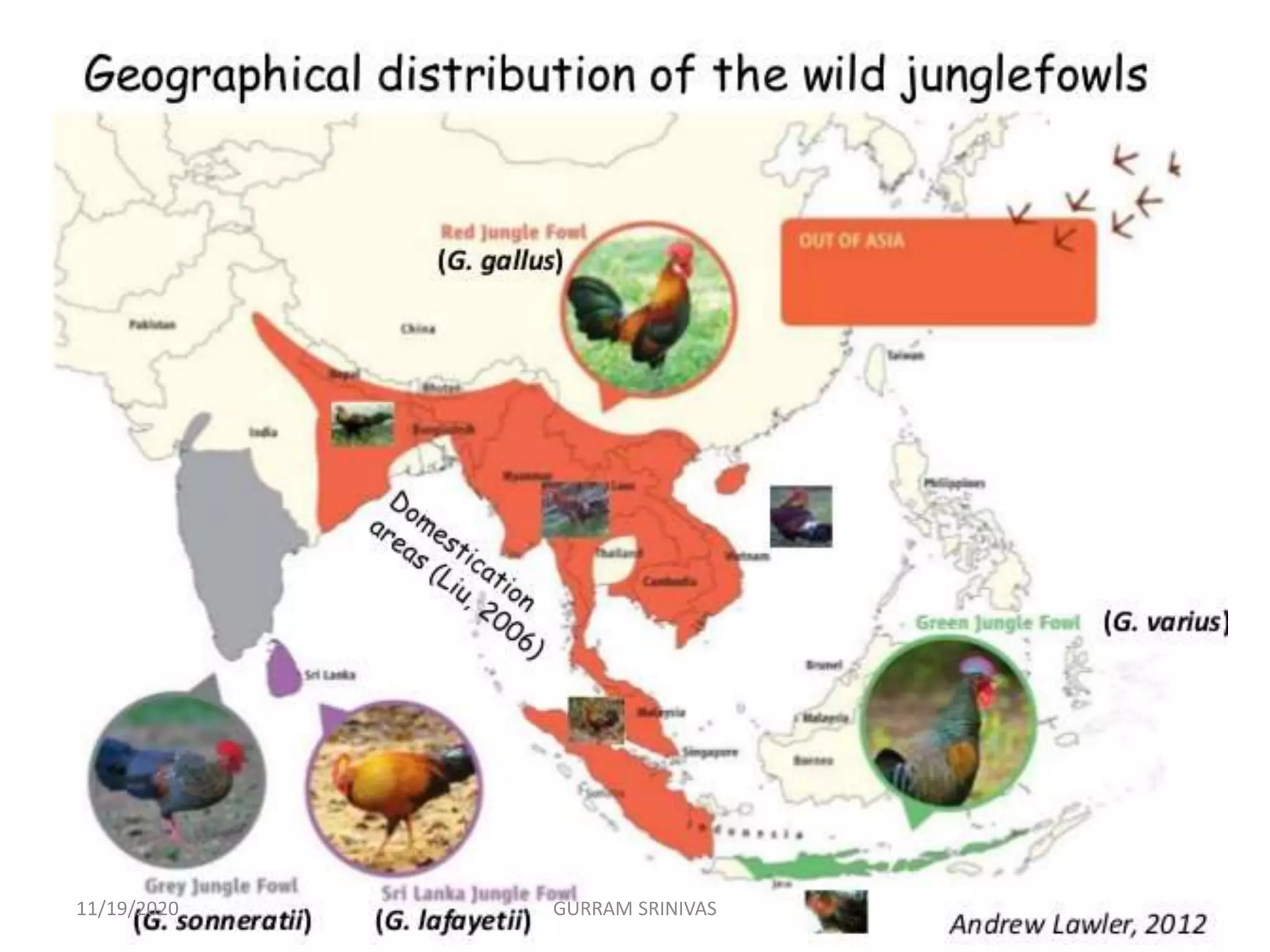
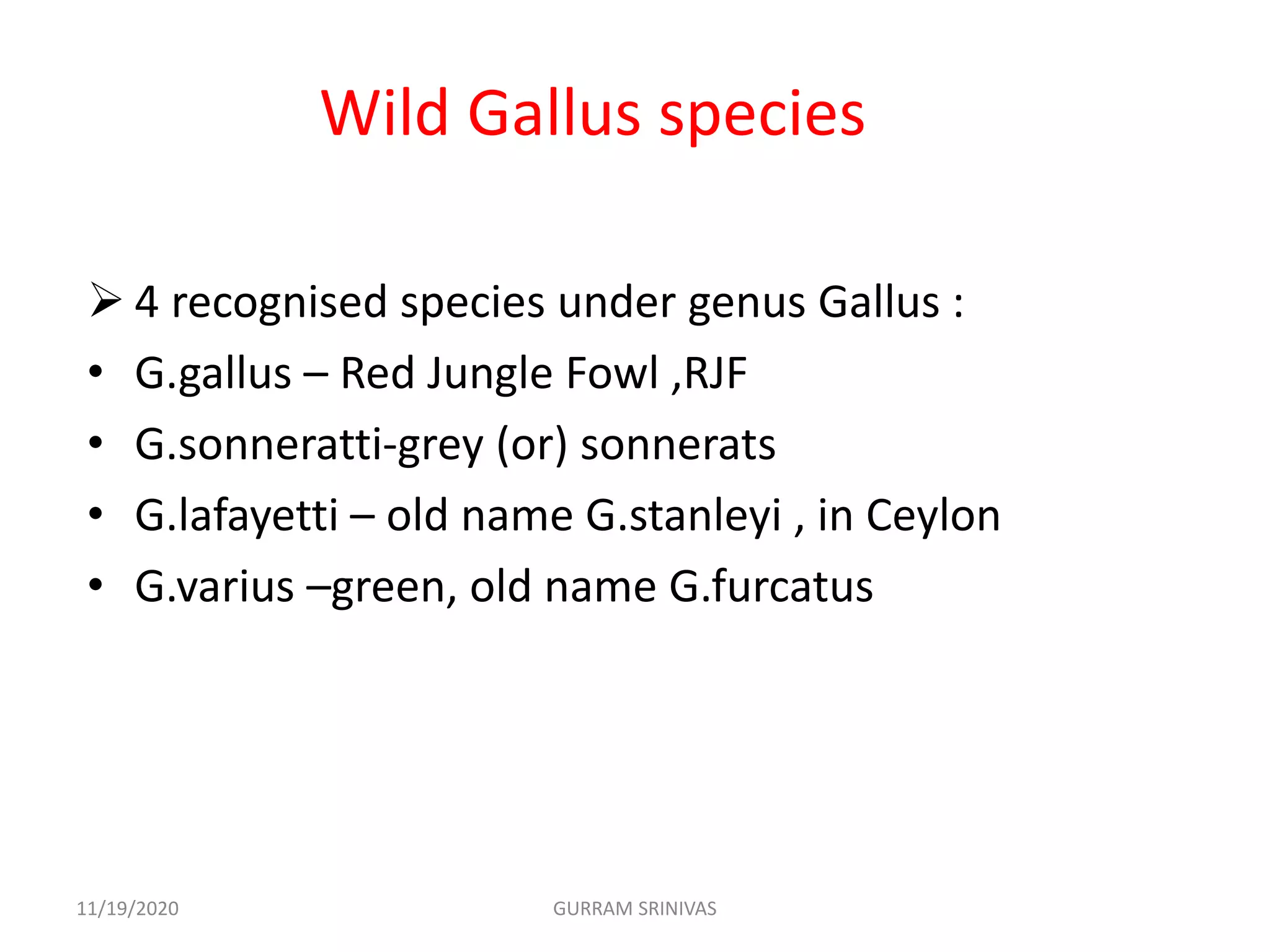
Wild Gallus species
 4 recognised species under genus Gallus :
• G.gallus – Red Jungle Fowl ,RJF
• G.sonneratti-grey (or) sonnerats
• G.lafayetti – old name G.stanleyi , in Ceylon
• G.varius –green, old name G.furcatus
11/19/2020 GURRAM SRINIVAS
Gallus gallus
• 5 Subspecies in males
• G.g.gallus – Cochin – Chinese RJF
• G.g.spadiceus – Burmese RJF
• G.g.jabouillei – Tokinese RJF
• G.g.murghi – Indian RJF
• G.g.bankiva – Javan RJF
 These differ in
• Color of ear lobes ( white to red )
• Shape and neck hackle feathers in males &
• Shade of red plumage in males (golden yellow to
mahogany)
11/19/2020 GURRAM SRINIVAS
Origin of modern poultry
• Not clear
• Might have begun in Burma
• In Harappan culture (2500 -2100 BC ) of the indus
valley reared chicken and later on diffused westward
to other parts of the world at a rate of 1.53 km /year.
• Except for Egypt ,diffusion of chicken into Africa is
unknown.
• India is likely to be source leads to well developed
trade between India & Africa
11/19/2020 GURRAM SRINIVAS
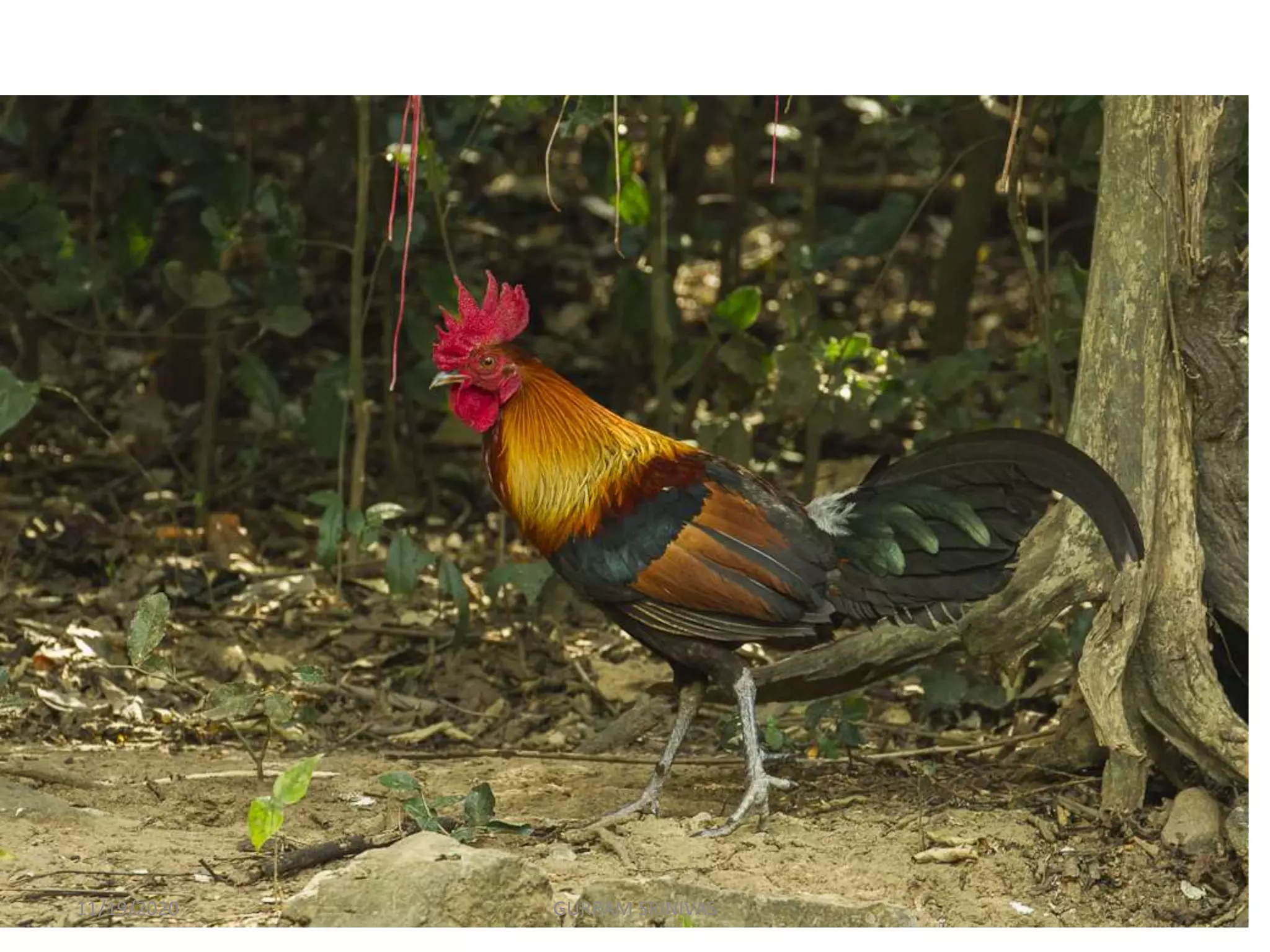
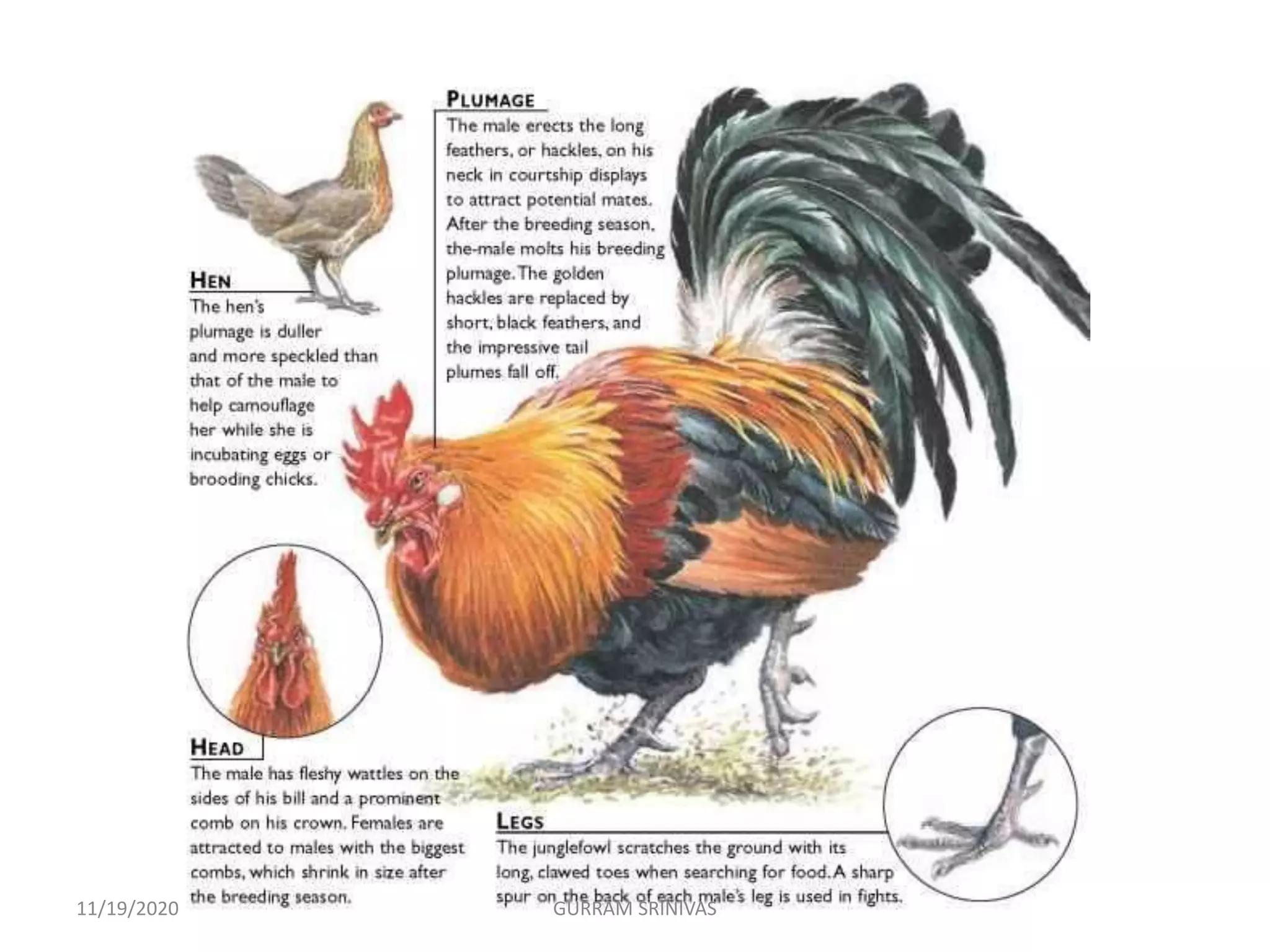
Gallus gallus (red jungle fowl )
• Comb is single upright ,serrated blade; a pair of
wattles.
• Male exhibit spectacular coloring whereas females
have drab color but feathers have identical
morphology in both the sexes .
11/19/2020 GURRAM SRINIVAS
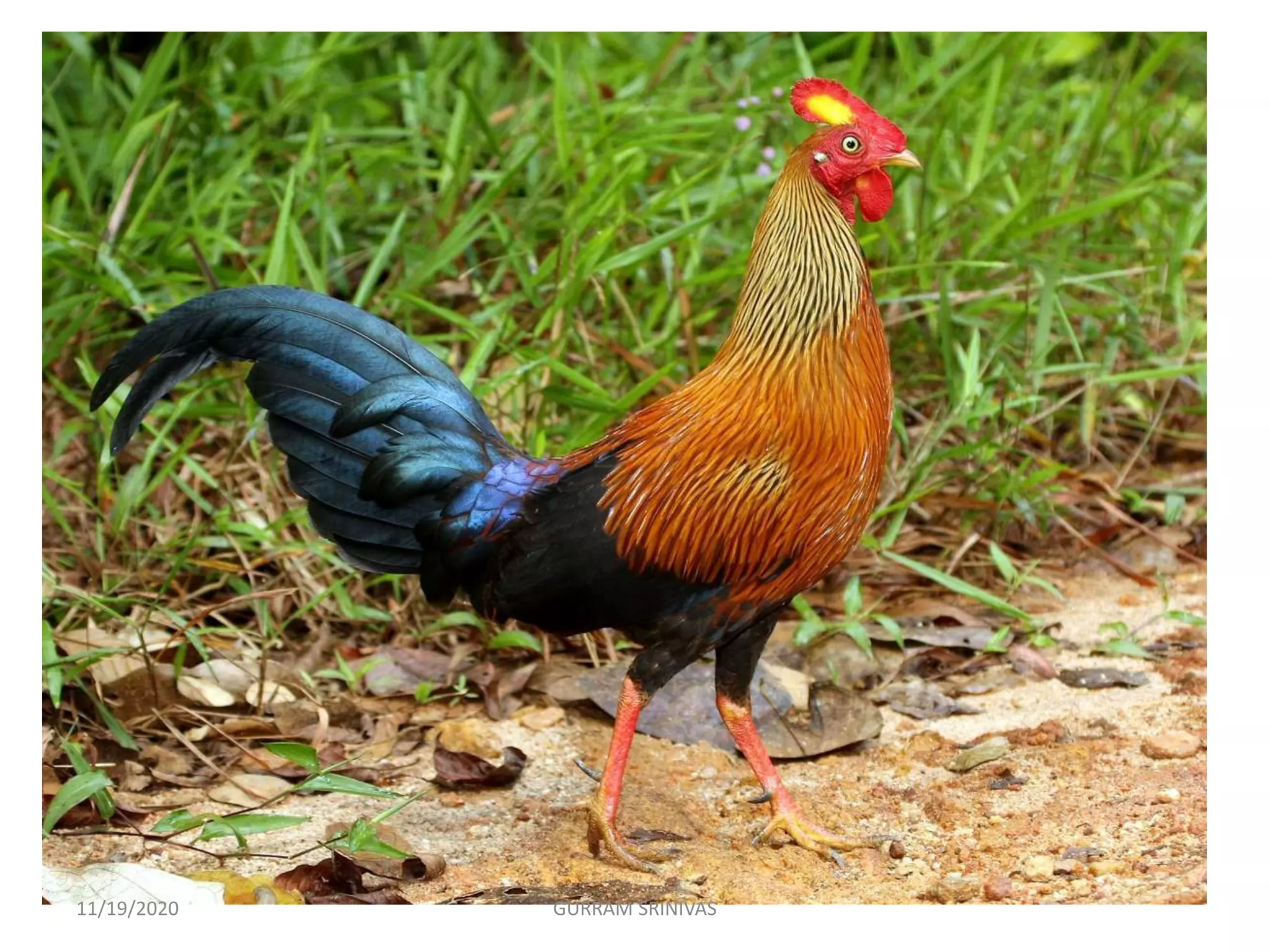
Gallus lafayetti [Ceylon jungle fowl]
• Male plumage is similar to RJF except that breast
feathers are pointed and fringed .males have a
peculiar patch of bluish purple feathers on the upper
breast.
• Plumage of the females is similar to those of RJF
11/19/2020 GURRAM SRINIVAS
Ceylon jungle fowl - female
11/19/2020 GURRAM SRINIVAS
Gallus sonneratti [grey jungle fowl]
• Male plumage is different from other species
• “sealing wax” spots on rachis ;those that are
i.sub-terminal being white
ii.terminal spots being shredded and yellow.
• Occurs in neck hackle ,saddle, and wing coverts.
• Body feathers are black with a white shaft and a grey
border.
• Wing and tail feathers are black ; bird appears grey.
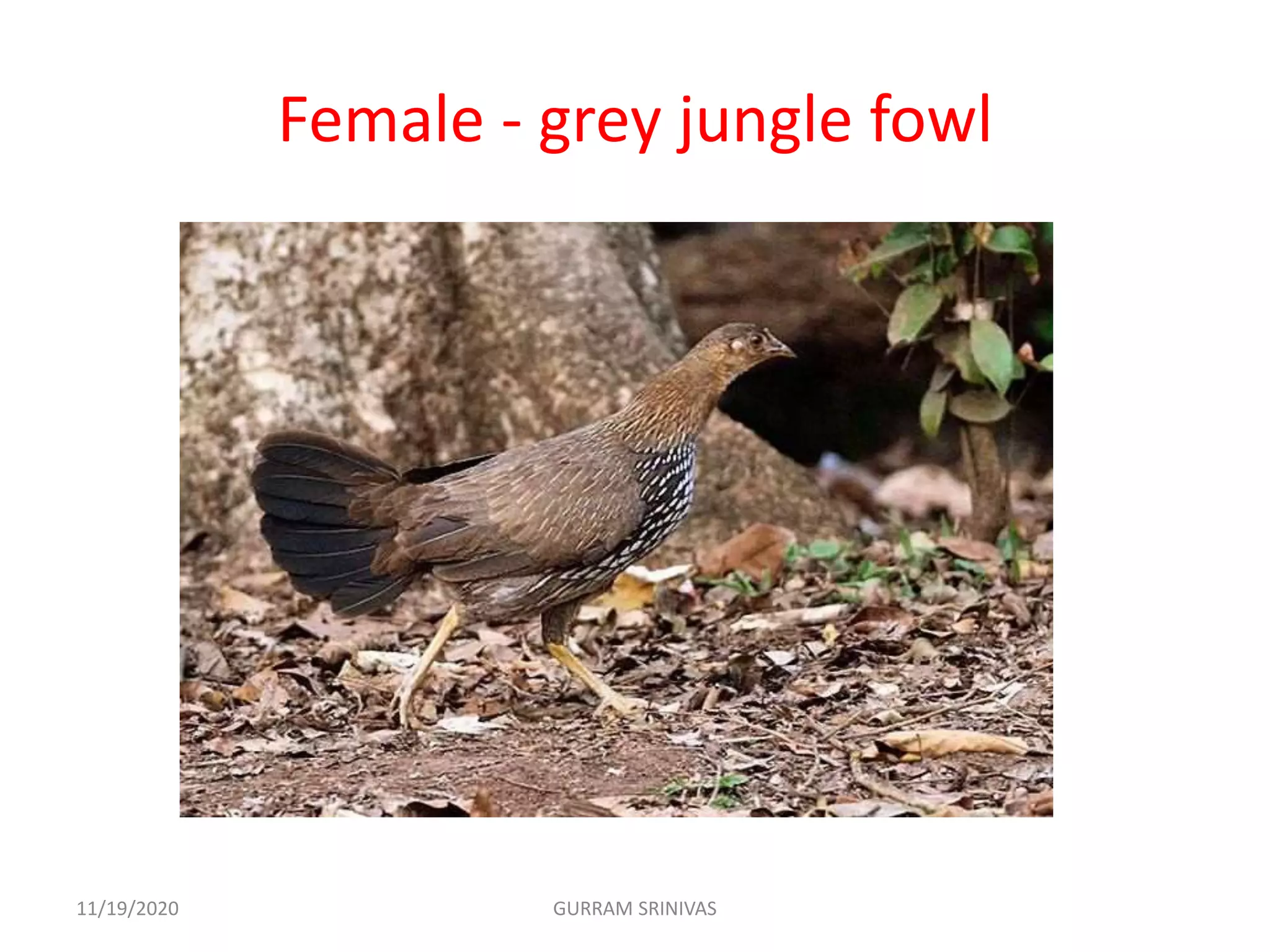
• Female plumage differs from RJF
i.In breast feathers which are white with broad
black/brown borders.
11/19/2020 GURRAM SRINIVAS
Female - grey jungle fowl
11/19/2020 GURRAM SRINIVAS
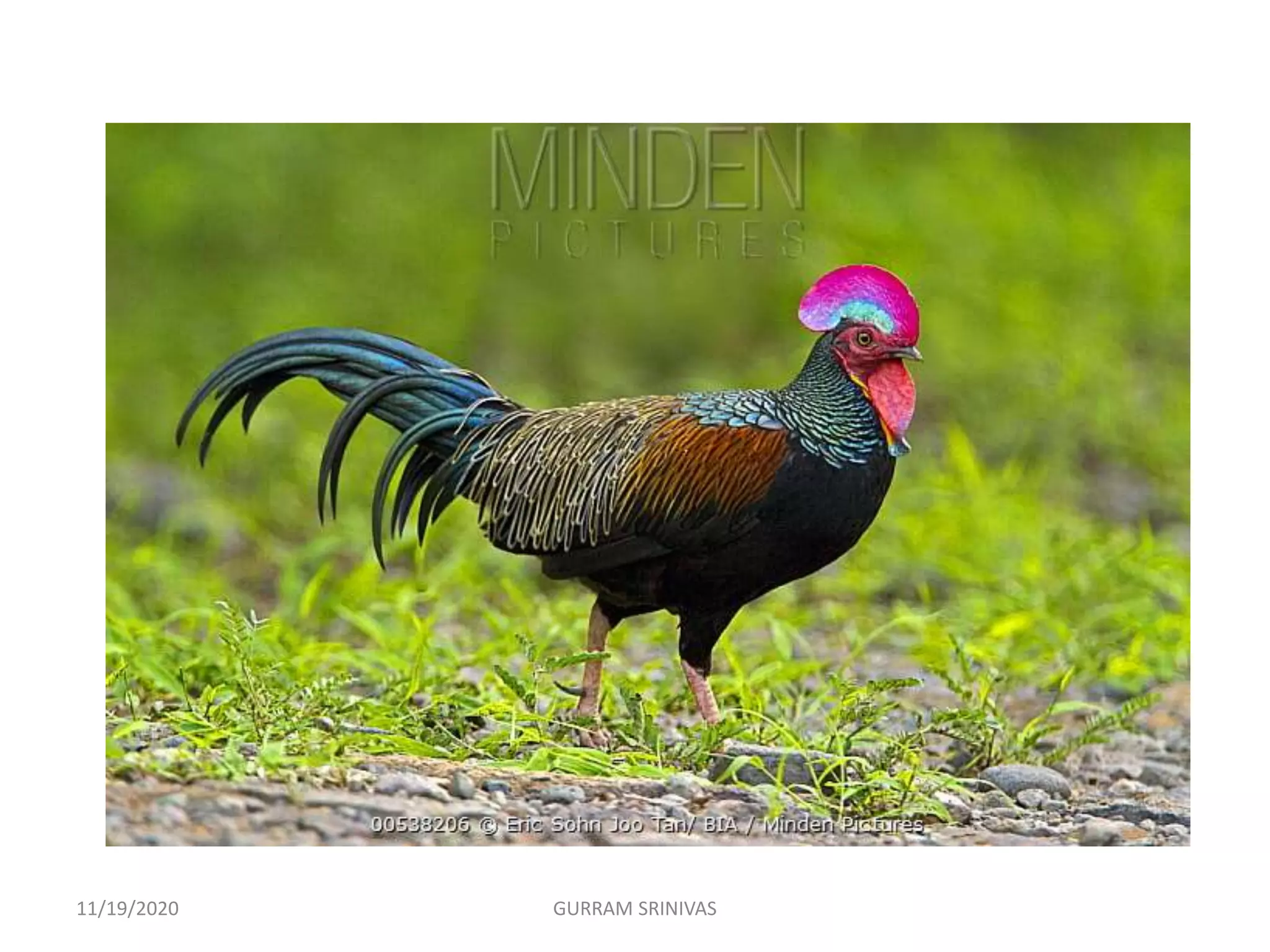
Gallus varius[green jungle fowl]
• Most primitive of four species
• Plumage consists of 16 tail feathers rather than 14 in other
species.
• Short truncate neck hackle feathers in males.
• Male plumage is glossy black , but hackle and saddle
feathers are edged with bronze and yellow imparting a
distinctly green coloration to the bird.
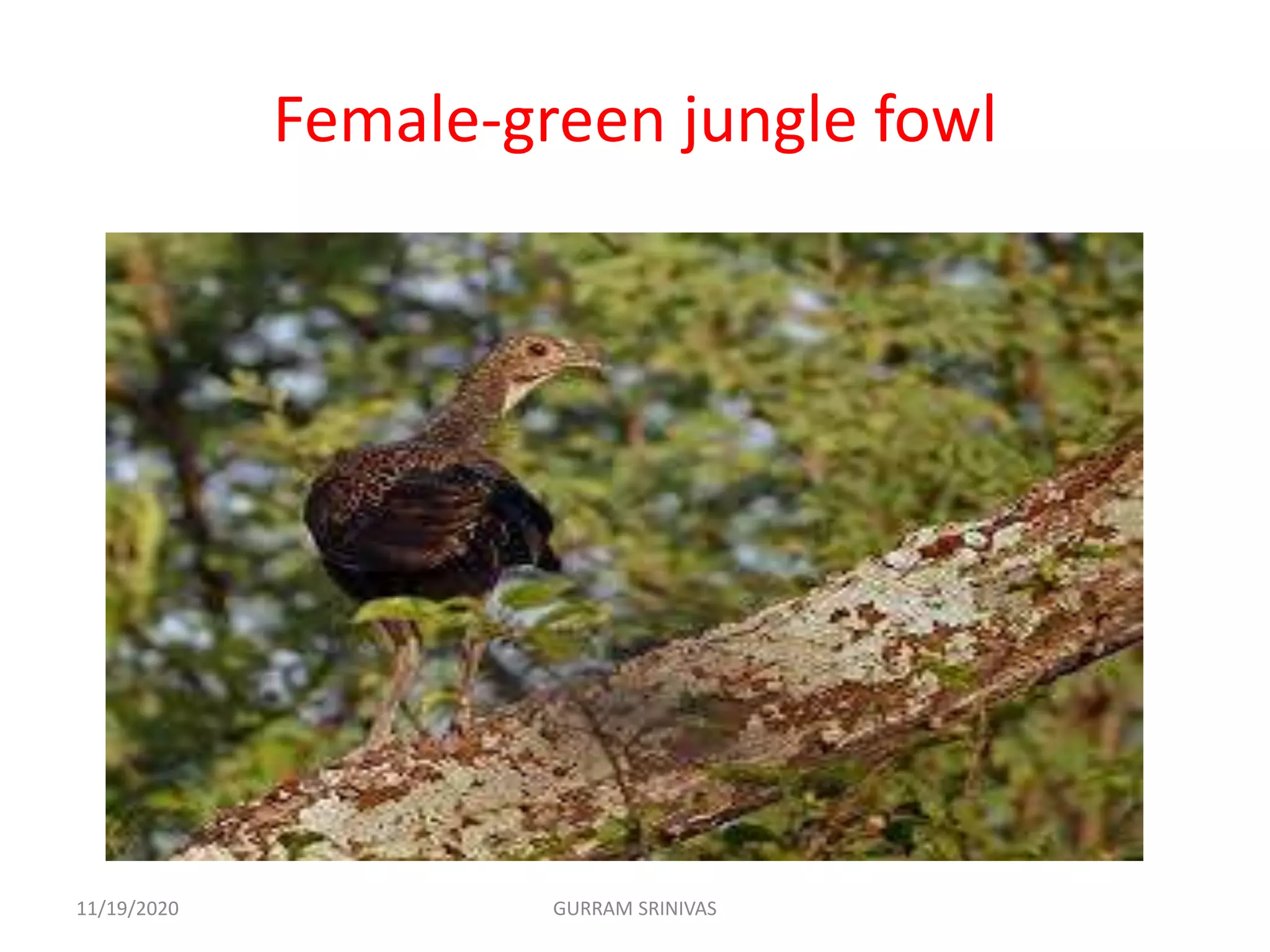
• In females feathers of the back and rump are
penciled(similar to dark Cornish),
i.upper breast feathers have dark edging ,
ii. lower breast feathers are pale and
iii.rest of the plumage has irregular barring.
11/19/2020 GURRAM SRINIVAS
Female-green jungle fowl
11/19/2020 GURRAM SRINIVAS
THANK YOU
11/19/2020 GURRAM SRINIVAS

Origin and domestcation of poultry

  • 1.
    ORIGIN AND GENETICCLASSIFICATION OF POULTRY 11/19/2020 GURRAM SRINIVAS
  • 2.
    Species Period Country Chicken5400 BC 2500-2100 BC China From Harappan Culture: may be main source of diffusion to the world Geese and Mallard ducks 2500 BC 1500 BC China Egypt- separately domesticated. In west mallard duck was not till middle age Ring necked pheasants 1300 BC Greece Turkey 200 BC to 700 AD Mexico Muscovy ducks 16th century Columbia, Peru Japanese quail 11th century Japan, China, Korea Guinea fowl West African birds introduced by Portugese 11/19/2020 GURRAM SRINIVAS
  • 3.
  • 4.
    Effects of domestication •Seed/grass eating species are preferred. • Reproduction in captivity: Reproduction became less dependent on climatic and environmental factors. • Development of social order. 11/19/2020 GURRAM SRINIVAS
  • 5.
    Consequences • Increase inbone length. • Noticeable changes in plumage. • Alteration to the limbs involving length, muscle attachments and joint structure. • Changes in skin covering, fat deposition and brain size. 11/19/2020 GURRAM SRINIVAS
  • 6.
    Purpose and utilizationof domestic birds • Initially used primarily for cultural needs, decorative arts and entertainment. • Later used as human food i. In ancient rome; geese were sacred initially and later on became a table delicacy. ii. In spain & Turkey – Cultural activities iii. Japanese quails – Song birds 11/19/2020 GURRAM SRINIVAS
  • 7.
    Domestication – chickenor domestic fowl • Only 3 fossils of Gallus species have been recorded . • Two of them from UK and one from Greece & Black sea region . • Fossil from UK is coracoid bone resembling Gallus gallus. Assigned to new species gallus europaeus . • Fossil from Greece and Black sea region is tarso- metatarsus bone similar to Gallus gallus & coracoid bone much longer. • Assigned to new species Gallus aesculapi . • Totally 4 species are known to modern ornithology . 11/19/2020 GURRAM SRINIVAS
  • 8.
    Genetic classification • Kingdom:Animalia • Phylum : chordate • Class : aves • Order : Galliformes • sub order : Galli • Family : phasianidae • Sub family : phasianinae • Tribe : phasianini • Genus : Gallus 11/19/2020 GURRAM SRINIVAS
  • 9.
    Wild Gallus species 4 recognised species under genus Gallus : • G.gallus – Red Jungle Fowl ,RJF • G.sonneratti-grey (or) sonnerats • G.lafayetti – old name G.stanleyi , in Ceylon • G.varius –green, old name G.furcatus 11/19/2020 GURRAM SRINIVAS
  • 10.
    Gallus gallus • 5Subspecies in males • G.g.gallus – Cochin – Chinese RJF • G.g.spadiceus – Burmese RJF • G.g.jabouillei – Tokinese RJF • G.g.murghi – Indian RJF • G.g.bankiva – Javan RJF  These differ in • Color of ear lobes ( white to red ) • Shape and neck hackle feathers in males & • Shade of red plumage in males (golden yellow to mahogany) 11/19/2020 GURRAM SRINIVAS
  • 11.
    Origin of modernpoultry • Not clear • Might have begun in Burma • In Harappan culture (2500 -2100 BC ) of the indus valley reared chicken and later on diffused westward to other parts of the world at a rate of 1.53 km /year. • Except for Egypt ,diffusion of chicken into Africa is unknown. • India is likely to be source leads to well developed trade between India & Africa 11/19/2020 GURRAM SRINIVAS
  • 12.
    Gallus gallus (redjungle fowl ) • Comb is single upright ,serrated blade; a pair of wattles. • Male exhibit spectacular coloring whereas females have drab color but feathers have identical morphology in both the sexes . 11/19/2020 GURRAM SRINIVAS
  • 13.
  • 14.
  • 15.
    Gallus lafayetti [Ceylonjungle fowl] • Male plumage is similar to RJF except that breast feathers are pointed and fringed .males have a peculiar patch of bluish purple feathers on the upper breast. • Plumage of the females is similar to those of RJF 11/19/2020 GURRAM SRINIVAS
  • 16.
  • 17.
    Ceylon jungle fowl- female 11/19/2020 GURRAM SRINIVAS
  • 18.
    Gallus sonneratti [greyjungle fowl] • Male plumage is different from other species • “sealing wax” spots on rachis ;those that are i.sub-terminal being white ii.terminal spots being shredded and yellow. • Occurs in neck hackle ,saddle, and wing coverts. • Body feathers are black with a white shaft and a grey border. • Wing and tail feathers are black ; bird appears grey. • Female plumage differs from RJF i.In breast feathers which are white with broad black/brown borders. 11/19/2020 GURRAM SRINIVAS
  • 19.
  • 20.
    Female - greyjungle fowl 11/19/2020 GURRAM SRINIVAS
  • 21.
    Gallus varius[green junglefowl] • Most primitive of four species • Plumage consists of 16 tail feathers rather than 14 in other species. • Short truncate neck hackle feathers in males. • Male plumage is glossy black , but hackle and saddle feathers are edged with bronze and yellow imparting a distinctly green coloration to the bird. • In females feathers of the back and rump are penciled(similar to dark Cornish), i.upper breast feathers have dark edging , ii. lower breast feathers are pale and iii.rest of the plumage has irregular barring. 11/19/2020 GURRAM SRINIVAS
  • 22.
  • 23.
  • 24.
  • 25.
  • 26.
  • 27.