





PLASMA COMPACTION
&
ELECTRODEPOSITION
NAME: Aliasgar Mandsaurwala
SAP ID: 60011115028
SUBJECT: Nanotechnology
INTRODUCTION…
• Most synthesizing methods produce nanostructured materials in a
powder form but bulk large dimension specimens or metal film is often
needed for reliable mechanical testing to be carried out.
• Various methods producing bulk or metal film, for example,
• consolidation of powders
• Deposition and
• Severe plastic deformation have been developed.
• Consolidation of nanopowders into a bulk form by conventional
methods such as hot pressing, extrusion, hot isostatic pressing (HIP)
can coarsen the grains under the application of heat and pressure.
• Severe plastic deformation (SPD) is a promising method to deform
bulk structures having coarser grains into submicron and
nanostructured products.
• Furthermore, solution phase synthesis, plasma pressure compaction,
microwave sintering and pulsed electrodeposition have also been used
to synthesize bulk nanostrucutred metals and alloys.
• Nanostructured coatings offer great potential due to their
superior characteristics that are not typically found in
conventional coatings.
• Because of the small grain size and consequently the large
volume fraction of atoms in or near the grain boundaries, these
materials exhibit properties that are often superior and
sometimes completely new, in comparison with those of
conventional coarse-grained materials.
• These include increased strength/hardness, enhanced
diffusivity, improved ductility/toughness, reduced density,
reduced elastic modulus, higher electrical resistivity, increased
specific heat, higher coefficient of thermal expansion, lower
thermal conductivity, increased corrosion and wear resistance
and superior soft magnetic properties.
ELECTRODEPOSITION…
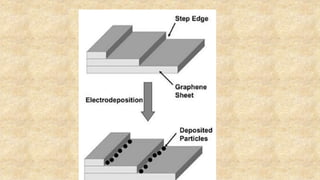
• Nanostructured deposits are formed on a cathode surface during plating
by properly controlling the electrodeposition parameters, e.g. bath
composition, temperature, pH, etc.
• A very large number of pure metals, alloys and ceramics can be
electrodeposited with grain sizes less than 100-nm.
• Pure metals, alloys, multilayered structures, metal matrix composites
have been successfully produced by electrodeposition methods.
• Electrodeposition is also an effective route to produce dense
nanostructured sheets for mechanical measurements.
• Its low cost, industrial applicability, high production rates have attracted
much interest in this technology for the deposition of nanostructured
metals for industrial applications.
• To obtain enhanced characteristics of any nanocoating, it is essential to optimize the
bath (electrolyte) composition as well as the deposition parameters in addition to
selecting appropriate anode and cathode materials with a suitable coating.
• Bath composition and deposition parameters for Ni–AIN nanocoating. NiSO4 · 6H2O
300 g/l NiCl2 · 6H2O 45 g/l H3BO3 40 g/l AlN powder 0–55 g/l pH 2–6 Current
density 0.5–5 A dm −2 Temperature 55 ◦C.
• The application of NC materials requires that these powders are consolidated to
their full density with minimal porosity, and this is not easy to achieve.
• Full densification with complete interparticle bonding requires the exposure of the
powder to high temperatures and pressures for extended periods of time, which is
likely to coarsen the microstructural features.
• The retention of the material in the NC state, however, warrants that the powder is
not exposed to high temperatures for longer periods of time; this may not result in
complete densification.
• Thus, successful consolidation to full density requires innovative methods of
consolidation.
• However, the nanostructured materials produced by ED and amorphous
crystallization that lead to the direct fabrication of high-density bulk materials are
not subject to these concerns
ADVANTAGES OF ED…
• Electrochemical deposition, also being an atomic deposition process, can be used to synthesize
nanocomposites.
• The obvious advantages of this century-old process of ED are as follows:
• a. Rapidity
• b. Low cost
• c. Free from porosity Pure nickel Ni-AlN (current density: 2A dm−2 , pH: 5.5. temperature: 55
◦C)
• d. High purity.
• e. Industrial applicability.
• f. Potential to overcome shape limitations or allows the production of free-standing parts with
complex shapes.
• g. Higher deposition rates.
• h. Produce coatings on widely differing substrates.
• i. Ability to produce structural features with sizes ranging from nm to µm.
• j. Easy to control alloy composition.
• k. Ability to produce compositions unattainable by other techniques.
• l. The possibility of forming of simple low-cost multilayers in many different systems, e.g. Cu/Ni,
Ni/Ni–P etc. m. No postdeposition treatment
OTHER ADVANTAGES
• low cost and industrial applicability.
• Simple operation.
• Versatility.
• High production rates.
• Well established industrial infrastructure.
• Relatively low cost of application, whereby nanostructured materials
can be produced by simple modification of bath chemistries and
electrical parameters used in current plating and electroforming
operations.
• Capability in a single-step process of producing pure metals, alloys,
and metalmatrix composites in various forms.
• Ability to produce fully dense nanostructures free of porosity.
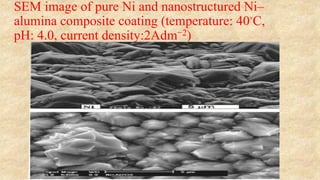
SEM image of pure Ni and nanostructured Ni–
alumina composite coating (temperature: 40◦C,
pH: 4.0, current density:2Adm−2)
Pure nickel
Ni-Alumina
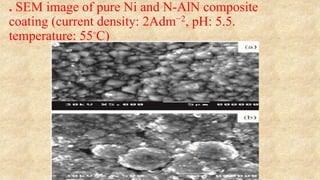
. SEM image of pure Ni and N-AlN composite
coating (current density: 2Adm−2, pH: 5.5.
temperature: 55◦C)
Pure nickel
Ni-AlN
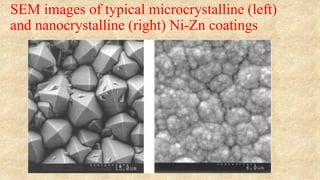
SEM images of typical microcrystalline (left)
and nanocrystalline (right) Ni-Zn coatings
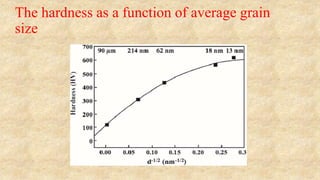
The hardness as a function of average grain
size
PLASMA PRESSURE
COMPACTION
• Plasma pressure compaction is a rapid densification process developed by Materials Modification
Incorporation (MMI, Fairfax, VA, USA).
• It is economically affordable, efficient and viable approach and it has the potential to minimize
grain growth by enhancing particle sinterability through the conjoint action of particle surface
activation and rapid heating for very short durations.
• The technique of plasma pressure compaction is a short-time, high temperature, low pressure
process that has been successfully used to compact micron size, ultrafine as well as nanometer
metallic, intermetallic and ceramic powders to full density and near-net shapes.
• In the PPC procedure, powders are simply poured into a graphite die and compacted by graphite
punches.
• At the beginning of the process, pulsed DC voltage is applied through the powder compacts to
generate an interparticle plasma that activates the surface by removing the oxide or
contamination layers.
• Subsequently, DC voltage is applied to achieve rapid densification by resistance sintering under
uniaxial pressure.
ADVANTAGES…
• The advantages of the P2C technique are:
• Reduced processing temperatures,
• Significant reduction in the consolidation time, (minutes versus hours).
• Lower oxygen content in the final part,
• Higher density,
• Does not need precompaction or the use of canning devices,
• Absence of sintering aids and additives
• The P2C process can be applied to all kinds of metals, intermetallics and quasiceramics.
P2C machines are designed based on the desired sample size, shape and the type of
material. In addition the P2C machine can be used to reactively synthesize and form near
net shaped parts or can be used to reactively join selected dissimilar materials.
• Another major advantage of the P2C setup is that it can be used very successfully on
micron sized powders as an alternative to Hip'ing or hot pressing.
• The typical shapes that can be produced using this machine can range from cylinders to
hollow tubes and circular plates. We can also provide the above shapes in a range of
sizes.
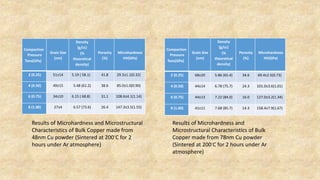
Compaction
Pressure
Tons(GPa)
Grain Size
(nm)
Density
(g/cc)
(%
theoretical
density)
Porosity
(%)
Microhardness
HV(GPa)
2 (0.25) 51±14 5.19 ( 58.1) 41.8 29.3±1.1(0.32)
4 (0.50) 49±15 5.48 (61.2) 38.6 85.0±1.0(0.90)
6 (0.75) 34±10 6.15 ( 68.8) 31.1 108.6±4.1(1.14)
8 (1.00) 27±4 6.57 (73.6) 26.4 147.3±3.5(1.55)
Results of Microhardness and Microstructural
Characteristics of Bulk Copper made from
48nm Cu powder (Sintered at 200◦C for 2
hours under Ar atmosphere)
Compaction
Pressure
Tons(GPa)
Grain Size
(nm)
Density
(g/cc)
(%
theoretical
density)
Porosity
(%)
Microhardness
HV(GPa)
2 (0.25) 68±20 5.86 (65.4) 34.6 69.4±2.5(0.73)
4 (0.50) 44±14 6.78 (75.7) 24.3 101.0±3.6(1.01)
6 (0.75) 44±13 7.22 (84.0) 16.0 127.0±3.2(1.34)
8 (1.00) 41±11 7.68 (85.7) 14.3 158.4±7.9(1.67)
Results of Microhardness and
Microstructural Characteristics of Bulk
Copper made from 78nm Cu powder
(Sintered at 200◦C for 2 hours under Ar
atmosphere)
Compactio
n Pressure
Tons (GPa)
`
Grain Size
(nm)
Density
(g/cc)
(%
theoretical
density)
Porosity
(%)
Microhardness
HV(GPa)
2 (0.25) 50±14 5.89 (65.7) 34.3 49.9±2.0(0.53)
4 (0.50) 46±23 7.06 (78.8) 21.2 54.3±1.0(0.58)
Results of Microhardness and
Microstructural Characteristics of Bulk
Copper made from micron size Cu powder
(81nm) (Sintered at 200◦C for 2 hours under
Ar atmosphere).
6 (0.75) 50±34 7.40 (82.6) 17.4 83.6±1.1(0.88)
8 (1.00) 48±24 7.78 (86.8) 13.2 132.3±1.5(1.40)
50µ
(a)
(b)
50µ
(c)
Pores
50µ
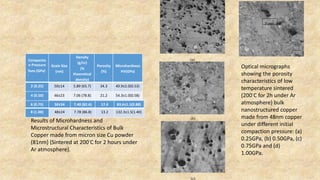
Optical micrographs
showing the porosity
characteristics of low
temperature sintered
(200◦C for 2h under Ar
atmosphere) bulk
nanostructured copper
made from 48nm copper
under different initial
compaction pressure: (a)
0.25GPa, (b) 0.50GPa, (c)
0.75GPa and (d)
1.00GPa.
(a)
50µ
50µ
(c)
50µ
50µ
b
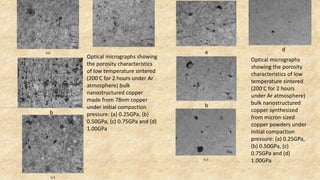
Optical micrographs showing
the porosity characteristics
of low temperature sintered
(200◦C for 2 hours under Ar
atmosphere) bulk
nanostructured copper
made from 78nm copper
under initial compaction
pressure: (a) 0.25GPa, (b)
0.50GPa, (c) 0.75GPa and (d)
1.00GPa
50µ
50µ
(c)
a
b
d
Optical micrographs
showing the porosity
characteristics of low
temperature sintered
(200◦C for 2 hours
under Ar atmosphere)
bulk nanostructured
copper synthesized
from micron sized
copper powders under
initial compaction
pressure: (a) 0.25GPa,
(b) 0.50GPa, (c)
0.75GPa and (d)
1.00GPa
CONCLUSION…
• Results of nanostructured copper synthesized from n-Cu (48nm) powder: The
results revealed that microhardness increased with an increase in compaction
pressure.
• Results of nanostructured copper synthesized from n-Cu (78nm) powder: The
results also revealed that microhardness increased with an increase in
compaction pressure.
• Results of nanostructured copper synthesized from micron size Cu powder :
The results revealed that microhardness increased with an increase in
compaction pressure, with a maximum increase obtained at 1GPa compaction
pressure.
Plasma compaction & electrodeposition (Nanotechnology)

Plasma compaction & electrodeposition (Nanotechnology)

  • 1.
    PLASMA COMPACTION & ELECTRODEPOSITION NAME: AliasgarMandsaurwala SAP ID: 60011115028 SUBJECT: Nanotechnology
  • 2.
    INTRODUCTION… • Most synthesizingmethods produce nanostructured materials in a powder form but bulk large dimension specimens or metal film is often needed for reliable mechanical testing to be carried out. • Various methods producing bulk or metal film, for example, • consolidation of powders • Deposition and • Severe plastic deformation have been developed. • Consolidation of nanopowders into a bulk form by conventional methods such as hot pressing, extrusion, hot isostatic pressing (HIP) can coarsen the grains under the application of heat and pressure. • Severe plastic deformation (SPD) is a promising method to deform bulk structures having coarser grains into submicron and nanostructured products. • Furthermore, solution phase synthesis, plasma pressure compaction, microwave sintering and pulsed electrodeposition have also been used to synthesize bulk nanostrucutred metals and alloys.
  • 3.
    • Nanostructured coatingsoffer great potential due to their superior characteristics that are not typically found in conventional coatings. • Because of the small grain size and consequently the large volume fraction of atoms in or near the grain boundaries, these materials exhibit properties that are often superior and sometimes completely new, in comparison with those of conventional coarse-grained materials. • These include increased strength/hardness, enhanced diffusivity, improved ductility/toughness, reduced density, reduced elastic modulus, higher electrical resistivity, increased specific heat, higher coefficient of thermal expansion, lower thermal conductivity, increased corrosion and wear resistance and superior soft magnetic properties.
  • 4.
    ELECTRODEPOSITION… • Nanostructured depositsare formed on a cathode surface during plating by properly controlling the electrodeposition parameters, e.g. bath composition, temperature, pH, etc. • A very large number of pure metals, alloys and ceramics can be electrodeposited with grain sizes less than 100-nm. • Pure metals, alloys, multilayered structures, metal matrix composites have been successfully produced by electrodeposition methods. • Electrodeposition is also an effective route to produce dense nanostructured sheets for mechanical measurements. • Its low cost, industrial applicability, high production rates have attracted much interest in this technology for the deposition of nanostructured metals for industrial applications.
  • 5.
    • To obtainenhanced characteristics of any nanocoating, it is essential to optimize the bath (electrolyte) composition as well as the deposition parameters in addition to selecting appropriate anode and cathode materials with a suitable coating. • Bath composition and deposition parameters for Ni–AIN nanocoating. NiSO4 · 6H2O 300 g/l NiCl2 · 6H2O 45 g/l H3BO3 40 g/l AlN powder 0–55 g/l pH 2–6 Current density 0.5–5 A dm −2 Temperature 55 ◦C. • The application of NC materials requires that these powders are consolidated to their full density with minimal porosity, and this is not easy to achieve. • Full densification with complete interparticle bonding requires the exposure of the powder to high temperatures and pressures for extended periods of time, which is likely to coarsen the microstructural features. • The retention of the material in the NC state, however, warrants that the powder is not exposed to high temperatures for longer periods of time; this may not result in complete densification. • Thus, successful consolidation to full density requires innovative methods of consolidation. • However, the nanostructured materials produced by ED and amorphous crystallization that lead to the direct fabrication of high-density bulk materials are not subject to these concerns
  • 7.
    ADVANTAGES OF ED… •Electrochemical deposition, also being an atomic deposition process, can be used to synthesize nanocomposites. • The obvious advantages of this century-old process of ED are as follows: • a. Rapidity • b. Low cost • c. Free from porosity Pure nickel Ni-AlN (current density: 2A dm−2 , pH: 5.5. temperature: 55 ◦C) • d. High purity. • e. Industrial applicability. • f. Potential to overcome shape limitations or allows the production of free-standing parts with complex shapes. • g. Higher deposition rates. • h. Produce coatings on widely differing substrates. • i. Ability to produce structural features with sizes ranging from nm to µm. • j. Easy to control alloy composition. • k. Ability to produce compositions unattainable by other techniques. • l. The possibility of forming of simple low-cost multilayers in many different systems, e.g. Cu/Ni, Ni/Ni–P etc. m. No postdeposition treatment
  • 8.
    OTHER ADVANTAGES • lowcost and industrial applicability. • Simple operation. • Versatility. • High production rates. • Well established industrial infrastructure. • Relatively low cost of application, whereby nanostructured materials can be produced by simple modification of bath chemistries and electrical parameters used in current plating and electroforming operations. • Capability in a single-step process of producing pure metals, alloys, and metalmatrix composites in various forms. • Ability to produce fully dense nanostructures free of porosity.
  • 9.
    SEM image ofpure Ni and nanostructured Ni– alumina composite coating (temperature: 40◦C, pH: 4.0, current density:2Adm−2) Pure nickel Ni-Alumina
  • 10.
    . SEM imageof pure Ni and N-AlN composite coating (current density: 2Adm−2, pH: 5.5. temperature: 55◦C) Pure nickel Ni-AlN
  • 11.
    SEM images oftypical microcrystalline (left) and nanocrystalline (right) Ni-Zn coatings
  • 12.
    The hardness asa function of average grain size
  • 13.
    PLASMA PRESSURE COMPACTION • Plasmapressure compaction is a rapid densification process developed by Materials Modification Incorporation (MMI, Fairfax, VA, USA). • It is economically affordable, efficient and viable approach and it has the potential to minimize grain growth by enhancing particle sinterability through the conjoint action of particle surface activation and rapid heating for very short durations. • The technique of plasma pressure compaction is a short-time, high temperature, low pressure process that has been successfully used to compact micron size, ultrafine as well as nanometer metallic, intermetallic and ceramic powders to full density and near-net shapes. • In the PPC procedure, powders are simply poured into a graphite die and compacted by graphite punches. • At the beginning of the process, pulsed DC voltage is applied through the powder compacts to generate an interparticle plasma that activates the surface by removing the oxide or contamination layers. • Subsequently, DC voltage is applied to achieve rapid densification by resistance sintering under uniaxial pressure.
  • 14.
    ADVANTAGES… • The advantagesof the P2C technique are: • Reduced processing temperatures, • Significant reduction in the consolidation time, (minutes versus hours). • Lower oxygen content in the final part, • Higher density, • Does not need precompaction or the use of canning devices, • Absence of sintering aids and additives • The P2C process can be applied to all kinds of metals, intermetallics and quasiceramics. P2C machines are designed based on the desired sample size, shape and the type of material. In addition the P2C machine can be used to reactively synthesize and form near net shaped parts or can be used to reactively join selected dissimilar materials. • Another major advantage of the P2C setup is that it can be used very successfully on micron sized powders as an alternative to Hip'ing or hot pressing. • The typical shapes that can be produced using this machine can range from cylinders to hollow tubes and circular plates. We can also provide the above shapes in a range of sizes.
  • 15.
    Compaction Pressure Tons(GPa) Grain Size (nm) Density (g/cc) (% theoretical density) Porosity (%) Microhardness HV(GPa) 2 (0.25)51±14 5.19 ( 58.1) 41.8 29.3±1.1(0.32) 4 (0.50) 49±15 5.48 (61.2) 38.6 85.0±1.0(0.90) 6 (0.75) 34±10 6.15 ( 68.8) 31.1 108.6±4.1(1.14) 8 (1.00) 27±4 6.57 (73.6) 26.4 147.3±3.5(1.55) Results of Microhardness and Microstructural Characteristics of Bulk Copper made from 48nm Cu powder (Sintered at 200◦C for 2 hours under Ar atmosphere) Compaction Pressure Tons(GPa) Grain Size (nm) Density (g/cc) (% theoretical density) Porosity (%) Microhardness HV(GPa) 2 (0.25) 68±20 5.86 (65.4) 34.6 69.4±2.5(0.73) 4 (0.50) 44±14 6.78 (75.7) 24.3 101.0±3.6(1.01) 6 (0.75) 44±13 7.22 (84.0) 16.0 127.0±3.2(1.34) 8 (1.00) 41±11 7.68 (85.7) 14.3 158.4±7.9(1.67) Results of Microhardness and Microstructural Characteristics of Bulk Copper made from 78nm Cu powder (Sintered at 200◦C for 2 hours under Ar atmosphere)
  • 16.
    Compactio n Pressure Tons (GPa) ` GrainSize (nm) Density (g/cc) (% theoretical density) Porosity (%) Microhardness HV(GPa) 2 (0.25) 50±14 5.89 (65.7) 34.3 49.9±2.0(0.53) 4 (0.50) 46±23 7.06 (78.8) 21.2 54.3±1.0(0.58) Results of Microhardness and Microstructural Characteristics of Bulk Copper made from micron size Cu powder (81nm) (Sintered at 200◦C for 2 hours under Ar atmosphere). 6 (0.75) 50±34 7.40 (82.6) 17.4 83.6±1.1(0.88) 8 (1.00) 48±24 7.78 (86.8) 13.2 132.3±1.5(1.40) 50µ (a) (b) 50µ (c) Pores 50µ Optical micrographs showing the porosity characteristics of low temperature sintered (200◦C for 2h under Ar atmosphere) bulk nanostructured copper made from 48nm copper under different initial compaction pressure: (a) 0.25GPa, (b) 0.50GPa, (c) 0.75GPa and (d) 1.00GPa.
  • 17.
    (a) 50µ 50µ (c) 50µ 50µ b Optical micrographs showing theporosity characteristics of low temperature sintered (200◦C for 2 hours under Ar atmosphere) bulk nanostructured copper made from 78nm copper under initial compaction pressure: (a) 0.25GPa, (b) 0.50GPa, (c) 0.75GPa and (d) 1.00GPa 50µ 50µ (c) a b d Optical micrographs showing the porosity characteristics of low temperature sintered (200◦C for 2 hours under Ar atmosphere) bulk nanostructured copper synthesized from micron sized copper powders under initial compaction pressure: (a) 0.25GPa, (b) 0.50GPa, (c) 0.75GPa and (d) 1.00GPa
  • 18.
    CONCLUSION… • Results ofnanostructured copper synthesized from n-Cu (48nm) powder: The results revealed that microhardness increased with an increase in compaction pressure. • Results of nanostructured copper synthesized from n-Cu (78nm) powder: The results also revealed that microhardness increased with an increase in compaction pressure. • Results of nanostructured copper synthesized from micron size Cu powder : The results revealed that microhardness increased with an increase in compaction pressure, with a maximum increase obtained at 1GPa compaction pressure.