Presented by:
Aliasgar Mandsaurwala
MMS Operations- 15
ROADMAP
• Law firms are defined in terms of knowledge organizations.
• Knowledge management is presented in terms of the
knowledge-based view of the firm.
• Knowledge categories in law firms are presented. The role
of IT is then discussed
• Proposed knowledge management technology (KMT) is
presented and applied to law firms.
INTRODUCTION
• Lawyers can be defined as knowledge
workers.
• They are professionals who have
gained knowledge through formal
education (explicit) and through
learning on the job (tacit).
• Having joined as associates in law,
they largely bring explicit knowledge
derived from formal education into
their firms and build tacit knowledge
through experience
• The legal industry will change rapidly
because of three important trends.
1. Global companies seek out law firms
that can provide consistent support
at all business locations
2. Client loyalty is decreasing as
companies increasingly base
purchases of legal services on a
more objective assessment of their
value.
3. New competitors have entered the
market, such as accounting firms
and Internet-based legal services
firms.
• Knowledge management can be
improved in law firms, and information
technology can be an enabler
KNOWLEDGE MANAGEMENT
• Core knowledge: is the basic knowledge required to stay in business. This
is the type of knowledge that can create efficiency barriers for entry of
new companies. Eg: Knowledge of the law, courts, clients and procedures.
• Advanced knowledge: is what makes the firm competitively visible and
active. Such knowledge allows the firm to differentiate its products and
services from that of a competitor. Eg: knowledge of law applications,
important court rulings and successful procedural case handling.
• Innovative knowledge: allows a firm to lead its entire industry to an extent
that clearly differentiates it from competition. Eg: knowledge of
standardized repetitive legal cases, successful settlements and modern
information technology.
KNOWLEDGE CATEGORIES IN LAW FIRMS
• Administrative knowledge
• Declarative knowledge
• Procedural knowledge
• Analytical knowledge
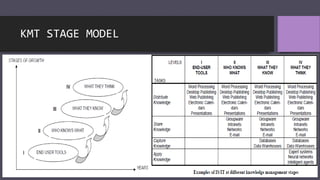
KMT STAGE MODEL
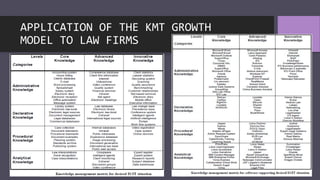
APPLICATION OF THE KMT GROWTH
MODEL TO LAW FIRMS
FUTURE
• Six kinds of expert systems can play an important role in
law firms in the future:
1. Diagnostic system
2. Planning system
3. Procedural guides
4. The intelligent checklist
5. Document modeling systems
6. Argument generating systems
Knowledge management for growth

Knowledge management for growth

  • 1.
  • 2.
    ROADMAP • Law firmsare defined in terms of knowledge organizations. • Knowledge management is presented in terms of the knowledge-based view of the firm. • Knowledge categories in law firms are presented. The role of IT is then discussed • Proposed knowledge management technology (KMT) is presented and applied to law firms.
  • 3.
    INTRODUCTION • Lawyers canbe defined as knowledge workers. • They are professionals who have gained knowledge through formal education (explicit) and through learning on the job (tacit). • Having joined as associates in law, they largely bring explicit knowledge derived from formal education into their firms and build tacit knowledge through experience • The legal industry will change rapidly because of three important trends. 1. Global companies seek out law firms that can provide consistent support at all business locations 2. Client loyalty is decreasing as companies increasingly base purchases of legal services on a more objective assessment of their value. 3. New competitors have entered the market, such as accounting firms and Internet-based legal services firms. • Knowledge management can be improved in law firms, and information technology can be an enabler
  • 4.
    KNOWLEDGE MANAGEMENT • Coreknowledge: is the basic knowledge required to stay in business. This is the type of knowledge that can create efficiency barriers for entry of new companies. Eg: Knowledge of the law, courts, clients and procedures. • Advanced knowledge: is what makes the firm competitively visible and active. Such knowledge allows the firm to differentiate its products and services from that of a competitor. Eg: knowledge of law applications, important court rulings and successful procedural case handling. • Innovative knowledge: allows a firm to lead its entire industry to an extent that clearly differentiates it from competition. Eg: knowledge of standardized repetitive legal cases, successful settlements and modern information technology.
  • 5.
    KNOWLEDGE CATEGORIES INLAW FIRMS • Administrative knowledge • Declarative knowledge • Procedural knowledge • Analytical knowledge
  • 6.
  • 7.
    APPLICATION OF THEKMT GROWTH MODEL TO LAW FIRMS
  • 8.
    FUTURE • Six kindsof expert systems can play an important role in law firms in the future: 1. Diagnostic system 2. Planning system 3. Procedural guides 4. The intelligent checklist 5. Document modeling systems 6. Argument generating systems