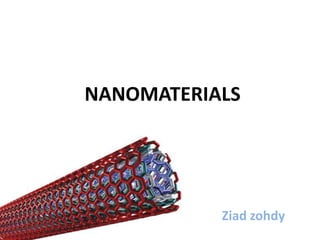
NANOMATERIALS
Ziad zohdy
What is nanomaterial
• Nanomaterials are commonly defined as
materials with an average grain size less than 100
nanometers
• Nanomaterials have extremely small size which
having at least one dimension 100 nm
• One billion nanometers equals one meter
• The average width of a human hair is on the order of
100,000 nanometers
• A single particle of smoke is in the order of
1,000 nanometers
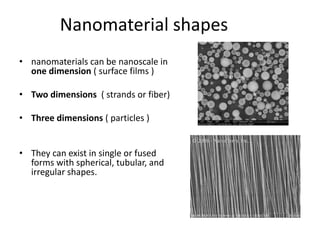
Nanomaterial shapes
• nanomaterials can be nanoscale in
one dimension ( surface films )
• Two dimensions ( strands or fiber)
• Three dimensions ( particles )
• They can exist in single or fused
forms with spherical, tubular, and
irregular shapes.
Why nanomaterials ?
• Nanotechnology exploits benefits of ultra
small size, enabling the use of particles to
deliver a range of important benefits
– Small particles are ‘invisible’ :
• Transparent Coatings/Films are attainable
– Small particles are very weight efficient:
• Surfaces can be modified with minimal material
• the behavior of nanomaterials may depend
more on surface area than particle
composition itself.
• Relative-surface area is one of the principal
factors that enhance its reactivity, strength
and electrical properties.
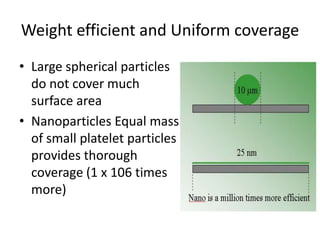
Weight efficient and Uniform coverage
• Large spherical particles
do not cover much
surface area
• Nanoparticles Equal mass
of small platelet particles
provides thorough
coverage (1 x 10⁶ times
more)
• by patterning matter on the nano scale, it is
possible to vary fundamental properties of
materials without changing the chemical
composition
Approaches
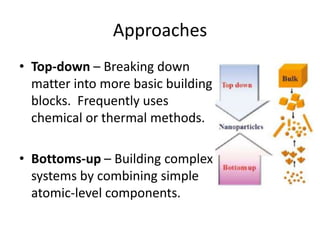
• Top-down – Breaking down
matter into more basic building
blocks. Frequently uses
chemical or thermal methods.
• Bottoms-up – Building complex
systems by combining simple
atomic-level components.
Methods for creating nanostructures
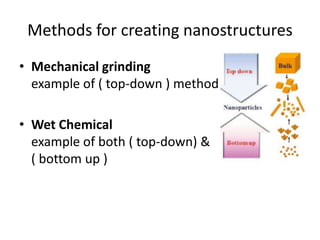
• Mechanical grinding
example of ( top-down ) method
• Wet Chemical
example of both ( top-down) &
( bottom up )
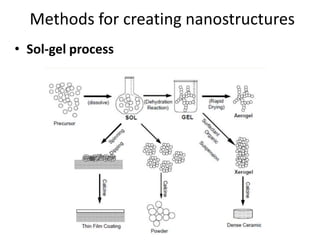
• Sol-gel process
Methods for creating nanostructures
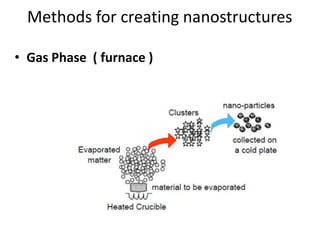
• Gas Phase ( furnace )
Methods for creating nanostructures
Different types of Nanomaterial
• Nanopowder
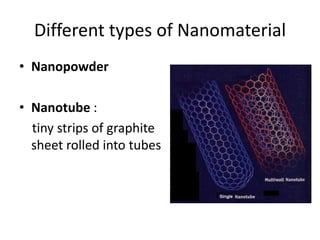
• Nanotube :
tiny strips of graphite
sheet rolled into tubes
Why are nanomaterials important
• These materials have created a high interest in recent
years by their high mechanical, electrical, optical and
magnetic properties.
Applications of nanomaterials
• nanophase ceramics
• nanostructured semiconductors
• Nanosized metallic powders
• Single nanosized magnetic particles
• Nanostructured metal-oxide thin films
Thank you
Ziad zohdy

Intro to nanomaterial

  • 1.
  • 2.
    What is nanomaterial •Nanomaterials are commonly defined as materials with an average grain size less than 100 nanometers • Nanomaterials have extremely small size which having at least one dimension 100 nm • One billion nanometers equals one meter
  • 3.
    • The averagewidth of a human hair is on the order of 100,000 nanometers • A single particle of smoke is in the order of 1,000 nanometers
  • 4.
    Nanomaterial shapes • nanomaterialscan be nanoscale in one dimension ( surface films ) • Two dimensions ( strands or fiber) • Three dimensions ( particles ) • They can exist in single or fused forms with spherical, tubular, and irregular shapes.
  • 5.
    Why nanomaterials ? •Nanotechnology exploits benefits of ultra small size, enabling the use of particles to deliver a range of important benefits – Small particles are ‘invisible’ : • Transparent Coatings/Films are attainable – Small particles are very weight efficient: • Surfaces can be modified with minimal material
  • 6.
    • the behaviorof nanomaterials may depend more on surface area than particle composition itself. • Relative-surface area is one of the principal factors that enhance its reactivity, strength and electrical properties.
  • 7.
    Weight efficient andUniform coverage • Large spherical particles do not cover much surface area • Nanoparticles Equal mass of small platelet particles provides thorough coverage (1 x 10⁶ times more)
  • 8.
    • by patterningmatter on the nano scale, it is possible to vary fundamental properties of materials without changing the chemical composition
  • 9.
    Approaches • Top-down –Breaking down matter into more basic building blocks. Frequently uses chemical or thermal methods. • Bottoms-up – Building complex systems by combining simple atomic-level components.
  • 10.
    Methods for creatingnanostructures • Mechanical grinding example of ( top-down ) method • Wet Chemical example of both ( top-down) & ( bottom up )
  • 11.
    • Sol-gel process Methodsfor creating nanostructures
  • 12.
    • Gas Phase( furnace ) Methods for creating nanostructures
  • 13.
    Different types ofNanomaterial • Nanopowder • Nanotube : tiny strips of graphite sheet rolled into tubes
  • 14.
    Why are nanomaterialsimportant • These materials have created a high interest in recent years by their high mechanical, electrical, optical and magnetic properties. Applications of nanomaterials • nanophase ceramics • nanostructured semiconductors • Nanosized metallic powders • Single nanosized magnetic particles • Nanostructured metal-oxide thin films
  • 15.