NAME: SUKESH HEGDE
1
SOL-GEL METHD CONSISTS SEVARAL STEPS
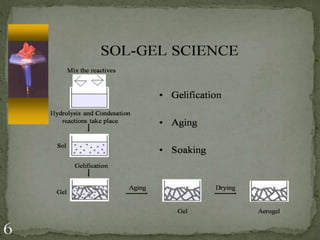
1) SOL FORMATION: Hydrolysis of metal organic reactant in an organic solvent
that is miscrible with water or inorganic salts in water results in formation of
sol
M-O-R + H2O M-OH + R-OH (hydrolysis)
2)GEL FORMATION: Condensation followed by polycondensation of sol results
in the formation of the gel.
Water condensation: hydrolysed species condense releasing water.
M-OH + HO-M M-O-M + H2O
Alcohol condensation: Hydrolysed species condense with unhydrolysed
species releasing alcohol.
M-O-R + HO-M M-O-M + R-OH
Aging of gel during which polycondensation reaction occurs, can exceed 7
days is critical to the prevention of cracks in gels that have been cast.
3)DRYING: It is nothing but removal of pore liquid
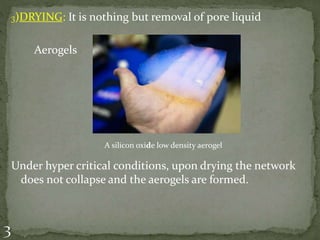
Aerogels
Under hyper critical conditions, upon drying the network
does not collapse and the aerogels are formed.
A silicon oxide low density aerogel
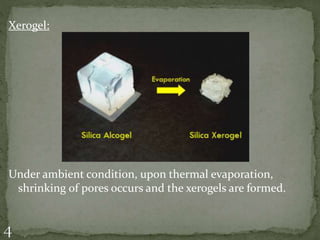
Xerogel:
Under ambient condition, upon thermal evaporation,
shrinking of pores occurs and the xerogels are formed.
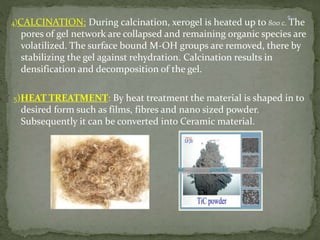
4)CALCINATION: During calcination, xerogel is heated up to 800 c. The
pores of gel network are collapsed and remaining organic species are
volatilized. The surface bound M-OH groups are removed, there by
stabilizing the gel against rehydration. Calcination results in
densification and decomposition of the gel.
5)HEAT TREATMENT: By heat treatment the material is shaped in to
desired form such as films, fibres and nano sized powder.
Subsequently it can be converted into Ceramic material.
Advantages:
a)Mono sized nano particals are produced by this
method.
b)It is useful for the synthesis of glases,glass ceramics or
ceramic meterials at lower temparature
Disadvantages:
a)Controlling the growth of the particles.
b)Avoiding the agglomerating of newly formed particles.
Reference:
www.google.com
www.srmuniv.ac.in
sol gel method

sol gel method

  • 1.
  • 2.
  • 3.
    SOL-GEL METHD CONSISTSSEVARAL STEPS 1) SOL FORMATION: Hydrolysis of metal organic reactant in an organic solvent that is miscrible with water or inorganic salts in water results in formation of sol M-O-R + H2O M-OH + R-OH (hydrolysis) 2)GEL FORMATION: Condensation followed by polycondensation of sol results in the formation of the gel. Water condensation: hydrolysed species condense releasing water. M-OH + HO-M M-O-M + H2O Alcohol condensation: Hydrolysed species condense with unhydrolysed species releasing alcohol. M-O-R + HO-M M-O-M + R-OH Aging of gel during which polycondensation reaction occurs, can exceed 7 days is critical to the prevention of cracks in gels that have been cast.
  • 4.
    3)DRYING: It isnothing but removal of pore liquid Aerogels Under hyper critical conditions, upon drying the network does not collapse and the aerogels are formed. A silicon oxide low density aerogel
  • 5.
    Xerogel: Under ambient condition,upon thermal evaporation, shrinking of pores occurs and the xerogels are formed.
  • 6.
    4)CALCINATION: During calcination,xerogel is heated up to 800 c. The pores of gel network are collapsed and remaining organic species are volatilized. The surface bound M-OH groups are removed, there by stabilizing the gel against rehydration. Calcination results in densification and decomposition of the gel. 5)HEAT TREATMENT: By heat treatment the material is shaped in to desired form such as films, fibres and nano sized powder. Subsequently it can be converted into Ceramic material.
  • 8.
    Advantages: a)Mono sized nanoparticals are produced by this method. b)It is useful for the synthesis of glases,glass ceramics or ceramic meterials at lower temparature Disadvantages: a)Controlling the growth of the particles. b)Avoiding the agglomerating of newly formed particles.
  • 9.

Editor's Notes