
GANDHINAGAR INSTITUTE OF
TECHONOLOGY(012)
SUBJECT : Physics (2110011)
Active Learning Assignment on the topic of
“ Introduction to Nano-materials “
BE Mechanical
Prepared By: Yash Pandya
Guided By :
CONTAIN
 Introduction
 Classification of Synthesis Method
 Techniques Used in Synthesis Method
 Properties & Applications of Nano-Materials
 Disadvantages of Nano-Materials
 References
What are Nano-Materials?
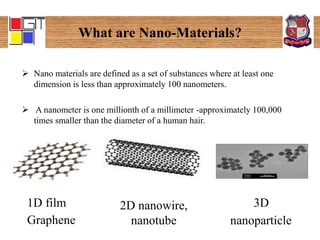
 Nano materials are defined as a set of substances where at least one
dimension is less than approximately 100 nanometers.
 A nanometer is one millionth of a millimeter -approximately 100,000
times smaller than the diameter of a human hair.
1D film
Graphene
2D nanowire,
nanotube
3D
nanoparticle
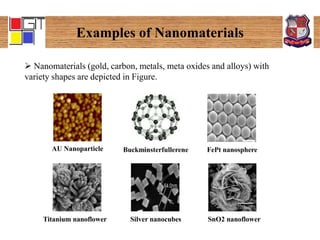
Examples of Nanomaterials
 Nanomaterials (gold, carbon, metals, meta oxides and alloys) with
variety shapes are depicted in Figure.
AU Nanoparticle Buckminsterfullerene FePt nanosphere
Titanium nanoflower Silver nanocubes SnO2 nanoflower
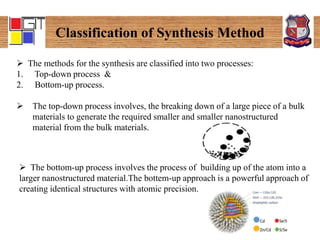
Classification of Synthesis Method
 The methods for the synthesis are classified into two processes:
1. Top-down process &
2. Bottom-up process.
 The top-down process involves, the breaking down of a large piece of a bulk
materials to generate the required smaller and smaller nanostructured
material from the bulk materials.
 The bottom-up process involves the process of building up of the atom into a
larger nanostructured material.The bottem-up approach is a powerful approach of
creating identical structures with atomic precision.
Techniques Used in Synthesis Method
 Various techniques are adopted for the synthesis of nano-materials based
on the above two process…
 For Top-down process : 1. Milling
2. Lithographics
3. Machining
 For Bottom-up process : 1. Plasma assisted deposition process.
2. Vapour deposition methods.
3. Liquid phase processes.
4. Molecular Beam Epitaxy.
5. Laser synthesis
PROPERTIES
 The nano-materials have high strength, hardness, formability and
toughness.
 Its magnetic moment can be increased by decreasing the particle size.
 Opticle density can be varied with the diameter.
 The melting point gets reduced on reducing the grain size.
 The magnetisation is higher.
APPLICATIONS
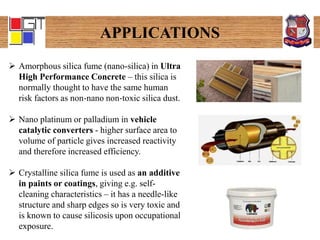
 Amorphous silica fume (nano-silica) in Ultra
High Performance Concrete – this silica is
normally thought to have the same human
risk factors as non‐nano non‐toxic silica dust.
 Nano platinum or palladium in vehicle
catalytic converters - higher surface area to
volume of particle gives increased reactivity
and therefore increased efficiency.
 Crystalline silica fume is used as an additive
in paints or coatings, giving e.g. self-
cleaning characteristics – it has a needle-like
structure and sharp edges so is very toxic and
is known to cause silicosis upon occupational
exposure.
Nano-medicine
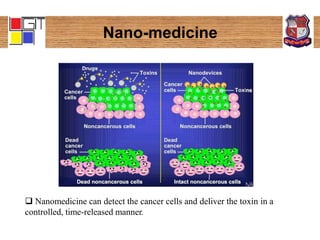
 Nanomedicine can detect the cancer cells and deliver the toxin in a
controlled, time-released manner.
Disadvantages
 Impurity
 Difficulity in synthesis, isolation & application
 Instability of the particles
 Biologically harmful
 More costly to produce compared to bulk materials
 Recycling and disposal
References
 http://en.wikipedia.org/wiki/Nanomaterials
 http://en.wikipedia.org/wiki/Atomic_force_microscopy
 Processing and synthesis techniques for the preparation
of nanomaterials
Thank You

Introduction to Nano-materials

  • 1.
    GANDHINAGAR INSTITUTE OF TECHONOLOGY(012) SUBJECT: Physics (2110011) Active Learning Assignment on the topic of “ Introduction to Nano-materials “ BE Mechanical Prepared By: Yash Pandya Guided By :
  • 2.
    CONTAIN  Introduction  Classificationof Synthesis Method  Techniques Used in Synthesis Method  Properties & Applications of Nano-Materials  Disadvantages of Nano-Materials  References
  • 3.
    What are Nano-Materials? Nano materials are defined as a set of substances where at least one dimension is less than approximately 100 nanometers.  A nanometer is one millionth of a millimeter -approximately 100,000 times smaller than the diameter of a human hair. 1D film Graphene 2D nanowire, nanotube 3D nanoparticle
  • 4.
    Examples of Nanomaterials Nanomaterials (gold, carbon, metals, meta oxides and alloys) with variety shapes are depicted in Figure. AU Nanoparticle Buckminsterfullerene FePt nanosphere Titanium nanoflower Silver nanocubes SnO2 nanoflower
  • 5.
    Classification of SynthesisMethod  The methods for the synthesis are classified into two processes: 1. Top-down process & 2. Bottom-up process.  The top-down process involves, the breaking down of a large piece of a bulk materials to generate the required smaller and smaller nanostructured material from the bulk materials.  The bottom-up process involves the process of building up of the atom into a larger nanostructured material.The bottem-up approach is a powerful approach of creating identical structures with atomic precision.
  • 6.
    Techniques Used inSynthesis Method  Various techniques are adopted for the synthesis of nano-materials based on the above two process…  For Top-down process : 1. Milling 2. Lithographics 3. Machining  For Bottom-up process : 1. Plasma assisted deposition process. 2. Vapour deposition methods. 3. Liquid phase processes. 4. Molecular Beam Epitaxy. 5. Laser synthesis
  • 7.
    PROPERTIES  The nano-materialshave high strength, hardness, formability and toughness.  Its magnetic moment can be increased by decreasing the particle size.  Opticle density can be varied with the diameter.  The melting point gets reduced on reducing the grain size.  The magnetisation is higher.
  • 8.
    APPLICATIONS  Amorphous silicafume (nano-silica) in Ultra High Performance Concrete – this silica is normally thought to have the same human risk factors as non‐nano non‐toxic silica dust.  Nano platinum or palladium in vehicle catalytic converters - higher surface area to volume of particle gives increased reactivity and therefore increased efficiency.  Crystalline silica fume is used as an additive in paints or coatings, giving e.g. self- cleaning characteristics – it has a needle-like structure and sharp edges so is very toxic and is known to cause silicosis upon occupational exposure.
  • 9.
    Nano-medicine  Nanomedicine candetect the cancer cells and deliver the toxin in a controlled, time-released manner.
  • 10.
    Disadvantages  Impurity  Difficulityin synthesis, isolation & application  Instability of the particles  Biologically harmful  More costly to produce compared to bulk materials  Recycling and disposal
  • 11.
  • 12.