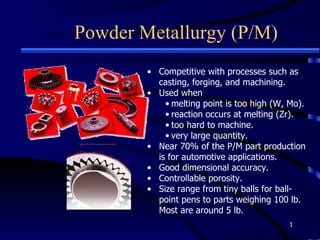
Powder Metallurgy (P/M) Competitive with processes such as casting, forging, and machining.  Used when melting point is too high (W, Mo). reaction occurs at melting (Zr). too hard to machine. very large quantity.  Near 70% of the P/M part production is for automotive applications. Good dimensional accuracy. Controllable porosity. Size range from tiny balls for ball-point pens to parts weighing 100 lb. Most are around 5 lb.
Basic Steps In Powder Metallurgy Powder Production Blending or Mixing Powder Consolidation Sintering Finishing
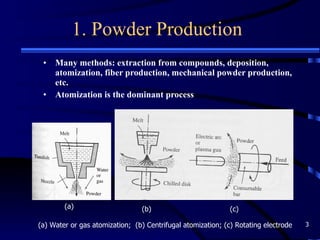
1. Powder Production Many methods: extraction from compounds, deposition, atomization, fiber production, mechanical powder production, etc. Atomization is the dominant process (a) (b) (c) (a) Water or gas atomization;  (b) Centrifugal atomization; (c) Rotating electrode
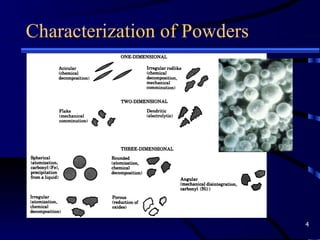
Characterization of Powders Size of powders 0.1 um – 1 mm Sieve size quoted as mesh number Particle D = 15/mesh number (mm) 325 mesh   45 um
2. Blending or Mixing Blending a coarser fraction with a finer fraction ensures that the interstices between large particles will be filled out. Powders of different metals and other materials may be mixed in order to impart special physical and mechanical properties through metallic alloying. Lubricants may be mixed to improve the powders’ flow characteristics. Binders such as wax or thermoplastic polymers are added to improve green strength. Sintering aids are added to accelerate densification on heating.
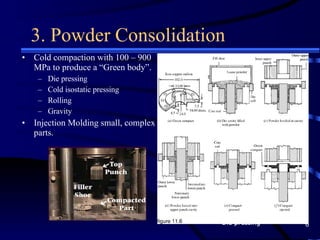
3. Powder Consolidation Cold compaction with 100 – 900 MPa to produce a “Green body”. Die pressing  Cold isostatic pressing Rolling Gravity Injection Molding small, complex parts. Die pressing
Friction problem in cold compaction W. Li The effectiveness of pressing with a single-acting punch is limited. Wall friction opposes compaction.  The pressure tapers off rapidly and density diminishes away from the punch. Floating container and two counteracting punches help alleviate the problem.
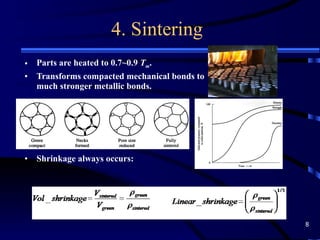
4. Sintering Parts are heated to 0.7~0.9  T m . Transforms compacted mechanical bonds to much stronger metallic bonds.  Shrinkage always occurs:
5. Finishing The porosity of a fully sintered part is still significant (4-15%).  Density is often kept intentionally low to preserve interconnected porosity for bearings, filters, acoustic barriers, and battery electrodes. However, to improve properties, finishing processes are needed: Cold restriking, resintering, and heat treatment. Impregnation of heated oil.  Infiltration with metal (e.g., Cu for ferrous parts). Machining to tighter tolerance.
Special Process: Hot compaction Advantages can be gained by combining consolidation and sintering,  High pressure is applied at the sintering temperature to bring the particles together and thus accelerate sintering.  Methods include Hot pressing Spark sintering Hot isostatic pressing (HIP) Hot rolling and extrusion Hot forging of powder preform Spray deposition
Process Capabilities A: highest, B: median, C: lowest Con’tional HIP Injection Molding (IM) Precision IM Preform Forging Metal All All (SA, SS) All (Steel, SS) All Steel, SA Surface detail B B-C B A A Mass, kg 0.01-5(30) 0.1-10 10-7000 (e) 0.01-0.2 0.005-0.2 0.1-3 Min. section, mm 1.5 1 0.1 3 Min. core diam. mm 4-6 1 0.2 5 Tolerance +/-% 0.1 2 0.3 0.1 0.25 Throughput (pc/h) 100-1000 5-20 100-2000 100-2000 200-2000 Min. quantity 1000-50,000 1-100 10,000 10,000 100,000 Eq. Cost B-C A A-B A-B A-B
Design Aspects (a) Length to thickness ratio limited to 2-4; (b) Steps limited to avoid density variation; (c) Radii provided to extend die life, sleeves greater than 1 mm, through hole greater than 5 mm; (d) Feather-edged punches with flat face; (e) Internal cavity requires a draft; (f) Sharp corner should be avoided; (g) Large wall thickness difference should be avoided; (h) Wall thickness should be larger than 1 mm.
Advantages and Disadvantages of P/M Virtually unlimited choice of alloys, composites, and associated properties.  Refractory materials are popular by this process. Controlled porosity for self lubrication or filtration uses. Can be very economical at large run sizes (100,000 parts). Long term reliability through close control of dimensions and physical properties. Very good material utilization.  Limited part size and complexity  High cost of powder material. High cost of tooling.  Less strong parts than wrought ones.  Less well known process.

Powder Metallurgy

  • 1.
    Powder Metallurgy (P/M)Competitive with processes such as casting, forging, and machining. Used when melting point is too high (W, Mo). reaction occurs at melting (Zr). too hard to machine. very large quantity. Near 70% of the P/M part production is for automotive applications. Good dimensional accuracy. Controllable porosity. Size range from tiny balls for ball-point pens to parts weighing 100 lb. Most are around 5 lb.
  • 2.
    Basic Steps InPowder Metallurgy Powder Production Blending or Mixing Powder Consolidation Sintering Finishing
  • 3.
    1. Powder ProductionMany methods: extraction from compounds, deposition, atomization, fiber production, mechanical powder production, etc. Atomization is the dominant process (a) (b) (c) (a) Water or gas atomization; (b) Centrifugal atomization; (c) Rotating electrode
  • 4.
    Characterization of PowdersSize of powders 0.1 um – 1 mm Sieve size quoted as mesh number Particle D = 15/mesh number (mm) 325 mesh  45 um
  • 5.
    2. Blending orMixing Blending a coarser fraction with a finer fraction ensures that the interstices between large particles will be filled out. Powders of different metals and other materials may be mixed in order to impart special physical and mechanical properties through metallic alloying. Lubricants may be mixed to improve the powders’ flow characteristics. Binders such as wax or thermoplastic polymers are added to improve green strength. Sintering aids are added to accelerate densification on heating.
  • 6.
    3. Powder ConsolidationCold compaction with 100 – 900 MPa to produce a “Green body”. Die pressing Cold isostatic pressing Rolling Gravity Injection Molding small, complex parts. Die pressing
  • 7.
    Friction problem incold compaction W. Li The effectiveness of pressing with a single-acting punch is limited. Wall friction opposes compaction. The pressure tapers off rapidly and density diminishes away from the punch. Floating container and two counteracting punches help alleviate the problem.
  • 8.
    4. Sintering Partsare heated to 0.7~0.9 T m . Transforms compacted mechanical bonds to much stronger metallic bonds. Shrinkage always occurs:
  • 9.
    5. Finishing Theporosity of a fully sintered part is still significant (4-15%). Density is often kept intentionally low to preserve interconnected porosity for bearings, filters, acoustic barriers, and battery electrodes. However, to improve properties, finishing processes are needed: Cold restriking, resintering, and heat treatment. Impregnation of heated oil. Infiltration with metal (e.g., Cu for ferrous parts). Machining to tighter tolerance.
  • 10.
    Special Process: Hotcompaction Advantages can be gained by combining consolidation and sintering, High pressure is applied at the sintering temperature to bring the particles together and thus accelerate sintering. Methods include Hot pressing Spark sintering Hot isostatic pressing (HIP) Hot rolling and extrusion Hot forging of powder preform Spray deposition
  • 11.
    Process Capabilities A:highest, B: median, C: lowest Con’tional HIP Injection Molding (IM) Precision IM Preform Forging Metal All All (SA, SS) All (Steel, SS) All Steel, SA Surface detail B B-C B A A Mass, kg 0.01-5(30) 0.1-10 10-7000 (e) 0.01-0.2 0.005-0.2 0.1-3 Min. section, mm 1.5 1 0.1 3 Min. core diam. mm 4-6 1 0.2 5 Tolerance +/-% 0.1 2 0.3 0.1 0.25 Throughput (pc/h) 100-1000 5-20 100-2000 100-2000 200-2000 Min. quantity 1000-50,000 1-100 10,000 10,000 100,000 Eq. Cost B-C A A-B A-B A-B
  • 12.
    Design Aspects (a)Length to thickness ratio limited to 2-4; (b) Steps limited to avoid density variation; (c) Radii provided to extend die life, sleeves greater than 1 mm, through hole greater than 5 mm; (d) Feather-edged punches with flat face; (e) Internal cavity requires a draft; (f) Sharp corner should be avoided; (g) Large wall thickness difference should be avoided; (h) Wall thickness should be larger than 1 mm.
  • 13.
    Advantages and Disadvantagesof P/M Virtually unlimited choice of alloys, composites, and associated properties. Refractory materials are popular by this process. Controlled porosity for self lubrication or filtration uses. Can be very economical at large run sizes (100,000 parts). Long term reliability through close control of dimensions and physical properties. Very good material utilization. Limited part size and complexity High cost of powder material. High cost of tooling. Less strong parts than wrought ones. Less well known process.