Pratik Chaudhari 
TY mech 
MIS- 111210015 
Subject – AMT
Introduction 
 Non-conventional machining system in which metal is 
removed by electrochemical process 
 Characterized as ‘Reverse Electroplating’ means it 
removes metal instead of adding it 
 Normally used for mass production and for hard 
materials that are difficult to machine using 
conventional processes 
 Both external and internal geometries can be 
machined
Principle 
 Faraday’s law of electrolysis : 
The Weight of the substance produced during 
electrolysis process is directly proportional to 
1. the current which passes 
2.the length of time of process 
3.The equivalent weight of the material 
 Two dissimilar metals are in contact with an electrolyte 
and anode loses metal to cathode
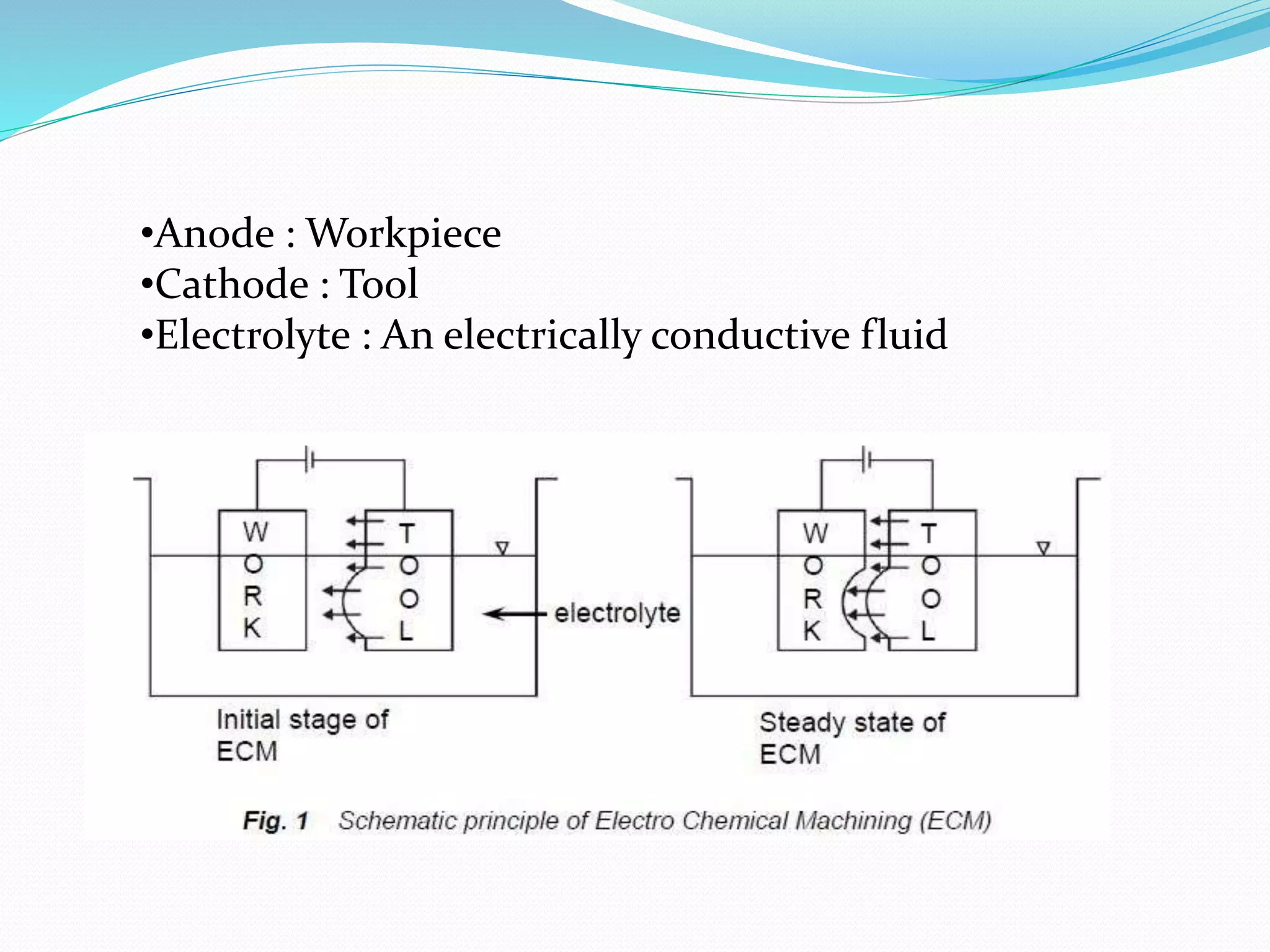
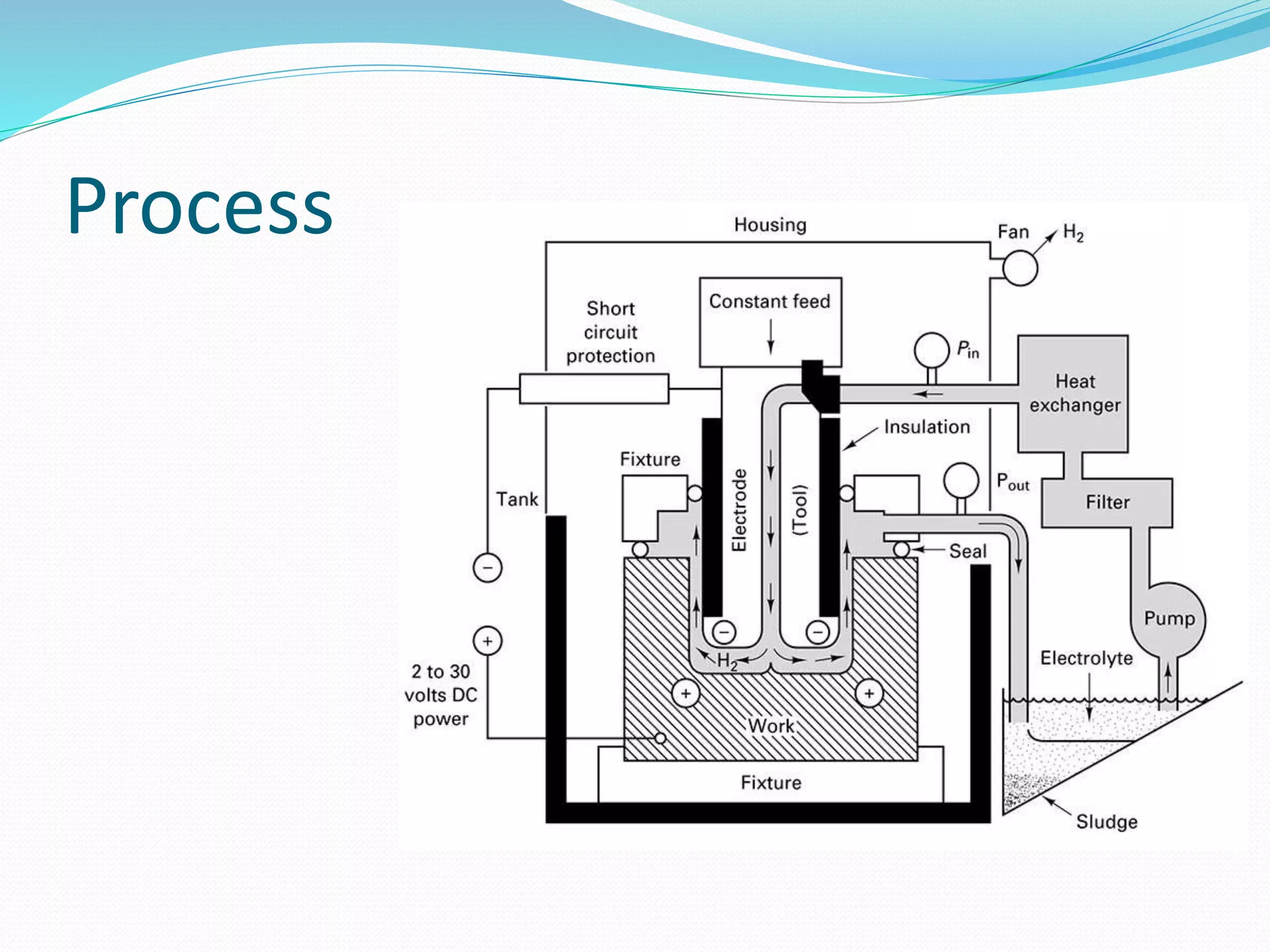
•Anode : Workpiece 
•Cathode : Tool 
•Electrolyte : An electrically conductive fluid
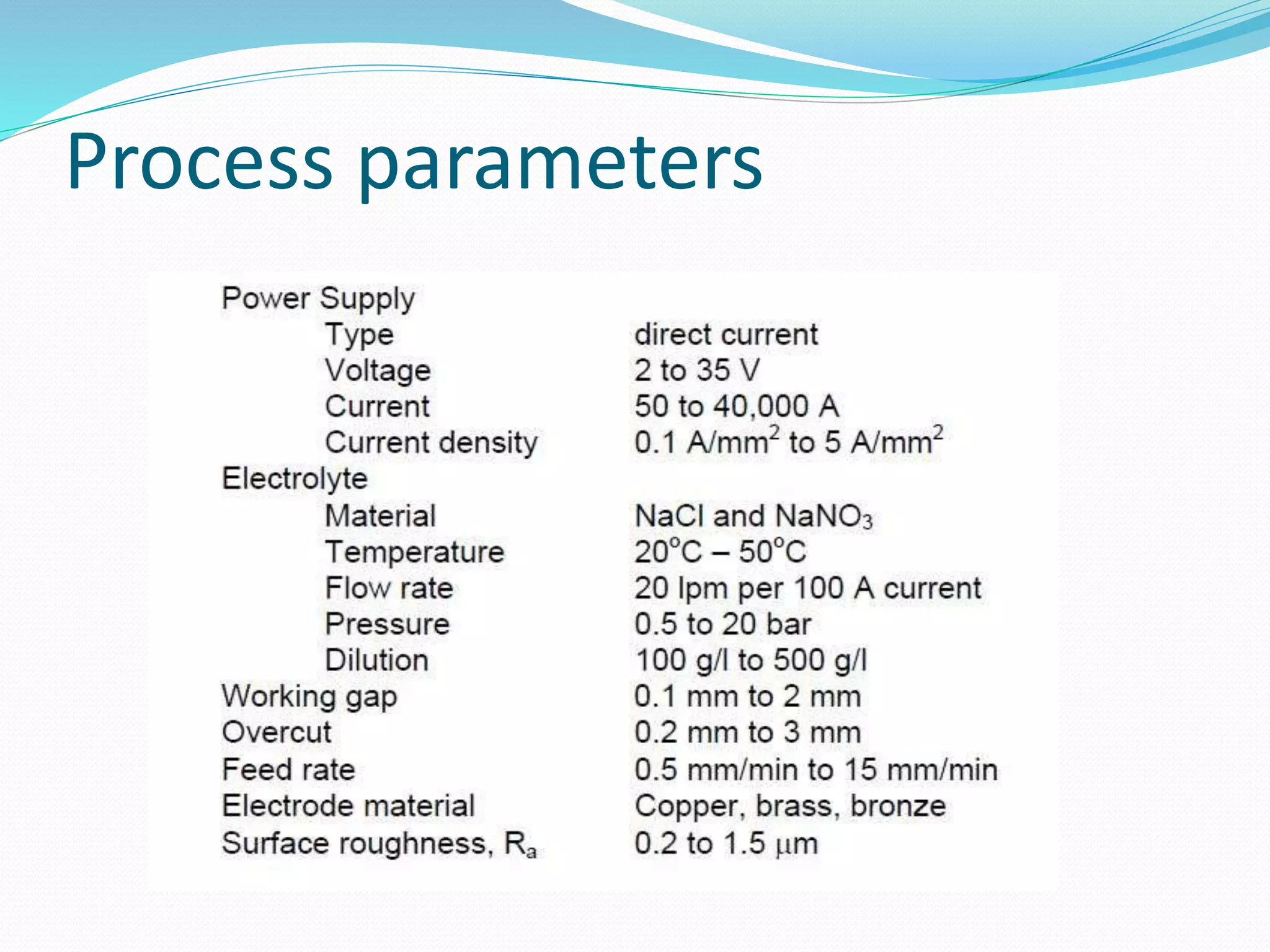
Process parameters
Process
Main subsytem 
 Power Supply 
 Electrolyte 
 Tool 
 The Control system 
 The machine
Power Supply 
 Available in sizes upto 10,000 amp (some circuits are 
available upto 40,000amp) 
 Range of voltage – 2 to 30 volts d.c. 
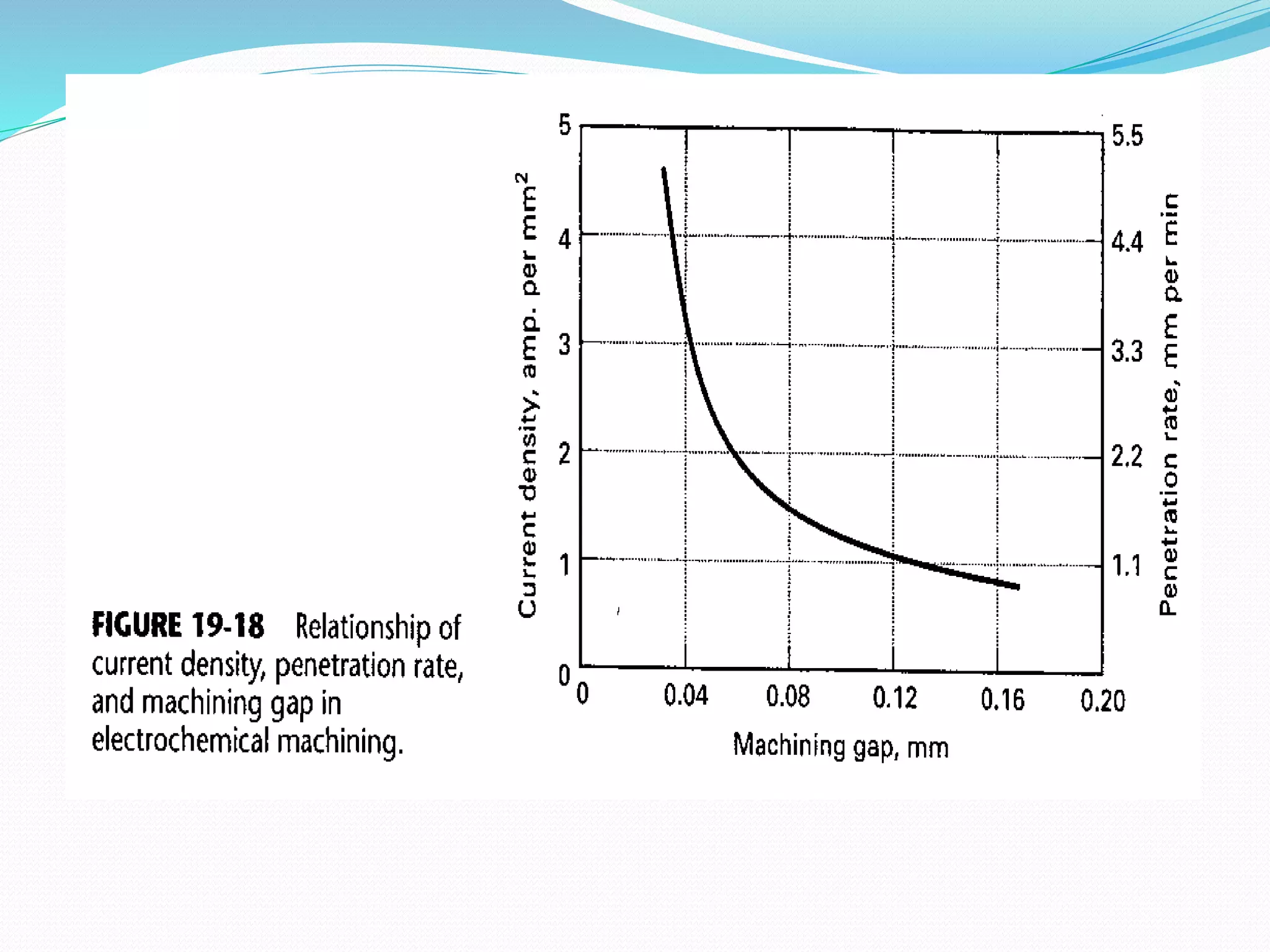
 A constant voltage has to be maintained and high 
density is required
Electrolyte 
 Essential for electrolytic process 
 It cools the cutting zone which becomes hot due to the 
flow of high current 
 Neutral salts are used as electrolyte in place of highly 
corrosive acids and alkalies 
 Electrolyte solution is pumped between the 
tool/workpiece gap at about 2.5 N/mm2 and 30 m/s
Tool 
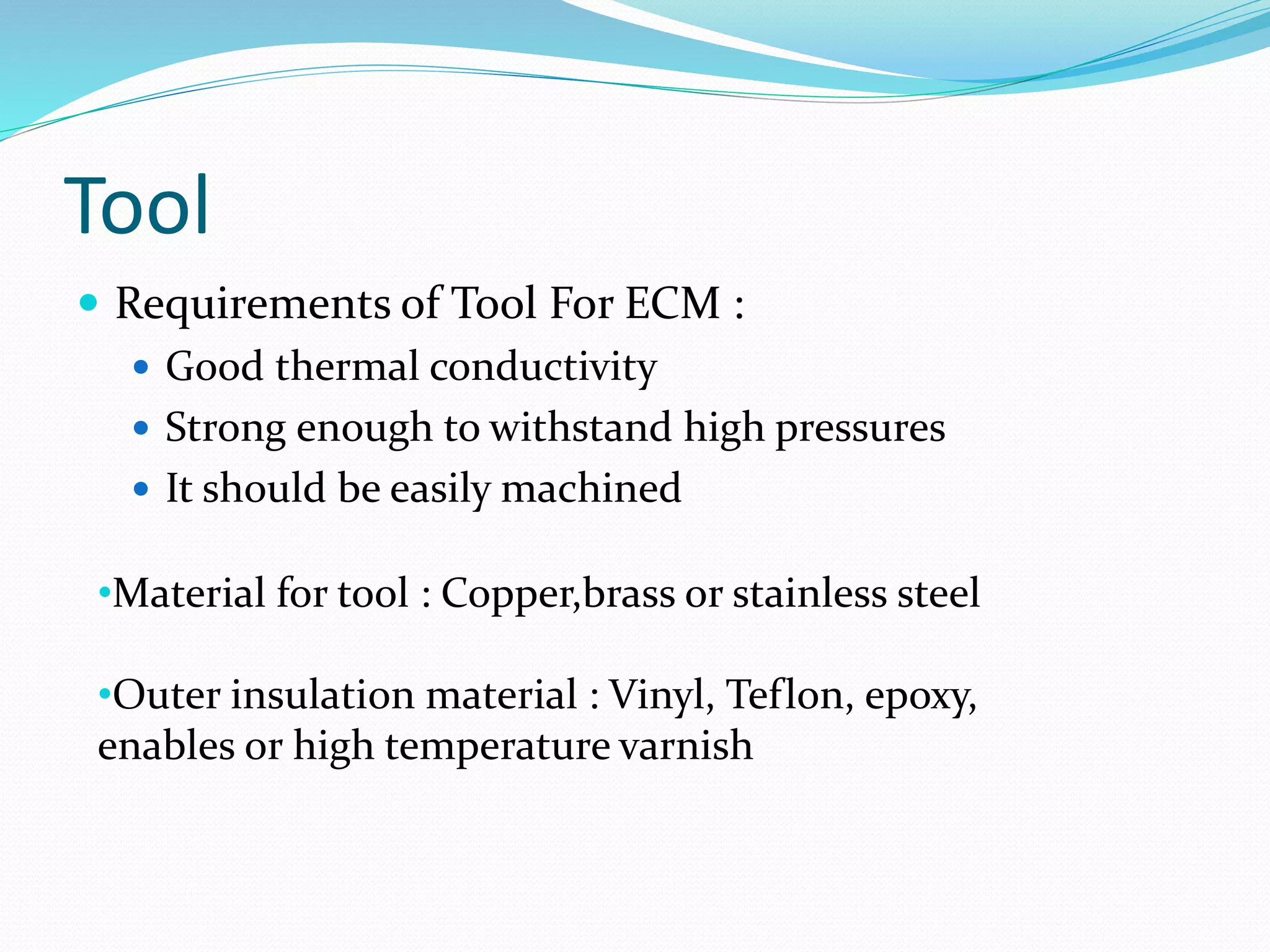
 Requirements of Tool For ECM : 
 Good thermal conductivity 
 Strong enough to withstand high pressures 
 It should be easily machined 
•Material for tool : Copper,brass or stainless steel 
•Outer insulation material : Vinyl, Teflon, epoxy, 
enables or high temperature varnish
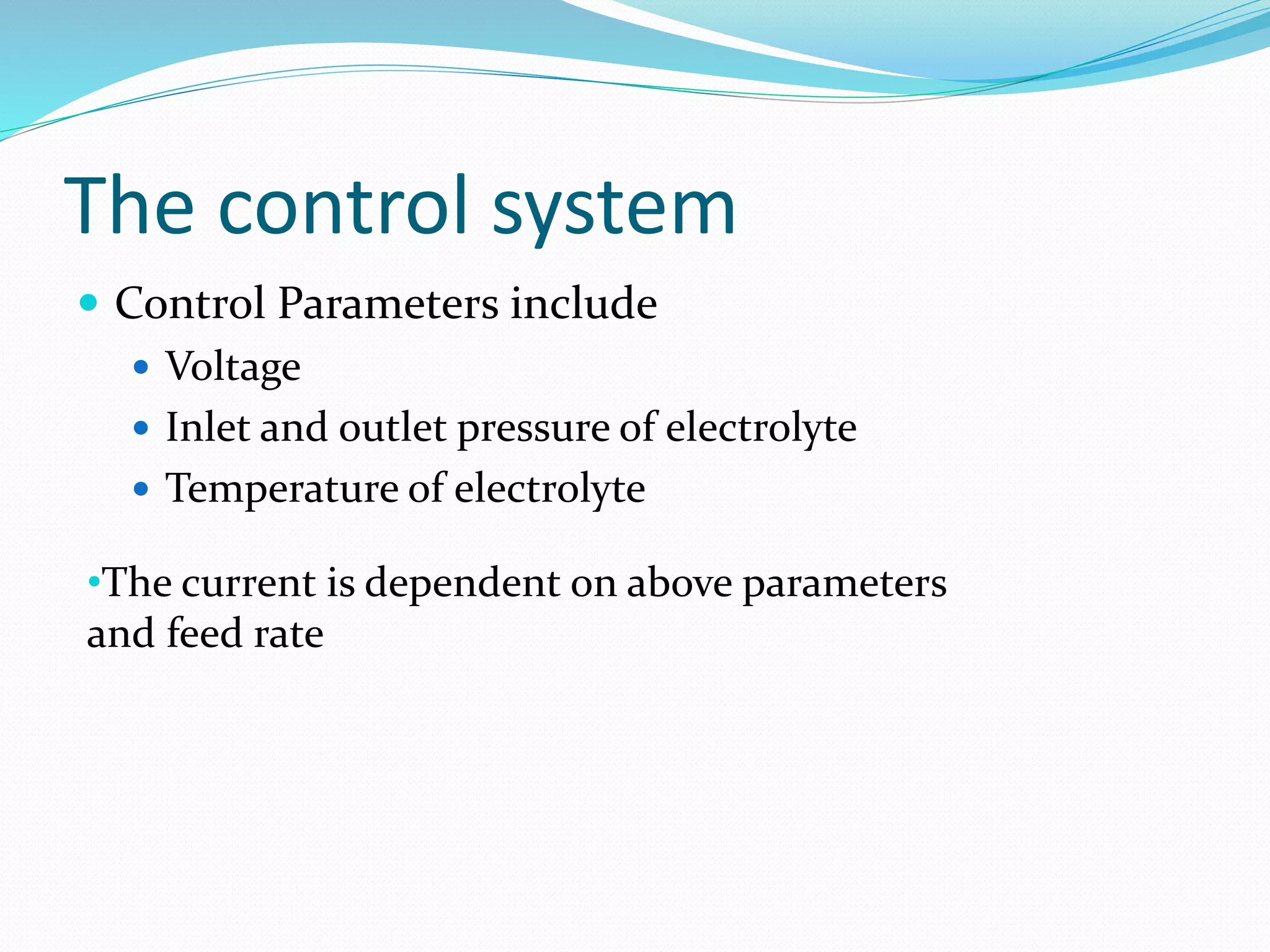
The control system 
 Control Parameters include 
 Voltage 
 Inlet and outlet pressure of electrolyte 
 Temperature of electrolyte 
•The current is dependent on above parameters 
and feed rate
Specialized ECM…
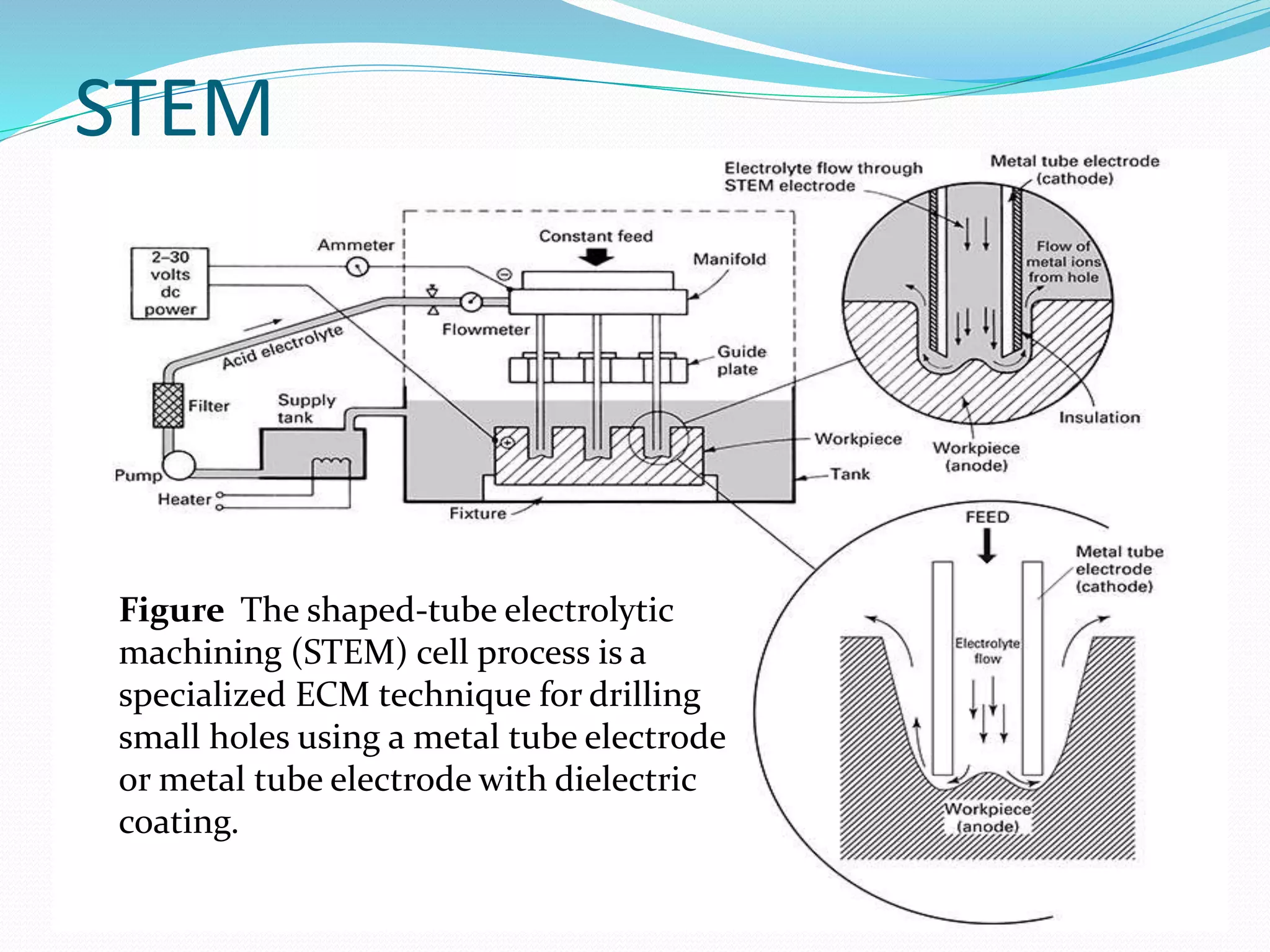
STEM 
Figure The shaped-tube electrolytic 
machining (STEM) cell process is a 
specialized ECM technique for drilling 
small holes using a metal tube electrode 
or metal tube electrode with dielectric 
coating.
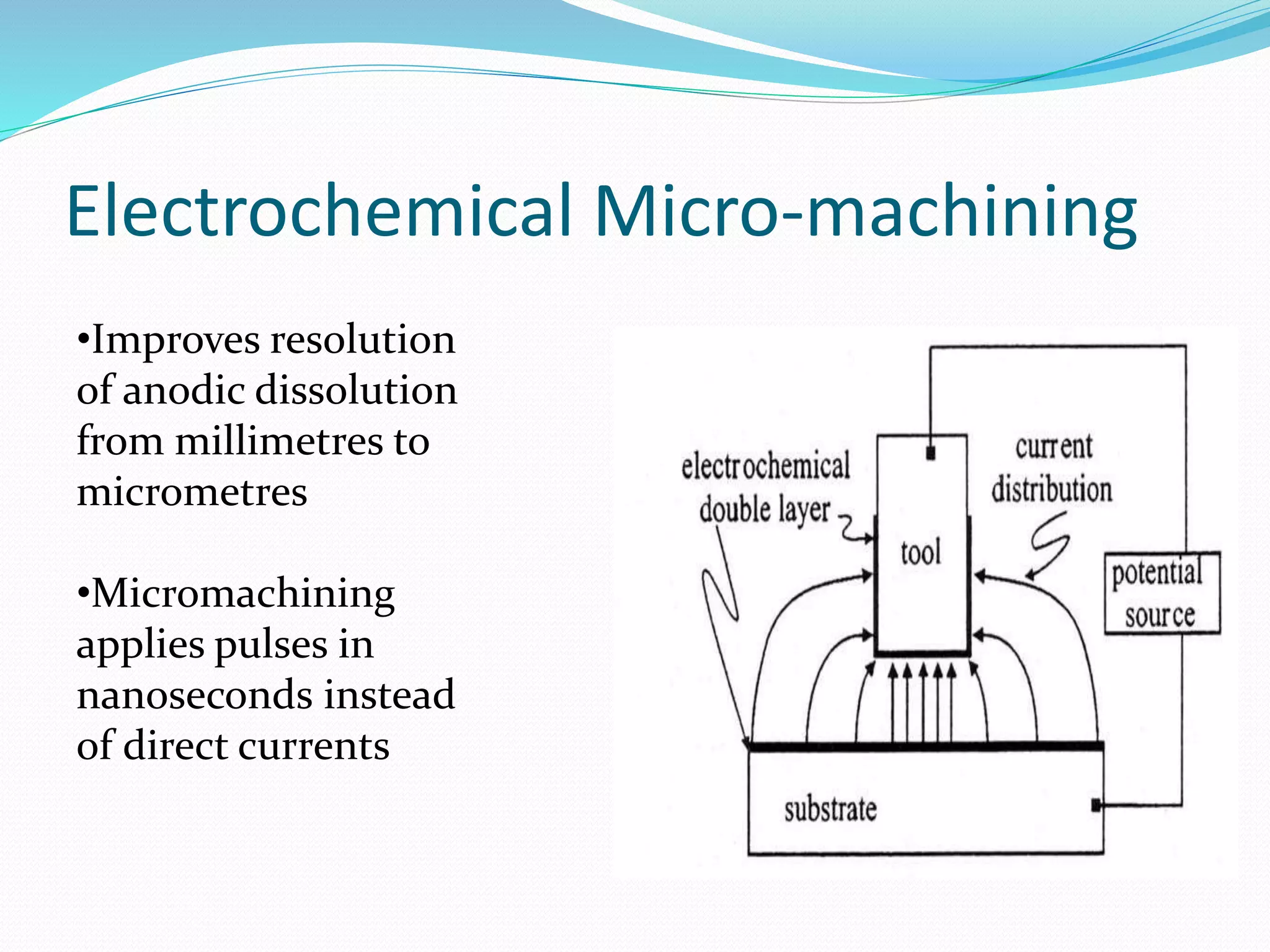
Electrochemical Micro-machining 
•Improves resolution 
of anodic dissolution 
from millimetres to 
micrometres 
•Micromachining 
applies pulses in 
nanoseconds instead 
of direct currents
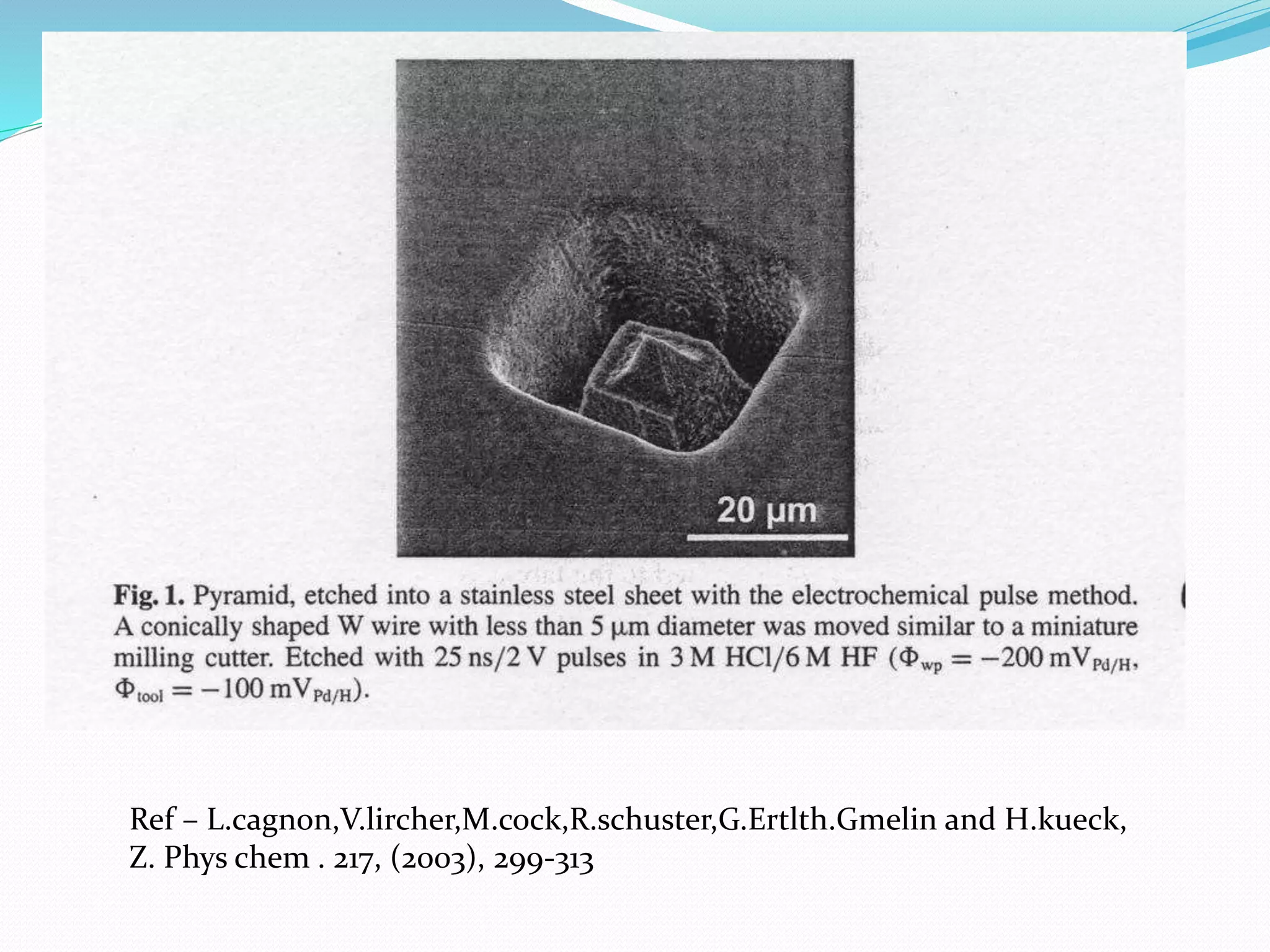
Ref – L.cagnon,V.lircher,M.cock,R.schuster,G.Ertlth.Gmelin and H.kueck, 
Z. Phys chem . 217, (2003), 299-313
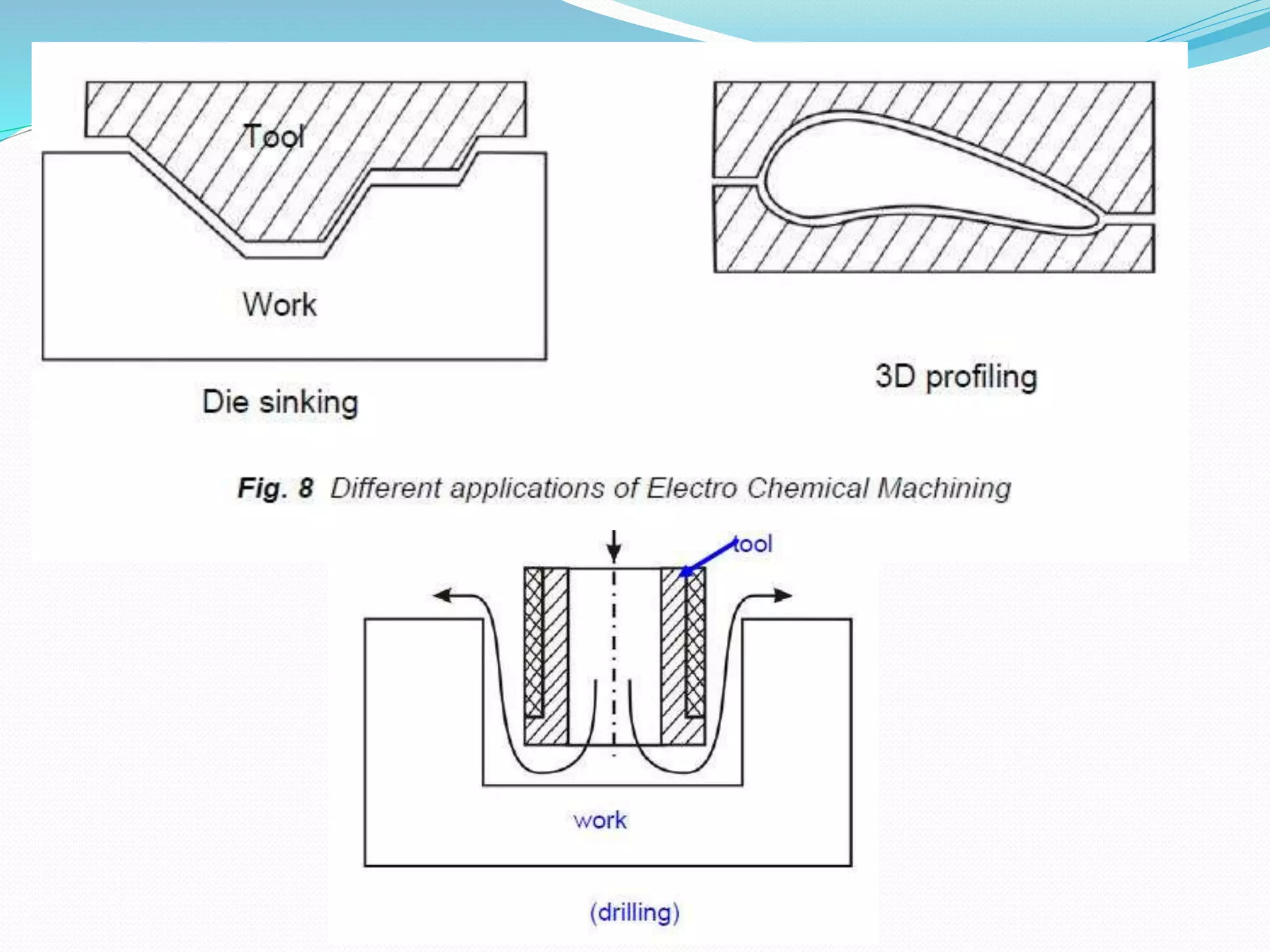
Further specialized Applications 
 Die Sinking 
 Profiling and contouring 
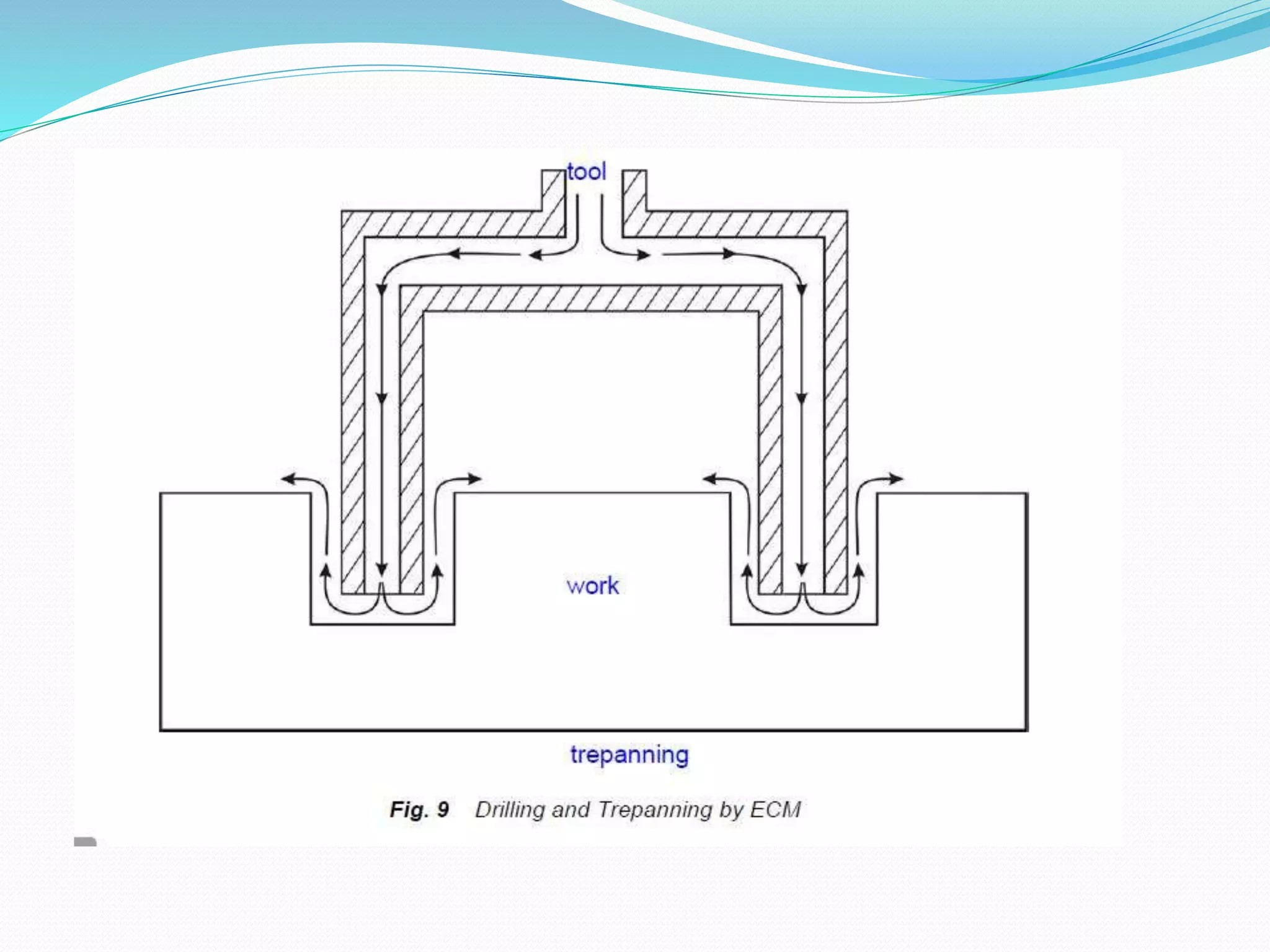
 Trepanning 
 Grinding 
 Drilling 
 Micro-machining 
 Pulsed ECM
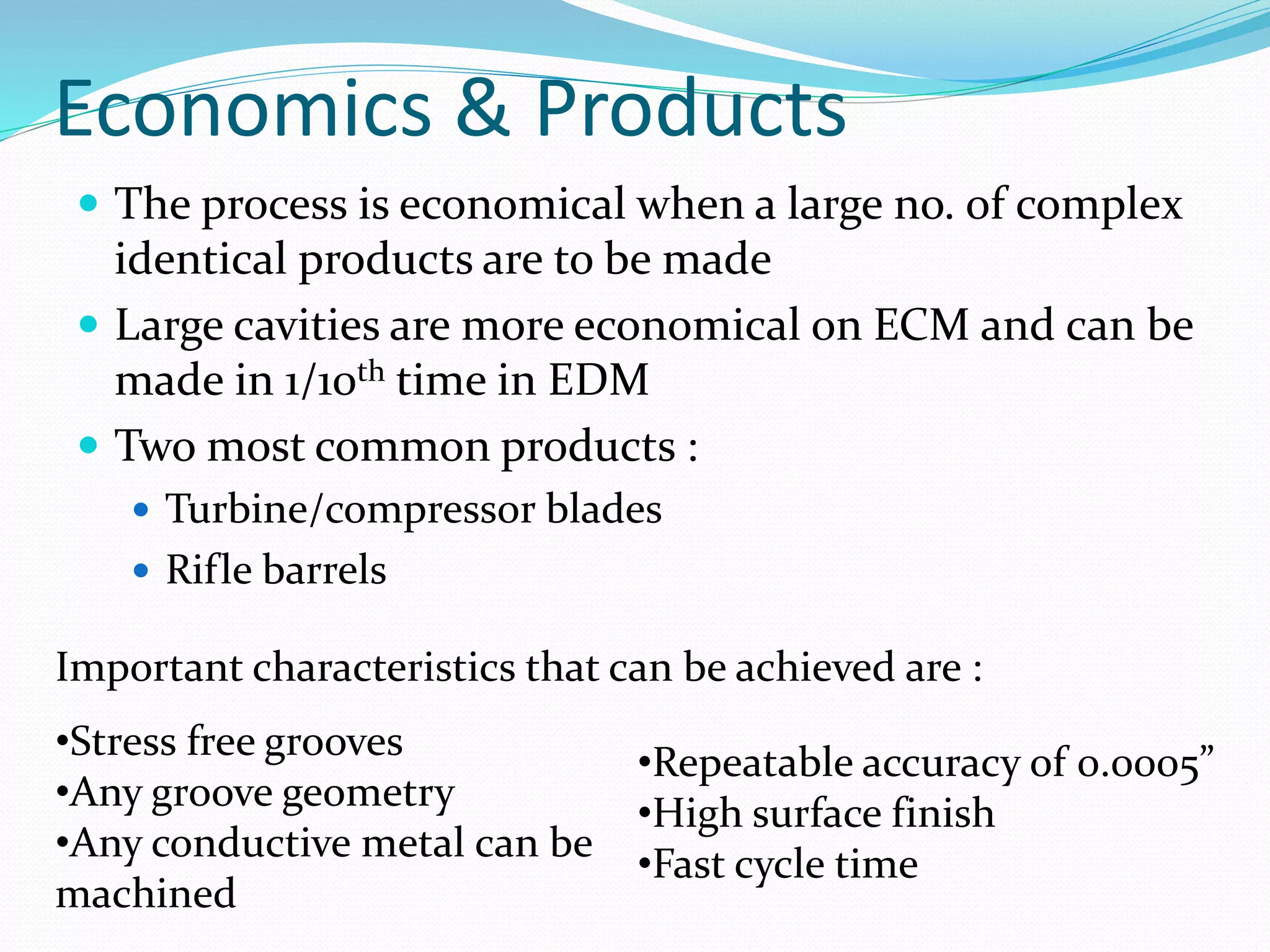
Economics & Products 
 The process is economical when a large no. of complex 
identical products are to be made 
 Large cavities are more economical on ECM and can be 
made in 1/10th time in EDM 
 Two most common products : 
 Turbine/compressor blades 
 Rifle barrels 
Important characteristics that can be achieved are : 
•Stress free grooves 
•Any groove geometry 
•Any conductive metal can be 
machined 
•Repeatable accuracy of 0.0005” 
•High surface finish 
•Fast cycle time
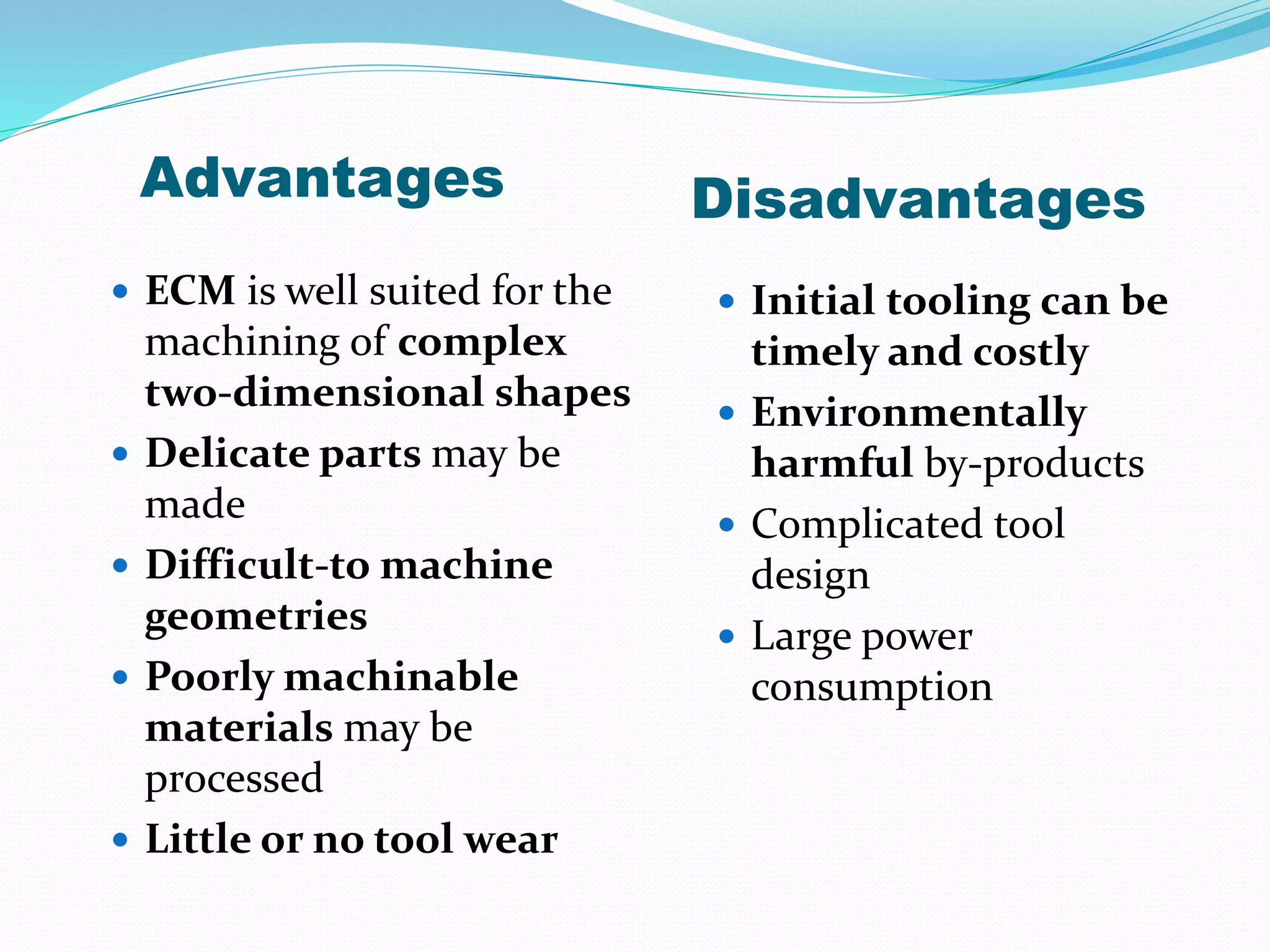
 ECM is well suited for the 
machining of complex 
two-dimensional shapes 
 Delicate parts may be 
made 
 Difficult-to machine 
geometries 
 Poorly machinable 
materials may be 
processed 
 Little or no tool wear 
 Initial tooling can be 
timely and costly 
 Environmentally 
harmful by-products 
 Complicated tool 
design 
 Large power 
consumption 
Advantages 
Disadvantages
References 
 Electrochemical machining – nptel 
 Science Direct – ECM 
 Wikipedia – electrochemical machining 
 Wendt – electrochemical machining & miccromaching
Thank You …

ECM : Electrochemical machining - Principle,process,subsystems & applications

  • 1.
    Pratik Chaudhari TYmech MIS- 111210015 Subject – AMT
  • 2.
    Introduction  Non-conventionalmachining system in which metal is removed by electrochemical process  Characterized as ‘Reverse Electroplating’ means it removes metal instead of adding it  Normally used for mass production and for hard materials that are difficult to machine using conventional processes  Both external and internal geometries can be machined
  • 3.
    Principle  Faraday’slaw of electrolysis : The Weight of the substance produced during electrolysis process is directly proportional to 1. the current which passes 2.the length of time of process 3.The equivalent weight of the material  Two dissimilar metals are in contact with an electrolyte and anode loses metal to cathode
  • 4.
    •Anode : Workpiece •Cathode : Tool •Electrolyte : An electrically conductive fluid
  • 5.
  • 6.
  • 7.
    Main subsytem Power Supply  Electrolyte  Tool  The Control system  The machine
  • 8.
    Power Supply Available in sizes upto 10,000 amp (some circuits are available upto 40,000amp)  Range of voltage – 2 to 30 volts d.c.  A constant voltage has to be maintained and high density is required
  • 10.
    Electrolyte  Essentialfor electrolytic process  It cools the cutting zone which becomes hot due to the flow of high current  Neutral salts are used as electrolyte in place of highly corrosive acids and alkalies  Electrolyte solution is pumped between the tool/workpiece gap at about 2.5 N/mm2 and 30 m/s
  • 11.
    Tool  Requirementsof Tool For ECM :  Good thermal conductivity  Strong enough to withstand high pressures  It should be easily machined •Material for tool : Copper,brass or stainless steel •Outer insulation material : Vinyl, Teflon, epoxy, enables or high temperature varnish
  • 12.
    The control system  Control Parameters include  Voltage  Inlet and outlet pressure of electrolyte  Temperature of electrolyte •The current is dependent on above parameters and feed rate
  • 14.
  • 15.
    STEM Figure Theshaped-tube electrolytic machining (STEM) cell process is a specialized ECM technique for drilling small holes using a metal tube electrode or metal tube electrode with dielectric coating.
  • 16.
    Electrochemical Micro-machining •Improvesresolution of anodic dissolution from millimetres to micrometres •Micromachining applies pulses in nanoseconds instead of direct currents
  • 17.
    Ref – L.cagnon,V.lircher,M.cock,R.schuster,G.Ertlth.Gmelinand H.kueck, Z. Phys chem . 217, (2003), 299-313
  • 19.
    Further specialized Applications  Die Sinking  Profiling and contouring  Trepanning  Grinding  Drilling  Micro-machining  Pulsed ECM
  • 22.
    Economics & Products  The process is economical when a large no. of complex identical products are to be made  Large cavities are more economical on ECM and can be made in 1/10th time in EDM  Two most common products :  Turbine/compressor blades  Rifle barrels Important characteristics that can be achieved are : •Stress free grooves •Any groove geometry •Any conductive metal can be machined •Repeatable accuracy of 0.0005” •High surface finish •Fast cycle time
  • 23.
     ECM iswell suited for the machining of complex two-dimensional shapes  Delicate parts may be made  Difficult-to machine geometries  Poorly machinable materials may be processed  Little or no tool wear  Initial tooling can be timely and costly  Environmentally harmful by-products  Complicated tool design  Large power consumption Advantages Disadvantages
  • 24.
    References  Electrochemicalmachining – nptel  Science Direct – ECM  Wikipedia – electrochemical machining  Wendt – electrochemical machining & miccromaching
  • 25.

Editor's Notes

  • #21 Die sinking is a process used to machine or create a specific size or shape cavity or opening in steel blocks. Most often, die sinking is used to place names, numbers, and other sources of information onto metal