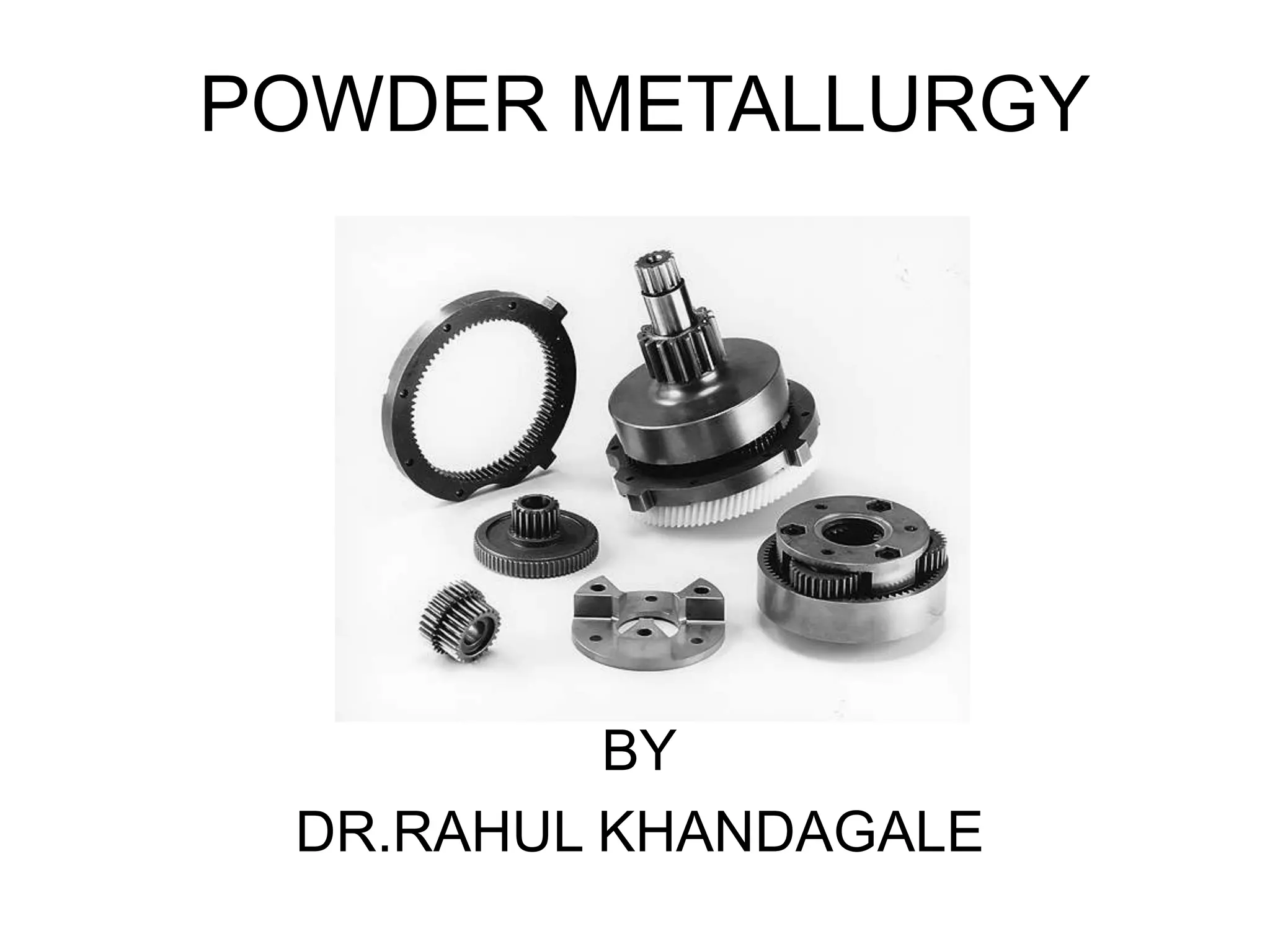
POWDER METALLURGY
BY
DR.RAHUL KHANDAGALE
History of Applications
• 3000 B.C. Egyptians made tools with
powder metallurgy
• 1900’s tungsten filament for light bulb
• 1930’s carbide tool materials
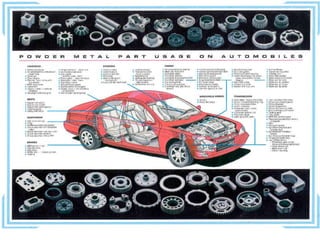
• 1960’s automobile parts
• 1980’s aircraft engine turbine parts
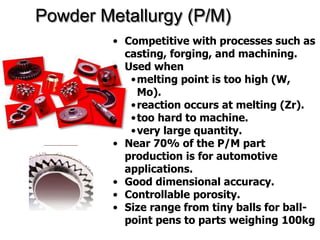
Powder Metallurgy (P/M)
• Competitive with processes such as
casting, forging, and machining.
• Used when
•melting point is too high (W,
Mo).
•reaction occurs at melting (Zr).
•too hard to machine.
•very large quantity.
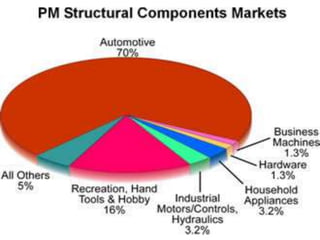
• Near 70% of the P/M part
production is for automotive
applications.
• Good dimensional accuracy.
• Controllable porosity.
• Size range from tiny balls for ball-
point pens to parts weighing 100kg
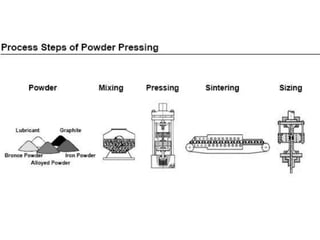
Basic Steps In Powder
Metallurgy
• Powder Production
• Blending or Mixing
• Powder Consolidation
• Sintering
• Finishing
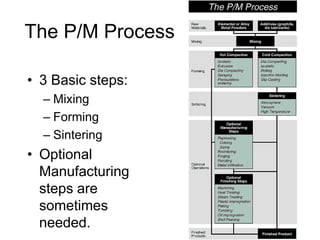
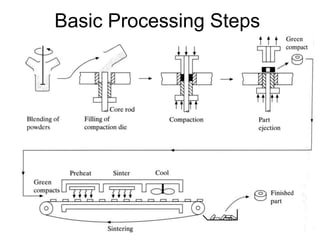
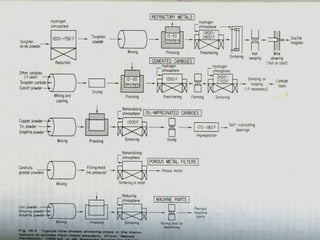
The P/M Process
• 3 Basic steps:
– Mixing
– Forming
– Sintering
• Optional
Manufacturing
steps are
sometimes
needed.
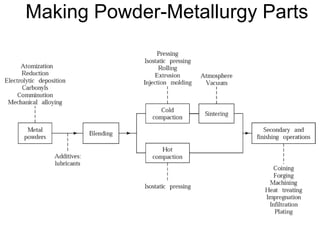
Making Powder-Metallurgy Parts
• Powder Metallurgy is defined as the
technique of producing metal & non metal
powders and utilizing them for
manufacturing components.
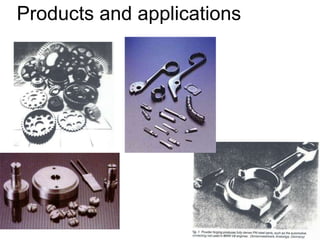
• Application:
Automotive- wipers, doors, clutches, brakes
Defence- rockets, missiles, bullets,cartridge
cases etc.
Refractory material.
Aerospace application such as satellite,
space vehicles.
Atomic applications such as reactors,
generators.
Steps in Powder Metallurgy
1) Powder production:
Methods:
a) Mechanical
b) Physical
c) Chemical
d) Electro-chemical
a) Machining:
• Use of machine tools to produce powders in the
form of chips.
• Relatively coarse powders of irregular shapes.
• Applications : Magnesium powders, beryllium
,silver solders, dental alloys, Cr powders for tracer
bullets in defence applications of fireworks.
b) Crushing:
The method use hammers, jaw crushers, gyratory
crushers etc.
Brittle materials - crushing irregular powders.
Ductile materials - elongated before fracturing
flaky in shape
Use: for brittle material like Ti,Zr,V
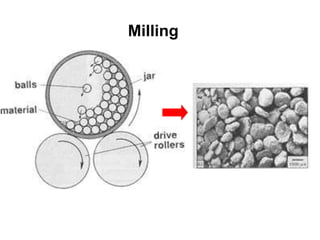
• Most widely used method.
• Rotating ball- mill machine is used.
• Tumbling performed as dry or wet In case
of wet water, alcohol or acetone is used.
• Application: Used for production of
carbide-metal and cermets.
c) Milling:
d) Shotting:
•Material is in hot boiling sate an poured on
vibrating screen.
•Liquid droplets are solidified in atmosphere.
Air or neutral gas as nitrogen.
•Application: Non ferrous metals.
Milling
Mechanical
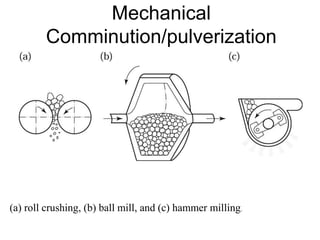
Comminution/pulverization
(a) roll crushing, (b) ball mill, and (c) hammer milling.
• Graining method is similar to shotting
except cooling medium is water.
• Coarse powder in spherical form.
• Application: Pulverizing powders of metals
such as Zn, Bi, Tin etc.
e) Graining:
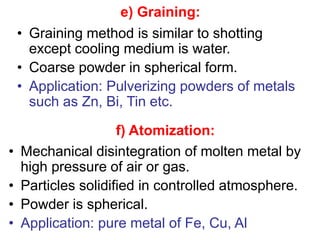
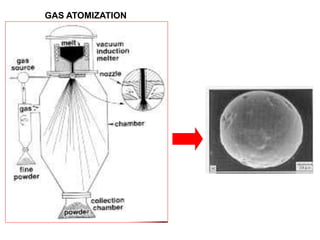
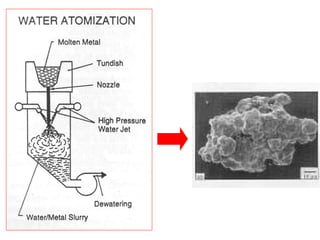
f) Atomization:
• Mechanical disintegration of molten metal by
high pressure of air or gas.
• Particles solidified in controlled atmosphere.
• Powder is spherical.
• Application: pure metal of Fe, Cu, Al
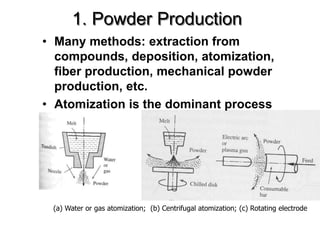
1. Powder Production
(a) Water or gas atomization; (b) Centrifugal atomization; (c) Rotating electrode
• Many methods: extraction from
compounds, deposition, atomization,
fiber production, mechanical powder
production, etc.
• Atomization is the dominant process
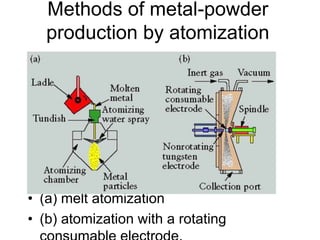
Methods of metal-powder
production by atomization
• (a) melt atomization
• (b) atomization with a rotating
GAS ATOMIZATION
a) Condensation:
• Condensing metal vapors to obtain metal
powders.
• For volatile metals transforms to vapors.
• Carried out in controlled atmp. to avoid
formation of metal oxides.
• Application: Mfg. of powders for Zn, Mg, Cd
2) Physical Processes
b) Thermal decomposition
(Gaseous Pyrolysis)
• Based on decomposing the carbonyl vapors of
metal at controlled temp. and pressure and
breaking the metal into powder.
• Decomposed powder is of high purity and
spherical in shape.
Application
• For metal carbonyls such as Fe, Ni, Mo, Co.
• Using carbon-monoxide then decomposition of
carbonyl vapors to metal powder.
• Carbonyls are volatile and vapors decompose
at temp. 150 – 4000C and pressure at 1 atm.
3) Chemical processes
a) Reduction:
Breaking the oxide, oxalates, formates or
halides of metals into metal powder by
using a suitable reducing agent.
Application: To obtain powders of Fe, Cu,
Ni, W, Mo, Co.
The reducing agent may be solid or gas
such as carbon, hydrogen, ammonia,
carbon monoxide
b) Intergranular corrosion:
Grain boundaries corrode faster than the grains.
Due to corrosion Grains separate out in the form
of poly crystalline metal.
Applications
• Stainless Steel – Fe, Cr, Ni
(Cr combines with C form complex carbide-then
carbide is corroded by boiling the steel in
aqueous solution of 11% CuSo4 and 10 %
H2SO4)
[Now atomization is used to obtain Fe powder]
• C) Precipitation
Less noble metal displaces a more noble metal in
an aqueous solution containing ions of more
noble metal.
The more noble metal thus separates out in the
form of precipitates.
Application
Powder production of Ag, Sn, Cu
Ag is displaced from an aqueous solution of silver
nitrate by Cu or Fe
Sn is displaced from an aqueous solution of
stannous chloride by Zn.
Cu is displaced from aqueous solution of CuSo4 by
Fe
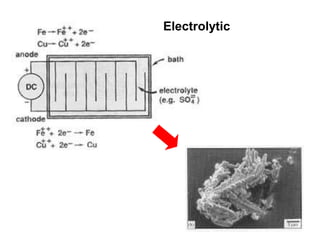
4) Electro-chemical Processes
• Based on electro deposition or electroplating
Metal powders are obtained by electro-deposition from
metal aqueous solutions or fused salts.
• In electro-plating a continuous & adherent coating
of metal is formed on the cathode component
while in electro deposition ,a coarse and non-
adherent layer is formed on the cathode
The powder size and type can be controlled by
High current, Low metal ion concentration, Low
temp. proper circulation of electrolyte
Application
Powder of Cu, Be, Fe, Zn, Sn, Ni
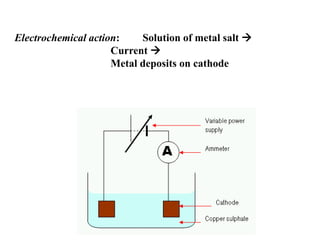
Electrochemical action: Solution of metal salt 
Current 
Metal deposits on cathode
Electrolytic
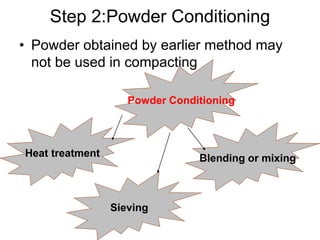
Step 2:Powder Conditioning
• Powder obtained by earlier method may
not be used in compacting
Heat treatment
Sieving
Blending or mixing
Powder Conditioning
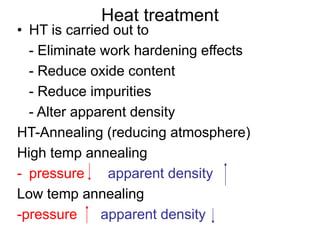
Heat treatment
• HT is carried out to
- Eliminate work hardening effects
- Reduce oxide content
- Reduce impurities
- Alter apparent density
HT-Annealing (reducing atmosphere)
High temp annealing
- pressure apparent density
Low temp annealing
-pressure apparent density
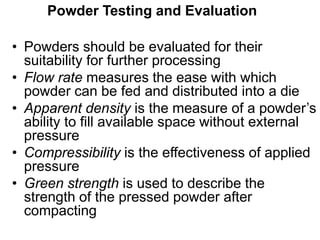
• Powders should be evaluated for their
suitability for further processing
• Flow rate measures the ease with which
powder can be fed and distributed into a die
• Apparent density is the measure of a powder’s
ability to fill available space without external
pressure
• Compressibility is the effectiveness of applied
pressure
• Green strength is used to describe the
strength of the pressed powder after
compacting
Powder Testing and Evaluation
Sieving
• Non uniform size of powder leads to alteration
of properties of final component
• Powder is passing over a set of std. sieves
and only the desired powder size is retained
for further processing
Blending or Mixing
• To obtain a homogenous mix. of powders to
improve the compacting and sintering
properties.
• Blenders-lubricants, gas or vapours
• Binders - increase green strength
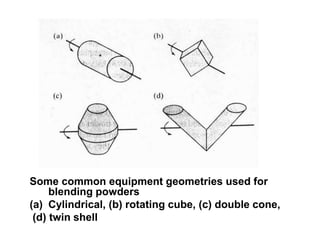
Some common equipment geometries used for
blending powders
(a) Cylindrical, (b) rotating cube, (c) double cone,
(d) twin shell
Step 3 Powder Compacting or Pressing
• Process of pressing and shaping to
powders in a die and punch
• Methods:
- Pressure less compacting
- Cold pressure compacting
- Hot pressure compacting
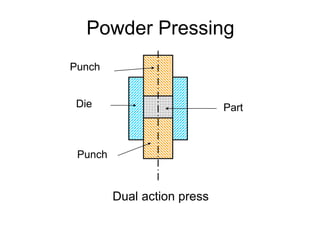
Powder Pressing
Punch
Punch
Die Part
Dual action press
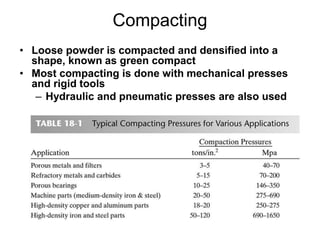
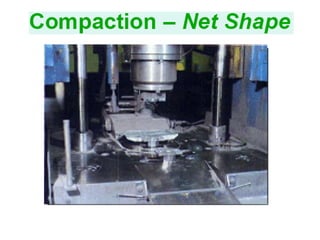
Compacting
• Loose powder is compacted and densified into a
shape, known as green compact
• Most compacting is done with mechanical presses
and rigid tools
– Hydraulic and pneumatic presses are also used
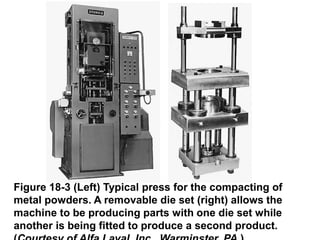
Figure 18-3 (Left) Typical press for the compacting of
metal powders. A removable die set (right) allows the
machine to be producing parts with one die set while
another is being fitted to produce a second product.
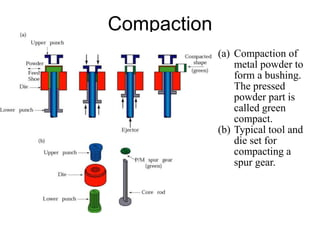
Compaction
(a) Compaction of
metal powder to
form a bushing.
The pressed
powder part is
called green
compact.
(b) Typical tool and
die set for
compacting a
spur gear.
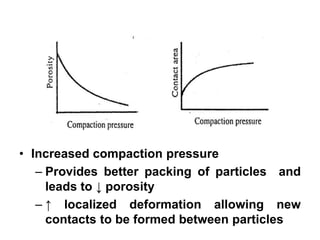
• Increased compaction pressure
– Provides better packing of particles and
leads to ↓ porosity
– ↑ localized deformation allowing new
contacts to be formed between particles
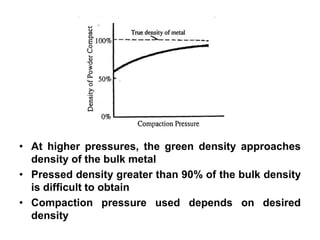
• At higher pressures, the green density approaches
density of the bulk metal
• Pressed density greater than 90% of the bulk density
is difficult to obtain
• Compaction pressure used depends on desired
density
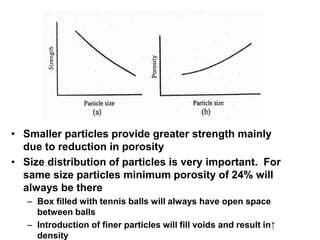
• Smaller particles provide greater strength mainly
due to reduction in porosity
• Size distribution of particles is very important. For
same size particles minimum porosity of 24% will
always be there
– Box filled with tennis balls will always have open space
between balls
– Introduction of finer particles will fill voids and result in↑
density
Density Variation
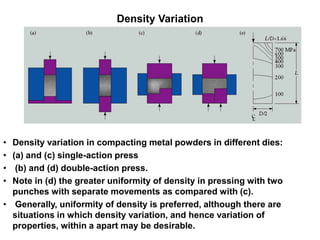
• Density variation in compacting metal powders in different dies:
• (a) and (c) single-action press
• (b) and (d) double-action press.
• Note in (d) the greater uniformity of density in pressing with two
punches with separate movements as compared with (c).
• Generally, uniformity of density is preferred, although there are
situations in which density variation, and hence variation of
properties, within a apart may be desirable.
Complex Compacting
• If an extremely complex shape is desired,
the powder may be encapsulated in a
flexible mold, which is then immersed in a
pressurized gas or liquid
– Process is known as isostatic compaction
• In warm compaction, the powder is heated
prior to pressing
• The amount of lubricant can be increased
in the powder to reduce friction
• Because particles tend to be abrasive, tool
wear is a concern in powder forming
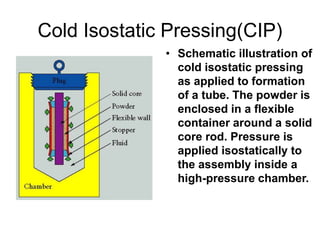
Cold Isostatic Pressing(CIP)
• Schematic illustration of
cold isostatic pressing
as applied to formation
of a tube. The powder is
enclosed in a flexible
container around a solid
core rod. Pressure is
applied isostatically to
the assembly inside a
high-pressure chamber.
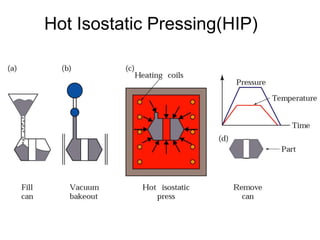
Hot-Isostatic Pressing
• Hot-isostatic pressing (HIP) combines
powder compaction and sintering into a
single operation
– Gas-pressure squeezing at high temperatures
• Heated powders may need to be protected
from harmful environments
• Products emerge at full density with
unifrom, isotropic properties
• Near-net shapes are possible
Hot Isostatic Pressing(HIP)
Other compacting and shaping
operations
• Rolling
• Extrusion
• Spray Deposition
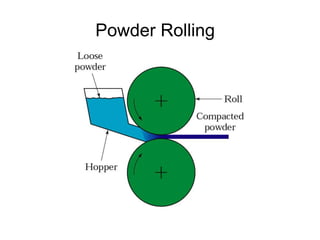
Powder Rolling
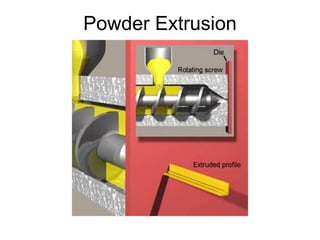
Powder Extrusion
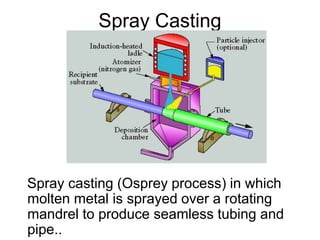
Spray Casting
Spray casting (Osprey process) in which
molten metal is sprayed over a rotating
mandrel to produce seamless tubing and
pipe..
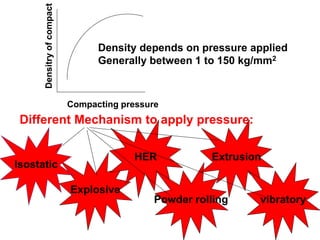
Densitry
of
compact
Compacting pressure
Density depends on pressure applied
Generally between 1 to 150 kg/mm2
Different Mechanism to apply pressure:
Explosive
HER
Powder rolling
Extrusion
vibratory
Isostatic
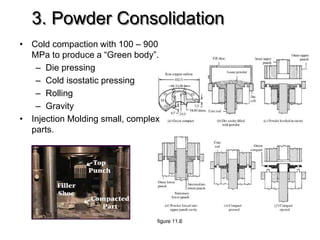
3. Powder Consolidation
• Cold compaction with 100 – 900
MPa to produce a “Green body”.
– Die pressing
– Cold isostatic pressing
– Rolling
– Gravity
• Injection Molding small, complex
parts.
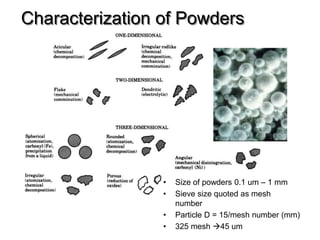
Characterization of Powders
• Size of powders 0.1 um – 1 mm
• Sieve size quoted as mesh
number
• Particle D = 15/mesh number (mm)
• 325 mesh 45 um
Sintering
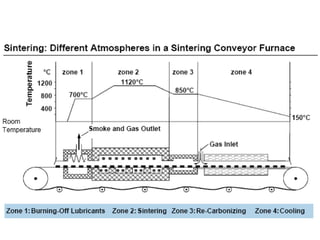
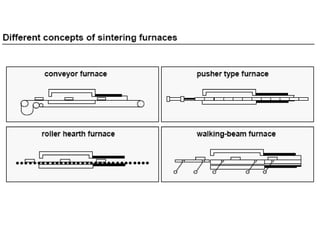
• In the sintering operation, the pressed-
powder compacts are heated in a controlled
atmosphere to right below the melting point
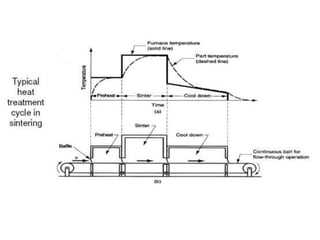
• Three stages of sintering
–Burn-off (purge)- combusts any air and
removes lubricants or binders that would
interfere with good bonding
–High-temperature- desired solid-state
diffusion and bonding occurs
–Cooling period- lowers the temperature of
the products in a controlled atmosphere
• All three stages must be conducted in
oxygen-free conditions
Carried out in three stages:
• First stage: Temperature is slowly
increased so that all volatile materials in the
green compact that would interfere with
good bonding is removed
– Rapid heating in this stage may entrap
gases and produce high internal
pressure which may fracture the compact
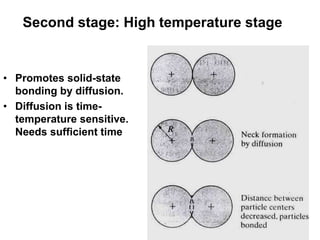
• Promotes solid-state
bonding by diffusion.
• Diffusion is time-
temperature sensitive.
Needs sufficient time
Second stage: High temperature stage
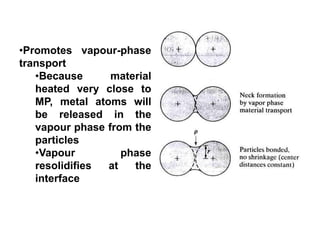
•Promotes vapour-phase
transport
•Because material
heated very close to
MP, metal atoms will
be released in the
vapour phase from the
particles
•Vapour phase
resolidifies at the
interface
• Third stage: Sintered product is cooled in
a controlled atmosphere
– Prevents oxidation and thermal shock
• Gases commonly used for sintering:
• H2, N2, inert gases or vacuum
• Liquid Phase Sintering
• During sintering a liquid phase, from
the lower MP component, may exist
• Alloying may take place at the particle-
particle interface
• Molten component may surround the
particle that has not melted
• High compact density can be quickly
attained
• Important variables:
– Nature of alloy, molten component/particle
wetting, capillary action of the liquid
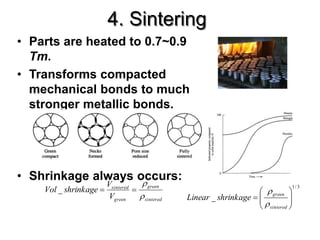
4. Sintering
• Parts are heated to 0.7~0.9
Tm.
• Transforms compacted
mechanical bonds to much
stronger metallic bonds.
• Shrinkage always occurs:
sintered
green
green
sintered
V
V
shrinkage
Vol




_ 3
/
1
_ 








sintered
green
shrinkage
Linear


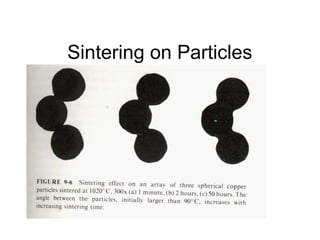
Sintering on Particles
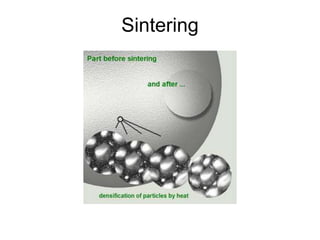
Sintering
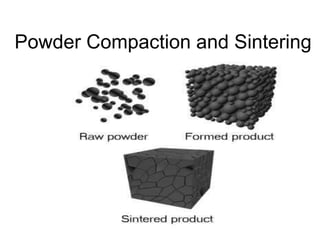
Powder Compaction and Sintering
Sintering
• The process whereby compressed metal
powder is heated in a controlled atmosphere
furnace to a temperature below its melting
point, but high enough to allow bonding of
the particles.
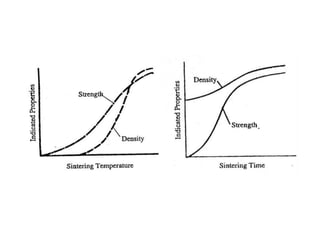
• Sintered density depends on its “green
density” and sintering conditions
(temperature, time and furnace atmosphere).
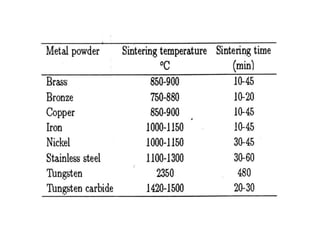
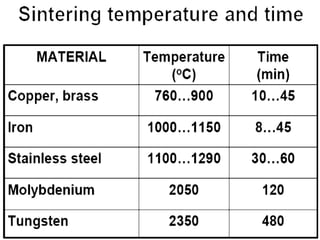
• Sintering temperatures are generally within 70
to 90% of the melting point of the metal or
alloy.
• Times range from 10 minutes for iron and
copper to 8 hours for tungsten and tantalum
• Sintering mechanisms are complex and
depend on the composition of metal
particles as well as processing
parameters. As temperature increases
two adjacent particles begin to form a
bond by diffusion (solid-state bonding).
• If two adjacent particles are of different
metals, alloying can take place at the
interface of two particles. One of the
particles may have a lower melting point
than the other. In that case, one particle
may melt and surround the particle that
has not melted (liquid-phase sintering).
Secondary Operations
• Most powder metallurgy products are
ready to use after the sintering process
• Some products may use secondary
operation to provide enhanced precision,
improved properties, or special
characteristics
• Distortion may occur during nonuniform
cool-down so the product may be
repressed, coined, or sized to improve
dimensional precision
Secondary Operations
• If massive metal deformation takes place in the
second pressing, the operation is known as P/M
forging
– Increases density and adds precision
• Infiltration and impregnation- oil or other liquid
is forced into the porous network to offer
lubrication over an extended product lifetime
• Metal infiltration fills in pores with other alloying
elements that can improve properties
• P/M products can also be subjected to the
conventional finishing operations: heat
treatment, machining, and surface treatments
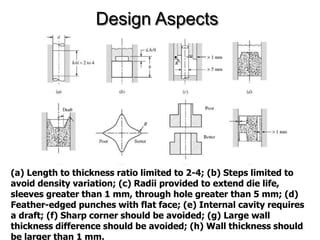
Design Aspects
(a) Length to thickness ratio limited to 2-4; (b) Steps limited to
avoid density variation; (c) Radii provided to extend die life,
sleeves greater than 1 mm, through hole greater than 5 mm; (d)
Feather-edged punches with flat face; (e) Internal cavity requires
a draft; (f) Sharp corner should be avoided; (g) Large wall
thickness difference should be avoided; (h) Wall thickness should
be larger than 1 mm.
Advantages and Disadvantages of P/M
• Virtually unlimited choice of alloys, composites, and
associated properties.
– Refractory materials are popular by this process.
• Controlled porosity for self lubrication or filtration
uses.
• Can be very economical at large run sizes (100,000
parts).
• Long term reliability through close control of
dimensions and physical properties.
• Very good material utilization.
• Limited part size and complexity
• High cost of powder material.
• High cost of tooling.
• Less strong parts than wrought ones.
• Less well known process.
Advantages and Disadvantages
of Powder Metallurgy
• Advantages
– Elimination or
reduction of
machining
– High production
rates
– Complex shapes
– Wide variations in
compositions
– Wide property
variations
– Scrap is eliminated
or reduced
• Disadvantages
– Inferior strength
properties
– High tooling costs
– High material cost
– Size and shape
limitations
– Dimensional
changes during
sintering
– Density variations
– Health and safety
hazards
Basic Processing Steps
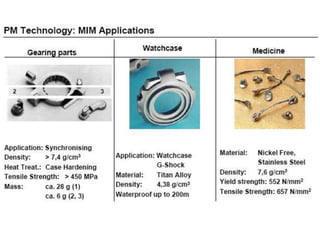
Products and applications
273598632-POWDER-METALLURGY-ppt.ppt

273598632-POWDER-METALLURGY-ppt.ppt

  • 1.
  • 2.
    History of Applications •3000 B.C. Egyptians made tools with powder metallurgy • 1900’s tungsten filament for light bulb • 1930’s carbide tool materials • 1960’s automobile parts • 1980’s aircraft engine turbine parts
  • 3.
    Powder Metallurgy (P/M) •Competitive with processes such as casting, forging, and machining. • Used when •melting point is too high (W, Mo). •reaction occurs at melting (Zr). •too hard to machine. •very large quantity. • Near 70% of the P/M part production is for automotive applications. • Good dimensional accuracy. • Controllable porosity. • Size range from tiny balls for ball- point pens to parts weighing 100kg
  • 4.
    Basic Steps InPowder Metallurgy • Powder Production • Blending or Mixing • Powder Consolidation • Sintering • Finishing
  • 5.
    The P/M Process •3 Basic steps: – Mixing – Forming – Sintering • Optional Manufacturing steps are sometimes needed.
  • 6.
  • 8.
    • Powder Metallurgyis defined as the technique of producing metal & non metal powders and utilizing them for manufacturing components. • Application: Automotive- wipers, doors, clutches, brakes Defence- rockets, missiles, bullets,cartridge cases etc. Refractory material. Aerospace application such as satellite, space vehicles. Atomic applications such as reactors, generators.
  • 9.
    Steps in PowderMetallurgy 1) Powder production: Methods: a) Mechanical b) Physical c) Chemical d) Electro-chemical
  • 10.
    a) Machining: • Useof machine tools to produce powders in the form of chips. • Relatively coarse powders of irregular shapes. • Applications : Magnesium powders, beryllium ,silver solders, dental alloys, Cr powders for tracer bullets in defence applications of fireworks. b) Crushing: The method use hammers, jaw crushers, gyratory crushers etc. Brittle materials - crushing irregular powders. Ductile materials - elongated before fracturing flaky in shape Use: for brittle material like Ti,Zr,V
  • 11.
    • Most widelyused method. • Rotating ball- mill machine is used. • Tumbling performed as dry or wet In case of wet water, alcohol or acetone is used. • Application: Used for production of carbide-metal and cermets. c) Milling: d) Shotting: •Material is in hot boiling sate an poured on vibrating screen. •Liquid droplets are solidified in atmosphere. Air or neutral gas as nitrogen. •Application: Non ferrous metals.
  • 12.
  • 13.
    Mechanical Comminution/pulverization (a) roll crushing,(b) ball mill, and (c) hammer milling.
  • 14.
    • Graining methodis similar to shotting except cooling medium is water. • Coarse powder in spherical form. • Application: Pulverizing powders of metals such as Zn, Bi, Tin etc. e) Graining: f) Atomization: • Mechanical disintegration of molten metal by high pressure of air or gas. • Particles solidified in controlled atmosphere. • Powder is spherical. • Application: pure metal of Fe, Cu, Al
  • 15.
    1. Powder Production (a)Water or gas atomization; (b) Centrifugal atomization; (c) Rotating electrode • Many methods: extraction from compounds, deposition, atomization, fiber production, mechanical powder production, etc. • Atomization is the dominant process
  • 16.
    Methods of metal-powder productionby atomization • (a) melt atomization • (b) atomization with a rotating
  • 17.
  • 19.
    a) Condensation: • Condensingmetal vapors to obtain metal powders. • For volatile metals transforms to vapors. • Carried out in controlled atmp. to avoid formation of metal oxides. • Application: Mfg. of powders for Zn, Mg, Cd 2) Physical Processes
  • 20.
    b) Thermal decomposition (GaseousPyrolysis) • Based on decomposing the carbonyl vapors of metal at controlled temp. and pressure and breaking the metal into powder. • Decomposed powder is of high purity and spherical in shape. Application • For metal carbonyls such as Fe, Ni, Mo, Co. • Using carbon-monoxide then decomposition of carbonyl vapors to metal powder. • Carbonyls are volatile and vapors decompose at temp. 150 – 4000C and pressure at 1 atm.
  • 21.
    3) Chemical processes a)Reduction: Breaking the oxide, oxalates, formates or halides of metals into metal powder by using a suitable reducing agent. Application: To obtain powders of Fe, Cu, Ni, W, Mo, Co. The reducing agent may be solid or gas such as carbon, hydrogen, ammonia, carbon monoxide
  • 22.
    b) Intergranular corrosion: Grainboundaries corrode faster than the grains. Due to corrosion Grains separate out in the form of poly crystalline metal. Applications • Stainless Steel – Fe, Cr, Ni (Cr combines with C form complex carbide-then carbide is corroded by boiling the steel in aqueous solution of 11% CuSo4 and 10 % H2SO4) [Now atomization is used to obtain Fe powder]
  • 23.
    • C) Precipitation Lessnoble metal displaces a more noble metal in an aqueous solution containing ions of more noble metal. The more noble metal thus separates out in the form of precipitates. Application Powder production of Ag, Sn, Cu Ag is displaced from an aqueous solution of silver nitrate by Cu or Fe Sn is displaced from an aqueous solution of stannous chloride by Zn. Cu is displaced from aqueous solution of CuSo4 by Fe
  • 24.
    4) Electro-chemical Processes •Based on electro deposition or electroplating Metal powders are obtained by electro-deposition from metal aqueous solutions or fused salts. • In electro-plating a continuous & adherent coating of metal is formed on the cathode component while in electro deposition ,a coarse and non- adherent layer is formed on the cathode The powder size and type can be controlled by High current, Low metal ion concentration, Low temp. proper circulation of electrolyte Application Powder of Cu, Be, Fe, Zn, Sn, Ni
  • 25.
    Electrochemical action: Solutionof metal salt  Current  Metal deposits on cathode
  • 26.
  • 27.
    Step 2:Powder Conditioning •Powder obtained by earlier method may not be used in compacting Heat treatment Sieving Blending or mixing Powder Conditioning
  • 28.
    Heat treatment • HTis carried out to - Eliminate work hardening effects - Reduce oxide content - Reduce impurities - Alter apparent density HT-Annealing (reducing atmosphere) High temp annealing - pressure apparent density Low temp annealing -pressure apparent density
  • 29.
    • Powders shouldbe evaluated for their suitability for further processing • Flow rate measures the ease with which powder can be fed and distributed into a die • Apparent density is the measure of a powder’s ability to fill available space without external pressure • Compressibility is the effectiveness of applied pressure • Green strength is used to describe the strength of the pressed powder after compacting Powder Testing and Evaluation
  • 30.
    Sieving • Non uniformsize of powder leads to alteration of properties of final component • Powder is passing over a set of std. sieves and only the desired powder size is retained for further processing Blending or Mixing • To obtain a homogenous mix. of powders to improve the compacting and sintering properties. • Blenders-lubricants, gas or vapours • Binders - increase green strength
  • 31.
    Some common equipmentgeometries used for blending powders (a) Cylindrical, (b) rotating cube, (c) double cone, (d) twin shell
  • 32.
    Step 3 PowderCompacting or Pressing • Process of pressing and shaping to powders in a die and punch • Methods: - Pressure less compacting - Cold pressure compacting - Hot pressure compacting
  • 33.
  • 34.
    Compacting • Loose powderis compacted and densified into a shape, known as green compact • Most compacting is done with mechanical presses and rigid tools – Hydraulic and pneumatic presses are also used
  • 35.
    Figure 18-3 (Left)Typical press for the compacting of metal powders. A removable die set (right) allows the machine to be producing parts with one die set while another is being fitted to produce a second product.
  • 37.
    Compaction (a) Compaction of metalpowder to form a bushing. The pressed powder part is called green compact. (b) Typical tool and die set for compacting a spur gear.
  • 38.
    • Increased compactionpressure – Provides better packing of particles and leads to ↓ porosity – ↑ localized deformation allowing new contacts to be formed between particles
  • 39.
    • At higherpressures, the green density approaches density of the bulk metal • Pressed density greater than 90% of the bulk density is difficult to obtain • Compaction pressure used depends on desired density
  • 40.
    • Smaller particlesprovide greater strength mainly due to reduction in porosity • Size distribution of particles is very important. For same size particles minimum porosity of 24% will always be there – Box filled with tennis balls will always have open space between balls – Introduction of finer particles will fill voids and result in↑ density
  • 41.
    Density Variation • Densityvariation in compacting metal powders in different dies: • (a) and (c) single-action press • (b) and (d) double-action press. • Note in (d) the greater uniformity of density in pressing with two punches with separate movements as compared with (c). • Generally, uniformity of density is preferred, although there are situations in which density variation, and hence variation of properties, within a apart may be desirable.
  • 42.
    Complex Compacting • Ifan extremely complex shape is desired, the powder may be encapsulated in a flexible mold, which is then immersed in a pressurized gas or liquid – Process is known as isostatic compaction • In warm compaction, the powder is heated prior to pressing • The amount of lubricant can be increased in the powder to reduce friction • Because particles tend to be abrasive, tool wear is a concern in powder forming
  • 43.
    Cold Isostatic Pressing(CIP) •Schematic illustration of cold isostatic pressing as applied to formation of a tube. The powder is enclosed in a flexible container around a solid core rod. Pressure is applied isostatically to the assembly inside a high-pressure chamber.
  • 44.
    Hot-Isostatic Pressing • Hot-isostaticpressing (HIP) combines powder compaction and sintering into a single operation – Gas-pressure squeezing at high temperatures • Heated powders may need to be protected from harmful environments • Products emerge at full density with unifrom, isotropic properties • Near-net shapes are possible
  • 45.
  • 46.
    Other compacting andshaping operations • Rolling • Extrusion • Spray Deposition
  • 47.
  • 48.
  • 49.
    Spray Casting Spray casting(Osprey process) in which molten metal is sprayed over a rotating mandrel to produce seamless tubing and pipe..
  • 50.
    Densitry of compact Compacting pressure Density dependson pressure applied Generally between 1 to 150 kg/mm2 Different Mechanism to apply pressure: Explosive HER Powder rolling Extrusion vibratory Isostatic
  • 51.
    3. Powder Consolidation •Cold compaction with 100 – 900 MPa to produce a “Green body”. – Die pressing – Cold isostatic pressing – Rolling – Gravity • Injection Molding small, complex parts.
  • 52.
    Characterization of Powders •Size of powders 0.1 um – 1 mm • Sieve size quoted as mesh number • Particle D = 15/mesh number (mm) • 325 mesh 45 um
  • 53.
  • 54.
    • In thesintering operation, the pressed- powder compacts are heated in a controlled atmosphere to right below the melting point • Three stages of sintering –Burn-off (purge)- combusts any air and removes lubricants or binders that would interfere with good bonding –High-temperature- desired solid-state diffusion and bonding occurs –Cooling period- lowers the temperature of the products in a controlled atmosphere • All three stages must be conducted in oxygen-free conditions
  • 55.
    Carried out inthree stages: • First stage: Temperature is slowly increased so that all volatile materials in the green compact that would interfere with good bonding is removed – Rapid heating in this stage may entrap gases and produce high internal pressure which may fracture the compact
  • 56.
    • Promotes solid-state bondingby diffusion. • Diffusion is time- temperature sensitive. Needs sufficient time Second stage: High temperature stage
  • 57.
    •Promotes vapour-phase transport •Because material heatedvery close to MP, metal atoms will be released in the vapour phase from the particles •Vapour phase resolidifies at the interface
  • 59.
    • Third stage:Sintered product is cooled in a controlled atmosphere – Prevents oxidation and thermal shock • Gases commonly used for sintering: • H2, N2, inert gases or vacuum
  • 61.
    • Liquid PhaseSintering • During sintering a liquid phase, from the lower MP component, may exist • Alloying may take place at the particle- particle interface • Molten component may surround the particle that has not melted • High compact density can be quickly attained • Important variables: – Nature of alloy, molten component/particle wetting, capillary action of the liquid
  • 62.
    4. Sintering • Partsare heated to 0.7~0.9 Tm. • Transforms compacted mechanical bonds to much stronger metallic bonds. • Shrinkage always occurs: sintered green green sintered V V shrinkage Vol     _ 3 / 1 _          sintered green shrinkage Linear  
  • 63.
  • 64.
  • 65.
  • 66.
    Sintering • The processwhereby compressed metal powder is heated in a controlled atmosphere furnace to a temperature below its melting point, but high enough to allow bonding of the particles. • Sintered density depends on its “green density” and sintering conditions (temperature, time and furnace atmosphere). • Sintering temperatures are generally within 70 to 90% of the melting point of the metal or alloy. • Times range from 10 minutes for iron and copper to 8 hours for tungsten and tantalum
  • 67.
    • Sintering mechanismsare complex and depend on the composition of metal particles as well as processing parameters. As temperature increases two adjacent particles begin to form a bond by diffusion (solid-state bonding). • If two adjacent particles are of different metals, alloying can take place at the interface of two particles. One of the particles may have a lower melting point than the other. In that case, one particle may melt and surround the particle that has not melted (liquid-phase sintering).
  • 72.
    Secondary Operations • Mostpowder metallurgy products are ready to use after the sintering process • Some products may use secondary operation to provide enhanced precision, improved properties, or special characteristics • Distortion may occur during nonuniform cool-down so the product may be repressed, coined, or sized to improve dimensional precision
  • 73.
    Secondary Operations • Ifmassive metal deformation takes place in the second pressing, the operation is known as P/M forging – Increases density and adds precision • Infiltration and impregnation- oil or other liquid is forced into the porous network to offer lubrication over an extended product lifetime • Metal infiltration fills in pores with other alloying elements that can improve properties • P/M products can also be subjected to the conventional finishing operations: heat treatment, machining, and surface treatments
  • 74.
    Design Aspects (a) Lengthto thickness ratio limited to 2-4; (b) Steps limited to avoid density variation; (c) Radii provided to extend die life, sleeves greater than 1 mm, through hole greater than 5 mm; (d) Feather-edged punches with flat face; (e) Internal cavity requires a draft; (f) Sharp corner should be avoided; (g) Large wall thickness difference should be avoided; (h) Wall thickness should be larger than 1 mm.
  • 75.
    Advantages and Disadvantagesof P/M • Virtually unlimited choice of alloys, composites, and associated properties. – Refractory materials are popular by this process. • Controlled porosity for self lubrication or filtration uses. • Can be very economical at large run sizes (100,000 parts). • Long term reliability through close control of dimensions and physical properties. • Very good material utilization. • Limited part size and complexity • High cost of powder material. • High cost of tooling. • Less strong parts than wrought ones. • Less well known process.
  • 76.
    Advantages and Disadvantages ofPowder Metallurgy • Advantages – Elimination or reduction of machining – High production rates – Complex shapes – Wide variations in compositions – Wide property variations – Scrap is eliminated or reduced • Disadvantages – Inferior strength properties – High tooling costs – High material cost – Size and shape limitations – Dimensional changes during sintering – Density variations – Health and safety hazards
  • 77.
  • 78.