Powder Metallurgy
 Presented To :Prof.Dr.Nahed El Mahalawy
 Presented By : Reham Mohamed
Outline
 Introduction .
 Metal Powder Production .
 Metal Powder characteristic .
 Metal Powder Heat-treatment
 compaction .
 Sintering .
 Secondary Operation (treatment) .
Powder metallurgy
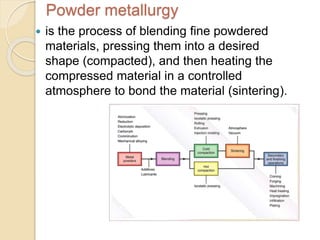
 is the process of blending fine powdered
materials, pressing them into a desired
shape (compacted), and then heating the
compressed material in a controlled
atmosphere to bond the material (sintering).
Why Powder Metallurgy is Important
 PM parts can be mass produced to net shape or
near net shape, eliminating or reducing the need
for subsequent machining
 PM process wastes very little material - about
97% of the starting powders are converted to
product
 PM parts can be made with a specified level of
porosity, to produce porous metal parts like
filters, oil-impregnated bearings and gears
Why Powder Metallurgy is
Important
 Certain metals that are difficult to fabricate
by other methods can be shaped by powder
metallurgy like Tungsten filaments for
incandescent lamp bulbs
 Certain alloy combinations and cermets
made by PM cannot be produced in other
ways
 PM compares favorably to most casting
processes in dimensional control
 PM production methods can be automated
for economical production
The powder metallurgy process generally
consists of four basic steps shows :
 (1) Powder Production
 (2) Powder mixing and blending
 (3) Compacting
 (4) Sintering
Metal Powder Production
The significant manufacturing methods of
metal powder production may be classed as
follows:
 1. Chemical methods (Chemical reduction).
 2. Physical methods (Electrolytic Method &
Atomization Method).
 3. Mechanical methods
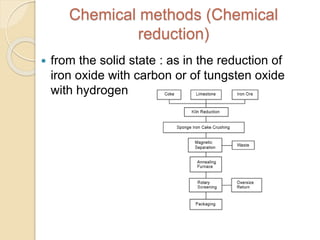
Chemical methods (Chemical
reduction)
 from the solid state : as in the reduction of
iron oxide with carbon or of tungsten oxide
with hydrogen
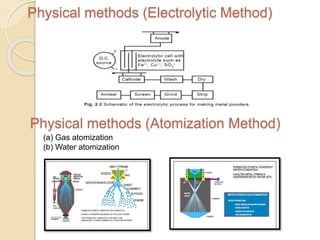
Physical methods (Electrolytic Method)
Physical methods (Atomization Method)
(a) Gas atomization
(b) Water atomization
Mechanical methods
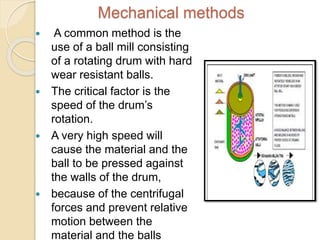
 A common method is the
use of a ball mill consisting
of a rotating drum with hard
wear resistant balls.
 The critical factor is the
speed of the drum’s
rotation.
 A very high speed will
cause the material and the
ball to be pressed against
the walls of the drum,
 because of the centrifugal
forces and prevent relative
motion between the
material and the balls
 The performance of metal powders during
processing and the properties of powder
metallurgy are dependent upon the
characteristics of the metal powders that are
used.
 characteristics of metal powders:
(a) Particle shape (b) Particle size
(c) Particle size distribution (d) Flow rate
(e) Compressibility (f)
Apparentdensity
(g) Purity
CHARACTERISTICS OF METAL POWDER
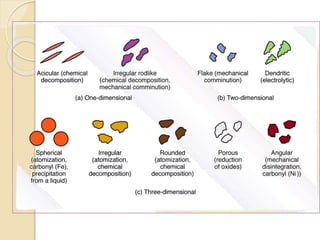
(a)Particle Shape:
 The particle shape depends largely on the method
of powder manufacture.
 The particle shape influences the flow
characteristics of powders.
 The desired product depends on the particle
shape .
 Spherical particles can be used when high
porosity is desired.
 If high strength is required, we can select coarse
particles.
 The shape usually described in terms of aspect
ratio.
 Aspect ratio : is a ratio of largest dimension to
smallest dimension, this ratio ranges from 1 (for
spherical particle) to about 10 (for flakelike or
needllike particle).
(b)Particle Size:
• The particle size influences the control of porosity,
compressibility and amount of shrinkage.
• It is determined by passing the powder through
standard sieves with various mesh size or by
microscopic measurement.
(c)Particle Size Distribution:
• means quantity of each standard particle size in
mixture.(which pass through standard sieves)
• Particle size distribution influences the packing of
powder and its behaviour during moulding and
sintering.
(d)Flow Rate:
• a measure of the ease by which powder can be fed
and distributed into the die.
• This determines the fineness of the particles.
(e)Compressibility:
 It is defined as volume of initial powder (powder
loosely filled in cavity) to the volume of compact
part.
 It depends on particle size, distribution and shape.
 Affects the green strength of the compact.
 The mechanical strength which a compacted
powder must have ,in order to withstand
mechanical operations to which it is subjected after
pressing and before sintering, without damaging its
fine details and sharp edges.
(f) Apparent Density:
 ability to fill available space without the application
of external pressure.
 It dependence on powder size and size
(g)Purity:
 High purity is required for a better product.
 For maintaining this, the particles must be
isolated from the atmospheric oxidation or
any contamination.
Metal Powder Heat treatment
 Before the consolidation process there is
treatment process to the powder, this called pre-
compaction process.
(I) Pre-compaction (metal powder
treatment):
 Annealing: It is customary that the powder
producer delivers the powder to the
fabricator ready for mixing.
 The aims of annealing are:
 1) To soften the powder.
 2) To reduce the residual amount of oxygen,
carbon and/or nitrogen from the powder.
Mixing and blending
 Mixing and blending are the two most
common pre-compaction steps in powder
metallurgy. Blending means the
combination of different sized powders of
the same chemistry.
 It is carried out to obtain a desired powder
size distribution.
 Various variables in the powder mixing
process have been highlighted by Hausner.
They are:
 1. Type of mixer
 2. Volume of the mixer
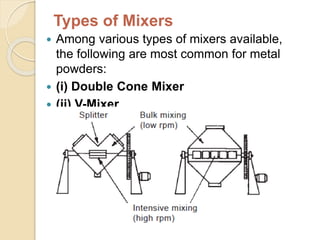
Types of Mixers
 Among various types of mixers available,
the following are most common for metal
powders:
 (i) Double Cone Mixer
 (ii) V-Mixer
Particle Size Reduction
 Suitable size reduction processes normally
produce an increase in the surface area (as
a result of decreasing the average particle
size) with narrow particle size distribution.
 These results in increased homogeneity of
non-uniform mixtures, increased chemical
reaction rates, the actual requirements of a
suitable size reduction process are
extremely varied and depend on several
parameters.
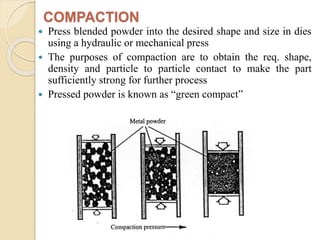
COMPACTION
 Press blended powder into the desired shape and size in dies
using a hydraulic or mechanical press
 The purposes of compaction are to obtain the req. shape,
density and particle to particle contact to make the part
sufficiently strong for further process
 Pressed powder is known as “green compact”
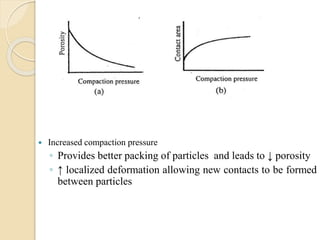
 Increased compaction pressure
◦ Provides better packing of particles and leads to ↓ porosity
◦ ↑ localized deformation allowing new contacts to be formed
between particles
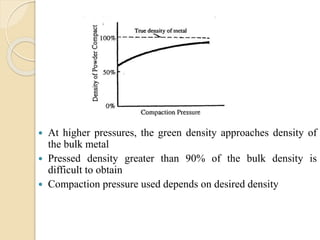
 At higher pressures, the green density approaches density of
the bulk metal
 Pressed density greater than 90% of the bulk density is
difficult to obtain
 Compaction pressure used depends on desired density
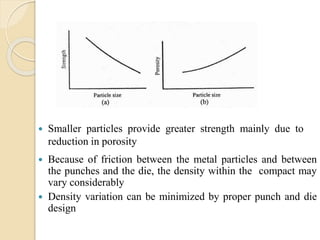
 Smaller particles provide greater strength mainly due to
reduction in porosity
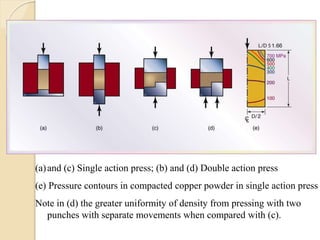
 Because of friction between the metal particles and between
the punches and the die, the density within the compact may
vary considerably
 Density variation can be minimized by proper punch and die
design
(a)and (c) Single action press; (b) and (d) Double action press
(e) Pressure contours in compacted copper powder in single action press
Note in (d) the greater uniformity of density from pressing with two
punches with separate movements when compared with (c).
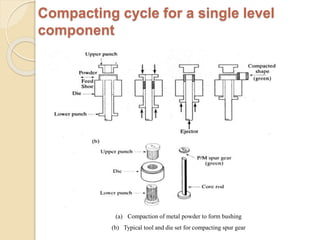
Compacting cycle for a single level
component
(a) Compaction of metal powder to form bushing
(b) Typical tool and die set for compacting spur gear
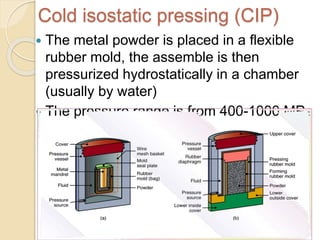
Cold isostatic pressing (CIP)
 The metal powder is placed in a flexible
rubber mold, the assemble is then
pressurized hydrostatically in a chamber
(usually by water)
 The pressure range is from 400-1000 MPa
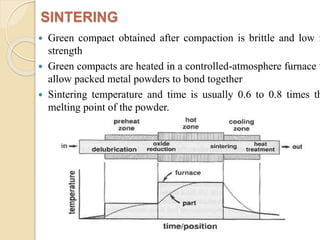
SINTERING
 Green compact obtained after compaction is brittle and low i
strength
 Green compacts are heated in a controlled-atmosphere furnace t
allow packed metal powders to bond together
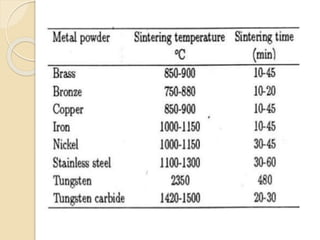
 Sintering temperature and time is usually 0.6 to 0.8 times th
melting point of the powder.
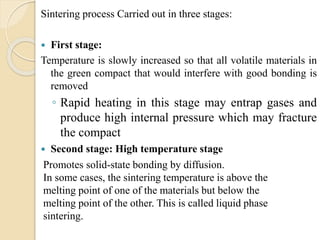
Sintering process Carried out in three stages:
 First stage:
Temperature is slowly increased so that all volatile materials in
the green compact that would interfere with good bonding is
removed
◦ Rapid heating in this stage may entrap gases and
produce high internal pressure which may fracture
the compact
 Second stage: High temperature stage
Promotes solid-state bonding by diffusion.
In some cases, the sintering temperature is above the
melting point of one of the materials but below the
melting point of the other. This is called liquid phase
sintering.
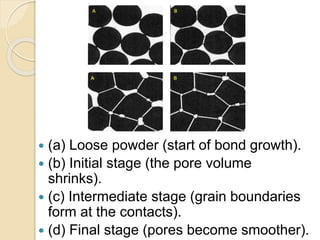
 (a) Loose powder (start of bond growth).
 (b) Initial stage (the pore volume
shrinks).
 (c) Intermediate stage (grain boundaries
form at the contacts).
 (d) Final stage (pores become smoother).
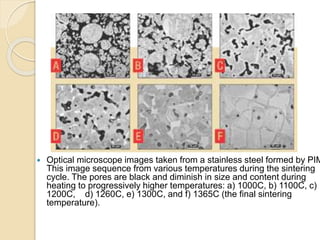
 Optical microscope images taken from a stainless steel formed by PIM
This image sequence from various temperatures during the sintering
cycle. The pores are black and diminish in size and content during
heating to progressively higher temperatures: a) 1000C, b) 1100C, c)
1200C, d) 1260C, e) 1300C, and f) 1365C (the final sintering
temperature).
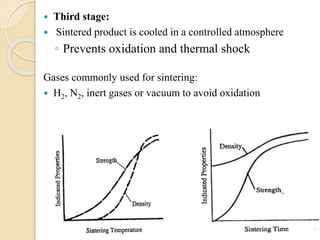
 Third stage:
 Sintered product is cooled in a controlled atmosphere
◦ Prevents oxidation and thermal shock
Gases commonly used for sintering:
 H2, N2, inert gases or vacuum to avoid oxidation
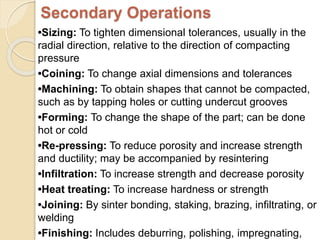
Secondary Operations
•Sizing: To tighten dimensional tolerances, usually in the
radial direction, relative to the direction of compacting
pressure
•Coining: To change axial dimensions and tolerances
•Machining: To obtain shapes that cannot be compacted,
such as by tapping holes or cutting undercut grooves
•Forming: To change the shape of the part; can be done
hot or cold
•Re-pressing: To reduce porosity and increase strength
and ductility; may be accompanied by resintering
•Infiltration: To increase strength and decrease porosity
•Heat treating: To increase hardness or strength
•Joining: By sinter bonding, staking, brazing, infiltrating, or
welding
•Finishing: Includes deburring, polishing, impregnating,
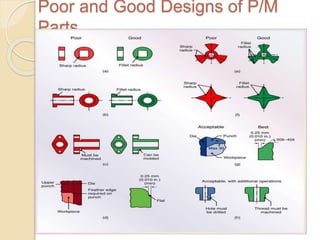
Poor and Good Designs of P/M
Parts
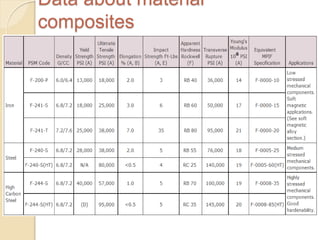
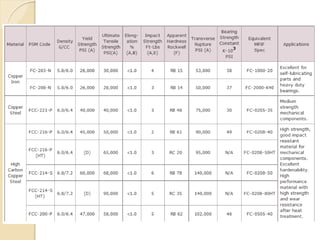
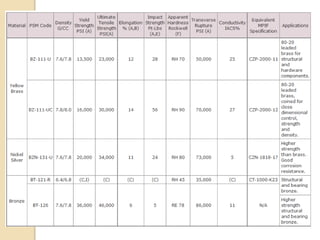
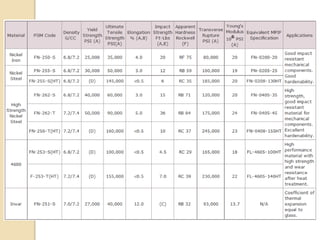
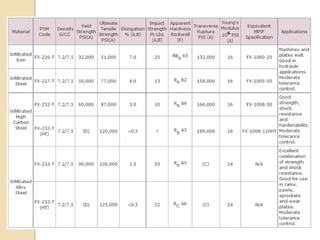
Data about material
composites
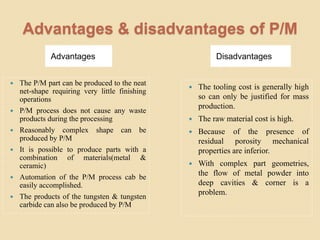
Advantages & disadvantages of P/M
Advantages Disadvantages
 The P/M part can be produced to the neat
net-shape requiring very little finishing
operations
 P/M process does not cause any waste
products during the processing
 Reasonably complex shape can be
produced by P/M
 It is possible to produce parts with a
combination of materials(metal &
ceramic)
 Automation of the P/M process cab be
easily accomplished.
 The products of the tungsten & tungsten
carbide can also be produced by P/M
 The tooling cost is generally high
so can only be justified for mass
production.
 The raw material cost is high.
 Because of the presence of
residual porosity mechanical
properties are inferior.
 With complex part geometries,
the flow of metal powder into
deep cavities & corner is a
problem.

Powder metallurgy (2) (1)

  • 1.
    Powder Metallurgy  PresentedTo :Prof.Dr.Nahed El Mahalawy  Presented By : Reham Mohamed
  • 2.
    Outline  Introduction . Metal Powder Production .  Metal Powder characteristic .  Metal Powder Heat-treatment  compaction .  Sintering .  Secondary Operation (treatment) .
  • 3.
    Powder metallurgy  isthe process of blending fine powdered materials, pressing them into a desired shape (compacted), and then heating the compressed material in a controlled atmosphere to bond the material (sintering).
  • 4.
    Why Powder Metallurgyis Important  PM parts can be mass produced to net shape or near net shape, eliminating or reducing the need for subsequent machining  PM process wastes very little material - about 97% of the starting powders are converted to product  PM parts can be made with a specified level of porosity, to produce porous metal parts like filters, oil-impregnated bearings and gears
  • 5.
    Why Powder Metallurgyis Important  Certain metals that are difficult to fabricate by other methods can be shaped by powder metallurgy like Tungsten filaments for incandescent lamp bulbs  Certain alloy combinations and cermets made by PM cannot be produced in other ways  PM compares favorably to most casting processes in dimensional control  PM production methods can be automated for economical production
  • 6.
    The powder metallurgyprocess generally consists of four basic steps shows :  (1) Powder Production  (2) Powder mixing and blending  (3) Compacting  (4) Sintering
  • 7.
    Metal Powder Production Thesignificant manufacturing methods of metal powder production may be classed as follows:  1. Chemical methods (Chemical reduction).  2. Physical methods (Electrolytic Method & Atomization Method).  3. Mechanical methods
  • 8.
    Chemical methods (Chemical reduction) from the solid state : as in the reduction of iron oxide with carbon or of tungsten oxide with hydrogen
  • 9.
    Physical methods (ElectrolyticMethod) Physical methods (Atomization Method) (a) Gas atomization (b) Water atomization
  • 10.
    Mechanical methods  Acommon method is the use of a ball mill consisting of a rotating drum with hard wear resistant balls.  The critical factor is the speed of the drum’s rotation.  A very high speed will cause the material and the ball to be pressed against the walls of the drum,  because of the centrifugal forces and prevent relative motion between the material and the balls
  • 11.
     The performanceof metal powders during processing and the properties of powder metallurgy are dependent upon the characteristics of the metal powders that are used.  characteristics of metal powders: (a) Particle shape (b) Particle size (c) Particle size distribution (d) Flow rate (e) Compressibility (f) Apparentdensity (g) Purity CHARACTERISTICS OF METAL POWDER
  • 12.
    (a)Particle Shape:  Theparticle shape depends largely on the method of powder manufacture.  The particle shape influences the flow characteristics of powders.  The desired product depends on the particle shape .  Spherical particles can be used when high porosity is desired.  If high strength is required, we can select coarse particles.  The shape usually described in terms of aspect ratio.  Aspect ratio : is a ratio of largest dimension to smallest dimension, this ratio ranges from 1 (for spherical particle) to about 10 (for flakelike or needllike particle).
  • 14.
    (b)Particle Size: • Theparticle size influences the control of porosity, compressibility and amount of shrinkage. • It is determined by passing the powder through standard sieves with various mesh size or by microscopic measurement. (c)Particle Size Distribution: • means quantity of each standard particle size in mixture.(which pass through standard sieves) • Particle size distribution influences the packing of powder and its behaviour during moulding and sintering. (d)Flow Rate: • a measure of the ease by which powder can be fed and distributed into the die. • This determines the fineness of the particles.
  • 15.
    (e)Compressibility:  It isdefined as volume of initial powder (powder loosely filled in cavity) to the volume of compact part.  It depends on particle size, distribution and shape.  Affects the green strength of the compact.  The mechanical strength which a compacted powder must have ,in order to withstand mechanical operations to which it is subjected after pressing and before sintering, without damaging its fine details and sharp edges. (f) Apparent Density:  ability to fill available space without the application of external pressure.  It dependence on powder size and size
  • 16.
    (g)Purity:  High purityis required for a better product.  For maintaining this, the particles must be isolated from the atmospheric oxidation or any contamination.
  • 17.
    Metal Powder Heattreatment  Before the consolidation process there is treatment process to the powder, this called pre- compaction process. (I) Pre-compaction (metal powder treatment):  Annealing: It is customary that the powder producer delivers the powder to the fabricator ready for mixing.  The aims of annealing are:  1) To soften the powder.  2) To reduce the residual amount of oxygen, carbon and/or nitrogen from the powder.
  • 18.
    Mixing and blending Mixing and blending are the two most common pre-compaction steps in powder metallurgy. Blending means the combination of different sized powders of the same chemistry.  It is carried out to obtain a desired powder size distribution.  Various variables in the powder mixing process have been highlighted by Hausner. They are:  1. Type of mixer  2. Volume of the mixer
  • 19.
    Types of Mixers Among various types of mixers available, the following are most common for metal powders:  (i) Double Cone Mixer  (ii) V-Mixer
  • 20.
    Particle Size Reduction Suitable size reduction processes normally produce an increase in the surface area (as a result of decreasing the average particle size) with narrow particle size distribution.  These results in increased homogeneity of non-uniform mixtures, increased chemical reaction rates, the actual requirements of a suitable size reduction process are extremely varied and depend on several parameters.
  • 21.
    COMPACTION  Press blendedpowder into the desired shape and size in dies using a hydraulic or mechanical press  The purposes of compaction are to obtain the req. shape, density and particle to particle contact to make the part sufficiently strong for further process  Pressed powder is known as “green compact”
  • 22.
     Increased compactionpressure ◦ Provides better packing of particles and leads to ↓ porosity ◦ ↑ localized deformation allowing new contacts to be formed between particles
  • 23.
     At higherpressures, the green density approaches density of the bulk metal  Pressed density greater than 90% of the bulk density is difficult to obtain  Compaction pressure used depends on desired density
  • 24.
     Smaller particlesprovide greater strength mainly due to reduction in porosity  Because of friction between the metal particles and between the punches and the die, the density within the compact may vary considerably  Density variation can be minimized by proper punch and die design
  • 25.
    (a)and (c) Singleaction press; (b) and (d) Double action press (e) Pressure contours in compacted copper powder in single action press Note in (d) the greater uniformity of density from pressing with two punches with separate movements when compared with (c).
  • 26.
    Compacting cycle fora single level component (a) Compaction of metal powder to form bushing (b) Typical tool and die set for compacting spur gear
  • 27.
    Cold isostatic pressing(CIP)  The metal powder is placed in a flexible rubber mold, the assemble is then pressurized hydrostatically in a chamber (usually by water)  The pressure range is from 400-1000 MPa
  • 28.
    SINTERING  Green compactobtained after compaction is brittle and low i strength  Green compacts are heated in a controlled-atmosphere furnace t allow packed metal powders to bond together  Sintering temperature and time is usually 0.6 to 0.8 times th melting point of the powder.
  • 29.
    Sintering process Carriedout in three stages:  First stage: Temperature is slowly increased so that all volatile materials in the green compact that would interfere with good bonding is removed ◦ Rapid heating in this stage may entrap gases and produce high internal pressure which may fracture the compact  Second stage: High temperature stage Promotes solid-state bonding by diffusion. In some cases, the sintering temperature is above the melting point of one of the materials but below the melting point of the other. This is called liquid phase sintering.
  • 30.
     (a) Loosepowder (start of bond growth).  (b) Initial stage (the pore volume shrinks).  (c) Intermediate stage (grain boundaries form at the contacts).  (d) Final stage (pores become smoother).
  • 31.
     Optical microscopeimages taken from a stainless steel formed by PIM This image sequence from various temperatures during the sintering cycle. The pores are black and diminish in size and content during heating to progressively higher temperatures: a) 1000C, b) 1100C, c) 1200C, d) 1260C, e) 1300C, and f) 1365C (the final sintering temperature).
  • 32.
     Third stage: Sintered product is cooled in a controlled atmosphere ◦ Prevents oxidation and thermal shock Gases commonly used for sintering:  H2, N2, inert gases or vacuum to avoid oxidation
  • 34.
    Secondary Operations •Sizing: Totighten dimensional tolerances, usually in the radial direction, relative to the direction of compacting pressure •Coining: To change axial dimensions and tolerances •Machining: To obtain shapes that cannot be compacted, such as by tapping holes or cutting undercut grooves •Forming: To change the shape of the part; can be done hot or cold •Re-pressing: To reduce porosity and increase strength and ductility; may be accompanied by resintering •Infiltration: To increase strength and decrease porosity •Heat treating: To increase hardness or strength •Joining: By sinter bonding, staking, brazing, infiltrating, or welding •Finishing: Includes deburring, polishing, impregnating,
  • 35.
    Poor and GoodDesigns of P/M Parts
  • 36.
  • 41.
    Advantages & disadvantagesof P/M Advantages Disadvantages  The P/M part can be produced to the neat net-shape requiring very little finishing operations  P/M process does not cause any waste products during the processing  Reasonably complex shape can be produced by P/M  It is possible to produce parts with a combination of materials(metal & ceramic)  Automation of the P/M process cab be easily accomplished.  The products of the tungsten & tungsten carbide can also be produced by P/M  The tooling cost is generally high so can only be justified for mass production.  The raw material cost is high.  Because of the presence of residual porosity mechanical properties are inferior.  With complex part geometries, the flow of metal powder into deep cavities & corner is a problem.