Powder metallurgy
Stages of production part by powder metallurgy
1. Preparing the row materials (powders)
2. Blending and mixing the row material
5. Compaction process
3. Preparing the tooling (dies and punches)
according to shape and dimensions of W.P
4. Fill the die by powders
6. Sintering process
POWDER METALLURGY
1. The Characterization of Engineering Powders
2. Production of Metallic Powders
3. Conventional Pressing and Sintering
4. Alternative Pressing and Sintering Techniques
5. Materials and Products for PM
6. Design Considerations in Powder Metallurgy
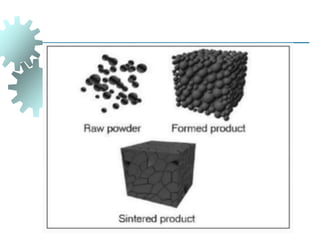
Powder Metallurgy (PM)
Metal processing technology in which parts are
produced from metallic powders
 Usual PM production sequence:
1. Pressing - powders are compressed into
desired shape to produce green compact
 using punch-and-die tooling designed
for the part
2. Sintering – green compacts are heated to
bond the particles into a hard, rigid mass
 Performed at temperatures below the
melting point of the metal
Limitations and Disadvantages of powder metallurgy
 High tooling and equipment costs
 Metallic powders are expensive
 Problems in storing and handling metal
powders
 Limitations on part geometry because metal
powders do not readily flow laterally in the die
during pressing
 Variations in density throughout part may be a
problem, especially for complex geometries
PM Work Materials
 Alloys of iron, steel, and aluminum
 Copper, nickel, and refractory metals such as
molybdenum and tungsten
 Metallic carbides such as tungsten carbide
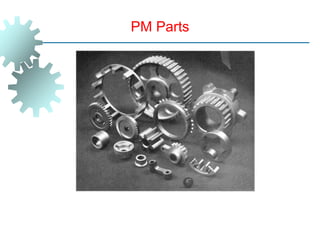
PM Parts
Engineering Powders
 Engineering powders include metals and
ceramics
 Geometric features of engineering powders:
 Particle size and distribution
 Particle shape and internal structure
 Surface area
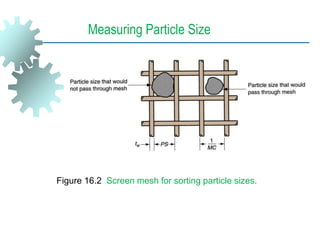
Figure 16.2 Screen mesh for sorting particle sizes.
Measuring Particle Size
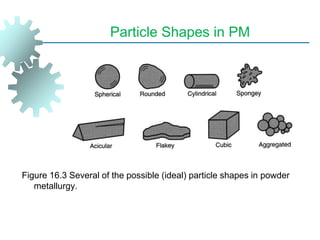
Figure 16.3 Several of the possible (ideal) particle shapes in powder
metallurgy.
Particle Shapes in PM
Particle Density Measures
 True density - density of the true volume of the
material
 The density of the material if the powders
were melted into a solid mass
 Bulk density - density of the powders in the
loose state after pouring
 Because of pores between particles, bulk
density is less than true density
Packing Factor
Bulk density divided by true density
 Typical values for loose powders range
between 0.5 and 0.7
 If powders of various sizes are present, smaller
powders will fit into spaces between larger
ones, thus higher packing factor
 Packing can be increased by vibrating the
powders,
 Pressure applied during compaction greatly
increases packing of powders through
rearrangement and deformation of particles
Porosity
Ratio of volume of the pores (empty
spaces) in the powder to the bulk
volume
Porosity + Packing factor = 1.0
Production of Metallic Powders
 Three principal methods by which metallic
powders are commercially produced
1. Crushing and Milling
2. Liquid metal atomization
3. Electrolytic deposition
 mechanical methods are used to reduce
powder sizes
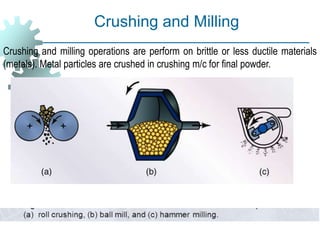
Crushing and milling operations are perform on brittle or less ductile materials
(metals). Metal particles are crushed in crushing m/c for final powder.
Crushing and Milling
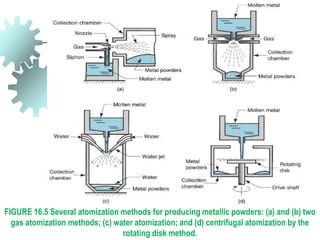
Atomization process
Atomization is one of the most effective industrial powder preparation methods.
- This method involves disintegration (atomizing) of liquid metal by means of
high speed medium (air, inert gas, water) striking the melt streaming through a
nozzle.
- The molten alloy is prepared in a furnace and then it is transferred to the
tundish.
- The melt is poured from the tundish through the nozzle into the chamber.
- The water (air, gas) jets break the melt stream into fine droplets.
- The droplets solidify when they fall in the chamber.
- The powder is collected at the bottom of the chamber.
- The powder is removed from the chamber and dried (if necessary).
FIGURE 16.5 Several atomization methods for producing metallic powders: (a) and (b) two
gas atomization methods; (c) water atomization; and (d) centrifugal atomization by the
rotating disk method.
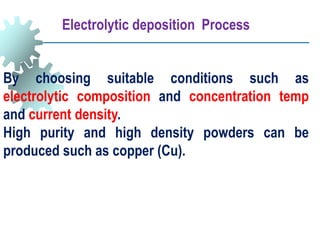
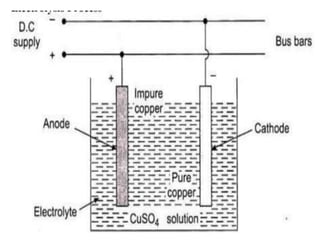
By choosing suitable conditions such as
electrolytic composition and concentration temp
and current density.
High purity and high density powders can be
produced such as copper (Cu).
Electrolytic deposition Process
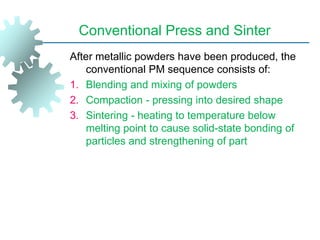
Conventional Press and Sinter
After metallic powders have been produced, the
conventional PM sequence consists of:
1. Blending and mixing of powders
2. Compaction - pressing into desired shape
3. Sintering - heating to temperature below
melting point to cause solid-state bonding of
particles and strengthening of part
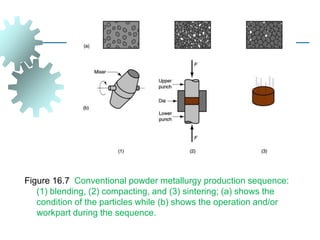
Figure 16.7 Conventional powder metallurgy production sequence:
(1) blending, (2) compacting, and (3) sintering; (a) shows the
condition of the particles while (b) shows the operation and/or
workpart during the sequence.
Blending and Mixing of Powders
For successful results in compaction and
sintering, the starting powders must be
homogenized
 Blending - powders of same chemistry but
possibly different particle sizes are
intermingled
 Different particle sizes are often blended
to reduce porosity
 Mixing - powders of different chemistries are
combined
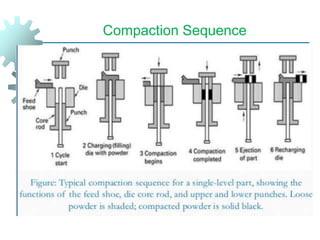
Compaction
Application of high pressure to the powders to
form them into the required shape
 Conventional compaction method is pressing,
in which opposing punches squeeze the
powders contained in a die
 The workpart after pressing is called a green
compact, the word green meaning not yet fully
processed
Compaction Sequence
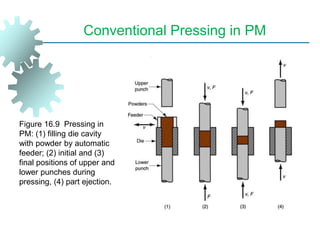
Conventional Pressing in PM
Figure 16.9 Pressing in
PM: (1) filling die cavity
with powder by automatic
feeder; (2) initial and (3)
final positions of upper and
lower punches during
pressing, (4) part ejection.
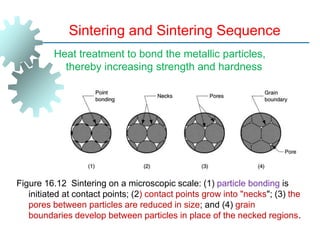
Sintering and Sintering Sequence
Heat treatment to bond the metallic particles,
thereby increasing strength and hardness
Figure 16.12 Sintering on a microscopic scale: (1) particle bonding is
initiated at contact points; (2) contact points grow into "necks"; (3) the
pores between particles are reduced in size; and (4) grain
boundaries develop between particles in place of the necked regions.
Impregnation and Infiltration
 Porosity is a unique and inherent
characteristic of PM technology
 It can be exploited to create special products
by filling the available pore space with oils,
polymers, or metals
 Two categories:
1. Impregnation
2. Infiltration
Impregnation
The term used when oil or other fluid is
permeated into the pores of a sintered PM part
 Common products are oil-impregnated
bearings, gears, and similar components
 Alternative application is when parts are
impregnated with polymer resins that seep into
the pore spaces in liquid form and then solidify
to create a pressure tight part
Infiltration
Operation in which the pores of the PM part are
filled with a molten metal
 The melting point of the filler metal must be
below that of the PM part
 Involves heating the filler metal in contact with
the sintered component so capillary action
draws the filler into the pores
 Resulting structure is relatively nonporous,
and the infiltrated part has a more uniform
density, as well as improved toughness and
strength
Alternatives to Pressing and Sintering
 Additional methods for processing PM parts
include:
 Isostatic pressing
 Hot pressing - combined pressing and
sintering
PM Products
 Gears, bearings, sprockets, fasteners,
electrical contacts, cutting tools, and various
machinery parts
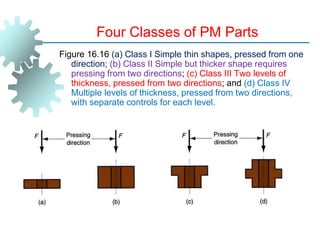
Figure 16.16 (a) Class I Simple thin shapes, pressed from one
direction; (b) Class II Simple but thicker shape requires
pressing from two directions; (c) Class III Two levels of
thickness, pressed from two directions; and (d) Class IV
Multiple levels of thickness, pressed from two directions,
with separate controls for each level.
Four Classes of PM Parts
‫النهاية‬

powder metallurgy.ppt ,forming ..........

  • 1.
  • 2.
    Stages of productionpart by powder metallurgy 1. Preparing the row materials (powders) 2. Blending and mixing the row material 5. Compaction process 3. Preparing the tooling (dies and punches) according to shape and dimensions of W.P 4. Fill the die by powders 6. Sintering process
  • 3.
    POWDER METALLURGY 1. TheCharacterization of Engineering Powders 2. Production of Metallic Powders 3. Conventional Pressing and Sintering 4. Alternative Pressing and Sintering Techniques 5. Materials and Products for PM 6. Design Considerations in Powder Metallurgy
  • 4.
    Powder Metallurgy (PM) Metalprocessing technology in which parts are produced from metallic powders  Usual PM production sequence: 1. Pressing - powders are compressed into desired shape to produce green compact  using punch-and-die tooling designed for the part 2. Sintering – green compacts are heated to bond the particles into a hard, rigid mass  Performed at temperatures below the melting point of the metal
  • 5.
    Limitations and Disadvantagesof powder metallurgy  High tooling and equipment costs  Metallic powders are expensive  Problems in storing and handling metal powders  Limitations on part geometry because metal powders do not readily flow laterally in the die during pressing  Variations in density throughout part may be a problem, especially for complex geometries
  • 6.
    PM Work Materials Alloys of iron, steel, and aluminum  Copper, nickel, and refractory metals such as molybdenum and tungsten  Metallic carbides such as tungsten carbide
  • 7.
  • 8.
    Engineering Powders  Engineeringpowders include metals and ceramics  Geometric features of engineering powders:  Particle size and distribution  Particle shape and internal structure  Surface area
  • 9.
    Figure 16.2 Screenmesh for sorting particle sizes. Measuring Particle Size
  • 10.
    Figure 16.3 Severalof the possible (ideal) particle shapes in powder metallurgy. Particle Shapes in PM
  • 11.
    Particle Density Measures True density - density of the true volume of the material  The density of the material if the powders were melted into a solid mass  Bulk density - density of the powders in the loose state after pouring  Because of pores between particles, bulk density is less than true density
  • 12.
    Packing Factor Bulk densitydivided by true density  Typical values for loose powders range between 0.5 and 0.7  If powders of various sizes are present, smaller powders will fit into spaces between larger ones, thus higher packing factor  Packing can be increased by vibrating the powders,  Pressure applied during compaction greatly increases packing of powders through rearrangement and deformation of particles
  • 13.
    Porosity Ratio of volumeof the pores (empty spaces) in the powder to the bulk volume Porosity + Packing factor = 1.0
  • 14.
    Production of MetallicPowders  Three principal methods by which metallic powders are commercially produced 1. Crushing and Milling 2. Liquid metal atomization 3. Electrolytic deposition  mechanical methods are used to reduce powder sizes
  • 15.
    Crushing and millingoperations are perform on brittle or less ductile materials (metals). Metal particles are crushed in crushing m/c for final powder. Crushing and Milling
  • 16.
    Atomization process Atomization isone of the most effective industrial powder preparation methods. - This method involves disintegration (atomizing) of liquid metal by means of high speed medium (air, inert gas, water) striking the melt streaming through a nozzle. - The molten alloy is prepared in a furnace and then it is transferred to the tundish. - The melt is poured from the tundish through the nozzle into the chamber. - The water (air, gas) jets break the melt stream into fine droplets. - The droplets solidify when they fall in the chamber. - The powder is collected at the bottom of the chamber. - The powder is removed from the chamber and dried (if necessary).
  • 17.
    FIGURE 16.5 Severalatomization methods for producing metallic powders: (a) and (b) two gas atomization methods; (c) water atomization; and (d) centrifugal atomization by the rotating disk method.
  • 18.
    By choosing suitableconditions such as electrolytic composition and concentration temp and current density. High purity and high density powders can be produced such as copper (Cu). Electrolytic deposition Process
  • 20.
    Conventional Press andSinter After metallic powders have been produced, the conventional PM sequence consists of: 1. Blending and mixing of powders 2. Compaction - pressing into desired shape 3. Sintering - heating to temperature below melting point to cause solid-state bonding of particles and strengthening of part
  • 22.
    Figure 16.7 Conventionalpowder metallurgy production sequence: (1) blending, (2) compacting, and (3) sintering; (a) shows the condition of the particles while (b) shows the operation and/or workpart during the sequence.
  • 23.
    Blending and Mixingof Powders For successful results in compaction and sintering, the starting powders must be homogenized  Blending - powders of same chemistry but possibly different particle sizes are intermingled  Different particle sizes are often blended to reduce porosity  Mixing - powders of different chemistries are combined
  • 24.
    Compaction Application of highpressure to the powders to form them into the required shape  Conventional compaction method is pressing, in which opposing punches squeeze the powders contained in a die  The workpart after pressing is called a green compact, the word green meaning not yet fully processed
  • 25.
  • 26.
    Conventional Pressing inPM Figure 16.9 Pressing in PM: (1) filling die cavity with powder by automatic feeder; (2) initial and (3) final positions of upper and lower punches during pressing, (4) part ejection.
  • 27.
    Sintering and SinteringSequence Heat treatment to bond the metallic particles, thereby increasing strength and hardness Figure 16.12 Sintering on a microscopic scale: (1) particle bonding is initiated at contact points; (2) contact points grow into "necks"; (3) the pores between particles are reduced in size; and (4) grain boundaries develop between particles in place of the necked regions.
  • 28.
    Impregnation and Infiltration Porosity is a unique and inherent characteristic of PM technology  It can be exploited to create special products by filling the available pore space with oils, polymers, or metals  Two categories: 1. Impregnation 2. Infiltration
  • 29.
    Impregnation The term usedwhen oil or other fluid is permeated into the pores of a sintered PM part  Common products are oil-impregnated bearings, gears, and similar components  Alternative application is when parts are impregnated with polymer resins that seep into the pore spaces in liquid form and then solidify to create a pressure tight part
  • 30.
    Infiltration Operation in whichthe pores of the PM part are filled with a molten metal  The melting point of the filler metal must be below that of the PM part  Involves heating the filler metal in contact with the sintered component so capillary action draws the filler into the pores  Resulting structure is relatively nonporous, and the infiltrated part has a more uniform density, as well as improved toughness and strength
  • 31.
    Alternatives to Pressingand Sintering  Additional methods for processing PM parts include:  Isostatic pressing  Hot pressing - combined pressing and sintering
  • 32.
    PM Products  Gears,bearings, sprockets, fasteners, electrical contacts, cutting tools, and various machinery parts
  • 33.
    Figure 16.16 (a)Class I Simple thin shapes, pressed from one direction; (b) Class II Simple but thicker shape requires pressing from two directions; (c) Class III Two levels of thickness, pressed from two directions; and (d) Class IV Multiple levels of thickness, pressed from two directions, with separate controls for each level. Four Classes of PM Parts
  • 34.