
Sol gel method for
synthesis of nanoparticles
Course title: Nanotechnology
Presented by: Sehrish Inam
1
3/21/2020
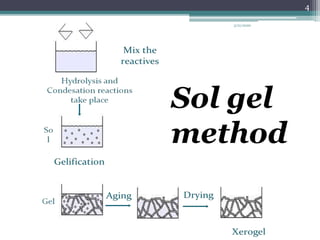
Sol gel
• A sol is a stable dispersion of particles or polymers
in a solvent. The particles may be amorphous or
crystalline.
• A gel consists of a three dimensional continuous
network, which encloses a liquid phase.
2
3/21/2020
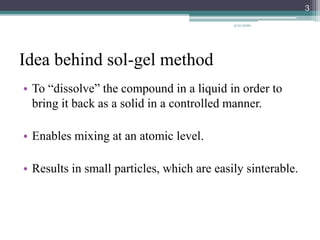
Idea behind sol-gel method
• To “dissolve” the compound in a liquid in order to
bring it back as a solid in a controlled manner.
• Enables mixing at an atomic level.
• Results in small particles, which are easily sinterable.
3
3/21/2020
Sol gel
method
4
3/21/2020
History
• Developed in the 1960s
• A method was needed where dust was reduced
(compared to the ceramic method) and which needed
a lower sintering temperature.
• Needed synthesis by remote control.
5
3/21/2020
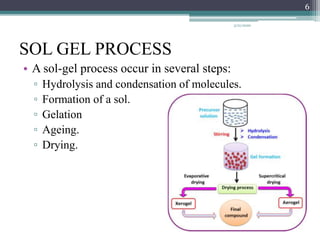
SOL GEL PROCESS
• A sol-gel process occur in several steps:
▫ Hydrolysis and condensation of molecules.
▫ Formation of a sol.
▫ Gelation
▫ Ageing.
▫ Drying.
6
3/21/2020
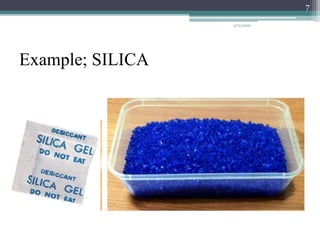
Example; SILICA
7
3/21/2020
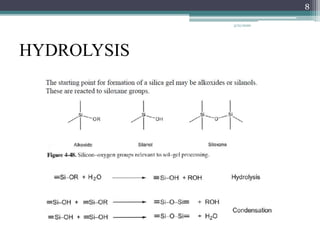
HYDROLYSIS
8
3/21/2020
CONDENSATION
• Parameters which influences the condensation
process:
▫ Type of precursor
▫ The ratio between alkoxide and water (RW)
▫ Type of catalyst used
▫ Type of solvent
▫ Temperature
▫ pH
▫ Relative and absolute concentrations of the reactants.
9
3/21/2020
Network Formation
• As the sol aggregates the viscosity will increase until
a gel is formed.
• The sol-gel transition (gel-point) is reached when a
continuous network is formed.
• The gel-time is determined as the time when it is
possible to turn the container upside-down.
10
3/21/2020
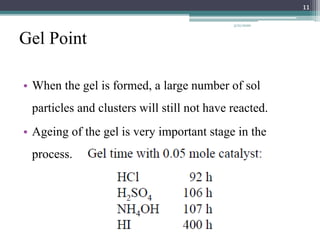
Gel Point
• When the gel is formed, a large number of sol
particles and clusters will still not have reacted.
• Ageing of the gel is very important stage in the
process.
11
3/21/2020
Ageing
• As the viscosity increase, the solvent is “trapped” inside
the gel.
• The liquid phase still contains sol particles and
agglomerates, which will continue to react, and will
condense as the gel dries.
• Hydrolysis and condensation are reversible processes.
12
3/21/2020
Drying
• Normal drying of the gel leads to reducing the pore size.
• OH groups on opposite sides may react and form new
bonds by condensation.
• Gas will enter the pores with a thin film of liquid on the
walls. This will evaporate and only isolated spaces with
liquid are left.
13
3/21/2020
Advantages of Sol gel method
• Sol-gel synthesis may be used to prepare materials
with a variety of shapes, such as porous structures,
thin fibers, dense powders and thin films.
• Obtain pure , size controlled stable and
monodispersed nanoparticles ranges 20-200 nm.
• Precise control over the doping level is also easier in
this process
14
3/21/2020
Disadvantages of Sol gel method
• This technique is quite substrate dependent.
• Metal alkoxides are the most preferred precursor.
But they are expensive.
• We have little control over porosity of the gel which
inturn affects the rate of solvent removal from the gel
in order to form the final powder.
• Formation of gel is a slow process, which makes sol
gel a time consuming fabrication technique as
compared to other methods (combustion synthesis).
15
3/21/2020
16
3/21/2020

Slide share version solgel method

  • 1.
    Sol gel methodfor synthesis of nanoparticles Course title: Nanotechnology Presented by: Sehrish Inam 1 3/21/2020
  • 2.
    Sol gel • Asol is a stable dispersion of particles or polymers in a solvent. The particles may be amorphous or crystalline. • A gel consists of a three dimensional continuous network, which encloses a liquid phase. 2 3/21/2020
  • 3.
    Idea behind sol-gelmethod • To “dissolve” the compound in a liquid in order to bring it back as a solid in a controlled manner. • Enables mixing at an atomic level. • Results in small particles, which are easily sinterable. 3 3/21/2020
  • 4.
  • 5.
    History • Developed inthe 1960s • A method was needed where dust was reduced (compared to the ceramic method) and which needed a lower sintering temperature. • Needed synthesis by remote control. 5 3/21/2020
  • 6.
    SOL GEL PROCESS •A sol-gel process occur in several steps: ▫ Hydrolysis and condensation of molecules. ▫ Formation of a sol. ▫ Gelation ▫ Ageing. ▫ Drying. 6 3/21/2020
  • 7.
  • 8.
  • 9.
    CONDENSATION • Parameters whichinfluences the condensation process: ▫ Type of precursor ▫ The ratio between alkoxide and water (RW) ▫ Type of catalyst used ▫ Type of solvent ▫ Temperature ▫ pH ▫ Relative and absolute concentrations of the reactants. 9 3/21/2020
  • 10.
    Network Formation • Asthe sol aggregates the viscosity will increase until a gel is formed. • The sol-gel transition (gel-point) is reached when a continuous network is formed. • The gel-time is determined as the time when it is possible to turn the container upside-down. 10 3/21/2020
  • 11.
    Gel Point • Whenthe gel is formed, a large number of sol particles and clusters will still not have reacted. • Ageing of the gel is very important stage in the process. 11 3/21/2020
  • 12.
    Ageing • As theviscosity increase, the solvent is “trapped” inside the gel. • The liquid phase still contains sol particles and agglomerates, which will continue to react, and will condense as the gel dries. • Hydrolysis and condensation are reversible processes. 12 3/21/2020
  • 13.
    Drying • Normal dryingof the gel leads to reducing the pore size. • OH groups on opposite sides may react and form new bonds by condensation. • Gas will enter the pores with a thin film of liquid on the walls. This will evaporate and only isolated spaces with liquid are left. 13 3/21/2020
  • 14.
    Advantages of Solgel method • Sol-gel synthesis may be used to prepare materials with a variety of shapes, such as porous structures, thin fibers, dense powders and thin films. • Obtain pure , size controlled stable and monodispersed nanoparticles ranges 20-200 nm. • Precise control over the doping level is also easier in this process 14 3/21/2020
  • 15.
    Disadvantages of Solgel method • This technique is quite substrate dependent. • Metal alkoxides are the most preferred precursor. But they are expensive. • We have little control over porosity of the gel which inturn affects the rate of solvent removal from the gel in order to form the final powder. • Formation of gel is a slow process, which makes sol gel a time consuming fabrication technique as compared to other methods (combustion synthesis). 15 3/21/2020
  • 16.