Plant growth and developmentg p
GrowthGrowth
Irreversible increase in size, results from cell division
and cell enlargement
Morphogenesis
Development of formp
Development
Sum of all of the changes that PROGRESSIVELY
elaborate an organism’s body
Nutritional requirementsq
CO2CO2
Mineral nutrients- essential chemical elements
absorbed from the soil in the form of inorganic ionsabsorbed from the soil in the form of inorganic ions
H20*
mineralsminerals
Essential nutrients
Required for a plant to grow from a seed andRequired for a plant to grow from a seed and
complete the life cycle
No other elem can replace itNo other elem can replace it
It has a direct or indirect action in plt metab
17 essential nutrients17 essential nutrients
Macronutrients - 9
Micronutrients – 8Micronutrients – 8
e
Macronutrients
Required in large amounts
Produces the body of the plant
Carrying out essential physiological processes
9 macronutrients (CHONPSKCaMg)9 macronutrients (CHONPSKCaMg)
1. CARBON
2. HYDROGEN
3. OXYGEN
4. NITROGEN
5. PHOSPHORUS
6. SULFUR
7. POTASSIUM
8. CALCIUM
9. MAGNESIUM
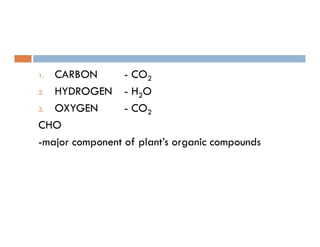
1 CARBON - CO21. CARBON CO2
2. HYDROGEN - H2O
3 OXYGEN CO3. OXYGEN - CO2
CHO
j f l ’ i d-major component of plant’s organic compounds
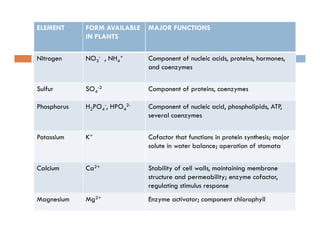
ELEMENT FORM AVAILABLE
IN PLANTS
MAJOR FUNCTIONS
Nitrogen NO3
- , NH4
+ Component of nucleic acids, proteins, hormones,
and coenzymes
Sulfur SO4
-2 Component of proteins, coenzymes
Phosphorus H2PO4
-, HPO4
2- Component of nucleic acid, phospholipids, ATP,Phosphorus H2PO4 , HPO4 Component of nucleic acid, phospholipids, ATP,
several coenzymes
Potassium K+ Cofactor that functions in protein synthesis; majorPotassium K Cofactor that functions in protein synthesis; major
solute in water balance; operation of stomata
Calcium Ca2+ Stability of cell walls, maintaining membraneCalcium Ca Stability of cell walls, maintaining membrane
structure and permeability; enzyme cofactor,
regulating stimulus response
Magnesium Mg2+ Enzyme activator; component chlorophyllMagnesium Mg Enzyme activator; component chlorophyll
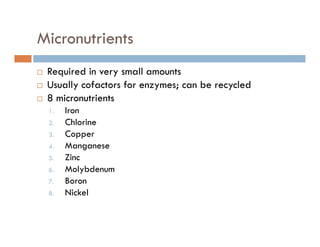
Micronutrients
Required in very small amounts
Usually cofactors for enzymes; can be recycled
8 micronutrients
I1. Iron
2. Chlorine
3. Copper
4. Manganese
5. Zinc
6 Molybdenum6. Molybdenum
7. Boron
8. Nickel
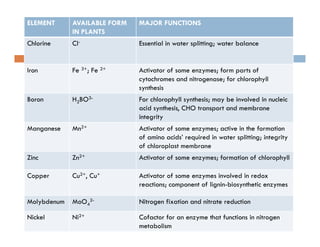
ELEMENT AVAILABLE FORM
IN PLANTS
MAJOR FUNCTIONS
Chlorine Cl- Essential in water splitting; water balanceC o e C sse a wa e sp g; wa e ba a ce
Iron Fe 3+; Fe 2+ Activator of some enzymes; form parts of
h d f hl h llcytochromes and nitrogenase; for chlorophyll
synthesis
Boron H2BO3- For chlorophyll synthesis; may be involved in nucleic
acid synthesis CHO transport and membraneacid synthesis, CHO transport and membrane
integrity
Manganese Mn2+ Activator of some enzymes; active in the formation
of amino acids’ required in water splitting; integrityof amino acids required in water splitting; integrity
of chloroplast membrane
Zinc Zn2+ Activator of some enzymes; formation of chlorophyll
Copper Cu2+, Cu+ Activator of some enzymes involved in redox
reactions; component of lignin-biosynthetic enzymes
Molybdenum MoO 2- Nitrogen fixation and nitrate reductionMolybdenum MoO4
2 Nitrogen fixation and nitrate reduction
Nickel Ni2+ Cofactor for an enzyme that functions in nitrogen
metabolism
Mineral Deficiencyy
1. Function1. Function
Chlorosis- yellowing of leaves
Deficiency in Mg or FeDeficiency in Mg or Fe
2. Mobility
Mg highly mobileMg- highly mobile
Symptoms of deficiency show up 1st in older organs
F i bilFe- immobile
Symptoms of deficiency show up in younger organs
Assignmentg
Make a list of deficiency symptoms of essentialMake a list of deficiency symptoms of essential
elements
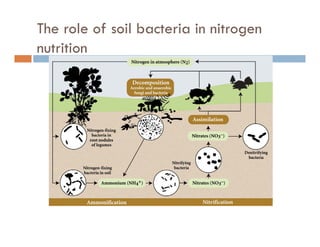
The role of soil bacteria in nitrogen
t itinutrition
Plant hormones coordinate growth, development and
responses to stimuliresponses to stimuli
HormoneHormone
Greek word “to excite”
A small molecule that carries information from theA small molecule that carries information from the
cell where it was produced to a particular target
cells, causing a change in response to internal needscells, causing a change in response to internal needs
or external stimuli
Minute concentrations are requiredMinute concentrations are required
Reaction to hormone: not on amounts but on relative
concentration compared to other hormonesconcentration compared to other hormones
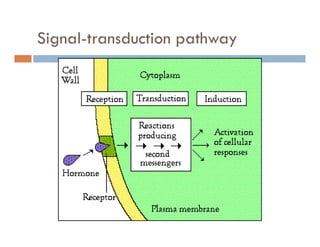
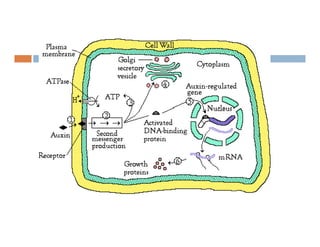
Signal-transduction pathwayg p y
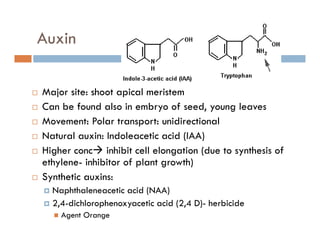
Auxin
Major site: shoot apical meristem
Can be found also in embryo of seed young leavesCan be found also in embryo of seed, young leaves
Movement: Polar transport: unidirectional
Natural auxin: Indoleacetic acid (IAA)Na u a au : do eace c ac d ( )
Higher conc inhibit cell elongation (due to synthesis of
ethylene- inhibitor of plant growth)
Synthetic auxins:
Naphthaleneacetic acid (NAA)
2 4 di hl h ti id (2 4 D) h bi id2,4-dichlorophenoxyacetic acid (2,4 D)- herbicide
Agent Orange
Auxin
Major function:Major function:
cell elongation
root growth (adventitious roots)root growth (adventitious roots)
differentiation and branching
Fruit development (seeds synthesize auxin)p ( y )
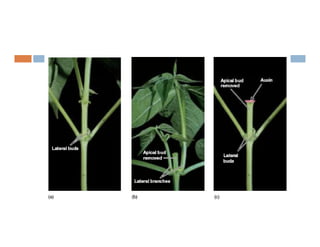
Apical dominance
Phototropism and gravitropismp g p
Acid growth hypothesisg yp
Cytokininy
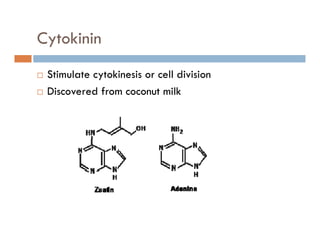
Stimulate cytokinesis or cell divisionStimulate cytokinesis or cell division
Discovered from coconut milk
Cytokininy
Sites: growing tissues in roots, embryos and fruitsSites: growing tissues in roots, embryos and fruits
Major functions
Cell division and differentiationCell division and differentiation
Counteracting apical dominance
Delaying aging of leavesDelaying aging of leaves
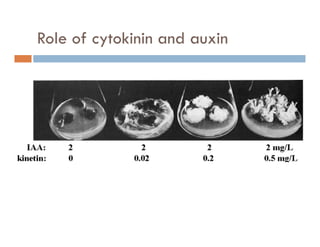
Role of cytokinin and auxiny
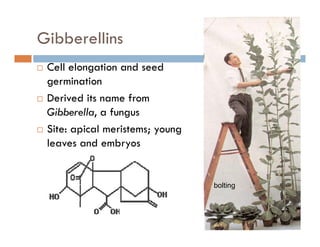
Gibberellins
Cell elongation and seed
germination
Derived its name from
Gibberella, a fungus
Site: apical meristems; young
leaves and embryos
bolting
Gibberellins
Major functions:
Stem elongation
GA – facilitate movement of expansins into correct position
in cell wallin cell wall
Reverse dwarfism
Seed germinationg
Stimulate production of alpha-amylase
Juvenility
Promotes flowering
Biennials flower in their first year
F i f i i i f f iFruit formation -- increases size of fruits
Abscisic Acid
Terpenoid hormoneTerpenoid hormone
Sites: leaves, stems, roots and green fruit
Slows growthSlows growth
seed dormancy
Dormant buds inhibits cell division of vascular cambiumDormant buds, inhibits cell division of vascular cambium
Stress hormones
Closes stomataCloses stomata
Water shortage can stress the root system
production of ABA transported to leavesproduction of ABA transported to leaves
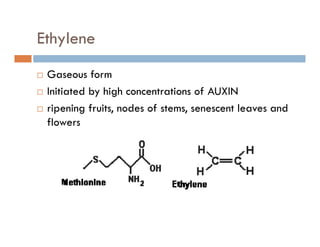
Ethyleney
Gaseous formGaseous form
Initiated by high concentrations of AUXIN
ripening fruits nodes of stems senescent leaves andripening fruits, nodes of stems, senescent leaves and
flowers
Ethyleney
Major functionsMajor functions
Represses growth in length while stimulating
expansion in widthexpansion in width
Ethylene production: stimulated by touch, wind or
any damageany damage
Growth maneuver: triple response
1 Slowing of stem or root elongation1. Slowing of stem or root elongation
2. Thickening of root or stem
3. Curving to grow horizontally3. Curving to grow horizontally
Ethyleney
Major functions:Major functions:
Abscission of leaves
Senescence/ agingSenescence/ aging
Progression of irreversible change that eventually leads
to deathto death
Related to fruit ripening and leaf abscission
Fruit ripeningFruit ripening
Chlorophyll degradation
Softening of fruitSoftening of fruit
Brassinosteroids
Newly discoveredy
Steroid
First discovered in Brassica, which includes cabbage
Bind to receptor protein the plasma membrane
Act like auxin
Stimulate cell division and elongation in stems
Cause differentiation of xylem cells
Pollen tube growthPollen tube growth
Slow root growth
Delay leaf abscissionDelay leaf abscission
Additional phytohormonesp y
Polyaminesy
Cell division and synthesis of DNA, RNA, and proteins
Root initiation and tuber formation
Development of embryos, flowers and fruit
Jasmonic acid
Fatty acid
Inhibits growth of seeds, pollen and roots
P t l ti f t i i dPromotes accumulation of proteins in seeds
Stimulates formation of flower, fruit and seed
Plant defensePlant defense
Growth responses
I T iI. Tropisms
Growth response that result in curvature of plant
OWA AWA forgans TOWARD or AWAY from stimuli
Negative and positive tropism
hA. Phototropism
B. Gravitropism
ThC. Thigmotropism
D. Heliotropism
H d iE. Hydrotropism
F. Chemotropism
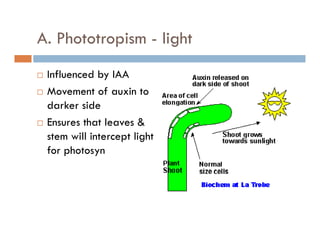
A. Phototropism - lightp g
Influenced by IAAInfluenced by IAA
Movement of auxin to
darker sidedarker side
Ensures that leaves &
stem will intercept lightstem will intercept light
for photosyn
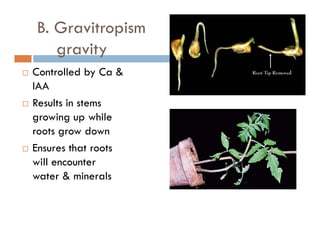
B. Gravitropism
itgravity
Controlled by Ca &y
IAA
Results in stems
growing up while
roots grow down
Ensures that roots
will encounter
water & minerals
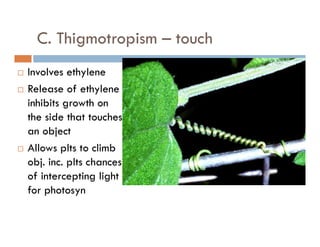
C. Thigmotropism – touchg p
Involves ethyleney
Release of ethylene
inhibits growth ong
the side that touches
an object
Allows plts to climb
obj. inc. plts chances
of intercepting light
for photosyn
Growth responses
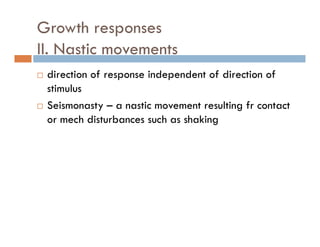
II N ti tII. Nastic movements
direction of response independent of direction ofdirection of response independent of direction of
stimulus
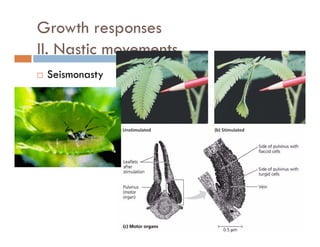
Seismonasty – a nastic movement resulting fr contactSeismonasty a nastic movement resulting fr contact
or mech disturbances such as shaking
Growth responses
II N ti tII. Nastic movements
SeismonastySeismonasty
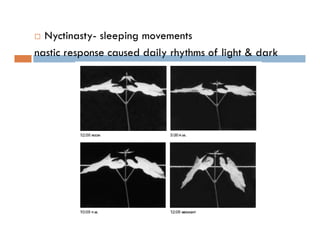
Nyctinasty- sleeping movements
nastic response caused daily rhythms of light & dark
Growth responses
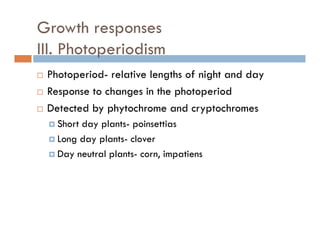
III Ph t i diIII. Photoperiodism
Photoperiod- relative lengths of night and dayPhotoperiod relative lengths of night and day
Response to changes in the photoperiod
Detected by phytochrome and cryptochromesDetected by phytochrome and cryptochromes
Short day plants- poinsettias
Long day plants cloverLong day plants- clover
Day neutral plants- corn, impatiens
Plant growth and development [compatibility mode]

Plant growth and development [compatibility mode]

  • 1.
    Plant growth anddevelopmentg p GrowthGrowth Irreversible increase in size, results from cell division and cell enlargement Morphogenesis Development of formp Development Sum of all of the changes that PROGRESSIVELY elaborate an organism’s body
  • 2.
    Nutritional requirementsq CO2CO2 Mineral nutrients-essential chemical elements absorbed from the soil in the form of inorganic ionsabsorbed from the soil in the form of inorganic ions H20* mineralsminerals
  • 3.
    Essential nutrients Required fora plant to grow from a seed andRequired for a plant to grow from a seed and complete the life cycle No other elem can replace itNo other elem can replace it It has a direct or indirect action in plt metab 17 essential nutrients17 essential nutrients Macronutrients - 9 Micronutrients – 8Micronutrients – 8 e
  • 4.
    Macronutrients Required in largeamounts Produces the body of the plant Carrying out essential physiological processes 9 macronutrients (CHONPSKCaMg)9 macronutrients (CHONPSKCaMg) 1. CARBON 2. HYDROGEN 3. OXYGEN 4. NITROGEN 5. PHOSPHORUS 6. SULFUR 7. POTASSIUM 8. CALCIUM 9. MAGNESIUM
  • 5.
    1 CARBON -CO21. CARBON CO2 2. HYDROGEN - H2O 3 OXYGEN CO3. OXYGEN - CO2 CHO j f l ’ i d-major component of plant’s organic compounds
  • 6.
    ELEMENT FORM AVAILABLE INPLANTS MAJOR FUNCTIONS Nitrogen NO3 - , NH4 + Component of nucleic acids, proteins, hormones, and coenzymes Sulfur SO4 -2 Component of proteins, coenzymes Phosphorus H2PO4 -, HPO4 2- Component of nucleic acid, phospholipids, ATP,Phosphorus H2PO4 , HPO4 Component of nucleic acid, phospholipids, ATP, several coenzymes Potassium K+ Cofactor that functions in protein synthesis; majorPotassium K Cofactor that functions in protein synthesis; major solute in water balance; operation of stomata Calcium Ca2+ Stability of cell walls, maintaining membraneCalcium Ca Stability of cell walls, maintaining membrane structure and permeability; enzyme cofactor, regulating stimulus response Magnesium Mg2+ Enzyme activator; component chlorophyllMagnesium Mg Enzyme activator; component chlorophyll
  • 7.
    Micronutrients Required in verysmall amounts Usually cofactors for enzymes; can be recycled 8 micronutrients I1. Iron 2. Chlorine 3. Copper 4. Manganese 5. Zinc 6 Molybdenum6. Molybdenum 7. Boron 8. Nickel
  • 8.
    ELEMENT AVAILABLE FORM INPLANTS MAJOR FUNCTIONS Chlorine Cl- Essential in water splitting; water balanceC o e C sse a wa e sp g; wa e ba a ce Iron Fe 3+; Fe 2+ Activator of some enzymes; form parts of h d f hl h llcytochromes and nitrogenase; for chlorophyll synthesis Boron H2BO3- For chlorophyll synthesis; may be involved in nucleic acid synthesis CHO transport and membraneacid synthesis, CHO transport and membrane integrity Manganese Mn2+ Activator of some enzymes; active in the formation of amino acids’ required in water splitting; integrityof amino acids required in water splitting; integrity of chloroplast membrane Zinc Zn2+ Activator of some enzymes; formation of chlorophyll Copper Cu2+, Cu+ Activator of some enzymes involved in redox reactions; component of lignin-biosynthetic enzymes Molybdenum MoO 2- Nitrogen fixation and nitrate reductionMolybdenum MoO4 2 Nitrogen fixation and nitrate reduction Nickel Ni2+ Cofactor for an enzyme that functions in nitrogen metabolism
  • 9.
    Mineral Deficiencyy 1. Function1.Function Chlorosis- yellowing of leaves Deficiency in Mg or FeDeficiency in Mg or Fe 2. Mobility Mg highly mobileMg- highly mobile Symptoms of deficiency show up 1st in older organs F i bilFe- immobile Symptoms of deficiency show up in younger organs
  • 10.
    Assignmentg Make a listof deficiency symptoms of essentialMake a list of deficiency symptoms of essential elements
  • 11.
    The role ofsoil bacteria in nitrogen t itinutrition
  • 12.
    Plant hormones coordinategrowth, development and responses to stimuliresponses to stimuli HormoneHormone Greek word “to excite” A small molecule that carries information from theA small molecule that carries information from the cell where it was produced to a particular target cells, causing a change in response to internal needscells, causing a change in response to internal needs or external stimuli Minute concentrations are requiredMinute concentrations are required Reaction to hormone: not on amounts but on relative concentration compared to other hormonesconcentration compared to other hormones
  • 13.
  • 15.
    Auxin Major site: shootapical meristem Can be found also in embryo of seed young leavesCan be found also in embryo of seed, young leaves Movement: Polar transport: unidirectional Natural auxin: Indoleacetic acid (IAA)Na u a au : do eace c ac d ( ) Higher conc inhibit cell elongation (due to synthesis of ethylene- inhibitor of plant growth) Synthetic auxins: Naphthaleneacetic acid (NAA) 2 4 di hl h ti id (2 4 D) h bi id2,4-dichlorophenoxyacetic acid (2,4 D)- herbicide Agent Orange
  • 16.
    Auxin Major function:Major function: cellelongation root growth (adventitious roots)root growth (adventitious roots) differentiation and branching Fruit development (seeds synthesize auxin)p ( y ) Apical dominance Phototropism and gravitropismp g p
  • 17.
  • 19.
    Cytokininy Stimulate cytokinesis orcell divisionStimulate cytokinesis or cell division Discovered from coconut milk
  • 20.
    Cytokininy Sites: growing tissuesin roots, embryos and fruitsSites: growing tissues in roots, embryos and fruits Major functions Cell division and differentiationCell division and differentiation Counteracting apical dominance Delaying aging of leavesDelaying aging of leaves
  • 21.
  • 22.
    Gibberellins Cell elongation andseed germination Derived its name from Gibberella, a fungus Site: apical meristems; young leaves and embryos bolting
  • 23.
    Gibberellins Major functions: Stem elongation GA– facilitate movement of expansins into correct position in cell wallin cell wall Reverse dwarfism Seed germinationg Stimulate production of alpha-amylase Juvenility Promotes flowering Biennials flower in their first year F i f i i i f f iFruit formation -- increases size of fruits
  • 24.
    Abscisic Acid Terpenoid hormoneTerpenoidhormone Sites: leaves, stems, roots and green fruit Slows growthSlows growth seed dormancy Dormant buds inhibits cell division of vascular cambiumDormant buds, inhibits cell division of vascular cambium Stress hormones Closes stomataCloses stomata Water shortage can stress the root system production of ABA transported to leavesproduction of ABA transported to leaves
  • 25.
    Ethyleney Gaseous formGaseous form Initiatedby high concentrations of AUXIN ripening fruits nodes of stems senescent leaves andripening fruits, nodes of stems, senescent leaves and flowers
  • 26.
    Ethyleney Major functionsMajor functions Repressesgrowth in length while stimulating expansion in widthexpansion in width Ethylene production: stimulated by touch, wind or any damageany damage Growth maneuver: triple response 1 Slowing of stem or root elongation1. Slowing of stem or root elongation 2. Thickening of root or stem 3. Curving to grow horizontally3. Curving to grow horizontally
  • 27.
    Ethyleney Major functions:Major functions: Abscissionof leaves Senescence/ agingSenescence/ aging Progression of irreversible change that eventually leads to deathto death Related to fruit ripening and leaf abscission Fruit ripeningFruit ripening Chlorophyll degradation Softening of fruitSoftening of fruit
  • 28.
    Brassinosteroids Newly discoveredy Steroid First discoveredin Brassica, which includes cabbage Bind to receptor protein the plasma membrane Act like auxin Stimulate cell division and elongation in stems Cause differentiation of xylem cells Pollen tube growthPollen tube growth Slow root growth Delay leaf abscissionDelay leaf abscission
  • 29.
    Additional phytohormonesp y Polyaminesy Celldivision and synthesis of DNA, RNA, and proteins Root initiation and tuber formation Development of embryos, flowers and fruit Jasmonic acid Fatty acid Inhibits growth of seeds, pollen and roots P t l ti f t i i dPromotes accumulation of proteins in seeds Stimulates formation of flower, fruit and seed Plant defensePlant defense
  • 30.
    Growth responses I TiI. Tropisms Growth response that result in curvature of plant OWA AWA forgans TOWARD or AWAY from stimuli Negative and positive tropism hA. Phototropism B. Gravitropism ThC. Thigmotropism D. Heliotropism H d iE. Hydrotropism F. Chemotropism
  • 31.
    A. Phototropism -lightp g Influenced by IAAInfluenced by IAA Movement of auxin to darker sidedarker side Ensures that leaves & stem will intercept lightstem will intercept light for photosyn
  • 32.
    B. Gravitropism itgravity Controlled byCa &y IAA Results in stems growing up while roots grow down Ensures that roots will encounter water & minerals
  • 33.
    C. Thigmotropism –touchg p Involves ethyleney Release of ethylene inhibits growth ong the side that touches an object Allows plts to climb obj. inc. plts chances of intercepting light for photosyn
  • 34.
    Growth responses II Nti tII. Nastic movements direction of response independent of direction ofdirection of response independent of direction of stimulus Seismonasty – a nastic movement resulting fr contactSeismonasty a nastic movement resulting fr contact or mech disturbances such as shaking
  • 35.
    Growth responses II Nti tII. Nastic movements SeismonastySeismonasty
  • 36.
    Nyctinasty- sleeping movements nasticresponse caused daily rhythms of light & dark
  • 37.
    Growth responses III Pht i diIII. Photoperiodism Photoperiod- relative lengths of night and dayPhotoperiod relative lengths of night and day Response to changes in the photoperiod Detected by phytochrome and cryptochromesDetected by phytochrome and cryptochromes Short day plants- poinsettias Long day plants cloverLong day plants- clover Day neutral plants- corn, impatiens