JJA Obico, Instructor, Department of Biology
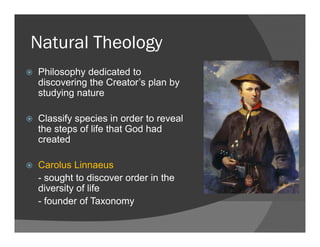
Natural TheologyNatural Theology
Philosophy dedicated top y
discovering the Creator’s plan by
studying nature
Classify species in order to reveal
the steps of life that God had
createdcreated
Carolus Linnaeus
- sought to discover order in the
diversity of life
- founder of Taxonomy- founder of Taxonomy
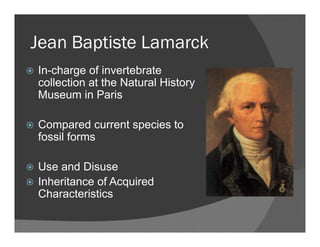
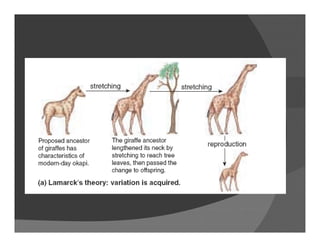
Jean Baptiste LamarckJean Baptiste Lamarck
In-charge of invertebrate
collection at the Natural History
Museum in Paris
Compared current species to
fossil formsfossil forms
Use and DisuseUse and Disuse
Inheritance of Acquired
Characteristics
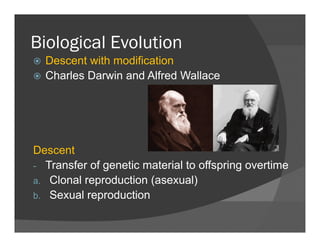
Biological EvolutionBiological Evolution
Descent with modification
Charles Darwin and Alfred WallaceCharles Darwin and Alfred Wallace
Descent
- Transfer of genetic material to offspring overtimeg p g
a. Clonal reproduction (asexual)
b. Sexual reproduction
Biological EvolutionBiological Evolution
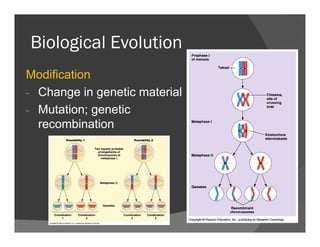
ModificationModification
- Change in genetic material
Mutation; genetic- Mutation; genetic
recombination
What evolves?What evolves?
Populationp
- A group of individuals of the same species
usually geographically delimited and
i ll h i ifi ftypically have a significant amount of gene
exchange
Species
- Consists of group generally intergrading- Consists of group generally intergrading,
interbreeding populations that are
reproductively isolated from other groups
Mechanisms of EvolutionMechanisms of Evolution
Genetic DriftGenetic Drift
Mutation
Gene flowGene flow
Non random mating
Natural Selection
Population Genetics (PopGen)Population Genetics (PopGen)
Study of behavior of genes in theStudy of behavior of genes in the
population
Genetics + EvolutionGenetics + Evolution
Mendel (1866); Darwin and Wallace
(1858)(1858)
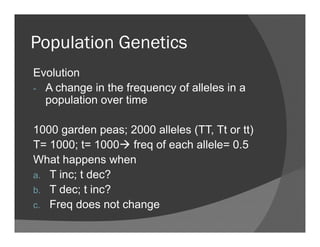
Population GeneticsPopulation Genetics
Evolution
- A change in the frequency of alleles in a
population over time
1000 garden peas; 2000 alleles (TT, Tt or tt)
T= 1000; t= 1000 freq of each allele= 0.5
What happens when
T i d ?a. T inc; t dec?
b. T dec; t inc?
F d t hc. Freq does not change
Hardy-Weinberg EquilibriumHardy Weinberg Equilibrium
Frequency of alleles will remain the sameFrequency of alleles will remain the same
under the following conditions:
1 Size of population is large1. Size of population is large
2. No mutations
3 N i ti3. No migrations
4. Mating is random
5. Natural selection does not take place
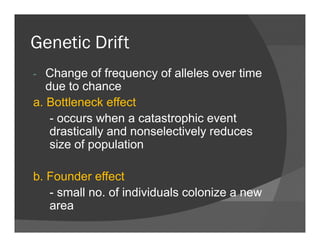
Genetic DriftGenetic Drift
- Change of frequency of alleles over timeChange of frequency of alleles over time
due to chance
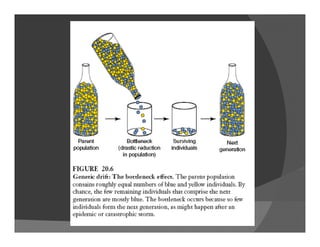
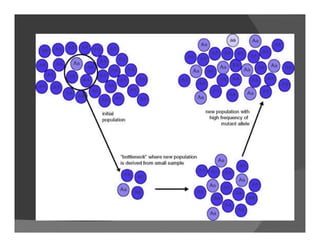
a. Bottleneck effect
- occurs when a catastrophic event
drastically and nonselectively reduces
size of population
b. Founder effect
- small no. of individuals colonize a new
area
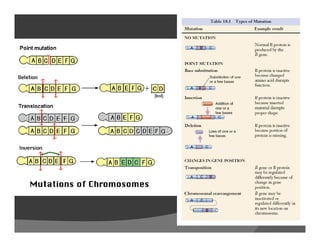
MutationsMutations
Alter the nucleotide sequence of genesAlter the nucleotide sequence of genes
May give an selective advantage in a
particular environmentparticular environment
eg. Tolerance to a toxic metal
Gene FlowGene Flow
Movement of alleles form one populationMovement of alleles form one population
to another
Pollen seeds fruitsPollen, seeds, fruits
Runners or horizontal stems
Mating is randomMating is random
Individuals mate without regard toIndividuals mate without regard to
genotype
Nonrandom matingNonrandom mating
- Self fertilization
A t ti ti t f- Assortative mating- outcome of
pollinator preference
H k th f t f d fleg. Hawkmoths prefer to feed on flowers
with long corolla tube
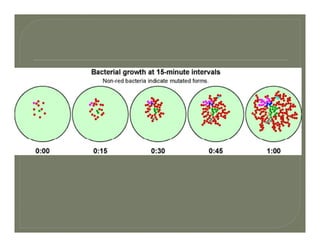
Natural selectionNatural selection
Thomas MalthusThomas Malthus
- Population of organisms tend to
increase geometricallyincrease geometrically
- Geometric progression:
2 4 8 16 32 642,4,8,16,32,64…
- Resources are limited
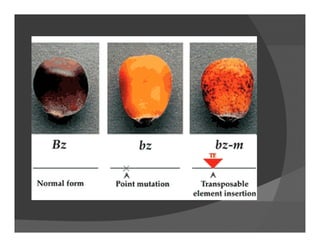
Individual variation within
species
MutationMutation
Crossing over
RecombinationRecombination
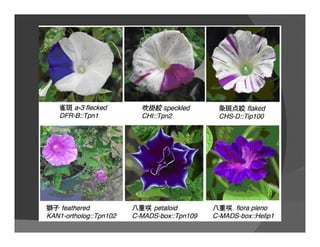
Transposons
- DNA sequences
- have the ability to move from place to
place in chromosomes
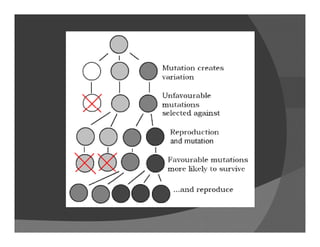
Natural selectionNatural selection
Individuals that are best adapted to theirIndividuals that are best adapted to their
environment have the greatest chance
of surviving and successfullyg y
reproducing
Certain traits that are common amongCertain traits that are common among
individuals
- provide superior adaptation in- provide superior adaptation in
environment
Less common traits- do not conferLess common traits- do not confer
selective advantage
Tropical ForestsTropical Forests
Lack of windLack of wind
Low light intensity
Plants
- Undivided leaves, large, with acumen
Competition for resources is NOTCompetition for resources is NOT
necessary for natural selection to occur
Natural selection may occur if certainNatural selection may occur if certain
individuals produce more offspring than
othersothers
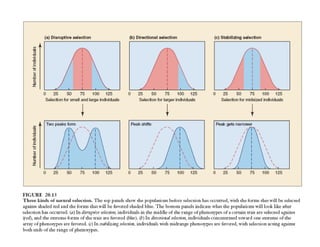
Modes of natural selectionModes of natural selection
Stabilizing selection
- eliminates extreme phenotypesp yp
Directional selection
shifts the average or typical in one direction- shifts the average or typical in one direction
by favoring one of the extreme phenotypes
- leads to ANAGENESIS or phyletic evolution
Diversifying selection
- splits a population into 2 parts favoring both- splits a population into 2 parts favoring both
extremes of phenotypic range
- leads to CLADOGENESIS or branching
evolutionevolution
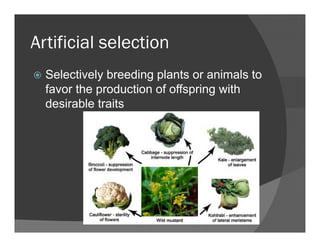
Artificial selectionArtificial selection
Selectively breeding plants or animals toSelectively breeding plants or animals to
favor the production of offspring with
desirable traits
Evolution can occur rapidlyEvolution can occur rapidly
Punctuated equilibriumPunctuated equilibrium
Eldredge and Gould, 1972
punctuated with short periods of rapidpunctuated with short periods of rapid
change
F th d fFew year or thousand of years
eg.
-Colonization of mine tailings by plants
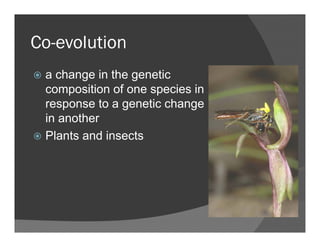
Co-evolutionCo evolution
a change in the genetica change in the genetic
composition of one species in
response to a genetic changep g g
in another
Plants and insectsPlants and insects
SpeciationSpeciation
Formation of new species from preexistingp p g
species
Ultimate result of evolution
Biological Species Concept
A population whose members have the- A population whose members have the
potential to interbreed with one another in
nature to produce viable, fertile offspring but
h t d i bl f til ff iwho cannot produce viable, fertile offspring
with members of other species
- Reproductively isolated from other populationsReproductively isolated from other populations
Reproductive isolationReproductive isolation
PrezygoticPrezygotic
- Sperm does not fertilize egg from other
populationpopulation
- No zygote is formed
Postzygotic
- Zygote or embryo does not survive or
adult is infertile
PrezygoticPrezygotic
Temporal isolationp
Seasonal
Diurnal
Ecological eg AcerEcological – eg. Acer
black maple (Acer nigrum)- dry, high Ca
sugar maple (A. saccharum)- acidic
Self fertilization
Floral
Behavioral restriction to one pollinatorBehavioral- restriction to one pollinator
Structural – white and red petaled flower
Pollen-pistil incompatibilityp p y
Post zygoticPost zygotic
Inviable seed
Hybrid inviability- not reach reproductive
maturity
Hybrid floral isolation – no pollinators
Hybrid sterility
Chromosomes do not pair during meiosis
Brocolli (Brassica oleracea) x radish (Raphanus
sativus) Raphanobrassica) p
Hybrid breakdown- problems in later
generation of hybrids
Modes of speciationModes of speciation
Allopatric speciationAllopatric speciation
Geographical barrier that physically isolates
populations hinders gene flowp p g
Sympatric speciation
Intrinsic factors alter gene flowIntrinsic factors alter gene flow
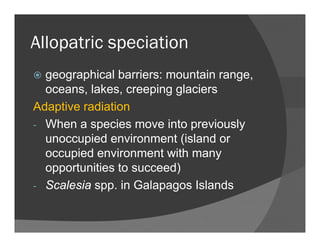
Allopatric speciationAllopatric speciation
geographical barriers: mountain rangegeographical barriers: mountain range,
oceans, lakes, creeping glaciers
Adaptive radiationAdaptive radiation
- When a species move into previously
unoccupied environment (island orunoccupied environment (island or
occupied environment with many
opportunities to succeed)opportunities to succeed)
- Scalesia spp. in Galapagos Islands
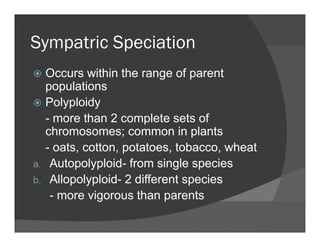
Sympatric SpeciationSympatric Speciation
Occurs within the range of parentOccurs within the range of parent
populations
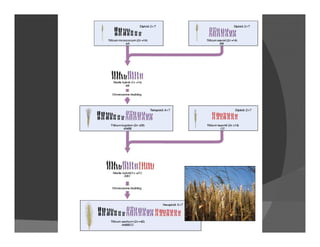
Polyploidyyp y
- more than 2 complete sets of
chromosomes; common in plants
- oats, cotton, potatoes, tobacco, wheat
a. Autopolyploid- from single species
b. Allopolyploid- 2 different species
- more vigorous than parentsg p
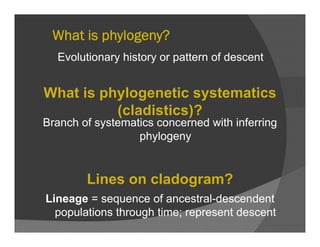
What is phylogeny?
Evolutionary history or pattern of descent
What is phylogenetic systematics
(cladistics)?(cladistics)?
Branch of systematics concerned with inferring
phylogenyphylogeny
Lines on cladogram?
Lineage = sequence of ancestral-descendentLineage sequence of ancestral descendent
populations through time; represent descent
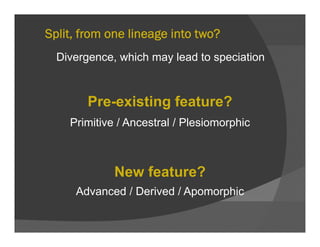
Split, from one lineage into two?
Divergence, which may lead to speciation
Pre-existing feature?g
Primitive / Ancestral / Plesiomorphic
New feature?New feature?
Advanced / Derived / Apomorphic
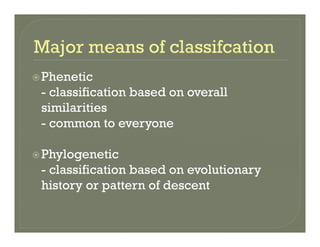
PheneticPhenetic
- classification based on overall
similaritiessimilarities
- common to everyone
Phylogenetic
classification based on evolutionary- classification based on evolutionary
history or pattern of descent
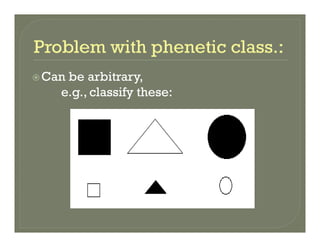
Can be arbitraryCan be arbitrary,
e.g., classify these:
Represented in the form of a cladogram/Represented in the form of a cladogram/
phylogenetic tree
CladogramCladogram
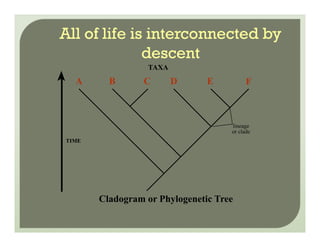
• Lines- lineage or clades; denote descent
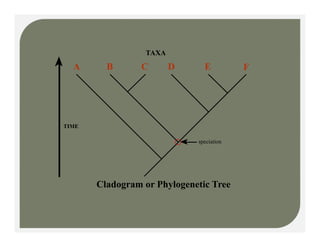
• Branching- divergence from a common ancestorBranching divergence from a common ancestor
Evolution recognized as a change from
pre-existing character state(ancestral) topre existing character state(ancestral) to
a new (derived) character state
All of life is interconnected byAll of life is interconnected by
TAXA
descentdescent
A B C D E F
TIME
lineage
or clade
TIME
Cladogram or Phylogenetic TreeCladogram or Phylogenetic Tree
A B C D E F
TAXA
TIME
speciation
Cladogram or Phylogenetic Tree
CladisticsCladistics
Methodology of inferring the pattern of
evolutionary history of a group ofevolutionary history of a group of
organisms using apomorphic characters
Ancestral character
Pleisiomorphy- Pleisiomorphy
Derived character
- Apomorphy- Apomorphy
Apomorphies the result of evolutionApomorphies - the result of evolution.
Taxa sharing apomorphies underwentTaxa sharing apomorphies underwent
same evolutionary history,
should be grouped togethershould be grouped together.
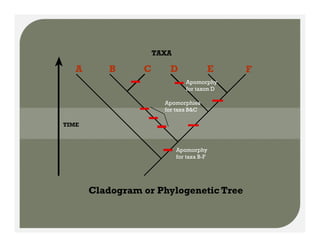
A B C D E F
TAXA
Apomorphies
f B&C
Apomorphy
for taxon D
for taxa B&C
TIME
Apomorphy
for taxa B-F
Cladogram or Phylogenetic Tree
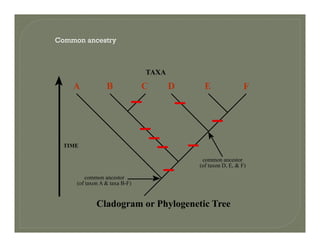
Common ancestry
TAXA
A B C D E F
TIME
common ancestor
(of taxon D, E, & F)
Cl d Ph l ti T
common ancestor
(of taxon A & taxa B-F)
Cladogram or Phylogenetic Tree
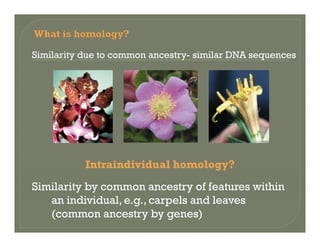
Similarity due to common ancestry- similar DNA sequences
Intraindividual homology?gy
Similarity by common ancestry of features within
an individual e g carpels and leavesan individual, e.g., carpels and leaves
(common ancestry by genes)
Similarity not by common ancestry.
Types?
Convergence independent evolution of aConvergence - independent evolution of a
similar feature in 2 or more lineages.
Reversal - loss of a derived feature with re-
establishment of ancestral featureestablishment of ancestral feature.
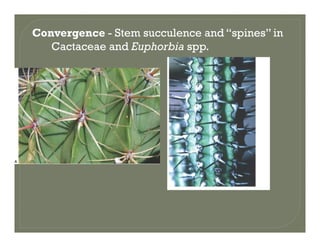
Convergence - Stem succulence and “spines” in
Cactaceae and Euphorbia sppCactaceae and Euphorbia spp.
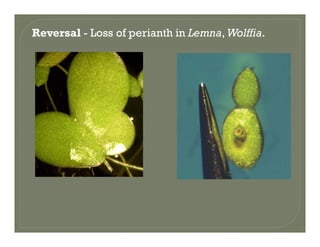
Reversal - Loss of perianth in Lemna, Wolffia.
Recognized group in phylogeneticRecognized group in phylogenetic
systematics
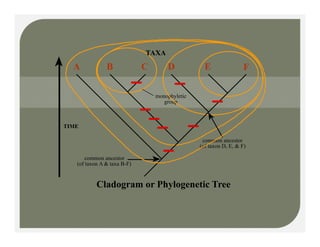
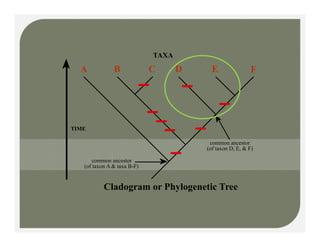
Consisting of a common ancestor plus allConsisting of a common ancestor plus all
of its descendants
Sequential listing of monophyletic groupSequential listing of monophyletic group
- serve as a phylogenetic classification
schemescheme
A B C D E F
TAXA
monophyletic
group
TIME
t
common ancestor
(of taxon A & taxa B-F)
common ancestor
(of taxon D, E, & F)
Cladogram or Phylogenetic Tree
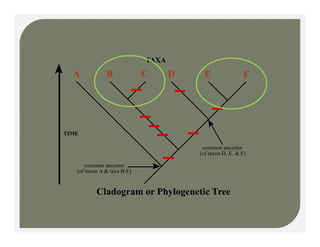
Consisting of a common ancestor but notConsisting of a common ancestor but not
all descendants of that common ancestor
Two or more separate groups each with a
separate common ancestor
A B C D E F
TAXA
TIME
common ancestor
(of taxon A & taxa B-F)
common ancestor
(of taxon D, E, & F)
Cladogram or Phylogenetic Tree
A B C D E F
TAXA
A B C D E F
TIME
common ancestor
( f t A & t B F)
common ancestor
(of taxon D, E, & F)
Cladogram or Phylogenetic Tree
(of taxon A & taxa B-F)
Evolution with phylogeny

Evolution with phylogeny

  • 1.
    JJA Obico, Instructor,Department of Biology
  • 2.
    Natural TheologyNatural Theology Philosophydedicated top y discovering the Creator’s plan by studying nature Classify species in order to reveal the steps of life that God had createdcreated Carolus Linnaeus - sought to discover order in the diversity of life - founder of Taxonomy- founder of Taxonomy
  • 3.
    Jean Baptiste LamarckJeanBaptiste Lamarck In-charge of invertebrate collection at the Natural History Museum in Paris Compared current species to fossil formsfossil forms Use and DisuseUse and Disuse Inheritance of Acquired Characteristics
  • 5.
    Biological EvolutionBiological Evolution Descentwith modification Charles Darwin and Alfred WallaceCharles Darwin and Alfred Wallace Descent - Transfer of genetic material to offspring overtimeg p g a. Clonal reproduction (asexual) b. Sexual reproduction
  • 6.
    Biological EvolutionBiological Evolution ModificationModification -Change in genetic material Mutation; genetic- Mutation; genetic recombination
  • 8.
    What evolves?What evolves? Populationp -A group of individuals of the same species usually geographically delimited and i ll h i ifi ftypically have a significant amount of gene exchange Species - Consists of group generally intergrading- Consists of group generally intergrading, interbreeding populations that are reproductively isolated from other groups
  • 9.
    Mechanisms of EvolutionMechanismsof Evolution Genetic DriftGenetic Drift Mutation Gene flowGene flow Non random mating Natural Selection
  • 10.
    Population Genetics (PopGen)PopulationGenetics (PopGen) Study of behavior of genes in theStudy of behavior of genes in the population Genetics + EvolutionGenetics + Evolution Mendel (1866); Darwin and Wallace (1858)(1858)
  • 11.
    Population GeneticsPopulation Genetics Evolution -A change in the frequency of alleles in a population over time 1000 garden peas; 2000 alleles (TT, Tt or tt) T= 1000; t= 1000 freq of each allele= 0.5 What happens when T i d ?a. T inc; t dec? b. T dec; t inc? F d t hc. Freq does not change
  • 12.
    Hardy-Weinberg EquilibriumHardy WeinbergEquilibrium Frequency of alleles will remain the sameFrequency of alleles will remain the same under the following conditions: 1 Size of population is large1. Size of population is large 2. No mutations 3 N i ti3. No migrations 4. Mating is random 5. Natural selection does not take place
  • 13.
    Genetic DriftGenetic Drift -Change of frequency of alleles over timeChange of frequency of alleles over time due to chance a. Bottleneck effect - occurs when a catastrophic event drastically and nonselectively reduces size of population b. Founder effect - small no. of individuals colonize a new area
  • 16.
    MutationsMutations Alter the nucleotidesequence of genesAlter the nucleotide sequence of genes May give an selective advantage in a particular environmentparticular environment eg. Tolerance to a toxic metal
  • 17.
    Gene FlowGene Flow Movementof alleles form one populationMovement of alleles form one population to another Pollen seeds fruitsPollen, seeds, fruits Runners or horizontal stems
  • 18.
    Mating is randomMatingis random Individuals mate without regard toIndividuals mate without regard to genotype Nonrandom matingNonrandom mating - Self fertilization A t ti ti t f- Assortative mating- outcome of pollinator preference H k th f t f d fleg. Hawkmoths prefer to feed on flowers with long corolla tube
  • 19.
    Natural selectionNatural selection ThomasMalthusThomas Malthus - Population of organisms tend to increase geometricallyincrease geometrically - Geometric progression: 2 4 8 16 32 642,4,8,16,32,64… - Resources are limited
  • 20.
    Individual variation within species MutationMutation Crossingover RecombinationRecombination Transposons - DNA sequences - have the ability to move from place to place in chromosomes
  • 23.
    Natural selectionNatural selection Individualsthat are best adapted to theirIndividuals that are best adapted to their environment have the greatest chance of surviving and successfullyg y reproducing
  • 25.
    Certain traits thatare common amongCertain traits that are common among individuals - provide superior adaptation in- provide superior adaptation in environment Less common traits- do not conferLess common traits- do not confer selective advantage
  • 26.
    Tropical ForestsTropical Forests Lackof windLack of wind Low light intensity Plants - Undivided leaves, large, with acumen
  • 28.
    Competition for resourcesis NOTCompetition for resources is NOT necessary for natural selection to occur Natural selection may occur if certainNatural selection may occur if certain individuals produce more offspring than othersothers
  • 30.
    Modes of naturalselectionModes of natural selection Stabilizing selection - eliminates extreme phenotypesp yp Directional selection shifts the average or typical in one direction- shifts the average or typical in one direction by favoring one of the extreme phenotypes - leads to ANAGENESIS or phyletic evolution Diversifying selection - splits a population into 2 parts favoring both- splits a population into 2 parts favoring both extremes of phenotypic range - leads to CLADOGENESIS or branching evolutionevolution
  • 32.
    Artificial selectionArtificial selection Selectivelybreeding plants or animals toSelectively breeding plants or animals to favor the production of offspring with desirable traits
  • 33.
    Evolution can occurrapidlyEvolution can occur rapidly Punctuated equilibriumPunctuated equilibrium Eldredge and Gould, 1972 punctuated with short periods of rapidpunctuated with short periods of rapid change F th d fFew year or thousand of years eg. -Colonization of mine tailings by plants
  • 34.
    Co-evolutionCo evolution a changein the genetica change in the genetic composition of one species in response to a genetic changep g g in another Plants and insectsPlants and insects
  • 35.
    SpeciationSpeciation Formation of newspecies from preexistingp p g species Ultimate result of evolution Biological Species Concept A population whose members have the- A population whose members have the potential to interbreed with one another in nature to produce viable, fertile offspring but h t d i bl f til ff iwho cannot produce viable, fertile offspring with members of other species - Reproductively isolated from other populationsReproductively isolated from other populations
  • 36.
    Reproductive isolationReproductive isolation PrezygoticPrezygotic -Sperm does not fertilize egg from other populationpopulation - No zygote is formed Postzygotic - Zygote or embryo does not survive or adult is infertile
  • 37.
    PrezygoticPrezygotic Temporal isolationp Seasonal Diurnal Ecological egAcerEcological – eg. Acer black maple (Acer nigrum)- dry, high Ca sugar maple (A. saccharum)- acidic Self fertilization Floral Behavioral restriction to one pollinatorBehavioral- restriction to one pollinator Structural – white and red petaled flower Pollen-pistil incompatibilityp p y
  • 38.
    Post zygoticPost zygotic Inviableseed Hybrid inviability- not reach reproductive maturity Hybrid floral isolation – no pollinators Hybrid sterility Chromosomes do not pair during meiosis Brocolli (Brassica oleracea) x radish (Raphanus sativus) Raphanobrassica) p Hybrid breakdown- problems in later generation of hybrids
  • 39.
    Modes of speciationModesof speciation Allopatric speciationAllopatric speciation Geographical barrier that physically isolates populations hinders gene flowp p g Sympatric speciation Intrinsic factors alter gene flowIntrinsic factors alter gene flow
  • 40.
    Allopatric speciationAllopatric speciation geographicalbarriers: mountain rangegeographical barriers: mountain range, oceans, lakes, creeping glaciers Adaptive radiationAdaptive radiation - When a species move into previously unoccupied environment (island orunoccupied environment (island or occupied environment with many opportunities to succeed)opportunities to succeed) - Scalesia spp. in Galapagos Islands
  • 41.
    Sympatric SpeciationSympatric Speciation Occurswithin the range of parentOccurs within the range of parent populations Polyploidyyp y - more than 2 complete sets of chromosomes; common in plants - oats, cotton, potatoes, tobacco, wheat a. Autopolyploid- from single species b. Allopolyploid- 2 different species - more vigorous than parentsg p
  • 44.
    What is phylogeny? Evolutionaryhistory or pattern of descent What is phylogenetic systematics (cladistics)?(cladistics)? Branch of systematics concerned with inferring phylogenyphylogeny Lines on cladogram? Lineage = sequence of ancestral-descendentLineage sequence of ancestral descendent populations through time; represent descent
  • 45.
    Split, from onelineage into two? Divergence, which may lead to speciation Pre-existing feature?g Primitive / Ancestral / Plesiomorphic New feature?New feature? Advanced / Derived / Apomorphic
  • 46.
    PheneticPhenetic - classification basedon overall similaritiessimilarities - common to everyone Phylogenetic classification based on evolutionary- classification based on evolutionary history or pattern of descent
  • 47.
    Can be arbitraryCanbe arbitrary, e.g., classify these:
  • 48.
    Represented in theform of a cladogram/Represented in the form of a cladogram/ phylogenetic tree CladogramCladogram • Lines- lineage or clades; denote descent • Branching- divergence from a common ancestorBranching divergence from a common ancestor Evolution recognized as a change from pre-existing character state(ancestral) topre existing character state(ancestral) to a new (derived) character state
  • 49.
    All of lifeis interconnected byAll of life is interconnected by TAXA descentdescent A B C D E F TIME lineage or clade TIME Cladogram or Phylogenetic TreeCladogram or Phylogenetic Tree
  • 50.
    A B CD E F TAXA TIME speciation Cladogram or Phylogenetic Tree
  • 51.
    CladisticsCladistics Methodology of inferringthe pattern of evolutionary history of a group ofevolutionary history of a group of organisms using apomorphic characters Ancestral character Pleisiomorphy- Pleisiomorphy Derived character - Apomorphy- Apomorphy
  • 52.
    Apomorphies the resultof evolutionApomorphies - the result of evolution. Taxa sharing apomorphies underwentTaxa sharing apomorphies underwent same evolutionary history, should be grouped togethershould be grouped together.
  • 53.
    A B CD E F TAXA Apomorphies f B&C Apomorphy for taxon D for taxa B&C TIME Apomorphy for taxa B-F Cladogram or Phylogenetic Tree
  • 54.
    Common ancestry TAXA A BC D E F TIME common ancestor (of taxon D, E, & F) Cl d Ph l ti T common ancestor (of taxon A & taxa B-F) Cladogram or Phylogenetic Tree
  • 55.
    Similarity due tocommon ancestry- similar DNA sequences Intraindividual homology?gy Similarity by common ancestry of features within an individual e g carpels and leavesan individual, e.g., carpels and leaves (common ancestry by genes)
  • 56.
    Similarity not bycommon ancestry. Types? Convergence independent evolution of aConvergence - independent evolution of a similar feature in 2 or more lineages. Reversal - loss of a derived feature with re- establishment of ancestral featureestablishment of ancestral feature.
  • 57.
    Convergence - Stemsucculence and “spines” in Cactaceae and Euphorbia sppCactaceae and Euphorbia spp.
  • 58.
    Reversal - Lossof perianth in Lemna, Wolffia.
  • 59.
    Recognized group inphylogeneticRecognized group in phylogenetic systematics Consisting of a common ancestor plus allConsisting of a common ancestor plus all of its descendants Sequential listing of monophyletic groupSequential listing of monophyletic group - serve as a phylogenetic classification schemescheme
  • 60.
    A B CD E F TAXA monophyletic group TIME t common ancestor (of taxon A & taxa B-F) common ancestor (of taxon D, E, & F) Cladogram or Phylogenetic Tree
  • 61.
    Consisting of acommon ancestor but notConsisting of a common ancestor but not all descendants of that common ancestor Two or more separate groups each with a separate common ancestor
  • 62.
    A B CD E F TAXA TIME common ancestor (of taxon A & taxa B-F) common ancestor (of taxon D, E, & F) Cladogram or Phylogenetic Tree
  • 63.
    A B CD E F TAXA A B C D E F TIME common ancestor ( f t A & t B F) common ancestor (of taxon D, E, & F) Cladogram or Phylogenetic Tree (of taxon A & taxa B-F)