Plant Growth Regulators
Rukman Somarathna
Bsc(Agri)/MBA
Introduction
• Plant growth regulators are the chemical substances which govern all
the factors of development and growth within plants. Some other
names used to refer to it are phytohormones and plant growth
hormones.
• Phytohormones are organic compounds which are either synthesized
in laboratories or produced naturally within the plants. They
profoundly control and modify the physiological processes like the
growth, development, and movement of plants.
• Based on their actions, plant growth regulators are broadly classified
into two major groups:
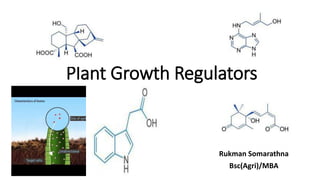
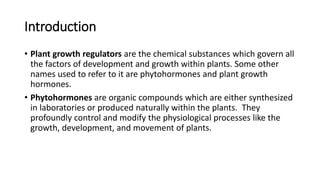
1. Plant growth promoters. Eg. Auxins, Gibberellins, and Cytokinins
2. Plant growth inhibitors.Eg. Abscisic acid and Ethylene
Ethylene can be grouped either into the promoters or into the plant
inhibitors.
Types of Plant Growth
Primary and Secondary Growth
• The meristematic cells present at the root and shoot apices divide
mitotically and increase the length of the plant body. This is known as
primary growth.
• Secondary growth is referred to as the increase in the diameter of
the plant body by the division of the secondary meristem.
Unlimited Growth
• When the plant constantly grows from the germination stage to
death, it is called unlimited growth.
Limited Growth
• In this stage, the plant parts stop growing after attaining a certain
size.
Vegetative Growth
• It involves the production of stem, leaves, and branches, except the
flowers.
Reproductive Growth
• Flowering occurs at this type of growth stage.
Factors Affecting Plant Growth
There are four major factors that affect the growth of the plants. They are:
• Light
• Water
• Temperature
• Nutrients
Soil nutrients are divided into macronutrients and micronutrients. Nitrogen,
potassium, calcium, magnesium, sulfur, and phosphorus are the
macronutrients required by the plants.
The micronutrients include iron, copper, etc. Deficiency of these nutrients in
plants makes them prone to several diseases. Even if a single nutrient is
lacking, it results in stunted growth of the plant.
Discovery of Plant Growth Regulators
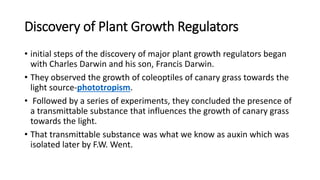
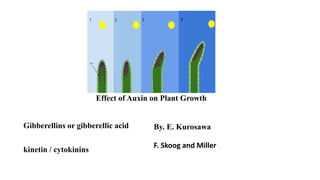
• initial steps of the discovery of major plant growth regulators began
with Charles Darwin and his son, Francis Darwin.
• They observed the growth of coleoptiles of canary grass towards the
light source-phototropism.
• Followed by a series of experiments, they concluded the presence of
a transmittable substance that influences the growth of canary grass
towards the light.
• That transmittable substance was what we know as auxin which was
isolated later by F.W. Went.
Effect of Auxin on Plant Growth
Gibberellins or gibberellic acid By. E. Kurosawa
kinetin / cytokinins
F. Skoog and Miller
Characteristics of Plant Growth Regulators
• Differentiation and elongation of cells.
• Formation of leaves, flowers, and stems.
• Wilting of leaves.
• Ripening of fruit.
• Seed dormancy, etc.
Types of Plant Growth Regulators
• Plant growth hormones or regulators are of the following types:
- Plant Growth Promoters
- Plant Growth Inhibitors
Plant Growth Promoters
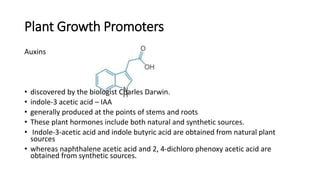
Auxins
• discovered by the biologist Charles Darwin.
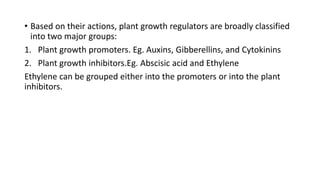
• indole-3 acetic acid – IAA
• generally produced at the points of stems and roots
• These plant hormones include both natural and synthetic sources.
• Indole-3-acetic acid and indole butyric acid are obtained from natural plant
sources
• whereas naphthalene acetic acid and 2, 4-dichloro phenoxy acetic acid are
obtained from synthetic sources.
Functions of Auxins
• Facilitate flowering in plants
• Used in the process of plant propagation.
• Used by gardeners to keep lawns free from weeds.
• Involved in the initiation of roots in stem cuttings.
• Prevention of dropping of leaves and fruits at early stages.
• Regulate xylem differentiation and assists in cell division.
• Auxins are widely used as herbicides to kill dicot weeds.
• Used to produce fruit without preceding fertilization.
• Promote natural detachment (abscission) of older leaves and fruits.
• Apical dominance may occur in which the growth of lateral buds is inhibited by
the growth of apical buds. In such cases, the shoot caps may be removed.
• These are produced by the apex of root and shoot.
Gibberellins
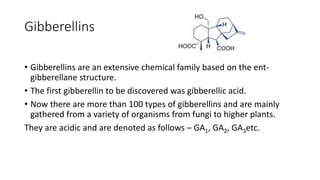
• Gibberellins are an extensive chemical family based on the ent-
gibberellane structure.
• The first gibberellin to be discovered was gibberellic acid.
• Now there are more than 100 types of gibberellins and are mainly
gathered from a variety of organisms from fungi to higher plants.
They are acidic and are denoted as follows – GA1, GA2, GA3etc.
Functions of Gibberellins
• Delay senescence in fruits.
• Involved in leaf expansion.
• Break bud and seed dormancy.
• Promote bolting in cabbages and beet.
• Facilitate elongation of fruits such as apples and enhance their shape.
• Used by the brewing industry to accelerate the malting process.
• Used as the spraying agent to increase the yield of sugarcane by elongation of the
stem.
• In young conifers, utilized to fasten the maturity period and facilitate early seed
production
• Helps in increasing the crop yield by increasing the height in plants such
as sugarcane and increase the axis length in plants such as grape stalks.
• Gibberellins are acidic in nature.
• It also delays senescence.
Cytokinins
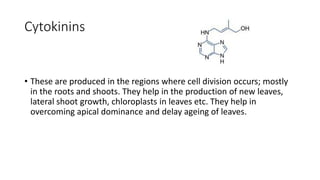
• These are produced in the regions where cell division occurs; mostly
in the roots and shoots. They help in the production of new leaves,
lateral shoot growth, chloroplasts in leaves etc. They help in
overcoming apical dominance and delay ageing of leaves.
Functions of Cytokinins
• Break bud and seed dormancy.
• Promotes the growth of the lateral bud.
• Promotes cell division and apical dominance.
• They are used to keep flowers fresh for a longer time.
• Used in tissue culture to induce cell division in mature tissues.
• Facilitate adventitious shoot formation and lateral shoot growth.
• Promotes nutrient mobilization that in turn assists delaying leaf
senescence.
• Helps in delaying the process of ageing (senescence) in fresh leaf crops like
cabbage and lettuce.
• Involved in the formation of new leaves and chloroplast organelles within
the plant cell.
• Used to induce the development of shoot and roots along with auxin,
depending on the ratio.
Plant Growth Inhibitors
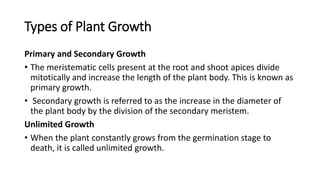
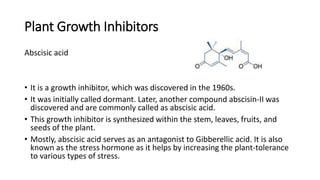
Abscisic acid
• It is a growth inhibitor, which was discovered in the 1960s.
• It was initially called dormant. Later, another compound abscisin-II was
discovered and are commonly called as abscisic acid.
• This growth inhibitor is synthesized within the stem, leaves, fruits, and
seeds of the plant.
• Mostly, abscisic acid serves as an antagonist to Gibberellic acid. It is also
known as the stress hormone as it helps by increasing the plant-tolerance
to various types of stress.
Functions of Abscisic acid
• Stimulates closing of stomata in the epidermis.
• Helps in the maturation and development of seeds.
• Inhibits plant metabolism and seed germination.
• It is involved in regulating abscission and dormancy.
• It is widely used as a spraying agent on trees to regulate dropping of
fruits.
• Induces seed-dormancy and aids in withstanding desiccation and
various undesired growth factors.
Ethylene
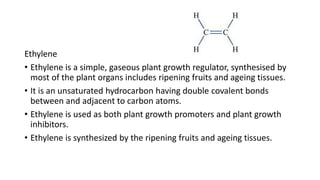
• Ethylene is a simple, gaseous plant growth regulator, synthesised by
most of the plant organs includes ripening fruits and ageing tissues.
• It is an unsaturated hydrocarbon having double covalent bonds
between and adjacent to carbon atoms.
• Ethylene is used as both plant growth promoters and plant growth
inhibitors.
• Ethylene is synthesized by the ripening fruits and ageing tissues.
Functions of Ethylene
Ethylene is the most widely used plant growth regulator as it helps in regulating
many physiological processes.
• Induce flowering in the mango tree.
• Promotes sprouting of potato tubers.
• Breaks the dormancy of seeds and buds.
• Enhances respiration rate during ripening of fruits.
• Applied to rubber trees to stimulate the flow of latex.
• Facilitates senescence and abscission of both flowers and leaves.
• Used to stimulate the ripening of fruits. For example, tomatoes and citrus fruits.
• Affects horizontal growth of seedlings and swelling of the axis in dicot seedlings.
• Increases root hair formation and growth, thus aids plant to expand their surface
area for absorption.
Thanks You

Plant Growth Regulators 1.pdf

  • 1.
    Plant Growth Regulators RukmanSomarathna Bsc(Agri)/MBA
  • 2.
    Introduction • Plant growthregulators are the chemical substances which govern all the factors of development and growth within plants. Some other names used to refer to it are phytohormones and plant growth hormones. • Phytohormones are organic compounds which are either synthesized in laboratories or produced naturally within the plants. They profoundly control and modify the physiological processes like the growth, development, and movement of plants.
  • 3.
    • Based ontheir actions, plant growth regulators are broadly classified into two major groups: 1. Plant growth promoters. Eg. Auxins, Gibberellins, and Cytokinins 2. Plant growth inhibitors.Eg. Abscisic acid and Ethylene Ethylene can be grouped either into the promoters or into the plant inhibitors.
  • 4.
    Types of PlantGrowth Primary and Secondary Growth • The meristematic cells present at the root and shoot apices divide mitotically and increase the length of the plant body. This is known as primary growth. • Secondary growth is referred to as the increase in the diameter of the plant body by the division of the secondary meristem. Unlimited Growth • When the plant constantly grows from the germination stage to death, it is called unlimited growth.
  • 5.
    Limited Growth • Inthis stage, the plant parts stop growing after attaining a certain size. Vegetative Growth • It involves the production of stem, leaves, and branches, except the flowers. Reproductive Growth • Flowering occurs at this type of growth stage.
  • 6.
    Factors Affecting PlantGrowth There are four major factors that affect the growth of the plants. They are: • Light • Water • Temperature • Nutrients Soil nutrients are divided into macronutrients and micronutrients. Nitrogen, potassium, calcium, magnesium, sulfur, and phosphorus are the macronutrients required by the plants. The micronutrients include iron, copper, etc. Deficiency of these nutrients in plants makes them prone to several diseases. Even if a single nutrient is lacking, it results in stunted growth of the plant.
  • 7.
    Discovery of PlantGrowth Regulators • initial steps of the discovery of major plant growth regulators began with Charles Darwin and his son, Francis Darwin. • They observed the growth of coleoptiles of canary grass towards the light source-phototropism. • Followed by a series of experiments, they concluded the presence of a transmittable substance that influences the growth of canary grass towards the light. • That transmittable substance was what we know as auxin which was isolated later by F.W. Went.
  • 8.
    Effect of Auxinon Plant Growth Gibberellins or gibberellic acid By. E. Kurosawa kinetin / cytokinins F. Skoog and Miller
  • 9.
    Characteristics of PlantGrowth Regulators • Differentiation and elongation of cells. • Formation of leaves, flowers, and stems. • Wilting of leaves. • Ripening of fruit. • Seed dormancy, etc.
  • 10.
    Types of PlantGrowth Regulators • Plant growth hormones or regulators are of the following types: - Plant Growth Promoters - Plant Growth Inhibitors
  • 11.
    Plant Growth Promoters Auxins •discovered by the biologist Charles Darwin. • indole-3 acetic acid – IAA • generally produced at the points of stems and roots • These plant hormones include both natural and synthetic sources. • Indole-3-acetic acid and indole butyric acid are obtained from natural plant sources • whereas naphthalene acetic acid and 2, 4-dichloro phenoxy acetic acid are obtained from synthetic sources.
  • 12.
    Functions of Auxins •Facilitate flowering in plants • Used in the process of plant propagation. • Used by gardeners to keep lawns free from weeds. • Involved in the initiation of roots in stem cuttings. • Prevention of dropping of leaves and fruits at early stages. • Regulate xylem differentiation and assists in cell division. • Auxins are widely used as herbicides to kill dicot weeds. • Used to produce fruit without preceding fertilization. • Promote natural detachment (abscission) of older leaves and fruits. • Apical dominance may occur in which the growth of lateral buds is inhibited by the growth of apical buds. In such cases, the shoot caps may be removed. • These are produced by the apex of root and shoot.
  • 13.
    Gibberellins • Gibberellins arean extensive chemical family based on the ent- gibberellane structure. • The first gibberellin to be discovered was gibberellic acid. • Now there are more than 100 types of gibberellins and are mainly gathered from a variety of organisms from fungi to higher plants. They are acidic and are denoted as follows – GA1, GA2, GA3etc.
  • 14.
    Functions of Gibberellins •Delay senescence in fruits. • Involved in leaf expansion. • Break bud and seed dormancy. • Promote bolting in cabbages and beet. • Facilitate elongation of fruits such as apples and enhance their shape. • Used by the brewing industry to accelerate the malting process. • Used as the spraying agent to increase the yield of sugarcane by elongation of the stem. • In young conifers, utilized to fasten the maturity period and facilitate early seed production • Helps in increasing the crop yield by increasing the height in plants such as sugarcane and increase the axis length in plants such as grape stalks. • Gibberellins are acidic in nature. • It also delays senescence.
  • 15.
    Cytokinins • These areproduced in the regions where cell division occurs; mostly in the roots and shoots. They help in the production of new leaves, lateral shoot growth, chloroplasts in leaves etc. They help in overcoming apical dominance and delay ageing of leaves.
  • 16.
    Functions of Cytokinins •Break bud and seed dormancy. • Promotes the growth of the lateral bud. • Promotes cell division and apical dominance. • They are used to keep flowers fresh for a longer time. • Used in tissue culture to induce cell division in mature tissues. • Facilitate adventitious shoot formation and lateral shoot growth. • Promotes nutrient mobilization that in turn assists delaying leaf senescence. • Helps in delaying the process of ageing (senescence) in fresh leaf crops like cabbage and lettuce. • Involved in the formation of new leaves and chloroplast organelles within the plant cell. • Used to induce the development of shoot and roots along with auxin, depending on the ratio.
  • 17.
    Plant Growth Inhibitors Abscisicacid • It is a growth inhibitor, which was discovered in the 1960s. • It was initially called dormant. Later, another compound abscisin-II was discovered and are commonly called as abscisic acid. • This growth inhibitor is synthesized within the stem, leaves, fruits, and seeds of the plant. • Mostly, abscisic acid serves as an antagonist to Gibberellic acid. It is also known as the stress hormone as it helps by increasing the plant-tolerance to various types of stress.
  • 18.
    Functions of Abscisicacid • Stimulates closing of stomata in the epidermis. • Helps in the maturation and development of seeds. • Inhibits plant metabolism and seed germination. • It is involved in regulating abscission and dormancy. • It is widely used as a spraying agent on trees to regulate dropping of fruits. • Induces seed-dormancy and aids in withstanding desiccation and various undesired growth factors.
  • 19.
    Ethylene • Ethylene isa simple, gaseous plant growth regulator, synthesised by most of the plant organs includes ripening fruits and ageing tissues. • It is an unsaturated hydrocarbon having double covalent bonds between and adjacent to carbon atoms. • Ethylene is used as both plant growth promoters and plant growth inhibitors. • Ethylene is synthesized by the ripening fruits and ageing tissues.
  • 20.
    Functions of Ethylene Ethyleneis the most widely used plant growth regulator as it helps in regulating many physiological processes. • Induce flowering in the mango tree. • Promotes sprouting of potato tubers. • Breaks the dormancy of seeds and buds. • Enhances respiration rate during ripening of fruits. • Applied to rubber trees to stimulate the flow of latex. • Facilitates senescence and abscission of both flowers and leaves. • Used to stimulate the ripening of fruits. For example, tomatoes and citrus fruits. • Affects horizontal growth of seedlings and swelling of the axis in dicot seedlings. • Increases root hair formation and growth, thus aids plant to expand their surface area for absorption.
  • 21.