Niroj kumar Jena (05 SST/12)
DefinItion
“Transference of a genotype or a group
of genotype of crop plants from the
place of their cultivation in to a new
area where they were not being grown
previously”.
Types of Plant Introduction
 Based on adaptation
 Primary Introduction - Variety is well adopted to the new
environment, released for commercial cultivation without any
alteration in the original genotype.
 Secondary Introduction - Introduced variety may be subjected to
selection & hybridisation to isolate a superior variety.
 Based on utilization
 Direct Introduction –new variety takes no time for establishment
 Indirect Introduction –new variety takes some time for
establishment
 Exotic variety – foreign variety directly recommended for
commercial cultivation in new environment.
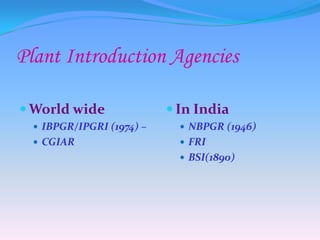
Plant Introduction Agencies
 World wide
 IBPGR/IPGRI (1974) –
 CGIAR
 In India
 NBPGR (1946)
 FRI
 BSI(1890)
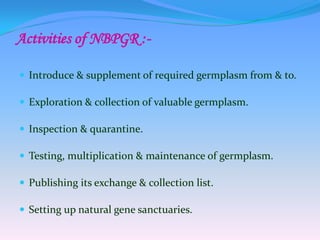
Activities of NBPGR :-
 Introduce & supplement of required germplasm from & to.
 Exploration & collection of valuable germplasm.
 Inspection & quarantine.
 Testing, multiplication & maintenance of germplasm.
 Publishing its exchange & collection list.
 Setting up natural gene sanctuaries.
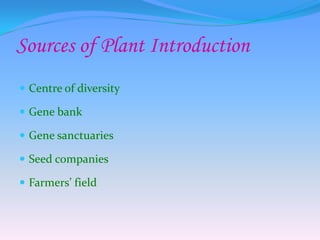
Sources of Plant Introduction
 Centre of diversity
 Gene bank
 Gene sanctuaries
 Seed companies
 Farmers’ field
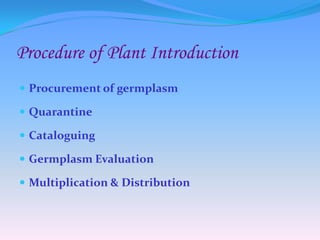
Procedure of Plant Introduction
 Procurement of germplasm
 Quarantine
 Cataloguing
 Germplasm Evaluation
 Multiplication & Distribution
Procurement of germplasm
 As Gift from individuals / institutuions
 Purchase
 collection through exploration
 Propagules
 Restriction on export & introduction of plant
materials
Quarantine
 Keeping materials in isolation to prevent the spread of
diseases.
 Fumigation or other treatments (if necessary).
 According to destructive insects & pests act, 1914,
quarantine for different group of plant produce is carried
out by different agencies.
 Quarantine & fumigation centres at Sea-ports(8),
Airports(7) & at entry point of land routes(7).
Cataloguing
 Accession number is given to a new introduced material
 Information regarding name of species & variety, place of origin,
adaptation & its various features are also recorded.
 Cataloguing of germplasm collections is published by gene bank.
 The introduced materials are of 3 types & given a prefix-
 EC – Exotic Collection
 IC – Indigenous Collection
 IW –Indigenous Wild
Purpose of Plant Introduction
 Obtain an entirely new crop species (Maize, Potato, Tomato etc.)
 To serve as new varieties (Sonora-64, Lerma rojo – wheat. TN 1, IR 8 -
Rice)
 To be utilized in crop improvement
 To save the crop from disease & pest. (Coffee was introduced in
South America from Africa to prevent losses from leaf rust).
 To be used in scientific studies.
 To be used for aesthetic value.
Important Achievements
 Crops are cultivated extensively after their
introduction as new crop species.
 Introductions have been directly released as variety.
 Varieties selected from introduction
 Introduction helps to develop varieties through
hybridization.
Merits of Plant Introduction
 Entirely new crop plant is derived.
 Quick & economical method of crop improvement.
 Genetic base can be broadened by plant introduction.
 Protection of crops from damage by introducing them in to
disease free areas.
 Development of superior varieties through selection &
hybridization by using introductions.
Demerits of Plant Introduction
 Introduction of weeds along with introduced
materials.
 Introduction of diseases along with introduced
materials.
 Introduction of insect pest along with introduced
materials.
 Some plants introduced as ornamental species became
noxious weeds.
 Some introduced plants are threat to the ecological
balance.
Plant introduction

Plant introduction

  • 1.
    Niroj kumar Jena(05 SST/12)
  • 2.
    DefinItion “Transference of agenotype or a group of genotype of crop plants from the place of their cultivation in to a new area where they were not being grown previously”.
  • 3.
    Types of PlantIntroduction  Based on adaptation  Primary Introduction - Variety is well adopted to the new environment, released for commercial cultivation without any alteration in the original genotype.  Secondary Introduction - Introduced variety may be subjected to selection & hybridisation to isolate a superior variety.  Based on utilization  Direct Introduction –new variety takes no time for establishment  Indirect Introduction –new variety takes some time for establishment  Exotic variety – foreign variety directly recommended for commercial cultivation in new environment.
  • 4.
    Plant Introduction Agencies World wide  IBPGR/IPGRI (1974) –  CGIAR  In India  NBPGR (1946)  FRI  BSI(1890)
  • 5.
    Activities of NBPGR:-  Introduce & supplement of required germplasm from & to.  Exploration & collection of valuable germplasm.  Inspection & quarantine.  Testing, multiplication & maintenance of germplasm.  Publishing its exchange & collection list.  Setting up natural gene sanctuaries.
  • 6.
    Sources of PlantIntroduction  Centre of diversity  Gene bank  Gene sanctuaries  Seed companies  Farmers’ field
  • 7.
    Procedure of PlantIntroduction  Procurement of germplasm  Quarantine  Cataloguing  Germplasm Evaluation  Multiplication & Distribution
  • 8.
    Procurement of germplasm As Gift from individuals / institutuions  Purchase  collection through exploration  Propagules  Restriction on export & introduction of plant materials
  • 9.
    Quarantine  Keeping materialsin isolation to prevent the spread of diseases.  Fumigation or other treatments (if necessary).  According to destructive insects & pests act, 1914, quarantine for different group of plant produce is carried out by different agencies.  Quarantine & fumigation centres at Sea-ports(8), Airports(7) & at entry point of land routes(7).
  • 10.
    Cataloguing  Accession numberis given to a new introduced material  Information regarding name of species & variety, place of origin, adaptation & its various features are also recorded.  Cataloguing of germplasm collections is published by gene bank.  The introduced materials are of 3 types & given a prefix-  EC – Exotic Collection  IC – Indigenous Collection  IW –Indigenous Wild
  • 11.
    Purpose of PlantIntroduction  Obtain an entirely new crop species (Maize, Potato, Tomato etc.)  To serve as new varieties (Sonora-64, Lerma rojo – wheat. TN 1, IR 8 - Rice)  To be utilized in crop improvement  To save the crop from disease & pest. (Coffee was introduced in South America from Africa to prevent losses from leaf rust).  To be used in scientific studies.  To be used for aesthetic value.
  • 12.
    Important Achievements  Cropsare cultivated extensively after their introduction as new crop species.  Introductions have been directly released as variety.  Varieties selected from introduction  Introduction helps to develop varieties through hybridization.
  • 13.
    Merits of PlantIntroduction  Entirely new crop plant is derived.  Quick & economical method of crop improvement.  Genetic base can be broadened by plant introduction.  Protection of crops from damage by introducing them in to disease free areas.  Development of superior varieties through selection & hybridization by using introductions.
  • 14.
    Demerits of PlantIntroduction  Introduction of weeds along with introduced materials.  Introduction of diseases along with introduced materials.  Introduction of insect pest along with introduced materials.  Some plants introduced as ornamental species became noxious weeds.  Some introduced plants are threat to the ecological balance.